
Gambling & Tax Debt
FanDuel Winnings Taxes in 2026: What You Owe and How to Fix the Debt
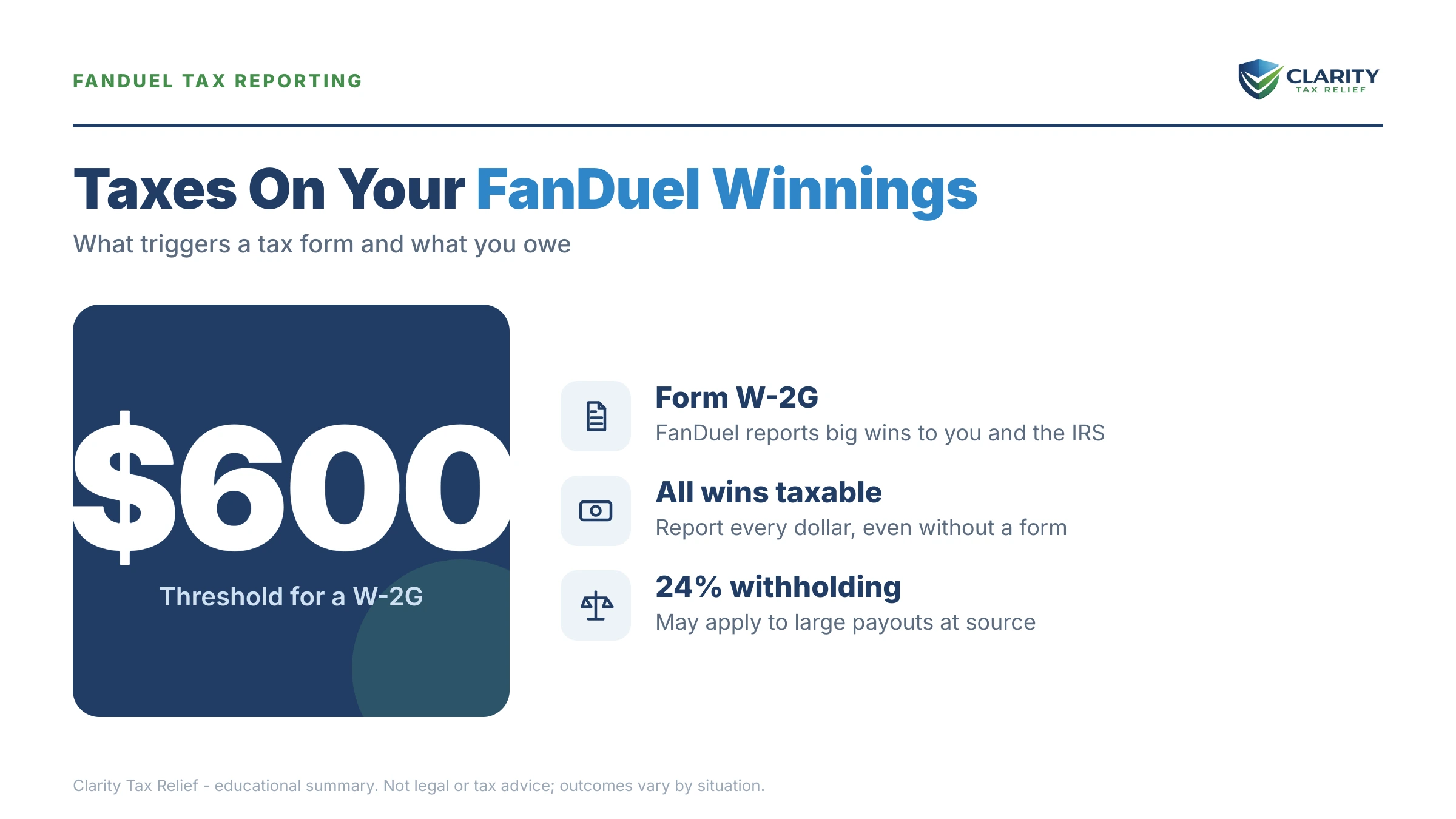
The short answer: FanDuel winnings are taxable income — every dollar, whether or not you got a tax form. FanDuel reports sportsbook wins of $600+ at 300-to-1 odds (Form W-2G) and fantasy net winnings of $600+ (1099-MISC) directly to the IRS. Losses only count if you itemize, so the IRS bills unreported winners on the gross.
You opened FanDuel's Tax Center in January, found a W-2G for a parlay that hit months ago, and now your return — or a letter from the IRS — says you owe thousands on money you mostly bet back and lost. That's the core trap in FanDuel winnings taxes: the IRS sees every winning ticket and none of your losing ones unless you prove them. It's fixable, and the fix starts with knowing exactly what FanDuel reported under your Social Security number.
Not sure which form you're even holding — or whether FanDuel sent one at all? The image below shows exactly what these tax documents look like and where to find the figures the IRS is matching against your return.
⏱ Your deadline: if an IRS notice is already in hand, the response date printed on page one controls — a CP2000 typically gives about 30 days. If no notice has arrived yet, your clock is the monthly one: the failure-to-pay penalty adds 0.5% per month plus compounding interest until you set something up.
Why you owe taxes on FanDuel winnings
FanDuel reports sportsbook wins of $600 or more at odds of 300-to-1 or higher to the IRS on Form W-2G. That single rule explains most of the confusion around this topic, because it cuts both ways: a $50 longshot parlay that pays $18,000 generates a W-2G the IRS will match, while a season of $500 moneyline wins generates no form at all — yet every one of those wins is still taxable income.
FanDuel isn't one product for tax purposes. Each arm of the platform has its own form, its own threshold, and its own withholding rule:
| FanDuel product | Form you get | IRS reporting threshold | Federal withholding |
|---|---|---|---|
| Sportsbook | Form W-2G | $600+ win at odds of 300-to-1 or higher | 24%, only when the payout tops $5,000 and is 300× the wager |
| Daily fantasy (DFS) | 1099-MISC | $600+ in net winnings for the year | None |
| FanDuel Casino — slots | Form W-2G | $1,200+ on a single spin | Generally none; backup withholding only if no SSN on file |
| FanDuel Casino — table games | Usually none | No W-2G for most table-game wins | None |
Two details on that table matter more than everything else. First, the DFS 1099-MISC is netted — winnings minus entry fees for the year — but a sportsbook W-2G is gross: it reflects one winning bet with zero credit for any losing bet, even one placed the same day. Second, because almost no standard sports bet carries 300-to-1 odds, most sportsbook users get no W-2G and no withholding — then meet the bill for the first time at filing, or when the IRS reconstructs it for them.
If your balance traces to slot jackpots or table play rather than betting, the reporting rules differ enough that our separate guide to casino winnings tax debt is the better map. Bet on DraftKings too? The same matching applies across books — see owe taxes on DraftKings winnings for how multiple sportsbooks' forms stack on one return.
What happens if you ignore FanDuel tax debt
Unreported FanDuel winnings typically trigger a CP2000 underreporter notice 12 to 18 months after you file. The IRS's Automated Underreporter system compares every W-2G and 1099-MISC under your SSN against your 1040; a mismatch generates the notice by machine, with no human involved. From there, the sequence runs on rails:
- CP2000 — proposed additional tax, interest, and often a 20% accuracy-related penalty. You can agree, dispute, or claim your losses in the response — but only by the date printed on the notice.
- CP3219A (Statutory Notice of Deficiency) — if the CP2000 goes unanswered, this 90-day letter is your last chance to contest the numbers in Tax Court before they become final.
- Assessment + CP14 — the balance posts to your account and the first bill arrives, with roughly 21 days before the reminder cycle begins.
- CP501 / CP503 — automated reminders while the 0.5% monthly penalty and interest compound.
- CP504 — Notice of Intent to Levy: the IRS can now take your state tax refund, and a federal tax lien becomes a live possibility.
- LT11 / Letter 1058 — final notice. A 30-day clock starts on your Collection Due Process rights (requested via Form 12153); after it runs, wage garnishment and bank levies (with a 21-day hold before funds leave) are on the table.
If you reported the winnings but couldn't pay, you skip the CP2000 stage and enter at CP14 — same sequence, same destination. And if betting balances stack across multiple years past $66,000, passport certification under the 2026 threshold joins the list. In 2026 the IRS workforce is down roughly 27%, which makes a human harder to reach — but this entire sequence is automated and never paused. You can estimate how fast the penalties and interest are compounding on your balance with our IRS Penalty & Interest Calculator.
| Notice | Response window | What acting in time protects |
|---|---|---|
| CP2000 | Date printed on the notice (typically ~30 days) | Your chance to dispute the tax and claim losses before assessment |
| CP3219A | 90 days | The right to petition Tax Court without paying first |
| CP14 | About 21 days | The cheapest window to pay or set up a plan |
| CP504 | Act before the final notice follows | Your state tax refund, which is now seizable |
| LT11 / Letter 1058 | 30 days | A Collection Due Process hearing (Form 12153) before wage or bank levy |
Holding a CP2000 for FanDuel winnings — or a bill you can't pay?
Send us the notice. An experienced tax professional will check whether the IRS's number ignores losses you can still claim, and map your payment options — free, before the response date printed on your notice passes.
Can't pay your FanDuel winnings taxes? Your real options
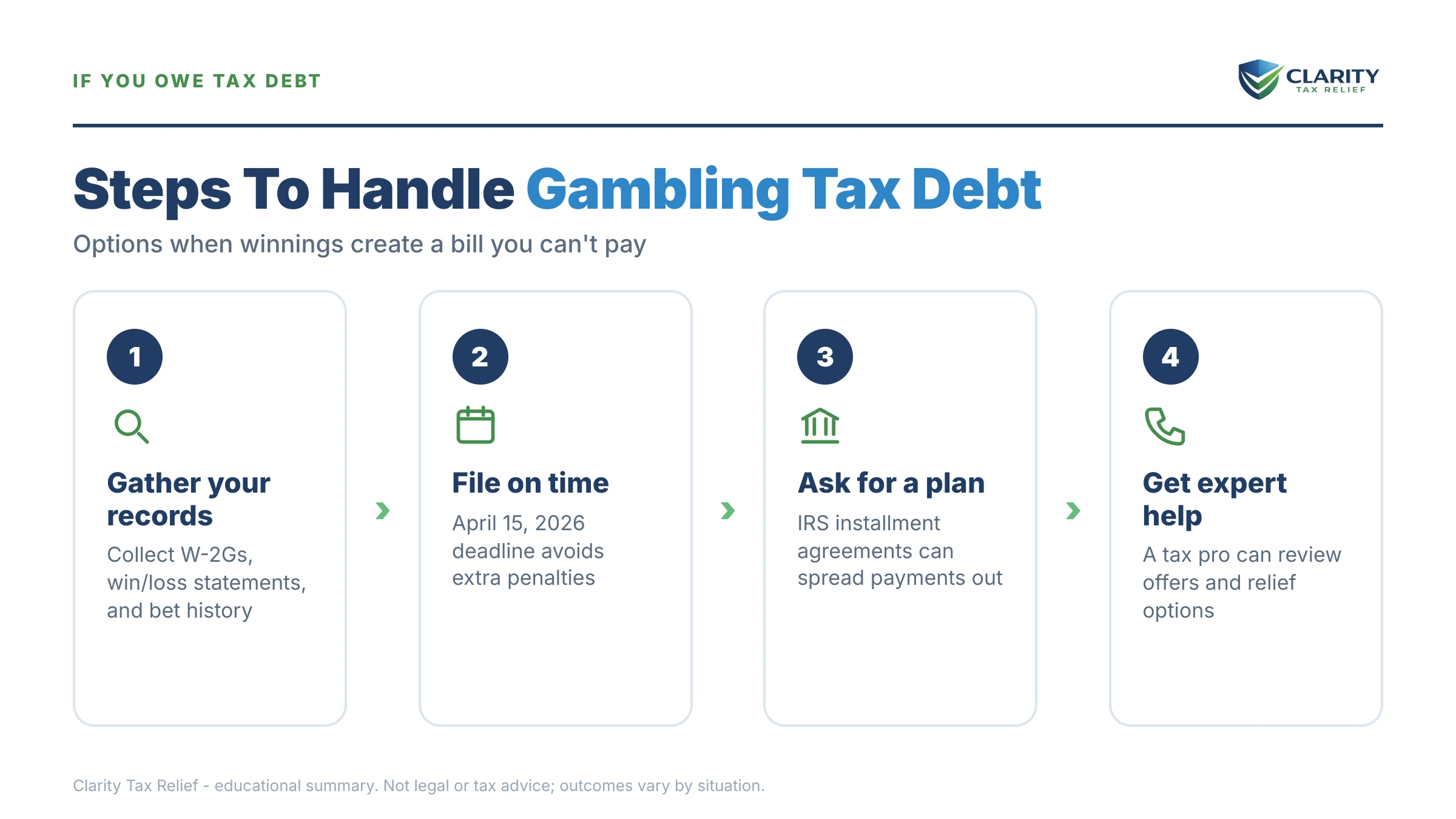
The IRS has a payment path for FanDuel tax debt at every balance level, from a $0-setup 180-day plan to a means-tested settlement. Which one fits depends on the balance, your income, and whether every return is filed — the general playbook for each program lives in our guide to how to settle tax debt yourself; here's how they line up against a betting-driven balance:
| Option | Best fit | Key threshold or cost |
|---|---|---|
| Pay in full | You have the cash or can raise it | Stops the 0.5%/month penalty and interest immediately |
| Short-term payment plan | Can clear the balance within 180 days | $0 setup fee; interest and penalties continue until paid |
| Streamlined installment agreement | Balances up to $50,000 | Up to 72 months, set up online; no detailed financials required |
| Non-streamlined plan | Balances over $50,000 | Financial disclosure (Form 433 series) required |
| Currently Not Collectible | Paying anything would cause genuine hardship | Collection pauses; the debt and interest remain |
| Offer in Compromise | Assets and income genuinely can't cover the debt | $205 fee, 20% down on lump-sum offers (both waived with low-income certification); roughly 1 in 5 offers accepted in FY2024 |
| Penalty relief (FTA / AEP) | Clean compliance for the prior 3 years | Removes penalties, not tax; AEP becomes automatic starting summer 2026 |
Two notes for bettors specifically. If the balance is under $10,000 and you can pay it within three years, the guaranteed installment agreement means the IRS must accept your plan. And on the settlement side, be realistic: an Offer in Compromise is math, not mercy — the IRS looks at what it could ever collect from you, and recent gambling spending can be treated as a dissipated asset and added back. Nobody can promise a settlement, and the roughly one-in-five acceptance rate reflects how strictly the numbers are run.
A worked example: $41,800 in FanDuel winnings, married filing jointly
Say a married couple filing jointly — both W-2 earners in the 22% bracket — had a big 2025 on FanDuel: several longshot parlays generated W-2Gs totaling $34,300, and a 1099-MISC showed $7,500 in net fantasy winnings. That's $41,800 in reported winnings. Across the same year, their losing bets totaled $29,000. Here's how three paths play out:
- They take the standard deduction: the full $41,800 is taxable. At 22%, that's roughly $9,196 in extra federal tax — more if the winnings push part of their income into the 24% bracket. The $29,000 in losses does nothing.
- They itemize: $29,000 in documented losses plus, say, $9,000 in mortgage interest and state taxes gives $38,000 in itemized deductions — beating a married-filing-jointly standard deduction of roughly $31,500 by $6,500. Tax saved: about $6,500 × 22% ≈ $1,430, cutting the bill to roughly $7,770. Notice the honest lesson: losses on paper don't automatically cancel winnings — itemizing only helps to the extent it beats the standard deduction you'd take anyway.
- They never reported it: a CP2000 lands about 15 months after filing proposing $9,196 in tax, a 20% accuracy-related penalty of about $1,839, roughly $690 in failure-to-pay penalty (15 months × 0.5%), plus compounding interest — a total in the neighborhood of $12,000. On a 72-month streamlined plan, that's roughly $170/month minimum, with interest still running, so paying faster always costs less.
One more wrinkle for joint filers: on a joint return, both spouses' winnings and losses combine — one spouse's documented losses can offset the other's W-2Gs. But if one spouse's betting created a bill the other never knew about, that's a different problem with its own relief path — see spouse gambling tax debt.
The gambling-loss deduction: how to actually use it
Gambling losses are deductible only if you itemize, only up to your winnings — and starting with tax year 2026, only up to 90% of the losses themselves under the One Big Beautiful Bill Act. In the example above, if those were 2026 bets, only $26,100 of the $29,000 would be deductible even with perfect records. That change makes break-even bettors owe real tax going forward — more on it in our guide to the One Big Beautiful Bill tax changes.
Proof is the other half. FanDuel's year-end win/loss statement is the starting point, backed by your own log of dates, wager types, and amounts. Some states add their own twist: several don't allow any gambling-loss deduction on the state return, so a federal fix may not fully solve the state bill.
Three situations change the play here. If you already filed without claiming losses you can document, amending the return to reduce the tax debt on Form 1040-X may shrink the balance before you negotiate payment on it. If the debt spans years you've already been assessed on, our guide to deducting gambling losses against back taxes covers what's still fixable. And if betting is genuinely your livelihood, Schedule C treatment changes the whole calculation — see professional gambler taxes, but note the IRS test is strict and self-employment tax comes with it.
How to respond to a FanDuel tax bill, step by step
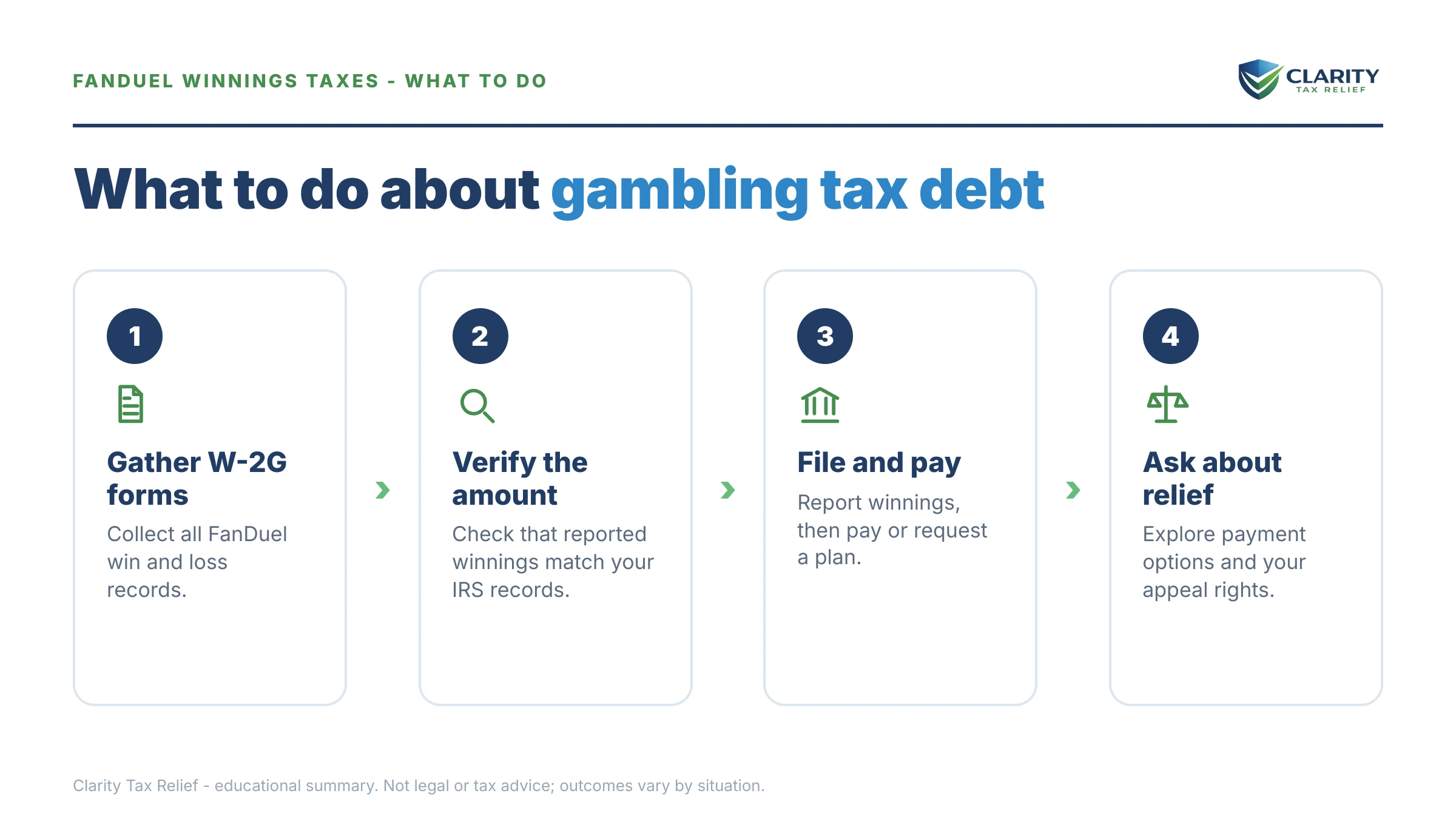
- Download your FanDuel tax documents. Log into FanDuel's Tax Center and pull every W-2G, every 1099-MISC, and the year-end win/loss statement for each year involved.
- Pull your IRS wage and income transcript. See exactly which forms were reported under your Social Security number, so you're responding to what the IRS actually has — not what you think it has.
- Compare the forms against your filed return. If winnings are missing, decide whether to amend now or answer the CP2000 with corrected figures — don't just sign and pay the proposed amount unchecked.
- Run the itemizing math before conceding the bill. Total your documented losses and check whether Schedule A beats your standard deduction; on a CP2000, losses can be claimed in your written response.
- Lock in a resolution before enforcement starts. Pay in full, set up a payment plan, or request hardship or settlement status using the options table above — any agreement in place stops the escalation sequence.
When you can handle this yourself — and when help changes the outcome
You can usually resolve a FanDuel tax bill under $10,000 yourself if your returns are filed and you agree with the numbers. Verify the balance in your IRS online account, set up the plan online at the IRS payment plans page, and if this is your first slip in three clean years, request penalty abatement while you're at it. If you're winning regularly, start quarterly estimated payments now so next April doesn't repeat this one.
Experienced help earns its cost in a narrower set of situations: a CP2000 where the IRS's proposed number ignores five figures of documentable losses; multiple unfiled or misfiled years across more than one sportsbook; a balance already at the CP504 or LT11 stage with a levy clock running; a possible professional-gambler position; or Offer in Compromise math where gambling spending risks being counted against you as a dissipated asset. In those cases the order of operations — fix the returns, claim the losses, abate the penalties, then negotiate the remainder — changes what you ultimately pay, and getting it wrong locks in a bigger number.
Terms on your FanDuel tax forms, decoded
- Form W-2G — the "Certain Gambling Winnings" form FanDuel files with the IRS for qualifying wins; the official rules are in the IRS's About Form W-2G page.
- 1099-MISC — the form FanDuel uses for daily fantasy, reporting your net contest winnings for the year in Box 3.
- Automated Underreporter (AUR) — the IRS computer program that matches W-2Gs and 1099s against your return and generates CP2000 notices by machine.
- Itemized deduction (Schedule A) — the only place a recreational bettor can claim losses; the IRS's plain-language rules are at Topic No. 419, Gambling Income and Losses.
- Session — a continuous period of play; keeping a session-level log is the record-keeping standard that survives IRS scrutiny.
- CSED — the Collection Statute Expiration Date: the IRS generally has 10 years from assessment to collect, though appeals, offers, and bankruptcy pause the clock.
FanDuel winnings tax questions, answered
Does FanDuel report my winnings to the IRS?
Yes — FanDuel sends the IRS a copy of every tax form it issues you. Sportsbook wins of $600 or more at odds of 300-to-1 or higher generate a Form W-2G, and daily fantasy players with $600 or more in net winnings for the year receive a 1099-MISC. The IRS computer matches those forms against your return automatically, so a form missing from your 1040 almost always surfaces.
Do I owe taxes on FanDuel winnings if I lost more than I won overall?
Usually yes, which surprises almost everyone. The tax law counts your winning bets as income and treats your losing bets as a separate itemized deduction — so unless you itemize on Schedule A, you pay tax on the gross wins even in a losing year. Losses can never exceed winnings on the deduction side, and they can't be carried to another year.
Does FanDuel withhold taxes from my winnings?
On most sports bets, no. Federal withholding of 24% is generally required only when a single payout exceeds $5,000 and the win is at least 300 times the wager — a threshold most bets never reach. That missing withholding is why so many bettors file in April and discover a balance due they never saw coming.
What happens if I didn't report my FanDuel winnings?
Expect a CP2000 underreporter notice, typically 12 to 18 months after you filed. It proposes the extra tax plus interest, and often a 20% accuracy-related penalty if the understatement is substantial. You get a response window printed on the notice to agree, dispute, or add your losses; ignore it and the IRS issues a CP3219A and assesses the balance.
Can I deduct my FanDuel losses?
Only if you itemize deductions on Schedule A, and only up to the amount of your winnings. Starting with tax year 2026, the deduction is further capped at 90% of your actual losses under the One Big Beautiful Bill Act. You also need records — FanDuel's year-end win/loss statement plus your own log is the standard proof.
How much tax will I pay on FanDuel winnings?
Winnings are taxed as ordinary income at your marginal rate, not a special gambling rate. A couple in the 22% bracket pays roughly $2,200 in federal tax on a $10,000 win, and large wins can push income into a higher bracket. Most states tax the winnings too, and some states don't allow any gambling-loss deduction at all.
Will the IRS know about small FanDuel wins that didn't generate a form?
There's no automatic matching for wins below the reporting thresholds, but they are still taxable income by law. Unreported small wins usually surface only in an audit, where bank-deposit analysis can reconstruct them from your FanDuel withdrawals. Reporting all winnings and then deducting documented losses is both the legal answer and the safer one.
Am I taxed differently if I bet on FanDuel professionally?
Possibly — a true professional gambler reports on Schedule C, deducting losses and expenses against winnings without itemizing, but pays self-employment tax on the net profit. The IRS applies a strict facts-and-circumstances test: regular, full-time pursuit of gambling as a livelihood. Most high-volume recreational bettors don't qualify, and claiming pro status incorrectly invites an exam.
Your next 24 hours
- Find the controlling numbers. Download every W-2G and 1099-MISC from FanDuel's Tax Center, and if an IRS notice arrived, locate the response date printed on page one — that date, not the mail pile, sets your clock.
- Gather your paper. Your last filed return, the notice itself, the year-end win/loss statement, and a rough total of what you actually lost — that's everything a real review needs.
- Get the free case review. Use the 2-minute form or call (888) 825-7779. Whether it's a CP2000 you can still contest or a balance quietly growing 0.5% a month plus interest, every month you wait is the only part of this that's guaranteed to cost more.
This guide is general information, not tax or legal advice for your specific situation. Eligibility for IRS programs depends on individual facts and circumstances; no outcome is guaranteed.