
Tax Debt by Profession
Professional Gambler Taxes in 2026: Schedule C, SE Tax, the 90% Loss Limit — and What to Do If You Owe
The short answer: professional gambler taxes run through Schedule C — winnings are business receipts, net profit is hit with 15.3% self-employment tax, and starting with 2026 returns only 90% of losses and gambling expenses are deductible, never more than winnings. Most pro-gambler IRS debt comes from unbudgeted SE tax and skipped quarterly estimated payments.
Your tracking app says you cleared six figures at the tables this year. Then your preparer drafts the return, and the number at the bottom includes a self-employment tax you never priced into a single session — and your spouse, who has a regular W-2 job, is now asking what signing a joint return means for their paycheck.
Here's the honest frame: the math is fixable, the IRS has structured programs for exactly this kind of balance, and 2026 brought one rule change every professional gambler needs to understand before filing anything. This guide covers all of it — how the tax works, why pros end up owing, and every realistic way out.
⏱ The clock on this debt: there is no single notice deadline yet, but the failure-to-pay penalty adds 0.5% of the balance every month, and interest compounds daily on top of it. And each quarterly estimated deadline you skip — April 15, June 15, September 15, January 15 — stacks a new year's debt on top of the old one.
How professional gambler taxes work in 2026
A professional gambler reports all winnings as Schedule C business income and pays 15.3% self-employment tax on the net profit. That's the core difference from a casual player, and it cuts both ways: pros pay more tax on the same profit, but they can deduct business expenses — travel to tournaments, entry fees, data subscriptions, coaching — that recreational players cannot touch.
Who counts as a professional? The standard comes from the Supreme Court's Groetzinger decision: you must pursue gambling with regularity, continuity, and a good-faith intent to earn a livelihood. Full-time hours, a separate bankroll, contemporaneous session logs, and business-like record keeping all support the status. There's no license and no election box — you claim it on your return and must be able to defend it.
Reporting itself runs on the session method. A session is one continuous stretch of play at the same game, and your income is the sum of your session results — not the sum of your W-2Gs. Casinos issue Form W-2G at fixed trigger points (a $1,200 slot jackpot, a $5,000 poker tournament cash), so a player can receive $180,000 in W-2Gs during a year they actually netted $40,000. Your session records are the only thing that bridges that gap when the IRS asks.
Then there's the 2026 change. Under the One Big Beautiful Bill tax changes, tax years beginning in 2026 cap the deduction for wagering losses — and, for professionals, gambling-related business expenses — at 90% of those amounts, still limited to total winnings. Run the math on a break-even year: $400,000 in session wins and $400,000 in session losses now means only $360,000 is deductible, leaving $40,000 of taxable "profit" on a year you didn't actually make a dime. High-volume players can owe real tax on phantom income, which makes accurate session accounting — and quarterly planning — matter more than it ever has.
| Tax question | Casual gambler | Professional gambler |
|---|---|---|
| Where winnings are reported | "Other income" on Schedule 1 | Gross receipts on Schedule C |
| Self-employment tax (15.3%) | Never | Yes, on net profit |
| Losses (2026 rule) | Itemized deduction only, 90% of losses, capped at winnings — lost entirely if you take the standard deduction | Schedule C deduction, 90% of losses, capped at winnings |
| Business expenses (travel, entry fees, tools) | Not deductible | Deductible, but folded into the 90%/winnings cap |
| Quarterly estimated payments | Often covered by job withholding | Required — nothing is withheld for you |
| Net losing year | No deduction against other income | No net operating loss from wagering either |
Why professional gamblers end up owing the IRS
Most professional gambler tax debt starts with a profitable year that had no withholding behind it. A W-2 employee pre-pays tax every paycheck; a poker pro or advantage player pre-pays nothing unless they send quarterly estimates themselves. By April, a good year has quietly become a five-figure bill — and the estimated-tax underpayment penalty is already attached before you even file.
The second driver is the SE tax itself. Players budget for income tax and forget that net Schedule C profit also carries 15.3% self-employment tax — on $92,000 of net profit, that's roughly $13,000 before a dollar of income tax is counted.
The third is the W-2G mismatch. The IRS computer matches every W-2G against your return, and when the gross W-2G total exceeds what it can find on your filing, it issues a CP2000 notice proposing tax on the full W-2G amount with zero credit for losses. Casual players hit this constantly — see our guides to casino winnings tax debt and sports betting tax debt — but pros hit it too when session totals and W-2G totals diverge and the records aren't attached to the response.
Finally, filing jointly multiplies the exposure. A joint return makes both spouses fully liable for the whole balance, which means the IRS can garnish the non-gambling spouse's paycheck and take refunds generated entirely by their withholding. If that's your household, our guide to spouse gambling tax debt covers the relief paths in depth.
One more angle worth checking before you resolve anything: if you filed as a casual gambler, took the standard deduction, and paid tax on gross W-2Gs, the balance itself may be wrong. Amending a return to lower a tax debt — to apply session accounting or properly claimed professional status — sometimes shrinks the problem before you ever negotiate it. The rules for offsetting old winnings are in deducting gambling losses against old debt.
What happens if you ignore gambling tax debt
An unpaid balance moves through the IRS's automated collection sequence whether or not a human ever reviews your file. The stages run in a fixed order, and each one removes options the previous stage still offered:
- CP14 — the first bill. You typically have about 21 days from the notice date before the system escalates. Cheapest moment to act.
- CP501 / CP503 — reminders. Still just bills, but the 0.5% monthly penalty and daily interest keep compounding.
- CP504 — intent to levy your state refund under IRC §6331(d). A federal tax lien becomes a live possibility.
- LT11 / Letter 1058 — final notice of intent to levy. A 30-day clock starts, along with your Collection Due Process rights (requested on Form 12153). After it runs, enforcement begins.
- Levy. A bank levy freezes funds with a 21-day hold before the money leaves. Here's the part specific to pros: with no employer wages to garnish, your bankroll account is the primary levy target — and a frozen bankroll ends your ability to play at all.
- Passport certification. Once the debt passes $66,000 (the 2026 threshold), the IRS can certify it to the State Department — a real problem if you travel for tournaments.
Every month of waiting adds penalty and interest on top of the tax. You can estimate what your balance grows to with our IRS Penalty & Interest Calculator. And don't count on 2026 staffing cuts to slow this down — the IRS workforce shrank roughly 27% in 2025, but every notice and levy in that sequence is issued by automation that never got laid off.
Owe the IRS on gambling income?
A professional gambler's return has moving parts most preparers never see — session accounting, W-2G reconciliation, SE tax, the new 90% limit. Get your balance and your options reviewed free before another month of penalty and interest posts. Call (888) 825-7779 or use the 2-minute form.
Your options when you owe as a professional gambler
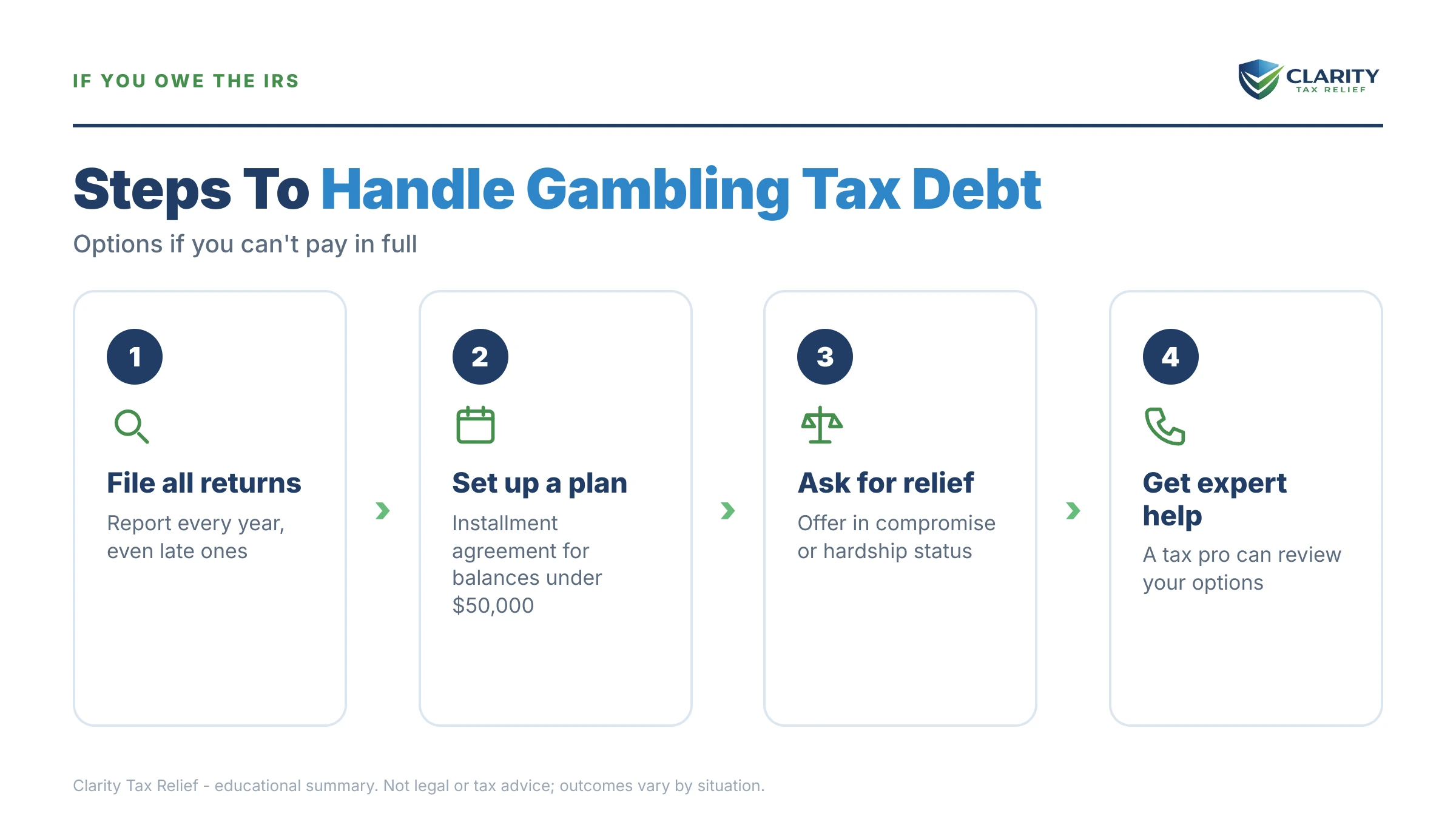
Any IRS balance under $50,000 can go on a payment plan of up to 72 months without filing a financial statement. That single fact resolves most pro-gambler debts. The full DIY mechanics for each program live in our pillar guide on how to settle tax debt yourself; here's how each option applies to gambling income specifically:
| Option | Typical eligibility | Cost & terms | The pro-gambler catch |
|---|---|---|---|
| Short-term payment plan | Can pay in full within 180 days | $0 setup; penalties and interest continue | Good after a big score — pay the debt out of the next cash |
| Streamlined installment agreement | Balance ≤ $50,000 (≤ $25,000 without direct debit) | Up to 72 months, set up online; failure-to-pay penalty drops to 0.25%/month while active | Variance-proof your payment — set it at a level a downswing can't break, because a missed payment risks default |
| Partial-pay installment agreement | Financials show you can't full-pay before the 10-year collection statute ends | Requires Form 433 disclosure; IRS reviews periodically | Swingy income means the IRS may revisit your payment after a good year |
| Currently Not Collectible | Paying anything would prevent basic living expenses | $0; collection pauses, debt and interest remain | Hard to sustain if bank records show active bankroll deposits |
| Offer in Compromise | Assets + future income genuinely can't cover the debt | $205 fee; 20% down on lump-sum offers (both waived with low-income certification); roughly 1 in 5 accepted in FY2024 | On a joint debt, a spouse's W-2 income and home equity count against you |
| Penalty abatement | Clean compliance the prior 3 years (first-time abate), or reasonable cause | Free to request; removes penalties, not tax or interest | Starting summer 2026, the Automatic Exemption from Penalty (AEP) applies qualifying relief with no request needed |
One further path for old debt: gambling-related income tax from returns filed years ago can sometimes be discharged in bankruptcy if it passes the timing tests — the framework is in Chapter 7 vs 13 tax debt. It almost never applies to recent years, so treat it as a fallback, not a plan.
A worked example: married couple, $23,800 balance
Say you owe $23,800 — a hypothetical, but a common shape. One spouse played poker full-time and netted $92,000 on Schedule C with zero estimated payments; the other earned W-2 wages with normal withholding. After SE tax, income tax, the underpayment penalty, and the spouse's withholding credit, the joint return lands at $23,800 due.
Here's the arithmetic on each realistic path:
- Streamlined installment agreement: $23,800 ÷ 72 months ≈ $331/month minimum. Interest and the reduced 0.25%/month penalty keep accruing, so paying only the minimum stretches the true payoff past 72 months of that amount. Budgeting $450–$500/month clears it in roughly four to five years and cuts total interest meaningfully.
- Short-term plan: if a tournament score or bankroll draw-down can produce $23,800 within 180 days, this costs nothing to set up and stops the escalation sequence immediately.
- Offer in Compromise: probably not a fit here. The IRS would count the W-2 spouse's income and any home equity toward what it can collect, and $23,800 against a $92,000-profit year plus wages is fully collectible on paper. An offer application would likely spend months and the $205 fee to get a rejection.
- Penalty abatement: if this is the couple's first slip after three clean years, first-time abatement can strip the failure-to-pay penalty from the balance — worth requesting regardless of which payment path they choose.
| Balance | Realistic options | Key threshold notes |
|---|---|---|
| Under $10,000 | Pay in full, short-term plan, or a guaranteed installment agreement | The IRS must accept a qualifying 3-year payment plan at this level |
| $10,000–$25,000 | Streamlined installment agreement (our $23,800 example), short-term plan | Online setup, no financial statement, any payment method |
| $25,000–$50,000 | Streamlined agreement with direct debit required | Still up to 72 months online; direct debit becomes mandatory above $25k |
| $50,000–$66,000 | Non-streamlined agreement, partial-pay, or OIC — full financial disclosure | Form 433 financials required; lien filing likely |
| Over $66,000 | All of the above, urgently | Passport certification threshold for 2026 — a tournament traveler's real risk |
How to respond when you owe, step by step
- Confirm your filing status honestly. Apply the Groetzinger factors — regularity, continuity, and livelihood intent — before you file or amend. Schedule C status you can't defend invites an exam, while missing it forfeits every expense deduction.
- Rebuild your session records. Pull casino win/loss statements, player's-card history, sportsbook and app year-end reports, and bank records, then reconcile the totals against every W-2G issued in your name.
- File every unfiled return first. The failure-to-file penalty runs 5% per month — ten times the failure-to-pay rate — and the IRS won't approve a payment plan or offer while returns are missing.
- Set up the resolution that fits your balance. Match your balance to the options table above and open the agreement online. A $23,800 balance, for example, fits a streamlined installment agreement with no financial disclosure required.
- Fund the current year's quarterlies. Start estimated payments now so this year doesn't become next year's debt — a new unpaid balance is grounds for defaulting most installment agreements.
Payment plans and direct payments both set up at IRS.gov/payments; the current plan terms are on the IRS payment plans page.
When you can handle this yourself — and when help changes the outcome
If your returns are filed, your session records support the numbers, and the balance is under $50,000, you can genuinely set up the payment plan yourself online in under an hour. A first-time penalty abatement request is also a phone call you can make on your own. Nobody needs to pay for that.
Experienced help changes outcomes in specific situations: a CP2000 or exam questioning your professional status, where the difference between winning and losing the argument is the entire SE tax and expense treatment of your career; multiple unfiled years that need session reconstruction from casino and bank records; a levy already frozen on your bankroll account; a joint debt where one spouse needs innocent spouse or injured spouse analysis; or offer-in-compromise math on genuinely uncollectible balances, where a miscalculated offer wastes months and fees. If your situation is on that list, get a professional review before you respond to anything — and if the IRS or the Taxpayer Advocate are your route, the Taxpayer Advocate Service is free when you qualify.
Terms on your return, decoded
- Session: one continuous period of play at the same game and venue — the unit you report, instead of individual bets.
- Form W-2G: the casino's report of certain wins to the IRS at fixed thresholds; the computer matches every one against your return.
- Self-employment (SE) tax: the 15.3% Social Security and Medicare tax on net Schedule C profit — the tax casual gamblers never pay.
- Groetzinger test: the Supreme Court standard for professional status — regularity, continuity, and intent to earn a livelihood from gambling.
- Section 165(d) wagering-loss limitation: the rule capping gambling deductions at winnings — tightened to 90% of losses and expenses for 2026 tax years.
- Joint and several liability: on a joint return, the IRS can collect the entire balance from either spouse, regardless of whose income created it.
Professional gambler tax questions, answered
Do professional gamblers pay self-employment tax?
Yes. If your gambling rises to a trade or business, your net Schedule C profit is subject to the 15.3% self-employment tax on top of regular income tax — 12.4% for Social Security up to the annual wage base and 2.9% for Medicare with no cap. Casual gamblers never owe SE tax on winnings, which is one reason the IRS scrutinizes who claims professional status. The trade-off is that professionals can deduct business expenses casual players cannot.
How does the IRS decide whether I'm a professional gambler?
There's no card or license — the standard comes from the Supreme Court's Groetzinger decision: you must gamble with regularity, continuity, and a good-faith intent to earn a livelihood from it. Full-time hours, detailed session records, a separate bankroll, and running it like a business all support professional status. Having a W-2 job doesn't automatically disqualify you, but occasional weekend play does.
Can a professional gambler deduct losses in 2026?
Only partially. For tax years beginning in 2026, the One Big Beautiful Bill Act limits the deduction for wagering losses — and for professionals, gambling-related business expenses — to 90% of those amounts, and the total still can't exceed your winnings. That means a gambler who exactly breaks even now shows taxable profit. A net losing year still produces no deductible loss against other income.
What is the session method for reporting gambling winnings?
A session is one continuous period of play at the same game — you report the net result of each session rather than every individual bet. For professionals, session totals feed the gross receipts line on Schedule C. The method matters because your W-2G totals will almost never match your session totals, and you need contemporaneous records to prove the difference if the IRS asks.
What happens if my W-2Gs don't match my tax return?
The IRS computer cross-matches every W-2G against your return, and a shortfall typically triggers a CP2000 underreporter notice proposing extra tax, penalties, and interest — usually about a year after you file. The proposal treats W-2G amounts as pure income and gives you no credit for losses or sessions unless you respond with documentation. Answer by the notice deadline with session records; silence turns the proposal into an assessed debt.
Is my spouse liable for my gambling tax debt if we file jointly?
Yes — a joint return creates joint and several liability, so the IRS can collect the entire balance from either spouse, including levying wages or a refund that came entirely from your spouse's job. Filing separately going forward protects future years but usually raises your combined tax. If the debt came from gambling income your spouse genuinely didn't know about, innocent spouse relief may apply.
Can I settle professional gambler tax debt with an Offer in Compromise?
Only if the IRS's own math shows it could never collect the full amount — the agency accepted roughly 1 in 5 offers in FY2024. On a joint debt, your spouse's income and your shared equity count toward what the IRS believes it can collect, which rules out many two-income households. A $205 application fee and, for lump-sum offers, a 20% down payment apply unless you meet low-income certification.
Do professional gamblers have to make quarterly estimated tax payments?
Yes. No casino or sportsbook withholds self-employment tax for you, so the IRS expects payments each April, June, September, and January covering both income tax and SE tax. Miss them and an underpayment penalty accrues even if you pay in full at filing. The common safe harbor is paying in 100% of last year's total tax (110% at higher incomes) through the year.
Your next 24 hours
- Total what the IRS already sees. Add up every W-2G issued in your name this year and request win/loss statements from each casino and year-end reports from each betting app — that's the number the matching computer starts from.
- Gather your paperwork. Last year's return (or the draft), your session log or bank records, and income details for both spouses if you file jointly.
- Get a free case review. Send it all through the 2-minute form or call (888) 825-7779 — every month of waiting adds another 0.5% penalty plus daily interest to the balance.
This guide is general information, not tax or legal advice for your specific situation. Eligibility for IRS programs depends on individual facts and circumstances; no outcome is guaranteed.