
Tax Debt & Family
Am I Responsible for My Deceased Husband's Tax Debt? (2026)
The short answer: you are personally responsible for a deceased husband's tax debt only if you signed a joint return for that year or live in a community property state. His separate and pre-marriage tax debts are collected from his estate, not from you — and innocent spouse relief can remove joint debt that was his doing.
So if you're asking "am I responsible for deceased husband tax debt," the honest answer is: sometimes — and the details decide everything. A letter arrived addressed to him, or to both of you, and it says money is owed to the IRS. Handling a tax bill while you're still handling his affairs feels impossible. It isn't. Whether you owe a single dollar comes down to three checkable facts, and the tables below sort every situation.
⏱ Your key window: if any of the debt comes from a joint return, you generally have 2 years from the IRS's first collection activity against you to request innocent spouse relief under §6015(b) or separation of liability under §6015(c). Equitable relief stays available for as long as the IRS can legally collect — but the strongest relief types have that 2-year clock.
Why the IRS is still billing your husband's account
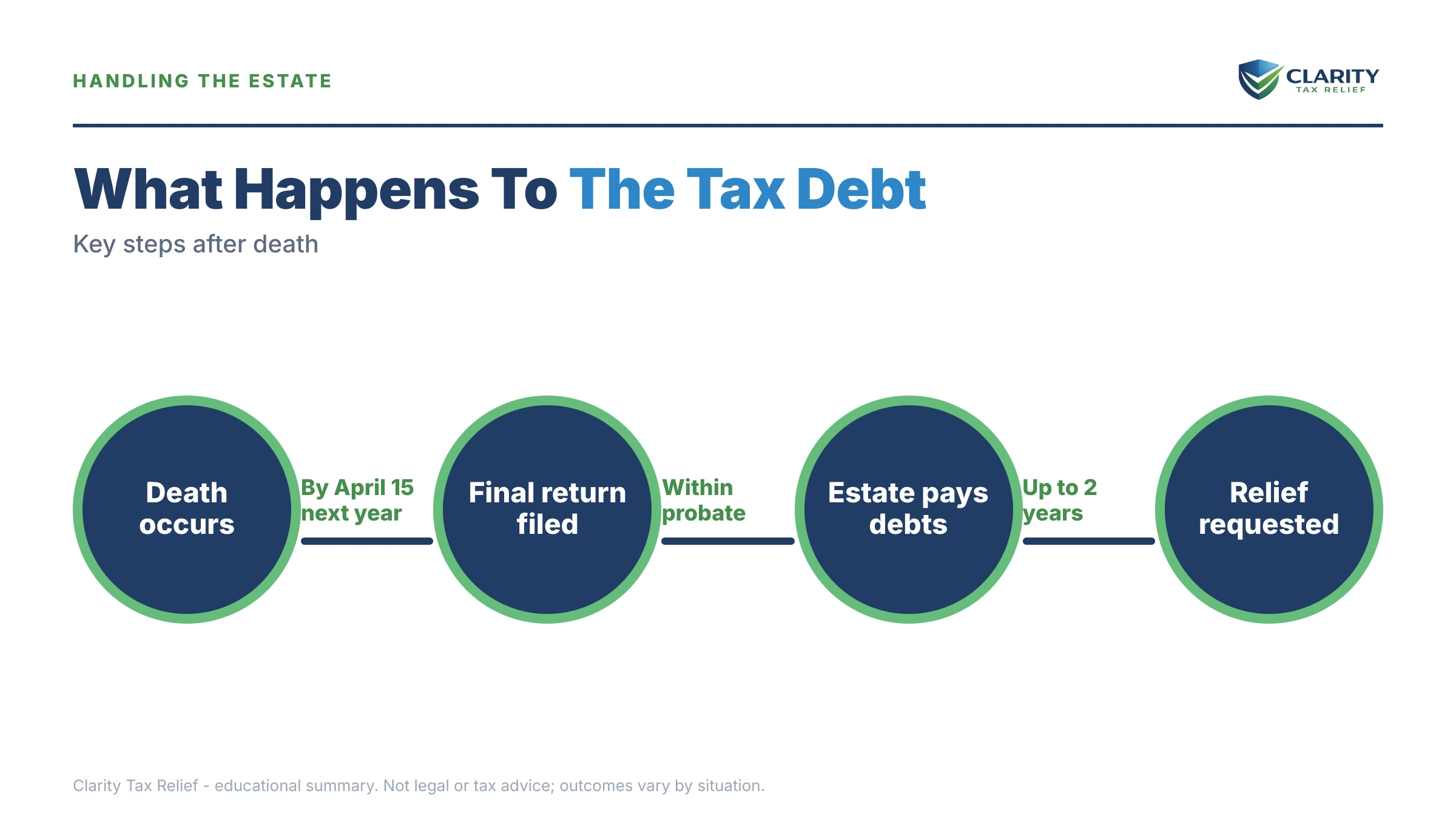
The IRS keeps billing a dead taxpayer's account until the balance is paid, the estate resolves it, or the 10-year collection statute runs out. Death doesn't cancel an assessed tax debt — it changes who the IRS can collect it from.
That's the part most widows never hear: the debt survives, but it doesn't automatically become yours. It becomes a claim against his estate — the property he left behind. The estate must pay the IRS before heirs receive anything, and if the estate runs dry, separate-return debt generally dies unpaid. We cover the estate side in depth in our guide to when an estate owes the IRS.
The exception that catches most surviving spouses: joint returns. When you signed a Form 1040 jointly, you accepted "joint and several" liability — the IRS can collect 100% of that year's balance from either signer. His death leaves you as the remaining signer. That's why the notices keep coming to your address, and why the answer to this question is different for every tax year on the notice.
One more clock worth knowing: the collection statute (CSED) gives the IRS 10 years from assessment to collect, whether the debtor is living or not. If his debt is old, part of it may be near expiration — you can estimate the expiration date with our CSED Calculator before agreeing to pay anything. Just know the clock pauses during offers, appeals, and bankruptcy, so debt doesn't simply vanish at year ten without checking the math.
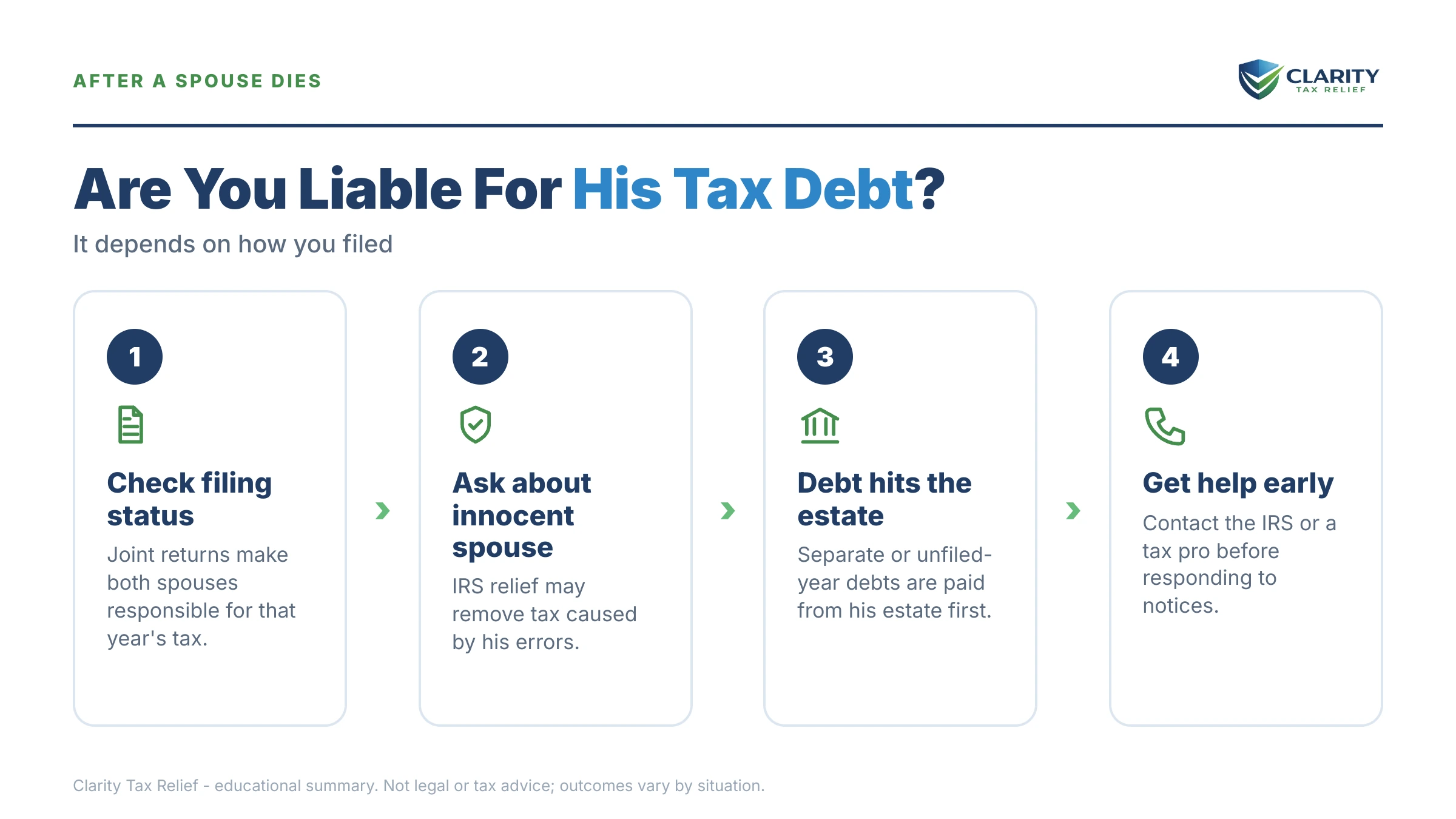
Am I responsible for deceased husband tax debt? Three questions decide
Only three facts determine whether a widow owes her late husband's tax debt: how each year's return was filed, what state you live in, and whether estate assets were distributed before the IRS was paid.
1. How was each return filed? Check the filing-status box on the first page of every return for every year on the notice. Joint years can be collected from you personally. Married-filing-separately years, and any debt from before your marriage, belong to his estate alone. This is why one widow can owe everything and another — with the same dollar amount on the notice — can owe nothing.
2. Do you live in a community property state? In Arizona, California, Idaho, Louisiana, Nevada, New Mexico, Texas, Washington, or Wisconsin, the IRS may be able to reach community assets even for a debt on his separate return. If that's your situation, community property tax relief under Section 66 can protect a spouse who neither knew about nor benefited from the income.
3. Did anyone hand out his assets before paying the IRS? If you (or another executor) distribute estate money to heirs while a federal tax claim goes unpaid, federal law can make the fiduciary personally liable for what was distributed. If you're administering his estate, read how an executor becomes personally liable to the IRS before writing any checks.
| Your situation | Are you personally liable? | Who the IRS collects from |
|---|---|---|
| You filed jointly for the year owed | Yes — jointly and severally, for the full amount | You and/or his estate, in any combination |
| He filed married-filing-separately | Generally no (common-law states) | His estate only |
| Debt is from years before your marriage | No | His estate only |
| Separate debt, community property state | Possibly in part — §66 relief may protect you | Community assets, then his estate |
| You're the executor and distributed assets before the IRS was paid | Yes, up to the value you distributed | You personally, under 31 U.S.C. §3713 |
| You divorced before his death (joint-year debt) | Yes, unless relief is granted | You — the decree doesn't bind the IRS |
That last row surprises people the most. A divorce decree can order him — or his estate — to pay the joint years, but the IRS never signed your decree and is not bound by it. Our guide to why the IRS ignores your divorce decree explains that gap, and if your refund has already been taken for a former spouse's balance, see what to do when an ex-husband's tax debt took my refund.
What happens if the debt is ignored
Unpaid tax debt after a death follows the same automated notice sequence as any other balance — and on joint years, the enforcement reaches the surviving spouse directly. The IRS computer doesn't know he died until someone tells it, and even then, joint-year collection continues against you:
- Balance-due bills — a CP14 and reminder notices arrive in his name or both names. No enforcement yet, but penalties and interest accrue monthly.
- CP504 — Notice of Intent to Levy. The IRS can seize a state tax refund at this stage, including a refund on a joint return you filed together.
- LT11 / Letter 1058 — the final notice. On joint-year debt, this starts a 30-day clock, after which the IRS can levy your wages and your bank accounts — widowhood is not a shield on a return you signed.
- Lien and estate complications — a federal tax lien can attach to estate property and to his interest in property you co-owned, clouding the title when you try to sell or refinance the house. See how an IRS lien after death works against inherited property.
- Refund offsets — your future federal refunds can be applied to joint-year balances until they're paid, year after year.
There's a second, quieter risk: paying debt that was never yours. Grieving spouses routinely pay separate-return balances out of their own savings because a scary letter arrived. Once paid, that money is very hard to recover. Sorting whose debt is whose comes before any payment.
Holding a notice for your late husband's taxes?
Before you pay a dollar of a debt that may belong to his estate — or lose the 2-year window on innocent spouse relief — let an experienced tax professional sort which years are actually yours. The review is free and confidential.
Your options as a surviving spouse, compared
Federal law gives a widowed spouse specific relief paths — three types of innocent spouse relief plus every standard resolution program. Which one fits depends on whether the debt is genuinely yours, partly yours, or not yours at all:
| Option | Who qualifies | Deadline / key threshold |
|---|---|---|
| Do nothing personally — estate resolves it | Debt is entirely from his separate or pre-marriage returns | Estate must pay the IRS before heirs are paid |
| Innocent spouse relief — §6015(b) | Joint filer who didn't know (and had no reason to know) of the understatement | 2 years from first IRS collection activity |
| Separation of liability — §6015(c) | Widowed, divorced, legally separated, or living apart 12+ months | 2 years from first IRS collection activity |
| Equitable relief — §6015(f) | Unfair to hold you liable; also covers tax that was reported but unpaid | Open while the IRS can still collect (CSED) |
| Community property relief — §66 | Separate filers in the nine community property states | Facts-based; request as early as possible |
| Short-term payment plan | Can pay a balance that's yours within 180 days | $0 setup fee; interest continues |
| Long-term installment agreement | Balance ≤ $50,000 (set up online, up to 72 months) | Interest and penalties keep accruing |
| Offer in Compromise | Your assets and income genuinely can't cover the debt — the IRS accepted roughly 1 in 5 offers in FY2024 | $205 fee; 20% down on lump-sum offers (both waived if AGI ≤ 250% of poverty) |
| Currently Not Collectible | Paying anything would create genuine hardship — common on survivor income | Pauses collection; debt and interest remain |
Two notes on that table. First, the innocent spouse rows all start with Form 8857 — one form covers all three relief types, and the IRS applies whichever fits. Our guide to innocent spouse relief covers the knowledge and benefit tests in detail, and separation of liability relief is often the strongest path for a widow because widowhood itself satisfies the marital-status test.
Second, if the joint return itself overstated the tax — a missed deduction, a 1099 that was wrong — amending a return to reduce tax debt can shrink the balance before you negotiate anything. For the mechanics of setting up payment options on your own, the full walkthrough lives in our guide to how to settle tax debt yourself.
A worked example: $11,300 from a joint year
Say the IRS says $11,300 is due from your 2023 joint return. You divorced in early 2025, and he died this spring. The balance traces to about $31,000 of 1099 consulting income he earned on the side and never told you about. This is hypothetical — but the math is real:
- Do nothing: as a joint signer, you're liable for the full $11,300. The failure-to-pay penalty adds 0.5% per month — roughly $56 a month on an $11,300 balance — plus compounding interest, and the notice sequence above rolls toward levy.
- Streamlined installment agreement: $11,300 ÷ 72 months ≈ $157/month minimum, though interest and penalties keep accruing, so paying more shortens the real payoff. (At $11,300 you're just over the $10,000 ceiling for a guaranteed installment agreement, but well under the streamlined limits.)
- Separation of liability under §6015(c): because you're both divorced and widowed, you qualify to request an allocation. The entire understatement traces to his unreported income, so your allocated share could be $0 — the IRS would then look to his estate for the $11,300. Filed within the 2-year window, this path costs you a form and documentation, not $157 a month for six years.
Same notice, three outcomes ranging from $11,300-plus-interest down to zero. That spread is why sorting liability comes before choosing a payment option.
How to respond, step by step
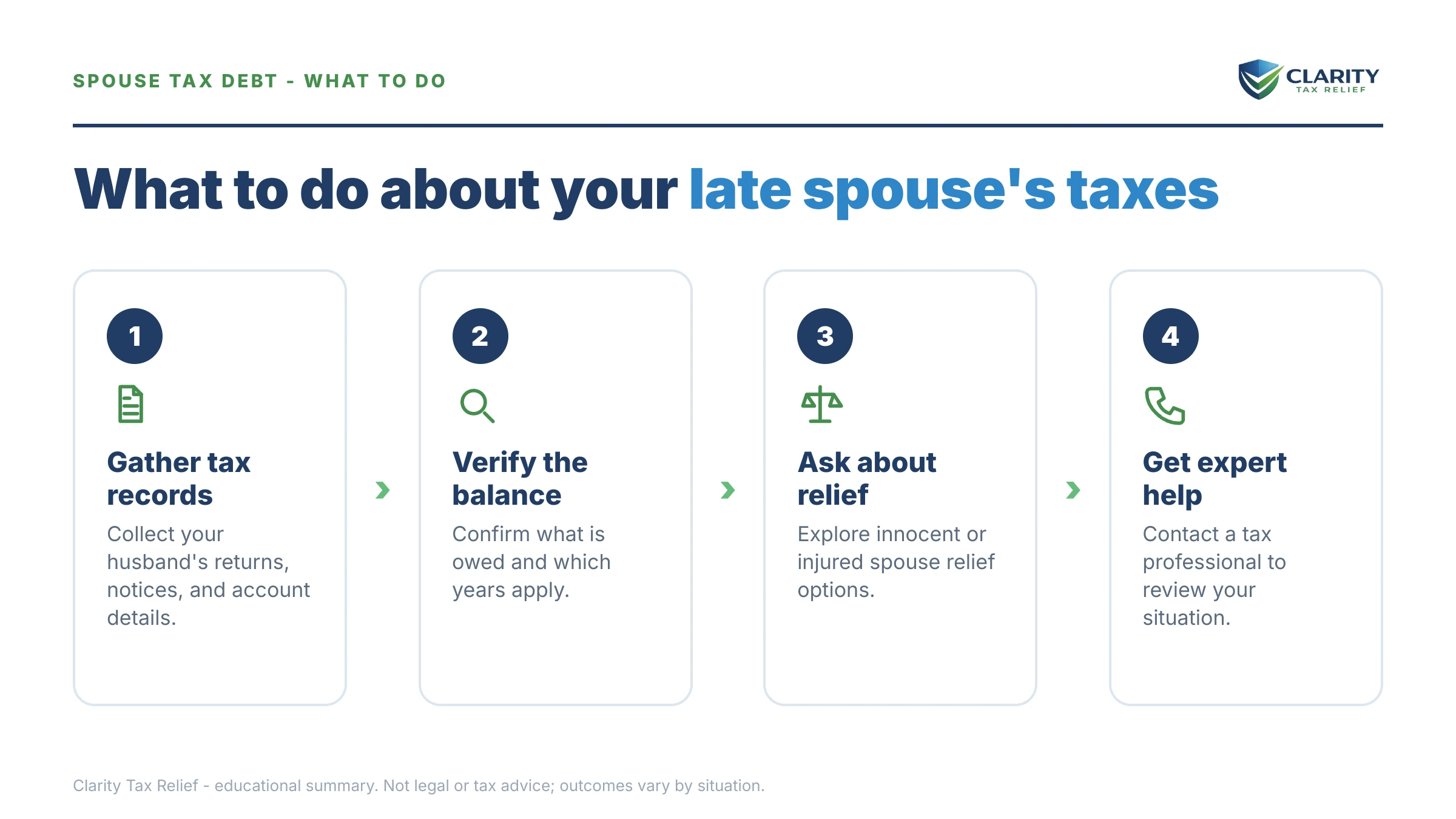
- Sort each year by how the return was filed. Pull the return for every year the IRS says is owed and check the filing-status box. Joint years are potentially yours; separate years belong to his estate.
- Verify the real balance with the IRS. Open an IRS online account or request account transcripts for each year listed so you're working from the actual number — with penalties and interest — not a guess.
- Route estate-only debt to the estate. Send separate-return and pre-marriage balances to the executor or probate attorney. Don't pay them from your own funds — you can't easily get that money back.
- File Form 8857 for joint debt that was his doing. If a joint-year balance traces to income or errors that were his, request innocent spouse or separation of liability relief — within 2 years of the IRS's first collection activity for most relief types.
- Resolve what is genuinely yours. For any balance that remains yours after the sorting is done, set up a payment plan, request hardship status, or explore an Offer in Compromise before the notices escalate.
When you can handle this yourself — and when help changes the outcome
You do not need professional help to decline payment of a debt that was never legally yours. If every year on the notice was filed married-filing-separately, you live in a common-law state, and someone else is administering the estate, your job is simply to forward the notices to the executor and keep your own money where it is.
You can also self-manage a small joint-year balance you agree with: an online payment plan on $11,300 takes about twenty minutes to set up at IRS.gov, no professional required.
Experienced help changes outcomes in four situations: an innocent spouse claim (the knowledge-and-benefit tests are facts-driven, and a weak first filing is hard to undo); a lien touching the house you inherited or co-owned; community property questions, where state law and §66 interact; and any case where you're the executor, because distributing assets in the wrong order creates personal liability that didn't exist before. In those cases, an hour with an experienced tax professional before you act is worth more than months of cleanup after.
Terms on your notice, decoded
- Joint and several liability — each signer of a joint return owes 100% of that year's tax, and the IRS can collect all of it from either one.
- Decedent's estate — the property a person leaves behind; it must pay the IRS before heirs receive anything.
- Form 8857 — the single request form for all three types of innocent spouse relief.
- Federal tax lien — the government's legal claim on a taxpayer's property; it can survive death and attach to estate assets.
- CSED — the Collection Statute Expiration Date; the IRS generally has 10 years from assessment to collect, with pauses for offers, appeals, and bankruptcy.
- Fiduciary liability (31 U.S.C. §3713) — an executor who pays heirs or other creditors before a known federal tax claim can become personally liable for the amount distributed.
Deceased husband's tax debt: your questions, answered
Does IRS debt die with the person who owed it?
No — a person's IRS debt does not die with them, but it doesn't automatically transfer to family either. The debt becomes a claim against his estate, which must pay the IRS before heirs receive anything. You personally owe it only if you signed a joint return for the year in question, live in a community property state, or received estate assets before the IRS was paid. The 10-year collection statute keeps running against the estate.
Can the IRS take the life insurance money I received as beneficiary?
Generally no. Life insurance paid directly to you as the named beneficiary passes outside his estate, so it is normally beyond the reach of his separate tax debt. The main exception: if the IRS filed a federal tax lien while he was alive, that lien attached to the policy's cash surrender value, and the IRS may claim proceeds up to that cash value. Proceeds are reachable, though, for any debt you jointly owe.
Can the IRS take the house now that it has passed to me?
It depends on how you held title and whether a lien was filed. A home owned jointly with right of survivorship passes to you automatically, but a federal tax lien recorded before his death may still encumber his interest — order a title search before selling or refinancing. If the home was his alone, it is an estate asset, and the estate must address the IRS claim before you can take it free and clear.
We always filed separately — can the IRS come after me for his taxes?
If every return during your marriage was filed separately and you live in a common-law state, you are not personally liable — the IRS collects from his estate only. In the nine community property states (AZ, CA, ID, LA, NV, NM, TX, WA, WI), the IRS may be able to reach community assets even for his separate debt, though Section 66 relief can protect a spouse who didn't know about or benefit from the income.
We were divorced when he died — am I still responsible for the joint years?
Yes, if the debt comes from a return you signed jointly — divorce decrees divide debts between spouses, but they do not bind the IRS, and his death doesn't change that. The IRS can pursue you for 100% of a joint-year balance. Your fix is separation of liability under Section 6015(c), which lets a divorced or widowed spouse split the debt based on whose income created it — request it within 2 years of the IRS's first collection activity against you.
Can I still get innocent spouse relief after my husband died?
Yes. Innocent spouse relief is requested by the spouse seeking protection, so your husband's death doesn't close the door — you file Form 8857 on your own. The IRS will notify his estate's representative, who has a right to participate, but the decision turns on your knowledge and benefit, not his availability. Traditional relief and separation of liability carry a 2-year deadline from first collection activity; equitable relief stays open as long as the collection statute runs.
Do I have to file a final tax return for my deceased husband?
If his income met the filing threshold for the year he died, a final Form 1040 is required. As the surviving spouse, you can usually file it jointly with your own return for that year if you haven't remarried — but understand that signing jointly makes you fully liable for any balance due on that final return. If the estate can't pay what the final return shows, resolution options exist for the estate itself.
Your next 24 hours
- Find the tax year on the notice, then pull that year's return and look at the filing-status box on page one. That single checkbox is the difference between "your debt" and "the estate's debt."
- Gather the paper trail: the IRS notice, his death certificate, your last three tax returns, and any probate or executor paperwork you have.
- Get a free case review — call (888) 825-7779 or use the 2-minute form. Interest and penalties accrue monthly on any joint-year balance, and the 2-year innocent spouse window only moves in one direction. Ten minutes of sorting now can keep you from paying a debt that was never yours.
For the IRS's own explanation of spousal relief, see Innocent Spouse Relief at IRS.gov. Payment options for balances that are genuinely yours are at IRS.gov/payments, and if the IRS itself is unresponsive while you sort an estate, the Taxpayer Advocate Service is an independent, free resource.
This guide is general information, not tax or legal advice for your specific situation. Eligibility for IRS programs depends on individual facts and circumstances; no outcome is guaranteed.