
Death & Tax Debt
Estate Owes IRS Back Taxes? The 2026 Executor's Guide to Resolving a Decedent's Tax Debt
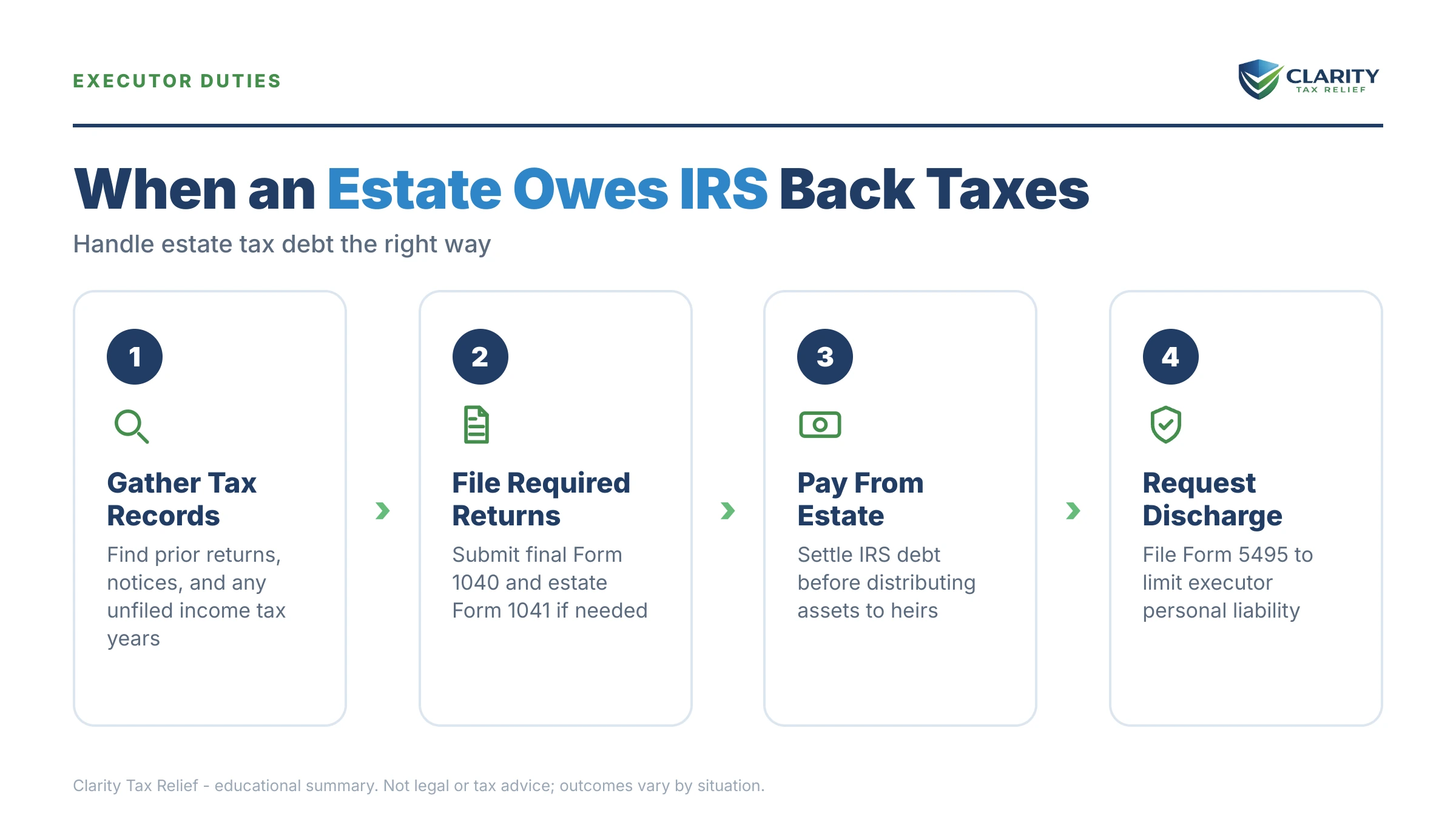
The short answer: when an estate owes the IRS, the debt is paid from the decedent's assets before heirs inherit anything — heirs are not personally liable. The executor's job: file Form 56, pull transcripts, file any missing returns, and pay the IRS before distributing assets, because distributing first can make the debt personally yours.
You're the one who agreed to settle the estate — and now, weeks after the funeral, the IRS mail addressed to someone who has died keeps landing in your hands. If the "estate owes IRS" question is keeping you up at night, here is the frame that changes everything: this is the estate's debt, paid from the estate's money, in a specific legal order. Your job isn't to find the cash. It's to follow the order.
The order matters more than the amount. Federal law puts the IRS ahead of nearly every other unsecured creditor of an estate, and an executor who pays the wrong people first — or hands assets to heirs while tax is unpaid — can be held personally responsible for what was paid out. Get the sequence right and the debt stays where it belongs: on the estate.
Your first IRS filing as executor is Form 56, the notice that puts you in charge of the decedent's tax account — the image below shows you exactly what this paperwork looks like and where to look, so you recognize what you're dealing with before you sign anything.
⏱ The clock that's actually running: there is no single statutory deadline to "resolve an estate's IRS debt" — but interest compounds daily and the failure-to-pay penalty adds 0.5% per month to the decedent's balance until the estate pays it. And any IRS notice sitting in the decedent's mail has its own printed response date. That printed date controls, whether or not anyone has read the letter.
Why the estate owes the IRS — and why the mail keeps coming
A person's federal tax debt does not disappear at death; it becomes a claim against their estate. Whatever the decedent owed — unpaid income tax, self-employment tax, penalties, interest, even an old audit assessment — transfers to the probate estate the moment they die, and the IRS collects from the assets the executor now controls.
Estates typically owe the IRS for one of four reasons: the decedent had an existing assessed balance and was in the collection pipeline; they died with unfiled returns (extremely common with self-employed and gig-economy decedents); their final-year income created a balance on the final tax return of a deceased person; or the estate itself earned income after death — rent, interest, gains on sold assets — that generates its own tax.
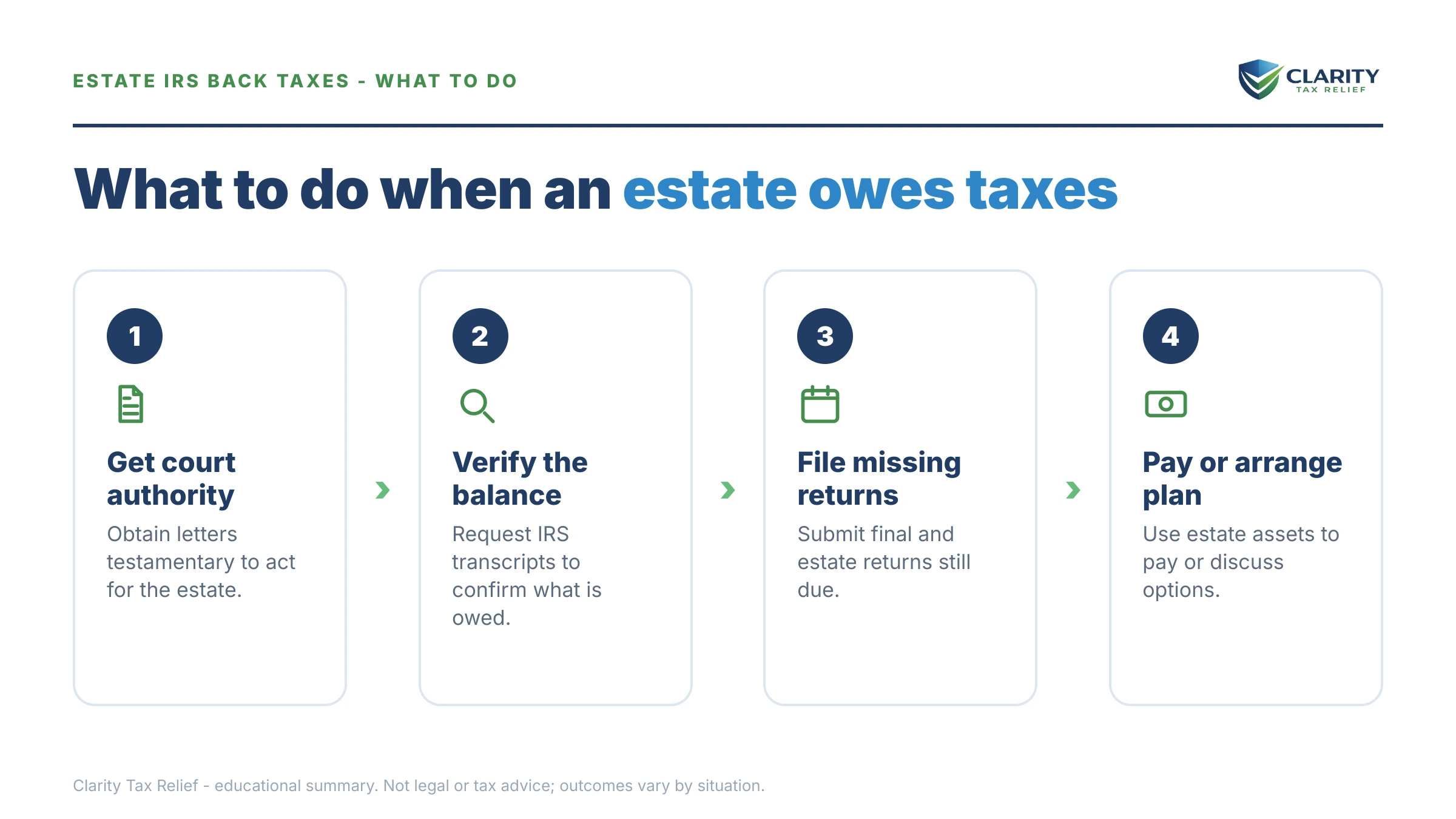
The mail keeps coming because the IRS's collection system doesn't know anyone died until a fiduciary tells it. Notices are computer-generated to the last known address, and each carries a live response deadline. That's why Form 56 — the notice of fiduciary relationship — comes before everything else: it reroutes the account, and the deadlines, to you.
Are heirs personally responsible when an estate owes the IRS?
Heirs do not inherit IRS debt — the IRS collects from the estate's assets, and if those run out, the shortfall generally goes uncollected. You cannot be forced to pay a parent's or sibling's back taxes from your own wages or savings simply because you're family. If you're the surviving child in this position, our guide to a parent who died owing taxes walks through the child's side specifically.
Three real exceptions, and they're narrow:
- Joint returns. A surviving spouse who signed a joint return is fully liable for that year's tax in their own right — see deceased spouse tax debt responsibility. Innocent-spouse relief may apply if the debt traces to income the survivor didn't know about.
- Transferee liability. If estate assets were handed out before the IRS was paid, the IRS can pursue the recipients — up to the value each received (IRC §6901). This is the main way the IRS can reach an inheritance after the fact.
- Liened property. A federal tax lien recorded before death follows the property it attached to, even into an heir's hands. More on that in our guide to an IRS lien after death.
Assets with named beneficiaries — life insurance, 401(k)s, IRAs, payable-on-death accounts — generally pass outside probate and aren't tapped for the estate's ordinary tax debt, though inherited retirement distributions create their own income tax for the beneficiary.
The three tax returns a decedent's estate may owe
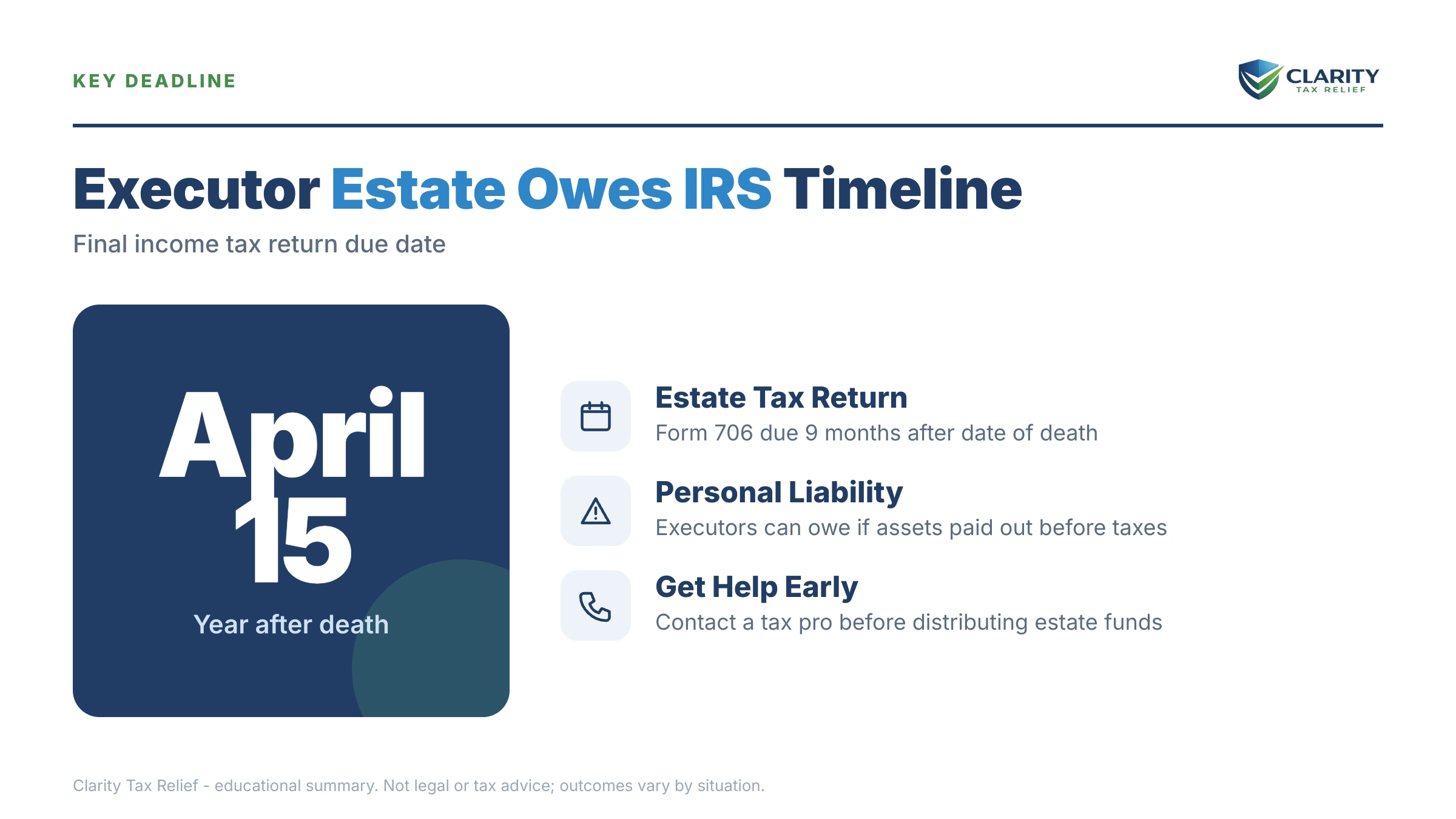
Most estates deal with one to three federal returns, and confusing them is the most common executor mistake. The federal estate tax (Form 706) applies only above a multimillion-dollar exemption — roughly $15 million per person in 2026 under current law — so for the vast majority of families, "the estate owes the IRS" means income tax, not estate tax.
| Return | What it covers | When it's due |
|---|---|---|
| Final Form 1040 | The decedent's income from January 1 through the date of death — plus any earlier unfiled years | The normal filing deadline for the year of death (typically April 15 of the following year) |
| Form 1041 | Income the estate earns after death — interest, rent, gains on assets sold during administration (generally required once estate income passes a small threshold) | The 15th day of the 4th month after the estate's tax year ends |
| Form 706 | Federal estate (transfer) tax — only estates above the multimillion-dollar exemption | 9 months after death (6-month extension available) |
If the estate genuinely owes Form 706 estate tax and the assets are illiquid, there's a dedicated installment provision — see our guide to what to do when the estate tax can't be paid. Everything else on this page is about the far more common problem: income tax debt left behind by the person who died.
What happens if you ignore a decedent's IRS debt
Ignoring an estate's IRS debt doesn't make it lapse — it makes the balance grow, the enforcement escalate, and the risk shift from the estate to the executor personally. Here's the sequence, in the order it unfolds:
- Notices keep generating to the decedent's last address — each with a printed response date that expires whether or not anyone opens the envelope.
- Penalties and interest compound on the estate's dime. Every month of drift is money that would otherwise go to heirs — see how IRS interest actually compounds.
- A federal tax lien attaches to the estate's property. The lien arises from assessment and survives death, clouding title on the house you're trying to sell out of probate.
- Levies and offsets begin. The IRS can seize a state refund, offset any federal refund due the decedent, and levy accounts held in the estate's name once the notice sequence runs its course.
- The executor becomes the target. If assets get distributed while tax goes unpaid, 31 U.S.C. §3713 lets the IRS collect from the executor personally — the one stage on this list you can never undo by writing a check from estate funds.
The notice sequence itself is the same automated ladder any taxpayer faces — the account doesn't know its owner died:
| Notice | What it means for the estate | Response window |
|---|---|---|
| CP14 | First bill on an assessed balance | Typically about 21 days from the notice date |
| CP501 / CP503 | Reminder bills — no enforcement yet, balance growing monthly | The date printed on each notice |
| CP504 | Intent to levy the state tax refund (IRC §6331(d)); lien filing becomes likely | 30 days from the notice date |
| LT11 / Letter 1058 | Final notice of intent to levy — bank levies and asset seizure become legal after this | 30 days, with Collection Due Process appeal rights via Form 12153 |
One more clock runs in the estate's favor: the 10-year collection statute (CSED) started at each assessment and keeps running after death. But unfiled years were never assessed — no return, no assessment, no expiration clock at all. That's why filing the missing returns is step one, not step last.
Settling an estate with IRS debt attached?
Before you pay a single creditor or distribute a single dollar, get the estate's IRS account decoded — every assessed year, every unfiled year, every notice in the pipeline. It's free, and it's the map that keeps the debt off your personal shoulders while penalties and interest are still accruing on the estate's balance.
Your options for resolving the estate's tax debt
An estate has most of the same resolution paths as a living taxpayer — but the IRS applies them differently, because an estate exists specifically to liquidate assets and pay claims. The shared background on how each program works lives in our guide to how to settle tax debt yourself; here's how each option actually plays for an estate:
| Option | When it fits an estate | Key threshold / cost |
|---|---|---|
| File accurate returns first | Any unfiled year, or any year the IRS filed a substitute return — often cuts the balance before a dime is paid | Free; refund years recoverable within 3 years via Form 1310 |
| Penalty relief (FTA / reasonable cause / AEP) | Death and final illness are classic reasonable-cause grounds; FTA needs a clean prior 3 years; AEP applies automatically starting summer 2026 | Free to request; can remove failure-to-file and failure-to-pay penalties |
| Pay in full from estate assets | The default — the IRS expects available assets to be applied before granting anything else | Stops penalty and interest accrual immediately |
| Payment arrangement | Assets are illiquid (a house mid-sale, a business winding down) and the estate needs time to convert them | Interest and penalties continue; the IRS will want a timeline tied to the liquidation |
| Offer in Compromise (doubt as to collectibility) | The estate is genuinely insolvent — total assets can never cover the debt | $205 application fee; roughly 1 in 5 offers accepted in FY2024 — never a given |
| Insolvent-estate closure | Assets exhausted in the correct priority order; the unpaid remainder generally goes uncollected | Free — but only safe if the executor followed the payment order |
Notice what's missing compared with a living taxpayer's menu: Currently Not Collectible hardship status is built around a person's living expenses, so it rarely maps onto an estate. And "the debt expires in 10 years" is true only for assessed years — and the estate usually can't stay open long enough to wait a CSED out anyway.
Executor personal liability: the mistake that makes it your debt
Under 31 U.S.C. §3713, an executor who distributes estate assets — or pays lower-priority creditors — while a known federal tax debt goes unpaid becomes personally liable, up to the amount paid out. This is the single sharpest edge in the entire topic, and it's why "just close the estate and hope" is the one strategy that can genuinely cost you your own money. Our companion guide covers when an executor is personally liable to the IRS in depth.
The safe payment order in an estate that can't cover everything: administration expenses (probate costs, reasonable executor and attorney fees) and any claims with higher legal priority first, then federal tax claims ahead of general unsecured creditors — credit cards, medical bills, personal loans — and heirs last of all. Paying grandma's credit card or advancing an heir "their share" before the IRS is exactly the move §3713 punishes.
Two forms exist specifically to protect you here:
- Form 4810 (Request for Prompt Assessment) asks the IRS to review the decedent's filed returns on a shortened clock — generally 18 months instead of the usual three years — so you can close the estate without a surprise assessment arriving years later.
- Form 5495 (Request for Discharge from Personal Liability) asks the IRS to release you, the fiduciary, from personal liability for the decedent's income and gift taxes; if the IRS doesn't assert additional tax within the statutory window — generally nine months — your personal exposure for those returns ends.
Neither form is mandatory. Both are cheap insurance that most self-directed executors have never heard of.
A worked example: the estate owes the IRS $61,200
Say your brother delivered for gig apps for years, never filed for 2022–2024, and died this spring. As executor, you pull his IRS account and find the IRS filed substitute returns (SFRs) for all three years, and the account shows $61,200: roughly $43,800 in tax, about $10,950 in failure-to-file penalties (the 5%-per-month penalty capped at 25% of the tax), and around $6,450 in failure-to-pay penalties and interest. This is a hypothetical, but the mechanics are exactly what estates of unfiled gig workers face.
Here's the leverage: SFRs are built from raw 1099 totals with zero business deductions — no mileage, no phone, no supplies. You reconstruct his mileage from the app records and bank statements (our guide to filing back taxes without records shows how) and file accurate Schedule C returns, replacing the substitute returns the IRS filed:
- Actual tax across the three years: roughly $24,000 instead of $43,800.
- Failure-to-file penalty recomputes on the lower tax: 25% × $24,000 ≈ $6,000 instead of $10,950.
- Failure-to-pay penalty and interest recompute too: roughly $3,600 instead of $6,450.
- New total: about $33,600 — a $27,600 reduction earned entirely by filing, before any relief program enters the picture.
The estate holds $48,000 after selling his car and closing his bank account. You pay the $33,600, file Form 5495 to cut off your personal exposure, and distribute the remaining $14,400 to heirs with a clear conscience. Had you distributed the $48,000 first, §3713 could have made the entire tax bill collectible from you. To sanity-check what penalties and interest are adding to any balance you're staring at, our Penalty & Interest Calculator can estimate the breakdown.
How to respond when the estate owes the IRS, step by step
- File Form 56 — notify the IRS you're the fiduciary so the account's notices and deadlines come to you instead of a dead letterbox.
- Pull the transcripts — request account transcripts and wage and income transcripts for every open year to see exactly what is assessed, what was filed, and what is missing.
- File every missing return — accurate returns almost always show less tax than IRS substitute returns, and any refund year can still be claimed with Form 1310 if within three years.
- Request penalty relief before paying — First-Time Abatement, reasonable cause (death and serious illness are classic grounds), or the new Automatic Exemption from Penalty can shrink the balance.
- Pay the IRS before heirs and unsecured creditors — after administration expenses and higher-priority claims, federal tax comes ahead of credit cards, medical bills, and every distribution.
- Request discharge, then distribute — file Form 5495 to cap your personal exposure for the decedent's income taxes, then close the estate and distribute what remains.
On step 4: penalty relief works differently in 2026 than the older guides describe. First-time penalty abatement still requires a clean compliance history for the prior three years, but starting summer 2026 the IRS's Automatic Exemption from Penalty (AEP) applies qualifying relief automatically — no request needed. For a decedent, reasonable cause is often the stronger argument anyway: a final illness that prevented filing is precisely the circumstance the standard was written for.
When you have to call about the account, be ready to prove your authority — the IRS won't discuss a decedent's account with just anyone. Have the death certificate, your letters testamentary (or equivalent court appointment), and your filed Form 56 in hand; our guide on what to say when calling the IRS about back taxes covers the scripts, and 2026's reduced phone staffing means every call needs to count.
What if the estate can't pay at all?
An insolvent estate pays what it can in the legal priority order, and the unpaid remainder generally dies with the estate — the IRS does not chase heirs for the shortfall. This is the honest answer to whether IRS debt dies with you: yes, once the assets are genuinely exhausted in the right order.
What "the right order" means in practice: probate and administration costs come off the top, secured creditors keep their collateral, federal claims get paid before general unsecured creditors, and heirs receive only what's left. An executor who follows that sequence and documents it walks away clean even when the IRS is left short. An executor who skips ahead — even sympathetically, even to a grieving spouse — is the one §3713 reaches.
For a deeply insolvent estate with some assets but nowhere near enough, an Offer in Compromise on doubt-as-to-collectibility grounds can formally close the account rather than leaving it open-ended. The IRS accepted roughly 1 in 5 offers in FY2024, so it's a real path but never a promised one — and for most insolvent estates, simply exhausting the assets correctly and documenting it achieves the same end for free.
When you can handle this yourself — and when experienced help changes the outcome
Plenty of estate tax debts are DIY-able. If the decedent filed everything, the assessed balance is accurate and modest, and the estate has cash to cover it, you can file Form 56, pay through the IRS's own channels, request penalty abatement in a letter, and close the file without paying anyone for help. Honest rule of thumb: one filed-and-agreed year plus liquid estate funds equals a self-serve situation.
Experienced help changes outcomes in the harder patterns:
- Multiple unfiled years — especially self-employment income, where reconstructing deductions (as in the example above) can cut the debt by a third or more, and where filing order and the six-year lookback involve judgment calls.
- SFR assessments on the account — replacing them is powerful but procedurally finicky.
- An estate that can't pay everything — the §3713 priority analysis is exactly where an executor's personal money is on the line.
- A lien clouding property the estate must sell, or a levy notice already in the sequence.
- A surviving spouse tangled in joint-return liability, where innocent-spouse and estate issues interact — see whether a widow is responsible for a husband's tax debt.
- The decedent owned a business — payroll and entity-level debts follow different rules entirely (start with when an LLC owes IRS back taxes).
If your situation is on that second list — multiple unfiled years, an insolvent estate, or property you can't sell under a lien — a free case review with an experienced tax professional will tell you in one call whether the estate's balance is even the right number: start with the 2-minute form or dial (888) 825-7779.
Terms on the estate's IRS mail, decoded
- Decedent — the legal term for the person who died; the IRS account stays in their name and SSN until the estate closes.
- Fiduciary — the person legally acting for the estate (executor, administrator, personal representative); Form 56 is how the IRS learns who that is.
- Probate estate — the assets that pass under the will or state law, and the pool the IRS's claim is paid from; beneficiary-designated assets generally sit outside it.
- Federal claims priority (31 U.S.C. §3713) — the statute putting federal debts ahead of ordinary creditors in an insolvent estate, and making a fiduciary who pays out of order personally liable.
- Transferee liability (IRC §6901) — the IRS's power to collect from someone who received estate assets before the tax was paid, up to the value received.
- SFR (Substitute for Return) — a return the IRS files for a non-filer using raw income reports and no deductions; almost always overstates the true tax.
- CSED — the Collection Statute Expiration Date, 10 years from each assessment; it keeps running after death but never starts on years that were never assessed.
Estate IRS debt questions, answered
Do I have to pay my deceased parent's IRS debt out of my own pocket?
No — the debt is paid from the estate's assets, not yours, and if the estate runs out of money before the IRS is paid, you owe nothing personally. The exceptions: you filed a joint return with the decedent, you co-owed the tax yourself, or you received estate assets before the IRS was paid, which can create transferee liability up to the value you received.
Does IRS debt die with you?
The debt survives death and becomes a claim against the estate, but if the estate is genuinely insolvent, whatever the assets cannot cover generally goes uncollected — the IRS does not pursue heirs for the shortfall. The caveats: a federal tax lien already attached to property follows that property, and anyone who received assets ahead of the IRS can be pursued for what they received.
Can the IRS take an inheritance I already received?
It can, up to the value of what you received, if the estate distributed assets to you while the decedent's tax debt was unpaid. This is transferee liability under IRC §6901, and a federal tax lien recorded before death also follows property into your hands. If you have already received a distribution from an estate with known IRS debt, get advice before spending it.
What is IRS Form 56 and does an executor have to file it?
Form 56, Notice Concerning Fiduciary Relationship, tells the IRS you are legally acting for the decedent and redirects the account's mail to you. Without it, collection notices keep going to the decedent's last address — and their response deadlines pass whether or not anyone reads them. Filing it is usually the executor's first IRS move, and you file a second Form 56 to end the relationship when the estate closes.
Can an executor be held personally liable for a decedent's taxes?
Yes. Under 31 U.S.C. §3713, an executor who pays other creditors or distributes assets to heirs while the estate cannot cover a known federal tax debt becomes personally liable up to the amount paid out. The protection is simple: establish what the IRS is owed first, pay it (after administration expenses and any debts with higher legal priority), and only then distribute what remains.
Can an estate get an IRS payment plan or an Offer in Compromise?
Both are possible, but the IRS treats estates differently from living taxpayers: because an estate exists to liquidate assets, the IRS usually expects available assets to be sold and applied first. Payment arrangements come into play when assets are illiquid — a house that has to sell, for example. An Offer in Compromise based on doubt as to collectibility is realistic mainly for genuinely insolvent estates, and acceptance is never guaranteed.
What if the person who died had years of unfiled tax returns?
The executor is responsible for filing them. Pull wage and income transcripts for the open years, file accurate returns — the IRS generally looks for the last six years of unfiled returns — and replace any substitute returns the IRS filed, which typically overstate the tax because they ignore deductions. If a year shows a refund, it can still be claimed within three years of that return's due date using Form 1310.
Does the 10-year collection statute keep running after death?
Yes — the CSED is 10 years from the date each tax was assessed, and death neither stops nor restarts it. If the decedent's debt was assessed eight years ago, the IRS has roughly two years left to collect from the estate. But unfiled years were never assessed, so no clock is running on them at all until returns are filed or the IRS assesses a substitute return.
Is life insurance or a retirement account with a named beneficiary at risk?
Assets that pass directly to a named beneficiary — life insurance, 401(k)s, IRAs, payable-on-death accounts — generally bypass probate and are not used to pay the estate's ordinary tax debt. Two caveats: a federal tax lien recorded against the decedent before death can still follow certain property, and distributions a beneficiary takes from an inherited retirement account are taxable income to the beneficiary.
Your next 24 hours
- Find the most recent IRS notice in the decedent's mail and note two things: the total balance and the printed response date. That date is the only live deadline on the account right now.
- Gather the file: the death certificate, your letters testamentary or court appointment, the decedent's last filed tax return, every piece of IRS mail, and a rough list of what the estate owns and owes.
- Get the estate's account decoded free before you pay any creditor or distribute anything — the 2-minute form or (888) 825-7779. Penalties and interest are accruing on the estate's balance every month it sits, and the payment order you choose in the next few weeks decides whether this stays the estate's debt or becomes yours.
Primary sources worth bookmarking: the IRS's About Form 56, Notice Concerning Fiduciary Relationship page, the IRS payments portal for paying an estate's balance, and the Taxpayer Advocate Service if the estate's case stalls inside the IRS.
This guide is general information, not tax or legal advice for your specific situation. Eligibility for IRS programs depends on individual facts and circumstances; no outcome is guaranteed.