
Assets & Collections
Can the IRS Take My Inheritance? What It Can Reach and How to Protect Your Options (2026)
Can the IRS take my inheritance? Yes. If you owe back taxes, the federal tax lien attaches to property you acquire after the debt arose — including inherited cash, real estate, and accounts — the moment your right to it vests. Even refusing the inheritance won't defeat the lien. But you control how the money is deployed, and timing changes everything.
The estate attorney just told you your share, probate is a few months from closing, and the whole time you've been carrying an IRS balance from the self-employment years that got away from you. You can see the collision coming — and that's actually the good news. For once, you have lead time to position the money before the IRS positions itself, and this guide maps exactly how.
⏱ Your real clock: there's no notice deadline on an inheritance itself, but your IRS balance grows every month it waits — a 0.5% monthly failure-to-pay penalty plus daily compounding interest. Every month probate drags on, the debt the inheritance has to cover gets bigger. The lien, meanwhile, attaches the day your interest vests — usually the date of death.
Why the IRS can take an inheritance you haven't even received yet
The federal tax lien under IRC §6321 attaches automatically to everything you own — and everything you acquire later, including an inheritance. The lien arises the moment the IRS assesses your tax and you don't pay after demand. No court order, no new paperwork, no letter announcing it.
Lawyers call this the "after-acquired property" rule: assets that come into your hands after the debt exists are captured just as completely as assets you already had. Under most state laws, your interest in an estate vests at the date of death — meaning the lien can grab your share while the estate is still in probate, before a dollar reaches you.
Two separate tools matter here, and people mix them up. The lien is the silent legal claim that attaches on its own. The levy is the active seizure — of a bank account, a distribution from the executor, or (rarely) inherited property itself — and that requires the IRS to send you a final notice first and wait 30 days. So "can the IRS take it" is really two questions: the claim already exists; the taking follows a process you can interrupt.
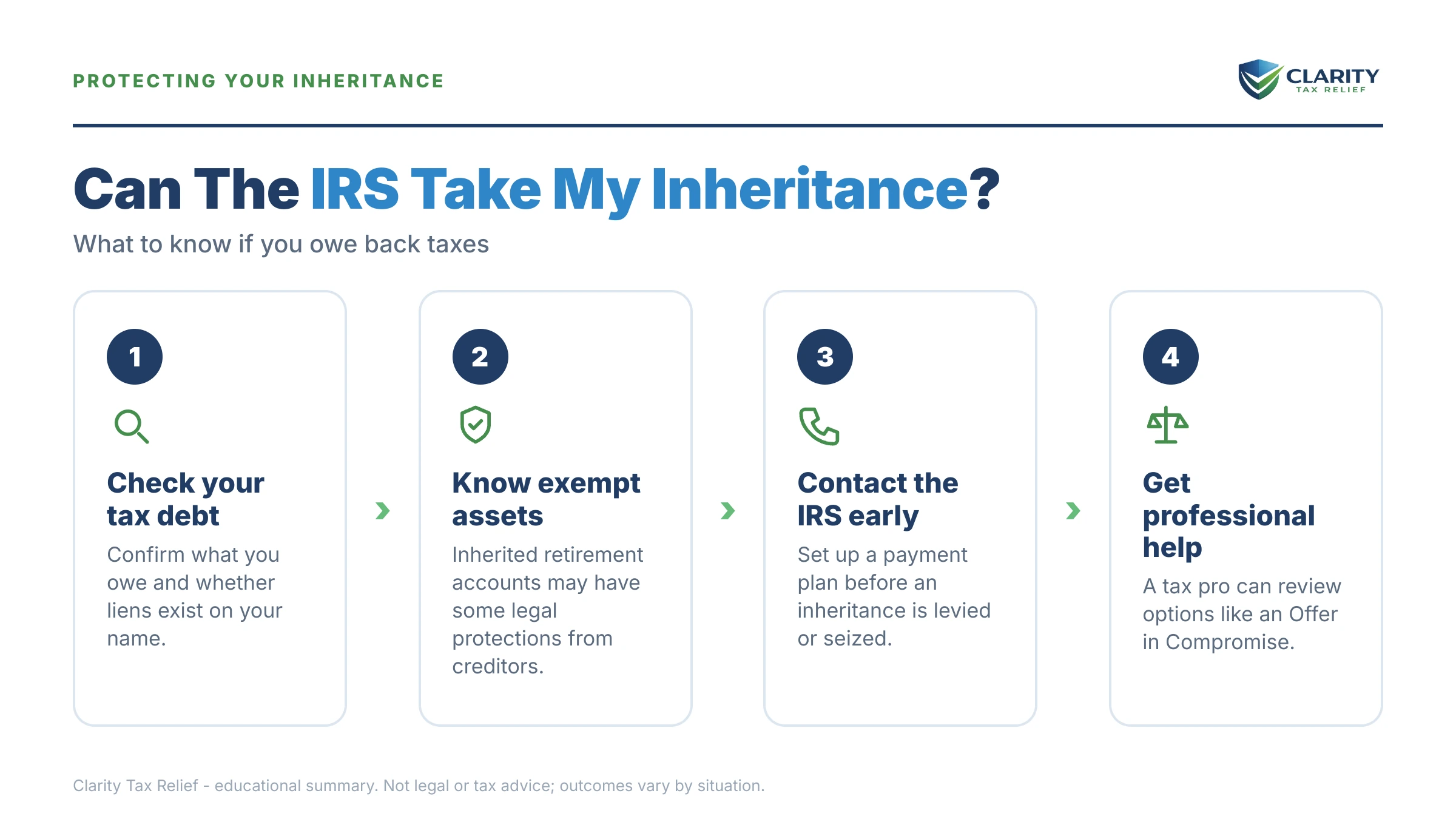
What the IRS can take, by type of inheritance
Once an inheritance is legally yours, virtually every form of it — cash, real estate, retirement money, life-insurance proceeds — is within the IRS's collection reach. What changes by asset type is how the IRS reaches it and what your smartest counter-move is.
| What you inherited | Can the IRS reach it? | How — and what to do |
|---|---|---|
| Cash bequest or bank transfer | Yes — easiest target | Once deposited, a bank levy freezes the funds for 21 days before they're sent to the IRS. Deploy the money deliberately before enforcement reaches it, not after. |
| House or other real estate | Yes — lien attaches at vesting | A filed lien clouds the title; you can't sell or refinance clean without paying the IRS from proceeds or getting a tax lien discharge (Form 14135). See can the IRS take my house for how seizure itself works. |
| Inherited traditional IRA or 401(k) | Yes — and withdrawals create new tax | The account can be levied, and every distribution you take is taxable income that can grow the debt. Read inherited IRA taxes owed and can the IRS take my IRA before touching it. |
| Life-insurance proceeds paid to you | Yes — once paid out | Proceeds land as your cash and are levy-eligible like any deposit. Details in can the IRS take life insurance. |
| TOD/POD accounts, inherited brokerage | Yes — probate-skipping doesn't matter | Transfer-on-death assets bypass probate, not the federal tax lien. The lien attaches the moment the account becomes yours. |
| Your share still sitting in probate | Yes — the IRS can levy the estate | The IRS can serve a levy on the executor for your distributive share. This is usually a revenue-officer move on larger balances, not an automated one. |
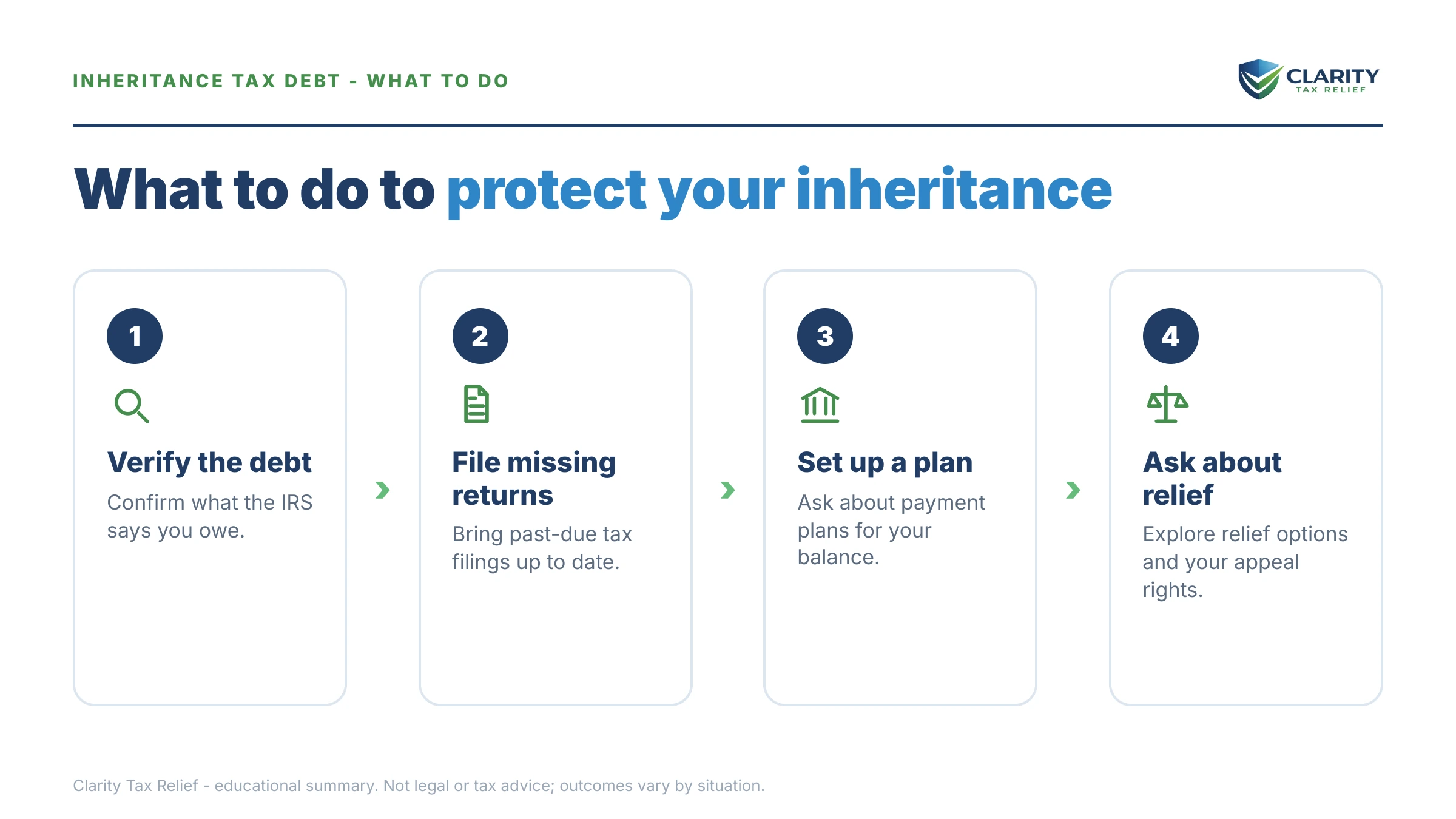
Can you refuse the inheritance so the IRS can't take it?
No — disclaiming an inheritance does not defeat a federal tax lien. The Supreme Court settled this in Drye v. United States (1999): your right to the inheritance is itself property, and the lien attaches to that right the moment it arises. Signing a state-law disclaimer so the money flows to your sibling instead simply doesn't work against the IRS, even though it works against most private creditors.
Trying to route around the lien creates worse problems than the lien itself. Gifting your share to family can be attacked as a fraudulent transfer or trigger a nominee lien against the recipient. And if you later apply for an Offer in Compromise, money you gave away or spent on non-essentials can be added back into the IRS's math as dissipated assets — you'd be negotiating as if you still had cash you no longer have.
The honest strategic frame: you can't keep the inheritance from the IRS. You can only control whether it's taken on the IRS's terms or applied on yours.
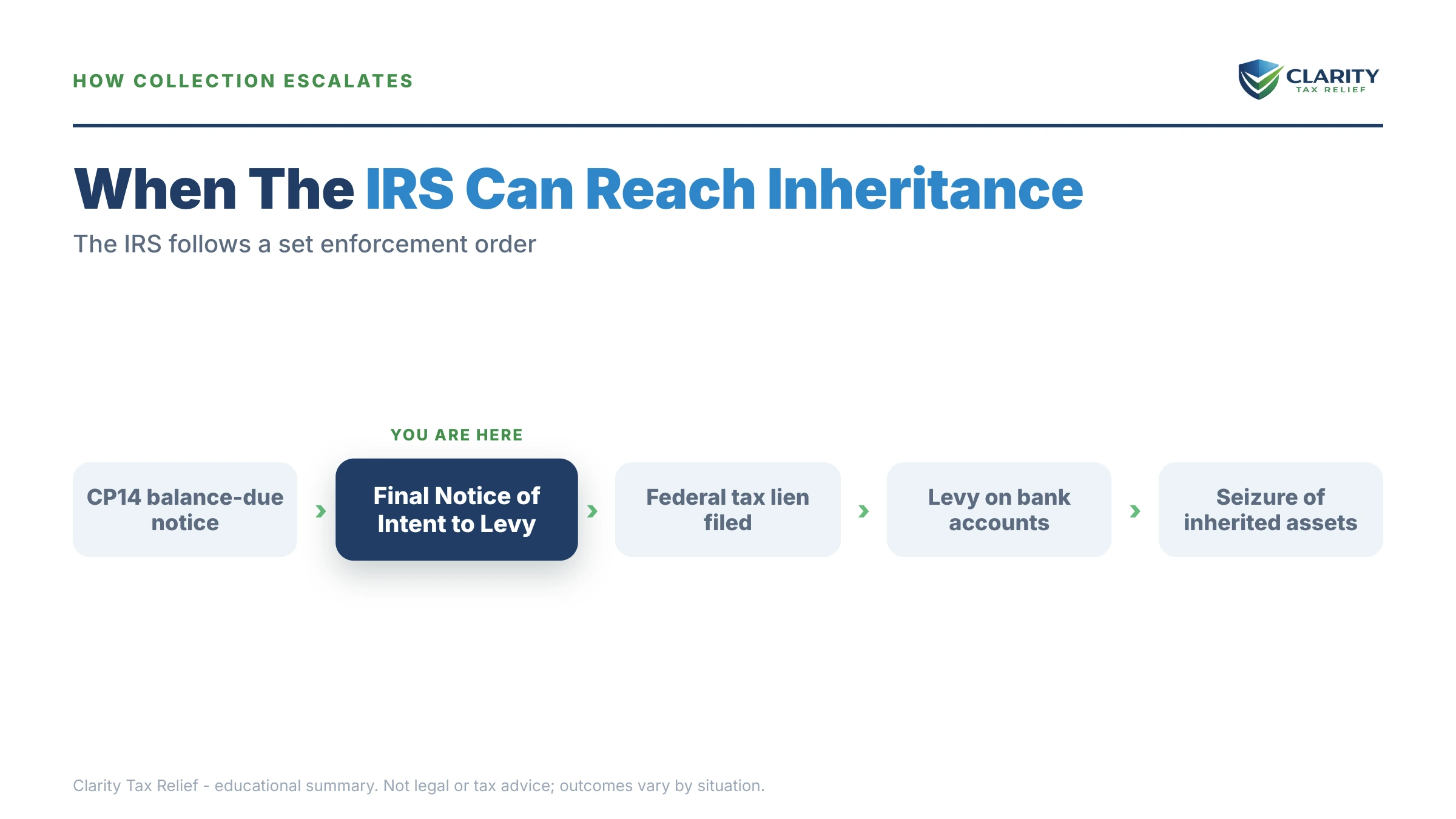
What happens if you ignore the debt after your inheritance arrives
Ignoring a tax debt after an inheritance lands doesn't just continue the old collection sequence — it hands the IRS a visible, levyable target it didn't have before. The stages run in this order:
- The statutory lien is already attached. From the day your interest vested, the IRS's claim covers the inheritance — silently, with nothing filed yet.
- A Notice of Federal Tax Lien gets filed. Now the claim is public record. It clouds the title on any inherited real estate and surfaces in every title search and lender file.
- CP504 — the IRS takes your state tax refund. This notice authorizes levy of state refunds under IRC §6331(d) and signals the account is moving toward full enforcement.
- LT11 / Letter 1058 — the final notice. A 30-day clock starts, along with your Collection Due Process rights (requested on Form 12153). This is the last structured off-ramp before seizure.
- Levy reaches the money. A bank levy freezes the deposited inheritance for 21 days before the funds leave; an estate levy intercepts your share at the executor; seizure of inherited real estate is rare but legally available.
Two amplifiers specific to 2026: if your total certified debt is $66,000 or more, the IRS can certify you to the State Department for passport revocation for tax debt. And while IRS staffing fell roughly 27% in 2025, the lien filings and levies above are generated by automated systems that never stopped running — a probate windfall is exactly the kind of asset those systems eventually find. You can estimate how fast your balance is compounding in the meantime with our IRS Penalty & Interest Calculator.
Inheritance on the way — and an IRS balance behind it?
This is a timing problem, and timing is winnable. Get your balance, lien status, and best use of the money mapped free by an experienced tax professional before the funds land — penalties and interest are accruing monthly either way.
How to use your inheritance against IRS debt: your real options
An inheritance changes which IRS resolution programs you qualify for — sometimes for the better, sometimes not. The general playbook for each program lives in our guide on how to settle tax debt yourself; here's specifically how a windfall interacts with each one.
| Option | Threshold / eligibility | How an inheritance changes it |
|---|---|---|
| Full payment | Inheritance ≥ balance | Stops all penalties and interest; a filed lien must be released within 30 days of full payment. Cleanest exit when the math works. |
| Short-term plan | Pay in full within 180 days; $0 setup fee | Ideal bridge when probate will close within six months — it holds off enforcement until the money arrives. |
| Streamlined installment agreement | Balance ≤ $50,000; up to 72 months, set up online | A partial paydown that drops you under $50,000 unlocks this without any financial disclosure. Interest and penalties continue on the remainder. |
| Guaranteed installment agreement | Balance ≤ $10,000 | If the inheritance gets you under $10,000, approval of a 3-year plan is essentially automatic by statute. |
| Offer in Compromise | Means-tested; $205 fee, 20% down on lump-sum offers | A cash inheritance goes into the IRS's collection-potential math dollar-for-dollar — it usually raises the required offer or ends eligibility. Only about 1 in 5 offers were accepted in FY2024. |
| Currently Not Collectible | Documented inability to pay basic living expenses | A meaningful cash inheritance generally disqualifies you or triggers removal at review. Don't count on hardship status surviving a windfall. |
A worked example: a $54,600 inheritance against a $71,000 IRS balance
Say you're a self-employed sole proprietor who owes the IRS $71,000 across three years of underpaid self-employment tax, and your mother's estate is about to distribute $54,600 to you. This is hypothetical — but the arithmetic is the arithmetic.
Path A — put it all on the debt. $71,000 − $54,600 leaves $16,400. That's under the $50,000 streamlined line (online 72-month plan, no financial disclosure) and, spread over 72 months, roughly $228/month before continuing interest. You've also dropped well below the $66,000 passport-certification threshold, and the smaller balance accrues far less penalty going forward.
Path B — strategic partial paydown. Apply $21,600 to bring the balance to $49,400 — under both the $50,000 streamlined line and the $66,000 passport line — and hold back $33,000 as a reserve for quarterly estimated taxes and business cash flow. The plan runs roughly $686/month over 72 months, again before interest. For a sole proprietor whose real risk is falling behind on next year's taxes while paying off the last three, keeping a quarterly-tax reserve is often what prevents the cycle from repeating.
What not to do: apply for an Offer in Compromise while $54,600 sits in your checking account. The IRS's offer math would count that cash nearly dollar-for-dollar, and spending it first on non-essentials risks the dissipated-asset add-back described above. With a windfall this close to the balance, a plan or paydown almost always beats a doomed offer.
How to respond when an inheritance is coming and you owe the IRS, step by step
- Pull your exact IRS balance: log into your IRS online account and write down the total, the tax years involved, and whether a lien shows on your account.
- Freeze your own hands before the money moves: don't spend, gift, or shift the inheritance until you have a plan — transfers can be unwound and can poison your best options later.
- Check the public record for a Notice of Federal Tax Lien: search the county where you live and the county where any inherited real estate sits.
- Map the money against the thresholds: full payment, the $50,000 streamlined-plan line, the $66,000 passport-certification line, and what your monthly cash flow can carry.
- Lock in your resolution before the next notice: set up the payment plan online if your path is simple, or get a professional review first if a lien discharge, an OIC, or unfiled years are in play.
The other direction: what if the person who died owed the IRS?
You do not personally inherit someone else's IRS debt — but the estate must pay the IRS before you get paid. The decedent's back taxes are a claim against the estate, and they generally come ahead of distributions to heirs. If the executor distributes assets before satisfying the IRS, the executor can become personally liable, and the IRS can pursue what heirs received through transferee liability.
If that's your situation — you're the heir or the executor, and the debt belonged to the person who died — the process, priorities, and protections are different from everything above. Start with our guide on when an estate owes the IRS.
When you can handle this yourself
Plenty of inheritance-plus-tax-debt situations need no professional at all. If the inheritance covers your balance, paying in full through IRS.gov/payments ends the problem and forces release of any filed lien within 30 days. If a partial paydown lands you under $50,000 with a payment you can afford, the IRS online payment-plan tool takes about twenty minutes. One year, undisputed amount, cash in hand — do it yourself and keep the fee.
Experienced help changes the outcome in a narrower set of cases: a lien already filed against inherited real estate you need to sell (discharge applications are technical and slow when done wrong), an inheritance colliding with a pending or planned Offer in Compromise, multiple unfiled Schedule C years that have to be filed before any agreement is possible, a levy already served on your bank or the estate, or an executor dispute over who the IRS gets paid ahead of. If you're stuck between the IRS and a probate court, the Taxpayer Advocate Service is also a free escalation path when normal channels stall. And if any of this involves selling the inherited house or timing an offer, a quick review of your numbers before you act is worth far more than one after — start with the free case review.
Terms in this guide, decoded
- Federal tax lien: the automatic legal claim that attaches to all your property — current and future — once tax is assessed and unpaid; it exists whether or not anything is filed. (The IRS's own explainer: Understanding a Federal Tax Lien.)
- Notice of Federal Tax Lien (NFTL): the public county filing that makes the lien visible to title companies, lenders, and buyers.
- Levy: the actual seizure — of a bank account, an estate distribution, or property — which requires a final notice and a 30-day window first.
- After-acquired property: assets you obtain after the tax debt arose; the existing lien captures them automatically, inheritance included.
- Disclaimer: a formal refusal of an inheritance under state law — effective against most creditors, but not against a federal tax lien.
- Dissipated asset: money the IRS decides you spent or gave away instead of paying tax; it can be added back into Offer in Compromise math as if you still had it.
Can the IRS take my inheritance? Your questions, answered
Can the IRS take my inheritance before I actually receive it?
Yes. Your interest in an estate generally vests at the date of death, and the federal tax lien attaches to that interest immediately — so the IRS can serve a levy on the executor for your distributive share before a check is ever cut. In practice, that move usually comes from an assigned revenue officer on larger balances; automated collections more often waits and levies your bank account after the deposit lands.
Can I disclaim or refuse an inheritance so the IRS can't take it?
No — not against the IRS. In Drye v. United States (1999), the Supreme Court held that a state-law disclaimer does not defeat the federal tax lien, because your right to the inheritance is itself property the lien reaches. Worse, a disclaimer or giveaway can later be counted as a dissipated asset, raising the minimum the IRS will accept in an Offer in Compromise or sinking it entirely.
Does the IRS automatically find out when I inherit money?
There is no automatic alert, but discovery is common. Probate filings are public record and a routine check for revenue officers, inherited accounts generate 1099s that flow to the IRS, and every collection financial statement — Form 433-A, Form 433-F, or an OIC application — asks about assets and transfers under penalty of perjury. Hiding an inheritance on those forms is where a collection problem turns into a fraud problem.
Is an inheritance taxable income that creates new IRS debt?
Generally no — inherited cash and property are not federal taxable income to you, and any estate tax is the estate's bill, not yours. The big exception is inherited pre-tax retirement money: every dollar you withdraw from an inherited traditional IRA or 401(k) is taxable income in the year you take it. A few states also charge their own inheritance tax; the federal government does not.
What happens if I inherit a house while I owe the IRS?
The federal tax lien attaches to your interest in the property the moment it vests. If a Notice of Federal Tax Lien is filed, any title company will find it, and you cannot sell or refinance with clean title until the IRS is paid from the proceeds or grants a discharge of that specific property under Form 14135. Selling and routing the IRS's share through escrow is usually the fastest clean exit.
Will an inheritance ruin my Offer in Compromise?
Often, yes — an OIC is based on reasonable collection potential, and a cash inheritance goes straight into that math dollar-for-dollar. If the money arrives while your offer is pending, the IRS can recalculate; if you spend it on non-essentials shortly before applying, it can be added back as a dissipated asset. When the inheritance approaches your balance, full payment or a payment plan usually beats a doomed offer.
Do I have to tell the IRS about an inheritance while I'm on a payment plan?
A streamlined installment agreement has no ongoing disclosure requirement — keep making payments and the plan continues, though your future refunds are still offset. Partial-pay agreements and Currently Not Collectible status are different: both come up for financial review, and a documented inheritance can raise your payment or pull you out of hardship status. Lying on a review financial statement is never the answer.
If my parent owed the IRS, do I inherit their tax debt?
No — IRS debt does not pass to heirs personally. But the estate must pay the IRS before distributing anything to you, and an executor who distributes first can become personally liable for the shortfall. If assets were already handed out, the IRS can pursue transferee liability to claw back what you received, up to the value of the transfer — so 'the estate already gave it to me' is not a shield.
Your next 24 hours
- Log into your IRS online account and write down your exact balance, the years it covers, and whether a lien indicator appears — that number decides which options in the table above are open to you.
- Gather the estate paperwork: the will or trust distribution letter, the expected amount and timing of your share, and your last filed return.
- Get a free case review before the money lands — use the 2-minute form or call (888) 825-7779. Positioning the inheritance before it arrives is what keeps it working for you; every month of waiting adds another 0.5% penalty plus interest to the balance it has to cover.
This guide is general information, not tax or legal advice for your specific situation. Eligibility for IRS programs depends on individual facts and circumstances; no outcome is guaranteed.