
Tax Debt Situations
Inherited IRA Taxes Owed: How the Bill Happened and How to Resolve It (2026)
The short answer: inherited IRA taxes owed usually happen because traditional inherited IRA distributions are taxed as ordinary income — and the default 10% withholding rarely covers your real bracket. You can pay in full, take up to 180 days, or set up a monthly IRS payment plan; penalties and interest accrue until you act.
You didn't do anything wrong. Someone you loved left you their IRA, you took money out — maybe to settle their affairs, maybe to shore up your business — and now your return shows a balance the withholding never came close to covering. The grief is real; so is the fix. This page walks through why the number is what it is, every way to pay it, and how to keep year two of the payout from doing the same thing.
Three facts drive almost every inherited IRA tax bill: the money is taxed at your ordinary rate, not the decedent's; custodians withhold only 10% by default on a one-time distribution; and there is no 10% early-withdrawal penalty, which lulls people into thinking there's no tax at all. The image below maps exactly how a single distribution turns into a balance due — where the Form 1099-R numbers come from and where the shortfall shows up.
⏱ The real clock: there's no single statutory deadline on an inherited IRA tax debt — but the failure-to-pay penalty adds 0.5% of the balance every month, plus daily-compounding interest, until you pay or start a plan. If a CP14 notice has already arrived, the pay-by date printed on it — typically 21 days from the notice date, or 10 business days if the balance is $100,000 or more — controls.
Why you owe taxes on an inherited IRA
Every dollar withdrawn from an inherited traditional IRA is taxable as ordinary income in the year you take it. The account grew tax-deferred for decades; the IRS collects when the money comes out, and death doesn't erase that deferral — it transfers it to you. Your custodian reports the distribution on Form 1099-R with code 4 (death) in Box 7, and the IRS's computers match that form against your return automatically.
Code 4 does one genuinely good thing: it exempts you from the 10% early-withdrawal penalty regardless of your age. But that's a penalty exemption, not a tax exemption. The taxable amount in Box 2a lands on your 1040 and stacks on top of everything else you earned that year.
That stacking is where business owners get hurt worst. If you already draw a salary from your company plus pass-through profit, the inherited IRA distribution doesn't get taxed at your average rate — it gets taxed at your top marginal rate, because it sits on the last layer of your income. Meanwhile the custodian withheld 10%, or nothing at all if you opted out on the distribution form. The gap between those two numbers is the bill you're staring at.
Two narrower reasons the number may be wrong in your favor: if the original owner made nondeductible contributions tracked on Form 8606, part of each distribution is tax-free basis you inherit — custodians almost never know this, so Box 2a can overstate the taxable amount. And if the account was a Roth IRA open at least five years, distributions are generally tax-free entirely. If either applies, amending the return to reduce the tax debt may shrink or erase the balance before you pay a dollar of it.
A worked example: how a $6,200 balance happens
Say you run a small company with a few employees, and last year you inherited your father's traditional IRA. You withdrew $28,000 to cover funeral costs and a slow quarter. The custodian applied the default 10% withholding — $2,800 — and you thought that handled it.
But your salary and business profit already put your last dollars in the 32% bracket. The distribution stacked on top:
- Tax on the distribution: $28,000 × 32% = $8,960
- Federal tax withheld (Box 4 of the 1099-R): −$2,800
- Shortfall on your return: ≈ $6,200 (before any underpayment penalty)
Nothing exotic happened. A 10% default withholding met a 32% marginal rate, and the 22-point gap became a balance due. This is a hypothetical, but it's the single most common way inherited IRA taxes owed come into existence — and if you'll be taking more distributions under the 10-year rule, the same math repeats every year you don't fix the withholding.
Inherited IRA tax rules by account and beneficiary type
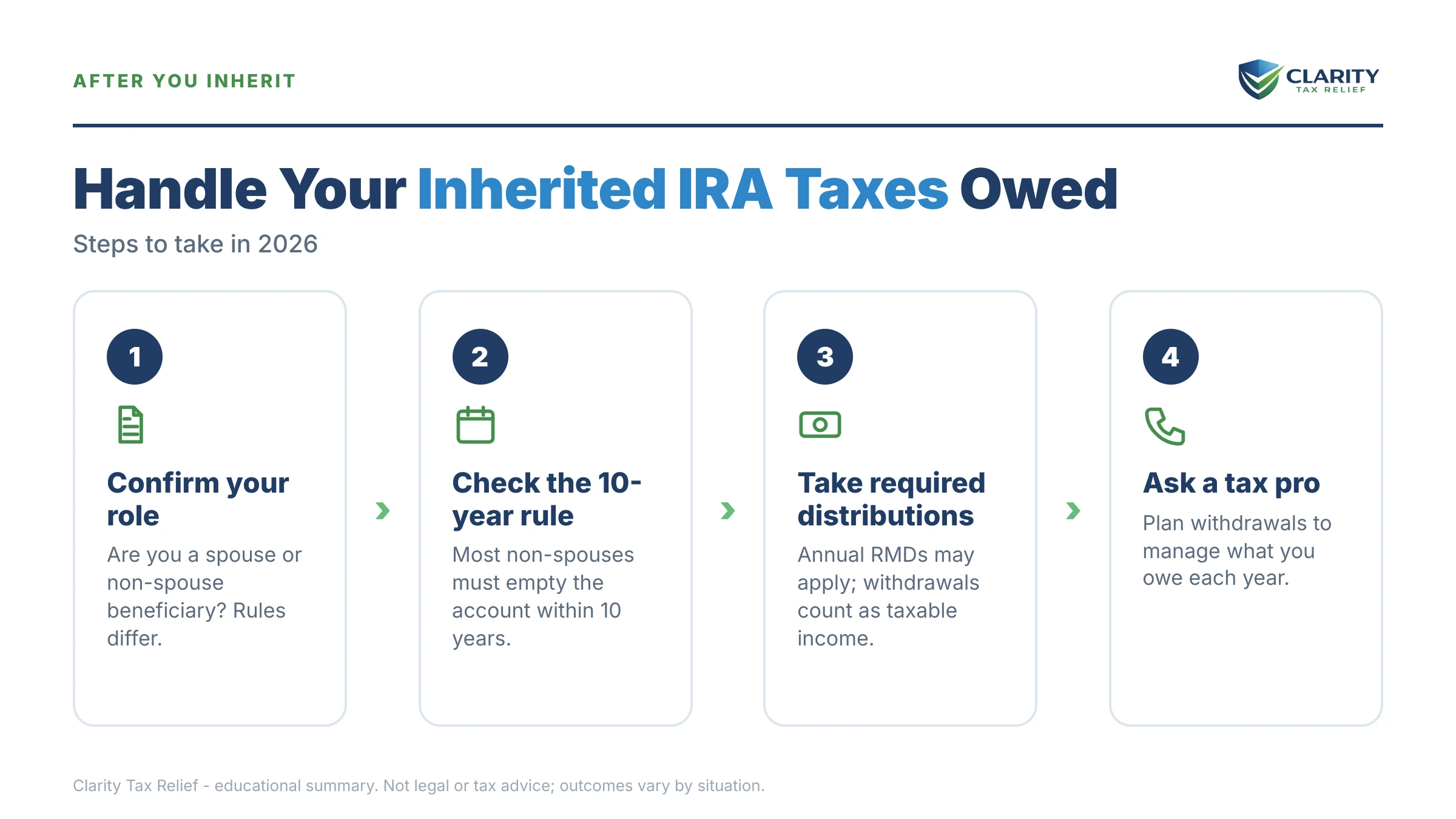
Most non-spouse beneficiaries who inherited in 2020 or later must empty the account by December 31 of the tenth year after the owner's death. That's the SECURE Act's 10-year rule, and it means today's bill probably isn't the last one — the whole account has to come out, and every traditional dollar is taxable when it does. If the owner had already reached their required beginning date, you generally also owe annual distributions during years one through nine, not just a lump at the end.
| What you inherited | Is the withdrawal taxed? | Deadline to empty the account |
|---|---|---|
| Traditional IRA — non-spouse (owner died 2020 or later) | Yes — ordinary income at your rate | Dec 31 of year 10; annual RMDs in years 1–9 if the owner had reached their required beginning date |
| Roth IRA — non-spouse | Generally no, if the account was open 5+ years | Dec 31 of year 10 (no annual RMDs required in between) |
| Traditional IRA — surviving spouse | Yes when withdrawn — but a spouse can roll it into their own IRA and defer | No 10-year rule; the spouse's own RMD schedule applies after a rollover |
| Any IRA — eligible designated beneficiary (minor child of the owner, disabled, chronically ill, or not more than 10 years younger) | Traditional: yes; Roth: generally no | Life-expectancy "stretch" payouts may still be allowed instead of 10 years |
One more trap sits inside the 10-year rule: missed RMDs carry their own excise tax — 25% of the amount you should have taken, reduced to 10% if you correct it promptly, and waivable for reasonable cause on Form 5329. If your balance due includes (or is about to include) a missed distribution, the fix is different from an ordinary tax debt — see our guide to the missed RMD penalty waiver.
And keep two liabilities separate in your head. Income tax on your distributions is yours alone. Any tax the person who died still owed is the estate's problem, paid from estate assets — if that's the situation you're untangling, start with what happens when a parent dies owing the IRS. The IRS can reach estate assets and, in some cases, inherited property for the decedent's debts — can the IRS take an inheritance covers where that line sits.
What happens if you ignore inherited IRA taxes owed
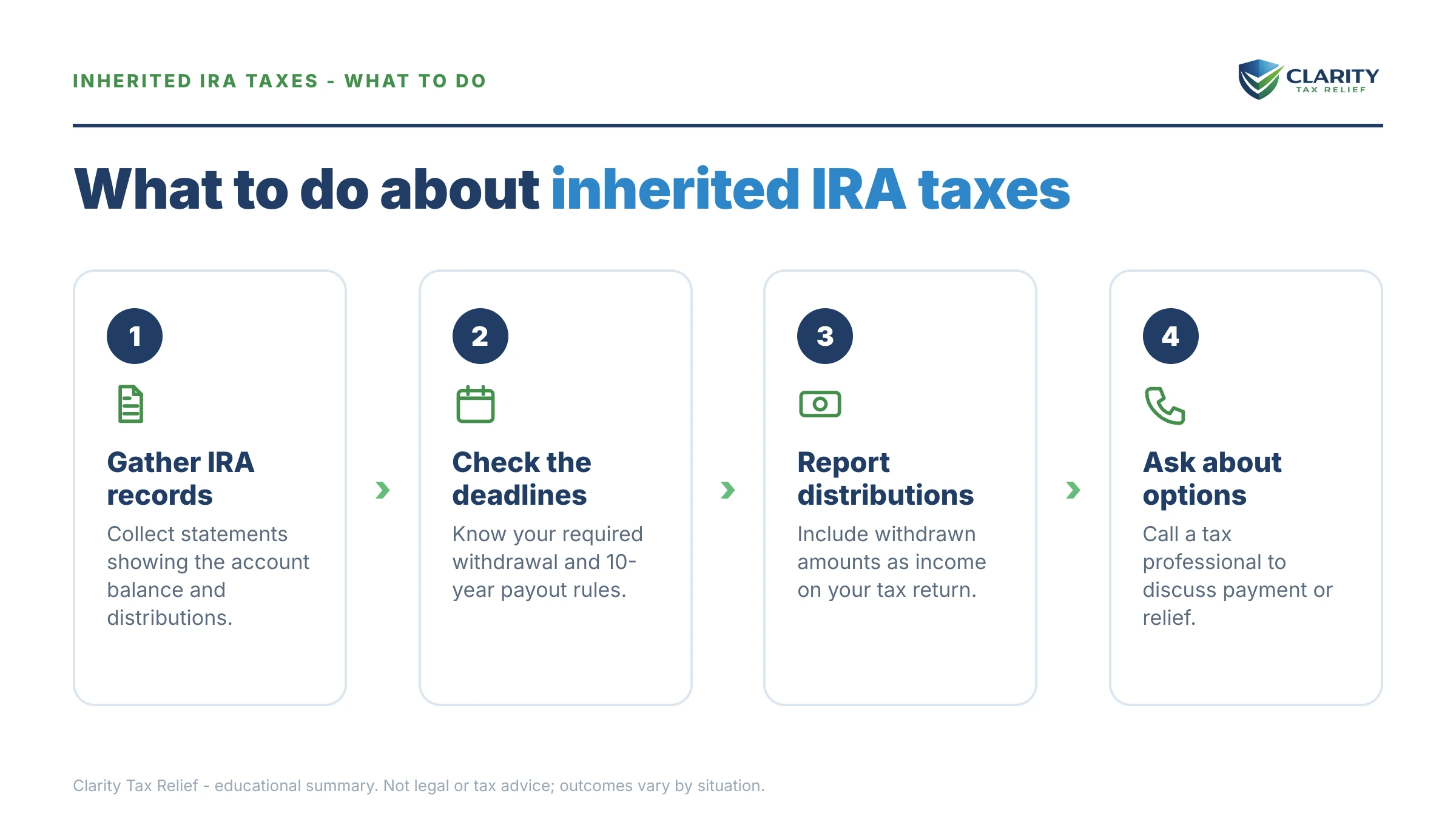
An unpaid balance from an inherited IRA distribution enters the same automated IRS collection sequence as any other tax debt. No human decides to escalate your file — the system does it on schedule, and each stage arrives with more enforcement power than the last:
- Balance assessed. The failure-to-pay penalty (0.5% per month) and daily-compounding interest start immediately. On $6,200, the penalty alone is roughly $31 a month before interest.
- CP14 — the first bill. You typically have about 21 days from the notice date (10 business days if the balance is $100,000 or more) to pay or arrange something before the next notice queues up.
- CP501 / CP503 — reminders. Still just bills, arriving weeks apart, each showing a larger balance.
- CP504 — Notice of Intent to Levy. The IRS can now seize your state tax refund, and a federal tax lien becomes a live possibility — a serious problem if your business ever needs credit.
- LT11 / Letter 1058 — final notice. A 30-day clock starts, along with your Collection Due Process appeal rights. After it runs, the IRS can levy bank accounts (with a 21-day hold before funds leave) and garnish wages — and yes, it can eventually reach retirement accounts, including the IRA itself.
The 2026 wrinkle: IRS staffing fell roughly 27% in 2025, so reaching a human to fix anything takes longer — but the notice-and-levy machine is automated and never stopped. Waiting doesn't buy leniency; it buys interest. You can estimate how fast your balance is growing with our Penalty & Interest Calculator.
Staring at a tax bill from an inherited IRA?
Send us the 1099-R and any IRS notice. An experienced tax professional will confirm the taxable amount is even right, then map your cheapest path to resolve it — free, confidential, no pressure. Penalties and interest accrue every month the balance sits.
How to pay taxes owed on an inherited IRA: every real option
A $6,200 balance sits in the friendliest zone of IRS collections — under $10,000, where the most generous payment programs live. Here's the full menu, from simplest to rarest. (The general mechanics of each program are covered in our guide to how to settle tax debt yourself; this table is tuned to a typical inherited-IRA-sized balance.)
| Option | Who qualifies | What disqualifies you |
|---|---|---|
| Pay in full | Anyone — stops penalties and the notice sequence immediately | Nothing; it's just cash flow |
| Short-term plan (up to 180 days) | Balances the IRS can see you'll clear within 180 days | Needing longer than 180 days |
| Guaranteed installment agreement | Tax owed of $10,000 or less, clean filing/payment record for the prior 5 years, full pay within 3 years | Recent late filings; a balance over the threshold; another IA in the last 5 years |
| Streamlined installment agreement | Balances up to $50,000, paid within 72 months, set up online with no financial disclosure | Unfiled returns; defaulting on a prior agreement |
| Currently Not Collectible (CNC) | Paying anything would leave you unable to cover basic living expenses (proven on a Form 433 financial statement) | Income or assets — including the remaining inherited IRA balance — that show ability to pay |
| Offer in Compromise (OIC) | Your assets plus future income genuinely can't cover the debt before collection expires | The untapped inherited IRA itself usually counts as a reachable asset, which sinks most offers at this balance size |
| Penalty abatement (FTA / AEP) | Clean compliance for the prior 3 years — or reasonable cause, such as a death in the family disrupting your filing | Recent penalties on your account; abatement removes penalties only, never the tax itself |
Be honest with yourself about the OIC row. Settlement marketing loves inheritance stories, but the IRS's own math counts what you still hold — and an inherited IRA with money left in it is, in the IRS's eyes, money that can pay the tax. The IRS accepted roughly 1 in 5 offers in FY2024; a $6,200 balance next to a funded account is almost never one of them. Penalty abatement, by contrast, is genuinely underused here: a death in the family is a classic reasonable-cause fact pattern, and first-time penalty abatement requires nothing more than three clean prior years. Starting summer 2026, the new Automatic Exemption from Penalty (AEP) begins applying similar relief automatically, with no request needed — so don't pay a penalty in a rush that the IRS may remove on its own.
| Option | Upfront cost | Typical cost over time (on a $6,200 balance) |
|---|---|---|
| Pay in full | $0 (free via IRS Direct Pay) | Cheapest total: accrual stops the day you pay |
| Short-term plan (180 days) | $0 setup fee | ~$31/month failure-to-pay penalty plus interest until paid — roughly $200–$250 extra if you use most of the window |
| Guaranteed IA (36 months) | Modest setup fee (lowest online with direct debit; reduced for low-income) | ≈ $172/month base ($6,200 ÷ 36) while penalties and interest keep accruing on the shrinking balance |
| Streamlined IA (72 months) | Same fee structure as above | ≈ $86/month base — lowest payment, highest total interest; pay extra whenever you can |
| CNC status | $0, but requires full financial disclosure | Debt keeps growing; collection pauses but the balance doesn't — and the IRS reviews your income later |
| Offer in Compromise | $205 application fee + 20% down on lump-sum offers (both waived with low-income certification, AGI ≤ 250% of the poverty line) | Months to a decision; auto-accepted only if the IRS doesn't rule within 2 years |
One warning built specifically for owners who run payroll: never cover a personal 1040 balance by delaying your federal payroll tax deposits. Withheld payroll taxes are trust funds, and diverting them converts a small, fixable personal debt into personal exposure under the Trust Fund Recovery Penalty — the one category of tax debt the IRS pursues hardest. A $6,200 installment agreement is a rounding error next to that. And if part of your balance traces to skipped quarterlies rather than the distribution itself, the fix for that piece is different — see the penalty math when you didn't pay estimated taxes.
How to respond to inherited IRA taxes owed, step by step
- Pull your Form 1099-R. Confirm Box 1 (gross distribution), Box 2a (taxable amount), and code 4 in Box 7 — a coding or basis error here changes what you actually owe.
- Verify the balance in your IRS online account. Compare what the IRS shows against your return before paying anything, and check that any withholding from Box 4 actually posted.
- File any unfiled return immediately. The failure-to-file penalty runs 5% per month — ten times the 0.5% failure-to-pay rate — so file even if you can't pay a dollar.
- Choose a payment path before the notices escalate. Pay in full, take up to 180 days with no setup fee, or set up an installment agreement online or with Form 9465.
- Request penalty relief. Ask for first-time abatement if your prior three years are clean, and watch for the automatic AEP exemption rolling out in summer 2026.
- Set withholding on future distributions. Elect withholding at your marginal rate or fold the distribution into your quarterly estimates so the next year of the 10-year rule doesn't repeat this.
When you can handle this yourself — and when help changes the outcome
A single-year balance under $10,000 with a clean filing history is one of the most DIY-friendly situations in tax debt. If that's you, set up the payment plan yourself: log in at IRS.gov/payments, pick the short-term option or an installment agreement (full program details on the IRS payment plans page), and call for first-time abatement. Twenty minutes, no professional needed.
Experienced help earns its cost when the picture is messier: Box 2a overstates the taxable amount because the decedent had Form 8606 basis; you've missed RMDs across multiple years and need excise-tax waivers stacked with the income-tax fix; the distribution sits on top of existing business or payroll debt; several tax years are unfiled; or a CP504 or LT11 has already arrived and enforcement is in motion. In those cases the order you fix things — returns first, penalties second, balance last — materially changes what you pay, and a wrong sequence can't always be undone. If you get stuck between the IRS's automated notices and its hard-to-reach phone lines, the Taxpayer Advocate Service is a free, independent escalation path.
Terms on your 1099-R and IRS notice, decoded
- Code 4 (Box 7): the distribution code marking a death distribution — it waives the 10% early-withdrawal penalty but not the income tax.
- Box 2a — taxable amount: the portion of the distribution the custodian believes is taxable; it can be wrong if the decedent had after-tax basis.
- Basis (Form 8606): nondeductible contributions the original owner already paid tax on — that basis passes to you and reduces the taxable share of each withdrawal.
- 10-year rule: the SECURE Act requirement that most non-spouse beneficiaries empty an inherited IRA by December 31 of the tenth year after the owner's death.
- RMD (required minimum distribution): the minimum you must withdraw in a given year; missing one triggers a separate 25% excise tax (10% if corrected quickly).
- Failure-to-pay penalty: the 0.5%-per-month charge that runs on any unpaid balance — the quiet engine growing your bill between notices.
Inherited IRA taxes owed: FAQs
Do you have to pay taxes on an inherited IRA?
Yes, for a traditional inherited IRA: every dollar you withdraw is taxed as ordinary income in the year you take it, at your regular tax bracket. Inherited Roth IRA withdrawals are generally tax-free as long as the account was open at least five years. There is no federal tax just for inheriting the account — the tax comes when money leaves it.
Is there a 10% early-withdrawal penalty on an inherited IRA?
No. Distributions from an inherited IRA are exempt from the 10% early-withdrawal penalty no matter how old you are, because they are coded as death distributions (code 4 on Form 1099-R). You still owe ordinary income tax on withdrawals from a traditional inherited IRA — the penalty exemption doesn't make the money tax-free.
What if I can't pay the taxes on my inherited IRA distribution?
File the return anyway and pick a payment path — the failure-to-file penalty is ten times the failure-to-pay penalty. A short-term plan gives you up to 180 days with no setup fee, and balances under $10,000 generally qualify for a guaranteed installment agreement paid over up to three years. Interest and a 0.5% monthly penalty accrue until the balance is paid.
Do I have to empty an inherited IRA within 10 years?
Most non-spouse beneficiaries who inherited in 2020 or later must empty the account by December 31 of the tenth year after the owner's death. If the owner had already reached their required beginning date, you generally must also take annual distributions during years one through nine. Spouses, minor children of the owner, and disabled or chronically ill beneficiaries have more flexible options.
What happens if I missed an RMD on my inherited IRA?
The IRS can charge a 25% excise tax on the amount you should have withdrawn, reduced to 10% if you correct the shortfall within the correction window. You can also ask the IRS to waive the excise tax entirely for reasonable cause by filing Form 5329 with an explanation. Take the missed distribution first — the waiver request is far stronger once the shortfall is fixed.
How much tax is withheld from an inherited IRA distribution?
By default, custodians withhold 10% federal tax from a one-time traditional IRA distribution, and you can elect more or opt out entirely. For most working beneficiaries, 10% is far less than the rate the distribution is actually taxed at, which is how surprise balances happen. If you'll take more distributions under the 10-year rule, elect withholding that matches your top tax bracket.
Am I responsible for taxes the person who died owed?
Not personally — the decedent's own income tax debt is paid from their estate, not from your pocket. What you owe is different: income tax on the distributions you take from the inherited IRA, which is your liability alone. The IRS can, however, collect the decedent's debt from estate assets before they're distributed.
Can the IRS levy an inherited IRA for my own back taxes?
Yes — retirement accounts, including inherited IRAs, are not off-limits to an IRS levy for your own tax debt. Levies on retirement accounts require extra internal approval and are usually a late-stage step, not a first move. Setting up a payment plan or hardship status before the final-notice stage keeps the account out of reach in practice.
Your next 24 hours
- Find Box 2a and Box 4 on your Form 1099-R. The gap between the taxable amount and what was actually withheld is the bill — and your first check on whether the IRS's number is even right.
- Gather three things: the 1099-R, your most recent filed return, and any IRS notice that's arrived, so whoever reviews it (you or a pro) sees the whole picture at once.
- Get a free case review — the 2-minute form at claritytaxrelief.com/#consult or (888) 825-7779. There's no notice-driven deadline on this debt yet, but the 0.5% monthly penalty and daily interest run until a plan is in place — every month of waiting is money.
This guide is general information, not tax or legal advice for your specific situation. Eligibility for IRS programs depends on individual facts and circumstances; no outcome is guaranteed.