
Tax Debt & Family
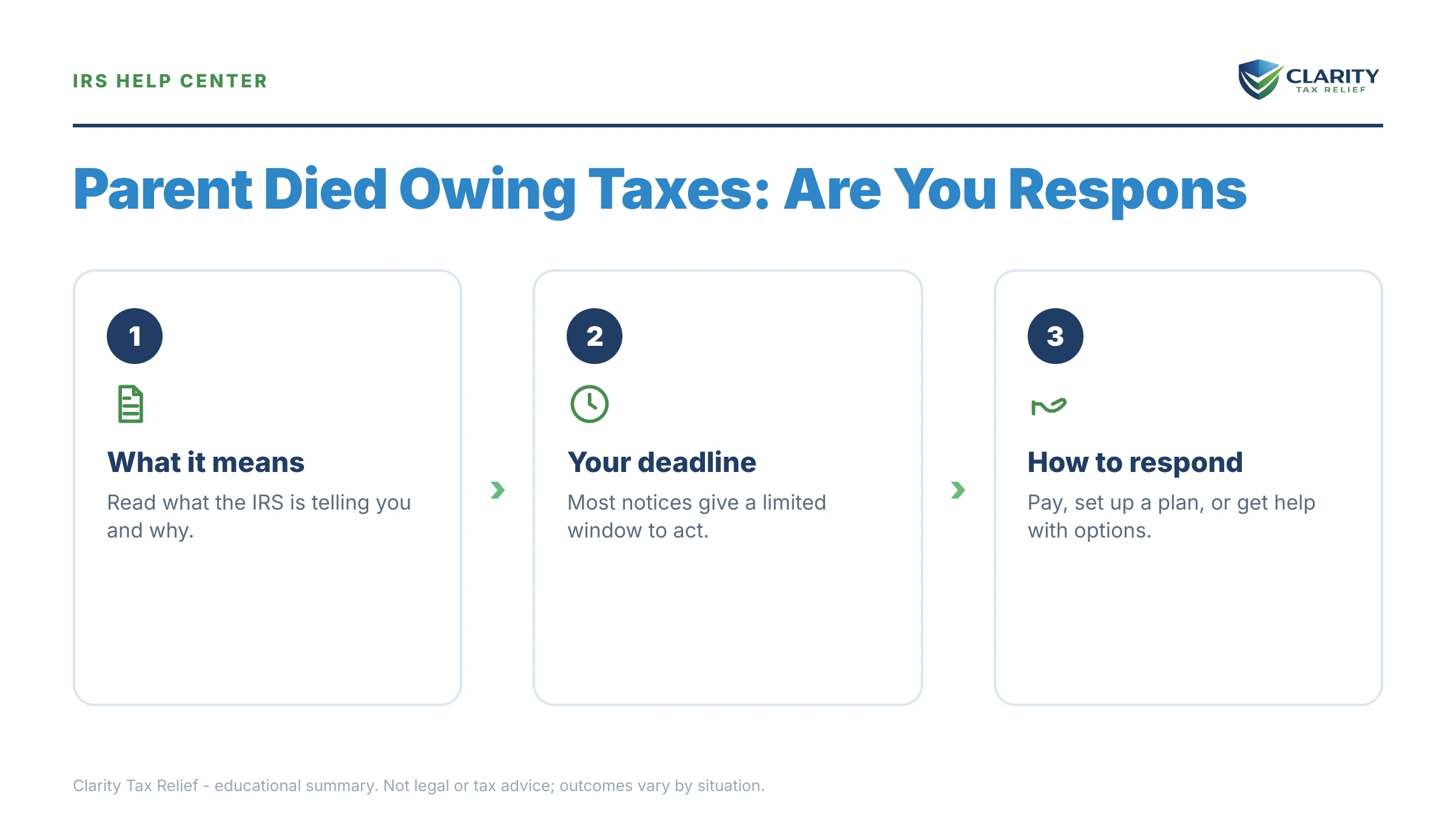
Parent Died Owing Taxes: Are You Responsible in 2026?
The short answer: if your parent died owing taxes, you are not personally responsible for the debt. The IRS collects from your parent's estate — the money and property they left behind — never from a child's own income or accounts. The two exceptions: executors who pay heirs before the IRS, and heirs who already received estate assets.
You're sorting through a box of your parent's papers — bank statements, the funeral program, and a stack of envelopes with "Internal Revenue Service" in the corner. Some are still sealed. Grief is heavy enough without wondering whether the government is about to come for your own bank account.
Here's the relief up front: it isn't. Federal tax law puts the debt on the estate, in a specific legal order, and your job is simply to work that order correctly. The image below maps exactly which assets the IRS can reach after a death — and which pass to you untouched.
⏱ The real clock: your parent's final Form 1040 is due by the regular April filing deadline of the year after death — and the 0.5%-per-month failure-to-pay penalty plus daily interest keep compounding on any unpaid balance until the estate resolves it. There is no levy pending against you, but the bill against the estate grows every month it sits.
Your parent died owing taxes — who actually has to pay?
A deceased parent's IRS debt is a claim against their estate, and children are not personally liable for a parent's taxes. There is no "inheritance of debt" in U.S. law. The IRS cannot levy your wages, freeze your accounts, or bill you simply because you're the son or daughter of someone who owed.
What the IRS can do is stand near the front of the line when the estate's assets are divided. Under federal law (31 U.S.C. §3713), claims of the United States get priority over most other unsecured creditors of an estate. Taxes get paid before heirs get inheritances — that's the whole rule in one sentence.
Two roles create real personal exposure, and both are avoidable. First, an executor or personal representative who distributes estate assets to family before paying the IRS can be held personally liable up to the amount they handed out — the full mechanics are in our guide to when an executor is personally liable to the IRS. Second, an heir who already received assets from an estate that couldn't cover its tax bill can face a "transferee" claim to claw back what they received. Neither one touches money you earned yourself.
| Your role | Personally liable? | What the IRS can reach |
|---|---|---|
| Child / heir who hasn't received anything yet | No | Nothing of yours — only estate assets |
| Executor / personal representative | Not for the debt itself — but yes under §3713 if you pay heirs before the IRS | Up to the amount you distributed out of order |
| Surviving spouse who filed jointly | Yes — joint returns mean joint liability for those years | The surviving spouse's own income and assets |
| Heir who already received estate assets | Possibly, as a transferee | Up to the value of what you received |
| Named beneficiary of life insurance or a retirement account | Generally no, for the parent's income-tax debt | The proceeds usually pass outside the estate (your own tax rules still apply) |
What the IRS can — and can't — touch after a death
The IRS's reach after a death stops at the edge of the estate: it collects from what your parent owned, not from what you own. If you're a 1099 contractor watching your own business account, nothing about your parent's balance changes your money, your quarterly payments, or your refund.
Inside the estate's reach: bank accounts in your parent's sole name, vehicles, the house, brokerage accounts without beneficiary designations, and money owed to your parent. If a federal tax lien was filed before death, it stays attached to that property and follows the house to whoever inherits it — see how an IRS lien after death works when heirs try to sell.
Generally outside the estate's reach: life insurance paid to a named beneficiary, retirement accounts with a named beneficiary, and accounts titled payable-on-death. These flow directly to you rather than through probate. One caution: an inherited IRA creates a new tax bill of your own when you take distributions — a different problem from your parent's old debt, covered in our guide to inherited IRA taxes owed. And if a lien existed during your parent's life, get advice before spending inherited property; the answer depends on when the lien arose and what it attached to.
The broader rule — when the government can and can't intercept what you inherit — is laid out in can the IRS take my inheritance. The short version: the IRS takes its share before the inheritance exists, not out of your pocket afterward.
What happens if the estate ignores the debt
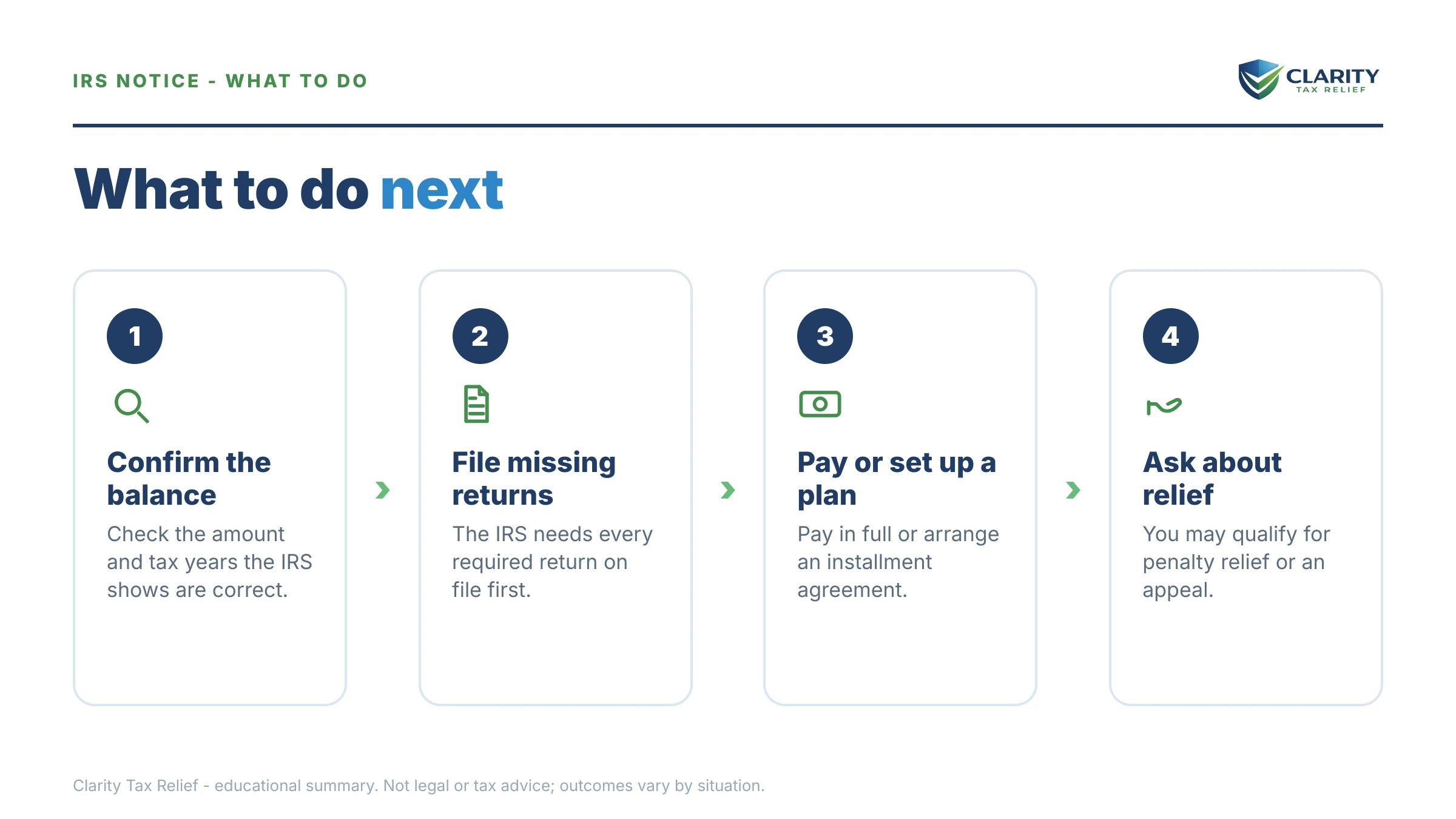
An unresolved federal tax claim doesn't fade after a death — it compounds, then attaches, then follows the money. The sequence runs like this:
- Notices keep mailing to your parent's last address. The IRS's automated system doesn't know about the death until a fiduciary tells it (Form 56), so bills for a deceased person keep arriving.
- Penalties and interest keep compounding against the estate — the 0.5%-per-month failure-to-pay penalty plus interest, month after month, on every open year.
- The federal tax lien attaches to estate property, clouding title on the very house the family is trying to sell or transfer.
- The IRS asserts its claim in the estate. A probate can't be closed cleanly around an unresolved federal tax claim, which stalls every heir's distribution.
- If the executor distributes anyway, the IRS shifts its focus to the executor personally under §3713 — up to the full amount that went out the door to heirs.
- Heirs who received assets can face transferee claims, unwinding inheritances long after the money was spent.
Notice what's not on that list: any action against a child who never touched estate assets. The escalation runs through the estate and the people who mishandled it — which is exactly why handling it in the right order matters more than handling it fast.
Sorting out a parent's IRS debt right now?
Send us photos of the notices you found. An experienced tax professional will pull the estate's full IRS picture, tell you what the estate actually owes, and show you the payment order that keeps you personally protected — free, confidential, no pressure. Every month the balance sits, penalties and interest keep growing against the estate.
Your options for resolving a deceased parent's tax debt
An estate has the same core resolution paths a living taxpayer has — plus two that only exist after a death: insolvency and penalty relief built on the final illness. Which one fits depends entirely on what the estate holds versus what the IRS is owed.
| Option | When it fits | Cost | What to expect |
|---|---|---|---|
| Pay in full from estate funds | The estate can cover the balance | $0 beyond the balance | Fastest close; stops all penalty and interest accrual immediately |
| Penalty abatement (Form 843, reasonable cause) | Late filing or payment was caused by the final illness or incapacity | $0 to request | Death and serious illness are classic reasonable cause; can remove a large slice of the balance |
| Arranged time to pay while assets sell | The estate is solvent but illiquid — e.g., the money is in a house | Interest continues | The fiduciary works out timing with the IRS so a sale, not heirs' pockets, funds the payoff |
| Offer in Compromise (doubt as to collectibility) | Estate assets are clearly and permanently less than the balance | $205 fee + 20% down on lump-sum offers | Rare for estates and means-tested; the IRS accepted roughly 1 in 5 offers in FY2024 |
| Insolvent estate — debt goes unpaid | Nothing left after higher-priority costs | $0 | Document assets and debts, pay in priority order, close the estate; the shortfall is not yours |
| Collection statute expiration (CSED) | Assessments are approaching 10 years old | $0 | The 10-year clock keeps running after death; old years may fall off before the IRS collects |
Three notes that change real outcomes. First, penalty abatement is often the biggest lever in a death case — if your parent was hospitalized or incapacitated when returns went unfiled or unpaid, that's the textbook reasonable-cause fact pattern, requested on Form 843. Second, the 10-year collection statute doesn't restart at death; if some of the balance is from assessments made eight or nine years ago, part of the claim may expire on its own — you can estimate the expiration dates with our CSED Calculator. Third, the mechanics of negotiating with the IRS — transcripts, financial disclosure, choosing between programs — are the same ones any taxpayer uses; the full playbook is in how to settle tax debt yourself, with the fiduciary standing in the taxpayer's shoes.
A worked example: $27,500 of debt and a $21,000 estate
Say you're a 1099 contractor and your mother died owing $27,500 — balances from her last three working years. Here's how the math actually plays out. Her probate estate holds a $12,000 checking account and a $9,000 car: $12,000 + $9,000 = $21,000. She also left you a $150,000 life insurance policy with you as the named beneficiary.
Funeral and administration costs run about $4,000, which probate law generally allows to be paid first. That leaves $21,000 − $4,000 = $17,000 available for the federal claim. The IRS receives $17,000; the remaining $27,500 − $17,000 = $10,500 goes uncollected, because the estate is insolvent. The executor documents it, closes the estate, and nobody writes a personal check. The $150,000 policy passed outside the estate — it's yours, and your own contractor income was never in play.
Now run the failure scenario. Suppose the executor had instead sent $7,000 each to you and your sibling before dealing with the IRS. The IRS could then pursue the executor personally for up to the $14,000 distributed — turning a debt nobody in the family owed into one a family member does. Same estate, same numbers, opposite outcome. The order of payment is everything.
One more upside in this hypothetical: if, say, $6,000 of the $27,500 is penalties that accrued while she was seriously ill, a reasonable-cause abatement could shrink the IRS claim before a dollar is paid — meaning more of that $17,000 stays in the estate for lower-priority debts or heirs.
How to respond, step by step
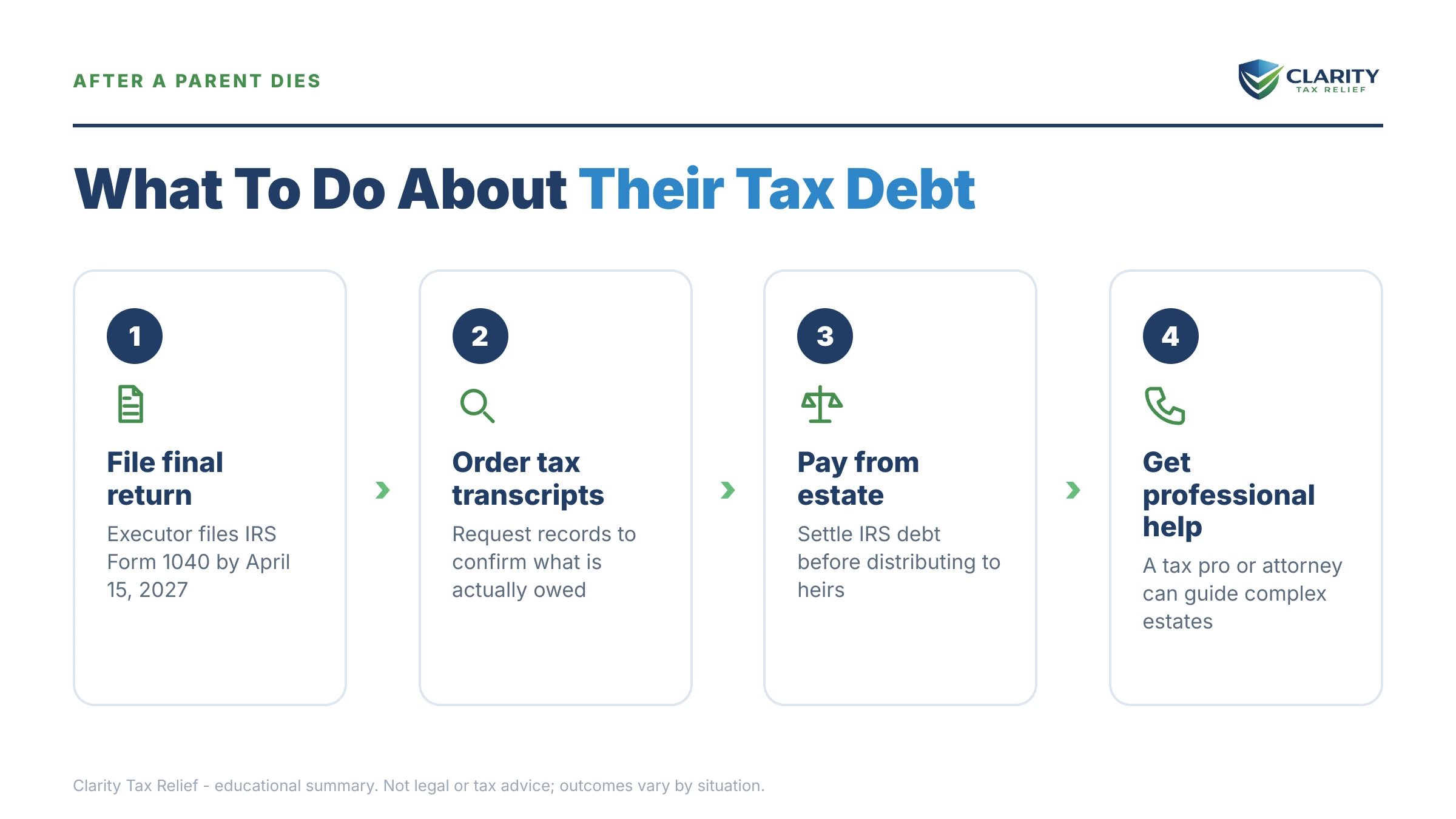
- Gather the IRS mail. Collect every IRS notice in your parent's papers and note the tax years, amounts, and notice numbers. Don't call the IRS yet — you can't act on the account until you have legal authority.
- Confirm who has authority. Get appointed personal representative through the probate court (or confirm who already is), then file Form 56 so the IRS directs future notices to the fiduciary instead of a deceased person's mailbox.
- Pull the full balance. Request your parent's account transcripts with Form 4506-T and your letters testamentary. Notices found in a drawer rarely show the complete picture across every tax year.
- File anything missing. File the final Form 1040 (and any unfiled prior years), plus Form 1041 if the estate earned $600 or more after death. Filing stops the failure-to-file penalty, which is ten times the failure-to-pay penalty.
- Pay the IRS before heirs. Settle the federal tax claim from estate funds before distributing anything to family. This single rule is what protects an executor from personal liability under 31 U.S.C. §3713.
- Resolve any shortfall. If the estate can't cover the debt, document insolvency, request penalty abatement where the final illness caused late filing or payment, and close the estate with a clean paper trail.
If the final return itself shows a balance due — common when a parent had income in their last year but no withholding — the mechanics of filing and paying that specific return are covered in our guide to a deceased final tax return that owes.
| Form | What it does | Who files it |
|---|---|---|
| Form 56 | Tells the IRS you're the fiduciary acting for the estate | Executor / personal representative |
| Final Form 1040 | Reports your parent's income from January 1 to the date of death | Executor or surviving spouse |
| Form 1310 | Claims a refund the IRS owes the decedent | The person entitled to the refund |
| Form 1041 | Reports income the estate earns after death ($600 or more) | Executor |
| Form 4506-T | Pulls account transcripts so you see the complete balance | Executor, with letters testamentary attached |
| Form 843 | Requests penalty abatement for reasonable cause (illness, incapacity) | Executor |
Situations that change the answer
A surviving parent filed jointly. This is the biggest exception in family cases: joint returns carry joint liability, so for any year your parents filed together, your surviving parent still owes the full balance personally — death of one spouse doesn't erase it. The survivor's options (including relief programs) are covered in deceased spouse tax debt — am I responsible. Children remain outside the debt either way.
Your parent owned a business with payroll debt. Employment-tax balances follow different tracks. The business's own 941 back taxes are claims against the business and the estate. But the Trust Fund Recovery Penalty — the personal assessment for withheld payroll taxes — attaches only to people who were "responsible persons" during the parent's life. You don't inherit that status; you'd only face it if you ran payroll or signed checks in the business yourself, the test explained in personally liable payroll taxes. If you helped operate the business before the death, get that reviewed before probate closes.
There's a house with equity. If a federal tax lien was filed, it rides the title. The clean path is usually a sale in which the IRS is paid from proceeds at closing — heirs split what's left, and nobody's personal money is involved. Don't quitclaim the house to family "to keep it simple"; moving lien-encumbered property around is how transferee problems start.
Your parent was owed a refund instead. Check before assuming a debt. If a filed or unfiled year shows a refund, Form 1310 claims it for the estate — but refunds expire, generally three years from the original due date, so unfiled refund years should be filed early in the process, not last.
When you can handle this yourself
Many of these cases genuinely don't need professional help. If the estate is clearly solvent, the balance covers one or two tax years, the amounts match your parent's records, and there's no business or real-estate complication — the executor can file the final return, pay the IRS from estate funds, and be done. Likewise, if your parent left essentially nothing that passes through probate, there's often nothing to administer and nothing to fear: file the final return if one is required, keep the records, and don't send the IRS your own money.
Experienced help changes the outcome in a different set of cases: multiple unfiled years you'd have to reconstruct without records, a business with payroll or trust-fund exposure, a lien-encumbered house you need to sell on a deadline, an insolvent estate where the executor's §3713 exposure turns on getting the payment order exactly right, or a balance you believe is wrong. In those cases, the fee usually buys something specific: penalties removed, a sale that closes, or an executor who never becomes personally liable. The IRS's own starting point for survivors is its deceased person page, and payments from estate funds go through IRS.gov/payments. If the IRS mishandles the account and you can't get it fixed through normal channels, the Taxpayer Advocate Service exists for exactly that.
Terms you'll see, decoded
- Probate — the court process that gathers a deceased person's assets, pays their debts in legal order, and distributes what's left.
- Personal representative / executor — the person legally authorized to act for the estate, including with the IRS.
- Letters testamentary — the court document proving that authority; the IRS requires it before discussing a decedent's account.
- 31 U.S.C. §3713 — the federal priority statute: U.S. claims get paid first, and a fiduciary who pays others first can be personally liable.
- Transferee liability — the IRS's ability to pursue someone who received assets that should have paid the tax, capped at the value received.
- CSED — the Collection Statute Expiration Date; the IRS generally has 10 years from assessment to collect, and death doesn't restart the clock.
Parent died owing taxes: your questions answered
Do I have to pay my parents' taxes if they die?
No. A deceased parent's tax debt is owed by their estate, not by their children, and the IRS cannot bill you, levy your bank account, or garnish your wages for it. The two exceptions are narrow: an executor who hands out estate assets before paying the IRS, and an heir who already received assets from an estate that couldn't cover its tax bill.
Can the IRS come after me for my deceased parent's tax debt?
Not for being their child. The IRS can only pursue you personally in two situations: you served as executor and distributed estate money before federal taxes were paid (fiduciary liability under 31 U.S.C. §3713), or you received assets from the estate that should have gone to the IRS first (transferee liability). In both cases your exposure is capped at what you distributed or received — never your own separate income.
Does IRS debt die with the person who owed it?
The debt survives death, but only as a claim against the estate. The 10-year collection statute keeps running after death, so old assessments may expire before the IRS collects. If the estate has no assets, the debt generally goes unpaid — the IRS writes it off rather than pursuing children who never received anything.
Can the IRS take my inheritance to pay my parent's taxes?
The IRS gets paid from estate assets before heirs do, so an inheritance can shrink or disappear if the estate owes taxes. Assets that pass by beneficiary designation — life insurance proceeds and retirement accounts with a named beneficiary — generally bypass the estate and reach you directly. If a federal tax lien was filed before death, property covered by it stays encumbered until the lien is paid or released.
Who files a deceased parent's final tax return?
The executor or court-appointed personal representative files it; if no one is appointed, whoever handles the parent's property takes it on. The final Form 1040 covers January 1 through the date of death and is due by the regular April filing deadline of the following year. File Form 56 to tell the IRS you're acting for the estate, and Form 1310 if a refund is due.
What if my parent's estate has no money to pay the IRS?
An insolvent estate pays what it can in the legal priority order, and the rest of the tax debt generally goes uncollected. Do not pay the shortfall from your own pocket — you have no legal obligation to, and the IRS cannot demand it. Document the estate's assets and debts carefully so the executor can show the shortfall wasn't caused by paying heirs first.
Do I need to open probate if my parent owed the IRS?
Only if there are probate assets to administer — a house, vehicles, or accounts with no named beneficiary. If your parent left nothing that passes through probate, there is usually no estate to administer and nothing for the IRS to claim. Many states also offer small-estate procedures that skip full probate; the IRS claim still gets priority inside whichever process you use.
Can the IRS put a lien on my parent's house after they die?
A federal tax lien that arose before death stays attached to the house after death and follows the property to whoever inherits it. The lien must typically be paid from sale proceeds at closing before heirs receive anything. If you inherit a house with a lien, you're not personally liable for the debt — but you can't sell or refinance with clear title until the lien is satisfied, discharged, or released.
Your next 24 hours
- Find the tax years and amounts. Pull every IRS envelope from your parent's papers and write down each notice number, tax year, and balance — that list is the skeleton of the whole case.
- Gather the authority documents. The will, any letters testamentary or probate filings, your parent's last filed return, and a rough list of what the estate owns. You can't act — and shouldn't pay anyone — without knowing both sides of the ledger.
- Get a free case review. Call (888) 825-7779 or use the 2-minute form. An experienced tax professional will map the estate's real balance, the penalty relief the final illness may support, and the payment order that keeps you and the executor personally protected — before another month of penalties and interest accrues against the estate.
This guide is general information, not tax or legal advice for your specific situation. Eligibility for IRS programs depends on individual facts and circumstances; no outcome is guaranteed.