
Levies & Seizures
Can the IRS Take Life Insurance? Cash Value & Death Benefits (2026)
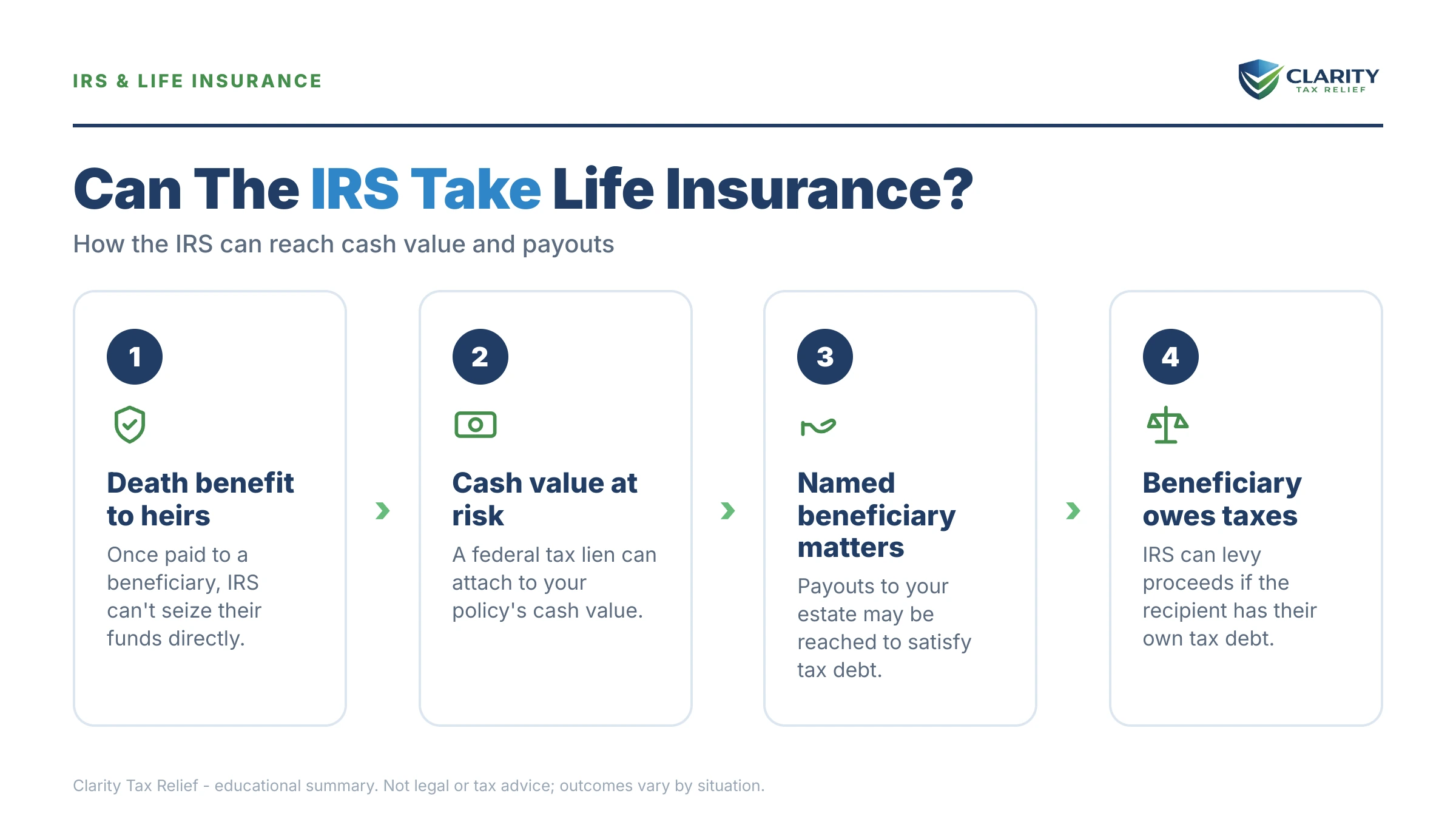
The short answer: the IRS can take life insurance — but only the cash surrender value of a permanent policy you own (whole, universal, or variable life). A term policy has nothing to take while you're alive, and a death benefit paid to a named living beneficiary is generally out of reach for the deceased's tax debt.
So can the IRS take life insurance? It depends entirely on one thing: whether your policy holds cash value. If you own a whole or universal life policy, that built-up cash value is property the IRS can levy, exactly the way it can levy a bank account. If you carry term life, there is nothing to seize until it pays out.
You may be a renter with no house or car to lose, thinking your policy is the one asset sitting quietly out of reach. It isn't automatically. But a life insurance levy runs on an unusually long clock, and that clock is your opportunity.
The image below shows you what an IRS levy on a life insurance policy looks like and where to find the date that controls how long you have. Read that date first — it changes everything about your next move.
⏱ Your window: when the IRS serves a levy on a cash-value policy, the insurer must pay the policy's cash loan value to the IRS on the 90th day after the levy is served (IRC §6332(b)). That's far longer than a bank levy's 21-day hold — 90 days to set up a resolution and get the levy released before any money moves.
Why the IRS can reach some life insurance and not others
The IRS can levy anything that is your "property or rights to property" under IRC §6331 — and the cash value of a permanent life insurance policy fits that definition perfectly. You can borrow against it, surrender it for cash, or change the beneficiary; that control makes it a reachable asset.
Term life is different. It's pure insurance with no savings component, so while you're living there is no cash value and literally nothing to levy. A death benefit that later pays to a named living beneficiary generally passes outside your estate, which is why the IRS usually cannot grab it for your tax debt after you die.
The federal tax lien matters here too. Once the IRS files a lien, it attaches to the cash value even before a levy is served — which is why cashing out a policy to "get ahead of" the IRS rarely works and can be treated as a dissipated asset. The table below maps out exactly which situations the IRS can and can't reach.
| Situation | Can the IRS reach it? | Why |
|---|---|---|
| Whole / universal / variable life cash value (you owe) | Yes | Cash surrender value is property you own and control |
| Term life policy (you owe, still living) | No | No cash value exists to levy |
| Death benefit paid to a named living beneficiary | No, in most cases | Proceeds pass outside the deceased's estate |
| Death benefit where the estate is the beneficiary | Yes | Proceeds flow into the estate, which the IRS can collect from |
| Proceeds already deposited in your bank account (you owe) | Yes | Once deposited, it's leviable cash like any other funds |
| Employer group term life (no cash value) | No | Term coverage with nothing to surrender |
What happens if you ignore the levy
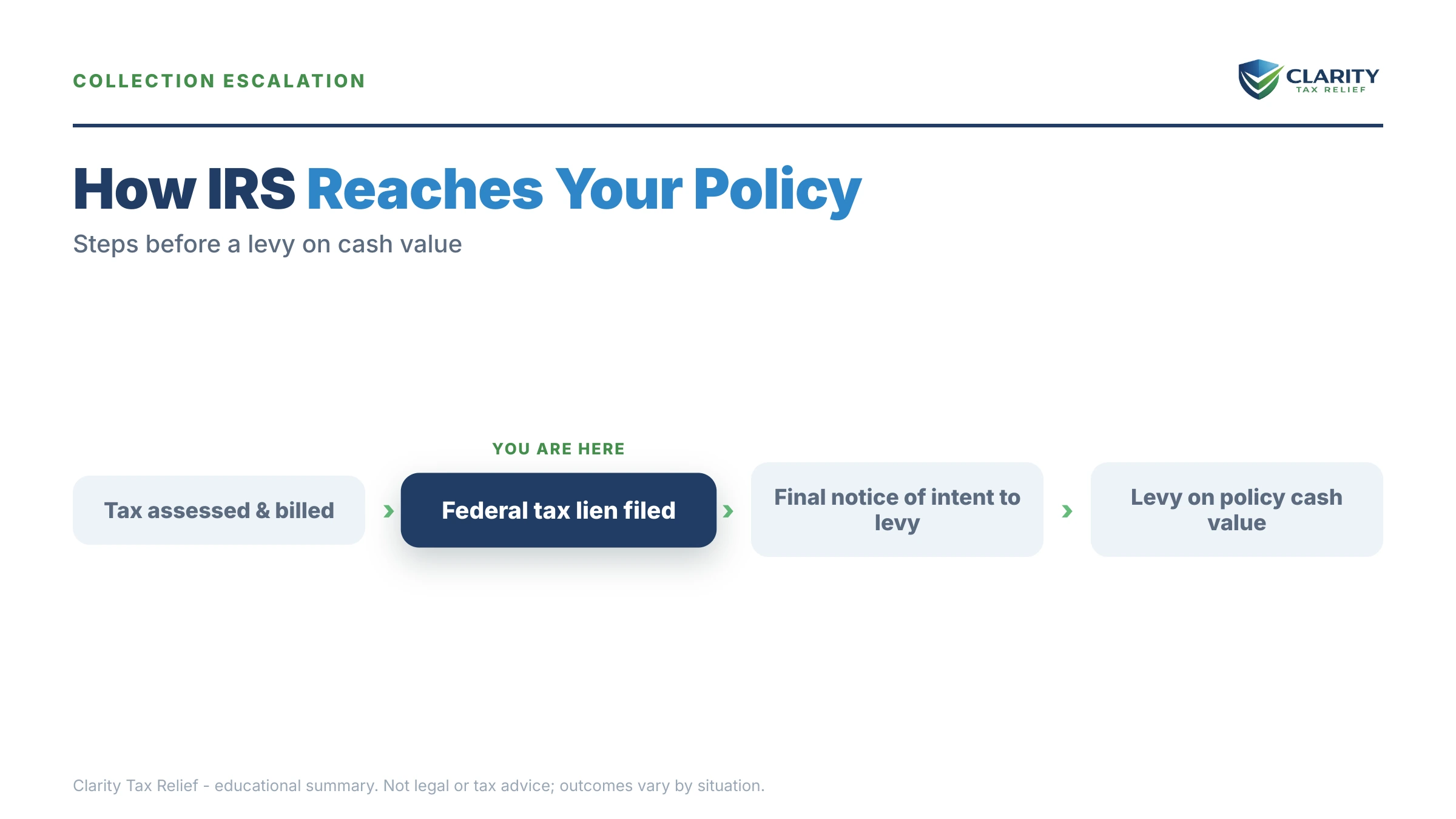
A life insurance levy doesn't arrive out of nowhere — it's the end of an automated sequence, and each step you skip removes an easier option. Here's the order it moves in:
- CP14 — the first bill for the balance due. No enforcement yet.
- CP501 / CP503 — reminder notices. The balance grows monthly with penalties and interest.
- CP504 — Notice of Intent to Levy your state tax refund; a federal tax lien becomes likely.
- LT11 / Letter 1058 — Final Notice of Intent to Levy, which opens a 30-day window and your Collection Due Process appeal rights.
- Levy served on the insurer — once the 30 days pass, the IRS can levy your policy's cash value. The insurer then pays that value on the 90th day.
Do nothing through all of it, and on day 90 after the levy your insurer wires the cash loan value straight to the IRS. Any remaining balance stays on your account, still accruing interest and the failure-to-pay penalty. In 2026, with IRS staffing cut roughly 27% but automated levies running untouched, waiting for a human to "look at your file" is the worst possible bet — the machine escalates on schedule regardless.
Facing a levy on your policy right now?
Send us the notice. An experienced tax professional will confirm whether your policy is even reachable and map the fastest path to release the levy — free, before the 90-day payment date closes.
Your options to stop a life insurance levy
Any resolution that gets you into good standing with collections generally halts a pending levy and can get one released — the same tools that stop a wage garnishment or bank levy protect your policy. Which one fits depends on what you can afford and what you own. (For the full DIY walkthrough, see how to settle tax debt yourself.)
| Option | Who it fits | Key threshold |
|---|---|---|
| Streamlined installment agreement | You can pay monthly over time | Balance ≤ $50,000; up to 72 months |
| Short-term payment plan | You can pay in full soon | Up to 180 extra days; $0 setup |
| Currently Not Collectible | Paying anything causes hardship | Income barely covers allowable living expenses |
| Offer in Compromise | Assets + income can't cover the debt | $205 fee (waived if AGI ≤ 250% of poverty); ~1 in 5 accepted |
| CDP hearing (Form 12153) | You got a final notice recently | File within 30 days of LT11/Letter 1058 |
| Penalty abatement | Clean prior 3 years or reasonable cause | First-Time Abate / AEP starting summer 2026 |
Two of these deserve a word. Currently Not Collectible pauses collection entirely when you genuinely can't pay — the debt stays, but the levy stops. An Offer in Compromise settles for less than the full balance only when the IRS's own math shows it can't collect more; here, that cash value counts as an asset the IRS expects to see in your offer, so it isn't a way to shield the policy. Anyone promising to make your balance vanish "for pennies on the dollar" is selling the scam the FTC has repeatedly shut down — real relief is means-tested.
A worked example: $83,100 owed, a whole life policy in the crosshairs
Say you owe $83,100 and you rent, so there's no house or car equity for the IRS to chase. But you have a whole life policy you've paid into for years, and it now holds about $18,000 in cash surrender value. The IRS files a lien, sends the final notice, and after 30 days serves a levy on your insurer.
Do nothing, and on the 90th day the insurer pays that $18,000 to the IRS. Your balance drops to roughly $65,100 — but you've lost the policy's savings and penalties and interest keep running on the rest. That $18,000 bought almost no relief.
Now run the alternative. Inside those 90 days you set up a 72-month streamlined installment agreement on the full $83,100 — roughly $1,150/month before interest — and the levy is released, keeping your policy intact. Or, if your income only covers basic living expenses, you file for Currently Not Collectible status and collection pauses. Or, if you truly have no way to pay and no other assets, the $18,000 cash value becomes part of the offer figure in an Offer in Compromise — the IRS treats it as collectible either way, so it's better inside a planned resolution than seized in a levy. The point: the 90-day clock is long enough to choose, if you act.
When you can handle this yourself — and when you shouldn't
You can often handle this alone if your balance is under $50,000 and you can afford a payment plan: setting up a streamlined installment agreement online generally stops a levy in its tracks, and if you only have a term policy, there's nothing to take in the first place. A single-year balance you agree with and can pay within 180 days rarely needs professional help.
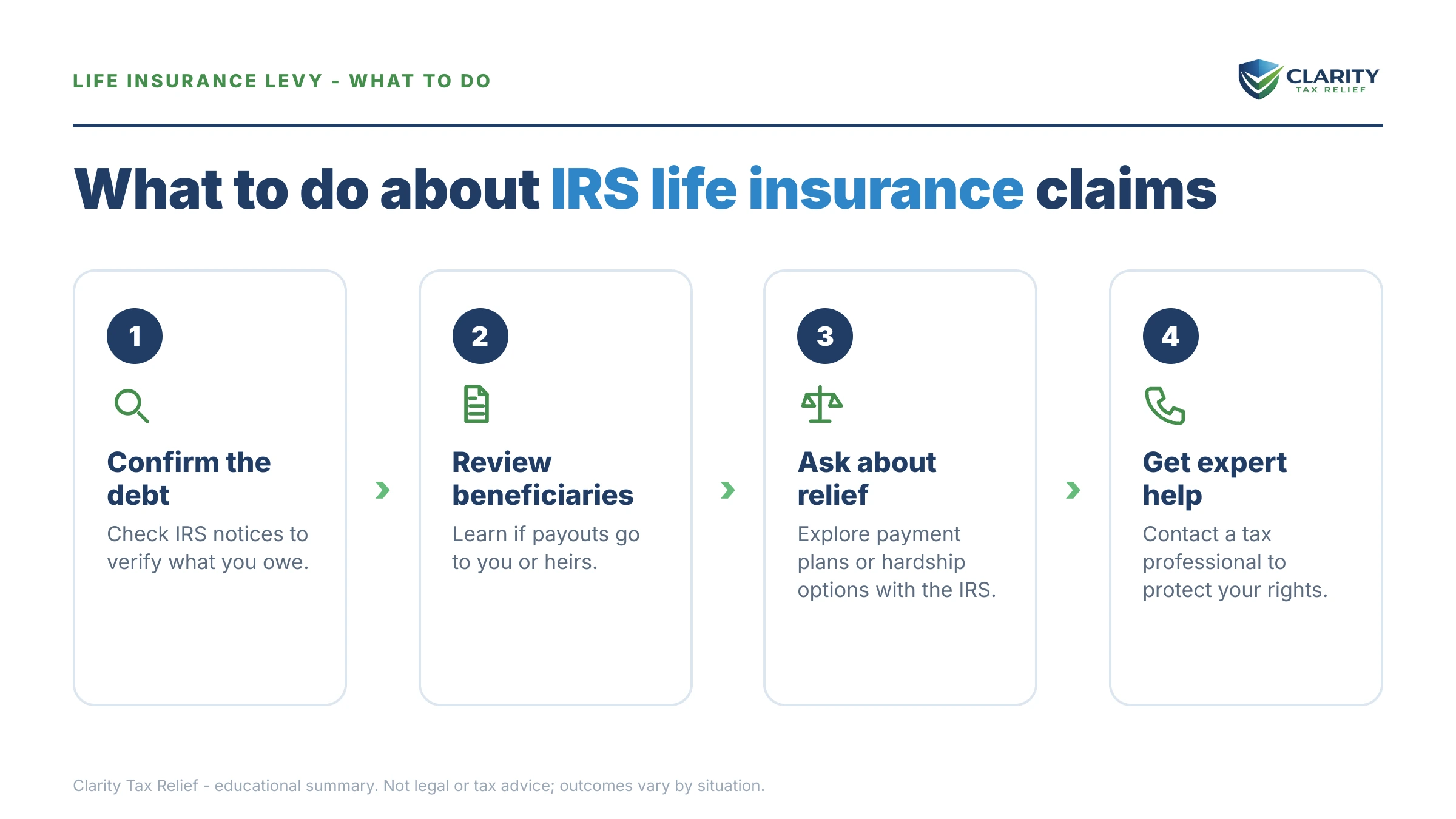
Experienced help changes the outcome when the levy is already served and the 90-day clock is running, when you owe a large balance across multiple years, or when an Offer in Compromise is on the table and the cash value affects the math. It also matters when a federal tax lien has attached to the policy — the sequence of what you fix first (returns, then penalties, then the balance) determines what you ultimately pay. A quick, one-sentence gut check: if a levy is in motion or you owe more than you can pay monthly, get the case reviewed before the payment date. You can request a free case review and know where you stand within an hour.
How to respond, step by step
- Identify your policy type — term (nothing to levy) versus permanent whole/universal/variable life with cash value.
- Find your notice and its date — the LT11 or Letter 1058 and the levy date; count 90 days to the insurer's payment.
- Verify the balance in your IRS online account before you act on anything.
- Pick a resolution that releases the levy — installment agreement, Currently Not Collectible, or an Offer in Compromise.
- Request a CDP hearing with Form 12153 if you're still within 30 days of the final notice.
- Get a professional review for a large balance, unfiled years, or a levy already in motion — before the 90-day date passes.
Terms on your notice, decoded
Cash surrender value — the amount your insurer would pay you if you cancelled a permanent policy today; this is the asset the IRS levies.
Cash loan value — the amount you could borrow against the policy; under IRC §6332(b) this is what the insurer pays the IRS on the 90th day.
Levy vs. lien — a lien is a legal claim that secures the debt against your property; a levy is the actual seizure. See lien vs. levy: the difference.
Death benefit — the payout at death, generally protected from the deceased's tax debt when paid to a named living beneficiary.
CDP rights — Collection Due Process, your right to an independent hearing within 30 days of a final notice, requested on Form 12153.
CSED — the 10-year Collection Statute Expiration Date, after which the IRS generally can't collect; note it pauses (tolls) for appeals, offers, and bankruptcy. See the 10-year collection statute.
Can the IRS take life insurance? Common questions
Can the IRS take my life insurance while I'm alive?
Only if your policy has cash value. The IRS can levy the cash surrender or loan value of a permanent policy — whole life, universal, or variable life — because that value is property you own and can access. A term life policy has no cash value while you're alive, so there is nothing for the IRS to levy until it pays a death benefit.
Can the IRS take life insurance proceeds after someone dies?
Generally no, when the money is paid to a named living beneficiary rather than the estate. Life insurance proceeds paid directly to a spouse, child, or other named person usually pass outside the deceased person's estate and are not reachable for the decedent's tax debt. The exception is when the estate itself is the beneficiary — then the proceeds flow into the estate and the IRS can collect from them.
How long after the IRS levies a life insurance policy does the money leave?
The insurer must pay the policy's cash loan value to the IRS on the 90th day after the levy is served, under IRC Section 6332(b). That 90-day window is unusually long compared to a bank levy's 21-day hold, and it gives you real time to set up a payment plan or hardship status and get the levy released before the insurer sends any money.
Can the IRS take the death benefit if I'm the beneficiary and I owe taxes?
Not the proceeds directly from the insurer, but the IRS can reach the money once it lands in your bank account. If you personally owe back taxes and inherit a life insurance payout, the payout is protected in transit — but the moment it's deposited, it becomes leviable funds like any other cash. Move quickly to arrange a resolution before the balance triggers a bank levy.
Can I just borrow against or cash out my policy before the IRS gets it?
You can, but doing it to defeat a levy can backfire. If the IRS has already filed a federal tax lien, that lien attaches to the cash value, and moving or spending it after the fact can be treated as a dissipated asset that the IRS adds back when calculating what you can pay. Talk to an experienced tax professional before touching the policy — the timing matters.
Does a term life insurance policy protect me from the IRS?
Yes, while you're alive there's nothing to take. Term life builds no cash value, so the IRS has no property right to levy during your lifetime. The only time term insurance intersects with IRS debt is at death, and even then the death benefit paid to a named living beneficiary generally stays out of reach for the deceased's tax debt.
How do I stop the IRS from taking my life insurance cash value?
Set up a resolution before the 90-day payment date. Getting into an installment agreement, being placed in Currently Not Collectible status, or filing an Offer in Compromise generally halts a pending levy and can get it released. You can also request a Collection Due Process hearing with Form 12153 if you're still within the 30-day window from your final notice.
Your next 24 hours
- Find the date. On your LT11 or Letter 1058, locate the notice date and the levy date — that's what the 90-day clock counts from.
- Gather three things. Your most recent tax return, the notice itself, and your policy's cash surrender value from a recent statement or a quick call to the insurer.
- Get a free case review. Use the 2-minute form or call (888) 825-7779 — we'll confirm whether your policy is reachable and start a levy-release plan before the 90-day payment date.
This guide is general information, not tax or legal advice for your specific situation. Eligibility for IRS programs depends on individual facts and circumstances; no outcome is guaranteed.