
IRS Forms
Estate Tax You Can't Pay: Every Form 706 Option for 2026
The short answer: if the estate can't pay the estate tax shown on Form 706, file the return anyway by the 9-month deadline, then request a payment extension under §6161 (Form 4768) — or elect §6166 installments, stretching payment up to roughly 14 years, if a closely-held business makes up more than 35% of the estate.
You're the executor now, on top of everything else — the divorce settled barely a year ago, and then your father passed. The attorney handed you a draft Form 706 showing tax due, and the estate's money is tied up in a house, a brokerage account still in probate, and a business you can't sell by any deadline. The tax is real, but so are the tools: the IRS has two payment-relief programs written specifically for estate tax, and both work best when you move before the nine-month mark.
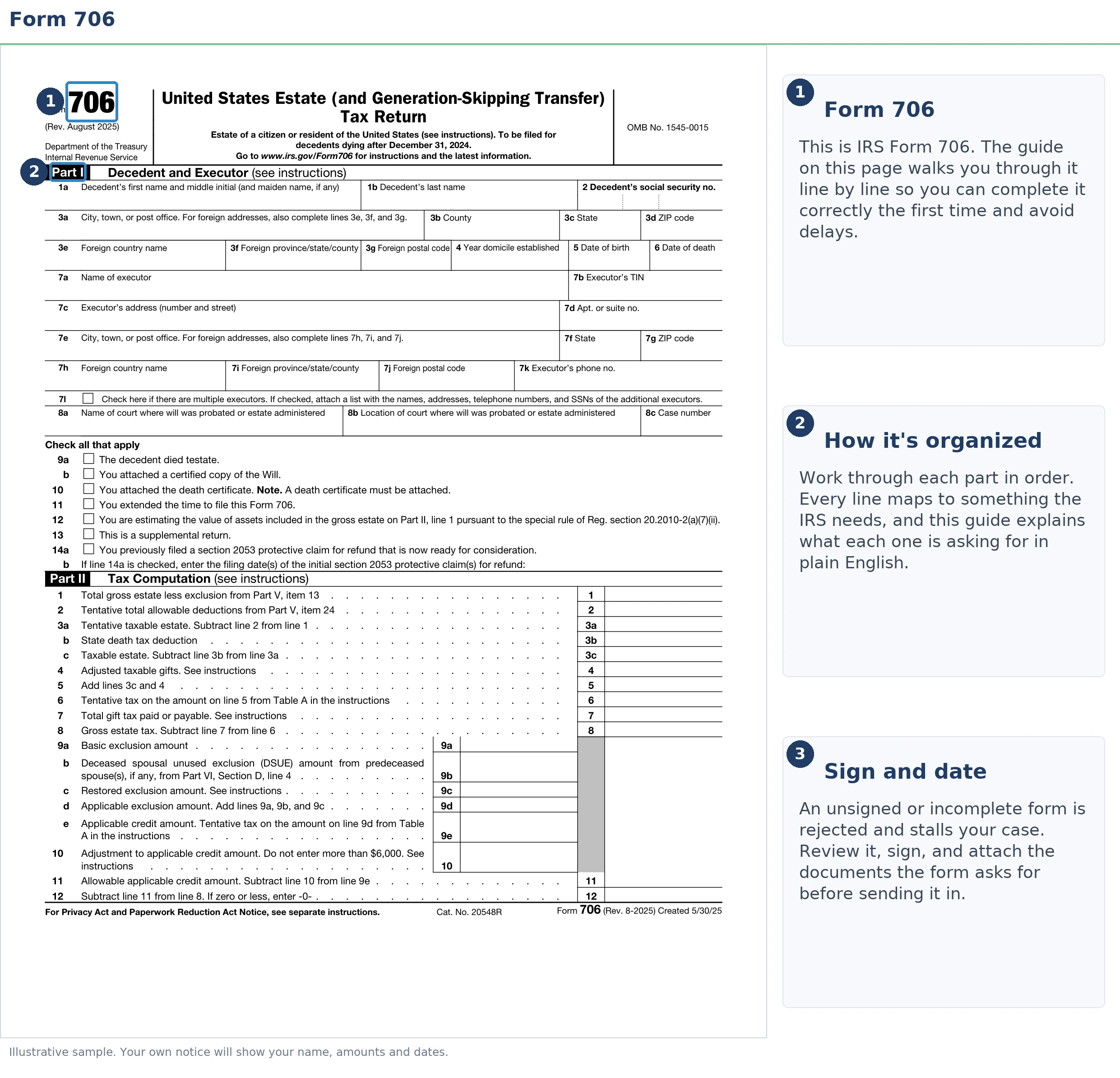
If you've never seen a Form 706 before, the image below shows exactly what the return looks like and where the balance due appears — so you can confirm the number you're actually dealing with before you decide anything.
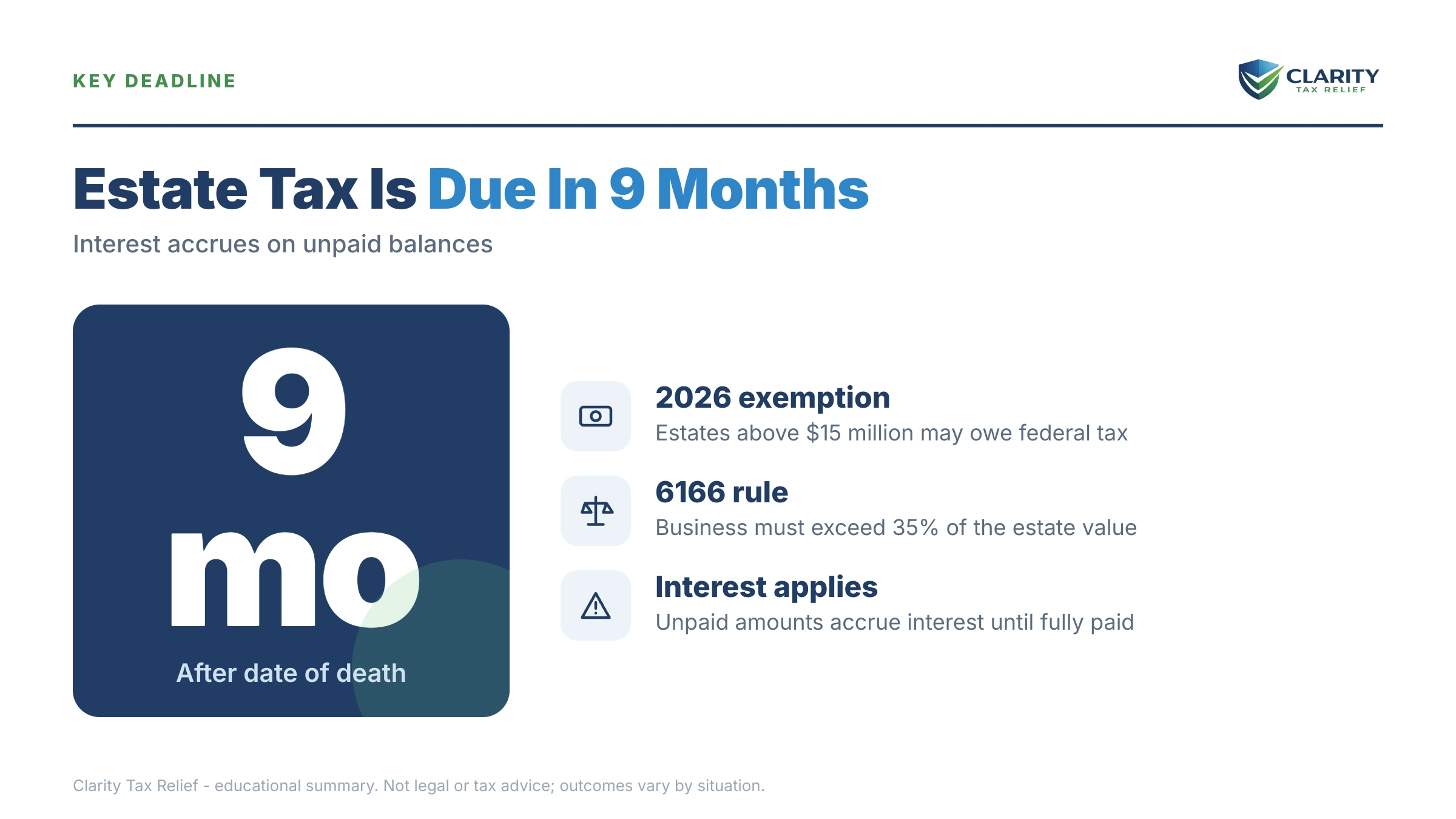
⏱ Your deadline: Form 706 — and the estate tax payment — are due 9 months after the date of death. Form 4768 extends the filing deadline six months automatically, but it does not extend payment unless you separately request (and the IRS grants) a §6161 extension. Interest starts accruing at the original nine-month date either way.
Why an estate owes estate tax it can't pay
Federal estate tax applies only above the $15 million per-person exemption for deaths in 2026 — yet the estates that owe it are often the least liquid. The wealth sits in real estate, a family business, farmland, or securities frozen in probate, while the IRS bill comes due in cash at month nine.
Divorce is one of the quietest triggers. Assets left to a surviving spouse pass free of estate tax under the unlimited marital deduction — but when the decedent divorced before death, that deduction vanishes, and property that would have passed tax-free becomes taxable. Estates that were never "supposed" to owe anything suddenly do, and nobody planned liquidity for it.
Two other common paths: the estate is only slightly over the exemption line (so the tax is five or six figures, not seven), or the decedent lived in one of the dozen-plus states with its own estate or inheritance tax and a far lower threshold. Those state bills follow state rules, not the IRS programs on this page — the state agency where the decedent lived is the right place to confirm its deadlines. And note what this article does not cover: a decedent's unpaid income tax is a different problem with different fixes — see our guide to an estate that owes the IRS back income taxes. For a general primer on any IRS mail the estate receives, start with why you got a letter from the IRS.
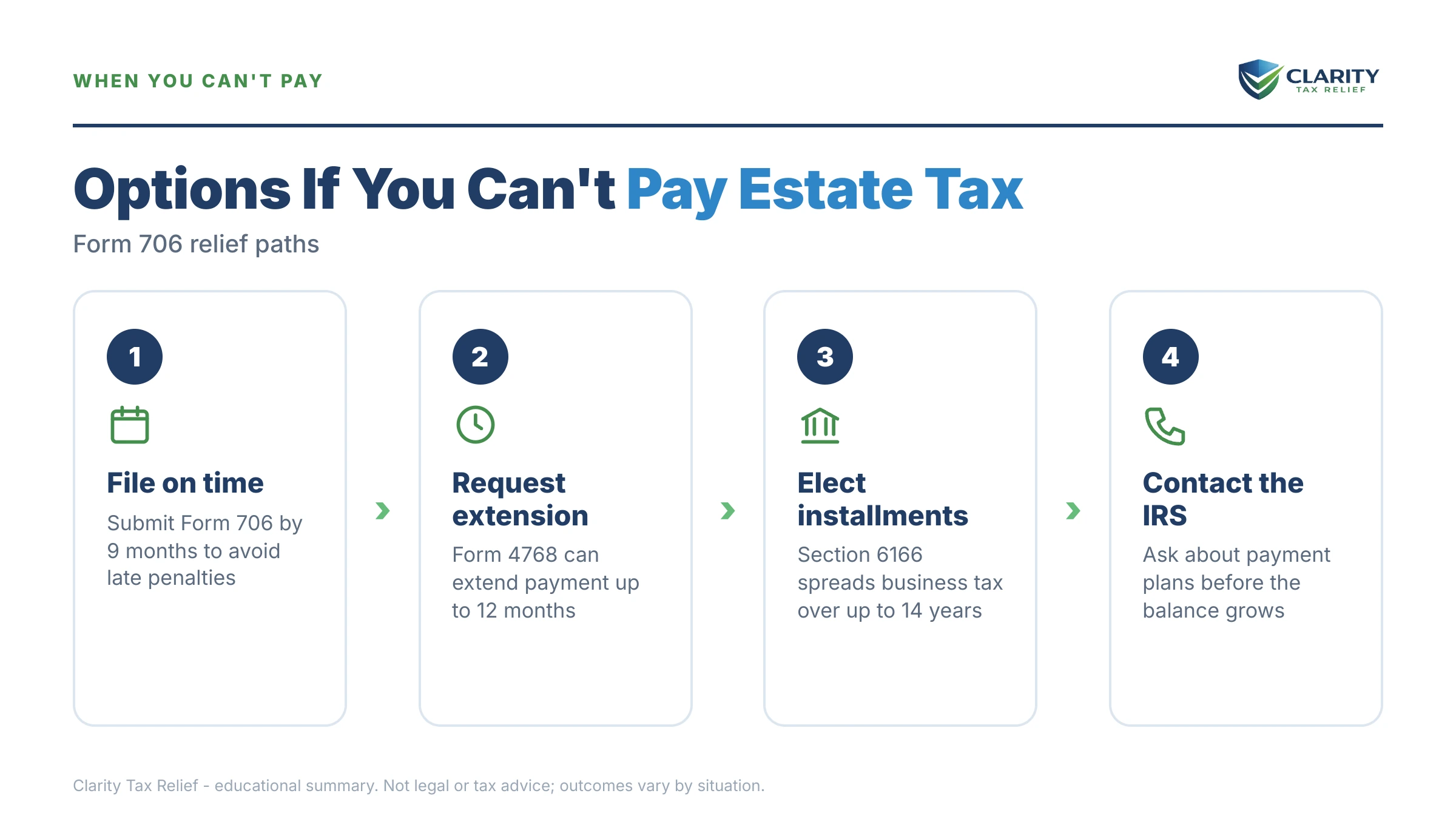
What happens if the estate misses the 9-month deadline
Estate tax that isn't paid nine months after death starts accruing a monthly failure-to-pay penalty at the standard 0.5% monthly rate — the rate doubles to 1% per month (hitting the cap far sooner) if the IRS issues a final intent-to-levy notice, and drops to 0.25% while an approved payment plan is in place — plus daily-compounding interest, with a lien already in place from the day the decedent died. The escalation runs in this order:
- Date of death — the §6324 estate tax lien attaches automatically to every asset in the gross estate. No filing, no recording, no warning letter. It lasts 10 years and follows property into heirs' hands.
- Month 9 — return and payment due. Miss the payment and the 0.5%/month penalty plus interest begin. Miss the filing and the penalty is ten times worse: 5% per month, up to 25% — and the §6166 installment election is generally forfeited, because it must be made on a timely filed return.
- Assessment and billing — the IRS assesses the balance and bills the estate. Penalties and interest compound while the notice sequence runs.
- Collection notices escalate — the estate works through the same automated collection ladder as any taxpayer, ending in a final notice of intent to levy with 30 days to request a Collection Due Process hearing via Form 12153 and a CDP hearing.
- Enforcement — with the lien already attached, the IRS can move against estate bank accounts, real property, and assets already distributed to beneficiaries. And an executor who distributed assets while the tax went unpaid can be pursued personally under 31 U.S.C. §3713 — the full picture is in our guide on when an executor is personally liable to the IRS.
The 2026 wrinkle: the IRS estate and gift unit is thinner after the workforce cuts, so processing a Form 4768 or a §6166 election takes longer — but the penalty accruals and the lien are automatic and never paused. Slow humans, punctual machine.
Here's what the timeline looks like as a reference table you can put next to the probate calendar:
| Deadline | What happens or is due | What you lose if it passes |
|---|---|---|
| Date of death | §6324 lien attaches to all estate property automatically | Nothing to do yet — but the 10-year lien clock starts |
| 9 months after death | Form 706 and full payment due | Late filing → 5%/month penalty and the §6166 election is generally forfeited; late payment → 0.5%/month penalty plus interest |
| 9 months (Form 4768 filed) | Filing extended 6 months automatically; §6161 payment extension requested | The payment extension is discretionary — no reasonable-cause statement, no extension |
| Each §6161 / §6166 anniversary | Annual renewal request or annual installment due | A missed §6166 installment can accelerate the entire deferred balance |
| Final notice of intent to levy (30 days) | Last stop before enforcement | Miss the Form 12153 window and levy on estate assets can begin |
Staring at a Form 706 the estate can't cover?
Get the estate's situation reviewed free — before the 9-month deadline passes, or before another month of penalties posts if it already has. We'll map which extension or election actually fits, and how to protect you as executor.
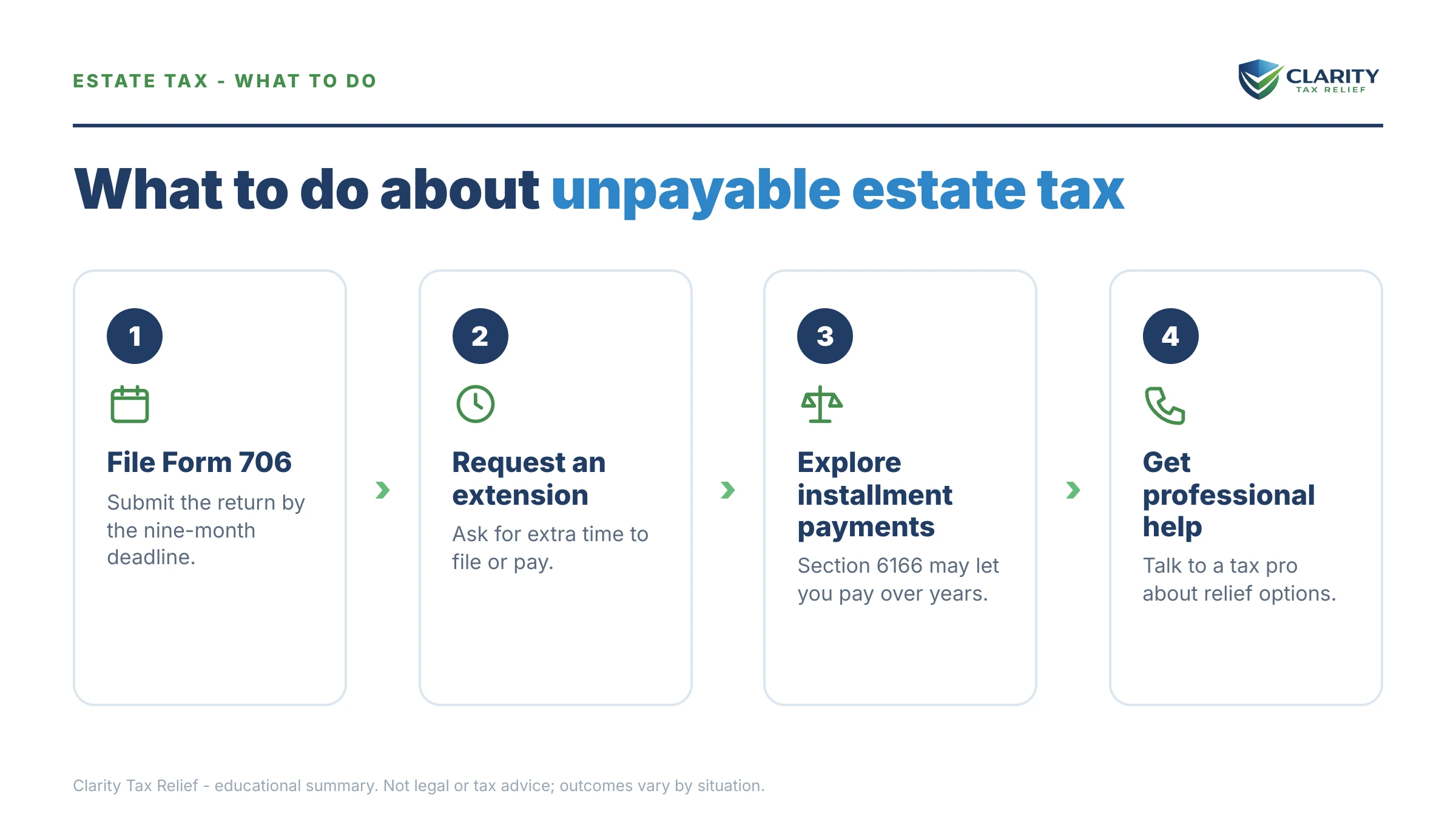
Options when you can't pay the estate tax in full
The IRS has two purpose-built relief tools for estate tax: the §6161 payment extension and the §6166 installment election — plus the ordinary levers of selling assets, borrowing, and penalty relief. Here's how they compare:
| Option | Who qualifies | How long | Cost & catch |
|---|---|---|---|
| Sell estate assets | Any estate with sellable property | As fast as the sale closes | The §6324 lien must be cleared first — Form 4422 requests a discharge so the sale can close |
| §6161 payment extension (via Form 4768) | Reasonable cause / undue hardship — e.g., assets that can't be sold in time without a loss | 12 months at a time, renewable up to 10 years | Discretionary, not automatic; interest keeps accruing, but an approved extension stops the failure-to-pay penalty |
| §6166 installment election | Closely-held business interest > 35% of the adjusted gross estate | Up to ~14 years (interest-only up to 4 years, then up to 10 annual installments) | 2% rate on a portion of the deferred tax; §6166 interest is not deductible; missed payments or selling half the business can accelerate everything |
| Borrow against estate assets | Estates with financeable real estate or business equity | Lender's terms | In some structures the loan interest is deductible as an administration expense — get professional review before signing |
| Penalty relief (reasonable cause) | Executor exercised ordinary business care and was still unable to file or pay on time | Applies to penalties already assessed | Removes penalties only — never the tax or interest; first-time abatement does not cover Form 706 |
The §6161 extension: time, not forgiveness
Section 6161 is the workhorse for illiquid but ordinary estates. On Form 4768 you explain why paying at month nine is impossible or would cause undue hardship — a house that can't sell before the deadline without a fire-sale price is the classic example. The IRS can grant 12 months at a time, renewable for up to 10 years. Interest runs the whole time, but an approved extension shuts off the 0.5%-per-month penalty, and it keeps the file out of enforcement.
The §6166 election: the 14-year path for business estates
Section 6166 exists because Congress didn't want family businesses and farms liquidated to pay estate tax. If a closely-held business interest exceeds 35% of the adjusted gross estate, the executor can elect — on a timely filed Form 706 — to defer the tax attributable to the business: interest-only payments for up to four years, then the tax itself in up to ten annual installments.
The pricing is unusually generous: a slice of the deferred tax (an inflation-adjusted amount, recalculated annually) accrues interest at just 2%, and the remainder at 45% of the standard underpayment rate. The trade-offs are real, though. That interest is not deductible anywhere, the IRS may require a bond or a special §6324A lien on the business, and the whole deferred balance can be accelerated if the estate misses an installment or disposes of half or more of the business interest. Treat a §6166 election like a 14-year contract, because that's what it is.
Selling property with the estate tax lien attached
Because the §6324 lien attaches at death, a title company will usually refuse to close on estate real estate until the IRS issues a discharge. For estate tax, that request goes in on Form 4422 — the estate-tax cousin of the standard tax lien discharge process — and the IRS typically wants the sale proceeds routed toward the tax or into escrow. Build the discharge lead time into any sale plan; it is not a same-week approval.
Penalty relief — but not the kind you've read about
Form 706 penalties can be removed for reasonable cause — an executor who relied on a qualified professional's advice about the deadline, or who was genuinely unable to marshal records in time, has a real argument. What does not apply here: first-time abatement, which excludes estate and gift returns, and the new Automatic Exemption from Penalty arriving in summer 2026, which follows the same pattern. Estate penalties are argued the old-fashioned way, in writing, with facts.
What $31,200 in estate tax actually costs, month by month
Say you're the executor and the taxable estate came in at $15,078,000 for a 2026 death — $78,000 over the $15 million exemption. At the 40% top rate, Form 706 shows $31,200 due ($78,000 × 40%). All hypothetical, but the arithmetic is exactly what you'd face:
- Do nothing: the failure-to-pay penalty runs $156 per month ($31,200 × 0.5%), climbing toward a $7,800 cap over roughly four years — with interest at the federal underpayment rate compounding daily on top. Our guide to IRS interest rates in 2026 shows how that rate resets quarterly.
- Don't even file: the failure-to-file penalty is $1,560 per month ($31,200 × 5%) — hitting its $7,800 maximum in just five months. Filing on time, even broke, saves the estate four figures immediately.
- File plus a §6161 extension: penalty avoided entirely; the estate pays only interest while the house sells or probate clears. On a balance this size, that's the difference between a nuisance cost and a five-figure leak.
- §6166: probably unavailable here — a closely-held business would need to be roughly $5.3 million of this estate to clear the 35% test. The 14-year track is built for business-heavy estates, not a cash timing problem.
Want your own numbers instead of these? You can estimate what penalties and interest would run on the estate's balance with our Penalty & Interest Calculator.
How to respond when the estate can't pay: step by step
- File Form 706 by the nine-month deadline — even with no payment attached, filing on time preserves the §6166 election and avoids the 5%-per-month failure-to-file penalty.
- Submit Form 4768 — request the automatic six-month filing extension if you need it, and a §6161 payment extension with a written reasonable-cause statement.
- Elect §6166 on the return if the estate qualifies — a closely-held business exceeding 35% of the adjusted gross estate is the test, and the election generally cannot be added after a late filing.
- Freeze distributions to heirs — until the tax is paid or a payment arrangement is in place; distributing first is what creates executor personal liability.
- Authorize an experienced tax professional with Form 2848 — our Form 2848 instructions walk through the power of attorney that lets someone negotiate the extension, the lien paperwork, and installment terms with the IRS estate and gift tax unit for you.
When you can handle this yourself — and when help changes the outcome
You can handle a Form 706 payment problem yourself when the estate has the money and just needs time. If the shortfall is a probate-timing issue — the cash exists, it's simply locked for a few months — a well-written Form 4768 with a clear reasonable-cause statement is something a careful executor, working with the estate's attorney, can do without a tax specialist.
Experienced help changes outcomes in four situations: a §6166 election (the 35% math, the 2%-portion computation, and the acceleration traps punish improvisation); a lien discharge needed to close a property sale on a real-estate-heavy estate; penalties already assessed that need a reasonable-cause case built; and any estate where distributions have already gone out to heirs, because now the executor's personal exposure and transferee liability are both on the table. In those cases, the fee for help is usually small next to what a forfeited election or an accelerated balance costs.
Terms on Form 706, decoded
- Adjusted gross estate — roughly the gross estate minus debts and expenses; it's the denominator in the §6166 35% test.
- Closely-held business — a sole proprietorship, or a partnership/corporation interest meeting §6166's ownership limits, that can unlock the installment election.
- §6324 estate tax lien — the automatic, unrecorded 10-year lien that attaches to every estate asset on the date of death and follows property to heirs.
- Fiduciary liability (§3713) — the rule that makes an executor personally liable for tax when estate assets go to others while the IRS goes unpaid.
- The 2% portion — the inflation-adjusted slice of §6166-deferred tax that accrues interest at only 2% instead of the normal underpayment rate.
- Marital deduction — the unlimited deduction for property passing to a surviving spouse; its absence after a divorce is often why the estate owes tax at all.
Estate tax payment questions, answered
What happens if an estate can't pay its estate tax?
The estate still must file Form 706 within nine months of the date of death — filing late adds a 5%-per-month penalty on top of the unpaid tax. Once filed, the executor can request a payment extension under §6161 or elect §6166 installments if a closely-held business makes up more than 35% of the adjusted gross estate. Interest accrues under every option, but enforcement against estate assets can usually be avoided.
Can estate tax be paid in installments?
Yes, but only through the §6166 election, and only for the portion of the tax attributable to a closely-held business interest that exceeds 35% of the adjusted gross estate. Qualifying estates can pay interest only for up to four years, then spread the tax over as many as ten annual installments — roughly 14 years total. The election must be made on a timely filed Form 706; miss the filing deadline and the option is generally gone.
What is the penalty for paying estate tax late?
The failure-to-pay penalty is 0.5% of the unpaid tax per month, up to a 25% cap, plus interest at the federal underpayment rate compounding daily. On a $31,200 balance that is $156 per month in penalty alone. If the return itself is late, the failure-to-file penalty is ten times worse — 5% per month — which is why executors should file Form 706 on time even when the estate cannot pay a dollar.
Is the executor personally liable if the estate can't pay estate tax?
An executor can become personally liable under 31 U.S.C. §3713 — but only by distributing estate assets to heirs or other creditors while the tax remains unpaid and the estate can't cover it. If you keep enough in the estate to satisfy the IRS, or resolve the balance through §6161 or §6166 before distributing, your personal assets stay out of it. This is the single most important rule for executors of estates that owe tax.
Can I get an extension to pay estate tax?
Yes. Form 4768 requests both an automatic six-month extension to file and a discretionary extension to pay under §6161 — up to 12 months at a time, renewable for as long as 10 years when the estate shows reasonable cause, such as assets that can't be sold quickly without a loss. The payment extension is not automatic: you must explain why paying on time is impossible or would cause undue hardship. Interest still accrues, but an approved extension stops the failure-to-pay penalty.
Does first-time penalty abatement apply to Form 706?
No. First-time abatement covers income, payroll, and certain business returns — estate and gift tax returns are excluded, and the Automatic Exemption from Penalty rolling out in summer 2026 follows the same pattern. For Form 706 penalties, the estate's path is reasonable cause: showing the executor exercised ordinary business care but still couldn't file or pay on time. Reliance on a qualified professional's advice about the deadline can qualify; simply not having the cash usually needs more.
Can the IRS take property from heirs to collect estate tax?
Yes. The §6324 estate tax lien attaches automatically to every asset in the estate on the date of death and follows property into the hands of heirs for 10 years. Beneficiaries who receive property from an estate that still owes tax can face transferee liability up to the value of what they received. That's why distributing early doesn't protect anyone — it just spreads the exposure.
Do I owe state estate tax if the estate is under the federal exemption?
Possibly. About a dozen states impose their own estate or inheritance tax with exemptions far below the federal $15 million — some begin taxing estates in the low seven figures. State returns have their own deadlines, forms, and payment-relief rules that do not mirror the IRS's §6161 or §6166. Check with the tax agency of the state where the decedent lived, and any state where the estate holds real property.
Your next 24 hours
- Find the date of death and count nine months forward. That calendar date controls everything on this page — note whether it's still ahead of you (extensions and the §6166 election are all in play) or already behind you (penalty containment becomes the priority).
- Gather three things: the draft or filed Form 706, the estate inventory split into liquid vs. locked-up assets, and any letters the IRS has already sent the estate.
- Get a free case review before distributing anything to heirs — call (888) 825-7779 or use the 2-minute form. The order you resolve the filing, the extension, and the lien determines what the estate — and you personally — end up paying.
Primary sources: the IRS pages for Form 706, United States Estate Tax Return and Form 4768, extension of time to file and pay estate tax, plus payment mechanics at IRS.gov/payments.
This guide is general information, not tax or legal advice for your specific situation. Eligibility for IRS programs depends on individual facts and circumstances; no outcome is guaranteed.