
IRS News & Changes
IRS Layoffs 2026 Processing Delays: What's Slower — and What Never Stopped
The short answer: IRS layoffs cut roughly 27% of the agency's workforce in 2025, and the 2026 processing delays are real — paper returns, amended returns, letters, and phone support are all slower. But collections never slowed: notices, offsets, liens, and levies are automated, and delays never pause penalties or interest.
You're searching "irs layoffs 2026 processing delays" because something of yours is stuck — an amended return, a written response, a refund, an innocent spouse request — and the only mail the IRS seems capable of sending is another balance-due notice. That mismatch isn't your imagination. It's the exact shape of the 2026 IRS.
Here's the map: the humans who answer, review, and resolve got cut. The computers that bill, offset, and levy did not. Once you understand which side of the agency handles your issue, you know exactly what to expect — and what to do instead of waiting.
⏱ The clock that never stops: interest on an unpaid balance compounds daily and the failure-to-pay penalty adds 0.5% per month, no matter how backlogged the IRS is. A processing delay on their end never pauses accrual on yours.

Why the IRS layoffs of 2026 are causing processing delays
The IRS workforce shrank by roughly 27% in 2025, and the work that requires a human is what slowed down in 2026. Paper returns have to be opened, transcribed, and reviewed by people. Amended returns are worked by people. Your letter disputing a balance sits in a queue until a person reads it. Phone lines connect to people — can't reach the IRS on the phone is now one of the most-searched tax questions in America for a reason.
The other half of the agency runs on code. Balance-due notices generate on a schedule. Refund offsets happen at the database level. Lien filings and levy notices are queued by the Automated Collection System without anyone reading your file. The enforcement side of the IRS was barely touched by the layoffs, because most of it was never done by humans in the first place.
The image below shows how this two-track system fits together — the human track that stalled and the automated track that didn't — so you can see at a glance which one your situation is on.
| IRS function | Handled by | Status in 2026 |
|---|---|---|
| Paper & amended returns | Humans | Slower — expect long, unpublished backlogs |
| Written correspondence & disputes | Humans | Slower — responses can sit for months |
| Phone support | Humans | Long holds; many calls never connect |
| Penalty abatement, OIC & hardship reviews | Humans | Slower decisions across the board |
| Balance-due notices (CP14 → CP504 → LT11) | Automated | On schedule — unaffected by layoffs |
| Refund offsets & state-refund levies | Automated | On schedule |
| Lien filings & levy issuance | Automated (ACS) | On schedule |
| Interest & penalty accrual | Automated | Daily and monthly — never pauses |
For a deeper look at how the staffing cuts change collection strategy itself, see our guide to IRS budget cuts 2026. And if your core question is whether an understaffed agency still expects payment, the blunt answer lives at IRS understaffed — do I still owe. (Spoiler: yes.)
What happens if you wait for the IRS to catch up
Waiting out the 2026 delays is the one strategy guaranteed to cost you money, because the collection sequence is automated and your balance grows the entire time. If you owe and do nothing, the machine works through these stages in order — no human decides to escalate you, and no backlog protects you:
- First bill (CP14) — the computer notes the balance and starts the notice sequence. Typically about 21 days to pay before the next stage queues.
- Reminder notices (CP501/CP503) — still just bills, but interest compounds daily and the 0.5% monthly penalty stacks with every cycle.
- CP504 — intent to levy your state refund — the IRS can seize your state tax refund under IRC §6331(d), and a federal tax lien becomes a live possibility.
- LT11 / Letter 1058 — final notice — a 30-day clock starts, along with your Collection Due Process rights (requested on Form 12153). This is your last structured off-ramp.
- Levy — a bank levy freezes funds with a 21-day hold before they're sent to the Treasury; a wage levy is continuous until released; Social Security can be reduced up to 15% through the Federal Payment Levy Program.
Notice the asymmetry: every stage that hurts you is automated and on time, while every stage that could help you — a human reading your dispute, reviewing your hardship claim, answering your call — is delayed. In 2026, the cost of ignoring a tax balance went up, not down.
Something stuck in the IRS backlog while your balance grows?
An experienced tax professional will review your notices, your transcript, and your options — and tell you which fixes bypass the backlog entirely. Interest and penalties accrue every month you wait; the review is free.
Your options if you owe during the slowdown
Every major IRS resolution program still exists in 2026 — what changed is how fast each one moves, and the fastest paths are the ones that never touch a human. The full playbook for working these programs on your own lives in our guide to how to settle tax debt yourself; here's how each option is actually performing under the layoffs:
| Option | Who typically qualifies | How the 2026 delays affect it |
|---|---|---|
| Short-term payment plan | Can pay in full within 180 days; $0 setup fee | Set up online — unaffected by staffing |
| Guaranteed installment agreement | Individuals owing $10,000 or less | Online — unaffected |
| Streamlined installment agreement | $50,000 or less; up to 72 months | Online — unaffected; minutes to set up |
| Non-streamlined agreement | Over $50,000; financial disclosure (Form 433-F) | Human review — slower decisions; a pending, good-faith proposal generally keeps enforcement at bay |
| Currently Not Collectible | Paying would leave you unable to cover basic living expenses | Human review — slower to grant, but levies pause once approved |
| Offer in Compromise | Assets plus future income genuinely can't cover the debt; $205 fee (waived with low-income certification) | Human review — slow, but offers undecided after 2 years are accepted by law (with narrow exceptions — a returned or rejected offer stops the clock, and time during court disputes does not count) |
| Penalty relief (FTA / AEP) | Clean compliance the prior 3 years | AEP begins rolling out automatically in summer 2026 — no request, no queue; traditional FTA requests move slowly |
Two 2026-specific notes. First, the new Automatic Exemption from Penalty (AEP) is the rare piece of good news in an understaffed year: qualifying penalties come off without anyone having to answer a phone. Second, be skeptical of ads claiming the layoffs unlocked new forgiveness — our breakdown of IRS Fresh Start 2026 separates the real program changes from the marketing.
A worked example: $54,600 after a divorce
Say you're recently divorced and a joint return left you holding $54,600 — the decree says your ex pays it, but the IRS isn't bound by a divorce decree and bills both names on the return. (Why that is, and what to do about it, is covered in divorce and IRS debt: who pays.) Here's the actual math on your paths, all figures hypothetical:
- Do nothing: the failure-to-pay penalty alone runs about $54,600 × 0.5% = $273 a month, plus daily-compounding interest on top — see how the rate is set at IRS interest rates 2026. You're also only $11,400 below the $66,000 threshold where the IRS can certify your debt to the State Department and block your passport. Waiting closes that gap for you.
- Buy your way under the streamlined line: pay $4,700 to bring the balance to $49,900, and the online 72-month plan opens up — roughly $49,900 ÷ 72 ≈ $693 a month before accruing interest and penalties, set up in minutes with no human review.
- Stay at $54,600: you're in IRS payment plan over $50,000 territory — a Form 433-F financial disclosure and a human decision, which is exactly the queue that's slow in 2026. Doable, but start immediately and document everything.
- If the debt came from income your ex hid: innocent spouse relief (Form 8857) may remove your share of the liability — but it's human-reviewed and slow this year, which is a reason to file early, not to wait. Start with innocent spouse relief: how to qualify.
You can estimate what waiting actually costs on your own numbers with our Penalty & Interest Calculator — it estimates accrual month by month, which makes the "act now vs. wait" comparison concrete.
Three situations the 2026 delays hit hardest
The layoffs don't hit every taxpayer equally — they punish anyone whose fix requires a human while their harm runs on autopilot.
Divorced with a joint balance. Innocent spouse and separation-of-liability requests are entirely human-reviewed, so relief that once took months can take far longer — while the automated side bills and escalates against both ex-spouses the whole time. File the relief request early and consider a payment arrangement in parallel so enforcement doesn't outrun the review.
Self-employed and 1099 filers. If you dispute a balance from mismatched 1099s — say a platform reported gross figures under the reverted 1099-K $20,000 threshold rules — your written explanation waits in a correspondence queue while the underreporter system keeps assessing. Respond in writing, keep proof, and don't assume silence means agreement.
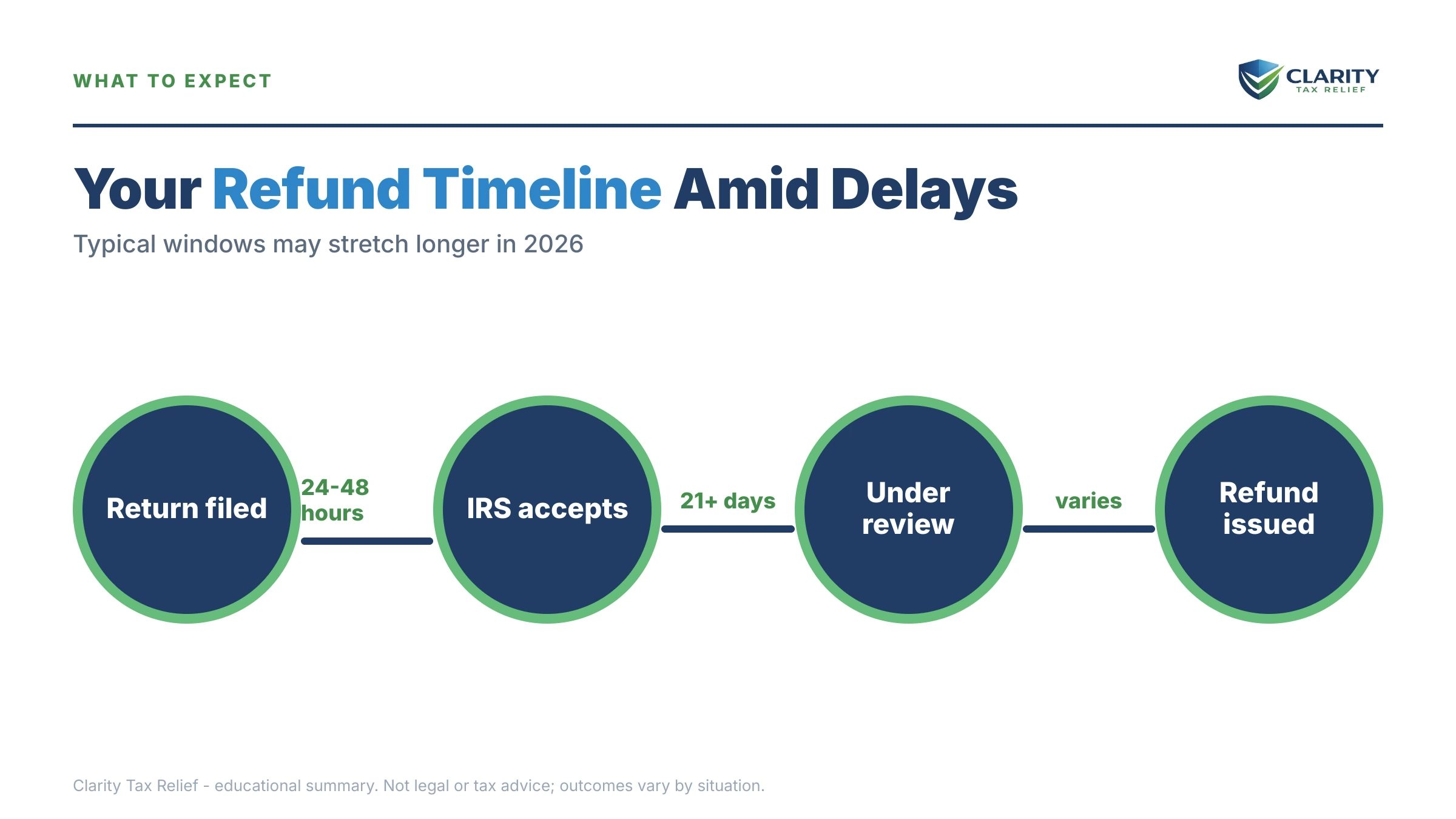
Anyone waiting on a refund or amended return. A refund the IRS owes you doesn't accrue penalties, but it also doesn't hurry. Check status online rather than calling, and if the delayed money is causing genuine hardship, the Taxpayer Advocate Service can force human attention (more below).
How to protect yourself during the 2026 IRS delays, step by step
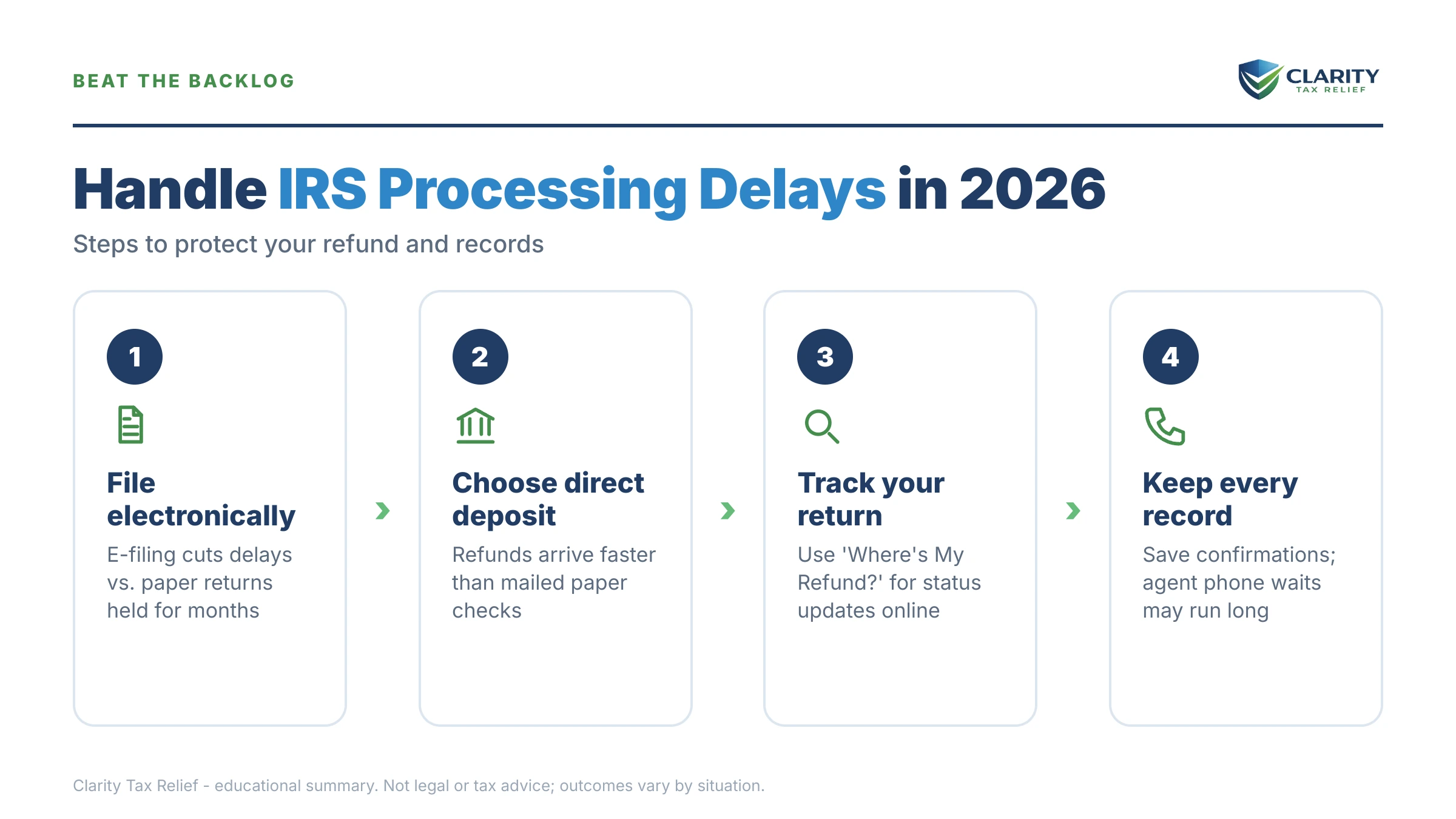
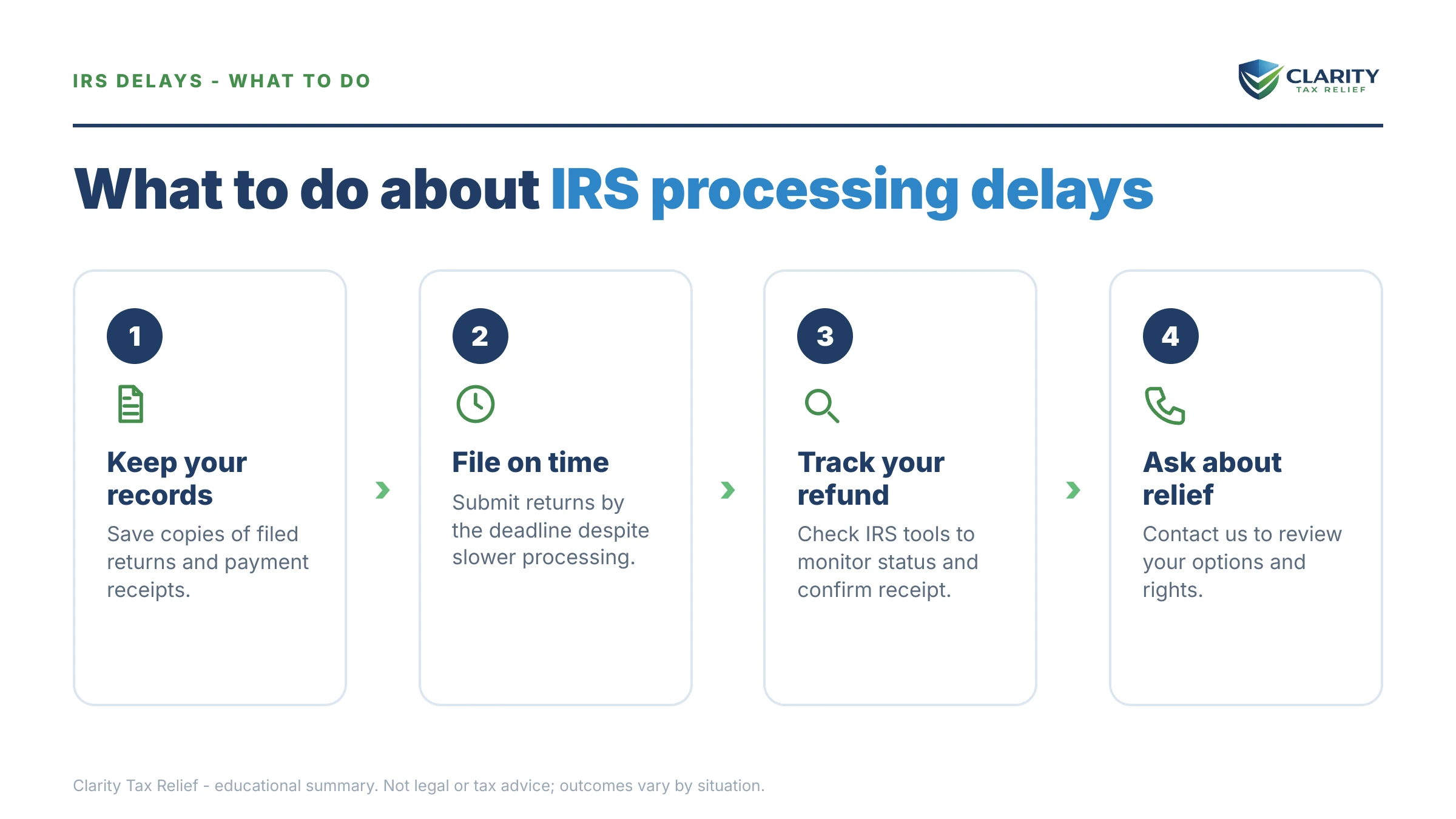
- Check your IRS online account. Log in at IRS.gov to see your real balance, notices, and payment history — no phone call, no hold time.
- File every return on time, even if you can't pay. The failure-to-file penalty (5% per month) is 10 times the failure-to-pay penalty (0.5% per month) — filing is the cheap half of compliance.
- Use self-service tools instead of the phone. Payment plans on balances up to $50,000 can be set up online in minutes, and the tool doesn't depend on staffing.
- Send anything on paper by certified mail and keep copies. In a backlog, your proof of what you sent and when you sent it is your protection if it sits unprocessed for months.
- Escalate genuine hardship to the Taxpayer Advocate Service. If a delay is causing real financial harm — a frozen refund you need, a levy the IRS won't release — file Form 911 for independent help.
Our walkthrough of setting up an IRS payment plan online covers step 3 screen by screen, and how to contact the Taxpayer Advocate Service covers when Form 911 will — and won't — get you a human.
When you can handle this yourself
Most people affected by the 2026 delays don't need professional help — they need the self-service route. If you owe $50,000 or less and agree with the balance, the online payment plan tool resolves it in one sitting. If you're simply waiting on a refund or amended return with no balance due, patience plus the online status tools is genuinely the right answer. If a single penalty is your only problem and your prior three years are clean, AEP may remove it without you lifting a finger.
Experienced help changes outcomes in the situations where a human decision determines what you pay and the queues are working against you: balances over $50,000 that require financial disclosure, an innocent spouse case racing an automated escalation, a levy already in motion, multiple unfiled years, or Offer in Compromise math where a preparation error means rejection and a restarted clock. In those cases, knowing exactly what the reviewer needs — the first time — is what the backlog rewards.
Terms you'll keep hearing in 2026, decoded
- ACS (Automated Collection System): the computer-driven arm of IRS collections that issues notices, liens, and levies without a caseworker — the part the layoffs didn't slow.
- AUR (Automated Underreporter): the matching program that compares your return to W-2s and 1099s and proposes extra tax by mail, automatically.
- CSED (Collection Statute Expiration Date): the end of the IRS's 10-year window to collect an assessed debt — it keeps running through the layoffs, but pauses for things like pending offers and bankruptcy.
- TAS (Taxpayer Advocate Service): an independent organization inside the IRS that intervenes when normal channels are causing you financial harm.
- AEP (Automatic Exemption from Penalty): the program replacing First-Time Abate starting summer 2026 — qualifying penalties come off automatically, with no request needed.
IRS layoffs and delays: your questions, answered
Are the 2026 IRS processing delays because of layoffs?
Yes. The IRS workforce shrank by roughly 27% in 2025, and the people who left handled the manual work — paper returns, amended returns, correspondence, and phone calls. Those queues are moving slower in 2026. Automated systems were not affected, so bills, offsets, and levy notices still go out on schedule.
Did the IRS stop collections because it's understaffed?
No. IRS collections are driven by automated systems that issue balance-due notices, seize refunds through offsets, file liens, and initiate levies without a human touching the file. Staffing cuts slowed the help side of the agency, not the enforcement side. If you owe, the notice sequence continues on its normal schedule.
Do IRS processing delays pause penalties and interest?
No. Interest compounds daily and the failure-to-pay penalty accrues at 0.5% per month no matter how long the IRS takes to process anything you send. Even if a response you mailed sits unopened for months, your balance grows the entire time. The one exception: if the IRS later grants abatement or adjusts the balance, related amounts can be removed retroactively.
How long is the IRS taking to process amended returns in 2026?
Longer than its historical norms, and the IRS is not publishing reliable timelines. Check the Where's My Amended Return tool for your actual status rather than calling. If your amended return would reduce a balance the IRS is actively collecting, tell the collection side in writing — a pending amendment doesn't automatically stop the notice sequence.
Should I wait for the IRS to catch up before setting up a payment plan?
No — waiting only adds penalties and interest, and the online payment plan tool doesn't depend on staffing. If you owe $50,000 or less, you can typically set up a plan of up to 72 months entirely online in minutes. Waiting for a human to contact you first is the most expensive strategy available in 2026.
Will the IRS forgive my tax debt because of the layoffs?
No. An assessed balance stays on the books regardless of staffing, and the 10-year collection statute keeps running in the background — though it pauses for things like pending offers and bankruptcy. Real forgiveness paths (an Offer in Compromise, penalty abatement, expiration of the collection statute) still exist, but each has its own eligibility test that layoffs didn't change.
Can I still reach a human at the IRS in 2026?
It's harder than it has been in years — hold times are long and many calls never connect. Try the online account first for balances, transcripts, and payment plans; it answers most questions without a call. For a genuine hardship the IRS isn't resolving, the Taxpayer Advocate Service (Form 911) is an independent path to a human.
Do the delays make an Offer in Compromise easier to get?
Not easier to qualify for — the IRS accepted roughly 1 in 5 offers in FY2024, and the financial math hasn't changed. But delays cut both ways: by law, an offer the IRS doesn't decide within 2 years is automatically accepted — with narrow exceptions: a returned or rejected offer stops the clock, and time during court disputes does not count — so slow processing modestly favors well-prepared offers. A sloppy offer still gets returned or rejected.
Your next 24 hours
- Log into your IRS online account at IRS.gov and write down your exact assessed balance and the most recent notice on file — that number, not the delays, is what determines your options.
- Gather three things: your last filed return, every IRS letter you've received, and a quick list of monthly income and expenses. That's everything needed to match you to a program — including the IRS's own payment plan options.
- Get a free case review. Interest compounds daily and the 0.5% monthly penalty stacks while your paperwork sits in a queue — an experienced tax professional can tell you which fix bypasses the backlog. Call (888) 825-7779 or use the 2-minute form. If a delay is causing genuine hardship right now, the Taxpayer Advocate Service is also a free option.
This guide is general information, not tax or legal advice for your specific situation. Eligibility for IRS programs depends on individual facts and circumstances; no outcome is guaranteed.