
IRS Programs
IRS Fresh Start 2026: What's Actually New — and What's Just Marketing
The short answer: IRS Fresh Start 2026 is not a new program — it's the umbrella label for existing IRS options: payment plans up to 72 months, Offers in Compromise, Currently Not Collectible status, and penalty relief. Nothing new "passed" for 2026 except one real change: automatic penalty relief (AEP) begins replacing First-Time Abate this summer.
You searched "irs fresh start 2026" because an ad — maybe several — told you a new government program can wipe your tax debt away, and you want to know if it's real before you call a stranger. Here's the honest version: the relief behind the label is real, the "new 2026 program" framing is not, and the difference decides whether you end up in the right IRS program or in a sales funnel. This guide separates the two, with the actual 2026 thresholds and costs.
⏱ The real clock: there is no Fresh Start enrollment deadline — but there is a running meter. The failure-to-pay penalty adds 0.5% of your balance every month, and interest compounds daily on top. On a $13,600 balance, that's roughly $68 a month in penalty alone before interest. Every month you wait to pick an option, the number gets worse.
What the "IRS Fresh Start program" actually is in 2026
"Fresh Start" is the name of a 2011–2012 IRS initiative, not a program you can enroll in today. Back then, the IRS raised lien-filing thresholds, expanded streamlined payment plans, and loosened Offer in Compromise terms. Those policy changes were absorbed into normal IRS procedure years ago — which means the "Fresh Start options" of 2026 are simply the standard collection alternatives that exist for every taxpayer who meets the criteria.
That's actually good news. You don't need to find a secret door or pay someone for "enrollment." The options are open year-round, most have published thresholds you can check yourself, and several can be set up online in under an hour. If you want the deeper history of whether the program exists at all, see is the IRS Fresh Start program real; for the eligibility rules in one place, see the IRS Fresh Start program requirements.
So why the 2026 ad blitz? Two reasons. First, the IRS workforce shrank by roughly 27% in 2025, and marketers spun that into "the IRS is weak — settle now." Second, "Fresh Start" tests well in ads because it sounds like forgiveness. The staffing cuts are real — our guide to the IRS budget cuts in 2026 covers what they actually change — but the automated collection systems that send notices and issue levies were not laid off. The image below shows how the real programs fit together under the Fresh Start label, so you can see the whole map at a glance.
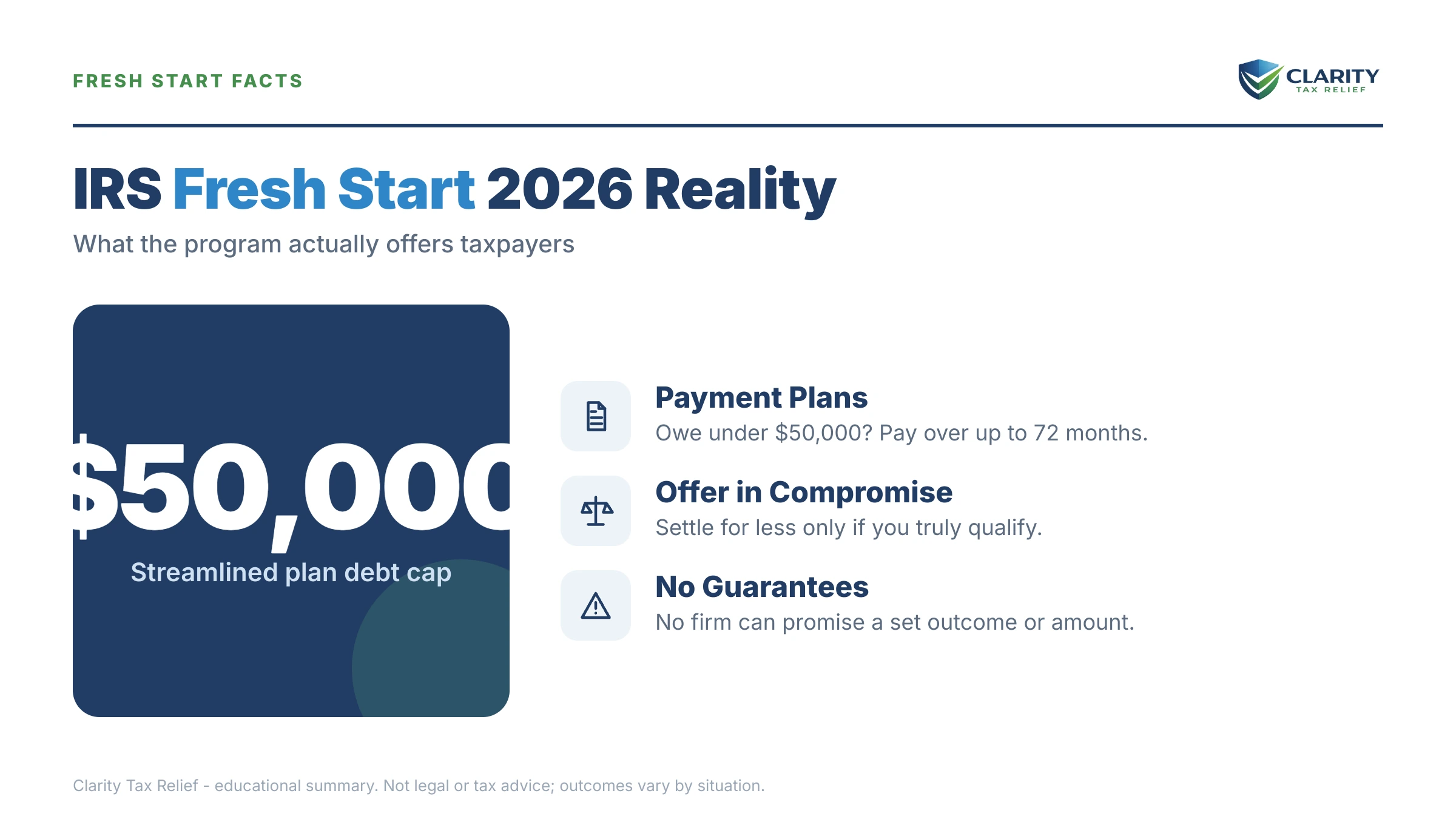
IRS Fresh Start 2026 changes: what's new, what's marketing
Exactly one meaningful Fresh Start-adjacent change takes effect in 2026: Automatic Exemption from Penalty (AEP) begins replacing First-Time Abate in the summer. AEP applies qualifying first-time penalty relief automatically — no letter, no phone call, no request. Everything else the ads call "new" is either an old rule wearing a 2026 costume or an outright invention.
Here's how the common claims stack up against reality:
| The claim you'll hear | What's actually true in 2026 |
|---|---|
| "A new Fresh Start Program just passed for 2026 — enroll before it closes" | No new program passed. "Fresh Start" is the 2011–2012 initiative's name; the 2026 rules are the standard IRS collection options, open year-round with no cap. |
| "Settle for pennies on the dollar — anyone can qualify" | Eligibility is means-tested, not negotiated. The IRS accepted roughly 1 in 5 Offers in Compromise in FY2024, and acceptance depends on financial math, not who calls on your behalf. |
| "Fresh Start freezes all IRS collections instantly" | Relief has conditions. A pending or approved arrangement generally pauses new levy action — but interest and penalties keep accruing, and defaults restart collection. |
| "With IRS layoffs, they'll never come after you" | Notices, liens, and levies are issued by automated systems that didn't shrink. Fewer humans mostly means slower answers when you need something. |
| "Your debt just disappears after 10 years" | The 10-year collection statute (CSED) is real, but it pauses during offers, appeals, and bankruptcy — waiting it out often extends it instead. |
One phrase in that table deserves its own warning: "pennies on the dollar" is the signature line of Offer in Compromise mills, and the FTC has taken firms apart over exactly these promises. The underlying OIC program is legitimate; the guarantee is the scam. If someone quotes you a settlement amount before seeing your finances, they're guessing — the IRS won't be.
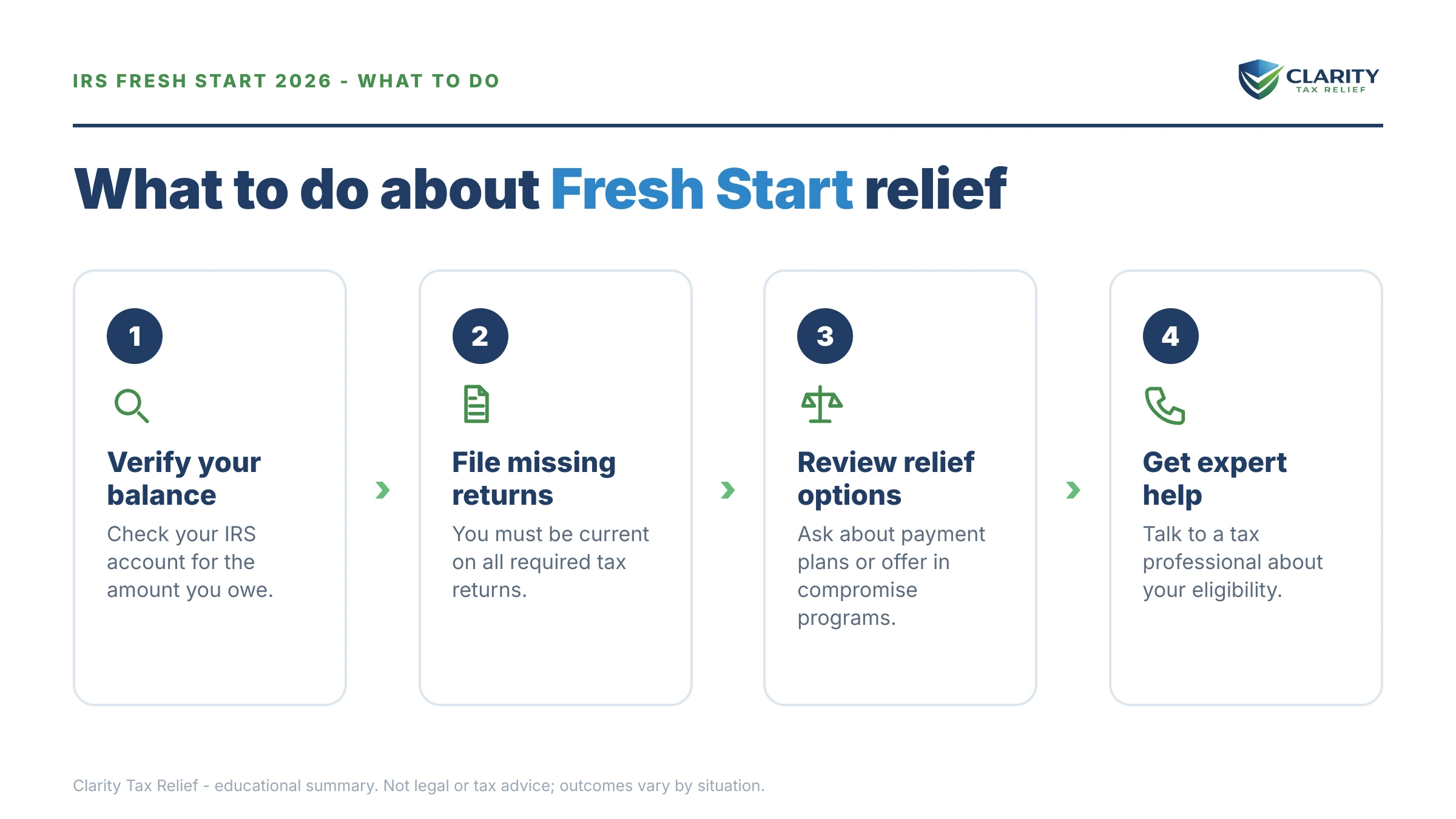
What happens if you ignore the debt while deciding
Tax debt escalates through an automated notice sequence whether or not any IRS employee ever reads your file. "Fresh Start" doesn't pause anything by itself — only an accepted or pending arrangement does. If you shelve the problem, here is the order things happen in:
- CP14 — the first bill. You typically have about 21 days from the notice date before the reminder cycle starts.
- CP501 / CP503 — reminders. No enforcement yet, but the balance grows every month and the file moves toward collections.
- CP504 — intent to levy. The IRS can now seize your state tax refund under IRC §6331(d), and a federal tax lien becomes a real possibility.
- LT11 / Letter 1058 — final notice. A 30-day clock starts on your Collection Due Process rights (requested on Form 12153). After it runs, wage and bank levies are on the table.
- Levy. A bank levy freezes funds for 21 days before the money leaves; a wage levy is continuous until released; up to 15% of Social Security can be taken through the Federal Payment Levy Program.
Two more consequences ride alongside the notices. A Notice of Federal Tax Lien can attach to everything you own once the balance is assessed and unpaid. And at $66,000 of seriously delinquent debt (the 2026 threshold), the IRS certifies you to the State Department for passport denial or revocation — not a concern at $13,600, but a reason not to let penalties and interest stack multiple years into that range. With the agency's phone lines strained by the 2026 IRS layoffs and processing delays, undoing a levy takes far longer than preventing one.
Not sure which Fresh Start option fits your numbers?
Send us your latest IRS notice or balance. An experienced tax professional will map your actual options — plan, offer, hardship status, or penalty relief — free and confidential. The balance grows every month either way; the review costs nothing.
The real Fresh Start options in 2026, with thresholds
Every option under the Fresh Start label has a published eligibility test — and the test, not a sales pitch, decides where you land. This table is the whole menu:
| Option | Who it fits / threshold | Cost to set up | What to know |
|---|---|---|---|
| Short-term payment plan | Can pay in full within 180 days | $0 | Interest and penalties still accrue until paid. |
| Long-term installment agreement (online) | Balance ≤ $50,000 (tax + penalties + interest); up to 72 months | Setup fee varies; lower with direct debit, waived/reduced for low income | Set up online; no detailed financial disclosure in most cases. |
| Guaranteed installment agreement | Balance ≤ $10,000 with a clean recent compliance history | Standard setup fee | The IRS must accept it when the criteria are met. |
| Offer in Compromise | Your assets + future income can't cover the full debt (RCP test) | $205 fee + 20% down on lump-sum offers; both waived for low-income applicants | Roughly 1 in 5 offers accepted in FY2024; approval is math, never promised. |
| Currently Not Collectible | Paying anything would prevent basic living expenses | $0 | Debt remains and refunds get offset; the IRS reviews periodically. |
| Penalty relief (FTA → AEP) | Clean compliance in the prior 3 years; AEP automatic from summer 2026 | $0 | Removes penalties, not the tax or most interest. |
Payment plans resolve the overwhelming majority of Fresh Start cases. Under $10,000, the guaranteed installment agreement gives you an approval right, not a request. Under $50,000, the streamlined installment agreement path means no Form 433 financial disclosure for most filers — you pick a payment that retires the debt within 72 months and set it up online. Above $50,000, the IRS requires financials and the case usually gets human review, which is where professional help starts changing outcomes. Note that interest keeps running inside a plan — it's charged at the federal short-term rate plus 3 points, adjusted quarterly (current figures in our guide to IRS interest rates for 2026) — so a plan is a truce, not a discount.
The Offer in Compromise is the program the ads are really selling. The IRS calculates your Reasonable Collection Potential (RCP) — the equity in what you own plus a multiple of your monthly disposable income — and will generally accept an offer only when it equals or exceeds that number. If your RCP covers the full debt, no offer succeeds, no matter who files it. You can estimate your own offer with our Offer in Compromise Calculator before spending a dime, and the mechanics are covered in how an offer in compromise actually works. Two under-advertised OIC facts: low-income certification (AGI at or below 250% of the poverty level) waives the $205 fee, the 20% down payment, and payments during review; and if the IRS neither rejects nor returns the offer within 24 months of submission, it is deemed accepted by law (IRC 7122(f)) — though any time the liability is being disputed in court doesn't count toward the clock, and in practice the IRS almost always acts before the deadline.
Currently Not Collectible is the hardship valve: if your documented income barely covers IRS-allowed living expenses, collection pauses while the debt (and interest) sits. It's a shelter, not a settlement — details in our guide to Currently Not Collectible status.
Penalty relief is the quiet win most people skip. First-time penalty abatement removes failure-to-file and failure-to-pay penalties for a year when your prior three years were clean — and beginning summer 2026, the new Automatic Exemption from Penalty (AEP) starts applying that relief automatically. Check your account before assuming you must ask.
Three edge cases that change the answer: if the debt is on a business or payroll account, these individual thresholds don't apply and the rules are stricter. If you dispute the amount itself, a doubt-as-to-liability offer or audit reconsideration comes before any payment program. And your state tax debt is a separate track — states run their own programs with their own statutes, so never assume an IRS arrangement covers a state balance.
A worked example: $13,600 after a divorce
Say you owe $13,600 — the last joint return with your ex came up short, the divorce is now final, and the IRS letters come addressed to you alone. Here's how the real math plays out. (This is a hypothetical illustration, not a prediction for your case.)
- Full pay in 180 days: if the settlement or a house sale is bringing cash within six months, a short-term plan costs $0 to set up and stops the notice sequence immediately. You'd still absorb accruing penalty and interest until the payoff — at 0.5%/month, the failure-to-pay penalty alone is about $68/month on $13,600.
- 72-month plan: $13,600 ÷ 72 is about $189/month as bare arithmetic. Because interest and penalties accrue inside the plan, expect the IRS's tool to set the payment somewhat higher — plan on roughly $210–$240/month — so the balance actually retires. At $13,600 you're under both the $25,000 streamlined line and the $50,000 online ceiling, so this sets up online with no financial disclosure.
- Offer in Compromise: only realistic if the divorce genuinely cratered your finances. If your income minus IRS-allowed expenses leaves, say, $75/month of disposable income, a lump-sum offer values that at 12 months: $75 × 12 = $900, plus asset equity — say $1,800 in your car above the allowance — for an RCP around $2,700. If the IRS's math instead shows you can fund a $220/month plan, the offer gets rejected, because a plan collects the full $13,600. Most steady earners at this balance fall in the second camp.
- The divorce wrinkle: a decree that assigns the tax bill to your ex does not bind the IRS — it can collect the whole joint balance from either of you and chase reimbursement is your problem, not theirs. See divorce and IRS debt: who pays. If the shortfall traces to your ex's unreported income or errors, innocent spouse relief may remove your share entirely — worth evaluating before you agree to pay all of it on a plan.
- Penalty relief on top: if your prior three years were clean, first-time abatement (or automatic AEP relief from this summer) can strip the accrued penalties off whichever option you choose — often several hundred dollars on a balance this size.
Deadlines and rights: the clocks already running
Fresh Start itself has no deadline, but the collection notices arriving while you decide each carry one — and some deadlines take a legal right with them when they pass.
| Notice | Response window | What's at stake if it passes |
|---|---|---|
| CP14 (first bill) | Typically about 21 days from the notice date | The automated reminder sequence starts; penalties and interest keep compounding. |
| CP504 (intent to levy) | The date printed on your notice | The IRS can seize your state tax refund under IRC §6331(d). |
| LT11 / Letter 1058 (final notice) | 30 days | Your right to a Collection Due Process hearing (Form 12153) before wage or bank levies. |
| CP508C (passport certification) | Applies at $66,000+ of seriously delinquent debt in 2026 | Passport denial or revocation until the debt is resolved or in an arrangement. |
| CP523 (defaulted agreement) | The date printed on your notice | Your installment agreement — and the levy protection that comes with it — terminates. |
The pattern to notice: entering any legitimate arrangement — plan, offer, or CNC — stops the sequence at whatever stage you're on. That's the real "Fresh Start benefit" the ads dress up: the programs freeze escalation; they never freeze interest.
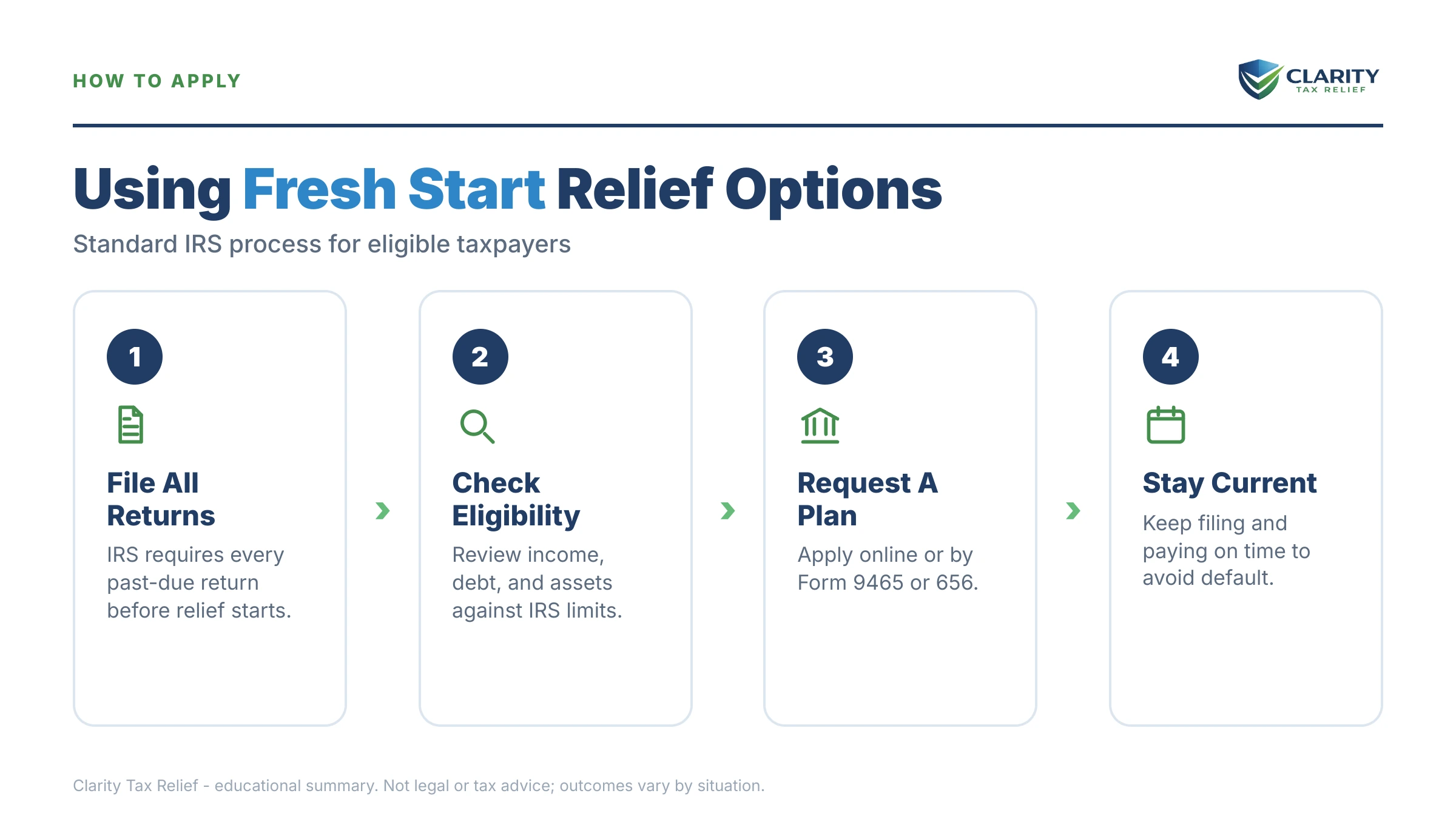
How to apply for IRS Fresh Start relief, step by step
- Pull your IRS records — log into your IRS online account or request account transcripts to confirm exactly what you owe, for which years, and whether any returns are missing.
- File every missing return — the IRS will not approve a payment plan, offer, or hardship status while required returns are unfiled. Get filing-compliant first.
- Match your numbers to a program — compare your balance and monthly budget against the thresholds: full payment within 180 days, a monthly plan up to 72 months, an Offer in Compromise, or Currently Not Collectible.
- Apply through the right channel — use the Online Payment Agreement tool or Form 9465 for payment plans, the Form 656 booklet for an offer, or Form 433-F financials for hardship status.
- Request penalty relief — ask for First-Time Abate if your prior three years are clean, and from summer 2026, check whether the new Automatic Exemption from Penalty already covers you.
- Stay compliant going forward — file and pay on time, including estimated taxes if you're self-employed. A missed future obligation can default the whole arrangement.
When you can handle Fresh Start yourself — and when help changes the outcome
Most people with one balance under $25,000 and no unfiled years can set up their own Fresh Start resolution online in an afternoon. If you agree with the amount, the streamlined plan tool asks a handful of questions and issues an agreement on the spot — no professional needed, and anyone who tells you otherwise is selling. Our guide to settling tax debt yourself walks the whole DIY path.
Experienced help earns its fee in specific situations: a levy or garnishment already in motion (releases are time-sensitive and procedural), multiple unfiled years (the order you file in changes what you owe), business or payroll tax debt (personal liability rules apply), balances over $50,000 (financial disclosure and human review), OIC candidacy (RCP math done wrong wastes the fee and months), and divorce-tangled joint liabilities where innocent spouse relief might beat every payment option. In those cases, the question isn't whether you can file the forms — it's whether you know which sequence produces the smallest number.
If your situation includes a levy in motion, several unfiled years, or a joint balance you're not sure you even owe, a free case review at (888) 825-7779 can map the sequence before another month of penalties posts.
Fresh Start terms, decoded
- Fresh Start Initiative — the 2011–2012 IRS policy changes (higher lien thresholds, easier plans, broader OIC terms) whose name now labels the whole menu of collection alternatives.
- Reasonable Collection Potential (RCP) — the IRS's formula for the most it could ever collect from you: asset equity plus a multiple of monthly disposable income; it sets the floor for any acceptable offer.
- CSED — the Collection Statute Expiration Date, generally 10 years after assessment, after which the IRS can no longer collect — but it pauses during offers, appeals, and bankruptcy.
- Streamlined installment agreement — a payment plan approved without detailed financial disclosure because the balance falls under the published thresholds.
- Currently Not Collectible (CNC) — an IRS status that pauses collection because paying would prevent basic living expenses; the debt and interest remain.
- AEP — Automatic Exemption from Penalty, the relief replacing First-Time Abate starting summer 2026; it applies automatically, with no request required.
IRS Fresh Start 2026 questions, answered
Is the IRS Fresh Start program real in 2026?
Yes — but it's a label, not a single program you enroll in. "Fresh Start" refers to a set of real IRS collection policies dating to 2011–2012: expanded payment plans, easier lien withdrawal, and broader Offer in Compromise terms. Anyone promising a "new 2026 Fresh Start Program" with an enrollment deadline is describing something that does not exist.
What are the requirements for the IRS Fresh Start program in 2026?
The core requirement for every option is filing compliance — all required returns filed. Beyond that, each program has its own test: online payment plans require a balance of $50,000 or less, an Offer in Compromise requires proving the IRS could never collect the full debt, and Currently Not Collectible requires showing that paying anything would leave you unable to cover basic living expenses.
Did the IRS launch a new Fresh Start program for 2026?
No new Fresh Start legislation or program launched for 2026. The one genuinely new development is Automatic Exemption from Penalty (AEP), which begins replacing First-Time Abate in summer 2026 and applies qualifying penalty relief automatically, with no request needed. Everything else — payment plan thresholds, OIC rules, hardship status — carries forward from existing law.
How do I apply for the IRS Fresh Start program?
There is no single Fresh Start application. You apply to the specific program that fits: payment plans through the Online Payment Agreement tool or Form 9465, an Offer in Compromise through the Form 656 booklet with a $205 fee, and Currently Not Collectible by submitting financials, usually on Form 433-F. Filing all required returns comes first — the IRS won't approve any arrangement while returns are missing.
Does the IRS Fresh Start program hurt your credit?
No. Since 2018, the credit bureaus no longer include federal tax liens on credit reports, and payment plans and OICs are not reported to credit bureaus at all. A filed Notice of Federal Tax Lien is still a public record that lenders can find during underwriting, so it can affect a mortgage application even though it won't move your score.
Can Fresh Start remove penalties and interest?
Penalties, often; interest, rarely. First-Time Abate can erase failure-to-file and failure-to-pay penalties if your prior three years were clean, and starting summer 2026 the IRS's Automatic Exemption from Penalty applies similar relief automatically. Interest is set by statute and is generally only removed when the underlying tax or penalty it grew from is removed.
How much does the IRS Fresh Start program cost?
The government's own fees are modest: $0 for a short-term payment plan, setup fees that vary for long-term plans (reduced or waived for low-income taxpayers and direct-debit setups), and a $205 application fee for an Offer in Compromise, waived entirely if your income is at or below 250% of the federal poverty level. Penalties and interest keep accruing until the balance is resolved, which is usually the bigger cost.
Does Fresh Start stop wage garnishment or levies?
An approved arrangement generally stops new levy action — the IRS does not garnish wages while you're in an accepted installment agreement, a pending Offer in Compromise, or Currently Not Collectible status. It doesn't automatically undo a levy already in motion, and defaulting on your agreement puts collection back in play. If a levy is active now, that release is a separate, urgent request.
Can I use Fresh Start for tax debt from a joint return after divorce?
Yes — and you may have options beyond it. The IRS can collect a joint-return balance from either spouse regardless of what the divorce decree says. You can resolve your exposure through any Fresh Start option, or, if the debt traces to your ex-spouse's income or errors, innocent spouse relief may remove your liability for some or all of it.
Your next 24 hours
- Confirm your real balance. Log into your IRS online account (or pull your latest notice) and note the total owed, the tax years, and which notice stage you're at — that stage decides how much time you have.
- Gather three things: your last filed return, every IRS notice you've received, and a rough monthly budget of income and essential expenses. That's everything needed to match you to a program.
- Get the free case review. Use the 2-minute form or call (888) 825-7779. There's no Fresh Start deadline to beat — but penalties and interest post every month, and the review tells you in one call whether a plan, an offer, hardship status, or penalty relief is your cheapest exit.
Primary sources: the IRS's own pages on payment plans and installment agreements and the Offer in Compromise list the current thresholds and fees. If you're stuck in IRS processing limbo, the independent Taxpayer Advocate Service is a free resource within the IRS.
This guide is general information, not tax or legal advice for your specific situation. Eligibility for IRS programs depends on individual facts and circumstances; no outcome is guaranteed.