
IRS Programs
Is the IRS Fresh Start Program Real? The Honest 2026 Answer
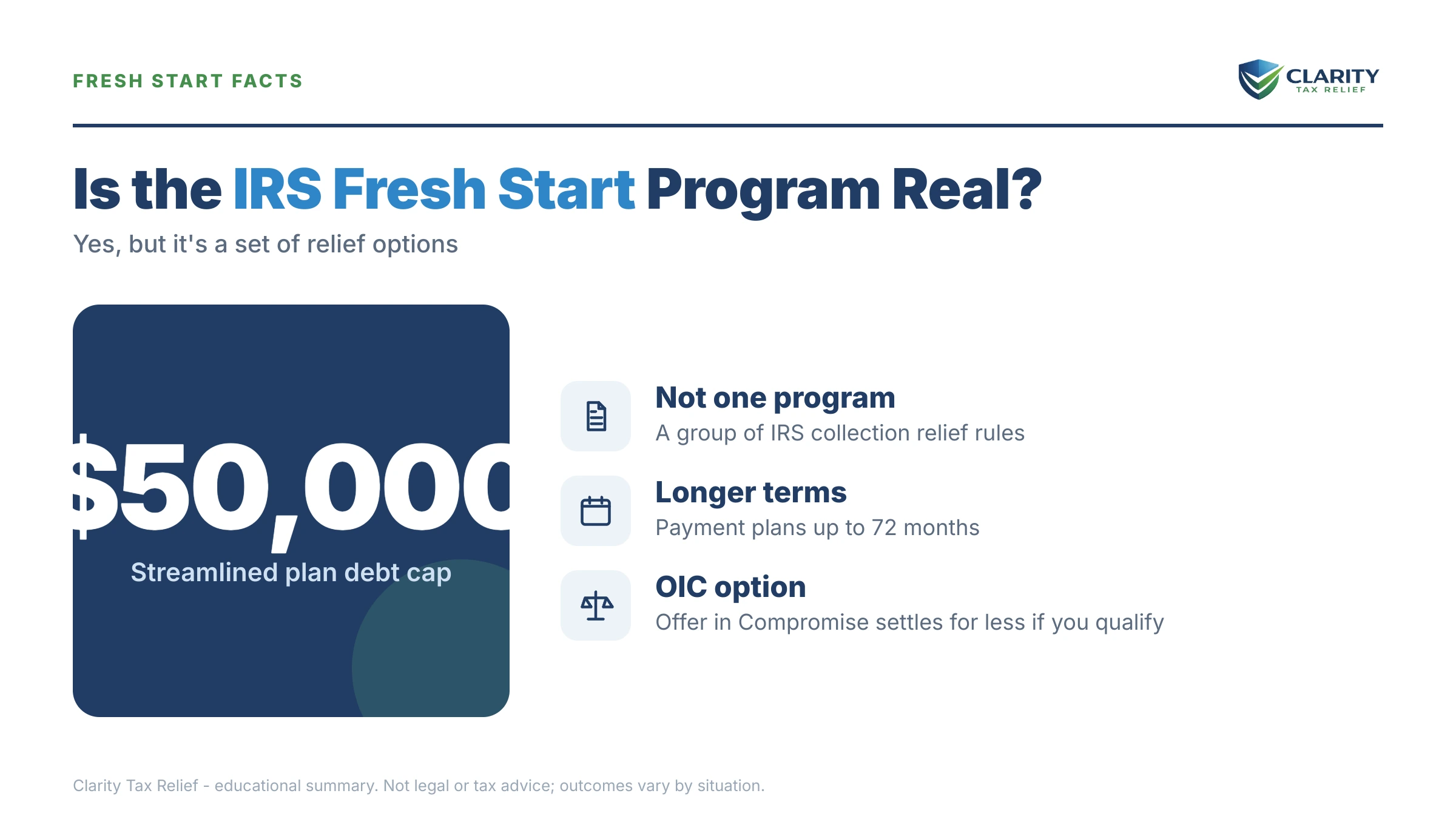
The short answer: yes, the IRS Fresh Start program is real — but it is not a single program you apply to. "Fresh Start" is the IRS's name for a set of 2011–2012 policy changes that loosened lien rules, payment plans, and Offer in Compromise math. Those changes are permanent policy in 2026, and free to use directly.
You heard a radio ad, saw a Facebook post, or got a slick letter promising the "IRS Fresh Start Program" can erase your tax debt — and your gut told you to check before calling the number. Good instinct. Searching "is the IRS Fresh Start program real" is exactly the right move, because the answer is both yes and no: the policy is real, and the way it's usually sold to you is not.
This guide separates the two — what the IRS actually changed, what those changes are worth to someone who owes a few thousand dollars, and how to spot the version that's just a sales funnel wearing a government-sounding name.
⏱ The real clock: there is no Fresh Start enrollment deadline — any ad claiming the program "expires soon" is a sales tactic. The clock that actually matters is accrual: the failure-to-pay penalty adds 0.5% of your balance every month, and interest compounds daily, until you get into a resolution.
Yes, the IRS Fresh Start program is real — here's where it came from
Fresh Start is the IRS's own name for collection policy changes announced in 2011 and expanded in 2012 — not a law, not a form, and not an enrollment window. The IRS launched it after the 2008–2009 recession left millions of households behind on taxes, and the changes were designed to make it easier to resolve a balance without a lien or levy wrecking your finances first.
Three changes did most of the work:
- Lien rules loosened. The IRS raised the threshold at which it generally files a Notice of Federal Tax Lien to $10,000, and created a path (Form 12277) to withdraw a lien — erase it as if never filed — for taxpayers on direct-debit payment plans with balances of $25,000 or less.
- Payment plans widened. The streamlined installment agreement threshold doubled from $25,000 to $50,000, with repayment terms stretched to 72 months and no detailed financial disclosure required.
- Offer in Compromise math softened. The IRS cut the number of months of future income it counts when valuing an offer, which dramatically lowered acceptable offer amounts for people with genuine hardship.
All of that was folded into standing IRS collection policy years ago. It has only expanded since — short-term plans now run up to 180 days, and online payment plans cover balances up to $50,000. What's genuinely changed lately (including the new automatic penalty relief arriving in summer 2026) is covered in our companion guide to IRS Fresh Start 2026 changes, and the full eligibility rules live in our guide to IRS Fresh Start program requirements.
Here's the part that creates all the confusion: the IRS never built anything called a "Fresh Start application." There is no box to check, no enrollment portal, no certificate. Marketing companies took the name of a policy memo and turned it into a brand — which is why the ads sound official and the IRS website barely mentions it.
What happens to your tax debt while you research
An unresolved IRS balance moves through an automated notice sequence whether or not you ever call anyone. In 2026, with the IRS workforce down roughly 27% from 2025 cuts, humans are harder to reach — but the notice and levy systems are automated and never stopped running. The sequence looks like this:
- CP14 — first bill. You typically have about 21 days from the notice date before the system queues the next letter. This is the cheapest moment in the entire sequence.
- CP501 / CP503 — reminders. Still just bills, but the failure-to-pay penalty and daily interest are compounding the balance every month.
- CP504 — intent to levy your state refund. Under IRC §6331(d), the IRS can now take your state tax refund, and a federal tax lien becomes a live possibility. This is not yet the final notice.
- LT11 / Letter 1058 — final notice of intent to levy. A 30-day clock starts, along with your Collection Due Process rights (requested via Form 12153). After 30 days, wage and bank levies become legal.
- Levy. A bank levy freezes funds for 21 days before they're sent to the IRS; a wage levy is continuous until released; Social Security can be levied up to 15% through the Federal Payment Levy Program.
Two escalations bite people with larger or multi-year debts specifically: once a combined balance passes $66,000 (the 2026 threshold), the IRS can certify the debt to the State Department and block passport renewal, and any unfiled years disqualify you from every resolution program until they're filed. The stage you're at when you finally act determines how many options you still have — which is why "researching Fresh Start" should take days, not months.
Not sure which Fresh Start pitch to believe?
Send us whatever letter or quote you're looking at. An experienced tax professional will tell you — free — whether it's a real IRS option for your numbers or a sales script, and what the direct route would cost you instead. Interest and penalties accrue monthly until something is in place, so the review is worth doing this week.
The real programs under the Fresh Start umbrella in 2026
"Fresh Start" in 2026 is really five ordinary IRS programs, each with its own eligibility line and cost. The full DIY playbook for each lives in our pillar on how to settle tax debt yourself; here's the map:
| Program | Who fits (2026 thresholds) | Cost & catches |
|---|---|---|
| Short-term payment plan | Can pay in full within 180 days | $0 setup fee; interest and penalties still accrue |
| Guaranteed installment agreement | Owe $10,000 or less, compliant filing history, pay within 3 years | IRS must accept; small setup fee; no lien typically filed |
| Streamlined installment agreement | Owe $25,000 or less ($50,000 with direct debit); up to 72 months online at $50,000 or under | No financial disclosure; setup fee reduced with direct debit, waived or reduced for low income |
| Offer in Compromise | Assets + future income genuinely can't cover the debt (means-tested) | $205 fee + 20% down on lump-sum offers — both waived with low-income certification; ~1 in 5 accepted in FY2024 |
| Currently Not Collectible | Paying anything would prevent basic living expenses (documented on Form 433-F) | Free; debt remains and interest accrues; reviewed when income rises |
| Penalty relief (FTA / AEP) | Clean compliance for the prior 3 years | Free; removes penalties, not tax; AEP makes it automatic starting summer 2026 |
Payment plans are where roughly nine out of ten "Fresh Start" callers actually land. If you owe $10,000 or less and have filed and paid on time historically, the guaranteed installment agreement means the IRS cannot say no. Under $50,000, you can set the whole thing up online in one sitting — our comparison of the best way to pay the IRS ranks each method by total cost. One catch that trips up self-employed readers: the IRS expects you current on this year's estimated taxes before it approves a plan for last year's debt.
The Offer in Compromise is the piece the ads are actually selling, and it's real — the IRS will accept less than you owe when its own math says the full amount is uncollectible. That math is called Reasonable Collection Potential: your available asset equity plus a set number of months of your future disposable income. If RCP comes out below your balance, an offer is viable; if it comes out above, the IRS rejects the offer no matter who files it. You can estimate your own numbers with our Offer in Compromise Calculator before anyone charges you a dime, and the full mechanics are in how an offer in compromise actually works. Two honest data points the ads omit: the IRS accepted roughly 1 in 5 offers in FY2024, and if the IRS doesn't decide within 2 years, the offer is automatically accepted by law — with narrow exceptions: a returned or rejected offer stops the clock, and time during court disputes does not count. Low-income certification (AGI at or below 250% of the federal poverty level) waives the $205 fee, the 20% down payment, and payments during review.
Currently Not Collectible pauses collection entirely when your budget genuinely can't absorb any payment — see Currently Not Collectible status for the hardship test. The debt doesn't vanish; the 10-year collection statute keeps running while the IRS leaves you alone.
Penalty relief is the quiet workhorse. First-time penalty abatement removes failure-to-file and failure-to-pay penalties for anyone with a clean prior 3 years — and starting summer 2026, the new Automatic Exemption from Penalty (AEP) applies that relief automatically, no request needed. On a balance that's been accruing for two years, that alone can cut hundreds or thousands off the total.
One boundary worth knowing: Fresh Start is federal only. If you also owe a state — California's FTB can collect for 20 years, and New York converts debts into public tax warrants — the state runs its own separate programs with its own rules, and nothing you set up with the IRS touches the state balance.
Say you owe $7,400 after a divorce: the Fresh Start math
Here's a clearly hypothetical example with the arithmetic shown. Say you finalized a divorce last year and got a bill for $7,400 — a joint-year balance where withholding was set for two incomes that no longer exist together. First, a hard truth: even if your decree says your ex pays half, the IRS isn't bound by it and can collect the full joint amount from either of you (see divorce and IRS debt: who pays). Now the Fresh Start options, priced out:
- Short-term plan (180 days): $7,400 ÷ 6 ≈ $1,233/month. $0 setup fee, done in half a year, least interest paid. Realistic only if the divorce didn't also wreck your cash flow.
- Guaranteed installment agreement (3 years): $7,400 ÷ 36 ≈ $206/month, and because the balance is under $10,000 with a clean history, the IRS must approve it. Interest and the 0.5%/month late-pay penalty keep accruing, so the true total lands meaningfully above $7,400 — paying faster than the minimum always saves money.
- 72-month online plan: $7,400 ÷ 72 ≈ $103/month — the lowest payment, but the most accrual over six years. Useful as a floor, not a goal.
- Offer in Compromise: this is where the "settle it for less!" ad falls apart. Say you have $180/month left after IRS-allowed living expenses and $5,600 in usable car equity. A lump-sum offer values you at ($180 × 12) + $5,600 = $7,760 — more than the $7,400 you owe. The IRS's math says you can full-pay, so any offer gets rejected, and any firm that quoted you a settlement on those numbers was selling you a rejection.
- Penalty relief: if your prior 3 years were clean — common for someone whose first-ever balance came from the divorce year — first-time abatement (or AEP, once it starts in summer 2026) strips the penalties out of that $7,400 before you ever start paying.
The realistic best path for these numbers: request penalty abatement, then set up the guaranteed agreement at around $206/month and pay it down faster whenever cash allows. Total professional-fee cost of doing that directly: $0 beyond the IRS setup fee. That's the honest Fresh Start.
Real Fresh Start vs. the scam version: how to tell
The single most reliable tell is this: the real Fresh Start has no application, no deadline, and no enrollment fee — so any pitch built around those three things is marketing, not the IRS. The name shows up constantly in tax relief scams, and its close cousin — "IRS one-time forgiveness" — is the same play with a different label.
| The pitch | The reality |
|---|---|
| "New 2026 Fresh Start Program — enroll before it closes" | Permanent policy since 2011–2012. No enrollment, no closing date. |
| "Settle for pennies on the dollar" | A debunked sales line. The OIC is means-tested; the IRS accepted roughly 1 in 5 offers in FY2024. |
| "Anyone with tax debt qualifies" | Every program has a threshold — balance caps, compliance history, or documented hardship. |
| "We'll stop all IRS collections immediately" | Relief has conditions and processing time; interest and penalties keep accruing throughout. |
| "The IRS called/texted you about Fresh Start eligibility" | The IRS initiates contact by mail. Unsolicited calls and texts about Fresh Start are not the IRS. |
Two related decoders help here. Official-looking "Final Notice — Fresh Start Initiative" mailers are usually private companies that bought lien records; our guide to real vs. fake IRS letters shows the markers of a genuine notice. And if someone calling about your "Fresh Start case" claims to collect for the IRS, check how to verify an IRS debt collector — only a handful of private agencies are authorized, and none of them pitch settlement programs.
To be clear: legitimate tax professionals also use the phrase "Fresh Start" as shorthand, and hiring representation is a reasonable choice for complicated cases. The line isn't whether a firm mentions Fresh Start — it's whether they quote you a settlement amount before analyzing your finances. The IRS's math decides what an offer is worth; anyone promising a number before doing that math is running the playbook we describe in OIC mills: how the scam works.
How to use the real Fresh Start programs, step by step
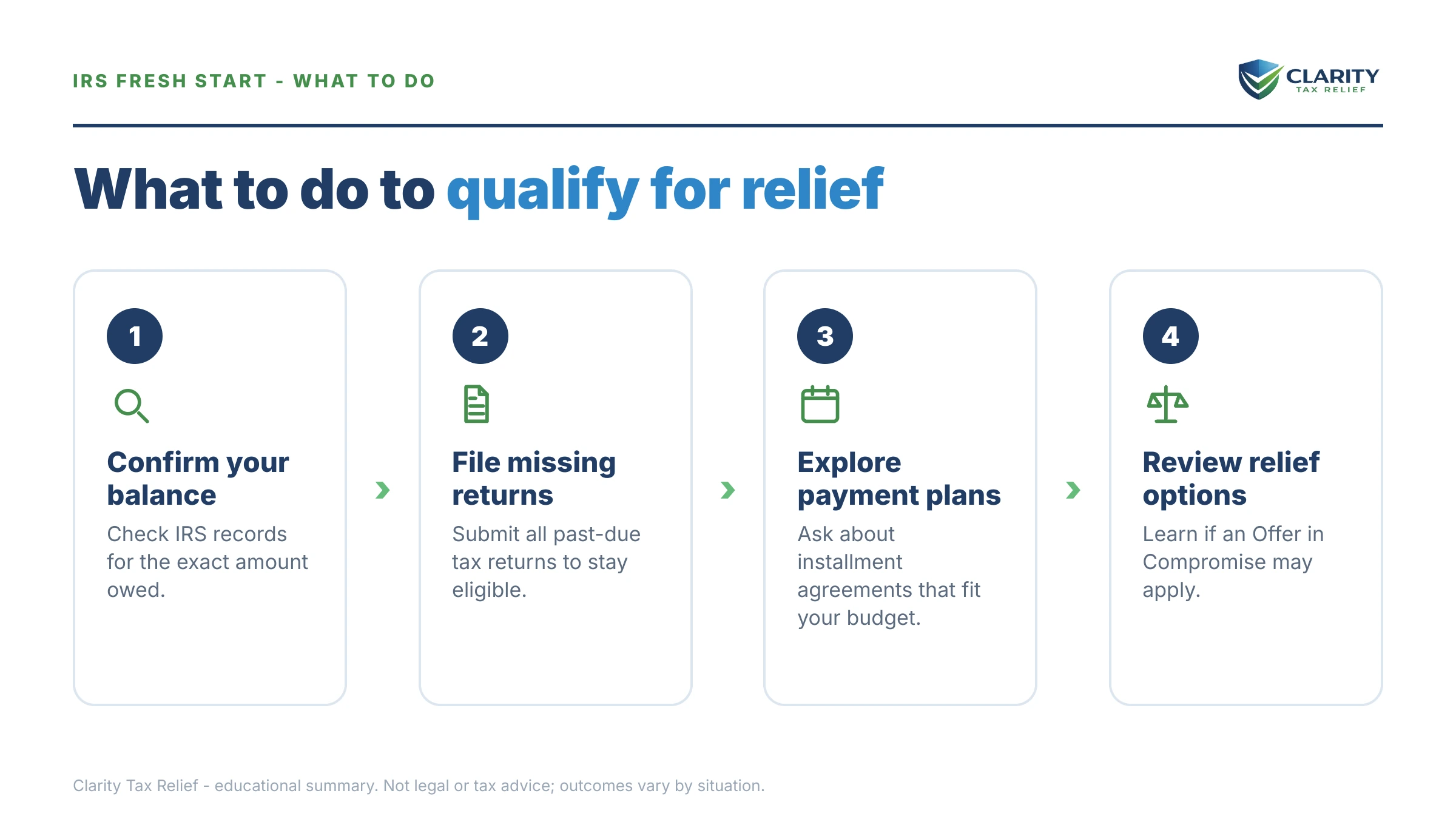
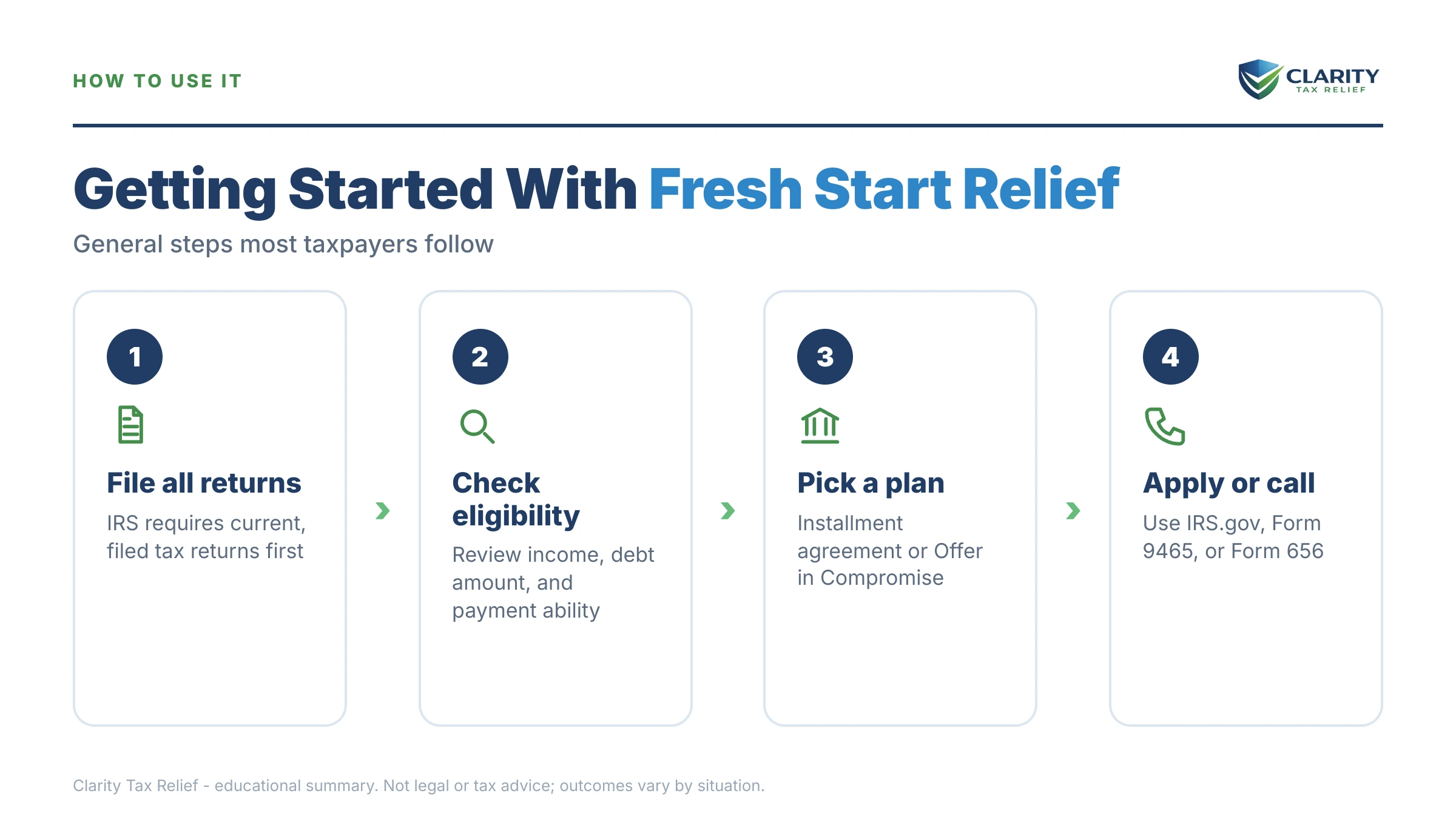
- Pull your real balance. Log into your IRS online account or request account transcripts so you're working from the IRS's numbers, not an ad's.
- File every missing return. No Fresh Start program will accept you with unfiled years, and filing stops the 5%-per-month failure-to-file penalty.
- Match your numbers to a program. Use the thresholds table above: your balance, your monthly ability to pay, and genuine hardship determine which door you fit through.
- Apply directly through IRS.gov. Set up a payment plan online in minutes, or submit Form 656 for an Offer in Compromise — you never need to pay anyone to "enroll in Fresh Start."
- Stay compliant going forward. Every agreement survives only if you file on time and pay new taxes as they come due; one missed year can default the whole arrangement.
Everything above lives on official channels: payment plan setup and terms at the IRS's payment plans and installment agreements page, the offer pre-qualifier and Form 656 booklet at the IRS's Offer in Compromise page, and — if the IRS itself is causing hardship or delay — free independent help through the Taxpayer Advocate Service.
Fresh Start deadlines and rights: what each window protects
Fresh Start itself has no deadline, but the collection notices arriving while you decide each carry one — and each window that closes takes a right with it.
| Trigger | Window | What's at stake |
|---|---|---|
| CP14 first bill | Typically 21 days from the notice date | The cheapest fix of the whole sequence; escalation queues after it passes |
| CP504 notice | The date printed on your notice | Your state tax refund becomes seizable; lien filing becomes likely |
| LT11 / Letter 1058 | 30 days from the notice date | Your Collection Due Process hearing right (Form 12153) — miss it and levies can begin |
| Balance reaches $66,000 (2026) | Ongoing once certified | Passport denial or revocation until you're in a qualifying agreement |
| CSED — 10 years from assessment | Fixed by law, paused by OIC, appeals, or bankruptcy | Collection ends at expiration; some resolution choices extend the clock, so know your dates first |
That last row matters more than most people realize: an Offer in Compromise pauses the 10-year collection clock while it's reviewed. If your debt is already old, filing an offer that gets rejected can leave you worse off than a payment plan that lets the statute run. Program choice is partly a calendar decision, not just a math decision.
When you can handle Fresh Start yourself — and when help changes the outcome
Most people asking whether Fresh Start is real can use it themselves, for free. You do not need professional help if:
- You owe $50,000 or less, all returns are filed, and you just need a payment plan — the online setup takes about 20 minutes.
- You agree with the balance and can pay within 180 days — the short-term plan costs nothing to set up.
- Your only issue is penalties after a clean 3-year history — first-time abatement is a phone call, and AEP will soon apply it automatically.
Experienced help genuinely changes outcomes in a narrower set of situations: a levy or garnishment already in motion, multiple unfiled years that have to be reconstructed and sequenced before any program will take you, business or payroll tax debt (which follows harsher rules), Offer in Compromise cases where the RCP math is close and how expenses are documented decides acceptance, and divorce-year debts where the real question is whether innocent spouse relief beats a payment plan entirely. In those cases the professional isn't selling access to Fresh Start — they're doing the analysis and sequencing that determines which door you can actually get through.
If your Fresh Start question has turned into a "which program fits my exact numbers" question, a free review with an experienced tax professional can map it in one call — (888) 825-7779 or the 2-minute form.
Terms in Fresh Start ads, decoded
- Fresh Start Initiative: the IRS's 2011–2012 collection policy changes — permanent policy, not an application or enrollment program.
- Offer in Compromise (OIC): a formal, means-tested agreement (Form 656) to settle a tax debt for less than the full amount when the IRS's math shows it can't collect in full.
- Reasonable Collection Potential (RCP): the IRS's valuation of you — asset equity plus months of future disposable income — that decides whether an offer is acceptable.
- Streamlined installment agreement: a payment plan approved without detailed financial disclosure, available at $25,000 or under ($50,000 with direct debit).
- Currently Not Collectible (CNC): a documented-hardship status that pauses collection; the debt and interest remain.
- CSED: the Collection Statute Expiration Date — generally 10 years after assessment, after which the IRS can no longer collect, though offers, appeals, and bankruptcy pause the clock.
Is the IRS Fresh Start program real? Your questions answered
Is the IRS Fresh Start program real or a scam?
The IRS Fresh Start program is real — it's the name the IRS gave a set of 2011–2012 collection policy changes that are still in effect in 2026. The scam version is the ad or robocall claiming it's a limited-time forgiveness program with an enrollment deadline. Used directly through IRS.gov, the underlying programs — payment plans, Offers in Compromise, penalty relief — cost little or nothing to request.
Is there an official IRS Fresh Start application or form?
No. No IRS form has "Fresh Start" on it anywhere. You apply to the underlying programs instead: Form 9465 or the Online Payment Agreement for an installment plan, Form 656 with Form 433-A (OIC) for an Offer in Compromise, and Form 843 for many penalty refund claims. Anyone selling you a "Fresh Start application" is charging you to fill out those standard forms.
Does the Fresh Start program forgive tax debt?
Only one piece of it can reduce what you owe: the Offer in Compromise, which is strictly means-tested — the IRS accepted roughly 1 in 5 offers in FY2024. Penalty abatement can remove penalties, which shrinks the total without touching the underlying tax. Most people qualify to restructure the debt, not erase it, and interest keeps accruing until the balance is resolved.
Who qualifies for the IRS Fresh Start program in 2026?
It depends on which piece you mean. Payment plans are the widest door: up to 72 months online for balances of $50,000 or less, and a guaranteed installment agreement under $10,000 if you've stayed compliant. An Offer in Compromise requires showing the IRS your assets and future income can't cover the debt. Currently Not Collectible requires documented financial hardship. Every path requires all returns filed first.
How much does the Fresh Start program cost?
There is nothing to enroll in, so enrollment is free. The underlying programs have modest costs: a short-term 180-day plan has a $0 setup fee, installment agreements carry a setup fee that drops with direct debit and is reduced or waived for low-income filers, and an Offer in Compromise costs $205 plus a 20% down payment on lump-sum offers — both waived if your AGI is at or below 250% of the federal poverty level.
Did the IRS Fresh Start program end, or does it expire?
It never expires — the 2011–2012 changes were folded into permanent IRS collection policy, and the thresholds have only loosened since. Any pitch that says the Fresh Start program "expires Friday" or is "closing to new applicants" is a sales tactic, not IRS policy. Specific dollar thresholds do get adjusted over time, which is the only real reason timing matters.
Is the Fresh Start call or letter I got actually from the IRS?
Almost certainly not. The IRS initiates contact by postal mail, not by phone calls, texts, or emails about "Fresh Start eligibility," and its real letters carry a notice number like CP14 in the corner. Companies buy lien records and mass-mail official-looking "Fresh Start Initiative" letters. Verify any balance yourself by logging into your IRS online account before responding to anyone.
Can the Fresh Start program remove a tax lien?
This is one of the genuinely real Fresh Start changes. The initiative raised the lien-filing threshold so the IRS generally doesn't file a lien below $10,000, and it created lien withdrawal through Form 12277 for taxpayers who enter direct-debit installment agreements on balances of $25,000 or less. After full payment, the IRS must release a lien, generally within 30 days.
Does the Fresh Start program stop wage garnishment?
Getting into a real agreement usually leads to a levy release, but nothing happens "instantly" the way ads claim. An approved installment agreement, Currently Not Collectible status, or a pending Offer in Compromise generally stops new levy action, and an active wage levy can be released once the agreement is in place. A wage levy is continuous until released, so acting before the LT11's 30-day window closes is far easier than acting after.
Your next 24 hours
- Get the real number. Log into your IRS online account (or pull your latest notice) and write down the exact balance for each year, plus how much of it is penalties — that penalty figure is what abatement may remove.
- Gather three things: your last filed return, proof of your current income, and — if the debt came from a joint year — your divorce decree and the notice showing whose name the balance is under.
- Get it mapped free. Bring those numbers to a free case review — the 2-minute form or (888) 825-7779 — and an experienced tax professional will tell you which real Fresh Start door your numbers fit through. The only clock running is accrual: every month unresolved adds penalty and interest to the balance.
This guide is general information, not tax or legal advice for your specific situation. Eligibility for IRS programs depends on individual facts and circumstances; no outcome is guaranteed.