
IRS Collections
Is This IRS Debt Collector Legitimate? How to Verify It in 2026
The short answer: yes, the IRS really uses three private debt collectors — CBE Group, Coast Professional, and ConServe. A legitimate one contacts you only after the IRS mails Notice CP40, can confirm the 10-digit authentication number on that letter, and never takes your money directly — every real payment goes to the U.S. Treasury.
The voice on the phone said they were collecting a federal tax debt "on behalf of the IRS," and every scam warning you've ever read lit up at once. Here's the uncomfortable twist: sometimes that call is real. The three checks in this guide settle the "is this IRS debt collector legitimate" question in about ten minutes — before a single dollar moves.
Everything turns on one document: IRS Notice CP40, the letter the IRS mails before any private agency is allowed to contact you. The image below shows you exactly what that assignment letter looks like and where to look for the number that proves — or disproves — the collector's story.
⏱ The real clock: a private collector's letter has no 30-day countdown — but if the debt is real, the 0.5% monthly failure-to-pay penalty plus daily compounding interest never pause while you decide. Take a day to verify, not a season. If the debt isn't real, the only clock is how fast the scammer can pressure you.
Why a private debt collector is contacting you about an IRS balance
Federal law lets the IRS assign certain old, inactive tax debts to exactly three contracted private collection agencies (PCAs): CBE Group, Coast Professional, and ConServe. These are typically balances that sat in the IRS collection queue for years without resolution — the IRS wasn't actively working the account, so it handed the phone calls to a contractor.
Two letters always come first. The IRS mails Notice CP40 telling you which agency now holds your account, and the agency mails its own introduction letter. Both carry the same 10-digit taxpayer authentication number, which you and the collector use to verify each other — you should never have to hand over your full Social Security number to prove anything. If you got a call before any letter, that alone is a red flag; the IRS explains why in its guidance on whether the IRS calls you at all.
Some accounts are never supposed to go to a PCA. Congress excluded most low-income taxpayers and those whose income is substantially from disability benefits, along with people in active audits or litigation, innocent-spouse claimants, taxpayers in disaster areas, and several other categories. If you fit one of those, you can ask for the account back — the assignment itself may be the error.
For the deeper background on the program and each contractor, see our companion guide to the IRS private collection agency program. This page stays focused on one job: proving whether the collector in front of you is real.
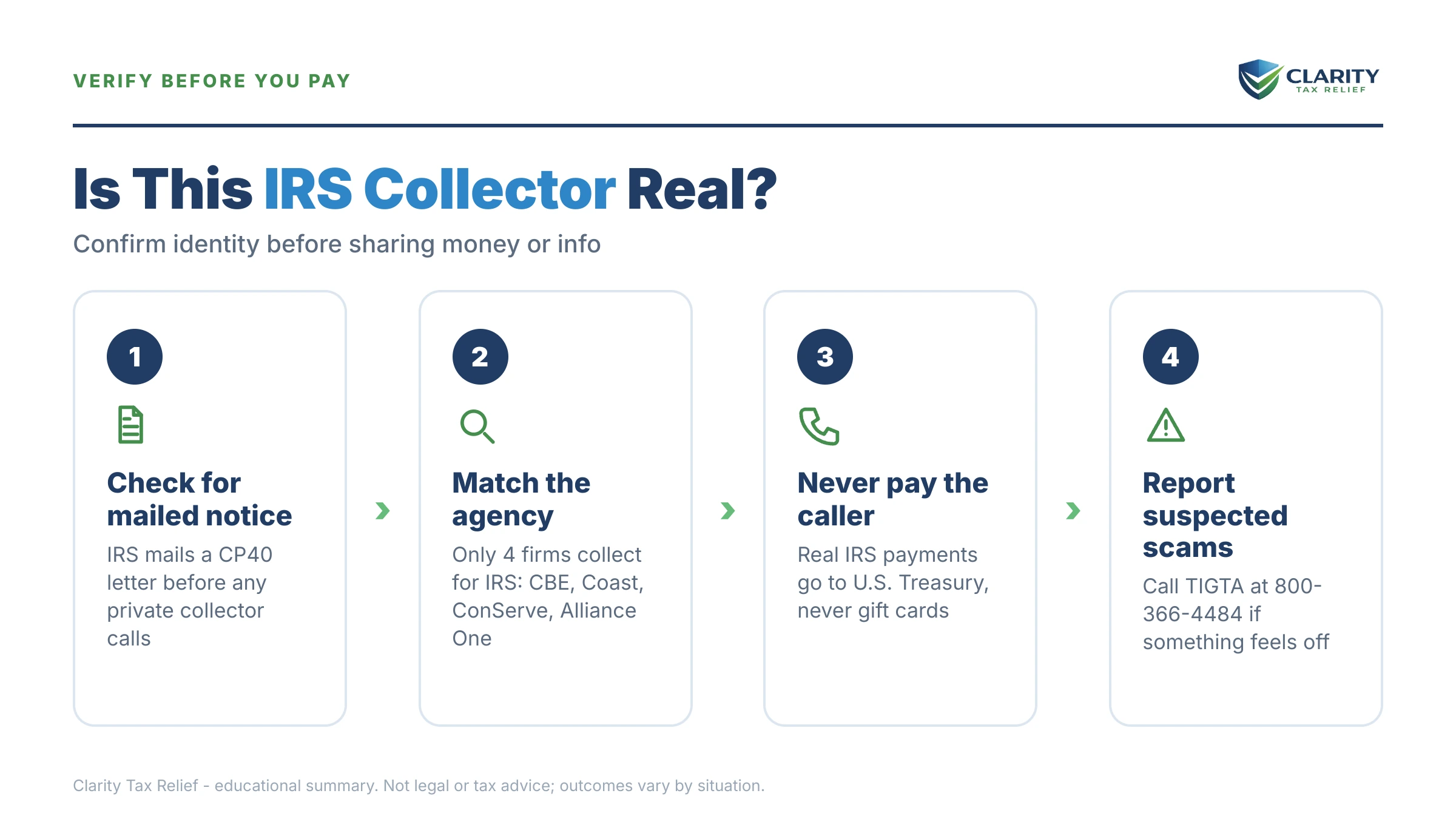
Is your IRS debt collector legitimate? The verification checklist
A legitimate IRS debt collector can pass three independent tests: the CP40 letter match, the balance match in your IRS online account, and a callback on a printed — not caller-ID — phone number. A scammer fails at least one every time, because the one thing they cannot fake is the IRS's own records.
Test 1 — the letters. Dig out your mail. No CP40 from the IRS and no introduction letter from the agency means no legitimate assignment exists, full stop. If you have the letters, the caller must be the agency named on them, and the 10-digit taxpayer authentication number must line up. (Worried the letter itself is fake? Here's how to tell if an IRS letter is real.)
Test 2 — your own IRS account. Log in at IRS.gov and check your balance by tax year. A real assignment sits on top of a real balance. If your account shows nothing owed — or a different amount — stop. Our IRS online account setup walkthrough gets you in within about 15 minutes if you've never registered.
Test 3 — the callback. Caller ID is trivially spoofed; scammers routinely display real agency names and even IRS numbers. Hang up and call back using only the phone number printed on your CP40 or the agency's mailed letter. A legitimate agency will pick up and know your account; a spoofer disappears.
| What happens | Legitimate PCA | Scammer |
|---|---|---|
| First contact | Mailed letters (CP40 + agency letter) before any call | Cold call, text, email, or social media message |
| Company name | CBE Group, Coast Professional, or ConServe only | Any other name — or a real name they can't back up |
| Identity check | Mutual verification with the 10-digit authentication number | Demands your full SSN, bank login, or card number |
| Where money goes | Only to the IRS — IRS.gov or a check to "United States Treasury" | Gift cards, wire transfer, crypto, payment apps, or "their" account |
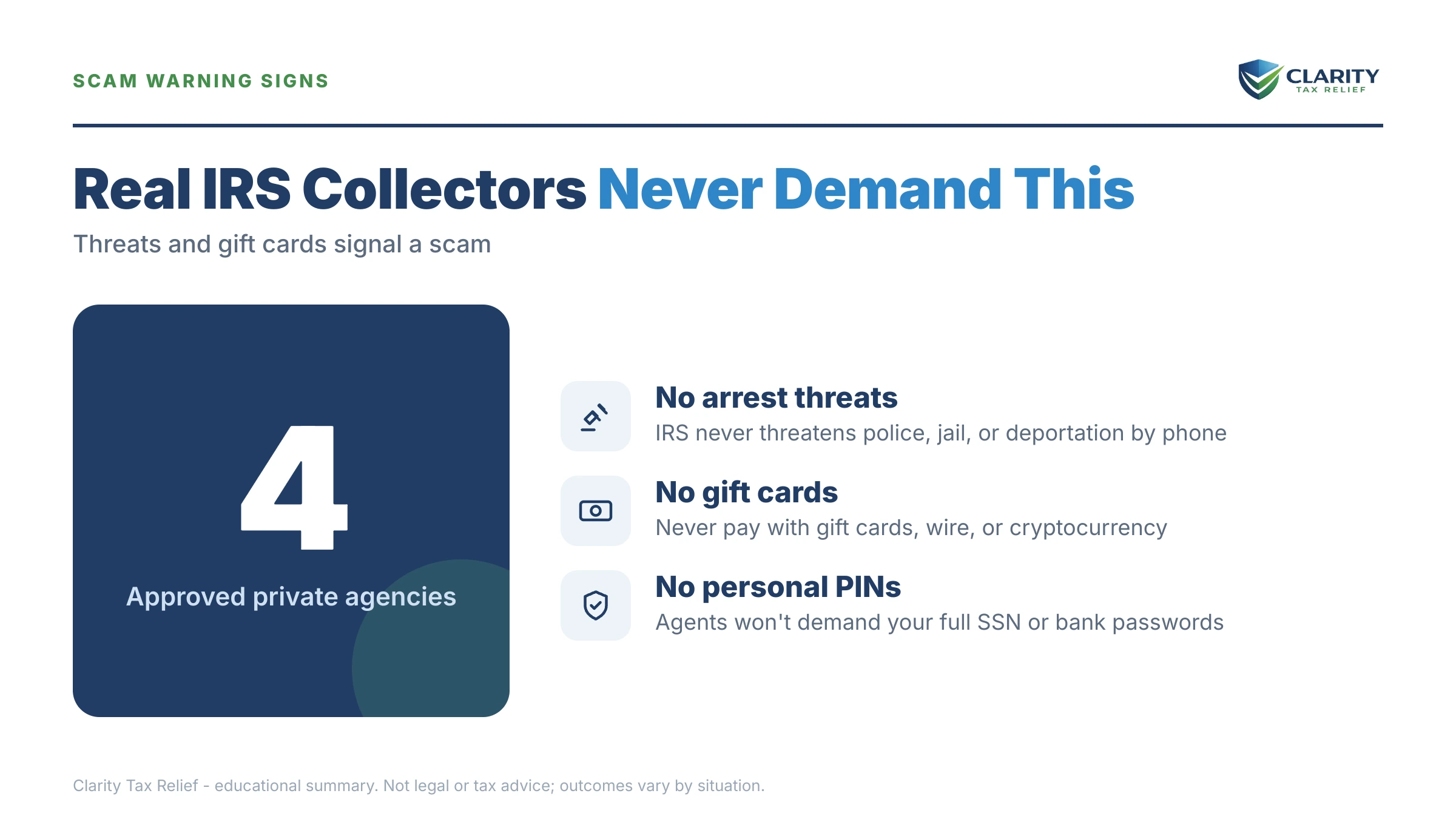
| Threats | None — a PCA has zero enforcement power | Arrest, deportation, license revocation, "police on the way" |
| Pressure | Gives you time to verify and check IRS records | Demands payment on this call, before you can check anything |
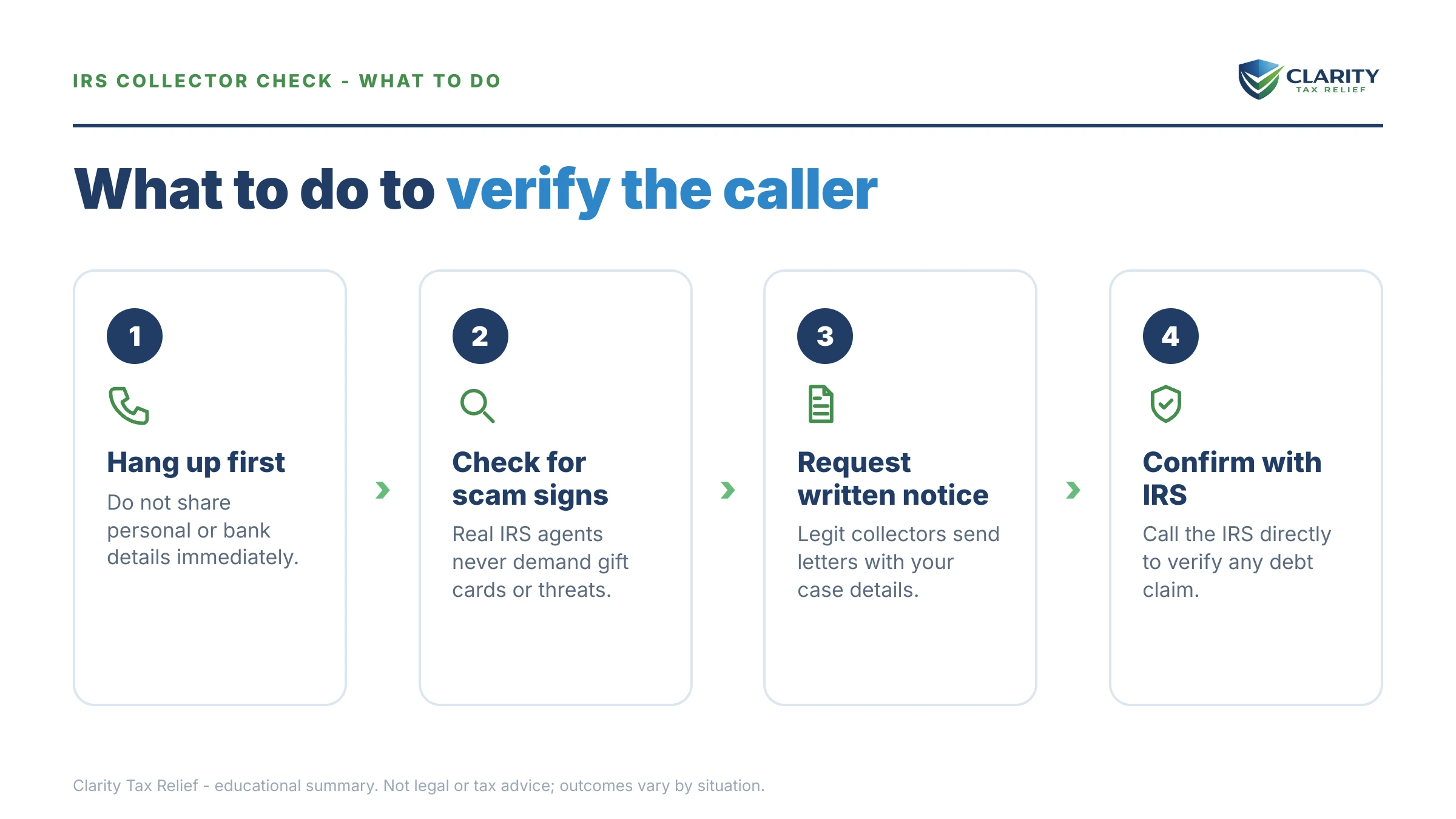
What an IRS private collection agency can — and cannot — do
A private collection agency working for the IRS has no levy, lien, garnishment, or arrest power — none. It can send letters, call you, discuss your balance, and set up a payment arrangement that runs through the IRS. That's the entire toolbox, and PCAs are bound by the Fair Debt Collection Practices Act on top of their IRS contract.
Everything with teeth stays with the IRS itself: only the IRS can garnish wages, levy a bank account, file a Notice of Federal Tax Lien, or seize property — and even then only after its own notice sequence with formal appeal rights. So the moment a caller threatens seizure "today" or police "on the way," they've told you what they are.
A PCA also can't process the IRS's relief programs. Hardship status, penalty abatement, and settlement offers all require the IRS — which matters when you're deciding whether to work with the agency or opt out, covered below.
What happens if you ignore a legitimate collector
Ignoring a legitimate PCA doesn't trigger a levy — but it doesn't freeze anything either, and the account eventually lands back with an agency that can enforce. The sequence runs like this:
- Letters and calls continue. The agency works the account — contact attempts, payment requests — with no power to force anything.
- The balance compounds the whole time. Interest accrues daily at the federal rate, and the failure-to-pay penalty adds 0.5% each month. Silence is the one option that's guaranteed to cost more.
- Your refunds keep disappearing. The IRS offsets every federal refund against the balance regardless of who holds the account.
- The account returns to the IRS. If the PCA gets nowhere, the file goes back into IRS inventory — where the automated notice ladder (CP501/CP503 → CP504 → LT11 final notice) and real levy power can resume.
- The 10-year collection clock keeps running. PCA assignment doesn't pause the CSED — the IRS generally has 10 years from assessment to collect, though appeals, offers, and bankruptcy can extend it. Since PCA debts are often already years old, it's worth knowing how long the IRS can collect back taxes in your case — you can estimate your own window with our CSED Calculator.
One honest caveat: "wait it out" is a real strategy only when the clock is nearly done and your finances are levy-proof. For most people, the growing balance and the eventual return to IRS enforcement make it the most expensive path on the list.
Not sure the collector calling you is real?
Send us the letter — or just the caller's name and number. An experienced tax professional will verify the contact, pull your real IRS balance, and map your cheapest way out before another month of penalties and interest posts. Free and confidential.
Verified it's real? Your options for the balance
Once the debt checks out, you have more options than the collector will describe — because a PCA can only process payment arrangements, while the IRS's full menu includes hardship status, penalty relief, and settlement. The complete DIY playbook lives in our guide to how to settle tax debt yourself — here's the short version matched to eligibility:
| Option | Who qualifies | What it costs |
|---|---|---|
| Pay in full | Anyone — pay via IRS.gov, never the agency | Stops the failure-to-pay penalty immediately; $0 fees |
| Short-term plan (up to 180 days) | Most taxpayers who can clear the balance within 180 days | $0 setup; interest and penalty accrue until paid |
| Guaranteed installment agreement | Individuals only; income-tax balance of $10,000 or less excluding penalties and interest; all returns filed; timely filing and payment for the past 5 years with no installment agreement in that period; full payment within 3 years | Setup fee applies; IRS must accept if criteria are met |
| Streamlined installment agreement | Up to $50,000, up to 72 months, set up online | Setup fee (reduced for direct debit); accrual continues |
| Currently Not Collectible | Genuine hardship — paying would leave you unable to cover basics; requires IRS, not the PCA | $0 to request; balance still grows, collection pauses |
| Offer in Compromise | Means-tested — assets and income genuinely can't cover the debt; per IRS data, the IRS accepted roughly 1 in 5 offers in FY2024 | $205 fee + 20% down on lump-sum offers (both waived with low-income certification) |
Wherever you land, the payment mechanics matter as much as the program — compare fees and posting times in the best way to pay the IRS, and if you're going the monthly route, here's how to set up an IRS payment plan online in one sitting. And if the collector — or anyone else — pitches "Fresh Start" as a magic program, read is the IRS Fresh Start program real first: the programs exist, the marketing around them often doesn't.
A worked example: $4,800, a collector calling, and a refinance on the calendar
Say you owe $4,800 from a return you filed three years ago, the account just landed with a PCA, and you're planning to refinance your mortgage this fall. Every number here is hypothetical, but the math is real.
The accrual first: the failure-to-pay penalty adds 0.5% per month — about $24 a month on $4,800 — plus daily interest at the federal rate, adjusted quarterly. That's roughly $300+ a year of pure drift for doing nothing.
The refinance angle changes the calculus. At $4,800 the IRS is unlikely to have filed a Notice of Federal Tax Lien, and keeping it that way matters: underwriters pull your history, and most lenders want either a zero IRS balance or a documented payment plan with a payment record before closing. Your two clean paths:
- Pay in full before underwriting — through IRS.gov, payable only to the United States Treasury. The balance zeroes, the penalty stops, and there's nothing to explain.
- Guaranteed installment agreement — at $4,800 you're under the $10,000 income-tax threshold (excluding penalties and interest), so if you're an individual who has filed all required returns, filed and paid on time for the past 5 years with no installment agreement in that period, and can pay the balance in full within 3 years, the IRS must accept. Thirty-six months puts the payment near $133/month plus accruing interest; paying it off early saves the remaining accrual, and a direct-debit plan gives your lender clean documentation.
Either way, the money and the paperwork run through the IRS — the collector's only legitimate role is pointing you there.
How to respond to an IRS debt collector, step by step
- Hang up and verify before paying anything. A legitimate collector will never object to verification. End the call politely; scammers escalate pressure, real agencies don't.
- Find your CP40 letter and match the authentication number. The 10-digit taxpayer authentication number on your CP40 must line up with what the collector can confirm. No CP40 and no agency letter means no legitimate assignment.
- Check your real balance in your IRS online account. Log in at IRS.gov and compare the balance by tax year. If the amounts don't match — or no balance exists — stop and report the contact.
- Call the agency back on the number printed on the letters. Never trust caller ID, which is easily spoofed. Use only the phone number on your CP40 or the agency's own mailed letter.
- Resolve the debt through the IRS — or opt out. Set up payment directly with the IRS, or send the agency a written request to return your account to the IRS if you'd rather not deal with a private collector at all.
If the contact fails verification, report it: IRS impersonation scams go to the Treasury Inspector General for Tax Administration at TIGTA.gov. And if a company then offers to "fix" the fake debt for a fee, that's a second scam riding the first — our tax relief scams guide covers the pattern.
When you can handle this yourself
Most people who verify a legitimate PCA contact don't need professional help. If the balance is a few thousand dollars, you agree you owe it, and your returns are filed, the verification steps above plus an online payment or payment plan finish the job in an afternoon — at $0 beyond the IRS's own setup fee.
Experienced help changes the outcome in a narrower set of situations: the balance is large or spans multiple years, you have unfiled returns behind the debt, you dispute the amount, the debt is old enough that the collection statute is genuinely in play, or you may qualify for hardship status or an Offer in Compromise — the options a PCA can't process and won't calculate for you. A time-pressured refinance with a lien risk on the table is another one, because sequencing the payoff against underwriting has real dollars attached.
If any of those fit, a free case review with an experienced tax professional costs nothing and tells you whether the DIY path or the represented path is cheaper — start here or call (888) 825-7779.
Terms on the letters, decoded
- PCA (private collection agency): one of the three companies the IRS contracts to work old, inactive tax debts — CBE Group, Coast Professional, or ConServe.
- Notice CP40: the IRS letter announcing your account was assigned to a named PCA; it always arrives before the agency's first contact.
- Taxpayer authentication number: the 10-digit number on your CP40 and the agency's letter, used so you and the collector can verify each other without exposing your SSN.
- FDCPA: the Fair Debt Collection Practices Act — the federal law that bans harassment, false threats, and deception by debt collectors, including IRS contractors.
- CSED: the Collection Statute Expiration Date — generally 10 years from assessment, after which the IRS can no longer collect; certain events pause the clock.
- United States Treasury: the only payee that should ever appear on a check for a federal tax debt — never a collection agency's name.
IRS debt collector questions, answered
Does the IRS really use private debt collectors?
Yes. Under federal law the IRS assigns certain older, inactive accounts to three contracted private collection agencies. You'll always get IRS Notice CP40 by mail before the agency ever contacts you, and the agency sends its own letter with the same 10-digit authentication number. If a "collector" calls with no letters on file, treat it as a scam until proven otherwise.
Which collection agencies are authorized to collect for the IRS?
Only three: CBE Group, Coast Professional, and ConServe. Any other company claiming to collect a federal tax debt on the IRS's behalf is not legitimate. Even when the caller uses one of the right names, verify independently — scammers impersonate the real agencies — by matching the authentication number on your CP40 letter and checking your balance in your IRS online account.
Should I ever pay the collection agency directly?
No. Every legitimate payment goes to the IRS — electronically through IRS.gov or by check payable to "United States Treasury." A real private collection agency will tell you this itself. Anyone directing payment to the agency's own account, a gift card, a wire transfer, cryptocurrency, or a payment app is a criminal, no matter how official the call sounds.
Can an IRS private collector garnish my wages or freeze my bank account?
No. Private collection agencies have no enforcement power — they cannot levy wages or bank accounts, file liens, seize property, or have you arrested. Only the IRS itself can do those things, and only after its own notice sequence with appeal rights. A caller threatening immediate seizure or police action has identified themselves as a scammer.
What is IRS Notice CP40?
CP40 is the letter the IRS mails to tell you your account has been assigned to a private collection agency. It names the agency and includes a 10-digit taxpayer authentication number that you and the agency use to verify each other. Keep it — it's your proof of which agency is real. If you never received one, call the IRS before engaging with any collector.
Can I refuse to work with the private collection agency?
Yes. You can opt out by telling the agency — in writing is best — that you want your account returned to the IRS. The debt doesn't go away; the IRS resumes handling it, and interest and penalties keep accruing. Opting out makes sense if you want an option a private agency can't process, such as an Offer in Compromise or hardship status.
How do I check whether I actually owe the IRS money?
Log into your IRS online account at IRS.gov, which shows your balance by year, penalties, interest, and payment history. It's the one source a scammer can't fake. If the caller's amount doesn't match your account — or your account shows no balance at all — don't pay anything and report the contact.
Why did my account go to a collector instead of the IRS?
The IRS assigns accounts it isn't actively working — typically older debts that sat in the collection queue without resolution. It doesn't mean anything new happened or that enforcement is imminent. Some taxpayers are excluded entirely, including most low-income taxpayers and those in disaster areas, under audit, or in litigation; if you fit an exclusion, ask for the account back.
Your next 24 hours
- Find the letters. Pull your Notice CP40 and the agency's introduction letter, and locate the 10-digit authentication number and the agency's printed phone number. No letters, no legitimacy.
- Pull your own numbers. Log into your account at IRS.gov and note the balance by year — or confirm there isn't one. The IRS's own program page at IRS.gov private debt collection lists the current contractors, and every legitimate payment route runs through IRS.gov/payments. If a collector is mistreating you on a real debt, the Taxpayer Advocate Service exists for exactly that.
- Get the contact — and the balance — reviewed free. Whether the collector is real or not, an experienced tax professional can confirm it and price out your cheapest resolution before another month of penalty and interest posts. Use the 2-minute form or call (888) 825-7779.
This guide is general information, not tax or legal advice for your specific situation. Eligibility for IRS programs depends on individual facts and circumstances; no outcome is guaranteed.