
IRS Collections
IRS Private Collection Agency Calling You? What's Real, What's a Scam, and What to Do (2026)
The short answer: a real IRS private collection agency assignment is legal and happens to three companies only — CBE Group, Coast Professional, and ConServe. It always starts with IRS Notice CP40 in the mail, the agency can never levy or garnish anything, and every payment goes to the U.S. Treasury — never to the collector.
The phone rang, the caller said they're collecting an old tax debt "on behalf of the IRS," and everything you've ever heard says the IRS doesn't call people. Now you're second-guessing a debt you thought was behind you — maybe from a year you'd rather forget. Here's the good news: this situation has a built-in verification system, the caller has almost no power over you, and you have more options than they'll mention.
Everything hinges on one letter: Notice CP40, which the IRS mails before any private collector is allowed to contact you. The image below shows you exactly what this assignment letter looks like and where to look for the number that lets you verify — or expose — the caller.
⏱ The clock that's actually running: a private-collection assignment has no printed deadline — but your balance is not standing still. The failure-to-pay penalty adds 0.5% of the balance every month, interest compounds on top, and the 10-year collection statute keeps ticking whether or not you ever answer the phone.
Why your account went to an IRS private collection agency
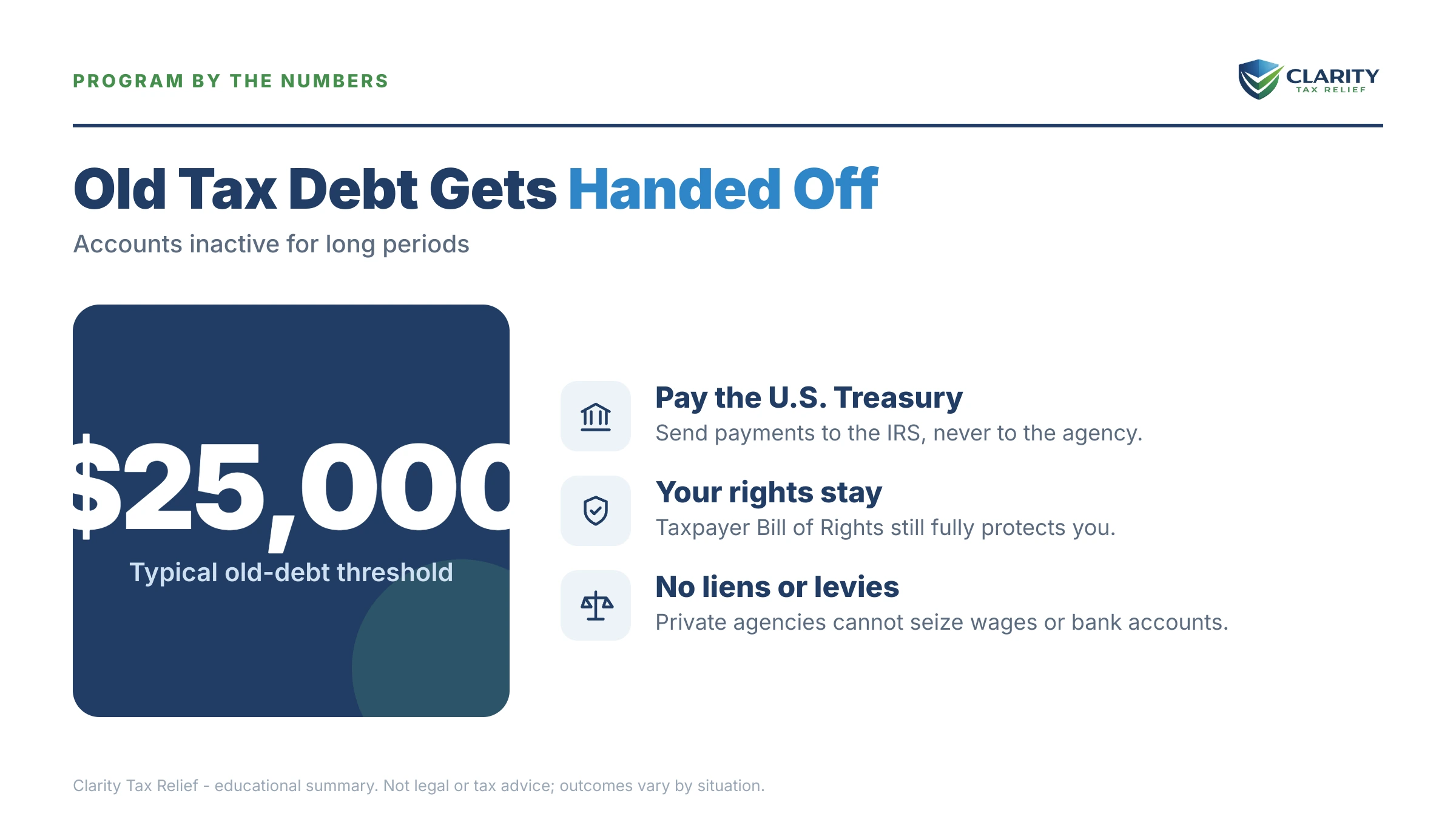
The IRS assigns older, inactive tax debts to private collectors under IRC §6306, a program Congress mandated in the 2015 FAST Act. "Inactive" is the key word: these are accounts the IRS itself stopped actively working — usually because no IRS employee is assigned to the case, the IRS couldn't locate you, or more than a year passed with no contact on the balance.
In other words, landing with a private collection agency (PCA) doesn't mean your case got more serious. It usually means the opposite: your debt sat in a queue so long the IRS outsourced the phone calls. With the IRS workforce cut roughly 27% in 2025, more dormant accounts than ever are flowing to the contractors — even as the IRS's own automated notices and levies continue running without them.
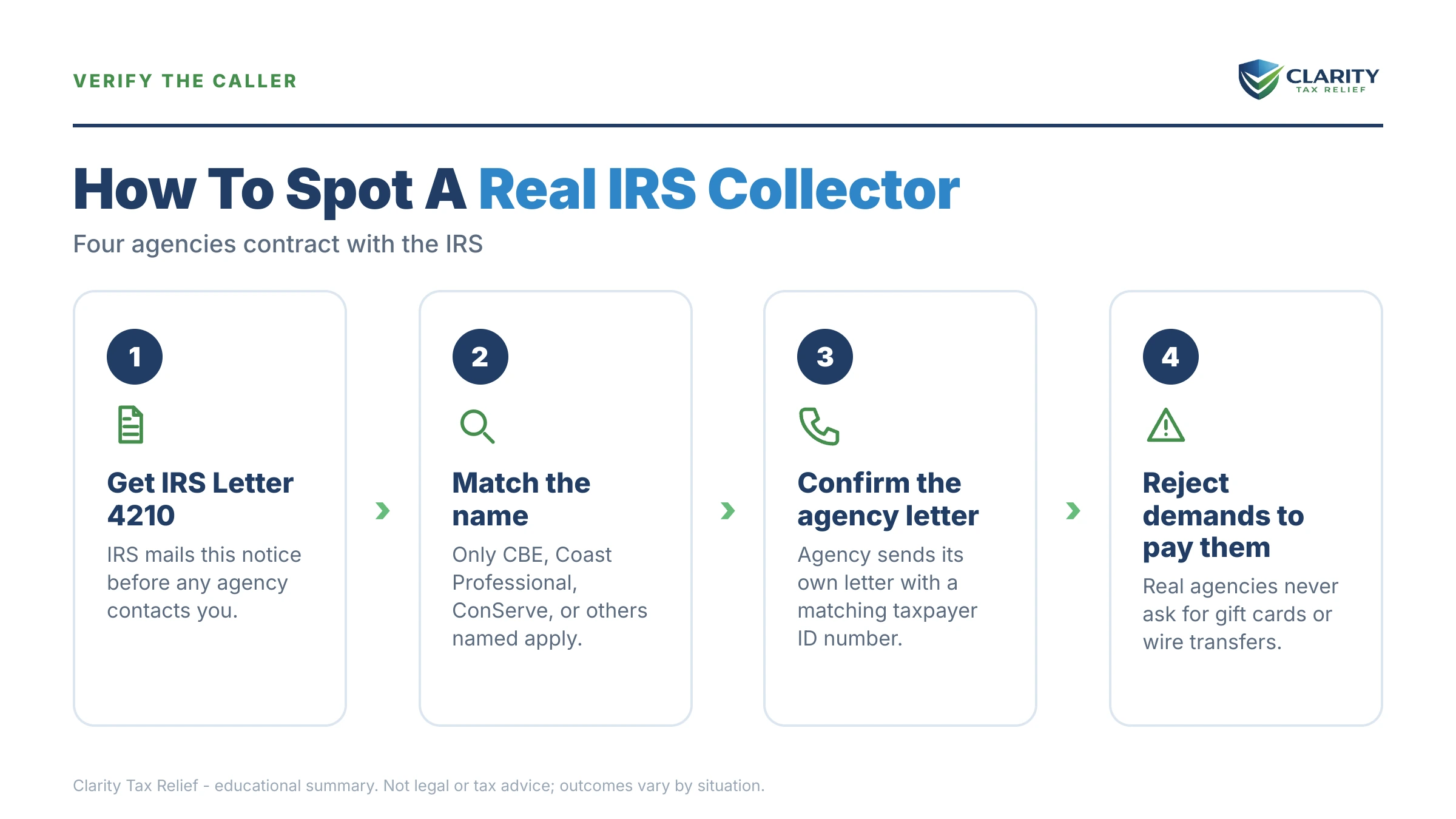
Before the agency can dial your number, two letters must arrive by mail: the IRS's CP40 announcing the assignment, then the agency's own introduction letter. Both letters carry the same 10-digit Taxpayer Authentication Number — the handshake code you and the collector use to verify each other on every call. A caller who can't work with that number is not your collector.
The three companies allowed to collect for the IRS in 2026
Only three private collection agencies are under contract with the IRS in 2026: CBE Group Inc., Coast Professional Inc., and ConServe. Your CP40 names which one holds your account — one of the three, never more than one at a time. Any caller claiming a different company name, or claiming to be "the IRS collections department" calling out of the blue, fails the test instantly; see does the IRS call you for how real IRS contact actually works.
These contractors are paid a percentage of what they collect (the statute allows up to 25%), which explains the persistence of the calls. They are bound by the Fair Debt Collection Practices Act: no threats, no calls at unreasonable hours, no discussing your debt with neighbors or family. If the caller's behavior violates those rules, that alone is a red flag — walk through our checklist on whether an IRS debt collector is legitimate before you say another word.
What a private collection agency can — and can't — do
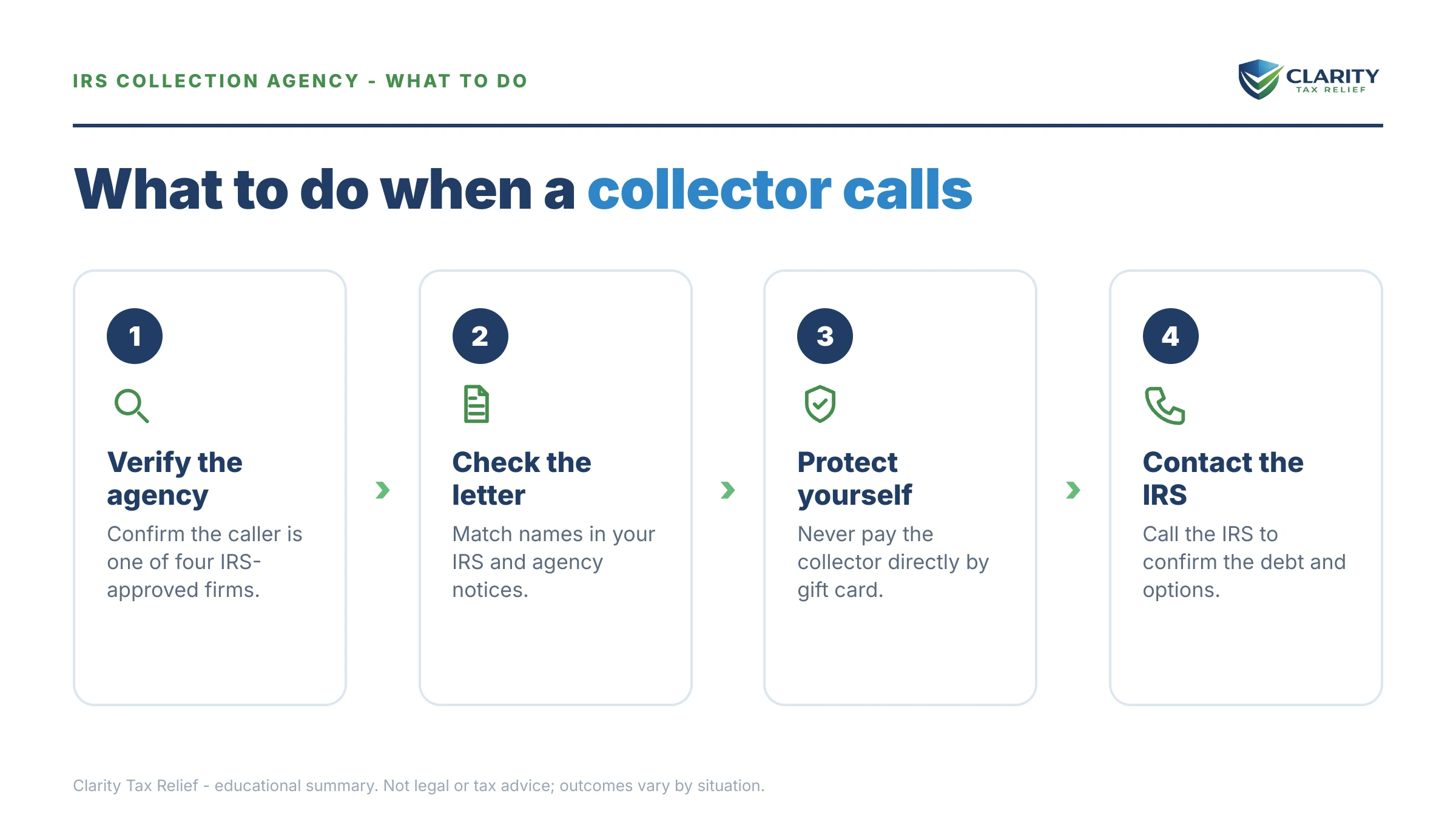
A private collection agency working for the IRS has no enforcement power at all — it cannot levy, lien, garnish, or seize anything. Its entire toolkit is letters, phone calls, and the ability to set up a payment arrangement. Every scary thing you associate with the IRS stays with the IRS, behind the IRS's own notice sequence and your appeal rights.
| Action | Private collection agency | The IRS itself |
|---|---|---|
| Call and write you about the debt | Yes — after the CP40 and its own letter arrive | Yes, mostly by mail |
| Set up a payment plan | Yes — arrangements of up to 7 years | Yes — plans up to 72 months and beyond |
| Accept your payment | Never — payment goes only to the U.S. Treasury or IRS.gov | Yes |
| File a federal tax lien | No | Yes |
| Levy bank accounts, wages, or Social Security | No | Yes, after final notice and appeal rights |
| Accept an offer in compromise or grant hardship status | No — those go through the IRS | Yes |
| Threaten arrest, deportation, or license revocation | Never — that's a scam signature | Never for a civil debt |
The payment rule is your single best scam filter. A real PCA will never take your money — checks go to the United States Treasury, electronic payments go through IRS.gov. Anyone directing money to their company, a gift card, a wire, or a payment app is a criminal borrowing the program's name.
What happens if you ignore the collection calls
Ignoring a private collection agency doesn't make the debt dormant again — it restarts a sequence that can end back at the IRS with real enforcement power. Here's the order things move in:
- Calls and letters continue — while the balance grows by 0.5% a month in failure-to-pay penalty, plus compounding interest.
- Your refunds keep disappearing — assignment to a PCA doesn't stop the IRS from seizing any federal tax refund and applying it to the debt.
- The agency returns the account to the IRS — PCAs must send back accounts they can't resolve, and accounts where you opt out or dispute the debt.
- The IRS can resume active collection — meaning its own notice ladder toward levy: typically a CP504, then a final notice such as an LT11. The full sequence is mapped in the order of IRS collection letters.
- After the final notice, levies become legal — bank accounts, wages, and up to 15% of Social Security through the Federal Payment Levy Program. That last one matters enormously on a fixed income.
One more thing runs through all five stages: the 10-year collection statute (CSED). It does not pause while a PCA holds your account — but certain moves, like filing an offer in compromise or bankruptcy, do pause it, which is what extends the IRS collection statute in ways that surprise people. If your debt is old, you can estimate how much collection time may remain with our CSED Calculator before deciding anything.
A collector says you owe the IRS?
Before you confirm anything on that phone, let an experienced tax professional verify the assignment, pull your real IRS balance, and map your cheapest way out — free, confidential, no pressure. Interest and penalties are accruing either way; knowing where you stand costs nothing.
Your options when a private collector has your tax debt
You are never limited to what the caller offers — every IRS resolution program still applies to a debt in private collection. The agency can only arrange full payment or a payment plan; anything else, from hardship status to a settlement offer, runs through the IRS itself. (The general playbook for each program lives in our guide to how to settle tax debt yourself; here's how each one interacts with a PCA.)
| Option | Who it fits | Cost & what to know |
|---|---|---|
| Pay in full at IRS.gov | You agree with the balance and can cover it | No fee. Stops penalty accrual immediately; the assignment ends. |
| Short-term payment plan | You can pay within 180 days | $0 setup. Interest and the 0.5%/month penalty continue until paid. |
| Payment arrangement through the PCA | You need monthly payments; balance fits within 7 years | Payments go to the Treasury, never the agency. Accrual continues. |
| IRS installment agreement | Balances up to $50,000 — up to 72 months, set up online | Setup fee varies (reduced or waived for low income). Bypasses the PCA entirely. |
| Currently Not Collectible (CNC) | Paying anything would leave you unable to cover basic living costs | Requires financial disclosure (Form 433-F) to the IRS. Collection pauses; debt and interest remain. |
| Offer in Compromise | Your income and assets genuinely can't cover the debt before the statute runs | $205 fee plus 20% down on lump-sum offers — both waived if your AGI is at or below 250% of the poverty level. The IRS accepted roughly 1 in 5 offers in FY2024. |
| Opt out in writing | You'd rather deal only with the IRS | Free. The account returns to the IRS; the debt and accrual continue. |
A worked example: $7,400 in private collection on a Social Security income
Say you're retired, your income is a $1,780 monthly Social Security check plus a small pension, and a PCA is calling about $7,400 from a year you cashed out an investment. Left alone, the failure-to-pay penalty adds about $37 a month (0.5% × $7,400), plus interest at the IRS's quarterly rate — the balance grows by roughly $500+ a year doing nothing.
A seven-year arrangement through the collector works out to roughly $88 a month toward the balance ($7,400 ÷ 84 months), a bit more in practice because interest and penalty keep accruing until it's paid. If the IRS later resumed active collection and levied Social Security instead, the Federal Payment Levy Program could take about $267 a month (15% × $1,780) — with no regard for your rent or medications. The $88 plan you choose beats the $267 levy you don't.
But run the eligibility check first: if that $7,400 year was unusual and your AGI is now at or below 200% of the federal poverty level, your account arguably shouldn't be with a collector at all — and if paying $88 would leave you short on essentials, CNC hardship status may fit better than any payment plan. Our guide to IRS hardship on Social Security walks through that exact math for fixed incomes.
Who can't be sent to a private collection agency (and how to get pulled back)
Congress barred the IRS from assigning several categories of taxpayers to private collectors — and the Taxpayer First Act of 2019 added protections aimed squarely at people on fixed and low incomes. If any of these fits you, tell both the agency and the IRS in writing: the account should be returned.
| Your situation | PCA assignment allowed? |
|---|---|
| You receive SSI or SSDI | No — excluded by the Taxpayer First Act |
| Your AGI is at or below 200% of the federal poverty level (around $31,000 for a single person; the figure adjusts yearly) | No — excluded by the Taxpayer First Act |
| You're serving in a combat zone | No — see combat zone IRS collection relief |
| You're a confirmed identity-theft victim | No |
| The debt is under audit, appeal, or litigation, or an innocent spouse claim is pending | No |
| You already have an installment agreement or a pending offer in compromise | No |
| You're in a federally declared disaster area | Not while disaster relief applies |
Note the trap for retirees: regular Social Security retirement benefits are not on the exclusion list — only SSI and SSDI are automatic. A retiree qualifies for exclusion through the income test instead, so the number that matters is your AGI, not the fact that you're retired. More on the broader fixed-income picture in retired and owe back taxes.
How to respond to an IRS private collection agency, step by step
- Find your CP40 notice. Locate the IRS letter that assigned your account and the 10-digit Taxpayer Authentication Number printed on it — that number is your verification key for every call.
- Verify the caller before saying anything. Make the agency authenticate itself against your CP40 number, and confirm the company matches the one named on your notice. Never read out your SSN or bank details to "prove" who you are.
- Check the real balance at IRS.gov. Log into your IRS online account and compare the balance the collector quotes against what the IRS itself shows for each tax year.
- Choose your resolution path. Pay in full at IRS.gov, set up a payment arrangement (payments go to the U.S. Treasury only), pursue hardship status through the IRS, or opt out in writing if you'd rather deal with the IRS directly.
- Put opt-outs and disputes in writing. Send any opt-out request or balance dispute by mail, keep copies, and note the date — a paper trail protects you if the calls continue.
When you can handle this yourself — and when help changes the outcome
Handle it yourself when the pieces are simple: you received the CP40, the caller checks out, your IRS online account confirms the balance, and you can pay in full or within 180 days. Setting up a short-term plan or a streamlined monthly agreement takes one session at IRS.gov and no professional fee.
Experienced help earns its cost in the messier cases: you never got a CP40 and can't tell real from fake; you believe you qualify for an exclusion (SSI, SSDI, low income) and the account should never have been assigned; paying anything threatens your rent, utilities, or medications; the balance covers multiple years or years you never filed; or the debt is old enough that CSED strategy — not payment — may be the right lens. In those situations, the order you do things in changes what you ultimately pay, and a misstep on the phone can restart problems a professional would have routed around. The full map of where a PCA sits in the machine is in the IRS collection process step by step.
Terms on your CP40 and collection letters, decoded
- CP40: the IRS letter announcing your account was assigned to a named private collection agency — always mailed before any call.
- Taxpayer Authentication Number: the 10-digit code printed on your CP40 and the agency's letter, used so you and the collector can verify each other.
- Inactive tax receivable: the legal label for a debt the IRS stopped actively working — the only kind of account that can go to a PCA.
- PCA: private collection agency — one of the three IRS contractors, with no levy, lien, or seizure power.
- FDCPA: the Fair Debt Collection Practices Act, the federal law that limits how and when the agency may contact you.
- CSED: the Collection Statute Expiration Date — the end of the IRS's 10-year window to collect, which keeps running during a PCA assignment.
You can confirm everything above straight from the source: the IRS's official private debt collection program page lists the current contractors, and all payments run through IRS.gov/payments. If the assignment itself is causing hardship the agency won't acknowledge, the independent Taxpayer Advocate Service can intervene at no cost.
IRS private collection agency questions, answered
Is a call from an IRS private collection agency a scam?
Not necessarily — the IRS legally assigns older, inactive tax debts to three private companies: CBE Group, Coast Professional, and ConServe. A legitimate assignment always begins with Notice CP40 mailed by the IRS before any call, and both you and the agency hold the same 10-digit Taxpayer Authentication Number. If a caller cannot match your CP40's number, or asks for payment by gift card, wire, or payment app, hang up — that is a scam, not a contractor.
Which private collection agencies does the IRS use in 2026?
Exactly three: CBE Group Inc., Coast Professional Inc., and ConServe. No other company is authorized to collect federal tax debt, so a caller claiming any other firm name is not working for the IRS. Your CP40 notice names the specific agency assigned to your account — if the caller's company doesn't match, end the call and report it.
Do I pay the private collection agency directly?
Never. Every payment on a federal tax debt goes to the United States Treasury by check, or electronically through IRS.gov — even when a private agency arranges the payment plan. A PCA will never take your card number or route money to itself. Anyone directing payment to their own company, a prepaid card, or an app like Venmo or Zelle is a criminal impersonating a collector.
Can an IRS private collection agency garnish my Social Security or freeze my bank account?
No. Private collection agencies have zero enforcement power — no levies, no liens, no wage garnishment, no Social Security offsets. Only the IRS itself can take those steps, and only after its own notice sequence with appeal rights. The real risk of ignoring a PCA is that the account can return to the IRS, which can levy — including up to 15% of Social Security through the Federal Payment Levy Program.
Can I refuse to work with the IRS's private collection agency?
Yes. You have the right to opt out by sending the agency a written request that your account be returned to the IRS; the agency must honor it. Opting out doesn't erase the debt — penalties and interest keep accruing and the IRS can resume its own collection — so pair the opt-out with a plan, such as an installment agreement or hardship status.
I'm on Social Security — why was my debt sent to a collection agency?
Regular Social Security retirement benefits don't automatically exclude you, but two related rules might: the IRS cannot assign accounts of SSI or SSDI recipients, and it cannot assign taxpayers whose adjusted gross income is at or below 200% of the federal poverty level. If either fits you, tell the agency and the IRS — the account should be pulled back. Many retirees on fixed incomes also qualify for currently-not-collectible hardship status.
Does the 10-year collection statute keep running while a private agency has my account?
Yes. Assignment to a private collection agency does not pause the 10-year collection statute (CSED) — the clock keeps running the whole time. That's partly why these accounts get assigned at all: they're older debts the IRS hasn't actively worked. Be careful, though: certain actions like filing an offer in compromise or bankruptcy pause the clock, so 'waiting it out' rarely works as cleanly as it sounds.
What is IRS Notice CP40?
CP40 is the letter the IRS mails to tell you your account has been assigned to a private collection agency. It names the agency and includes your 10-digit Taxpayer Authentication Number, which you and the agency use to verify each other on the phone. If you get collection calls but never received a CP40, don't confirm anything — check your IRS online account and treat the call as unverified.
Your next 24 hours
- Find the CP40. Dig out the IRS assignment letter and circle the 10-digit Taxpayer Authentication Number and the agency's name — no CP40, no verified collector, no conversation.
- Gather your numbers. Your last filed return, any letters from the agency, and a quick look at your IRS online account balance — plus your monthly income and essential expenses if money is tight.
- Get the free case review. Call (888) 825-7779 or use the 2-minute form and we'll verify the assignment, check whether you should be excluded from private collection entirely, and price out every option — while penalties and interest are still small enough to matter.
Ready to make the calls stop the right way?
An experienced tax professional can confirm whether that collector is real, whether your account belongs with them at all, and which resolution costs you the least — free and confidential.
This guide is general information, not tax or legal advice for your specific situation. Eligibility for IRS programs depends on individual facts and circumstances; no outcome is guaranteed.