
IRS Collections & Levies
Can the IRS Seize Property? When Your Home and Real Estate Are Actually at Risk (2026)
The short answer: yes, the IRS can seize property — including homes and real estate — but only after a Final Notice of Intent to Levy and a 30-day response window. Seizing a primary residence also requires a federal district court order, and homes are exempt from levy entirely when the debt is $5,000 or less.
Maybe you're partway through a refinance and the loan officer just asked about a tax balance. Maybe a letter arrived warning that the IRS "may seize your property or rights to property." Either way, you're now looking at your front door and wondering if the government can really take it. It can — but the path there is long, procedural, and full of exits, and you're standing near the very beginning of it.
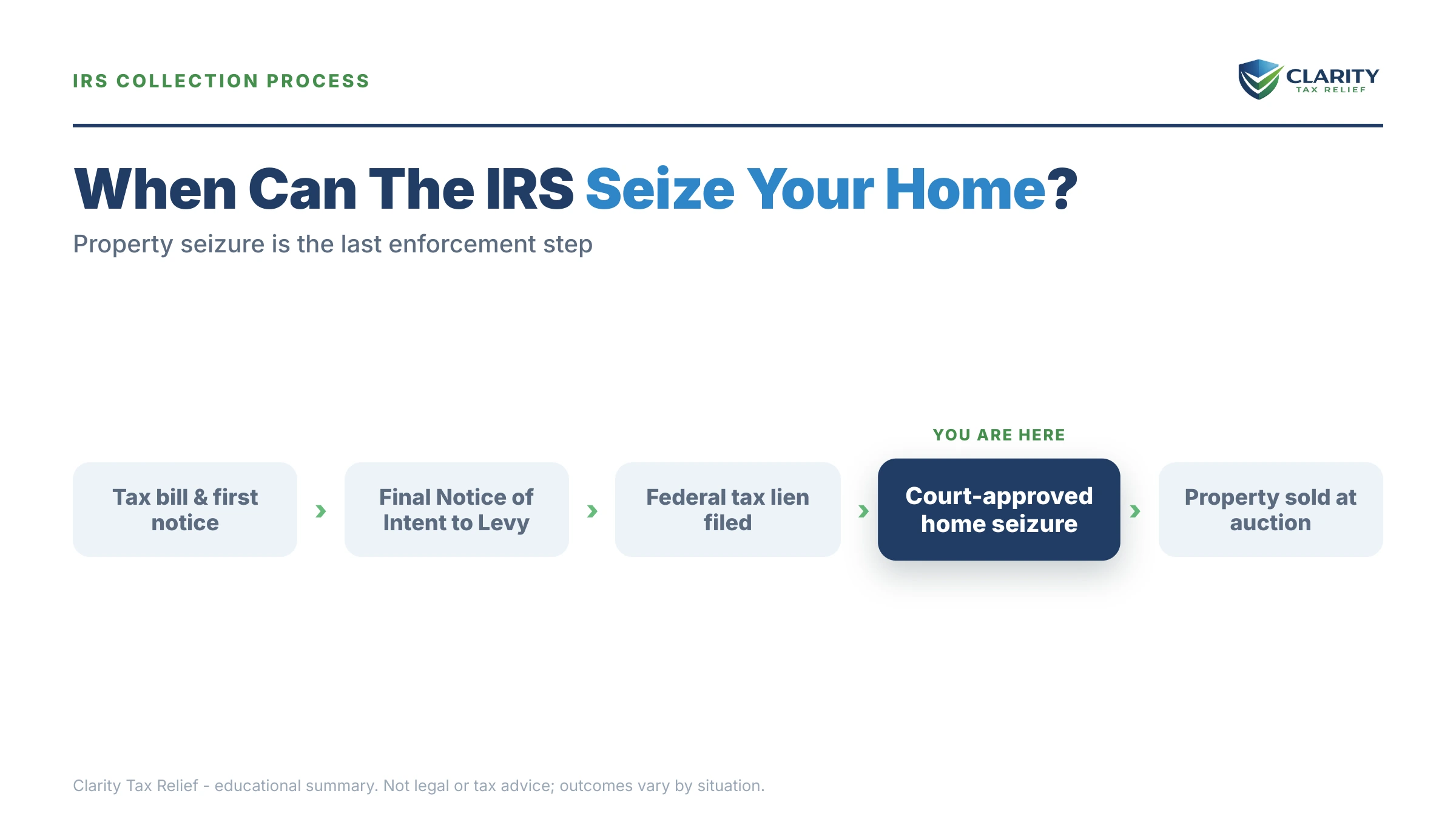
Real-property seizure is the last move in the IRS playbook, not the first. Before any of it can happen, specific notices must be sent, specific rights must be offered, and — for the house you live in — a federal judge must sign off. The image below shows where a property seizure actually sits in the collection sequence, so you can see exactly how far you are from it and which stop matters most right now.
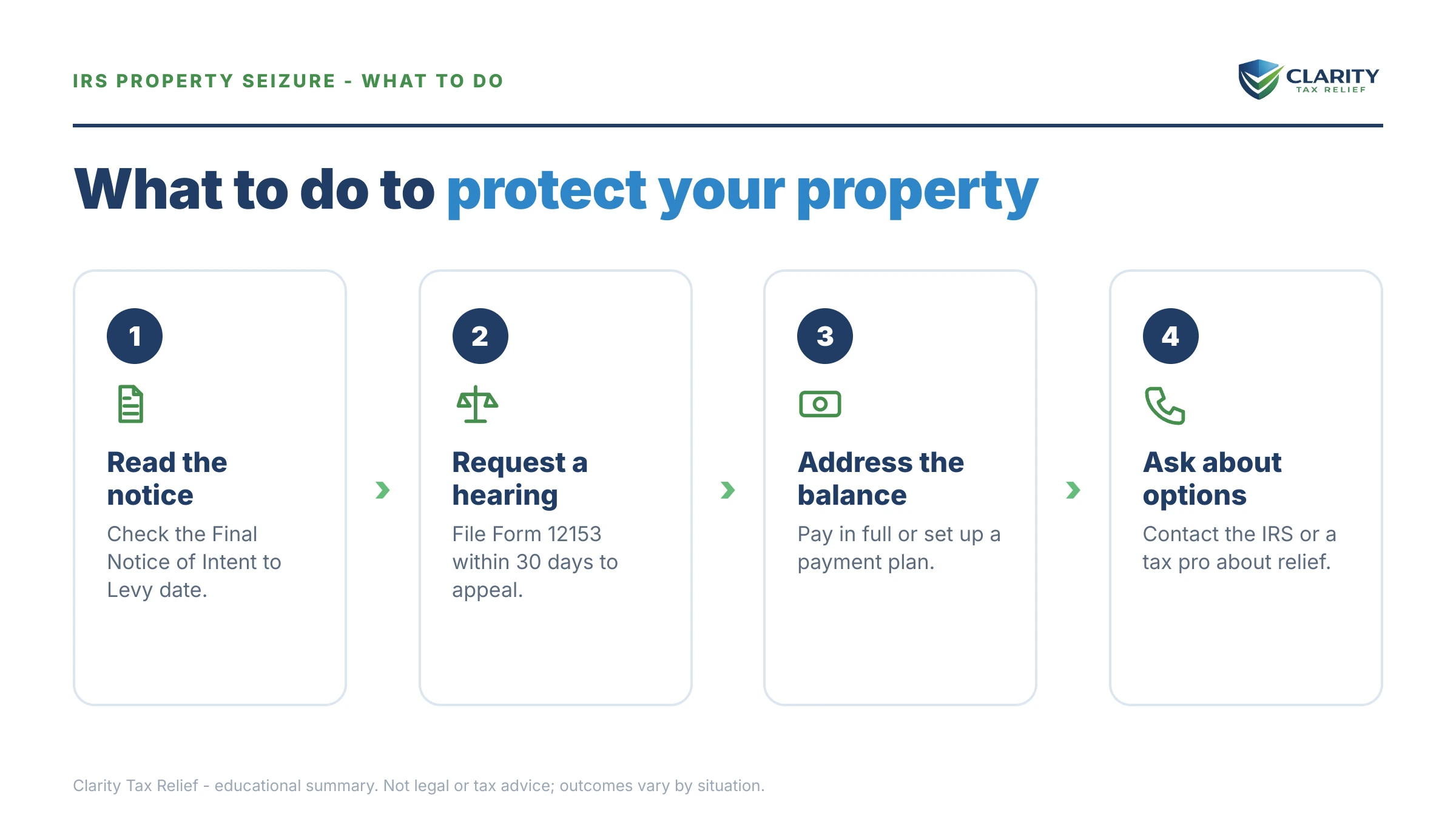
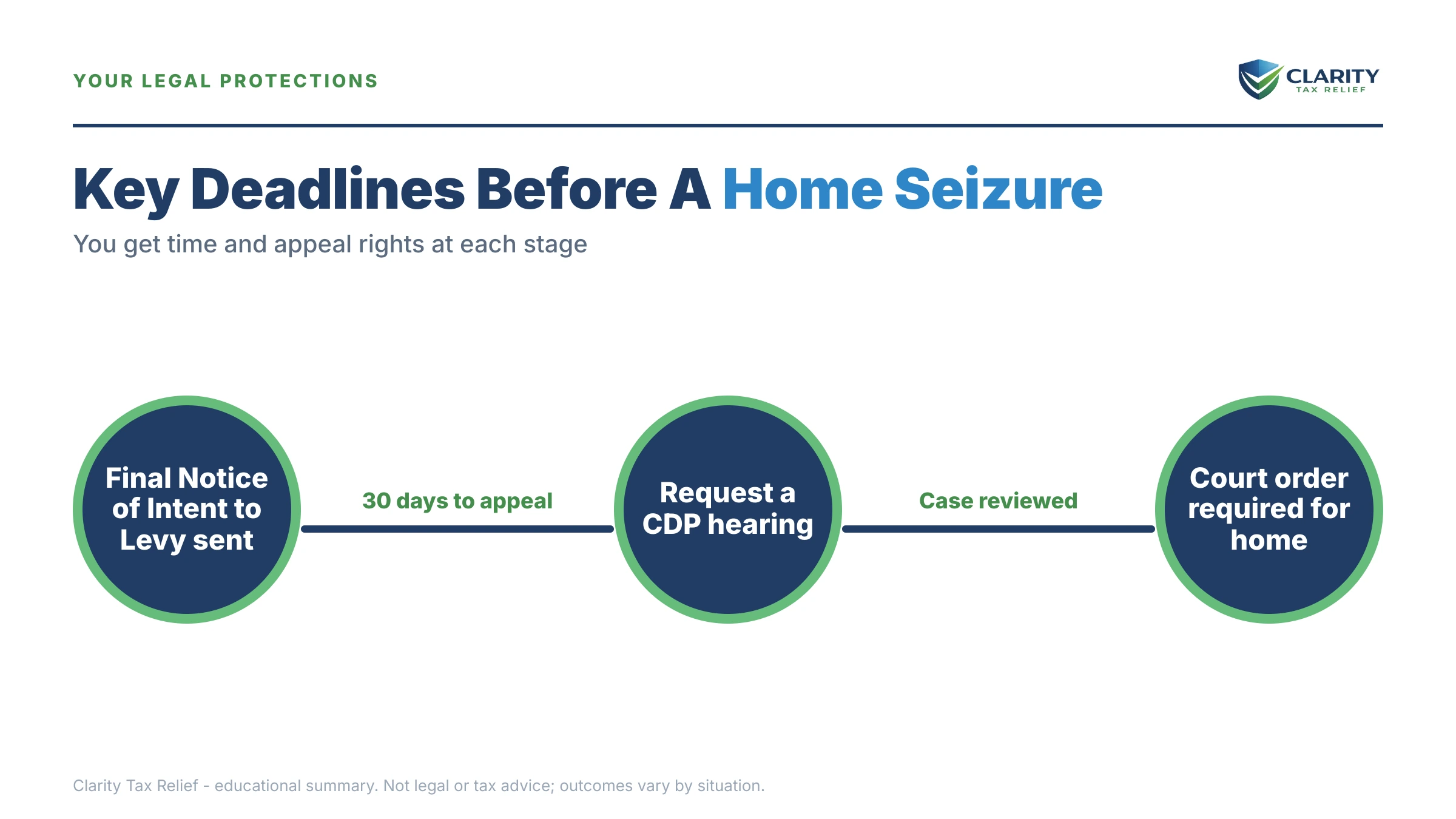
⏱ The clock that matters: you have 30 days from the date on an LT11 or Letter 1058 — the Final Notice of Intent to Levy — to request a Collection Due Process hearing using Form 12153. A timely request pauses levy and seizure action while your case is heard. If you haven't received that letter yet, no seizure of any kind can legally happen.
Why the IRS moves toward seizing property — and why it almost never gets there
The IRS seizes real estate only after every easier collection tool — refund offsets, bank levies, wage levies — has failed to resolve the debt. Seizure is expensive for the government, slow, and wrapped in legal requirements, so it's reserved for cases with two ingredients: substantial equity and a long record of non-response. The IRS seizure statistics bear this out — actual seizures are a tiny fraction of enforcement actions compared with the millions of levies on bank accounts and paychecks issued every year.
That context matters for how you should read a threatening letter. The phrase "seize your property or rights to property" appears on notices sent to millions of people, most of whom owe amounts the IRS would never chase into real estate. If you're asking specifically about your residence, our companion guide can the IRS take my house goes deeper on the home-only question; this article covers the full seizure process — any real property — and everything that stops it.
One caution before anything else: seizure threats are also a favorite tool of scammers, precisely because they terrify people into paying fast. If the letter demands gift cards, wire transfers, or immediate phone payment, learn how to tell if an IRS letter is real before you respond to anyone.
The legal walls between the IRS and your home
Under federal law, a home used as a residence is exempt from levy only when the amount of the levy is $5,000 or less; for larger debts the IRS can still seize a principal residence, but only with written approval from a federal district court judge. That statutory floor, in IRC §6334, is the first of several walls between an automated collection notice and an actual seizure of the place you live.
The second wall is judicial. To seize a primary residence, the IRS must petition a federal district court and get a judge's written approval — a government attorney has to show the court that the debt is valid, the law was followed, and no reasonable alternative exists. Rental properties, vacation homes, and commercial buildings don't get this court-order protection, which is why investment real estate is seized more readily than residences.
The third wall is economic. The IRS is barred from seizing property when the costs of seizure and sale would exceed what the sale could produce. Before any seizure, the IRS calculates your equity — fair market value minus your mortgage and any senior liens — and sets a minimum bid for auction. A house with little or no equity after the mortgage is, in practical terms, not worth seizing, and the law says so explicitly.
Beyond real estate, §6334 also shields certain property categories from levy altogether: unemployment benefits, workers' compensation, certain limited personal effects and household goods, and tools of your trade up to inflation-adjusted limits. Wages and bank accounts, by contrast, have far thinner protection — which is exactly why the IRS goes after them first.
What happens if you ignore the notices that let the IRS seize property
Property seizure is the final stage of a notice sequence that starts with an ordinary bill and escalates only when each letter goes unanswered. Here's the full path, in order:
- CP14 — the first bill. You typically have about 21 days from the notice date before the sequence advances. No enforcement power yet.
- CP501 / CP503 — reminders. Still just bills, but interest and the monthly failure-to-pay penalty keep compounding the balance.
- CP504 — Notice of Intent to Levy. Under IRC §6331(d), the IRS can now seize your state tax refund. Despite the alarming title, it is not the notice that authorizes taking your house or bank account.
- LT11 / Letter 1058 — Final Notice of Intent to Levy. This is the legal trigger. It starts a 30-day clock and your Collection Due Process rights. Read the full LT11 notice breakdown if this is the letter in your hand.
- Active levies on liquid assets. After the 30 days pass, the IRS levies the easy targets first: bank accounts (a 21-day hold before funds are sent) and wages (a continuous levy until released — you can estimate what a wage levy could leave you with using our IRS wage garnishment calculator).
- Revenue officer assignment and physical seizure. Only when liquid-asset levies fail and real equity exists does a human revenue officer pursue real property — with court approval required for a residence. Seized real estate is sold at public auction against a minimum bid, and you retain a 180-day right of redemption after the sale.
One 2026 reality check: the IRS workforce shrank roughly 27% in 2025, and reaching a human is genuinely harder — but the notice stream, the levies, and the deadlines are generated by automated systems that never stopped running. Fewer staff means slower fixes, not slower enforcement.
Holding a levy or seizure notice right now?
If a Final Notice of Intent to Levy is in your mailbox, the 30-day window to claim your hearing rights is already running. Send us the notice — an experienced tax professional will confirm exactly where you are in the sequence and which option protects your property, free and confidential.
Your options: what actually takes seizure off the table
A pending installment agreement request or Offer in Compromise legally bars the IRS from most levy action while it's under review. That single rule is why acting — even imperfectly — beats waiting: the moment a resolution is in motion, the seizure machinery stops. The full application walkthroughs live in our guide to how to settle tax debt yourself; here's how the options compare for someone worried about property:
| Option | Who typically qualifies | Cost to start | Effect on seizure risk |
|---|---|---|---|
| Short-term payment plan | Can pay in full within 180 days | $0 setup fee | Enforcement stops while you're current |
| Guaranteed installment agreement | Owe $10,000 or less; full pay within 3 years | Setup fee varies (lower with direct debit) | Levy and seizure barred while active |
| Streamlined installment agreement | Owe $50,000 or less; up to 72 months, set up online | Setup fee varies | Levy and seizure barred while active |
| Offer in Compromise | Assets + future income genuinely can't cover the debt; roughly 1 in 5 offers accepted in FY2024 | $205 fee + 20% down for lump-sum offers (both waived with low-income certification) | Levy generally barred while the offer is pending |
| Currently Not Collectible | Paying anything would create documented hardship | $0 (financial disclosure required) | Active collection pauses; interest still accrues and a lien may still file |
You'll see the phrase "Fresh Start" attached to most of these programs in ads. The programs are real; the marketing around them often isn't — is the IRS Fresh Start program real separates the two. And if you can simply pay, the method matters less than the timing; our comparison of the best way to pay the IRS covers fees and processing speed for each channel.
If you're refinancing with a tax debt on the books
For most homeowners who owe the IRS, the real property threat isn't seizure — it's a Notice of Federal Tax Lien surfacing during a title search. A filed lien attaches to your home and sits ahead of any new loan, which is why underwriters stop cold when one appears. If a lien has already been filed, a tax lien subordination (Form 14134) can let the new lender take priority so the refinance closes; the practical mechanics are in can I refinance with an IRS lien. If no lien has been filed yet, resolving or paying the balance before underwriting is almost always the cleaner path.
| Balance | Realistic enforcement exposure | Best-fit options |
|---|---|---|
| Under $10,000 | Notices, refund offsets; residence levy barred at $5,000 or less; lien possible but less common | Short-term plan or guaranteed installment agreement |
| $10,000 – $25,000 | Lien filing becomes likely; bank/wage levies if final notice is ignored | Streamlined installment agreement online; penalty relief |
| $25,000 – $50,000 | Lien expected; levies follow non-response; direct debit often required for a streamlined plan | Streamlined agreement with direct debit; OIC if finances qualify |
| $50,000 – $66,000+ | Financial disclosure required for a plan; passport certification at $66,000 (2026 threshold) | Non-streamlined agreement; OIC; CNC if hardship |
| $100,000+ | Revenue officer assignment likely; asset review; real-property seizure realistic where equity exists | Negotiated agreement with representation; OIC; lien strategy |
A worked example: $6,200 owed and a refinance on the calendar
Say you owe $6,200 from last year's return and you're planning to refinance this fall. First, the fear check: at $6,200, your home is barely above the $5,000 statutory levy exemption, no court would approve a residence seizure for that amount, and no revenue officer is coming. Your actual risks are the growing balance and a possible lien hitting your title report.
Now the math. The failure-to-pay penalty runs 0.5% per month — about $31 a month on $6,200 at the start — plus interest, so waiting quietly costs real money. A short-term plan gives you up to 180 days with a $0 setup fee: roughly $1,034 a month for six months clears it before underwriting ever starts. If that's too steep, $6,200 is under the $10,000 ceiling for a guaranteed installment agreement — full payment within three years works out to about $172 a month on the principal, a bit more in practice as accruals are folded in. Either route stops enforcement immediately; the 180-day payoff also means no balance and no lien in your loan file when the appraiser shows up.
How to respond, step by step
- Verify the letter is real. Log into your IRS online account and confirm the balance and notice match what the IRS actually has on file before you react to anything.
- Find the notice number and date. An LT11 or Letter 1058 starts a 30-day clock from the date printed in the top corner; earlier notices in the sequence mean you have more room to work.
- Request a CDP hearing if you received a final notice. File Form 12153 within 30 days — a timely request pauses levy and seizure action while your case is heard, and preserves your right to go to Tax Court.
- Set up a resolution before the deadline. A payment plan, an Offer in Compromise, or Currently Not Collectible status each takes seizure off the table while it is pending or in place.
- Get experienced help if a revenue officer is assigned. Once a human officer is working your case toward the equity in real estate, the stakes, the deadlines, and the paperwork all change — that is the point where representation changes outcomes.
The step-by-step mechanics of a hearing request are covered in our Form 12153 CDP hearing guide, and payment plans can be set up directly on the IRS payment plans page.
When you can handle this yourself — and when help changes the outcome
Most people worried about property seizure can resolve their situation without hiring anyone. If your balance is under $50,000, no final notice has arrived, and you agree with the amount, an online payment plan through IRS.gov/payments ends the escalation in an afternoon. A balance you can clear within 180 days doesn't even need a formal agreement — just the short-term plan and discipline.
Experienced help earns its cost in a narrower set of situations: a revenue officer has been assigned and is asking about your home's equity; you're inside the 30-day window after an LT11 and the CDP request needs to be done right the first time; you have multiple unfiled years complicating any agreement; or you're weighing an Offer in Compromise, where the financial math decides everything. And one more distinction worth knowing: private collection agencies the IRS uses for some old accounts have no levy or seizure power at all — if a caller claims otherwise, check whether the IRS debt collector is legitimate before engaging. If nothing here resolves cleanly, the Taxpayer Advocate Service is an independent, free channel for cases stuck inside the IRS.
Terms on your notice, decoded
- Lien: a legal claim securing the debt against everything you own — it clouds your title but takes nothing. See IRS lien vs levy for the full distinction.
- Levy: the actual taking of property or money — a bank account swept, wages redirected, an asset seized.
- Seizure: a levy on physical property (real estate, vehicles, equipment), carried out by a revenue officer rather than a computer.
- CDP (Collection Due Process): your right, triggered by the final notice, to a hearing before levy action — requested on Form 12153 within 30 days.
- Minimum bid: the floor price the IRS sets before auctioning seized property, based on forced-sale value minus senior liens like your mortgage.
- Right of redemption: your 180-day window after a real-estate sale to reclaim the property by paying the purchaser the sale price plus interest.
- CSED: the Collection Statute Expiration Date — the IRS generally has 10 years from assessment to collect, including by seizure, though certain actions pause that clock.
IRS property seizure questions, answered
Can the IRS really seize your house for back taxes?
Yes, but it is rare and heavily restricted. The IRS must issue a Final Notice of Intent to Levy, wait 30 days, and — for a primary residence — obtain approval from a federal district court. Federal law also exempts a home from levy entirely when the debt is $5,000 or less, and the IRS will not seize property when the costs of sale would exceed your equity.
How much do you have to owe before the IRS will seize property?
There is no published dollar trigger, but the practical floor is high. A primary residence cannot be levied at all for debts of $5,000 or less, and real-property seizures generally happen in revenue officer cases involving larger balances, meaningful equity, and years of non-response. Balances under $50,000 usually qualify for an online payment plan that takes seizure off the table entirely.
How long does it take before the IRS seizes property?
Typically years, not weeks. Seizure sits at the very end of the collection sequence: a first bill, reminder notices, a CP504, a Final Notice of Intent to Levy with a 30-day response window, then levies on easier targets like bank accounts and wages. Real estate comes last because it requires the most procedure — including a court order for a primary residence.
Can I get my property back after the IRS seizes it?
Sometimes. Before the sale, the IRS can release seized property if you enter a payment arrangement or show the seizure creates economic hardship. After a real-estate sale, you have a 180-day right of redemption: you can reclaim the property by paying the purchaser the sale price plus interest. Acting before the sale is far cheaper than redeeming after it.
Is a federal tax lien the same as the IRS seizing my house?
No. A lien is a legal claim that attaches to your property and secures the debt — it clouds your title and complicates a sale or refinance, but nothing is taken. A levy or seizure is the actual taking of property. Most homeowners with tax debt encounter a lien; very few ever face an actual seizure of their home.
Will a payment plan stop the IRS from seizing property?
Generally, yes. While a request for an installment agreement or an Offer in Compromise is pending, the IRS is legally barred from most levy action, and an active agreement keeps that protection in place as long as you stay current. The exceptions are defaulted agreements and rare jeopardy situations where the IRS believes collection is at immediate risk.
Can the IRS seize property I own jointly with a spouse or family member?
The IRS can reach your interest in jointly owned property, and the federal tax lien attaches to your share even when a co-owner owes nothing. Courts can authorize the sale of an entire property in some cases, with the non-liable owner compensated for their share — but joint ownership adds real friction, and judges weigh the innocent co-owner's interests before approving a sale.
Your next 24 hours
- Find your notice number and date. It's printed in the top corner of the letter. An LT11 or Letter 1058 means the 30-day clock is running; a CP504 or earlier means no seizure of any kind is legally possible yet.
- Gather three things: the notice itself, your most recent tax return, and — if you're a homeowner — your latest mortgage statement, so your equity picture is clear from the first conversation.
- Get a free case review. Call (888) 825-7779 or use the 2-minute form. If a final notice has arrived, we'll map your CDP options before the 30-day window closes; if it hasn't, we'll show you how to resolve the balance before interest and penalties push it — or a lien — any further.
This guide is general information, not tax or legal advice for your specific situation. Eligibility for IRS programs depends on individual facts and circumstances; no outcome is guaranteed.