
IRS Collections
Passport Denied for Tax Debt: How the $66,000 Threshold Works in 2026
The short answer: your passport was denied because the IRS certified your tax debt as "seriously delinquent" — $66,000 or more for 2026, counting penalties and interest — to the State Department under IRC §7345. Paying below $66,000 won't undo it: only full payment or a qualifying arrangement, like an installment agreement, reverses the certification.
You mailed the renewal forms and the fee weeks ago. What came back wasn't a blue booklet — it was a letter saying the State Department can't issue your passport because the IRS reported you as seriously delinquent. That sinking feeling is real, but so is this: the certification is reversible, and the exact steps off the list are laid out on this page.
Two documents drive everything here: the IRS's CP508C notice that certified you, and the State Department letter that denied or held your application. The image below shows exactly what the CP508C looks like and where to find the certified balance and tax years, so you can confirm the numbers before you act.
⏱ Your deadline: if a passport application or renewal is pending, the State Department typically holds it open for 90 days after its denial letter so you can resolve the debt or prove the certification is wrong. Miss that window and the application is denied outright — you start over, fee and all. No application pending? The clock is softer but still running: interest and the late-payment penalty accrue on the balance every month.

Why your passport was denied: the $66,000 threshold, explained
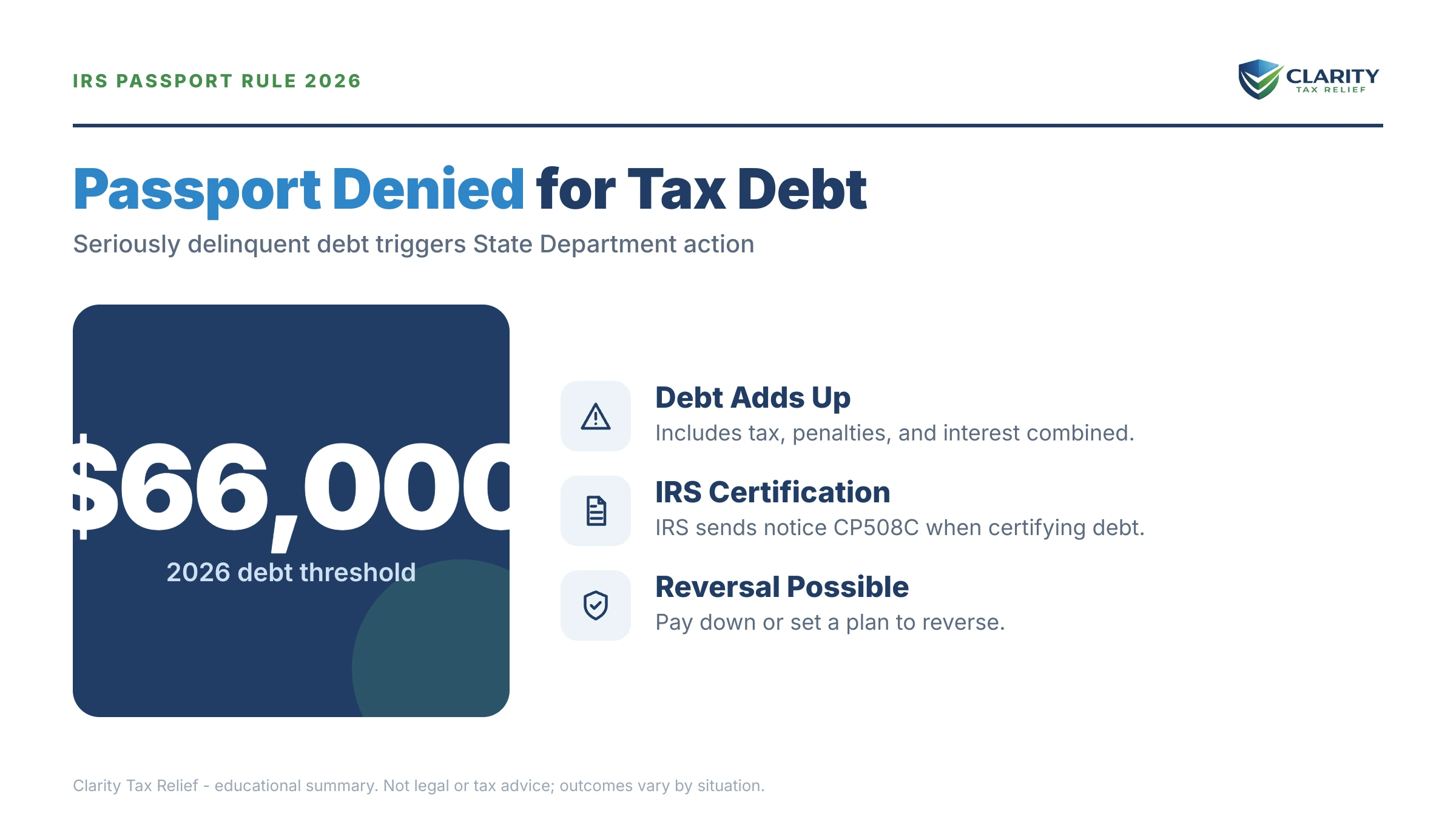
The IRS must certify a tax debt to the State Department once it exceeds $66,000 in 2026 and has reached the lien or levy stage. The rule comes from IRC §7345, added by the FAST Act in December 2015. Congress set the original threshold at $50,000 and indexed it to inflation — which is how it climbed to $66,000 for 2026.
Crossing the dollar line alone isn't enough. To be "seriously delinquent," your debt must meet all three tests:
- Assessed: the IRS has formally put the balance on your account — not just proposed it.
- Over the threshold: tax, penalties, and interest combined, with all certified years added together. A $58,000 tax bill from three years ago can quietly grow past $66,000 without you paying a dollar less.
- At the enforcement stage: the IRS has filed a Notice of Federal Tax Lien and your Collection Due Process rights have lapsed or been used, or it has issued a levy.
Some debts never count toward the threshold, including FBAR penalties and child support. And several situations block certification even above $66,000: a payment plan you're current on, an accepted Offer in Compromise you're paying, a timely-requested CDP hearing (Form 12153), or a pending innocent spouse request. The IRS also generally holds off on accounts in bankruptcy, in hardship Currently Not Collectible status, in federally declared disaster areas, in combat zones, and for confirmed identity-theft victims.
One more thing this is not: a travel ban imposed by the IRS. The IRS certifies; the State Department acts. That distinction matters when you're deciding who to call — and it's why the fix always runs through the tax debt, not the passport office. (If your concern is an existing passport being taken, see our companion guide to a passport revoked for tax debt — this page focuses on denials and the threshold mechanics.)
What happens if you ignore the certification
An ignored passport certification costs you the 90-day application hold first, then every future renewal, and potentially the passport already in your wallet. The sequence is administrative and largely automated — and the IRS's certification systems kept running through 2025's roughly 27% workforce reduction, even as its phone lines got harder to reach:
- State Department hold letter. A pending application or renewal is frozen — typically for 90 days — while you resolve the debt. Do nothing and it's denied.
- Standing denial. The certification stays attached to your Social Security number. Every new application or renewal is denied until the IRS reverses it — there's no expiration or annual reset.
- Letter 6152. If the debt sits long enough, the IRS may send this letter telling you it intends to recommend the State Department revoke your existing passport unless you make contact and resolve the balance.
- Revocation or restriction. The State Department can revoke a valid passport or limit it to direct return travel to the United States. If you live or work abroad, this is the stage that upends your life fastest — see what changes when you owe the IRS and move abroad.
- Collection continues in parallel. By definition, a certified debt already has a lien filed or a levy issued. The passport action is on top of normal collection, not instead of it, and interest plus the monthly failure-to-pay penalty keep compounding the balance.
Certified under the $66,000 rule?
Send us your CP508C and the State Department letter. An experienced tax professional will map the fastest route to decertification — free and confidential. If your application is inside the 90-day hold, the order you do things in decides whether you make the window.
Every way to reverse the certification — and what each requires
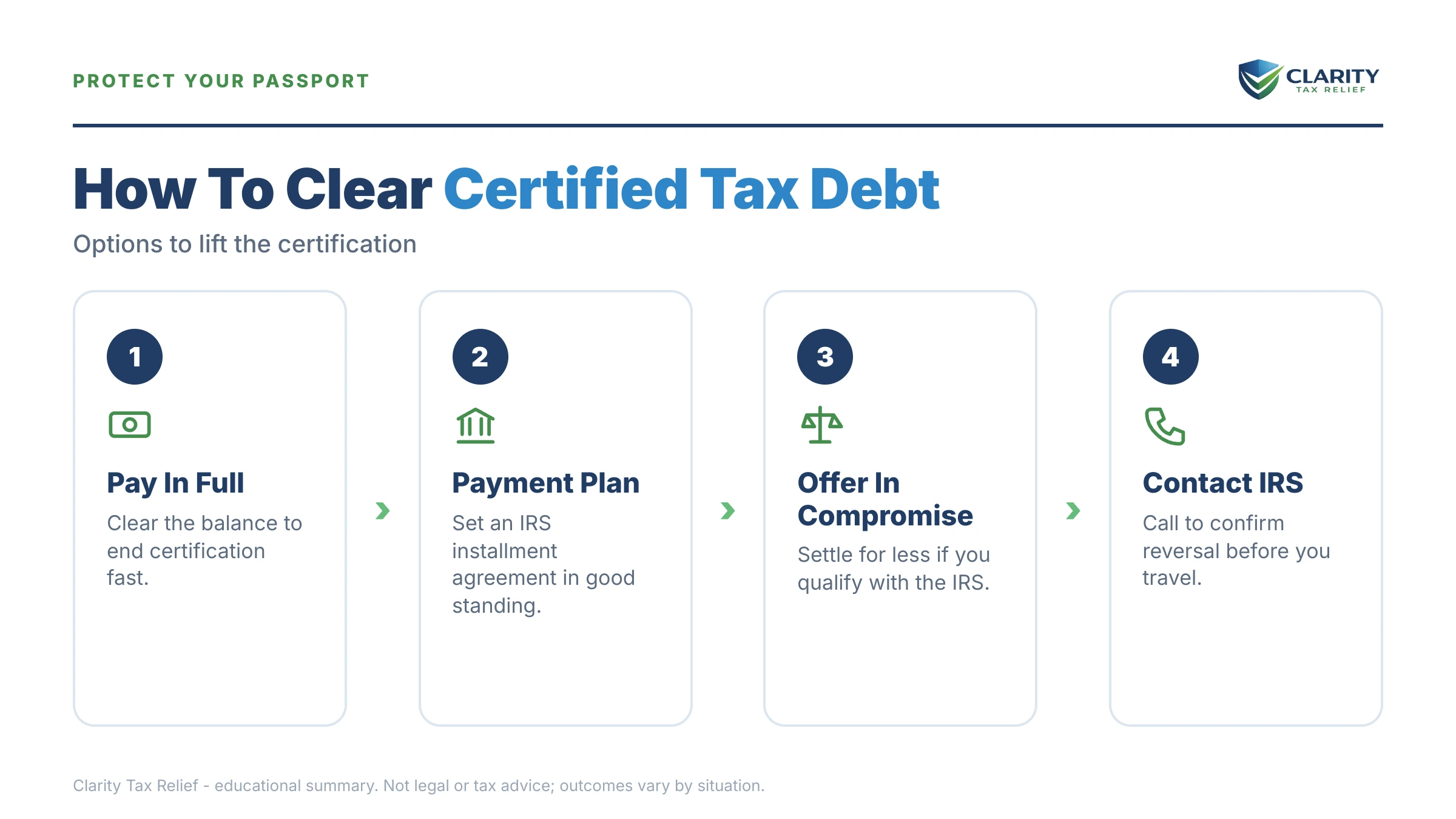
Five arrangements reverse a passport certification, and partial payment is not one of them. That's the trap most people fall into: once certified, writing a check that drops you from $68,500 to $65,999 changes nothing. The debt must be fully resolved or moved into an excluded status. Here's the full menu:
| Option | What it takes | Effect on your certification |
|---|---|---|
| Pay in full | The entire certified balance — tax, penalties, and interest | Reversed; the IRS mails a CP508R confirming it |
| Installment agreement | ≤ $50,000: set up online for up to 72 months. Above $50,000: Form 433-F financials, or pay down to $50,000 first | Reversed once the agreement is active and payments stay timely |
| Offer in Compromise (accepted) | $205 fee and 20% down on lump-sum offers (both waived with low-income certification); roughly 1 in 5 offers accepted in FY2024 | Reversed while you're paying an accepted offer; the IRS also generally pauses certification while an offer is pending |
| Currently Not Collectible (hardship) | Financials showing any payment would prevent basic living expenses | Hardship-CNC accounts are generally excluded and decertified |
| Timely CDP hearing request | Form 12153 filed within the 30-day window on your levy notice | Debt is excluded while the hearing is pending |
| Innocent spouse request | Form 8857 filed and pending | The requesting spouse is excluded while it's considered |
| CSED expiration | The 10-year collection statute runs out (it can be paused by appeals, an OIC, or bankruptcy) | Reversed — the debt is legally unenforceable |
| Paying below $66,000 after certification | Any partial payment | Does NOT reverse it — certification stands until the debt is resolved or excluded |
For most people denied at the threshold, the practical answer is a payment plan. A streamlined installment agreement covers balances up to $50,000 with no financial disclosure; above that line, an IRS payment plan over $50,000 requires a Form 433-F financial statement but works the same way for passport purposes. An offer in compromise and Currently Not Collectible status both reverse certification too, but each is means-tested — the IRS runs the math on your income and assets, and most applicants at this debt level with steady income won't qualify. The general playbook for negotiating these programs on your own lives in our guide to how to settle tax debt yourself; this page sticks to what's unique to the passport rules.
One quiet path deserves a mention: if your debt is old, the 10-year collection statute may be closer than you think. When the CSED passes, the debt becomes legally unenforceable and the certification must be reversed. Read how the 10-year collection statute (CSED) works — and you can estimate your own expiration date with our CSED Calculator.
CP508C, CP508R, and Letter 6152: the notices decoded
Three IRS notices and one State Department letter make up the entire paper trail of a passport certification. Knowing which one you're holding tells you exactly where you stand:
| Notice | What it means | What to do |
|---|---|---|
| CP508C | The IRS certified your debt as seriously delinquent to the State Department | Verify the balance and years; if anything is wrong, call the number on the notice; otherwise pick a resolution from the table above |
| State Department denial/hold letter | Your application or renewal is frozen, typically for 90 days, pending resolution | Resolve the debt inside the window; the IRS — not you — tells State when you're clear |
| Letter 6152 | The IRS intends to recommend revocation of your existing passport | Contact the IRS immediately at the number on the letter — this is the last stop before revocation |
| CP508R | The certification has been reversed | Keep it as proof, and confirm State has processed the reversal before booking travel |
A detail that trips people up: the IRS mails the CP508C by regular mail to your last known address at the moment of certification. If you moved and never updated your address, the first sign of trouble may be the State Department letter — the certification is still valid even if you never saw the CP508C.
A worked example: married couple, $68,500 joint balance
Say you and your spouse filed jointly and owe $68,500 across two tax years — a shortfall that started with an early 401(k) withdrawal tax bill you couldn't pay, then grew with penalties and interest. A lien was filed last year, the appeal window lapsed, and this spring both of you were certified. This is purely hypothetical, but the math is real:
- Both passports are affected. On a joint return, each spouse is liable for the full $68,500 — so each of you individually exceeds the $66,000 threshold, and each gets a CP508C.
- Paying $2,501 accomplishes nothing. Dropping the balance to $65,999 doesn't decertify you. Post-certification, only full resolution or an excluded status counts.
- Path A — pay down to $50,000, then go streamlined: an $18,500 payment brings the balance to $50,000, which qualifies for an online agreement over up to 72 months. That's about $695/month ($50,000 ÷ 72) as a floor, while interest and the 0.5%-per-month late-payment penalty keep accruing until it's paid off.
- Path B — keep your cash, disclose your finances: a non-streamlined agreement on the full $68,500 requires Form 433-F. If, say, roughly seven years remain before the collection statute expires, full payment over 84 months works out to about $816/month ($68,500 ÷ 84) before ongoing interest.
Either agreement, once active with the first payment made, moves the debt out of "seriously delinquent" status — the IRS then notifies the State Department, generally within 30 days, and both certifications are reversed. If your renewal is sitting in the 90-day hold, Path A is usually faster to set up; Path B preserves your savings but adds financial-disclosure time you may not have.
How to respond to a passport denial for tax debt, step by step
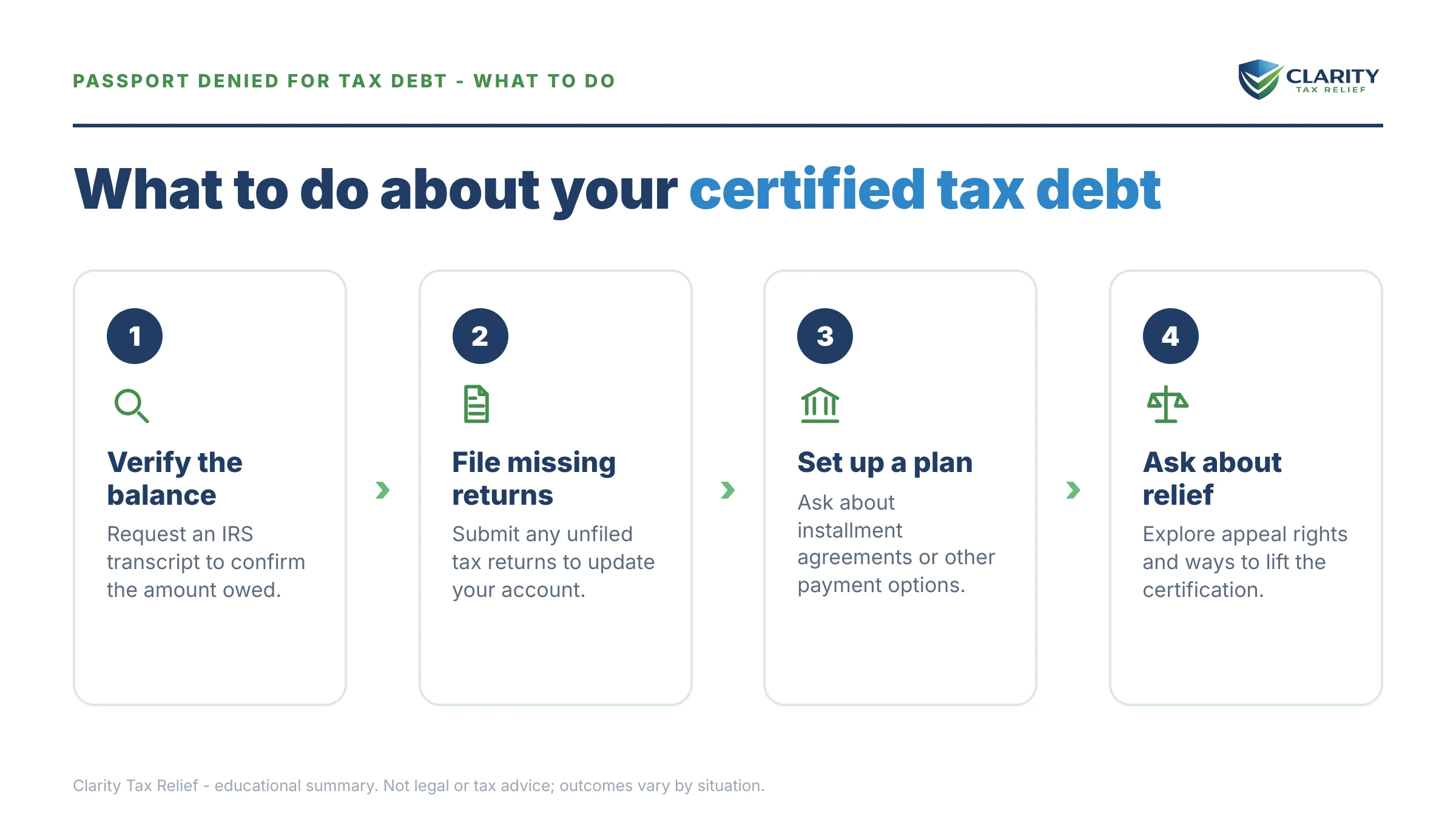
- Confirm the certification and the exact balance. Pull your CP508C and your IRS online account, and verify the certified balance, the tax years included, and that the debt is actually yours.
- Check whether an exclusion already applies. If you have a timely installment agreement, a pending CDP hearing or innocent spouse request, an accepted offer, or an open bankruptcy, call the number on the notice — you may be certified in error.
- Choose the fastest resolution you can sustain. For most balances just over the threshold, that's an installment agreement; full payment, an accepted Offer in Compromise, or hardship CNC status also reverse certification.
- Set the arrangement up before your hold expires. If a passport application is pending, the State Department typically holds it 90 days — get the agreement in place and your first payment made inside that window.
- Request expedited decertification if travel is imminent. With an open application and proof of upcoming international travel, ask the IRS to expedite its reversal notice to the State Department.
- Watch for the CP508R and confirm with State. The reversal notice is your proof; confirm the State Department has processed it before finalizing travel plans.
When you can handle this yourself — and when help changes the outcome
Plenty of passport certifications get resolved without professional help. You can likely handle it yourself if the balance is accurate, you agree with it, and you can either pay in full or pay it down to $50,000 and set up a streamlined plan online in one sitting. That's a same-week fix in many cases — the IRS's own reversal cycle is the only wait.
Experienced help tends to change the outcome when the situation has moving parts: a joint debt where one spouse has an innocent-spouse claim worth preserving before agreeing to pay everything; a balance over $50,000 where the Form 433-F numbers determine your monthly payment for years; unfiled returns that block any agreement until they're in; a Letter 6152 with revocation on the table; travel booked inside the 90-day hold, where expedite requests and timing have to be coordinated; or a certification you believe is flat-out wrong, where the remedy runs through Tax Court. In those cases, the cost of getting the sequence wrong — a denied application, a defaulted agreement, a waived claim — usually exceeds the cost of getting it reviewed.
Terms on your CP508C, decoded
- Seriously delinquent tax debt: an assessed federal tax debt over the inflation-adjusted threshold ($66,000 in 2026) that has reached the lien or levy stage, with no exclusion applying.
- Certification: the IRS formally reporting your debt to the State Department under IRC §7345 — the trigger for passport denial.
- Decertification (reversal): the IRS notifying the State Department that your debt no longer qualifies; confirmed to you by notice CP508R.
- Notice of Federal Tax Lien: the public filing that secures the government's claim on your property — one of the two enforcement triggers for certification.
- Collection Due Process (CDP): your right to an appeals hearing before certain lien and levy actions; a timely-pending CDP hearing excludes the debt from certification.
- CSED: the Collection Statute Expiration Date — generally 10 years from assessment, pausable by appeals, an OIC, or bankruptcy. A debt past its CSED is legally unenforceable and must be decertified.
For the IRS's own explanation of the certification notice, see Understanding your CP508C notice on IRS.gov, and check passport application status through the U.S. Department of State's travel site.
Passport tax-debt questions, answered
Why was my passport denied over the $66,000 tax debt threshold?
Federal law (IRC §7345, part of the 2015 FAST Act) requires the IRS to certify 'seriously delinquent tax debt' to the State Department, which must then deny your passport application or renewal. The threshold started at $50,000 in 2015 and is inflation-adjusted each year — it is $66,000 for 2026. Your debt also had to reach the lien or levy stage before certification; a fresh balance alone doesn't qualify.
Does the $66,000 threshold include penalties and interest?
Yes. The threshold is measured against your total assessed liability — tax, penalties, and interest combined — and every certified tax year is added together into one figure. Some debts don't count toward it, including FBAR penalties and child support. That's why a taxpayer who owes $58,000 in tax alone can still cross $66,000 once penalties and interest are added.
If I pay my tax debt below $66,000, will the passport certification be removed?
No — this is the most misunderstood part of the rule. Once you're certified, partial payment doesn't reverse it, even if it drops you to $65,999. Reversal happens only when the debt is fully paid, becomes legally unenforceable, or stops being 'seriously delinquent' because you entered an excluded status such as a timely installment agreement or an accepted Offer in Compromise. Paying below the threshold only helps if you do it before the IRS certifies you.
Will my spouse's passport be denied too on a joint tax debt?
It can be. On a jointly filed return, each spouse is individually liable for the entire balance, so a $68,500 joint debt puts both spouses over the $66,000 threshold and both can be certified. A spouse with a pending innocent spouse relief request is excluded from certification while that request is being considered.
How fast can I get my passport back after resolving the debt?
The IRS generally notifies the State Department within 30 days of your debt being fully resolved or entering an excluded status, and mails you a CP508R confirming the reversal. If you have an open passport application and proof of imminent international travel, you can ask the IRS to expedite the reversal, which typically shortens the wait to a few weeks. Confirm the reversal processed before booking nonrefundable travel.
Can I still get a passport for an emergency while certified?
Possibly. The State Department has discretion to issue a limited-validity passport for emergency or humanitarian circumstances, and it will generally allow a passport good only for direct return to the United States if you're already abroad. These are case-by-case decisions made by the State Department, not the IRS, so start with the contact information on your denial letter.
Can I fight the certification if it's wrong?
Yes, in two ways. Call the phone number on your CP508C first — errors like identity theft, an already-resolved balance, or a missed exclusion are often fixed administratively. If that fails, IRC §7345(e) lets you sue in U.S. Tax Court or federal district court to have an erroneous certification reversed; there is no administrative appeal specifically for the certification itself.
Will the State Department revoke a passport I already have?
It can, but denial of new applications and renewals is far more common. Revocation of a valid passport is discretionary, and the IRS typically sends Letter 6152 first, asking you to contact them to resolve the debt before it recommends revocation to the State Department. If you receive Letter 6152, treat it as your last clear warning.
Your next 24 hours
- Find two numbers: the certified balance and notice date on your CP508C, and — if you have a State Department letter — the date it was issued, which starts the typical 90-day hold.
- Gather three things: your most recent filed tax return, both letters, and a quick snapshot of your monthly income and expenses. That's what any installment agreement, hardship, or offer decision will be built on. If you decide to pay anything, do it only through IRS.gov/payments.
- Get a free case review. Use the 2-minute form or call (888) 825-7779. If your application is inside the hold window, we'll map the fastest qualifying arrangement first; if not, we'll stop the balance from growing past where it already is.
This guide is general information, not tax or legal advice for your specific situation. Eligibility for IRS programs depends on individual facts and circumstances; no outcome is guaranteed.