
IRS Collections & Levies
How Much Can the IRS Take From My Paycheck in 2026?
The short answer: how much can the IRS take from my paycheck? Almost all of it. Unlike private creditors capped at 25%, an IRS wage levy protects only a fixed exempt amount — set by your filing status, dependents, and pay frequency — and your employer must send everything above that line to the IRS, every payday, until the levy is released.
Maybe payroll broke the news before the IRS did: a levy notice landed on your employer's desk, and your next check is about to be a fraction of normal. If you're mid-refinance on your house — with an underwriter about to pull your paystubs — the timing feels catastrophic. It isn't. A wage levy is one of the most reversible collection actions the IRS takes, and the release paths below work on ordinary balances like $31,200.
Farther down, an image shows exactly what this levy paperwork looks like and which parts of it decide how much of each check you keep — knowing where those pieces are is half the battle.
⏱ Your real clocks: if an LT11 or Letter 1058 arrived within the last 30 days, you have 30 days from its date to request a Collection Due Process hearing before the levy can proceed on that debt. And once your employer hands you the levy's Statement of Exemptions, you typically have three work days to return it — miss that, and your protected amount is calculated at the worst possible setting.

Why the amount isn't a percentage — it's everything above a fixed line
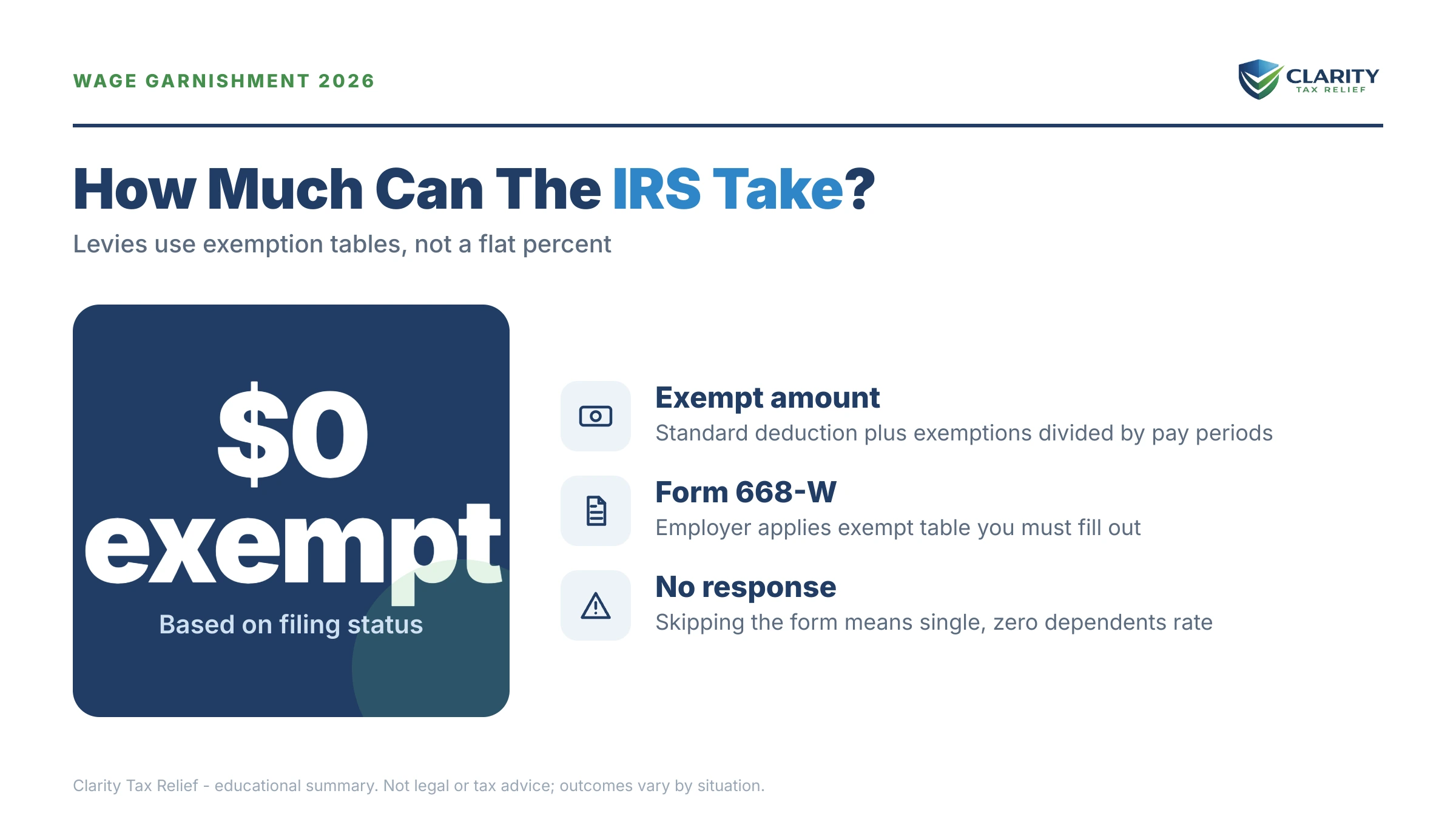
The IRS does not take a percentage of your paycheck; it leaves you a fixed exempt amount and takes everything else. This is the single biggest thing people get wrong. State garnishments and private-creditor garnishments are generally capped at 25% of disposable earnings under federal consumer-credit law. That cap does not apply to the IRS.
Instead, when the IRS serves your employer with Form 668-W (Notice of Levy on Wages, Salary, and Other Income), the calculation flips. Publication 1494 — the IRS's annual exemption table — sets a protected amount per paycheck based on three inputs:
- Your filing status (single, married filing jointly, head of household, etc.)
- The number of dependents you claim on the levy's Statement of Exemptions
- How often you're paid (weekly, biweekly, semimonthly, monthly)
The protected amount is essentially your standard deduction, plus an allowance for each dependent, divided across the year's pay periods. Everything above that number — not 25% of it, all of it — goes to the IRS out of every check. For a single filer with a decent salary, that routinely works out to 60–80% of take-home pay.
Two nuances matter. First, the levy attaches to your pay after taxes and after deductions that were already in effect when the levy arrived (health insurance, an existing 401(k) contribution, a prior child-support order). You generally can't add new voluntary deductions afterward to shrink what the IRS gets. Second, the exempt amount is per pay period and never grows with your check — a point that becomes painful the first time a bonus lands. You can run your own numbers through our IRS Wage Garnishment Calculator to estimate what a levy would leave you.
How much can the IRS take from my paycheck if I have dependents?
Each dependent you claim on the levy's Statement of Exemptions raises the amount of every paycheck you keep. When your employer receives Form 668-W, they're required to give you the statement portion (Parts 3 and 4). You fill in your filing status and dependents, sign it, and return it — typically within three work days.
If you don't return it, your employer has no discretion: they must compute your exempt amount as if you were married filing separately with no dependents — the least generous line in the table. For a head of household with three kids, that default can mean losing hundreds of extra dollars per check that the law would have protected.
Claim only dependents you're actually entitled to claim — the statement is signed under penalties of perjury. But claim every one you have. Returning the statement late still helps: the exempt amount adjusts on future checks, though nothing already remitted comes back.
The image below shows what this levy paperwork looks like and where the filing-status and dependent information sits, so you know exactly which part to complete and return.
What an IRS wage levy reaches — and what it doesn't
An IRS wage levy is continuous: it attaches once and repeats every payday until the IRS releases it. That makes it fundamentally different from most other levies, and its reach is broad:
- Bonuses, commissions, and overtime are levied almost in full, because the exempt amount stays flat no matter how big the check is. A $6,000 bonus in a levied pay period is mostly gone.
- A second W-2 job isn't automatically covered — the 668-W binds the employer it was served on — but the IRS can and does serve additional levies on other employers it finds through wage reporting.
- 1099 and contractor pay works differently: a levy on a payer generally grabs only what's owed to you at that moment, not future invoices. If you're a contractor, see can the IRS garnish 1099 income — the strategy is different.
- Social Security benefits aren't taken through Form 668-W at all; the Federal Payment Levy Program takes up to 15% of benefits instead. Details in can the IRS garnish Social Security.
Switching jobs pauses the levy only until the IRS locates the new employer — and a levy dodge that looks deliberate invites faster, harsher enforcement, including bank levies.
The notice sequence that led to your paycheck
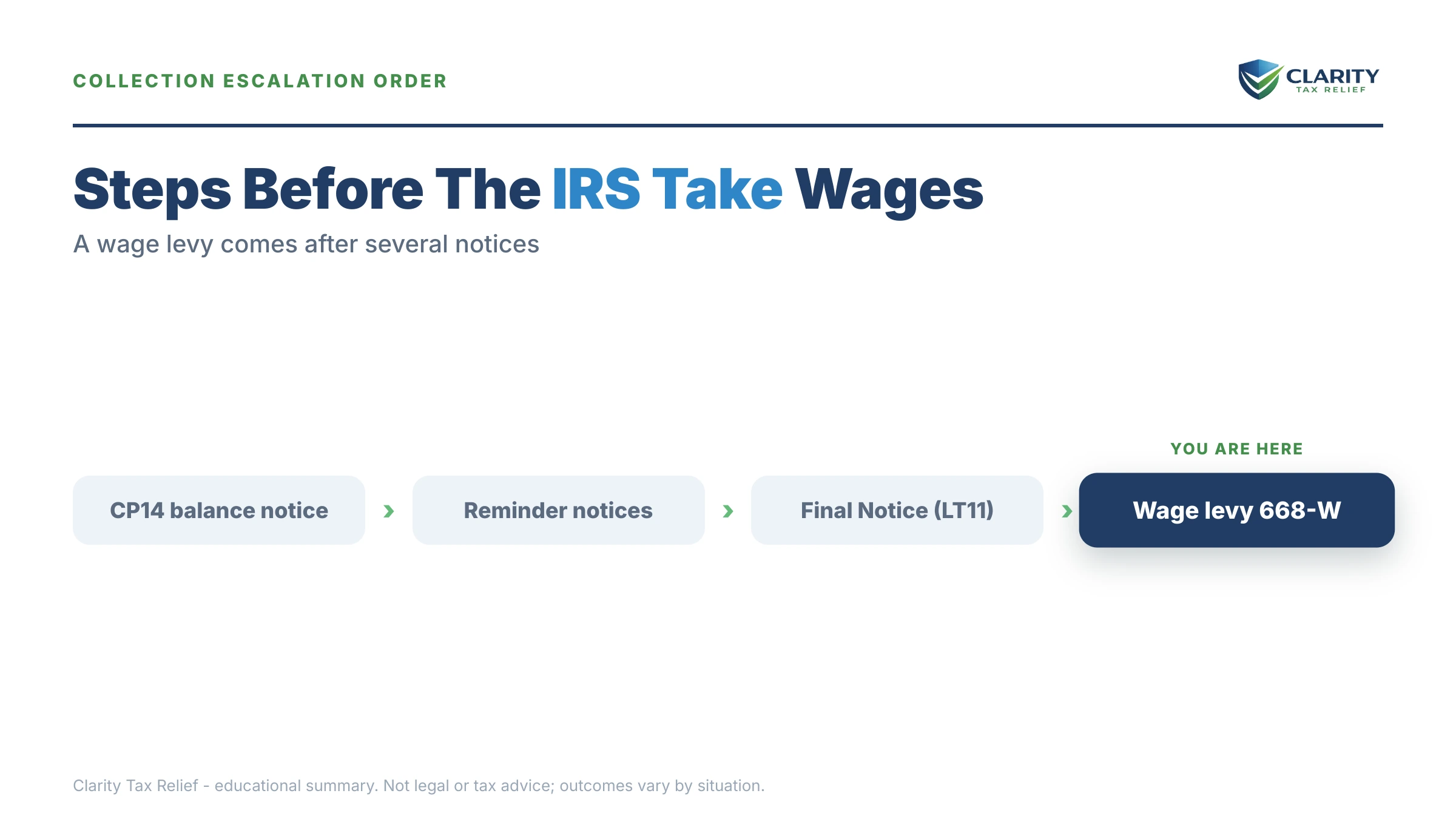
A wage levy is never the first letter — it's the last step in a mailed sequence that starts with a simple bill. If your check is already being levied, every notice below has already gone to your address on file, which is why "I never heard from the IRS" usually means "the IRS wrote to an old address."
| Notice | What it means | Typical timing |
|---|---|---|
| CP14 | First bill for the balance due | About 21 days to respond before the next notice |
| CP501 / CP503 | Reminder bills — no enforcement yet, balance growing | Typically several weeks apart |
| CP504 | Intent to levy your state tax refund — not the final notice | Escalates if unanswered |
| LT11 / Letter 1058 | Final Notice of Intent to Levy — the legal gateway to your wages | 30 days before a levy can begin, with appeal rights |
| Form 668-W served on employer | Wage levy begins | Hits the first paycheck after payroll processes it; continuous until released |
The LT11 notice is the pivotal document: its date started the 30-day clock that made the levy legal. Dig it out of the pile — that date determines which appeal rights you still have.
Your deadlines and rights, at a glance
You have 30 days from the date on an LT11 or Letter 1058 to request a Collection Due Process hearing before a wage levy can begin. Even after a levy starts, several rights stay open — none of them expire just because money is already coming out of your check.
| Moment | Window | The right at stake |
|---|---|---|
| Date on LT11 / Letter 1058 | 30 days | Collection Due Process hearing (Form 12153) — generally blocks the levy on that debt while pending, with Tax Court review preserved |
| After the 30 days pass | Up to 1 year from the notice | Equivalent Hearing — Appeals still reviews your case, but the levy can continue and there's no Tax Court path |
| Employer hands you the Statement of Exemptions | Typically 3 work days | Your true filing status and dependents set the exempt amount; miss it and the married-filing-separately/zero default applies |
| Any time the levy is active | No deadline | Economic hardship release under IRC §6343 if the levy prevents basic living expenses |
| Date each balance was assessed | 10 years (CSED) | Collection generally must stop when the statute runs — though appeals, offers, and bankruptcy pause the clock |
If you're inside the 30-day window, the CDP hearing via Form 12153 is usually the strongest single move available — it forces a human review before the machine proceeds.
What happens if you do nothing
An active wage levy does not expire, shrink, or pause on its own — it runs until the debt is paid, released, or the collection statute ends. Waiting it out is a strategy that compounds against you at every stage:
- Every payday, it repeats. Your employer has no choice: everything above the exempt amount is remitted to the IRS, check after check.
- Raises, bonuses, and overtime get absorbed. The protected amount stays fixed, so every extra dollar you earn flows straight to the debt.
- Other levies stack on top. The IRS can add an bank levy with its 21-day hold, seize your state and federal refunds, and levy other income sources — a wage levy doesn't use up its authority.
- A Notice of Federal Tax Lien gets filed or stays on record. On balances the size of $31,200, the IRS often files one — a public record that title searches and mortgage underwriters find immediately.
- Penalties and interest keep accruing. The 0.5%-per-month failure-to-pay penalty plus compounding interest means the levy has to collect more than the number you started with.
- It runs to the CSED. Collection generally continues until 10 years from assessment — and the clock pauses during appeals, offers, and bankruptcy, so it's rarely a fast exit.
One 2026 reality worth naming: the IRS workforce shrank roughly 27% in 2025, so reaching a human to fix this takes real patience — but the automated levy program never slowed down. The machine collects while the phone lines struggle, which is exactly why acting before the next payroll cutoff matters.
A wage levy is taking your check right now?
The levy repeats every payday until it's released — and most releases can be set in motion before your next payroll cutoff. Get your levy reviewed free by an experienced tax professional: we'll map the fastest release path for your exact balance and paycheck.
Your options to get the levy released
Every legal path to releasing an IRS wage levy runs through one of six doors: full payment, a payment plan, hardship status, an offer, an appeal, or bankruptcy. The complete playbook — including scripts and timing — lives in our guide on how to stop an IRS wage garnishment; here's how each door compares for a typical mid-five-figure balance:
| Option | Who it fits / requirement | Cost and what to expect |
|---|---|---|
| Pay in full | You can access the funds (savings, loan, family) | Fastest release; stops all future penalties and interest on the balance |
| Short-term payment plan | Can pay everything within 180 days | $0 setup fee; interest and penalties continue, but the levy is generally released once approved |
| Streamlined installment agreement | Balance ≤ $50,000; up to 72 monthly payments; can be set up online | Modest setup fee (lower online / with direct debit); interest continues; levy generally released on approval |
| Currently Not Collectible / hardship release | The levy leaves you unable to pay basic living expenses; financial disclosure (Form 433-F) required | $0; collection pauses and the levy is released, but the debt remains and interest accrues |
| Offer in Compromise | Your assets and future income genuinely can't cover the debt; $205 fee (waived with low-income certification) | The IRS accepted roughly 1 in 5 offers in FY2024 — means-tested, months-long, never a quick levy fix on its own |
| CDP appeal | Within 30 days of your LT11 / Letter 1058 | Free; levy on the disputed debt generally can't proceed while the hearing is pending |
| Bankruptcy's automatic stay | A genuine bankruptcy case, not a levy tactic | Filing generally halts the levy immediately — but it's a major legal step; see below |
For most people holding this exact problem, the streamlined installment agreement is the workhorse: under $50,000, no detailed financial disclosure, set up online, levy released once it's in place. If the levy is genuinely breaking your household budget, the hardship levy release or full Currently Not Collectible status can stop collection without a payment — the tradeoff is that the debt keeps growing behind the pause. And if you're weighing more drastic moves, understand exactly how bankruptcy stops an IRS levy before treating it as an escape hatch; the automatic stay is real, but recent tax debt usually survives the case.
Worked example: a $31,200 debt, a biweekly paycheck, and a refinance on the line
Say you owe $31,200, you're single with no dependents, and you gross $2,700 every two weeks — about $2,080 take-home. Under recent Publication 1494 tables, a single filer with no dependents paid biweekly keeps roughly the standard deduction divided across 26 checks — call it about $620 per paycheck as an illustration (check the current-year table for your exact figure). This is hypothetical math, not a prediction of your case.
The levy math looks like this:
- Take-home per check: $2,080. Protected: ~$620. Levied: ~$1,460 per check.
- Over a month (26 checks ÷ 12 months): $1,460 × 2.17 ≈ $3,160/month going to the IRS.
- You're living on roughly $1,345/month — while your mortgage, utilities, and everything else still come due.
Now compare the alternative you could set up online this week: a streamlined installment agreement on $31,200 runs $31,200 ÷ 72 ≈ $433/month minimum before accruing interest and penalties — realistically budget somewhat more to retire the balance faster. That's roughly a $2,700-per-month cash-flow difference between the levy and the plan, and the plan gets the levy released.
For the refinance, the difference is even starker. An active garnishment shows up the moment the lender verifies employment and pulls paystubs, and it torpedoes your debt-to-income math. A payment plan, by contrast, is a fixed monthly obligation most underwriters can work with. Same debt — completely different loan file.
How to respond to an IRS wage levy, step by step
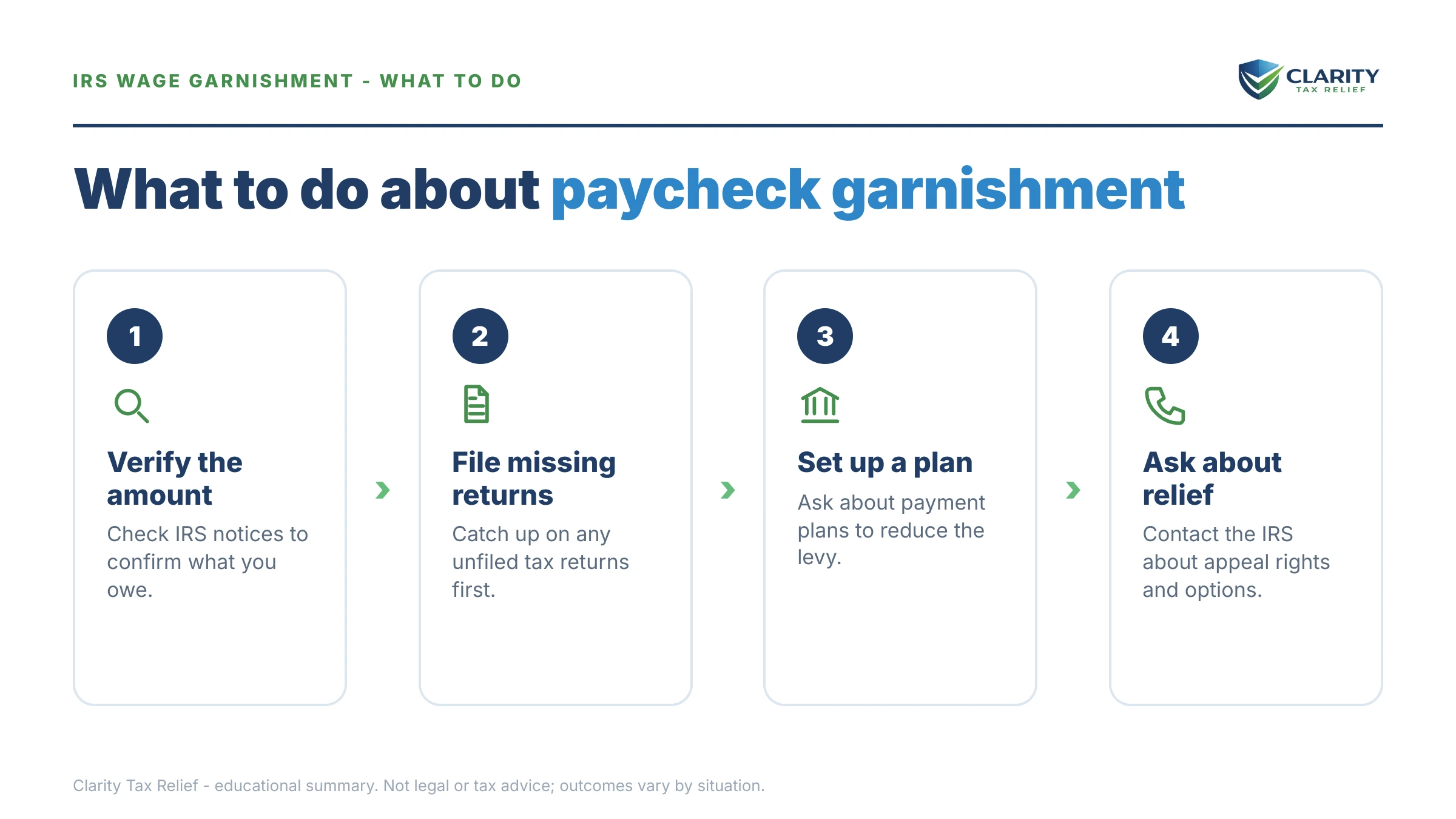
- Locate the final notice that authorized the levy. Find your LT11 or Letter 1058 and check its date. If it is within the last 30 days, you can still file Form 12153 for a Collection Due Process hearing, which generally pauses the levy on that debt while your case is heard.
- Return the Statement of Exemptions within three work days. Complete the statement your employer gives you from Form 668-W with your true filing status and dependents. If you skip it, your employer must use the least generous default and your protected amount shrinks.
- Verify the full balance in your IRS online account. Log in at IRS.gov and confirm every year with a balance, plus accrued penalties and interest. The levy may cover more than one tax year, and your release strategy depends on the true total.
- Start a release path before your next payday. Pay in full at IRS.gov/payments, set up a payment plan, or request a hardship release with financial documentation. Any of the three can trigger a levy release; a payment plan is the most common for balances like $31,200.
- Confirm the release reaches your payroll department. The IRS issues Form 668-D to release a wage levy. Ask that it be faxed directly to your employer and follow up with payroll before the next pay cycle closes, or you may lose one more check to processing lag.
Garnishment while you're trying to refinance
A wage garnishment and the federal tax lien that often accompanies it can each independently sink a refinance. The garnishment surfaces through paystubs and employment verification and wrecks your debt-to-income ratio; the lien surfaces through the title search and clouds the property itself.
The sequence that saves a closing usually looks like: get the levy released (payment plan is fastest), then deal with the lien. Depending on your numbers, that can mean paying the lien off through the refinance proceeds, or requesting tax lien subordination so the new lender takes priority and the loan can close. Our guide on refinancing with an IRS lien walks through which path fits which loan. The key point: lenders close loans over IRS debt every week — but almost never over an active garnishment. Release first, then close.
When you can handle this yourself — and when help changes the outcome
If your balance is under $50,000, you agree you owe it, and you can afford the streamlined monthly payment, you can very likely fix this yourself. Set up the installment agreement through your IRS online account, request the levy release, and confirm it with payroll — no professional required, no fee beyond the IRS's setup charge.
Experienced help earns its cost in specific situations: the levy is active and a closing date or payroll cutoff is bearing down; you have multiple unfiled years (the IRS generally won't grant agreements or releases until required returns are in); the hardship math on Form 433-F needs to be built correctly the first time; you're weighing an Offer in Compromise, where the means-testing is unforgiving; or the debt is business or payroll tax, which follows different and harsher rules. If you can't get traction with the IRS at all and the levy is causing genuine hardship, the Taxpayer Advocate Service is a free, independent avenue inside the IRS itself.
If the levy is already hitting your check and closing day is on the calendar, have an experienced tax professional map the fastest release path before another payday passes — the free case review takes about two minutes to start, or call (888) 825-7779.
Terms on your levy paperwork, decoded
- Form 668-W — the Notice of Levy on Wages, Salary, and Other Income served on your employer; it's what makes the garnishment legal and continuous.
- Exempt amount — the fixed slice of each paycheck the levy can't touch, set by filing status, dependents, and pay frequency.
- Publication 1494 — the IRS table your employer uses to look up your exempt amount; the current version is posted at IRS Publication 1494 (PDF).
- Continuous levy — a levy that attaches once and repeats every pay period, unlike a bank levy, which grabs only what's there on the day it lands.
- CDP (Collection Due Process) — your right to an independent Appeals hearing, requested on Form 12153 within 30 days of the final notice.
- Form 668-D — the release document the IRS sends your employer when the levy ends; the garnishment doesn't stop until payroll has it.
- CSED — the Collection Statute Expiration Date, generally 10 years from assessment, after which the IRS's ability to collect (and levy) ends.
How much can the IRS garnish? Your questions, answered
Can the IRS take my whole paycheck?
Almost — and for higher earners it comes close. The levy protects only a fixed exempt amount based on your filing status, dependents, and pay frequency, and your employer must send everything above it to the IRS. For a single filer with no dependents, the protected amount is roughly the standard deduction spread across the year's paychecks; the rest is levied. If what's left won't cover basic living expenses, you can request an economic hardship release.
What percentage of your paycheck can the IRS garnish?
None — the IRS doesn't use a percentage at all. Private creditors are generally capped at 25% of disposable earnings under federal law, but an IRS wage levy works in reverse: a fixed dollar amount is protected and the IRS takes the remainder. That means the more you earn, the larger the share the IRS collects — often 50% to 80% of take-home pay.
How much notice does the IRS give before garnishing wages?
You'll typically receive a series of mailed notices ending with an LT11 or Letter 1058, the final notice of intent to levy. From that letter's date you have 30 days to request a Collection Due Process hearing on Form 12153, and in most cases the IRS cannot start the wage levy during that window. If you never updated your address, those notices may have gone to an old one — the levy is still valid.
Can my employer refuse to garnish my wages or fire me over it?
No on both counts, in most cases. An employer who ignores a Form 668-W can become personally liable for the amounts it should have withheld, so payroll will comply. Federal law generally prohibits firing an employee because of a single garnishment, though protections thin out if multiple separate garnishments hit. Your employer is not the decision-maker here — the release has to come from the IRS.
What happens if I don't return the Statement of Exemptions?
Your employer must calculate your protected amount at the least generous setting — typically married filing separately with no dependents — which shrinks what you keep each payday. You usually have about three work days to return the statement after your employer hands it to you. Filing it late is still worth doing: the exempt amount adjusts going forward, though the IRS won't refund what was already over-collected because of the default.
Does an IRS wage levy take bonuses, commissions, and overtime?
Yes. The exempt amount is fixed per pay period and does not grow with your check, so a bonus or heavy-commission period is levied almost in full. If your pay is mostly commissions, the levy can swing wildly from check to check while the protected amount stays flat. Timing a payment plan before a bonus pays out can preserve thousands of dollars.
How long does an IRS wage garnishment last?
It's continuous — the levy repeats every payday until the IRS issues a release, the balance is paid in full, or the 10-year collection statute (CSED) expires on the debt. It does not renew or expire on its own like some state garnishments. The practical way out is a release: full payment, a payment plan, hardship status, or a successful appeal.
Will setting up a payment plan stop the garnishment?
In most cases, yes. Once an installment agreement is approved, the IRS generally releases the wage levy, and balances under $50,000 can often be set up online as a streamlined agreement with up to 72 months to pay. Ask the IRS to fax the release (Form 668-D) directly to your payroll department — waiting on mail can cost you another levied paycheck.
Can the IRS garnish my spouse's paycheck for my tax debt?
Only if your spouse is liable for the debt — usually because you filed a joint return for the year in question. For joint liabilities, the IRS can levy either spouse's wages, or both. If the debt is from your separate return or from before the marriage, your spouse's paycheck is generally out of reach, though community-property states can complicate whose income is exposed.
Your next 24 hours
- Find the date on your LT11 or Letter 1058. If it's within the last 30 days, your strongest appeal right — the CDP hearing — is still open, and preserving it comes before everything else.
- Gather three things: the levy paperwork from your employer (including the Statement of Exemptions), your most recent paystub, and last year's tax return. That's everything needed to compute your exempt amount and your realistic release path.
- Get your free levy review — the 2-minute form or (888) 825-7779. The levy repeats every payday and penalties and interest keep accruing until it's released, so the goal is simple: a release in motion before your next payroll cutoff.
This guide is general information, not tax or legal advice for your specific situation. Eligibility for IRS programs depends on individual facts and circumstances; no outcome is guaranteed.