
Back Taxes by Situation
Real Estate Investor Back Taxes: How to Resolve IRS Debt From Rentals, Recapture & Failed 1031s (2026)
The short answer: real estate investor back taxes usually come from three sources: unreported rental income, depreciation recapture on a property sale, or a failed 1031 exchange. Payment plans, penalty relief, and — rarely, because property equity counts against you — an Offer in Compromise can resolve the debt. Act before a federal tax lien attaches to every property you own.
You closed on the sale, the wire hit your account, and the money is long since redeployed — into the next down payment, the renovation, the reserve fund. Now the IRS says a chunk of that money was never yours. Real estate tax debt has a specific shape: the cash is illiquid, the gain was bigger than you thought, and the collateral the IRS wants is the exact asset your strategy depends on. That also means it has a specific fix — and acting before a lien clouds your titles is most of it.
⏱ The clock that's actually running: there's no single statutory deadline on investor back taxes, but the failure-to-pay penalty adds 0.5% of the balance every month and interest compounds daily on top of it. Separately, once a Notice of Federal Tax Lien files, it attaches to every property you own — and it doesn't wait for you to be ready.
Why real estate investors end up owing back taxes
Real estate creates tax debt in ways almost no other investment does: the gain on paper routinely exceeds the cash at closing. Selling agents, property managers, lenders, and rental platforms all report to the IRS independently — so the debt usually surfaces through automated matching, not an audit.
The most common triggers, in rough order of how often we see them:
- Unreported or underreported rental income. A property manager's 1099-MISC, a platform 1099-K, or a lender's Form 1098 on a property your Schedule E never mentioned — any mismatch feeds the automated underreporter program, which sends a CP2000 notice proposing extra tax. If unreported rent is your specific issue, the landlord owes IRS guide goes deeper on that path.
- Depreciation recapture on a sale. Covered in full below — this is the single biggest surprise bill in real estate, because it's taxed even when the sale barely netted cash.
- A failed or partial 1031 exchange. Miss the 45-day identification window or the 180-day closing window and the entire deferred gain lands in one tax year. Take any cash out of the exchange ("boot") and that portion is taxable even if the rest succeeds.
- Dealer reclassification. Flip properties frequently enough and the IRS can treat you as a dealer: gains become ordinary income subject to self-employment tax, and installment-sale treatment disappears. The reclassification often arrives years later, with penalties attached to every affected return.
- Short-term rental self-employment tax. Average stays of a week or less combined with substantial services (cleaning between guests, meals, concierge-style extras) can push income off Schedule E and onto Schedule C — adding roughly 15.3% self-employment tax nobody budgeted. The Airbnb host owes taxes guide covers that scenario specifically.
- Disallowed passive losses. The $25,000 active-participation loss allowance phases out between $100,000 and $150,000 of modified AGI. Investors who deducted rental losses above those limits get the deduction reversed — with interest running from the original due date.
- Foreclosure or short-sale phantom income. Losing a property can still create taxable income: cancelled debt on a recourse loan generates a 1099-C, and a foreclosure is treated as a sale that can trigger recapture. The 1099-C cancelled debt taxes guide explains the insolvency escape hatch.
| Trigger | How the IRS catches it | What you're billed |
|---|---|---|
| Unreported rental income | 1099-MISC / 1099-K matching; Form 1098 on an unlisted property | Tax on the income + 20% accuracy penalty risk + interest |
| Property sale (recapture) | Form 1099-S filed by the closing agent | Up to 25% on unrecaptured §1250 gain + capital gains tax |
| Failed 1031 exchange | Exchange reported, replacement never closes | Entire deferred gain taxed in the year the exchange broke |
| Dealer reclassification | Exam of flip frequency and intent | Ordinary rates + self-employment tax on flip profits |
| Short-term rental services | Platform 1099-K + Schedule E/C mismatch | ~15.3% self-employment tax on net rental profit |
| Foreclosure / cancelled debt | Lender files 1099-C / 1099-A | Tax on forgiven debt unless insolvency applies |
| Missed estimated payments | Automatic when the return posts | Underpayment penalty stacked on the balance |
Depreciation recapture: the back-tax bill investors never see coming
Depreciation recapture taxes your prior depreciation deductions at up to 25% when you sell — even if you never actually claimed the depreciation. The tax code's standard is depreciation "allowed or allowable": the IRS reduces your basis by what you could have deducted, whether or not you did. Skip depreciation for a decade and you get no deduction during ownership but the full recapture bill at sale.
The mechanics explain why the bill outruns the cash. Say a building depreciated $8,000 a year for ten years. Your basis dropped $80,000, so your taxable gain grew $80,000 — and that slice is taxed as unrecaptured §1250 gain at a maximum 25% rate, not the lower long-term capital gains rate. If the sale proceeds went straight to paying off the mortgage and the next acquisition, the tax is due anyway. Recapture is reported on Form 4797 with the sale, and there is no election to skip it.
Two partial escapes exist. If you under-claimed depreciation, Form 3115 can catch up the missed deductions in the year of sale so they offset the recapture — worth real money and frequently missed by generalist preparers. And if the numbers on an IRS notice look wrong (they often do — the IRS sees your gross sale price from the 1099-S, not your basis, improvements, or selling costs), amending a return to lower a tax debt or responding to the notice with corrected figures can shrink the balance before you negotiate payment on it. If your bill came from selling a property you lived in first, the sold a house, owe capital gains guide covers how the home-sale exclusion interacts with rental years.
What happens if you ignore real estate investor back taxes
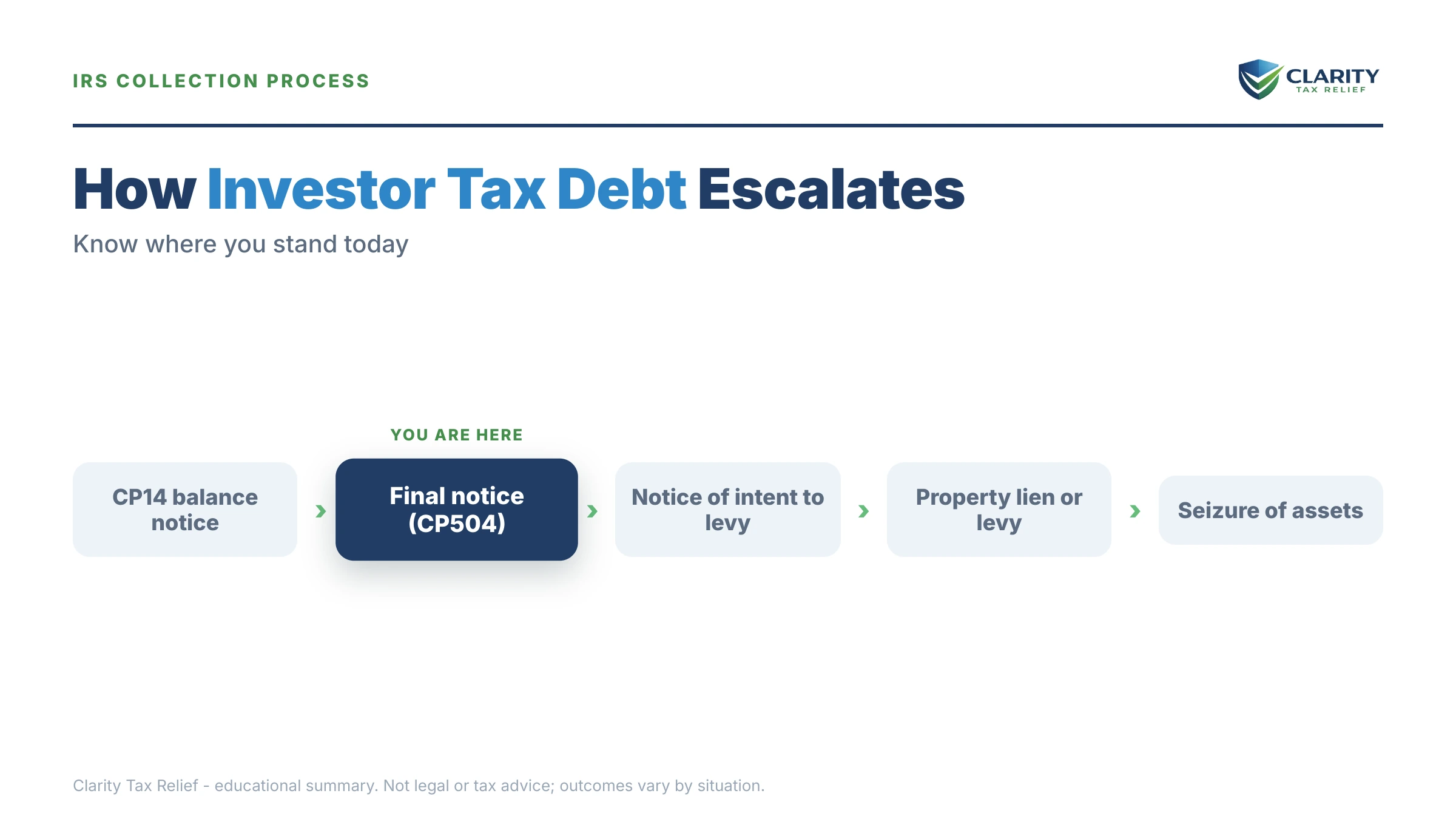
An unpaid investor tax debt moves through an automated notice sequence that ends with a lien on every property you own and a levy on your rent and accounts. The stages arrive in a fixed order — typically about five weeks apart — and each one removes options:
- CP2000 or CP14 — either a proposed change from document matching (still disputable) or the first bill after you filed. This is the cheapest stage to act: nothing is assessed or enforced yet on a CP2000, and a CP14 balance can still be put on a plan before any enforcement.
- CP501 / CP503 — reminder bills. No enforcement yet, but the 0.5% monthly failure-to-pay penalty and daily interest are compounding the whole time.
- CP504 — Notice of Intent to Levy under IRC §6331(d). The IRS can now seize your state tax refund, and a Notice of Federal Tax Lien becomes a realistic next move.
- Federal tax lien filing — the step that hurts investors most. The lien attaches to every property you own, present and future-acquired. Refinances stall, lenders walk, and every sale now requires IRS paperwork to close. See federal tax lien on your house for exactly what attaches and what it blocks — and selling a house with an IRS lien if you're already under contract.
- LT11 / Letter 1058 — Final Notice of Intent to Levy, starting a 30-day clock and your Collection Due Process rights (requested on Form 12153). After that window, the IRS can levy bank accounts (funds held 21 days before they leave), garnish a W-2 paycheck continuously, and serve levies on your tenants or property manager — redirecting your rent checks to the Treasury.
One 2026 reality check: the IRS workforce shrank roughly 27% in 2025, so reaching a human is harder than ever — but this entire sequence is generated by automated systems that never stopped running. Understaffing delays your fix; it does not delay the machine.
Back taxes tied to a rental or a sale?
Before a lien touches your titles, get the notice and your numbers reviewed free. An experienced tax professional will check whether the IRS overstated your gain and map the option that fits your equity — no pressure, no obligation.
Your options for resolving real estate investor back taxes
Every IRS resolution program is available to real estate investors — but property equity changes the math on each one. The general playbook for negotiating with the IRS on your own lives in our guide to how to settle tax debt yourself; here's how each option behaves when you own real estate:
| Option | Basic eligibility | The catch for investors |
|---|---|---|
| Short-term payment plan | Pay in full within 180 days; $0 setup fee | None — the cleanest fix for a one-off recapture bill you can cover from the next few months of rent |
| Guaranteed installment agreement | Balance ≤ $10,000; pay within 36 months | No financial disclosure — the IRS never looks at your equity. Ideal for small investor balances |
| Streamlined installment agreement | Balance ≤ $50,000; up to 72 months, set up online | Still no equity review — but a lien can be filed at the IRS's discretion at higher balances |
| Non-streamlined IA / PPIA | Above $50,000, or payments below full-pay; Form 433-A financials | The IRS sees every property and may push you to borrow against equity before approving low payments |
| Currently Not Collectible | Paying anything would prevent basic living expenses | Very hard with rental equity or positive cash flow — the IRS expects the assets to pay first |
| Offer in Compromise | $205 fee; 20% down on lump-sum offers; offer must meet your reasonable collection potential | Equity in real estate counts toward RCP at quick-sale value — accessible equity usually sinks the offer |
| Penalty abatement (FTA / AEP) | Clean compliance history for the prior 3 years, or reasonable cause | None — and starting summer 2026, Automatic Exemption from Penalty applies without a request for qualifying taxpayers |
| Bankruptcy | Income tax meeting the 3-year / 2-year / 240-day tests | A pre-existing tax lien survives discharge and stays on your properties — compare Chapter 7 vs 13 for tax debt before assuming either helps |
The pattern worth internalizing: below $50,000, the IRS never asks about your properties; above it, your equity becomes the negotiation. That's why paying a balance down under a streamlined threshold — even by borrowing modestly — sometimes beats a financially-disclosed agreement where every unit you own goes on Form 433-A. And it's why the Offer in Compromise marketing aimed at investors is mostly noise: an offer succeeds only when the IRS genuinely can't collect more, and visible real estate equity is the definition of collectible.
A worked example: the $4,800 recapture bill
Say you're single, you have a W-2 job, and you sold the one condo you'd been renting out. Between recapture on five years of depreciation and gain your withholding never covered, you owe $4,800. Here's the real math on each path:
- Do nothing: the failure-to-pay penalty runs 0.5% × $4,800 = $24 a month, plus daily-compounding interest on top — and the notice sequence above starts marching. You can estimate your own accrual with our Penalty & Interest Calculator.
- Short-term plan (180 days, $0 setup): $4,800 ÷ 6 ≈ $800/month. Enforcement stops; penalties and interest still accrue until paid, but on a shrinking balance.
- Guaranteed installment agreement: at $4,800 you're under the $10,000 ceiling, so approval is essentially automatic with returns filed. Spread over 36 months that's roughly $133/month plus accruing penalties and interest — no financial disclosure, no equity review, no lien in the normal course.
- Offer in Compromise: not realistic here. With a steady W-2 paycheck, the IRS's future-income math alone will exceed $4,800 — an offer would cost you the $205 fee and months of waiting to be told what the numbers already say.
- Penalty relief: if your prior three years were clean, first-time abatement can strip the failure-to-pay penalties that accumulated — and under the AEP rules rolling out in summer 2026, qualifying penalty relief becomes automatic, no request needed. On a $4,800 balance that's real money back.
This scenario is hypothetical, but the shape is the most common one we see from part-time investors: a small, fixable balance that becomes a lien-and-levy problem only through inaction.
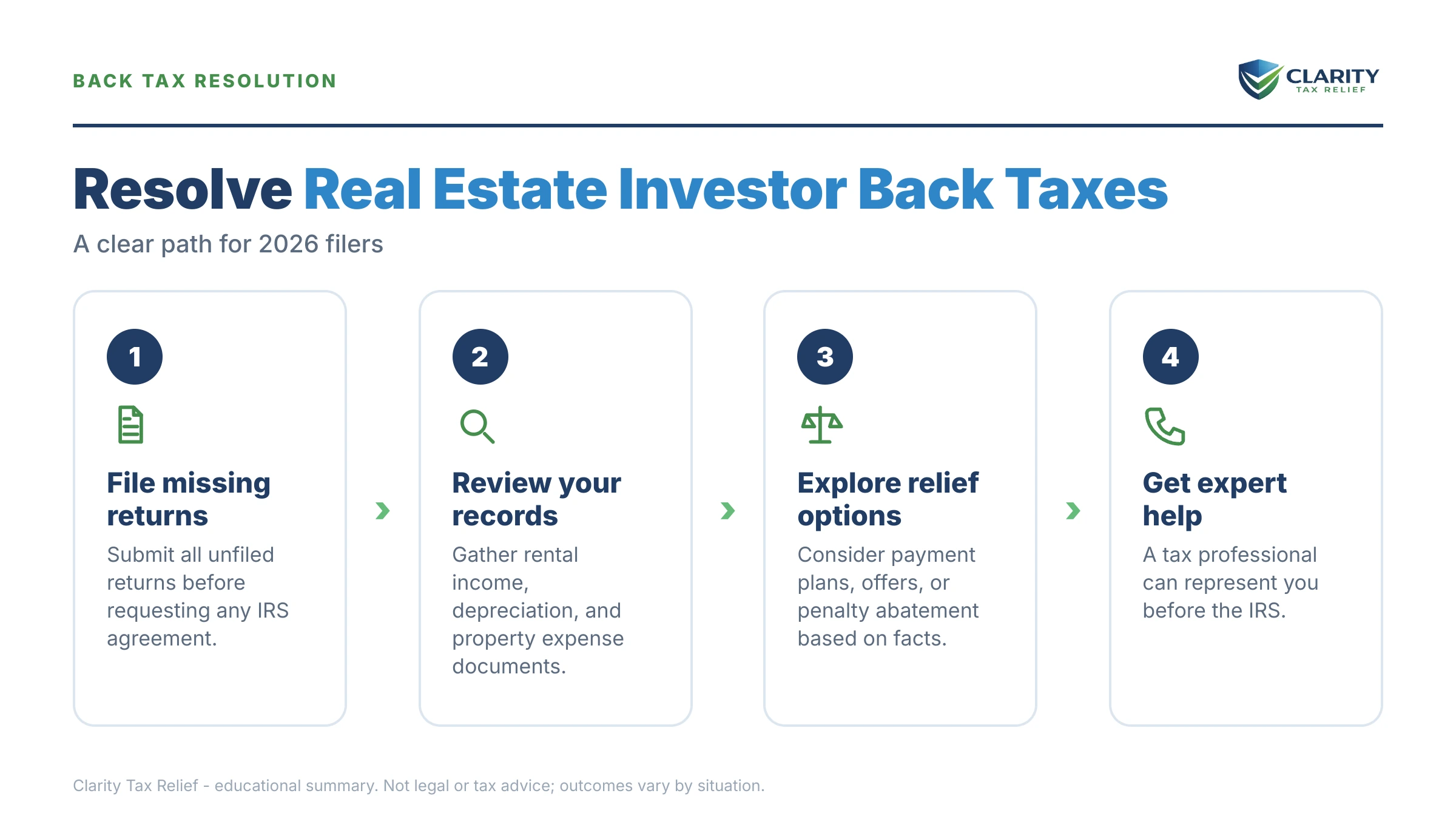
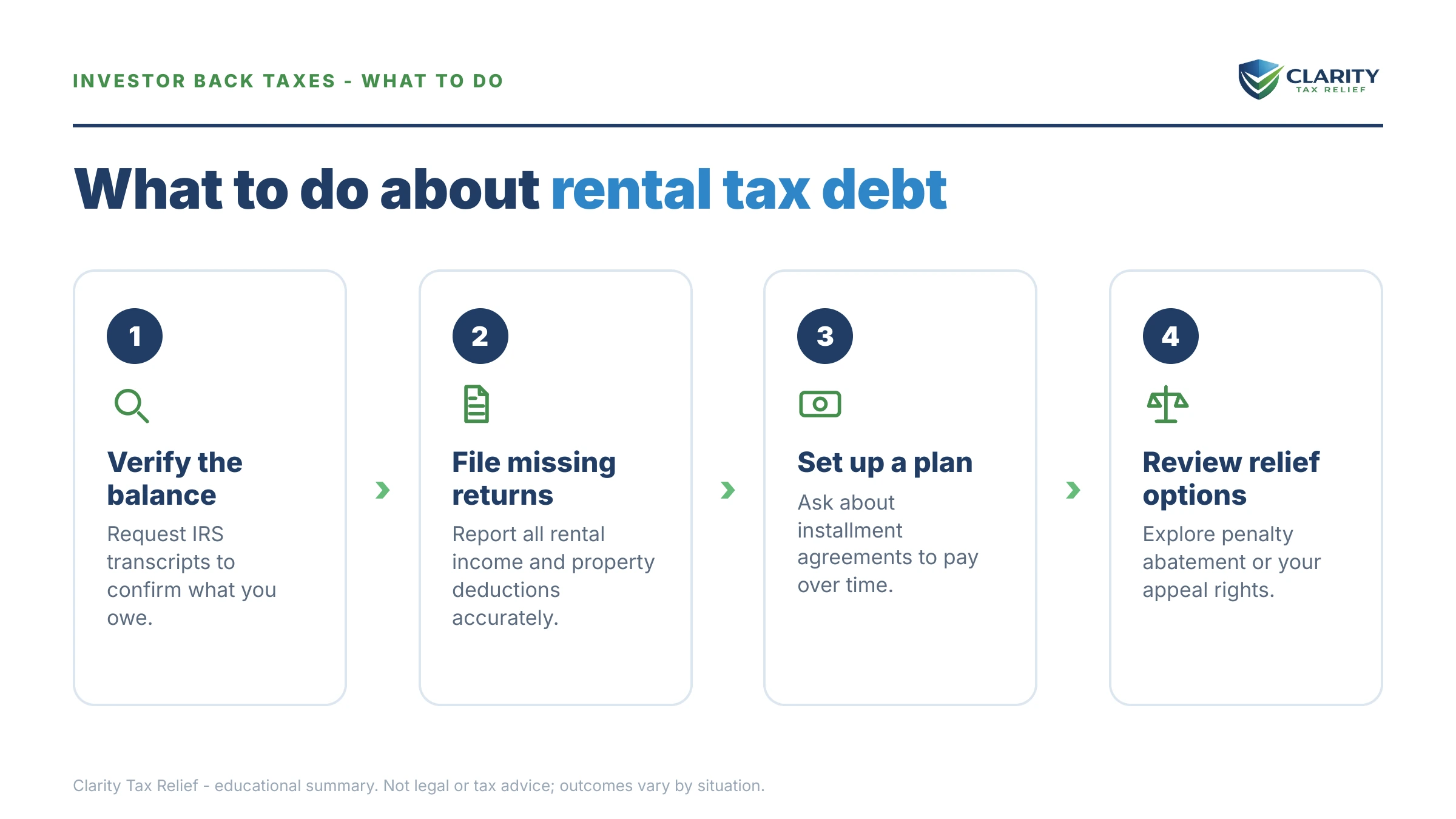
How to respond to real estate investor back taxes, step by step
- Pull your IRS transcripts. Get the wage and income transcript and account transcript for every year involved, so you're working from the IRS's own numbers — including every 1099-S and 1099-MISC it has on file.
- Verify the math. Check basis, closing costs, improvements, and depreciation schedules — matching notices routinely overstate gain because the IRS sees your gross sale price, not your basis.
- File or amend first. Submit any missing Schedule E years and correct basis errors before negotiating; the IRS won't finalize most agreements while returns are outstanding.
- Pick your resolution. Choose the option from the table above that fits your balance and equity, and set it up online or by phone before the next notice escalates.
- Protect your properties. If a lien has filed and a sale or refinance is pending, request a discharge (Form 14135 lien discharge) or subordination (Form 14134 lien subordination) early — processing takes weeks, not days.
IRS transcript codes real estate investors see
Your account transcript tells you exactly where an investor tax debt sits — before any notice arrives. These are the codes that matter most on a rental or sale-related balance:
| Code | What it means | What to do |
|---|---|---|
| 150 | Your return posted; the base tax is assessed | Confirm the figures match what you filed |
| 922 | Underreporter review — a 1099-S or rental 1099 didn't match your return | A CP2000 is likely coming; assemble basis and expense records now (see code 922 — underreporter review) |
| 290 | Additional tax assessed — the proposed change became real | The dispute window has narrowed; move to resolution or reconsideration |
| 276 | Failure-to-pay penalty posted | Check first-time abatement eligibility before paying it |
| 971 | A notice was issued — the sequence is moving | Match the date to the letter in hand; don't let one go unopened |
| 582 | Lien indicator — a federal tax lien is on your account | Get discharge or subordination paperwork moving before any sale or refi |
| 570 | Account hold — something is under review | Wait for the paired 971 notice before acting |
Situations that change the playbook
The single-rental, single-year case above is the simple version. These variations change what you should do first:
Multiple years or multiple properties. All years get resolved in one agreement — the IRS won't do one plan per year. But the order matters: fix the overstated years by amendment or CP2000 response first, then negotiate the true total. Negotiating before correcting means paying a plan on inflated numbers.
Property held in an entity. A single-member LLC's rental debt is your personal debt — the entity is disregarded. A partnership or S-corp passes the income (and the debt) through to your personal return. A C corporation's balance is genuinely the corporation's, with its own resolution track — see C corporation tax debt if your holding entity got the notice rather than you.
A 1031 exchange still in motion. If you're inside the 45/180-day windows on a new exchange while owing back taxes, tell your qualified intermediary and get advice before the IRS files a lien — a lien attaching mid-exchange can complicate the replacement closing.
You dispute the amount. A CP2000 is a proposal, not a bill — respond with basis documentation before the deadline printed on it and the balance may shrink or vanish before assessment. Once code 290 posts, you're arguing uphill through audit reconsideration instead.
State back taxes on the same properties. Rental income and sale gains are usually taxable to the state where the property sits, so out-of-state investors often owe nonresident state returns they never filed. States run their own programs and their own clocks — California's FTB, for example, has a 20-year collection statute, twice the IRS's. Resolve with each agency separately; an IRS agreement does nothing for a state balance.
When you can handle this yourself — and when help changes the outcome
An investor with one property, one tax year, and a balance under $10,000 can usually resolve this alone. If you agree with the IRS's numbers, a guaranteed installment agreement or 180-day plan takes one online session or one phone call — no professional required, and anyone who tells you otherwise is selling something.
Experienced help earns its cost in specific situations: when the IRS's gain calculation ignores your basis and a proper CP2000 response or amended return could cut the debt before you pay a cent of it; when a Form 3115 depreciation catch-up could offset recapture; when a lien has filed and a sale or refinance is on a closing calendar; when multiple unfiled Schedule E years need reconstruction; when dealer reclassification or an exam is in play; or when the balance is large enough that Form 433-A financials — and every property on them — become the negotiation. In those cases the professional isn't buying you sympathy; they're changing the number being negotiated.
Terms on your notice and transcript, decoded
- Depreciation recapture / unrecaptured §1250 gain — the slice of your sale gain created by depreciation deductions, taxed at up to 25% instead of capital-gains rates.
- Form 1099-S — the form your closing agent files reporting the gross sale price to the IRS; it's how the IRS knows you sold.
- Boot — cash or non-like-kind value received in a 1031 exchange; taxable even when the rest of the exchange defers.
- Federal tax lien — the government's legal claim against everything you own; a lien clouds title, a levy actually takes money or property.
- CSED — the collection statute expiration date: 10 years from assessment, pausable by offers, appeals, and bankruptcy.
- Passive activity loss — rental losses limited by income rules; deducting past the limits is a common source of reversed deductions and back taxes.
If one of these terms is sitting on a notice about your property right now, a free review with an experienced tax professional — (888) 825-7779 or the 2-minute form — can pinpoint where you are in the sequence before a lien complicates your next refinance or closing.
Real estate investor back taxes: your questions answered
Do I owe depreciation recapture if I never claimed depreciation on my rental?
Yes. Recapture is computed on depreciation allowed or allowable — the IRS taxes you on the depreciation you could have claimed, even if you never took a dollar of it. That is the worst of both worlds: no deduction during ownership, full recapture at sale. An experienced tax professional can often file Form 3115 to catch up the missed depreciation so the deduction offsets the recapture in the year of sale.
Can the IRS put a lien on my rental properties for back taxes?
Yes. A federal tax lien attaches to everything you own once a balance is assessed, demanded, and unpaid — and a filed Notice of Federal Tax Lien makes it public, clouding title on every rental, blocking clean refinances, and complicating closings. Liens generally file deeper in the collection sequence, so setting up a payment arrangement early is the most reliable way to keep your properties unencumbered.
Can the IRS levy my rental income directly?
It can. After the final notice of intent to levy (LT11 or Letter 1058) and the 30-day window it starts, the IRS can serve a levy on your tenants or property manager, ordering them to send rent to the IRS instead of you. Tenants almost always comply, because paying you after receiving a levy makes them personally liable for the amount they should have turned over.
What happens to my taxes if my 1031 exchange fails?
If you miss the 45-day identification window or the 180-day closing window, the exchange fails and the deferred gain — including depreciation recapture — becomes taxable in the year the exchange broke. A partial failure works the same way: any cash or non-like-kind value you receive (called boot) is taxable even if the rest of the exchange succeeds. If you cannot pay the resulting bill, the resolution options in this guide apply.
Will the IRS accept an Offer in Compromise if I have equity in real estate?
Rarely, if the equity is meaningful. An OIC is accepted only when your reasonable collection potential — equity in assets plus future income — is less than the balance, and rental equity counts toward that number at roughly its quick-sale value. The IRS accepted roughly 1 in 5 offers in FY2024, and investors with accessible equity are usually rejected because the IRS can simply collect from the property.
How does the IRS find unreported rental income?
Mostly through document matching. The closing agent files Form 1099-S reporting your sale price, property managers issue 1099-MISC forms for rent they collected, platforms issue 1099-Ks above the $20,000 / 200-transaction threshold, and your lender's Form 1098 shows mortgage interest on a property your return never mentions. When those documents don't match your return, the automated underreporter program generates a CP2000.
Can I sell a property that has an IRS tax lien on it?
Yes. The most common route is paying the IRS from sale proceeds at closing — the lien is satisfied and released. If the sale won't cover the full balance, you can apply for a certificate of discharge on Form 14135, which removes the lien from that one property so the sale can close; the IRS generally takes whatever proceeds remain after senior mortgages. Start the application weeks before closing, not days.
Does IRS debt from a rental sale expire after 10 years?
Generally yes — the IRS has 10 years from assessment to collect (the CSED), after which the remaining balance expires. But the clock pauses while an offer in compromise, bankruptcy, or collection appeal is pending, so the real expiration date is often later than year ten. Waiting out the statute while owning leviable rental income and visible equity is rarely a realistic strategy for an investor.
Can bankruptcy clear real estate investor tax debt?
Sometimes. Income tax from rental income or a property sale can be discharged in Chapter 7 if the return was due more than 3 years ago, was filed more than 2 years ago, and the tax was assessed more than 240 days ago — and the return wasn't fraudulent. Two catches for investors: a tax lien filed before the bankruptcy survives and stays attached to your properties, and recent tax years never qualify.
Your next 24 hours
- Find the year and the amount. On a CP2000, it's the "proposed amount due" line — and note whether it's still a proposal (disputable) or an assessed bill. On a CP14 or later notice, it's the balance box and the pay-by date.
- Gather the paper that changes the math. The notice itself, the closing or settlement statement for any property sold, your depreciation schedules, Schedule E for the years involved, and your last filed return. Basis documents are where investor balances shrink.
- Get the free case review. Call (888) 825-7779 or use the 2-minute form. Penalties and interest are accruing monthly either way — a 20-minute review tells you whether the IRS's gain figure is even right before you agree to pay it.
Primary sources: the IRS's payment plans and installment agreements page covers plan setup and thresholds, IRS.gov/payments handles direct payment, and the independent Taxpayer Advocate Service can intervene when normal channels stall.
This guide is general information, not tax or legal advice for your specific situation. Eligibility for IRS programs depends on individual facts and circumstances; no outcome is guaranteed.