
Tax Debt Situations
Sold a House and Owe the IRS Capital Gains? What to Do in 2026
The short answer: if you sold a house and owe the IRS capital gains you can't pay, report the sale and file on time anyway — then use a payment plan. Balances of $25,000 or less typically qualify for a streamlined monthly agreement of up to 72 months, set up online, with no financial disclosure.
You signed at the title company months ago, the proceeds went straight into the next chapter — the new place, the business, the debts you finally cleared — and now your tax return is showing a five-figure balance nobody withheld at closing. If you're a sole proprietor, that gain landed on top of a year of untaxed 1099 income, which is exactly how the number got this big.
Here's the part that matters: the IRS already knows about the sale. Your closing agent filed a Form 1099-S reporting the gross price — the image below shows exactly what that form looks like and where the number the IRS is watching for appears. Everything in this guide flows from matching that number correctly.
⏱ Your real deadline: federal capital gains tax from a home sale is due by April 15 of the year after closing. If you're self-employed and pay quarterly, an estimated payment on the gain is generally due at the next quarterly deadline after the sale. Past the due date, interest plus a 0.5%-per-month failure-to-pay penalty accrue until the balance is paid.
Why you owe the IRS capital gains after selling your house
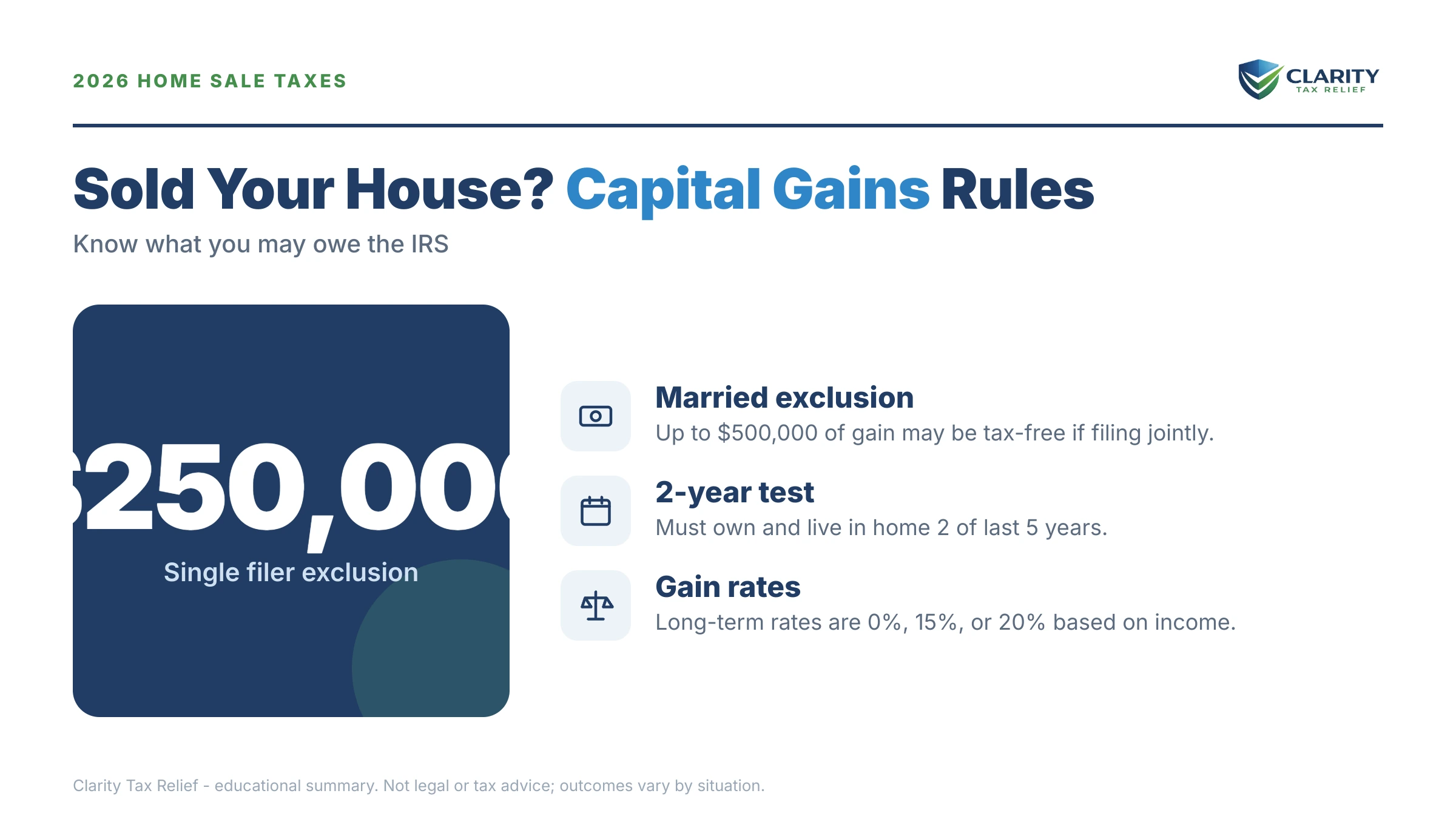
Selling a primary residence is tax-free up to $250,000 of gain — $500,000 if married filing jointly — when you owned and lived in the home for at least 2 of the 5 years before closing. That's the Section 121 exclusion, and it's why most home sellers owe nothing. You landed on this page because you're in one of the exceptions.
The common ways a home sale creates an IRS bill: the gain blew past the exclusion cap, the house was a rental or second home the exclusion never covered, you sold before hitting the 2-year mark, or — the sole-proprietor special — you deducted a home office and the depreciation now comes back as taxable income even though the rest of the gain is excluded.
There's a stacking problem too. Capital gain sits on top of your other income when the IRS picks your rate, so a big sale year can push a self-employed filer from the 0% or 15% capital-gains bracket into 15% or 20% — and if the gain lifts your modified AGI above $200,000 (single) or $250,000 (joint), the 3.8% Net Investment Income Tax applies to gain above that line as well.
| Your situation | Is the gain taxable? | What's actually taxed |
|---|---|---|
| Primary home, lived in 2 of last 5 years, gain under $250k / $500k | No | Nothing — Section 121 excludes the full gain |
| Primary home, gain above the exclusion cap | Partly | Only the gain over $250k/$500k, at long-term rates (0/15/20%) |
| Primary home with a home office or prior rental use | Partly | Depreciation claimed after May 6, 1997 is recaptured at up to 25% — even when everything else is excluded |
| Owned or lived in it less than 2 years | Usually yes | Full gain — ordinary rates if held ≤1 year; a partial exclusion may apply if you moved for work, health, or unforeseen circumstances |
| Rental or investment property | Yes | Full gain at capital-gains rates plus depreciation recapture; no Section 121 exclusion |
| Second or vacation home | Yes | Full gain; no exclusion, and a loss is not deductible if the use was personal |
| Inherited house | Often no | Basis steps up to date-of-death value, so only appreciation after inheritance is taxed |
If your sale was a rental with years of depreciation behind it, the math gets deeper than this page — see our guide to real estate investor back taxes for recapture, 1031, and multi-property situations.
The math behind a $16,400 bill: a worked example
A hypothetical shows how an ordinary sale produces a very real balance. Say you owe $16,400 — here's one way a single, self-employed designer gets there.
You bought the house in 2015 for $198,000 and put $20,000 of improvements into it, so your cost basis is $218,000. Over ten years you deducted a home office and claimed $11,600 of depreciation, cutting your adjusted basis to $206,400. You sold for $590,000 with $32,000 in selling costs — $558,000 realized.
Gain: $558,000 − $206,400 = $351,600. Section 121 excludes $250,000, but never the depreciation. What's left taxable:
- $90,000 of gain over the exclusion × 15% long-term rate = $13,500
- $11,600 of home-office depreciation recaptured at up to 25% = $2,900
- Total federal bill: $16,400
Two ways to pay it: a short-term plan means roughly $2,735 a month for six months with a $0 setup fee. A 72-month streamlined installment agreement starts around $228 a month minimum — while interest and the 0.5% monthly late-payment penalty keep accruing, so paying faster than the minimum always saves money. Most people land in between.
Notice what the example also shows: rebuilding your basis matters. Forget the $20,000 of improvements and the $32,000 of selling costs, and this same seller "owes" $7,800 more than the law requires.
What happens if you ignore the capital gains tax you owe
An unpaid home-sale tax bill escalates on autopilot — and an unreported home sale escalates worse. There are two failure paths, and they end in the same place:
- April 15 passes unpaid. Interest accrues daily and the failure-to-pay penalty adds 0.5% per month. If you also didn't file, the failure-to-file penalty runs 5% per month — ten times worse, which is why filing on time is non-negotiable even with no money.
- CP14 arrives — the first bill, with about 21 days before the sequence advances. Reminder notices (CP501, CP503) follow, typically weeks apart, each with a bigger balance.
- CP504 — the IRS can now take your state tax refund, and a federal tax lien becomes realistic. A lien matters double here if you're planning your next purchase — see can I buy a house if I owe the IRS.
- LT11 / Letter 1058 — the final notice. After 30 days the IRS can levy bank accounts (where your sale proceeds may still be sitting) and, for a sole proprietor, send levies to your clients for the 1099 payments they owe you.
The second path is quieter and nastier. If you never reported the sale at all, IRS computers match the 1099-S against your return and the underreporter unit sends a CP2000 notice proposing tax on the entire gross sale price with zero basis and zero exclusion — because the IRS doesn't know what you paid for the house. Sellers who would have owed $16,400 get proposed bills several times that size. The fix is responding with the real numbers, but the burden is now on you.
In 2026, don't count on staffing chaos to save you: the IRS workforce shrank roughly 27% in 2025, but the 1099-S matching, the notice sequence, and the levies are all automated. The machine escalates whether or not a human reads your file. To see how fast the balance itself grows while you wait, run your numbers through our Penalty & Interest Calculator — it estimates what delay actually costs.
Staring at a home-sale tax bill you can't pay?
Interest and penalties on that balance are compounding every month you wait — but the right plan usually takes one afternoon to set up. An experienced tax professional will recheck your gain math (many sellers owe less than their software says) and match you to the cheapest resolution — free and confidential.
Can't pay the capital gains tax? Your real options
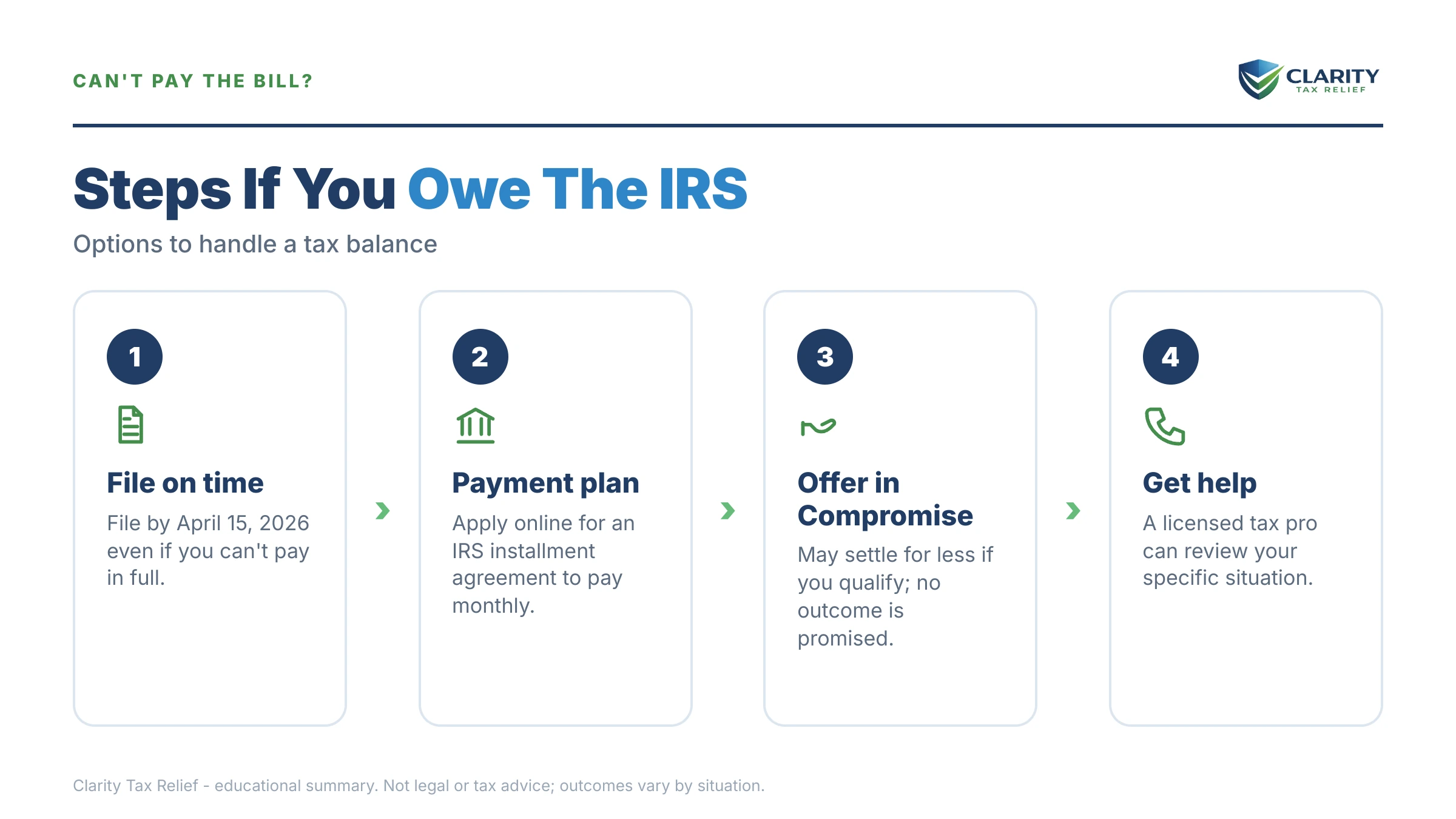
The IRS has a full menu of payment programs, and a home-sale balance under $25,000 qualifies for the easiest one. Which option fits depends on the size of the bill and what your finances look like now that the proceeds are spent:
| Option | Who it fits | Cost & the catch |
|---|---|---|
| Pay in full | Anyone with proceeds still in the bank | Free at IRS.gov; stops all penalties and the notice sequence immediately |
| Short-term plan (up to 180 days) | You can clear it within six months | $0 setup fee; interest and 0.5%/month penalty continue until paid |
| Streamlined installment agreement | Balance ≤ $25,000 (≤ $50,000 with direct debit); up to 72 months | Setup fee applies (lower online/direct debit); no financial disclosure required |
| Non-streamlined agreement | Balances above $50,000, or longer terms needed | Requires Form 433 financial disclosure; the IRS may look at remaining sale proceeds and assets |
| Currently Not Collectible | Paying anything would leave you unable to cover basic living expenses | Collection pauses, but the debt, interest, and possible lien remain — hard to get in the year of a large sale |
| Offer in Compromise | Assets and income genuinely can't cover the debt before the collection statute runs | $205 fee (waived for low-income applicants); the IRS accepted roughly 1 in 5 offers in FY2024 — sale proceeds count against you |
| First-time penalty abatement | Clean compliance record the prior 3 years | Removes failure-to-file/failure-to-pay penalties; starting summer 2026 the new Automatic Exemption from Penalty (AEP) applies this relief automatically for qualifying accounts |
One honest note on settlement: an Offer in Compromise is a poor fit for most home sellers, because the IRS measures what it could collect from your assets — and you just demonstrated you had a six-figure asset. Where offers work is when the proceeds are genuinely gone into non-recoverable places and income can't cover the balance. For the full self-service walkthrough of every program above, see how to settle tax debt yourself.
And to defuse the fear behind the question most sellers won't say out loud: the IRS collecting on this debt through payment plans and, at worst, levies is routine; actually seizing a personal residence is rare and heavily restricted — can the IRS take my house covers exactly when that's possible.
How to respond, step by step
- Recompute the real gain. Rebuild your basis with the purchase price, improvement receipts, and selling costs, then apply the Section 121 exclusion if you qualify. Many home sellers owe less than their software's first pass suggests.
- Report the sale and file on time. Put the sale on Form 8949 and Schedule D even if you can't pay a dollar of the tax — filing on time avoids the 5%-per-month failure-to-file penalty and prevents a zero-basis CP2000.
- Pay whatever you can by the due date. Every dollar paid at IRS.gov/payments shrinks the base the 0.5%-per-month penalty and daily interest are computed on.
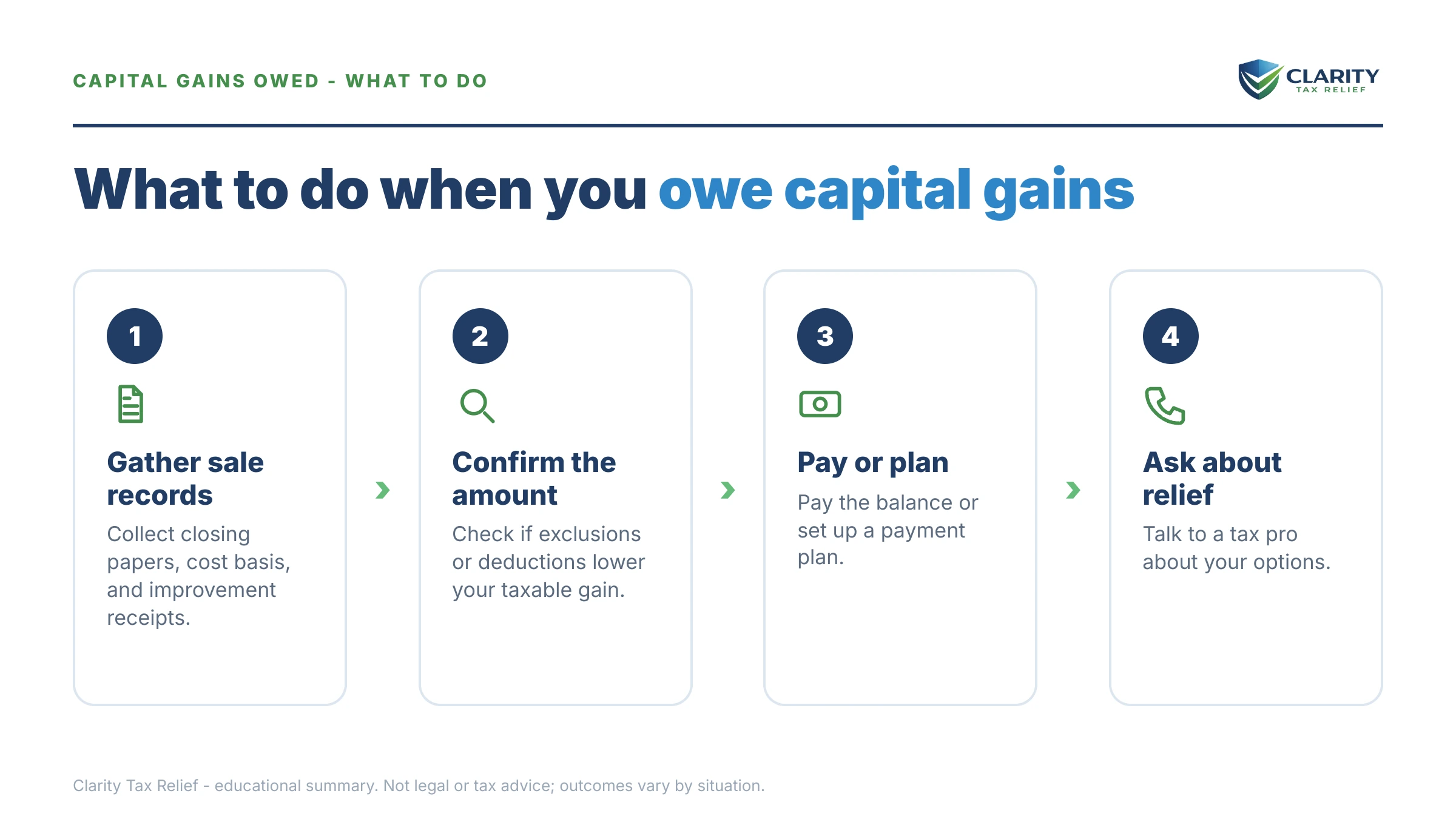
- Set up a payment plan before notices start. A balance of $25,000 or less usually qualifies for a streamlined installment agreement online in one sitting; up to $50,000 works with direct debit. Doing this now keeps the CP14 sequence from ever escalating.
- Fix this year's estimated payments. If the sale spiked last year's income, your safe-harbor number for this year changed too. Adjust your quarterly estimates so next April doesn't repeat this one.
On step 5: as a sole proprietor your safe harbor is generally 100% of last year's total tax — 110% if your AGI topped $150,000 — and a big sale year inflates that figure. Our guide to how quarterly estimated taxes work shows the recalculation; if you already missed the quarter the sale closed in, the estimated-tax penalty math explains what that costs and the Form 2210 exceptions that can reduce it.
When you can handle this yourself
Most home-sale tax bills under $25,000 are a do-it-yourself fix. If you agree with the number, this is a single tax year, and the streamlined monthly payment fits your budget, set the plan up online at IRS.gov and you're done — no professional required. Same if you can simply clear it within 180 days.
Experienced help changes the outcome in specific situations: a CP2000 already proposed tax on your full sale price and you need basis and exclusion documented properly; the property was a rental with years of depreciation (or none claimed — the IRS recaptures "allowed or allowable" depreciation, so skipping the deduction didn't skip the recapture); you have other unfiled years the sale year would sit on top of; the balance is large enough that the IRS wants full financials; or a lien has been filed and you need to close on the next property — see selling a house with an IRS lien for how liens and closings interact. In those cases, the sequencing — returns first, penalties second, balance last — routinely changes what you pay.
Terms on your closing paperwork and tax return, decoded
- Form 1099-S — the form your closing agent files with the IRS reporting the gross sale price; it's why the IRS expects to see the sale on your return.
- Section 121 exclusion — the rule letting you exclude up to $250,000 of home-sale gain ($500,000 joint) if you owned and lived in the home 2 of the last 5 years.
- Adjusted basis — purchase price plus improvements, minus depreciation; the starting point for measuring your gain.
- Unrecaptured Section 1250 gain — the tax term for depreciation recapture: depreciation you claimed comes back as gain taxed at up to 25%, and the exclusion can't shelter it.
- Net Investment Income Tax (NIIT) — a 3.8% surtax on investment income, including taxable home-sale gain, when modified AGI exceeds $200,000 single / $250,000 joint.
- Safe harbor — the estimated-payment level (generally 100% of last year's tax, 110% for higher incomes) that protects you from underpayment penalties.
Sold a house, owe the IRS: your questions answered
How long do I have to pay capital gains tax after selling a house?
The tax is due by April 15 of the year after the sale — there is no separate federal payment at closing. If you're self-employed or otherwise make quarterly estimated payments, the IRS generally expects an estimated payment by the quarterly deadline after your closing date. Miss those dates and interest plus a 0.5%-per-month failure-to-pay penalty accrue on the unpaid balance.
Do I have to pay capital gains tax if I sold my primary residence?
Often not. If you owned and lived in the home for at least 2 of the 5 years before closing, Section 121 lets you exclude up to $250,000 of gain ($500,000 married filing jointly). You owe tax only on gain above that — plus any depreciation you claimed after May 6, 1997, such as home-office depreciation, which can never be excluded.
What happens if I can't pay the capital gains tax on my home sale?
Report the sale and file on time anyway, then set up a payment arrangement. A short-term plan gives you up to 180 days with no setup fee; balances of $25,000 or less usually qualify for a streamlined installment agreement of up to 72 months without financial disclosure ($50,000 with direct debit). Interest and the late-payment penalty keep accruing until the balance is paid.
Does the IRS know I sold my house?
Almost always yes. The closing agent files Form 1099-S reporting the gross sale price, and IRS computers match it against your return. If you don't report the sale, the automated underreporter system can send a CP2000 proposing tax on the entire sale price with zero basis — a bill far larger than what you'd owe by reporting correctly.
Can I avoid capital gains by buying another house with the money?
Not for a personal residence. The old 'rollover' rule that let you defer gain by buying a more expensive home was repealed in 1997 and replaced by the $250,000/$500,000 exclusion. A 1031 exchange defers gain only on investment or business property, and it must be arranged through a qualified intermediary before you close — it can't be done after the sale.
Do I pay self-employment tax on the profit from selling my house?
No. Gain from selling your home is capital gain, not self-employment income, so no SE tax applies even if you're a sole proprietor. The exception is depreciation recapture from a home office you deducted — that portion is taxed at up to 25% as unrecaptured Section 1250 gain, but it is still not subject to SE tax.
Do I owe the IRS anything if I sold my house at a loss?
No tax is due on a loss, but you should still report the sale if you received a 1099-S so the IRS can match it. A loss on a personal residence is not deductible — you can't use it to offset other income. A loss on a rental or investment property, by contrast, is generally deductible on Form 4797.
Primary sources worth bookmarking: the IRS's own rules on home sales are in Tax Topic 701, Sale of Your Home and Publication 523, Selling Your Home; every payment option runs through IRS.gov/payments.
Your next 24 hours
- Pull the closing disclosure and the 1099-S from your closing packet. The gross-proceeds figure on the 1099-S is the number the IRS will match — everything else is your job to document down from there.
- Gather your basis records: the purchase settlement statement, improvement receipts, home-office depreciation schedules from past returns, and last year's return for your safe-harbor number.
- Get a free case review. Send us the numbers at the 2-minute form or call (888) 825-7779 — an experienced tax professional will verify the gain, check whether penalty relief applies, and set up the cheapest payment path before another month of interest and penalties lands on the balance.
This guide is general information, not tax or legal advice for your specific situation. Eligibility for IRS programs depends on individual facts and circumstances; no outcome is guaranteed.