
Owe the IRS
Two Jobs, Owe Taxes Every Year? Why It Happens — and the 2026 Fix
The short answer: with two jobs, you owe taxes every year because each employer withholds as if that paycheck is your only income — the standard deduction and lowest brackets get applied twice, so your combined income is under-withheld. The fix: check the Step 2(c) box on a new Form W-4 at both jobs.
You did everything right. You worked two jobs, taxes came out of both paychecks, you filed on time — and the return still says you owe. Again. It isn't a filing mistake and it isn't bad luck; it's a design flaw in how payroll withholding treats multiple incomes, and it will repeat every April until you change two pieces of paper.
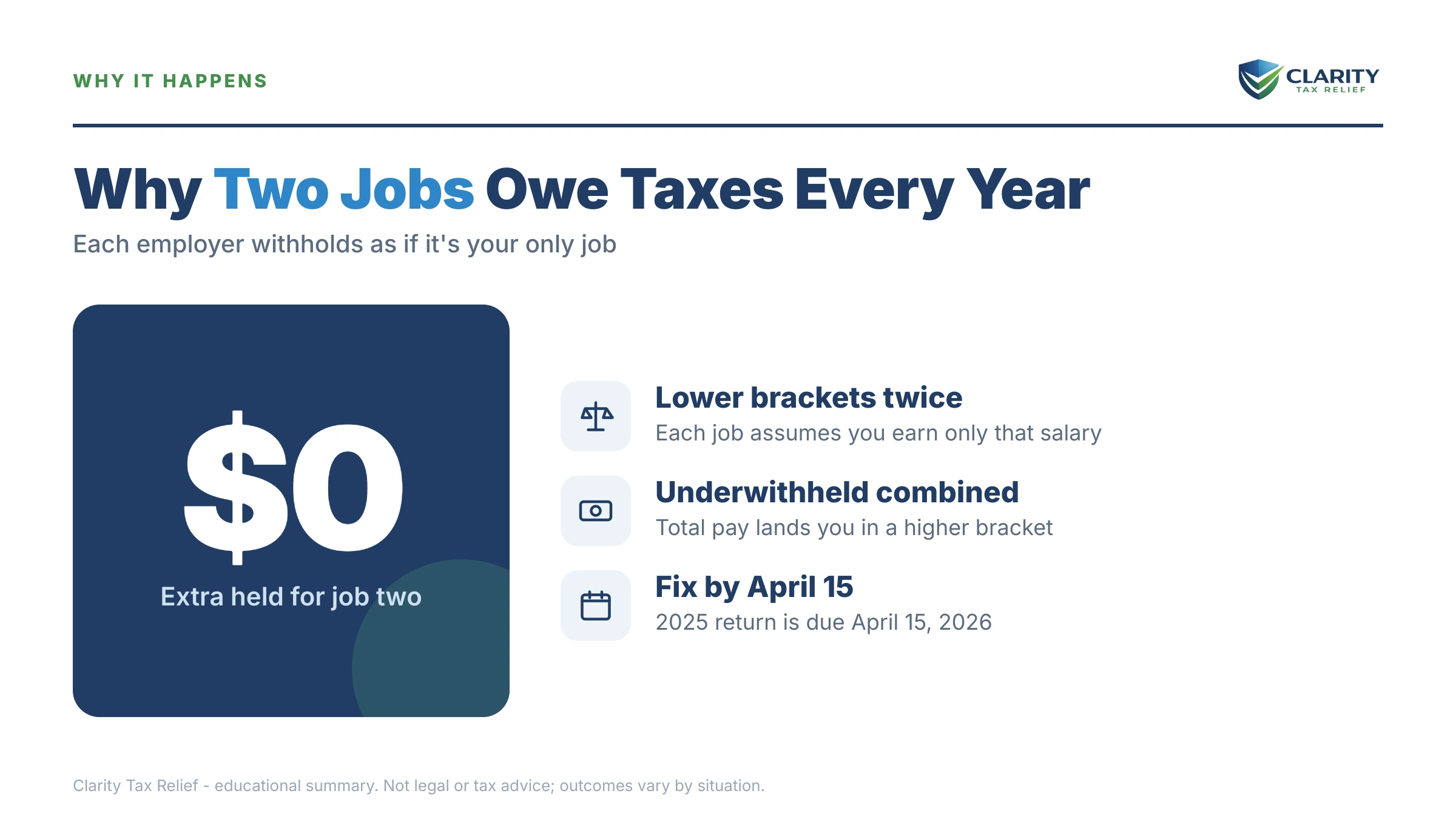
This guide covers both halves of the problem: the 15-minute withholding fix that stops next year's bill, and what to do about the balance that's already stacked up. The visual below maps how two paychecks combine into a tax bracket neither employer withholds for — it makes the whole problem click in about ten seconds.
⏱ The clock that's actually running: there's no notice deadline on this problem — there's a meter. The IRS adds a 0.5% failure-to-pay penalty every month, plus daily compounding interest, to each unpaid year. And every pay period on your old W-4 adds to next April's bill.
Why two jobs make you owe taxes every year
Each employer's payroll system withholds as if that job pays 100% of your income — which is why a household earning $38,000 across two paychecks can come up thousands short every April. Job A applies the full standard deduction and starts your income in the 10% bracket. Job B, which knows nothing about Job A, does the exact same thing.
On the tax return, none of that generosity survives. You're one taxpayer. You get one standard deduction, not two, and your combined income climbs the brackets once — landing in rates neither paycheck withheld for. The smaller job is usually the bigger culprit: if it pays less than the standard deduction on its own, its payroll system withholds close to nothing, because in its view you owe no tax at all.
If you're drawing Social Security on top of two part-time jobs, the math gets worse in two directions. First, Social Security withholds nothing by default — you have to affirmatively request it. Second, wages push your benefits into taxation: once your "combined income" (wages plus half your benefits) passes $25,000 single or $32,000 married filing jointly, part of your Social Security becomes taxable, and above $34,000 / $44,000 up to 85% of it does. Each extra dollar you earn can drag Social Security dollars into taxable income with it, so your effective rate on those wages runs higher than the bracket alone suggests. If that describes you, the companion guide for people retired and owing back taxes goes deeper on the fixed-income side.
Two other versions of the same trap: if your second "job" pays on a 1099, there's no withholding at all and you owe self-employment tax on top — that's its own problem, covered in first year self-employed owe taxes. And if this is the first April the number shocked you rather than an annual pattern, start with filed taxes owe more than expected. One more note: most states with an income tax use the same single-job assumption in their own withholding forms, so if you owe your state every year too, fix the state W-4 equivalent at the same time.
What happens if you keep owing and never catch up
Unpaid balances from repeat under-withholding stack year over year, and IRS collection escalates the same automated way for a $3,900 shortfall as for a $39,000 one. Here's the sequence, in order:
- Refund offset. Any refund you ever generate is seized automatically and applied to the oldest year first — before you see it. This repeats until the debt is gone; here's will the IRS take my refund every year for how offsets work.
- CP14 — the first bill. Each unpaid year produces its own CP14 notice, with roughly 21 days to pay or arrange something before reminders begin.
- CP501 and CP503 reminders. Still just bills — but the balance grows every month they sit.
- CP504 — intent to levy. The IRS can now take your state tax refund, and a federal tax lien becomes a live possibility.
- LT11 — final notice. A 30-day clock starts, with formal appeal rights. After it runs, the IRS can levy bank accounts and wages — and under the Federal Payment Levy Program, take up to 15% of your Social Security benefit every month. See the 15% Social Security levy for how that works and how to stop it.
There's a lesser-known escalation specific to chronic under-withholders: the IRS can send your employer a withholding lock-in letter (Letter 2802C is the warning stage). Once a lock-in takes effect, your employer must withhold at the rate the IRS dictates, and you lose control of your own W-4. Fixing your withholding voluntarily now keeps that decision in your hands.
Two more mileposts worth knowing. A balance like $19,700 sits well under the $66,000 passport-certification threshold for 2026 — but balances that compound untreated for years do reach it. And in 2026, with the IRS workforce down roughly 27%, it's harder than ever to reach a human to fix things — while the automated notices, offsets, and levies never paused. The machine escalates on schedule whether anyone answers the phone or not.
Owing every April — and the old years are piling up?
Repeat balances with penalties compounding monthly are exactly the pattern that ends in refund offsets and Social Security levies. Get your full multi-year balance reviewed free — we'll map the withholding fix and the cheapest way out of the back debt in one call.
The withholding fix: stop next April's bill in 15 minutes
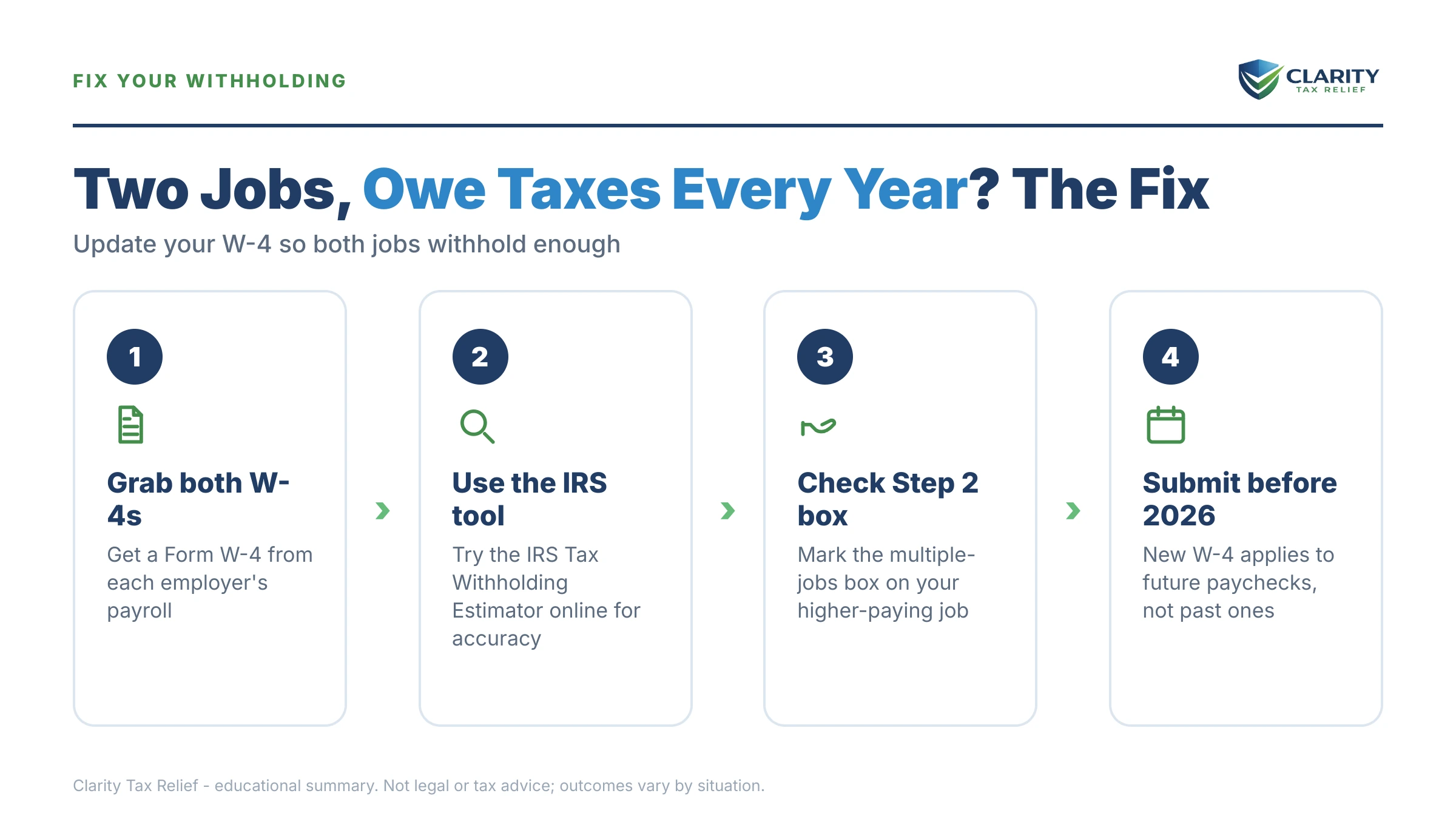
The fix for two-job under-withholding is Step 2 of Form W-4 — and it only works if you do it at both jobs. The Step 2(c) checkbox tells each payroll system to withhold using split tables that assume a second, similar income exists. Check it at one job only and you've fixed half the leak.
Three refinements matter:
- Unequal jobs: the checkbox assumes the two jobs pay roughly the same. If one pays double the other, use the multiple jobs worksheet on the W-4 (or the IRS's online estimator) and enter the result — usually as extra withholding at the higher-paying job.
- Line 4(c) is your dial: whatever the tables miss, a flat extra-dollar amount per paycheck on line 4(c) covers. If you owed $3,900 last year and get paid every two weeks at your main job, adding $150 per check closes the gap.
- Don't wait for January: a new W-4 takes effect on the next payroll run. Fixing it in July still rescues half the year.
Even if you always pay in full at filing, chronic under-withholding costs extra: owe $1,000 or more at filing without hitting the safe-harbor thresholds and the IRS tacks on an estimated-tax underpayment penalty — a surcharge for paying late within the year, on top of the tax itself.
Because two-job households often have three or four income streams, here's the complete fix, source by source:
| Income source | The form | What to do with it |
|---|---|---|
| W-2 job #1 (higher pay) | Form W-4 | Check the Step 2(c) box; add any extra flat amount on line 4(c). Give it to payroll — it never goes to the IRS. |
| W-2 job #2 | Form W-4 | Check Step 2(c) here too — the fix fails unless both jobs have it. |
| Social Security benefits | Form W-4V | Choose voluntary withholding of 7%, 10%, 12%, or 22% of your benefit; file it with the Social Security Administration. |
| Pension or IRA withdrawals | Form W-4P | Set a withholding rate with the plan administrator or custodian. |
| 1099 / gig income | Form 1040-ES | No withholding exists — make quarterly estimated payments directly to the IRS instead. |
Say you owe $19,700: the two-job math, worked out
Here's a hypothetical that shows how a modest annual gap compounds into a five-figure debt. Say you're 68 and single, drawing $24,000 a year in Social Security, plus a $22,000 part-time pharmacy job and a $16,000 weekend bookkeeping job — both W-2.
Each payroll system runs its math alone. The pharmacy job sees $22,000, applies your full standard deduction, and withholds a few hundred dollars. The bookkeeping job sees $16,000 — less than the standard deduction by itself — and withholds almost nothing. Social Security withholds zero. Total withheld: roughly $700 for the year.
Your return sees something very different. Wages of $38,000 plus half your benefits puts combined income around $50,000 — far past the $34,000 threshold, so 85% of your Social Security ($20,400) is taxable. Total income lands near $58,400; after the standard deduction, the federal tax runs roughly $4,600 (rounded for illustration). Withheld $700, owed $4,600: you're about $3,900 short — every single year.
Run that pattern for five filing seasons: five shortfalls of roughly $3,900 is $19,500 in tax, and with the 0.5%-per-month failure-to-pay penalty and compounding interest layered on the older years, the balance sits right around $19,700.
Now the fix side of the ledger. Checking Step 2(c) at both jobs raises paycheck withholding to reflect the combined wages, and a Form W-4V election at 12% pulls about $2,880 a year from Social Security. Together that covers the annual gap — meaning next April produces a small refund or a near-zero balance instead of adding a sixth year to the pile. The remaining $19,700? That's the next section.
Your options for the $19,700 you already owe
A five-figure, multi-year balance from under-withholding has more resolution paths than the notices mention — the full do-it-yourself walkthrough lives in our guide on how to settle tax debt yourself. Here's how each option lines up against a $19,700 balance:
| Option | Who typically qualifies | Cost and key numbers |
|---|---|---|
| Pay in full | Anyone with savings to cover it | Stops the 0.5%/month penalty and interest immediately — the cheapest path if the cash exists. |
| Short-term plan (180 days) | Can pay the full $19,700 within 6 months | $0 setup fee; penalties and interest continue until paid off. |
| Streamlined installment agreement | Balance ≤ $50,000 and all returns filed | Up to 72 months, set up online. On $19,700 that's roughly $274/month minimum — a bit more in practice, since interest keeps accruing. |
| Currently Not Collectible | Income covers only basic living expenses — common on fixed Social Security income | Free to request; collection pauses, but the debt and interest remain. See IRS hardship while on Social Security. |
| Offer in Compromise | Assets plus future income genuinely can't cover the debt — means-tested, not marketing | $205 fee plus 20% down on lump-sum offers (both waived with low-income certification, AGI ≤ 250% of poverty). The IRS accepted roughly 1 in 5 offers in FY2024. |
| First-time penalty abatement / AEP | Clean compliance in the 3 years before the first bad year | Free to request; removes penalties (not tax) on that year. Automatic penalty relief (AEP) begins replacing FTA in summer 2026 — no request needed. |
Two nuances specific to repeat under-withholders. First, penalty relief usually applies only to the first bad year — first-time abatement requires a clean prior three years, so once the pattern starts, later years generally need reasonable cause instead. To see how much of your $19,700 is penalty and interest rather than tax, estimate it with our IRS Penalty & Interest Calculator. Second, the IRS conditions every agreement on staying current going forward — which means the W-4 fix isn't optional. A payment plan defaults if you owe again next April and can't pay it, so fixing withholding is step one of the resolution, not an afterthought.
How to fix owing taxes every year with two jobs, step by step
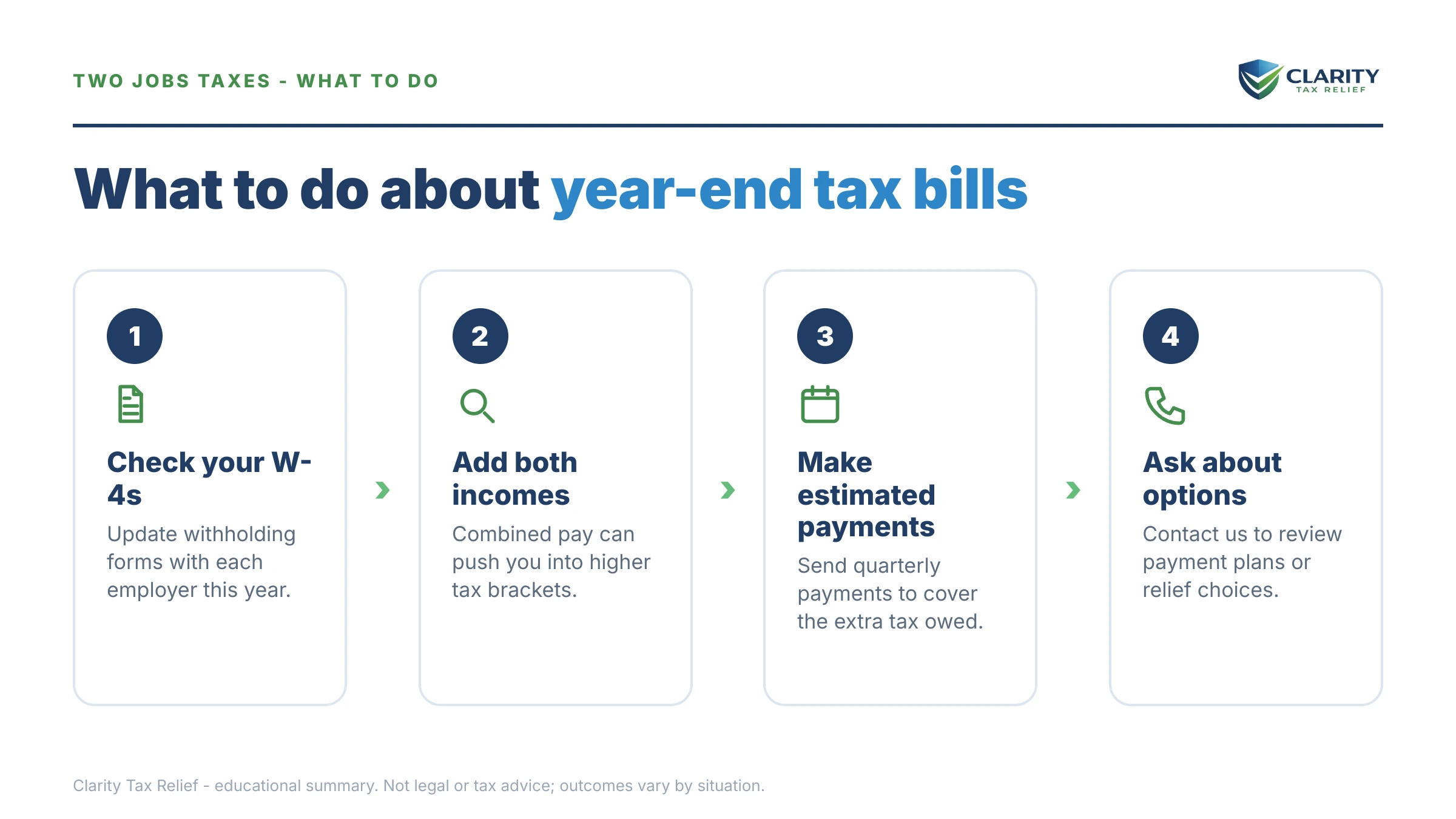
- Pull your real balance. Log in to your IRS online account and note the total owed and which years it covers — mailed notices lag behind the live number.
- Fix the withholding today. Submit a new Form W-4 with the Step 2(c) box checked at both jobs, and file Form W-4V with Social Security if you draw benefits.
- Verify with the estimator. Run your combined numbers through the IRS Tax Withholding Estimator mid-year and add a flat dollar amount on line 4(c) if you're still short.
- Resolve the old balance. Set up a payment plan at IRS.gov/payments, request hardship status, or pursue an offer if your finances genuinely can't cover the debt.
- Request penalty relief. Ask for first-time abatement on the earliest year if your prior three years were clean — and note that the IRS's Automatic Exemption from Penalty (AEP) begins rolling out in summer 2026.
When you can handle this yourself — and when help changes the outcome
Most two-job withholding problems are genuinely do-it-yourself. If you owe for one or two years, the total is a few thousand dollars, and every return is filed, you don't need to pay anyone: submit the new W-4s, set up a streamlined plan online in twenty minutes, and request first-time abatement on the earliest year by phone or letter. That's the honest answer.
Experienced help earns its cost in specific situations: the balance spans several years and you're not sure penalty relief was ever applied; a CP504 or LT11 has already arrived and levy action is in motion; the IRS is taking (or threatening) part of your Social Security; some years never got filed at all (start with haven't filed taxes in a year if that's one year, because the sequencing of filings, penalty requests, and the payment plan changes what you ultimately pay); or your fixed income is tight enough that hardship status or an offer is realistically on the table and the financial-disclosure math needs to be done right the first time.
Terms on your account, decoded
- Step 2(c) checkbox: the box on Form W-4 that tells payroll to withhold as if a second, similar income exists in your household.
- Combined (provisional) income: your wages and other income plus half your Social Security — the number that decides how much of your benefits are taxed, up to 85%.
- Form W-4V: the voluntary withholding request you file with the Social Security Administration to have 7%, 10%, 12%, or 22% withheld from benefits.
- Safe harbor: the withholding level — generally 90% of this year's tax or 100% of last year's — that protects you from the underpayment penalty even if you owe at filing.
- Refund offset: the automatic seizure of any refund to pay a prior-year balance, applied before the refund reaches you.
- FPLP: the Federal Payment Levy Program — the system that lets the IRS take up to 15% of a Social Security benefit, month after month, for unresolved debt.
Two jobs and taxes: your questions answered
Why do I owe taxes every year when I have two jobs?
Because each employer withholds as if that job is your only income, so both apply the full standard deduction and the lowest tax brackets. Your combined income is taxed in higher brackets than either paycheck withheld for, and the gap becomes a balance due every April. Checking the Step 2(c) box on the W-4 at both jobs tells each payroll system to withhold at the correct combined rate.
Should I claim 0 on both W-4 forms?
Claiming 0 no longer works the way it did — the IRS removed withholding allowances from Form W-4 in 2020. The modern equivalent is Step 2: check the box in Step 2(c) at both jobs, or use the multiple jobs worksheet for a more precise number. If you still come up short, add a flat dollar amount per paycheck on line 4(c) instead of guessing.
What does the Step 2(c) checkbox on Form W-4 actually do?
It tells your employer's payroll system to withhold using tables that assume two roughly equal incomes in the household, which cuts the standard deduction and bracket amounts applied to your paycheck about in half. It only works if it's checked at both jobs. If one job pays much more than the other, the multiple jobs worksheet or the IRS withholding estimator gives a more accurate result than the checkbox alone.
Can I have federal taxes withheld from my Social Security check?
Yes. File Form W-4V with the Social Security Administration and choose voluntary withholding of 7%, 10%, 12%, or 22% of your monthly benefit. For many working retirees whose wages make up to 85% of their benefits taxable, 10% or 12% covers the tax the benefits generate. The withholding stays in place until you file a new W-4V to change or stop it.
Will the IRS take my Social Security check for back taxes?
It can. Under the Federal Payment Levy Program, the IRS can take up to 15% of your Social Security retirement benefits, and unlike a one-time bank levy this one repeats every month until the debt is resolved. It only happens after the notice sequence ends with a final notice of intent to levy, so getting on a payment plan or hardship status before that point prevents it.
Is there a penalty for under-withholding even if I pay in full every April?
Often, yes. If you owe $1,000 or more at filing and your withholding didn't reach the safe harbor — generally 90% of this year's tax or 100% of last year's (110% for higher incomes) — the IRS adds an estimated-tax underpayment penalty on top of the balance. Fixing your W-4s or making quarterly payments is the only way to stop that penalty from repeating.
Will the IRS keep my refund if I finally over-withhold one year?
Yes — as long as you owe for prior years, any refund is automatically offset and applied to the oldest balance before you see a dime. That continues every year until the debt is paid or otherwise resolved. An installment agreement doesn't stop the offset either; refunds are still applied to your balance while you're on a plan.
Does getting married cause the same two-income withholding problem?
It can create the identical problem with one job each. Two spouses filing jointly are a single tax household, but each employer withholds as if that one salary is the couple's entire income. The fix is the same: check the Step 2(c) box on both spouses' W-4s, or have the higher earner add extra flat withholding on line 4(c).
Your next 24 hours
- Find your annual gap. Pull last year's return, add up box 2 from every W-2, and compare the total to your total tax line. That number is what your W-4s need to cover — and what next April will cost if nothing changes.
- Gather three things: your most recent pay stub from each job, your Social Security benefit statement, and any IRS notices you've received — that's everything needed to size both the fix and the back balance.
- Get the back years reviewed free. Call (888) 825-7779 or use the 2-minute form. Penalties and interest are compounding on every unpaid year each month — a reviewer can tell you in one call whether a payment plan, hardship status, or penalty relief is your cheapest path.
This guide is general information, not tax or legal advice for your specific situation. Eligibility for IRS programs depends on individual facts and circumstances; no outcome is guaranteed.