
IRS Letters
IRS Letter 2802C: The Withholding Lock-In Warning Letter, Explained (2026)
The short answer: Letter 2802C warns that too little federal tax is coming out of your paycheck. It is not a bill. Submit a corrected Form W-4 to your employer now — otherwise the IRS can send a 2800C "lock-in" letter ordering your employer to withhold at the maximum rate, taking your W-4 out of your hands.
You read Letter 2802C twice looking for a dollar amount due, and there isn't one — just the IRS telling you your own paycheck is set up wrong. That's what makes this letter different from nearly every other IRS envelope: the fix isn't a payment, it's a payroll form. Handle it now and your employer never even knows the letter existed; wait, and the IRS starts writing to your payroll department instead of you.
The image below shows exactly what Letter 2802C looks like and where to find the withholding instructions and the Withholding Compliance Unit contact information printed on it — worth checking before you act, since scammers imitate paycheck-related notices.
⏱ Your real clock: Letter 2802C prints no fixed pay-by date. Your window is the gap before the IRS mails Letter 2800C — the actual lock-in order — to your employer's payroll department. Once that letter goes out, your employer must apply the IRS-set withholding rate by the start date printed on it, and your W-4 no longer controls your paycheck. Every pay period you wait also deepens the under-withholding for 2026.
Why you got Letter 2802C
Letter 2802C comes from the IRS Withholding Compliance Program when the W-2 withholding your employer reports doesn't cover the tax on your filed returns. It's a computer match, not an accusation: the system compared what came out of your paychecks with what you actually owed and found a repeated shortfall.
The most common triggers are ordinary ones. Two incomes hitting one tax return is the classic cause — a second job, or a married couple where both spouses' W-4s assume theirs is the only paycheck. If that's your household, the two jobs and owing every year problem is almost certainly what tripped the match. Other triggers: a W-4 claiming exemption from withholding you no longer qualify for, extra untaxed income (bonuses, RSUs, a side business) with no withholding adjustment to cover it, or a W-4 filled out during a life change and never revisited.
Two things Letter 2802C is not: it's not an audit, and it's not a bill. Nobody is questioning your deductions, and no balance is printed on it. If the under-withholding already produced balances for past years, those get billed separately — that surprise usually arrives as a CP14 notice, and if the shock is new to you, start with filed and owe more than expected. (If you're not sure why any IRS letter shows up, the general decoder is why did I get a letter from the IRS — this page covers what's specific to 2802C.)
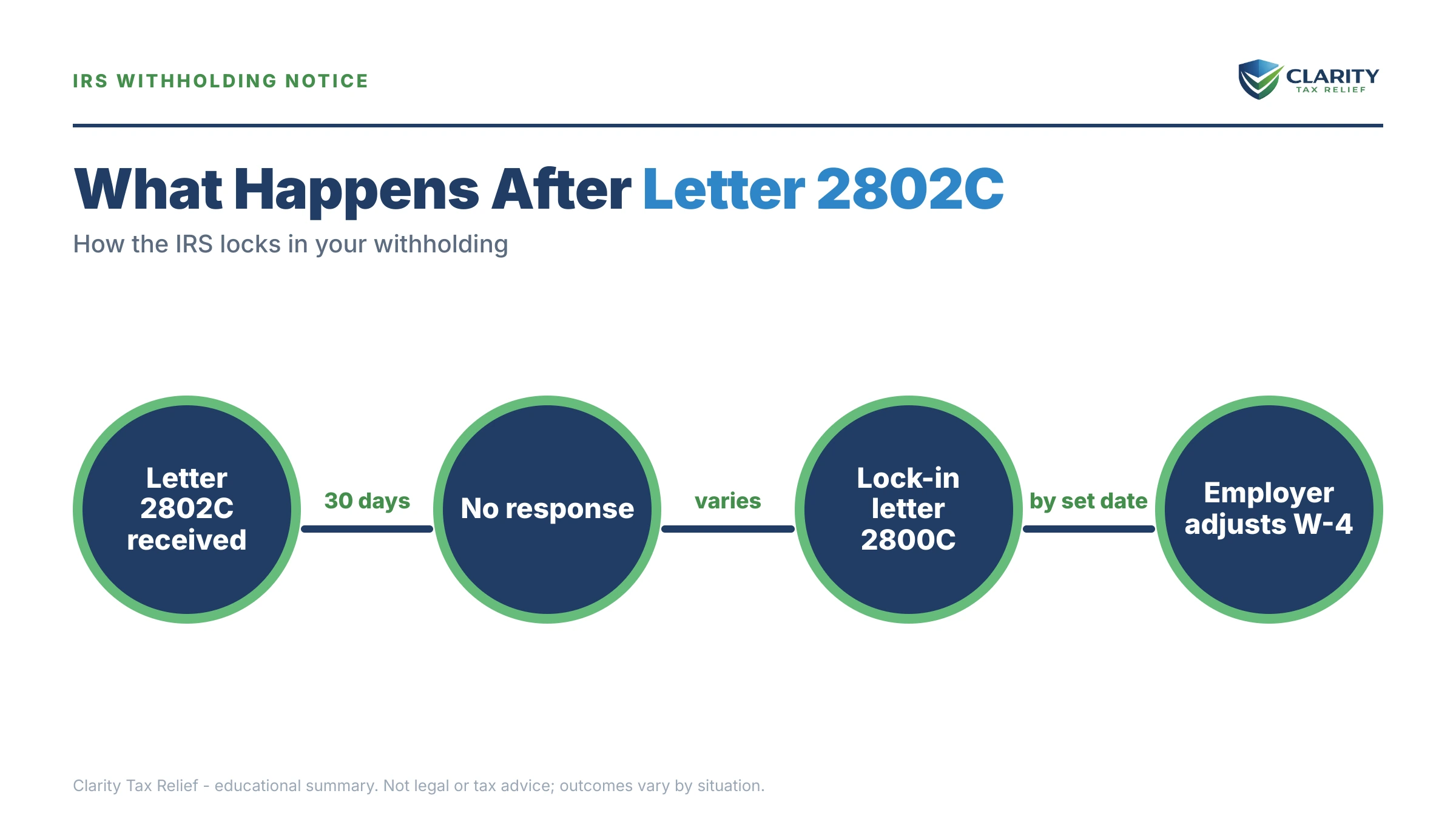
What happens if you ignore Letter 2802C
Ignoring Letter 2802C doesn't produce a levy — it produces a lock-in, which means the IRS takes over your W-4 and your employer is legally required to go along. The sequence runs like this:
- Letter 2802C — the warning, sent only to you. You still control your own withholding. You are here.
- Letter 2800C — the lock-in letter, sent to your employer. It orders payroll to withhold at an IRS-specified rate — typically the maximum, as if you were single with no adjustments — starting on the date printed on the letter. Your employer has no discretion: a company that ignores a lock-in letter becomes liable for the withholding itself.
- Letter 2801C — sent to you, confirming the lock-in and explaining how to dispute the rate with the Withholding Compliance Unit.
- The lock-in operates. Any new W-4 you file that would reduce withholding below the locked-in rate must be approved by the IRS before your employer can honor it. Change jobs and the IRS can send a fresh lock-in letter to the new employer — the order follows you, not the position.
- Any unpaid balance escalates on its own track. The withholding letters don't pause collection on back taxes the shortfall created. Those balances run the normal notice ladder, ending at Letter 1058 — the final notice of intent to levy, which starts a 30-day clock on your appeal rights.
One more consequence people miss: a lock-in at the maximum rate can cut take-home pay sharply and without warning to your budget — a real problem if, like a lot of 2802C recipients, you're mid-mortgage-application or planning a refinance and your monthly cash flow suddenly shrinks.
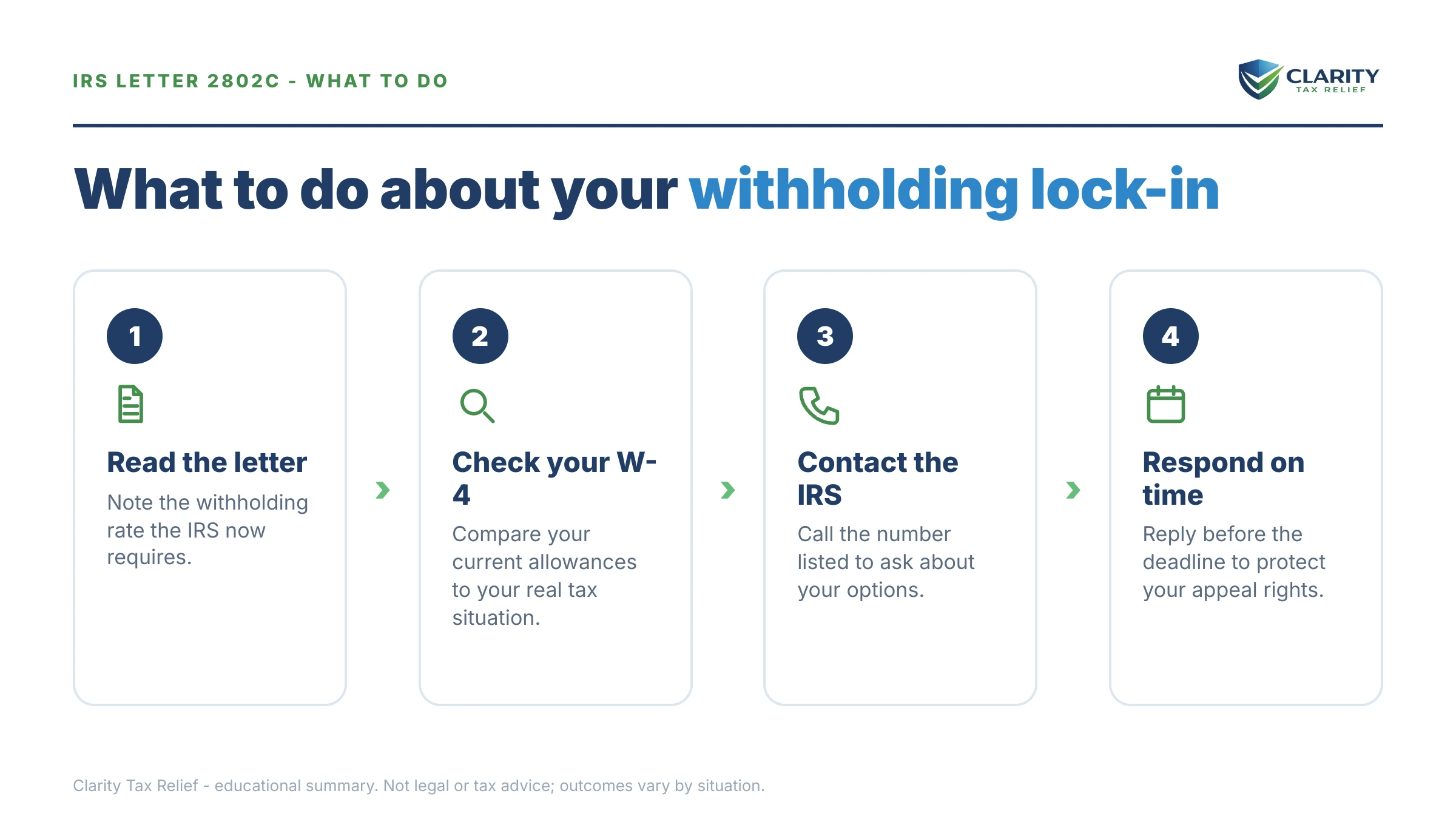
Holding a Letter 2802C right now?
Get it reviewed free before the IRS moves to the employer lock-in stage. An experienced tax professional will check whether the IRS's withholding math is right, whether back-year balances are lurking behind it, and exactly what your corrected W-4 should say.
The lock-in letter sequence at a glance
Three letters make up the withholding lock-in process, and only the first one leaves you in control. Here's who receives each one and what it does:
| Letter | Who gets it | What it does | Your move |
|---|---|---|---|
| Letter 2802C | You only | Warns your withholding is too low and asks you to self-correct with a new Form W-4 | Fix your W-4 now — the only stage where you keep control |
| Letter 2800C | Your employer | Orders payroll to withhold at an IRS-set rate beginning on the date printed on the letter | Contact the Withholding Compliance Unit — only the IRS can change the order |
| Letter 2801C | You | Confirms the lock-in and explains how to dispute the rate or request a change | Respond with pay stubs and your latest return if the rate is wrong |
| Modification / release notice | Your employer | Loosens or ends the lock-in after you demonstrate sustained compliance | Keep filing on time and keep withholding accurate to earn it |
Fixing the withholding — and the balance behind it
Correcting Letter 2802C itself takes one form: a new W-4 filed with your employer, sized so your 2026 withholding actually covers your projected tax. But most people holding this letter have a second problem — the back-year balances the under-withholding already created. Those need their own plan, and the right one depends on the amount:
| What you owe | Realistic options | What it takes |
|---|---|---|
| Under $10,000 | Guaranteed installment agreement or a 180-day short-term plan ($0 setup) | Filed returns; approval is essentially procedural at this level |
| $10,000–$25,000 | Streamlined installment agreement | No financial disclosure; set up online in minutes |
| $25,000–$50,000 | Online payment plan up to 72 months; direct debit typically required in this band | No Form 433 financials needed if you stay current on new-year taxes |
| Over $50,000 | Full-financial installment agreement, hardship status, or an Offer in Compromise where the math genuinely supports one | Form 433 financial disclosure; the IRS reviews income and assets |
Penalty relief can shrink the balance before you commit to a plan. If your prior three years were clean, first-time penalty abatement can remove the failure-to-pay penalty — and starting summer 2026, the IRS's new Automatic Exemption from Penalty (AEP) applies similar relief automatically, with no request needed for qualifying accounts. If the shortfall also triggered an estimated-tax underpayment penalty, note that fixing withholding mid-year helps: withholding is treated as paid evenly across the year, which is one advantage a W-4 correction has over catch-up estimated payments.
A worked example: $36,900 behind with a refinance on the calendar
Say your household runs two W-2 incomes, both W-4s were set as if each job were the only one, and three years of shortfalls plus penalties and interest have stacked to $36,900 — roughly $11,000 of tax short per year, with about $3,900 in accumulated penalties and interest on top. (Hypothetical numbers; you can estimate your own accruals with our Penalty & Interest Calculator.) You're also planning to refinance the house this fall.
At $36,900 you're under the $50,000 line, so a 72-month online payment plan is available without financial disclosure: $36,900 ÷ 72 ≈ $513 a month as a floor, understanding interest and the 0.5%-per-month late-payment penalty keep accruing, so paying more than the minimum shortens the real payoff. A 180-day short-term plan would mean about $6,150 a month for six months — usually unrealistic mid-refinance.
The refinance is exactly why acting at the 2802C stage matters. An unresolved five-figure balance can lead to a Notice of Federal Tax Lien, which complicates underwriting badly — see refinancing with an IRS lien, and if a lien has already been filed, tax lien subordination is the tool that can still let the loan close. A direct-debit installment agreement with on-time history, by contrast, is something most lenders can work with. And a lock-in at the maximum rate would shrink your take-home pay in the exact months you're documenting cash flow for a lender. Fixing the W-4 and starting the plan now keeps both problems off the closing table.
How to respond to Letter 2802C, step by step
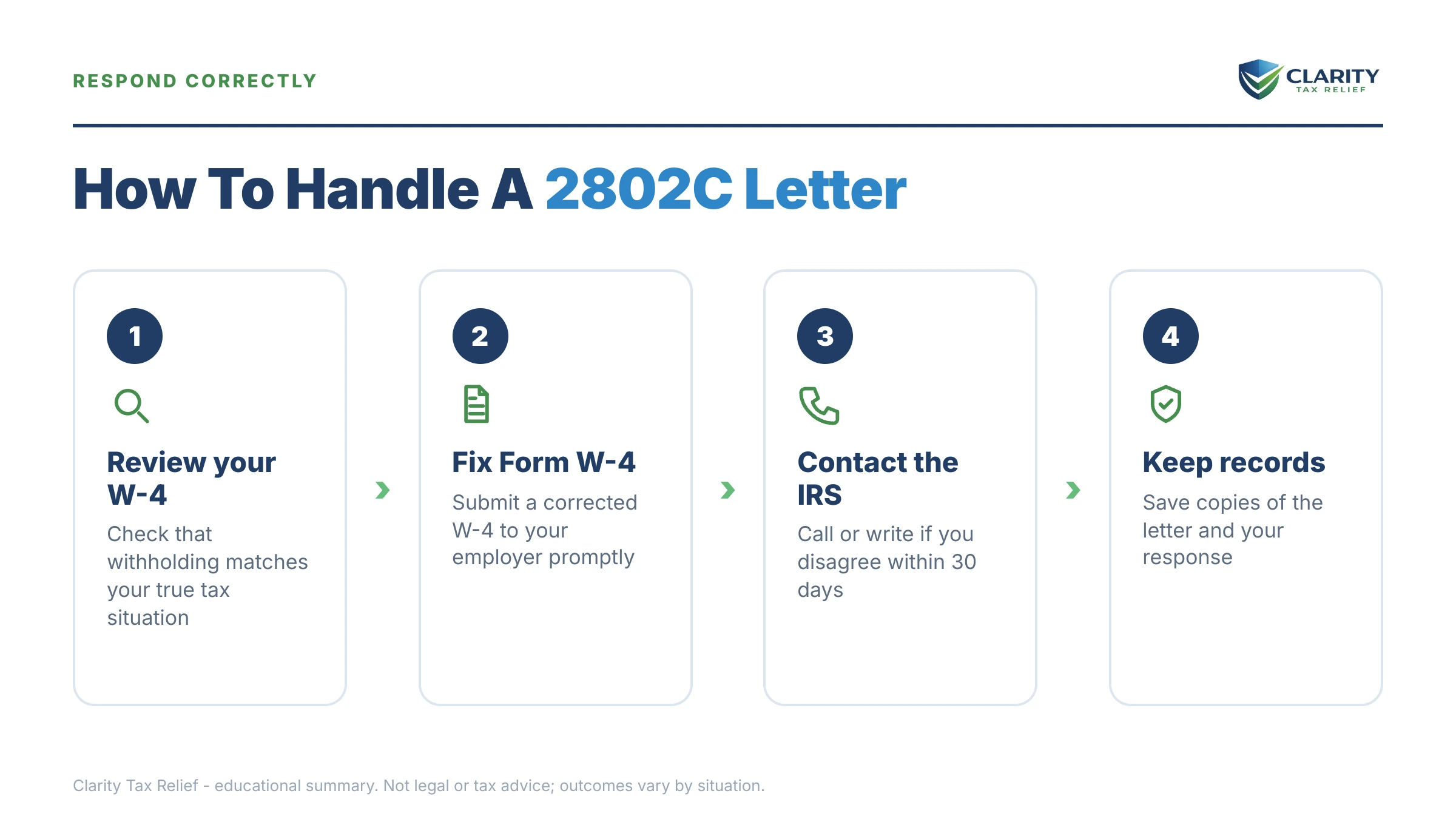
- Verify the letter is real. A genuine Letter 2802C arrives by postal mail, never by text or email. Confirm what the IRS has on file by checking your account and wage records online.
- Run your real numbers. Use the IRS Tax Withholding Estimator with your latest pay stub and last return to see what your withholding should actually be for 2026.
- Submit a corrected Form W-4. Give the new W-4 to your employer's payroll department — not the IRS. This single form is what closes the Withholding Compliance file.
- File any missing returns and address any balance. Unfiled years or unpaid balances keep the lock-in threat alive. Set up a payment plan if you can't pay in full.
- Call the Withholding Compliance Unit if you disagree. Use the toll-free number printed on your letter, with pay stubs and your most recent return in hand, to show your withholding already covers your projected tax.
- Keep proof of the fix. Save a copy of the new W-4 and the first pay stub showing the increased withholding, in case the IRS's records lag behind your correction.
For step two, the calculator lives at the IRS Tax Withholding Estimator — ten minutes with your most recent pay stub gives you the exact figures for the new W-4. If you want to see the wage data the IRS matched against your return, pull it yourself: how to get your IRS transcript online.
Already locked in? Getting a 2800C lock-in modified or released
A withholding lock-in has no expiration date — it stays until the IRS modifies or releases it. If Letter 2800C already reached your employer, you have three levers, and none of them run through your payroll department:
Dispute the rate. If the IRS-set rate over-withholds for your actual situation — you have dependents, deductions, or a spouse's withholding the computer match didn't credit — call the Withholding Compliance Unit at the number on your Letter 2801C with pay stubs and your latest return. The IRS can adjust the locked-in rate; your employer cannot.
Request a modification for changed circumstances. A new child, a pay cut, or a spouse leaving the workforce all change the right withholding. You don't have to wait for a full release to ask for the rate to be revised.
Build the compliance record for release. The IRS loosens lock-ins for taxpayers who file on time and whose withholding genuinely covers their tax, sustained over time. Every on-time return moves you toward release; every missed one resets the trust. Meanwhile, remember the one-way valve: you can always file a W-4 that increases withholding above the locked-in rate — only decreases need IRS approval.
If a lock-in is squeezing your budget while old balances are also in collection, don't triage it alone — a free case review can sequence the fixes so the withholding, the penalties, and the payment plan get handled in the right order.
When you can handle this yourself
Most people can resolve Letter 2802C without professional help, because the core fix is one payroll form. Handle it yourself if: you agree the withholding was low, all your returns are filed, and any back-year balance is small enough to pay within 180 days or set up online. Estimator, new W-4, payment plan if needed — done in an afternoon.
Experienced help changes the outcome when the letter sits on top of a bigger problem: a 2800C lock-in already in force that's over-withholding for your real situation; multiple unfiled years (which block every payment plan until they're in); a combined balance pushing past $50,000, where the IRS starts reviewing your finances; self-employment or equity income mixed in, where a W-4 alone can't cover the tax; or a lien threatening a home purchase or refinance, where sequencing the resolution before underwriting is the whole game. In those cases the order you fix things in — returns, penalties, withholding, then the balance — changes what you end up paying.
Terms on your letter, decoded
- Lock-in letter: the IRS order (Letter 2800C) that requires your employer to withhold at an IRS-set rate, overriding your W-4.
- Withholding Compliance Unit: the IRS office that runs the lock-in program — the only party that can change or release a lock-in, via the number printed on your letter.
- Form W-4: the Employee's Withholding Certificate you file with your employer; since its 2020 redesign it uses filing status and dollar adjustments, not "allowances."
- Maximum withholding rate: the default lock-in setting — withholding as if you were single with no adjustments, the highest standard rate for a W-2 employee.
- Under-withholding: the gap between what your paychecks withheld and the tax your return actually showed — the mismatch that triggered this letter.
- Modification: an IRS adjustment to a locked-in rate short of full release, available when your circumstances or your compliance record support it.
Letter 2802C questions, answered
Is Letter 2802C serious?
It's serious in a specific way: it's the last stage where you control your own W-4. Nothing is being levied or garnished, and no balance is printed on the letter itself. But if you don't correct your withholding, the IRS can send a 2800C lock-in letter to your employer, and after that your employer must withhold at the IRS-ordered rate no matter what W-4 you file.
Does Letter 2802C mean I owe the IRS money?
Not by itself — 2802C addresses your withholding rate, not a balance. Many people who get it do owe for prior years, because the under-withholding it flags usually produced balances the IRS bills separately, starting with a CP14. Check your IRS online account: fixing the W-4 stops the problem from growing, but any existing balance still needs its own plan.
Will my employer see Letter 2802C?
No. Letter 2802C goes only to you; your employer is not copied and has no way to know you received it. Your employer only becomes involved if you don't self-correct and the IRS issues Letter 2800C, the actual lock-in order, which goes straight to your payroll department with a mandatory withholding rate and start date.
How do I stop the IRS from sending a lock-in letter to my employer?
Do what 2802C asks before the IRS acts: submit a new Form W-4 with corrected withholding, file any missing returns, and address any balance with full payment or a payment plan. If your records show the IRS is wrong — for example, your withholding already covers your projected tax — call the Withholding Compliance Unit at the number printed on your letter with your pay stubs and most recent return.
Can I submit a new W-4 after a lock-in takes effect?
Yes, but with a one-way limit: your employer may honor a new W-4 only if it results in more withholding than the lock-in requires. Any W-4 that would reduce withholding below the locked-in rate must be approved by the IRS first. Employers that ignore a lock-in letter become liable for the withholding themselves, so payroll departments follow these orders strictly.
Will changing jobs get me out of a withholding lock-in?
No. The lock-in follows the person, not the job — when the IRS learns you have a new employer, it can issue a lock-in letter to that employer too. Trying to outrun it also delays the compliance record you need to get the lock-in modified or released. The faster exit is filing on time, keeping withholding accurate, and then asking the Withholding Compliance Unit for a modification.
How long does a withholding lock-in last?
Until the IRS releases or modifies it — there is no automatic expiration date. The Withholding Compliance Unit generally wants to see that you're filing on time and that your withholding actually covers your tax before it loosens the rate. If your situation changes — a new dependent, a drop in income — you can request a modification rather than waiting for a full release.
Why did the IRS decide my withholding is too low?
The IRS matches the W-2 withholding your employer reports against the tax on your filed returns. When that comparison shows repeated shortfalls — commonly from two jobs, a working spouse, or a W-4 claiming exemption — the Withholding Compliance Program flags the account and mails Letter 2802C. It's a computer match, not a human accusation, which is why the fix is procedural: correct the W-4 and the file closes.
Your next 24 hours
- Find two things on your letter: the tax years the IRS says were under-withheld, and the Withholding Compliance Unit phone number printed on it — you'll need both whether you agree or dispute.
- Gather your numbers: your most recent pay stub, your last filed return, and a copy of your current W-4 from payroll. That's everything the withholding estimator — and any reviewer — needs to size the fix.
- Get the free case review: send us the letter through the 2-minute form or call (888) 825-7779. Every pay period at the wrong withholding deepens the shortfall, and any back-year balance keeps accruing penalties and interest while you wait — a review now tells you exactly what the new W-4 should say and how to handle whatever sits behind it.
If a balance does need paying, do it directly through IRS.gov/payments — never through anyone who contacts you by phone or text — and payment plan details are on the official IRS payment plans page. Our walkthrough: how to set up an IRS payment plan online.
This guide is general information, not tax or legal advice for your specific situation. Eligibility for IRS programs depends on individual facts and circumstances; no outcome is guaranteed.