
Business Tax Debt
Trucking Company Tax Debt: How to Resolve Payroll, IFTA & Fleet Balances in 2026
The short answer: trucking company tax debt usually stacks three layers — income and self-employment tax, 941 payroll taxes, and highway taxes like Form 2290 and IFTA. Resolve the payroll layer first: through the Trust Fund Recovery Penalty, it's the one layer the IRS can pin on you personally, no matter your entity.
You're still dispatching loads, the factoring deposit hit this morning, and there's a stack of IRS mail on the passenger seat you haven't fully opened — some addressed to you, some to the business's EIN. Trucking company tax debt rarely comes from one mistake; it accumulates across quarters while you're on the road. It's fixable, and fixing it in the right order is most of the battle. This guide maps every layer, what the IRS actually levies first, and each resolution option with its real thresholds.
⏱ The clocks already running: there's no single deadline on trucking tax debt, but three timers never stop. Interest compounds daily. Missed payroll deposits climb a penalty ladder that reaches 15% if the balance remains unpaid more than 10 days after the IRS's first demand notice. And once your assessed federal debt passes $66,000 (the 2026 threshold), the IRS can certify your passport — a direct problem for cross-border loads. Any final notice of intent to levy on your desk starts its own 30-day clock; check the date printed on it.
Why trucking company tax debt piles up so fast
A trucking operation owes more separate taxes to more agencies than almost any other small business its size. A sole proprietor with two or three trucks can simultaneously owe income and self-employment tax on Schedule C profit, quarterly 941 payroll taxes on any W-2 driver, annual 940 FUTA, Form 2290 heavy highway vehicle use tax on every rig at or above 55,000 pounds, and quarterly IFTA fuel tax through their base state.
Three trucking-specific patterns create most of the debt we see. First, freight rates swing: in a soft market you cover fuel, insurance, and truck payments first, and quarterly estimated taxes are what gets skipped. Second, paper profit doesn't match cash — if your preparer missed depreciation on a tractor or the per diem for nights away from home, your return can show taxable income the bank account never saw. Third, driver classification: paying company drivers on 1099 when they should be W-2 builds a hidden payroll debt that surfaces all at once in an exam — the same trap covered in our guide to the worker misclassification penalty.
The layer that matters most is the 941 payroll layer, because withheld employee taxes are "trust fund" money — you held it for the government, and the IRS treats not paying it as its most serious collection problem. If you're a one-truck operator with no employees, your situation is simpler; start with our guide to owner-operator truck driver back taxes instead.
| Tax | Form / agency | Personal-liability risk |
|---|---|---|
| Income + self-employment tax | Form 1040, Schedule C (IRS) | Always personal for a sole proprietor; passes through an LLC to you |
| Payroll withholding + FICA | Form 941 (IRS) | Trust-fund portion assessable against owners and check-signers personally via the TFRP — no entity shields it |
| Federal unemployment | Form 940 (IRS) | Business-level debt; personal only if the business is a sole proprietorship |
| Heavy highway vehicle use tax | Form 2290 (IRS) | Small dollars, big leverage — no stamped Schedule 1 means the state won't renew registration on a 55,000-lb+ truck |
| IFTA fuel tax | Quarterly IFTA return (your base-jurisdiction state) | State enforces it; nonpayment risks IFTA license revocation, ending legal interstate operation |
| State weight-distance taxes | Varies (e.g., NY HUT, KY, NM, OR) | State-by-state; unpaid balances can block permits and registration in that state |
Notice what that table means strategically: the IRS holds the biggest dollar amounts, but the states hold your authority to run. A carrier negotiating a large IRS balance while ignoring a small IFTA or 2290 balance can end up parked anyway.
What happens if you ignore trucking tax debt
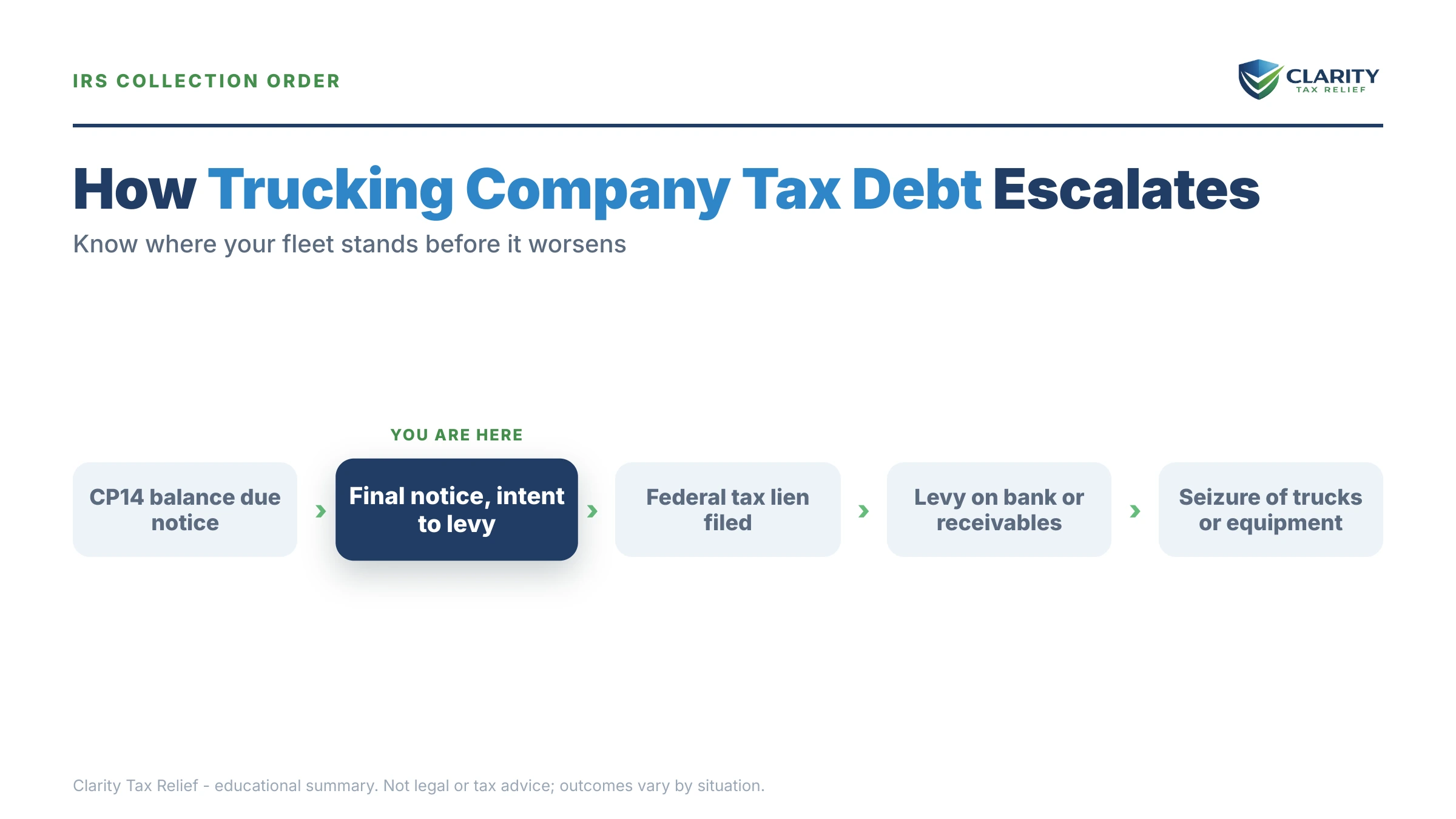
IRS collection against a trucking business is automated at the start and cash-flow-targeted at the end. The sequence runs whether or not a human ever reviews your file — and in 2026, with the IRS workforce down roughly 27% from 2025 cuts, humans are harder to reach while the automated levies never paused:
- First bills — CP14 on personal balances, CP161 on business balances. No enforcement yet; the cheapest moment to act.
- Reminder notices — the balance grows monthly with penalties and interest while the system queues the next letter.
- CP504 / CP504B — intent to levy. The IRS can now take your state tax refund, and a federal tax lien becomes likely. A lien attaches to everything — trucks, trailers, receivables — and can spook your factor and lenders. See our CP504B notice guide if that's what you're holding.
- LT11 / Letter 1058 (or CP297 for a business) — final notice of intent to levy. This starts a 30-day clock and your Collection Due Process appeal rights. After it expires, actual levies begin.
- Levies on your cash flow — a bank levy (funds held 21 days before they're sent) and, uniquely painful for carriers, an IRS levy on accounts receivable served directly on your factoring company or brokers. One piece of paper to your factor can capture every settlement before it reaches you.
- Trust Fund Recovery Penalty investigation — on 941 debt, a revenue officer conducts Form 4180 interviews and proposes assessing the trust-fund portion against you personally via Letter 1153, which gives you 60 days to protest.
- Passport certification — once the assessed debt exceeds $66,000 in 2026, the IRS can certify it to the State Department, blocking passport renewal — and cross-border freight with it.
Meanwhile the state clocks run in parallel: missed IFTA quarters trigger their own penalties and, eventually, license revocation, and an unpaid 2290 quietly blocks the next registration renewal.
Behind with the IRS on your trucking business?
Before a levy hits your factor or a Trust Fund Recovery Penalty investigation starts, get a free review of exactly where your account stands — every year, every form, every layer — and which resolution actually fits your numbers. Penalties and interest are accruing either way; knowing your position costs nothing.
Your options for resolving trucking company tax debt
Every IRS balance a trucking company owes can be resolved through one of six programs — the right one depends on the debt type, the amount, and what your finances show. For the general mechanics of each program, our pillar on how to settle tax debt yourself covers them in depth; here is how each applies to a carrier:
| Option | Key threshold / requirement | Trucking-specific note |
|---|---|---|
| Short-term payment plan | Full pay within 180 days; $0 setup fee | Good for a single bad quarter; interest and penalties still accrue |
| Streamlined installment agreement | Individual debt ≤ $50,000; up to 72 months, set up online | Covers Schedule C income/SE debt without submitting financials |
| Business / in-business payroll plan | Must be current on this quarter's 941 deposits first | The path for an operating carrier with payroll debt — see the business payroll tax payment plan rules |
| Partial payment installment agreement | Financials (Form 433-F/433-B) show you can't full-pay before the collection statute expires | Monthly payment set by ability to pay, not the balance |
| Currently Not Collectible | Financials show paying anything creates hardship | Pauses levies; the debt and interest remain, and the IRS reviews when income recovers |
| Offer in Compromise | $205 fee; 20% down on lump-sum offers (both waived if AGI ≤ 250% of poverty); ~1 in 5 accepted FY2024 | Truck and trailer equity counts against you in the offer math |
| Penalty abatement | First-Time Abate needs a clean prior 3 years; reasonable cause needs documented events | Can strip late-filing/late-payment penalties off multiple years; a new Automatic Exemption from Penalty (AEP) begins rolling out in summer 2026 |
Two carrier-specific rules cut across all of these. First, the IRS will not approve any arrangement while you're still falling behind on current taxes — this quarter's deposits and estimates must be clean before old debt can be negotiated. Second, IFTA and state weight-distance balances live entirely outside these IRS programs; they're negotiated separately with your base state under its own rules.
Also check whether the debt itself is overstated before you negotiate it. Trucking returns prepared without depreciation schedules, per diem, or full fuel and repair costs are common — and you can amend a return to reduce tax debt before choosing a payment path, which shrinks every number downstream.
A worked example: $68,500 in trucking tax debt
Say you're a sole proprietor running three trucks and you owe the IRS $68,500 across 2023 and 2024 — roughly $52,000 in income and self-employment tax, $10,300 in penalties, and $6,200 in accrued interest. This is a hypothetical, but the math is real:
- Straight installment agreement: $68,500 ÷ 72 months ≈ $952/month before ongoing interest. But because the balance is over $50,000, you can't set this up online without submitting a Form 433-F financial statement.
- The pay-down move: pay $18,501 up front to bring the balance to $49,999, and you qualify for a streamlined online agreement — $49,999 ÷ 72 ≈ $695/month, no financial disclosure, no asset review of your trucks.
- Passport exposure: at $68,500 you're already over the $66,000 certification threshold for 2026. Getting an installment agreement in place generally prevents certification — or reverses one — which matters if you ever run Canadian or Mexican freight. Details in our guide to a passport revoked for tax debt.
- Offer in Compromise check: suppose your three tractors carry $45,000 in equity and your books show about $400/month left after allowable expenses. A lump-sum offer would need to be at least roughly $45,000 + ($400 × 12) = $49,800 — a discount, but nowhere near the "pennies on the dollar" pitch you'll hear on the radio, and equity in working trucks makes many carrier offers uneconomical.
- Penalty relief first: if 2023 was your first slip after clean years, First-Time Abate on that year could remove a chunk of the $10,300 in penalties before you calculate any payment plan. You can estimate what penalties and interest are adding each month with our Penalty & Interest Calculator.
| Amount owed | Realistic options | What changes at this band |
|---|---|---|
| Under $10,000 | Full pay, 180-day plan, guaranteed installment agreement | Approval is essentially automatic if returns are filed; handle it yourself online |
| $10,000 – $25,000 | Streamlined plan, penalty abatement | Still no financials needed; liens usually avoidable if you act before CP504 |
| $25,000 – $50,000 | Streamlined plan (direct debit often required at the top of the band) | Last band where the IRS never looks at your truck equity |
| $50,000 – $100,000 | Financially-verified plan, pay-down to $49,999, PPIA, OIC review | Form 433-F required; passport certification possible above $66,000; lien likely |
| Over $100,000 | Revenue-officer-managed plan, PPIA, OIC, CNC | A human RO gets assigned; asset review of the fleet; get representation before the first meeting |
If the debt includes 941 payroll taxes
Payroll debt changes everything about priority, because the trust-fund portion — the taxes you withheld from drivers' paychecks — can be assessed against you personally through the Trust Fund Recovery Penalty, and that personal assessment survives even if the company closes. The mechanics of falling behind on payroll, and how the IRS unwinds it, are covered in our guide to 941 back taxes.
The strategic consequence: if you can only pay one layer, pay the trust-fund payroll layer. Income tax debt can sit in a payment plan; unpaid trust-fund taxes turn a business problem into a lifelong personal one. Carriers running as an entity should also know that incorporating doesn't change this — the analysis for corporate income tax debt is different (see C corporation tax debt), but trust-fund liability pierces every entity type. The same dynamic drives construction payroll tax debt cases, where labor-heavy payrolls meet thin margins.
If a revenue officer has already asked you to sit for a Form 4180 interview, or you've received Letter 1153 proposing the penalty against you, stop and get representation before you answer anything — Letter 1153 gives you 60 days to protest, and what you say in a 4180 interview determines who gets assessed.
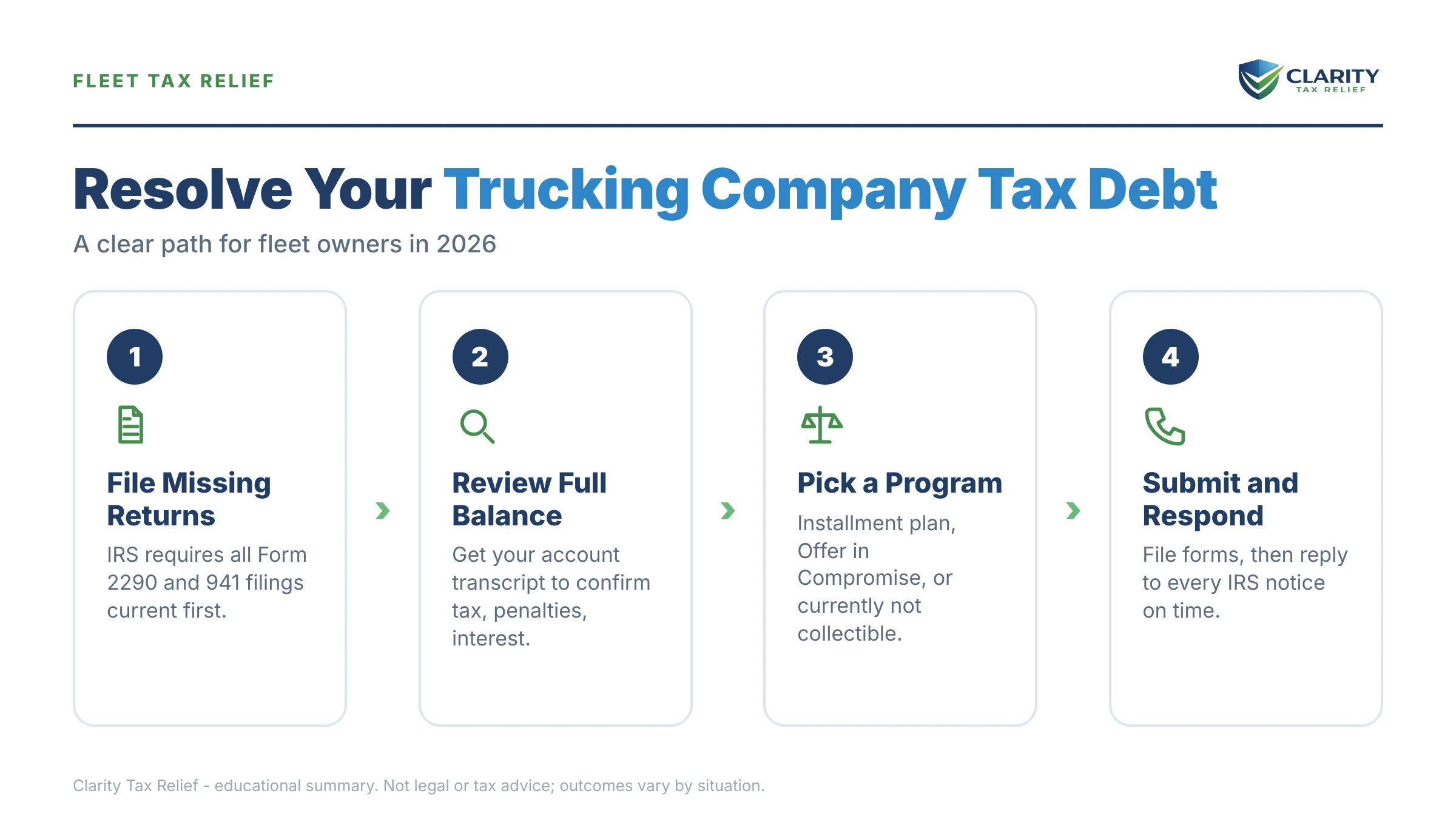
How to respond to trucking company tax debt, step by step
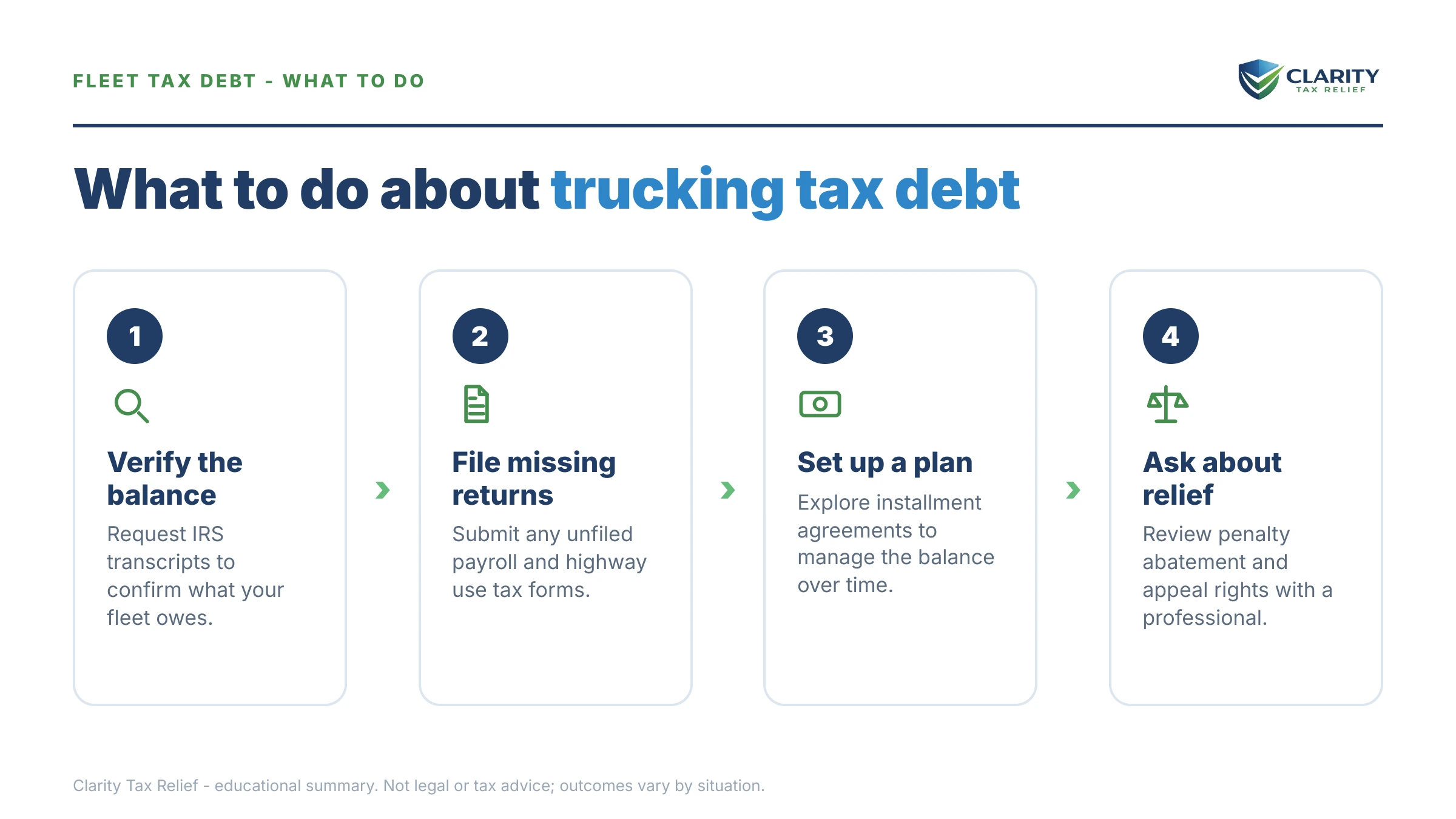
- Pull your complete IRS record — request account transcripts for every tax form and every year (1040, 941, 940, 2290) so you know the true total, which years are assessed, and whether a Trust Fund Recovery Penalty investigation has started.
- Get current-quarter taxes clean first — make this quarter's payroll deposits and estimated tax payments and file this year's Form 2290; the IRS will not approve any resolution while you are still falling behind on new taxes.
- Verify the assessed amounts and fix bad returns — check whether depreciation, per diem, fuel, insurance, and repair deductions were actually claimed; amending an inflated year can shrink the debt before you negotiate the rest.
- Separate the layers and resolve payroll debt first — split the total into trust-fund payroll debt, income and self-employment tax, and highway taxes, then prioritize the payroll layer, because it is the only one that follows you personally through the TFRP.
- Lock in a resolution before the final levy notice expires — set up the payment plan, hardship status, or offer that fits your numbers at IRS.gov/payments or through a professional; an arrangement in place stops levies on your bank account and your factoring company.
- Answer any TFRP contact immediately — if a revenue officer requests a Form 4180 interview or you receive Letter 1153, get representation before responding; Letter 1153 gives you only 60 days to protest personal assessment.
When you can handle this yourself — and when help changes the outcome
Plenty of trucking tax debt doesn't need professional help. If your debt is income tax only, under $25,000, all returns are filed, and you agree with the numbers, set up the streamlined plan online yourself (the official terms are on the IRS payment plans page) — it takes an evening, not a retainer. The same goes for a single missed 2290: file it, pay it, get the Schedule 1, done. If money is tight and your case is simple, the Taxpayer Advocate Service and low-income taxpayer clinics offer free help.
Experienced help changes outcomes in four carrier situations: a levy already served on your bank or factor, where release speed determines whether trucks keep rolling; any 941 debt with a TFRP investigation open, where interview answers decide personal liability; multiple unfiled years, where returns must be built from settlement statements and fuel records before anything can be negotiated; and balances over $50,000, where the financial statement you submit sets your payment — and truck equity, lease structures, and seasonal revenue are exactly the line items that get mispriced when the form is filled out casually.
Terms on your notices, decoded
- Trust fund taxes — the income tax and FICA you withheld from drivers' paychecks; money the IRS considers held in trust for the government.
- TFRP (Trust Fund Recovery Penalty) — a personal assessment of 100% of the unpaid trust-fund portion against anyone "responsible" who "willfully" didn't pay it.
- Schedule 1 (Form 2290) — the stamped proof that the heavy highway vehicle use tax was paid; states require it to register trucks at or above 55,000 pounds.
- IFTA — the International Fuel Tax Agreement; you file one quarterly fuel tax return with your base state, which settles up with every state and province you ran through.
- Accounts receivable levy — an IRS levy served on someone who owes you money (a factor or broker), capturing your settlements before they reach you.
- CSED — the Collection Statute Expiration Date; the IRS generally has 10 years from assessment to collect, though appeals, offers, and bankruptcy pause the clock.
Trucking tax debt questions, answered
Can the IRS shut down my trucking company for back taxes?
Seizing and padlocking an operating business is legally possible but rare — the IRS almost always levies your cash flow first. For a trucking company, that usually means a levy on your bank account or a levy served on your factoring company or brokers, which can stop your revenue in a single day. Getting into a payment arrangement before the final levy notice expires is what prevents both.
Can the IRS take my CDL for tax debt?
No — there is no federal mechanism for the IRS to revoke a commercial driver's license over unpaid taxes. The real license threats are different: your state can revoke your IFTA license for unpaid fuel taxes, your state won't renew heavy-vehicle registration without a stamped Schedule 1 proving Form 2290 was paid, and the IRS can certify your passport once your federal debt tops $66,000 in 2026 — a serious problem if you run cross-border loads.
Am I personally liable for my trucking company's payroll taxes?
If you operate as a sole proprietor, yes — every dollar of the business's tax debt is already your personal debt. If you run an LLC or corporation, the withheld portion of payroll taxes can still be assessed against you personally through the Trust Fund Recovery Penalty if you were a responsible person who willfully failed to pay. An entity does not shield anyone from trust-fund liability.
Can the IRS levy my factoring company?
Yes. Money a factor or broker owes you is an account receivable, and the IRS can serve a levy on the factoring company that captures those funds before they ever reach you. Because most small carriers run their entire cash flow through one factor, this single levy can be more damaging than a bank levy. It generally only happens after the IRS has sent a final notice of intent to levy and the 30-day window has passed.
What happens if I don't pay the Form 2290 heavy highway use tax?
Penalties and interest accrue on the unpaid tax, but the operational hit comes faster: without a stamped Schedule 1 proving payment, your state DMV generally will not register or renew the registration on any truck at or above 55,000 pounds. That means an unpaid 2290 can park a truck at renewal time even if the dollar amount is small. File and pay it first — it is usually the cheapest layer to clear.
Does IFTA fuel tax debt go to the IRS?
No. IFTA is administered by your base-jurisdiction state, which collects and distributes fuel tax among the member states and provinces — the IRS is not involved. That means an IFTA balance must be resolved with your state agency under its own rules, and none of the IRS payment plan or settlement thresholds apply to it. Ignoring it risks IFTA license revocation, which ends legal interstate operation.
Can a trucking company get an offer in compromise?
Yes, but the math is strict — the IRS accepted roughly 1 in 5 offers in FY2024, and equity in trucks and trailers counts against you in the calculation. An offer only works when your assets plus what the IRS could collect from future income genuinely fall short of the balance. The $205 application fee and 20% down payment on lump-sum offers are waived if your AGI is at or below 250% of the federal poverty level.
Will the IRS take my passport if my trucking tax debt is over $66,000?
Once your assessed federal debt exceeds $66,000 in 2026, the IRS can certify it to the State Department, which can deny your passport renewal or revoke the passport. For drivers hauling into Canada or Mexico, that directly cuts revenue. Entering an installment agreement or having an offer in compromise pending generally prevents certification or gets an existing one reversed.
Your next 24 hours
- Sort the mail by form number. Find the newest IRS notice for each type of tax — the form number (941, 1040, 2290) and tax period printed in the top corner tell you which layers you owe and how far each has escalated. Anything that says "intent to levy" goes to the top of the pile.
- Gather your numbers. Pull your last two years of returns, payroll records for any W-2 drivers, factoring statements, and your IFTA account status — that's everything needed to price your real options.
- Get the free case review. Send us what you found — an experienced tax professional will map every layer of your trucking tax debt and the resolution that fits your cash flow, before a levy reaches your factor. Call (888) 825-7779 or use the 2-minute form. Interest and penalties accrue every day the balance sits.
This guide is general information, not tax or legal advice for your specific situation. Eligibility for IRS programs depends on individual facts and circumstances; no outcome is guaranteed.