
IRS Payment Plans
IRS Payment Plan Over $100k: How to Get One Approved in 2026
The short answer: an IRS payment plan over $100k is available — but never online. You must submit a full financial statement (Form 433-A or 433-F), accept direct debit in most cases, and expect a federal tax lien. Your monthly payment comes from your documented ability to pay, not a flat formula.
You added up the notices — or logged into your IRS online account — and the total starts with a 1 and runs six figures. That number has a way of making every plan feel pointless. It isn't: the IRS puts taxpayers who owe more than $100,000 on monthly agreements every single day. The difference is that at this level, you have to prove the number you can pay.
The IRS builds that number from one document — the Form 433 financial statement — and the image below shows you exactly what that document looks like and which sections drive your monthly payment.
⏱ The clock that matters: a six-figure balance has no single response deadline, but the cost of waiting is measurable. Interest compounds daily and the failure-to-pay penalty adds 0.5% of the balance every month — and at over $100,000 you are already well past the $66,000 passport-certification threshold for 2026.
Why an IRS payment plan over $100,000 plays by different rules
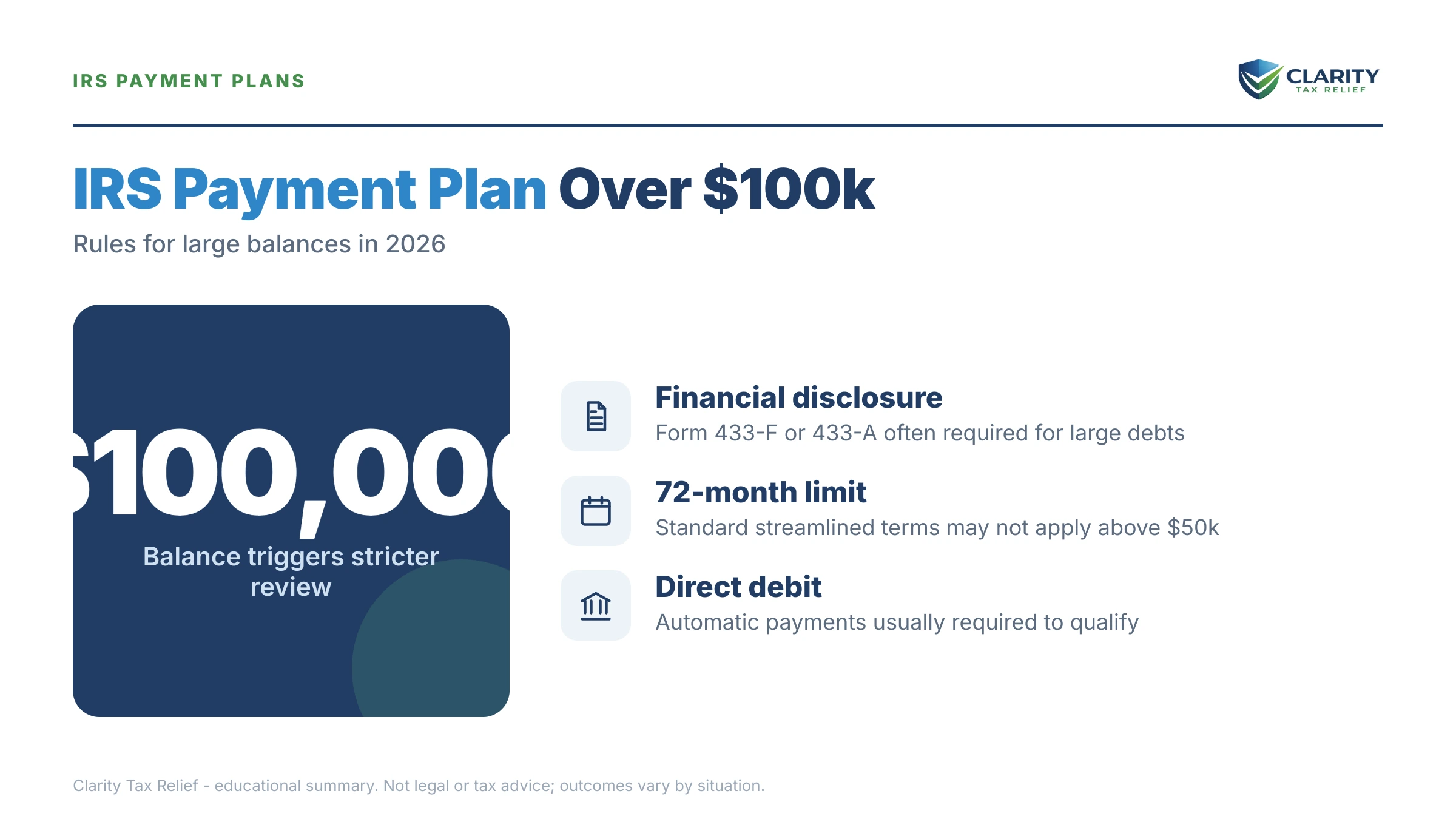
Above $100,000, there is no self-service button: the IRS online payment agreement tool caps long-term plans at $50,000, so every six-figure agreement is a negotiated, human-reviewed non-streamlined installment agreement.
If your balance were smaller, you could set the whole thing up in twenty minutes — our guide to how to set up an IRS payment plan online covers that path, and the IRS payment plan over $50,000 guide covers the middle band. This page covers what changes above the line, and four things do:
- Financial disclosure is mandatory. You'll complete Form 433-A or 433-F and document income, expenses, and every asset with equity.
- Your first bill arrives with a shorter fuse. A CP14 for a balance of $100,000 or more gives you 10 business days to respond, not the usual ~21 days.
- A Notice of Federal Tax Lien is nearly automatic at this balance, even once you're on a plan.
- A revenue officer may be assigned — a local collection employee with levy authority, rather than the automated notice stream.
| Assessed balance | What you can get | What the IRS requires |
|---|---|---|
| $10,000 or less | Guaranteed installment agreement — approval is required by law if you meet the conditions | No financial statement; clean filing history |
| $25,000 or less | Streamlined installment agreement, up to 72 months | No financial statement |
| $25,001–$50,000 | Streamlined agreement, up to 72 months, set up online | Direct debit; no financial statement |
| $50,001–$100,000 | Plan by phone or mail; terms negotiated | Financial information generally required (Form 433-F) |
| Over $100,000 | Non-streamlined agreement only — human review | Full Form 433-A/433-F, direct debit expected, lien likely, possible revenue officer |
What the IRS will examine before saying yes
Above $100,000, the IRS approves a payment only after verifying three things: your real income, your allowable expenses, and the equity in what you own.
Income. W-2 earners submit pay stubs. If you're self-employed or on 1099s, expect to provide three months of bank statements and a profit-and-loss summary — the IRS averages fluctuating income rather than taking your slowest month. Our Form 433-A instructions walk through every line.
Expenses. The IRS does not accept your actual budget. It measures your spending against national and local standards — the IRS allowable living expenses standards — and anything above the caps (a large car payment, private school, high discretionary spending) generally doesn't count. Income minus allowed expenses is what the IRS considers available for payment.
Assets. Home equity, vehicles, investment accounts, business equipment, even crypto. On a six-figure case, the reviewer may ask why you can't borrow against equity to pay part of the balance before granting monthly terms. That question deserves a prepared answer, not an improvised one.
One more thing the disclosure decides: whether you full-pay at all. If your allowable monthly payment, multiplied by the months left on the 10-year collection statute, can't reach the balance, you're in partial-pay territory — covered below. You can estimate how many months remain on your own statute with our CSED Calculator.
What happens if you do nothing about a $100k+ balance
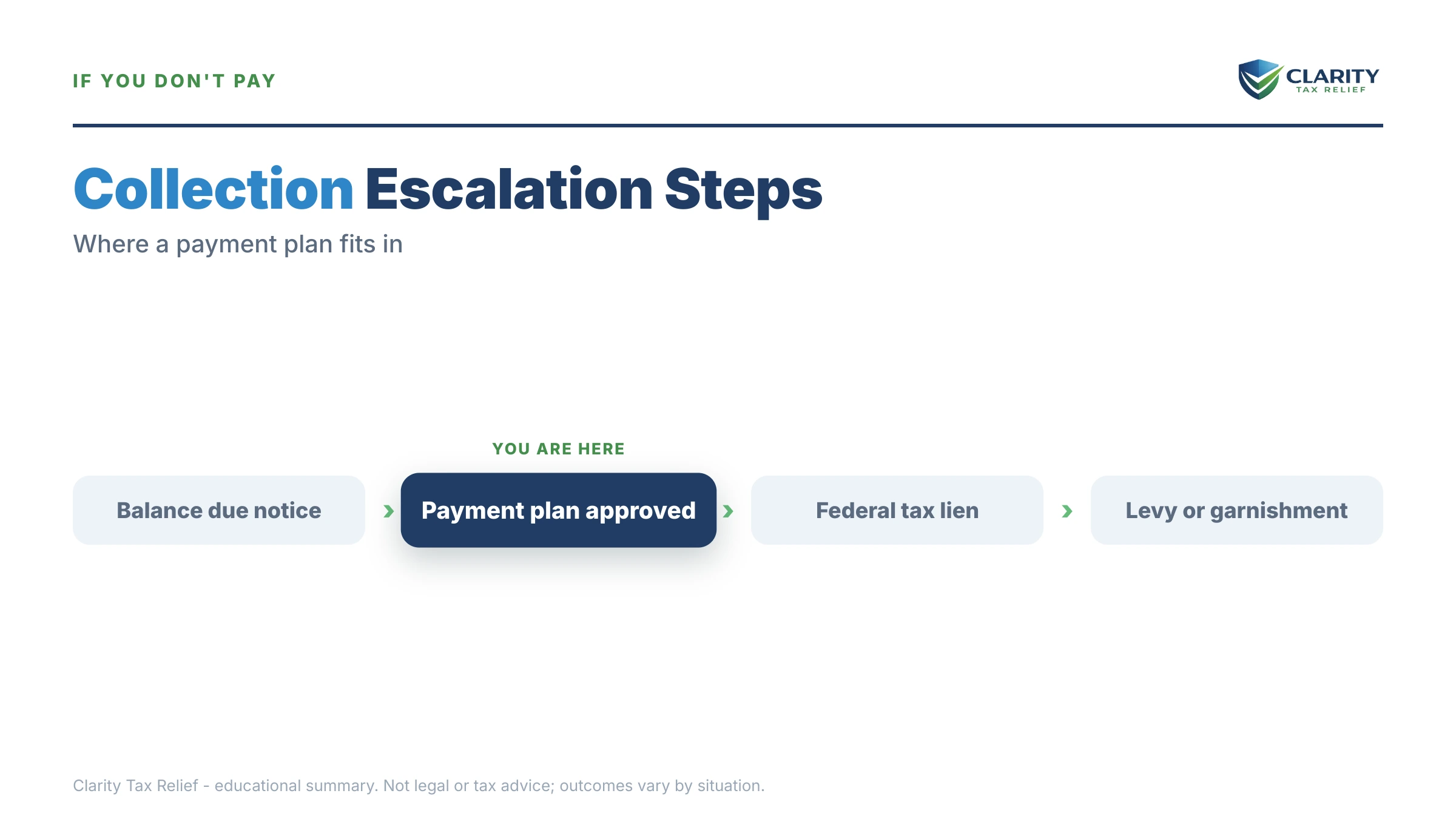
A six-figure balance moves through the IRS collection machine in a fixed sequence, and the machine is fully automated — 2025's roughly 27% workforce cut made humans harder to reach but did not slow the notices or the levies.
- CP14 — the first bill. At $100,000 or more, it allows only 10 business days before the sequence advances.
- CP501 / CP503 — reminders. Still just bills, but interest and the monthly failure-to-pay penalty are compounding the whole time.
- Notice of Federal Tax Lien. Filed publicly against everything you own — expect this early at your balance level. It complicates selling or refinancing property.
- CP504 — intent to levy your state refund under IRC §6331(d). Not the final notice, but the last calm one.
- LT11 / Letter 1058 — final notice of intent to levy. Starts a 30-day clock and your Collection Due Process rights (requested on Form 12153). After 30 days, levies are legal.
- CP508C — passport certification. Your balance is well above the $66,000 threshold, so the IRS can certify it to the State Department, which can deny a passport application or renewal — see passport revoked for tax debt.
- Enforcement. Bank levies (a 21-day hold before funds leave), continuous wage levies — and for contractors, a levy served directly on your clients that seizes payments they owe you. For a 1099 earner, that letter to a client can end the relationship even after the tax problem is fixed.
Every stage is preventable. An approved installment agreement stops the sequence, keeps levies off the table, and keeps your account out of the seriously-delinquent passport category.
Owe the IRS six figures right now?
Before you hand the IRS a financial statement that sets your payment for years, have an experienced tax professional review your numbers. We'll map your options against your real income and the months left on your collection statute — free, confidential, no pressure.
Your options when you owe the IRS more than $100,000
A monthly agreement is the most common resolution above $100,000, but it is not the only one — and the financial statement you prepare for the plan is the same document that reveals whether something better fits. (For the broader strategy picture at this size, see I owe the IRS $100,000.)
| Option | Upfront cost | Timeline | Who it fits |
|---|---|---|---|
| Short-term full pay | $0 setup fee | Up to 180 days | You can liquidate or borrow the full amount |
| Non-streamlined installment agreement (full pay) | Setup fee (lower with direct debit; low-income waivers exist) | Monthly until paid — must finish within the collection statute | Income covers the IRS's disposable-income math |
| Partial-pay installment agreement | Setup fee; full financial review | Monthly until the CSED expires; reviews typically every 2 years | Allowable payment can't full-pay before the statute runs |
| Pay down below $50,001, then streamlined plan | Lump payment to cross the threshold | Up to 72 months, set up online | Access to funds without raiding protected retirement |
| Currently Not Collectible | $0 | Paused until finances improve; balance keeps growing | Genuine hardship — any payment breaks the budget |
| Offer in Compromise | $205 fee + 20% of the offer (both waived with low-income certification) | Months of review; auto-accepted if the IRS doesn't decide within 2 years | Assets and income genuinely can't cover the debt — roughly 1 in 5 offers accepted in FY2024 |
Full-pay agreement. The default outcome when your allowable payment retires the debt within the statute. Set it up as a direct debit installment agreement — at this balance the IRS effectively requires it, and automatic drafts prevent the missed-payment defaults that restart collection.
Partial-pay agreement (PPIA). When the math doesn't reach full payment, the IRS can accept less per month and let the remainder expire at the CSED. It's a genuine path — with strings: a lien, periodic re-reviews, and a payment that rises if your income does. Details in our partial payment installment agreement guide.
The pay-down play. If you're at, say, $108,000 and can raise $58,000 from non-retirement sources, paying the assessed balance to $50,000 or less converts your case from a negotiated agreement to a streamlined one — no financial statement, online setup, up to 72 months. It's often the single highest-leverage move available. It is a bad trade if the cash comes from a 401(k) withdrawal that creates a new tax bill next April.
CNC or an offer. If the 433 shows no ability to pay, Currently Not Collectible status pauses collection entirely — the honest comparison is in payment plan vs currently not collectible. An Offer in Compromise settles for less than the balance, but only when the IRS's own math shows it could never collect in full; eligibility is means-tested, and most large-balance earners with steady income don't qualify.
One flag on all of these: while an agreement is active, any federal refund you're owed is offset against the balance and doesn't count as your monthly payment — see will the IRS take my refund on a payment plan.
Worked example: a 1099 contractor with a $118,000 balance
Say you're an independent contractor grossing $7,400 a month and, after three unpaid years of self-employment tax plus penalties and interest, you owe $118,000. This is hypothetical — but the math is exactly what an IRS reviewer runs.
- Business expenses run $1,200/month, so net income is $6,200/month.
- The IRS allowable-expense standards for your household allow $4,700/month of living costs.
- Disposable income: $6,200 − $4,700 = $1,500/month available for the IRS.
- Suppose 96 months remain on your earliest collection statute. Full pay requires roughly $118,000 ÷ 96 ≈ $1,229/month before ongoing interest — so at $1,500/month, the IRS approves a full-pay agreement, and the payment will be $1,500, because the IRS takes what the 433 shows, not the minimum.
- If your disposable income were only $700/month, the picture flips: $700 × 96 = $67,200, well short of $118,000. That's a partial-pay agreement — or, if assets are thin too, an offer conversation.
The hidden line item: as a contractor you must also pay this year's quarterly estimates on top of the plan. On $6,200/month of net income, that's real money every quarter — and skipping it defaults the agreement. Budget both numbers before you agree to either.
How to set up an IRS payment plan over $100,000, step by step
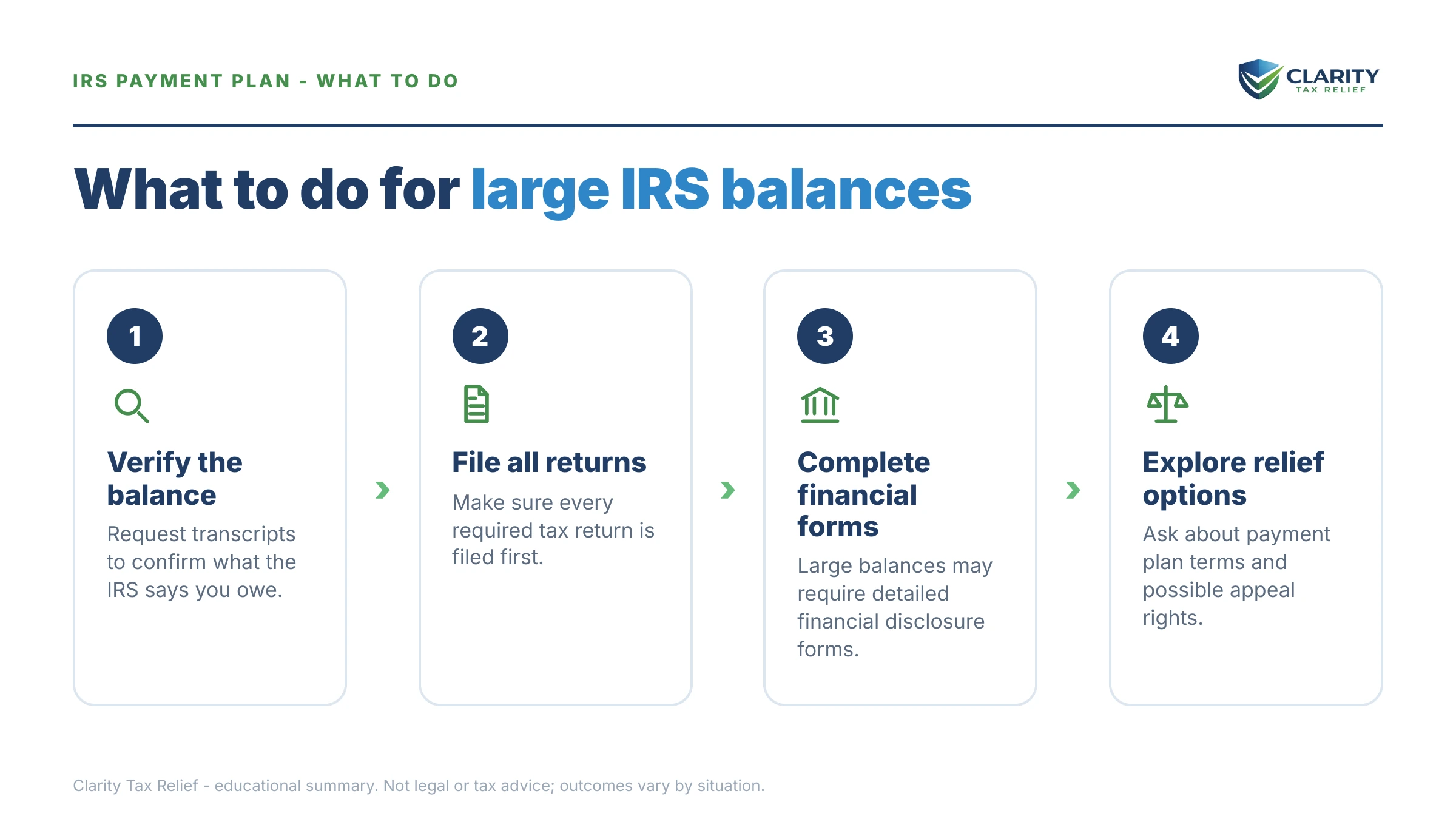
- Pull your account transcripts — confirm the exact balance for every year and note each assessment date (each one starts its own 10-year collection clock).
- File every missing return — the IRS will not approve an installment agreement while required returns are unfiled, so compliance comes before negotiation.
- Complete Form 433-A (or 433-F) — document your income, allowable expenses, and asset equity before you propose a number, so the number is one you can defend.
- Propose the payment — call the number on your most recent notice (or have a representative do it) and request direct-debit terms with your supporting figures ready.
- Sign and calendar the agreement — you'll confirm terms on Form 433-D; note the monthly draft date and watch for CP521 reminder statements.
- Stay current on this year's taxes — one missed quarterly estimated payment can default the entire agreement, so build current-year taxes into your monthly budget.
Situations that change the six-figure math
Married couples. If the debt is from joint returns, both spouses are each liable for the full amount, and a joint 433 includes both incomes. If only one spouse owes, the other's income still affects the household expense picture — how the agreement is structured can protect the non-liable spouse's assets.
Multiple years. A $100k+ balance is usually several years stacked. Each year has its own CSED, so the oldest debt may expire years before the newest — which changes what a partial-pay agreement actually leaves behind. Never negotiate a six-figure plan without a year-by-year statute analysis.
Business and payroll debt. If part of the balance is unpaid 941 payroll tax, different — and harsher — rules apply, including personal trust-fund liability for owners. Don't fold payroll debt into a personal plan without understanding that exposure first.
You dispute the amount. Never sign an agreement on a balance you believe is wrong — a plan is an acknowledgment. Exam errors, CP2000 mismatches, and substitute-for-return assessments can often be corrected first, shrinking the number you're financing.
State debt on top. States run their own collection systems on their own timelines — California's FTB, for instance, has a 20-year collection statute. An IRS agreement does nothing to stop a state, so sequence both.
Reading your transcript while the agreement processes
Large-balance cases move slowly in 2026, and your account transcript is the fastest way to see what the IRS has actually done — before any letter arrives.
| Code | What it means | What to do |
|---|---|---|
| 971 | A notice was issued on your account | Match it to the letter in hand and calendar any deadline it sets |
| 582 | Federal tax lien indicator | Expected at this balance; factor it into any plan to sell or refinance property |
| 276 | Failure-to-pay penalty posted | Normal accrual; confirm the reduced rate applies once your agreement is active |
| 196 | Interest assessed | Accrues until paid — pay above the minimum whenever possible |
| 480 | Offer in Compromise pending | Collection generally pauses — but the review time extends your collection statute |
| 530 | Account placed in Currently Not Collectible | Enforcement paused; the balance still grows and the IRS revisits when income rises |
When you can handle this yourself — and when help changes the outcome
Some six-figure cases are genuinely manageable alone. If your returns are all filed, you agree with the balance, your income is steady and documented, and the full-pay math clearly works, you can complete the 433, call the IRS, and set up the agreement yourself — the official IRS payment plans page lays out the mechanics. Patience with hold times is the main cost.
Experienced help tends to change the result in specific situations: a revenue officer is already assigned; the numbers land in partial-pay or offer territory, where how the 433 is prepared can swing the payment by hundreds a month for years; multiple years with different statutes are stacked; the balance includes payroll tax; or a levy or passport certification is already in motion and needs to be unwound, not just prevented. If a levy is causing immediate economic harm and you can't get traction, the independent Taxpayer Advocate Service also exists for exactly that.
If your case has any of those pressure points, have an experienced tax professional pressure-test your financial statement before the IRS sees it — a free case review takes about ten minutes, or call (888) 825-7779.
Terms on your notices, decoded
- Non-streamlined installment agreement — any payment plan above the thresholds where the IRS approves without financial review; yours will be one.
- CSED — Collection Statute Expiration Date: the IRS generally has 10 years from each assessment to collect, though appeals, offers, and bankruptcy pause the clock.
- Notice of Federal Tax Lien — a public filing that attaches the government's claim to your property; it secures the debt but doesn't take anything.
- Revenue officer — a local IRS collection employee assigned to larger or more complex cases, with authority to set deadlines and issue levies.
- Partial-pay installment agreement — a monthly plan that won't fully pay the debt before the CSED; the shortfall can expire uncollected.
- Seriously delinquent tax debt — a balance over $66,000 (for 2026) that the IRS can certify to the State Department for passport denial; debts in an approved agreement are excluded.
IRS payment plan over $100k: your questions, answered
Can I set up an IRS payment plan over $100,000 online?
No. The IRS online payment agreement tool caps long-term plans at $50,000, so a six-figure balance goes through the phone, the mail (Form 9465 plus a collection information statement), or a revenue officer. Expect to submit Form 433-A or 433-F and back it up with bank statements and income records. Some taxpayers pay the balance down below $50,001 first specifically to regain online eligibility.
Will the IRS file a tax lien if I owe more than $100,000?
Almost certainly, yes. A Notice of Federal Tax Lien protects the government's claim on a balance this size, and getting on a payment plan does not automatically remove one already filed. The lien no longer appears on consumer credit reports, but it is a public record that attaches to your property and can complicate selling or refinancing a home.
Will a revenue officer be assigned to my case?
It is much more likely above $100,000 than below it, especially if you also have unfiled returns or business and payroll debt. A revenue officer is a local IRS collection employee who sets deadlines, can summon records, and has levy authority. The upside: an RO is a single decision-maker you — or your representative — can negotiate with directly, instead of an automated queue.
Can the IRS take my passport if I owe over $100k?
Yes. The seriously-delinquent-tax-debt threshold is $66,000 for 2026, so a $100,000-plus balance clears it easily. The IRS certifies the debt to the State Department (you'd get a CP508C notice), which can deny a passport application or renewal. A balance being paid on time under an approved installment agreement is excluded from certification — one of the strongest reasons to get a plan in place.
How does the IRS decide my monthly payment above $100,000?
From your Form 433 numbers: monthly income minus allowable living expenses equals what the IRS treats as available for payment, and it checks whether that amount full-pays the debt before the 10-year collection statute expires. It is not a flat formula like balance divided by 72. If your allowable payment can't retire the debt in time, the IRS looks at a partial-pay agreement or another resolution instead.
What is a partial-pay installment agreement (PPIA)?
A monthly plan that pays less than what's needed to clear the debt before the 10-year collection statute runs out; whatever remains at the CSED can expire uncollected. The IRS requires full financial disclosure, usually files a lien, and revisits your finances periodically — typically about every two years — raising the payment if your income grows.
Should I pay my balance down below $50,000 first?
Sometimes, yes. Dropping the assessed balance to $50,000 or less can make you eligible for a streamlined agreement — up to 72 months, set up online, no financial statement, and far less lien exposure. But don't drain protected retirement accounts or your emergency fund to cross the line; a 401(k) withdrawal creates its own new tax bill. Run the full cost first.
Does interest stop once I'm on the payment plan?
No. Interest keeps compounding daily on the unpaid balance, and the failure-to-pay penalty continues too — though it is cut in half, to 0.25% per month, while an installment agreement is in effect. Paying more than the required minimum whenever you can is the only lever that lowers the total cost of a six-figure plan.
Will the IRS keep my tax refunds while I'm on the plan?
Yes. Every federal refund you're owed gets applied to the balance until it's paid in full — and the offset does not count as your monthly payment, which you still owe separately. Many self-employed taxpayers deliberately set their estimated payments so they don't generate a refund the IRS will sweep.
Your next 24 hours
- Get the real number. Log into your IRS online account or pull account transcripts and write down the balance for each year — plus each assessment date, which controls how long the IRS has to collect.
- Gather your proof. Your last filed return, three months of bank statements, a simple profit-and-loss or 1099 totals, and your monthly bills — everything a Form 433 will ask for. Payment mechanics live at IRS.gov/payments.
- Get your six-figure balance reviewed free. Interest and the failure-to-pay penalty are compounding every month you wait, and your passport standing is already at stake — call (888) 825-7779 or use the 2-minute form and we'll map your options before you commit to a payment.
This guide is general information, not tax or legal advice for your specific situation. Eligibility for IRS programs depends on individual facts and circumstances; no outcome is guaranteed.