
IRS Programs & Rules
IRS Payment Plan Changes 2026: What Actually Changed (and What Didn't)
The short answer: the real IRS payment plan changes 2026 delivered sit around the plans, not inside them. The Automatic Exemption from Penalty begins replacing First-Time Abate this summer, the passport threshold rose to $66,000, and IRS phone help is thinner. The core thresholds — 180-day short-term plans and 72-month online plans up to $50,000 — didn't change.
Maybe you already send the IRS money every month, or maybe you've been putting off setting a plan up — and now a headline, a radio ad, or a salesperson has you wondering whether the rules moved underneath you this year. Most of them didn't. This guide separates the three changes that are real from the noise, then walks through exactly which plan fits your balance in 2026 — including what the math looks like on a fixed income.

IRS payment plan changes 2026: the three that are real
Only three 2026 developments genuinely affect people who owe the IRS and pay over time — and none of them changed the plan thresholds themselves.
1. Automatic Exemption from Penalty (AEP) starts replacing First-Time Abate
Beginning in summer 2026, the IRS is rolling out the Automatic Exemption from Penalty (AEP) to replace First-Time Abate. The idea: if your compliance history is clean for the prior three years, qualifying penalties come off automatically — no request, no letter, no phone call.
Why this matters for a payment plan: penalties are part of the balance your plan has to finance. If AEP removes a failure-to-pay penalty before you set up the agreement, every monthly payment goes further. Until the rollout reaches your account, the traditional First-Time Abate request still works — check your transcript rather than assuming.
2. The passport threshold rose to $66,000
For 2026, the IRS certifies "seriously delinquent" tax debt to the State Department at $66,000 (the figure adjusts for inflation each year). Certification can block a passport renewal or application. An active installment agreement generally prevents certification even above the threshold — which makes a plan the single fastest passport protection if you owe at that level.
3. A much thinner IRS — with fully automated collections
The IRS workforce shrank roughly 27% in 2025. Two practical consequences for anyone dealing with a payment plan in 2026:
- Phone-based anything is slower. Setting up, modifying, or reinstating a plan by phone can mean long holds. The Online Payment Agreement tool still answers instantly — use it whenever your balance qualifies.
- Silence is not forgiveness. Notices, refund offsets, and levies are generated by automated systems that were not cut. The escalation sequence below runs whether or not a human ever reviews your file.
And the "changes" that are just marketing
There is no "new 2026 Fresh Start program," no 2026 forgiveness initiative, and no expiring enrollment window. "Fresh Start" refers to policy changes from more than a decade ago that are baked into today's standard options. If a pitch pressures you to "enroll before the 2026 program closes," that's a sales tactic, not tax law — here's what's actually new in IRS Fresh Start for 2026 versus what's marketing.
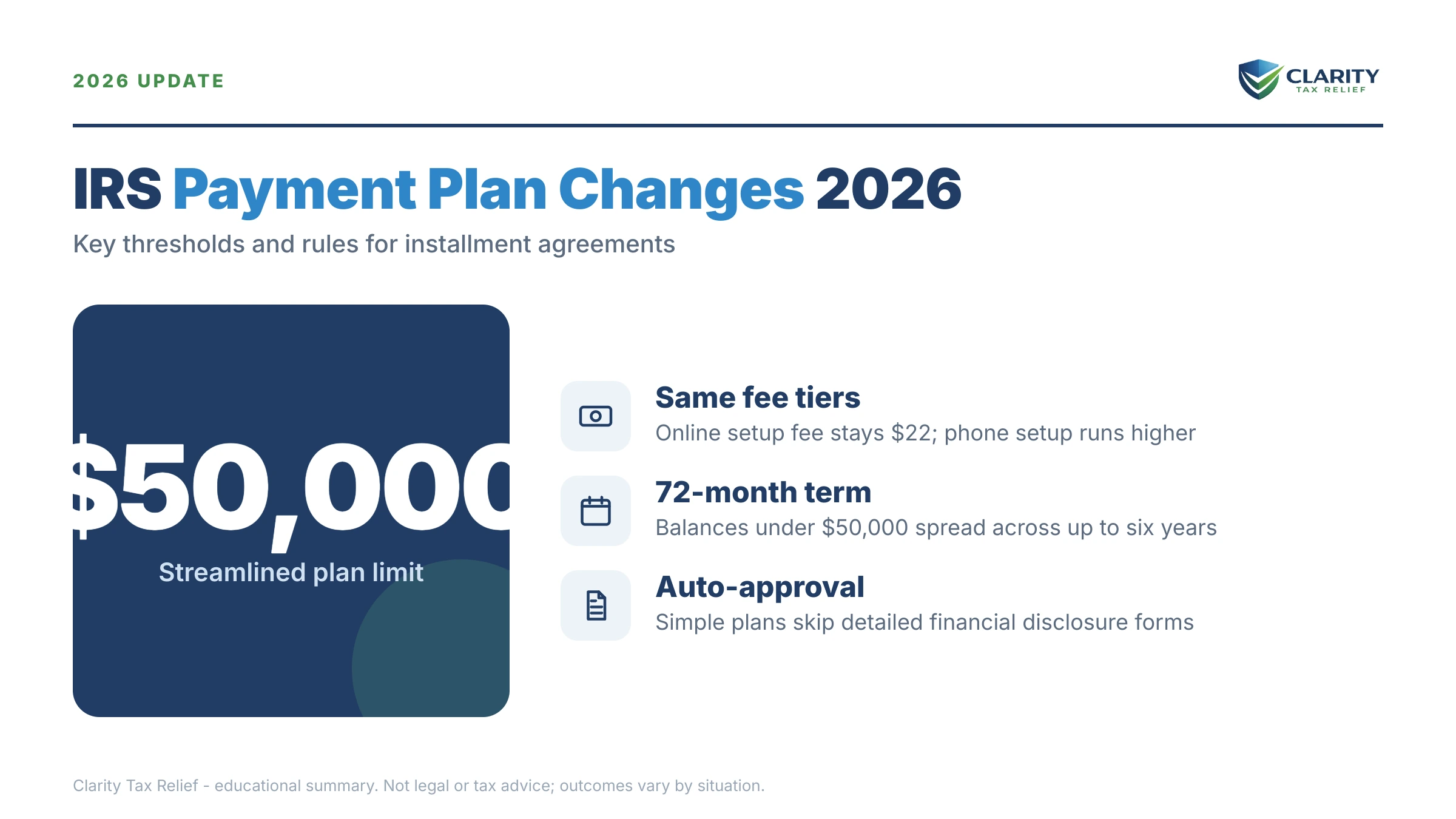
What didn't change: the 2026 payment plan thresholds
Every core installment agreement threshold carried into 2026 unchanged. As of this year:
- Short-term plan: pay in full within 180 days, $0 setup fee.
- Online long-term plan: individuals owing $50,000 or less (tax, penalties, and interest combined) can get up to 72 months online, no financial disclosure.
- Guaranteed installment agreement: owe $10,000 or less in tax with a compliant history and the IRS must accept a plan that full-pays within 3 years.
- Streamlined installment agreement: up to $25,000 without direct debit — or up to $50,000 with direct debit.
- Interest and penalties still accrue on every plan. Rates reset quarterly — see the current IRS interest rates for 2026 — and setup fees still vary by how you apply, with waivers for low-income taxpayers (full tiers in our guide to the IRS payment plan setup fee).
One quiet advantage that also didn't change: while an installment agreement is active, the failure-to-pay penalty is cut in half, from 0.5% to 0.25% per month. That discount alone is a reason to formalize a plan instead of just mailing what you can.
⏱ The clock that actually runs: there's no application deadline for a payment plan — but an unresolved balance grows every single month. The failure-to-pay penalty adds 0.5% of the balance monthly (0.25% once a plan is active), and interest compounds daily until the debt is gone. You can estimate your own penalty and interest buildup with our Penalty & Interest Calculator.
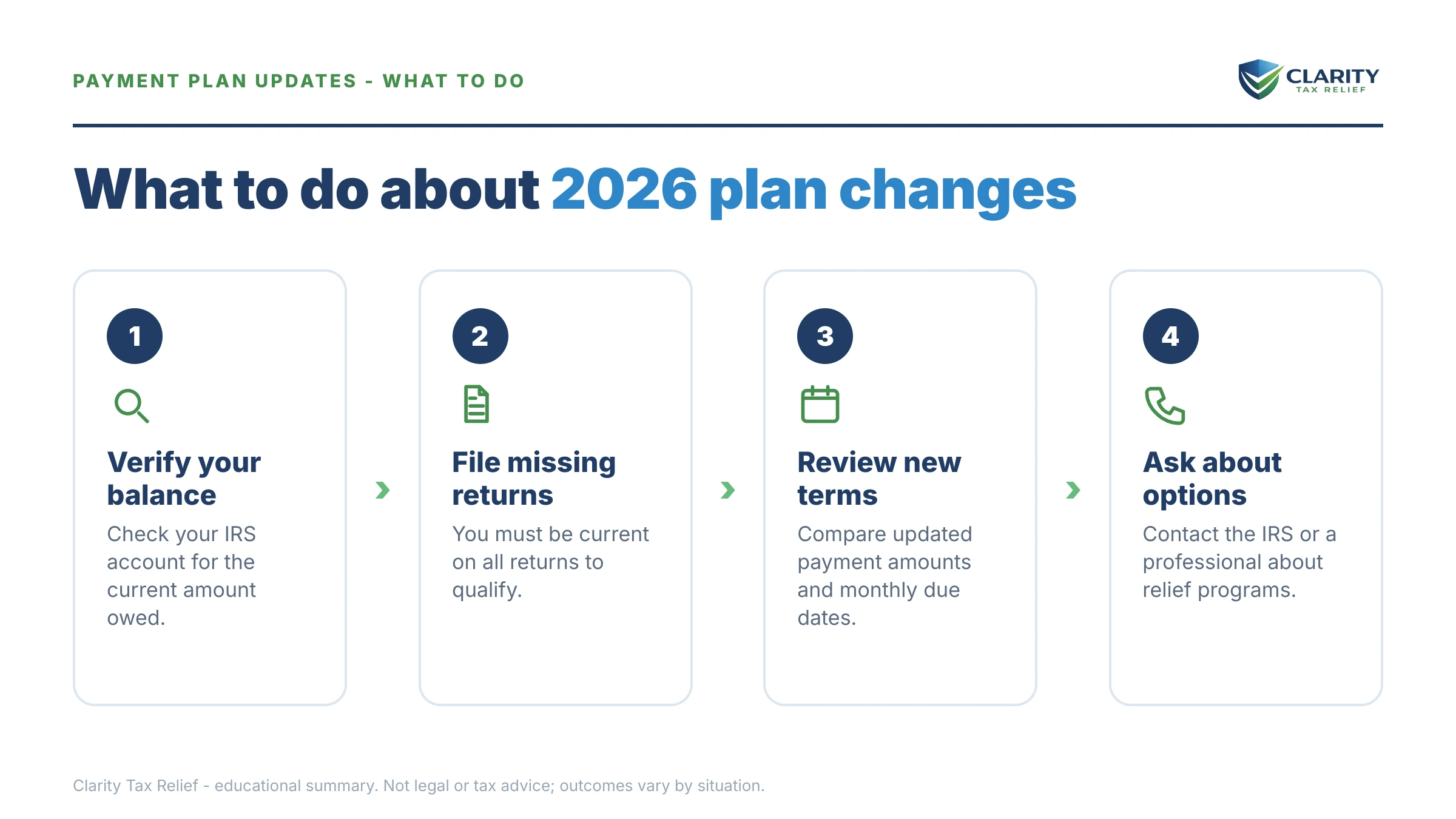
What happens if you owe and do nothing in 2026
Nothing in the 2026 changes slowed IRS collections — the notice-and-levy machine is automated and kept running straight through the staffing cuts. Without a plan in place, the sequence looks like this:
- First bill (CP14). You typically have about 21 days from the notice date before the system queues the next letter.
- Reminder notices (CP501/CP503). Still just bills — but the balance grows with each monthly penalty cycle.
- CP504 — intent to levy your state refund. The IRS can now take your state tax refund, and a federal tax lien becomes a live possibility.
- LT11 / Letter 1058 — final notice. A 30-day clock starts, along with your Collection Due Process appeal rights. After it runs, the IRS can levy.
- Levy. Bank accounts (with a 21-day hold before funds leave), wages (continuous until released) — and for retirees, the Federal Payment Levy Program can take up to 15% of each Social Security check, month after month, without a court order.
If you're already on a plan and stop paying, a parallel sequence runs: a missed payment, a catch-up window, then a CP523 notice of intent to terminate — and once the agreement terminates, full collection powers return. Details in my payment plan defaulted — now what.
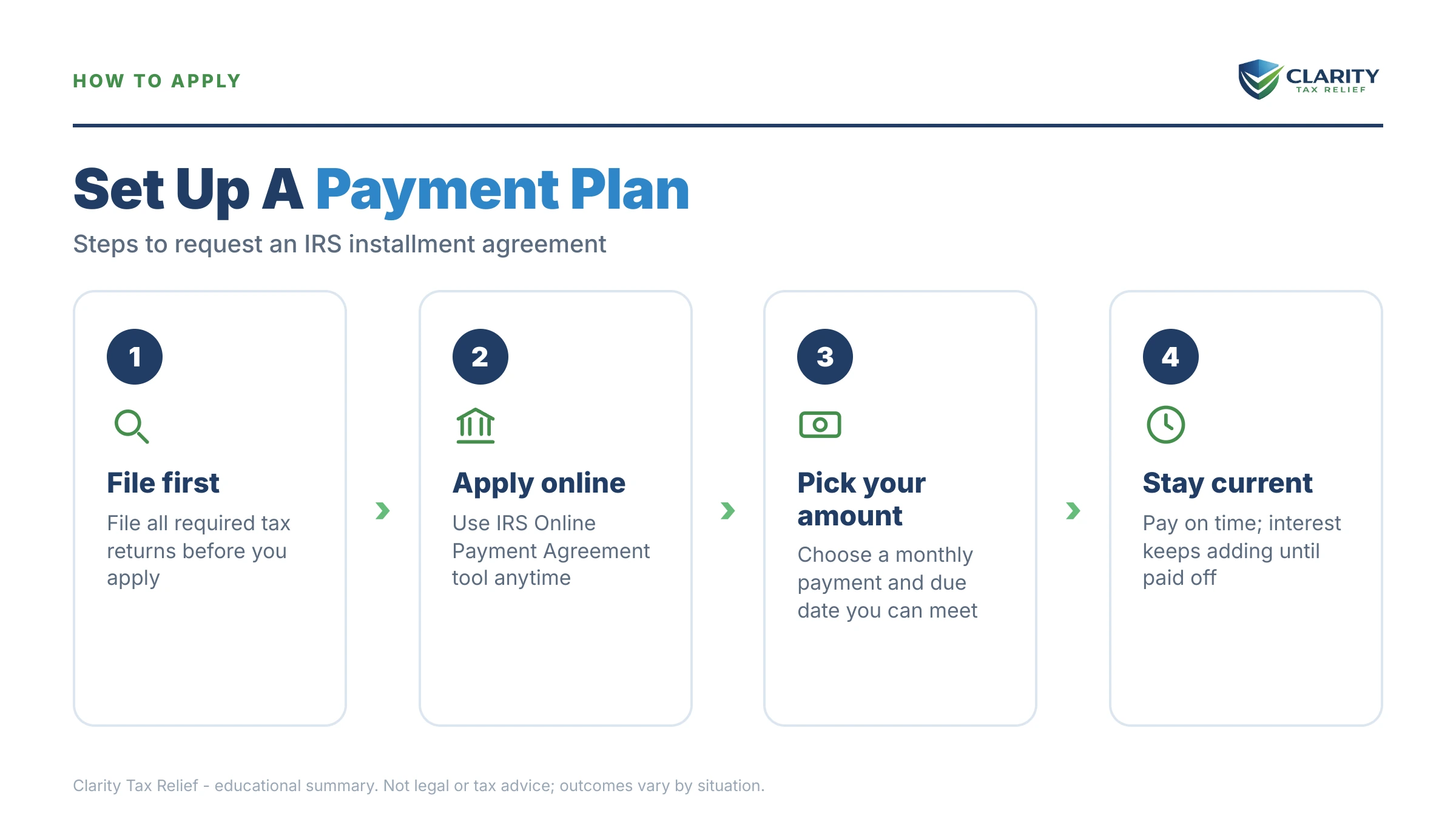
Owe the IRS and not sure which 2026 plan fits?
An experienced tax professional will review your balance, your income, and the 2026 options — free and confidential. Every month you wait adds another round of penalties and daily-compounding interest to the number a plan has to cover.
Your payment plan options in 2026: costs and timelines
Every 2026 payment plan option for individuals fits into one of six tiers, and the right one depends almost entirely on how much you owe and what you can genuinely pay each month. (For the click-by-click setup process, see the full walkthrough on how to set up an IRS payment plan online.)
| Option | 2026 eligibility | Setup cost | How long |
|---|---|---|---|
| Short-term payment plan | Can pay in full within 180 days | $0 | Up to 180 days |
| Guaranteed installment agreement | Owe $10,000 or less in tax; compliant filing history | Standard fee (waived or reduced for low income) | Up to 3 years |
| Streamlined installment agreement | Owe $25,000 or less — or up to $50,000 with direct debit | Lowest fee when set up online with direct debit | Up to 72 months |
| Non-streamlined agreement | Over $50,000, or payments below the streamlined math | Setup fee plus Form 433 financial review | Negotiated, up to the CSED |
| Partial-payment installment agreement | Genuinely can't full-pay before the collection statute expires | Setup fee plus full financial disclosure; periodic reviews | Until the CSED expires |
| Currently Not Collectible | Any payment would prevent basic living expenses | $0 (financial disclosure required) | Reviewed periodically; debt remains and accrues |
Two edge cases with their own rules: businesses use separate, lower thresholds and a different application track — see the business IRS installment agreement guide — and state tax agencies run entirely separate programs; none of the IRS figures on this page apply to a state balance.
How much you owe changes your options
Your total balance — all years combined — determines which 2026 plan you can get without handing the IRS a full financial statement.
| You owe (all years) | Realistic 2026 options | What the IRS will want |
|---|---|---|
| Under $10,000 | Guaranteed installment agreement; short-term 180-day plan | No financials; stay filed and current |
| $10,000–$25,000 | Streamlined agreement; short-term plan; AEP/First-Time Abate on penalties | No financials for streamlined terms |
| $25,000–$50,000 | Streamlined agreement with direct debit; online 72-month plan | Direct debit above $25,000; no Form 433 |
| $50,000–$66,000 | Non-streamlined agreement; partial-pay or OIC if the math supports it | Form 433-F financial disclosure |
| Over $66,000 | Non-streamlined agreement (a plan also blocks passport certification); partial-pay; OIC | Full financials and closer IRS review |
Above $50,000 the process changes character — financial disclosure, negotiated terms, sometimes asset questions. That tier has its own guide: IRS payment plan over $50,000.
A worked example: $27,500 owed on a Social Security income
Say you're retired, drawing $2,200 a month in Social Security plus a small pension, and a taxable IRA withdrawal left you owing $27,500 for 2025. Here's how the 2026 rules actually price out — this is a hypothetical, not a client story:
- You qualify for the online 72-month plan ($27,500 is under $50,000). Because you're over $25,000, streamlined treatment requires direct debit from your bank account.
- The floor payment: $27,500 ÷ 72 ≈ $382 a month. But interest compounds daily and the reduced 0.25% monthly failure-to-pay penalty (about $69 a month at the start, shrinking as the balance falls) keeps posting — so if you want the debt truly gone in six years, budget roughly $450 a month.
- The do-nothing comparison: ignore it, and the Federal Payment Levy Program can eventually take 15% of your Social Security — $330 of that $2,200 check, involuntarily, every month — while the full 0.5% penalty ($137.50 a month at first) and daily interest pile onto the balance. You'd be paying almost a plan-sized amount with nothing negotiated and a bank levy still possible.
- If $382 is genuinely unaffordable: a partial-payment installment agreement or Currently Not Collectible status may fit — both require a Form 433-F showing your income and allowable expenses, and both leave the 10-year collection statute running, meaning some of the debt may never be collected before the CSED expires.
- Passport check: $27,500 is well under the $66,000 certification threshold — no passport exposure here.
Fixed-income cases have their own leverage points — allowable expenses, protected income, penalty relief — covered in depth in retired and owe back taxes.
Already on a plan? What 2026 means for you
An existing installment agreement is not disturbed by anything that changed in 2026 — your terms stand as long as you keep paying and keep filing. Three things worth knowing this year:
- AEP may shrink your balance. If a qualifying penalty comes off automatically, your payoff date moves up. Watch your account transcript after the summer rollout.
- You can pay extra without penalty. There's no prepayment charge, and every extra dollar cuts daily interest — the math is in pay off an IRS payment plan early.
- A new unpaid year defaults the plan. The most common way agreements die in any year is a fresh balance on the next return. If a 2025 balance is coming, deal with it before the plan trips.
How to set up or update an IRS payment plan in 2026, step by step
- Pull your total balance. Log in to your IRS online account and note the balance for every year you owe — a plan has to cover all of them combined.
- Match your balance to a tier. Use the tables above: under $10,000, under $25,000, under $50,000 with direct debit, or over $50,000 with financial disclosure.
- Apply online first. The Online Payment Agreement tool carries the lowest setup fee and gives an instant answer; mailing Form 9465 works but takes weeks longer, especially with 2026 staffing levels.
- Choose direct debit. It's required for streamlined treatment above $25,000, lowers the setup fee, and prevents the missed payments that default agreements.
- Set a payment you can sustain. On a fixed income, commit to the number your budget actually supports — you can always pay extra, but a defaulted plan restarts collection.
- Keep the confirmation and stay compliant. Save your Form 433-D or online confirmation, file every future return on time, and pay new years in full — a new unpaid balance defaults an existing plan.
When you can handle this yourself — and when help changes the outcome
Most people under $50,000 with one or two tax years and no levy in motion can set up a 2026 payment plan themselves online in under an hour. If your balance is accurate, your returns are filed, and the 72-month math produces a payment you can live with, you don't need to pay anyone — the setup guide above and the IRS tool are enough.
Experienced help changes outcomes in specific situations: a levy or Social Security offset already in motion, unfiled years that block any agreement, a balance over $50,000 where Form 433 numbers get negotiated, a defaulted agreement you need reinstated on survivable terms, or a fixed income where the real question is whether a plan is even the right tool versus hardship status or an Offer in Compromise. In those cases the difference isn't paperwork — it's how the financial disclosure is framed, and that directly sets what you pay.
Terms you'll see in 2026, decoded
- Streamlined installment agreement: a plan approved on your balance alone — no financial disclosure — up to $25,000, or $50,000 with direct debit.
- Guaranteed installment agreement: the plan the IRS must accept by law when you owe $10,000 or less in tax and meet compliance conditions.
- Direct debit installment agreement: payments pulled automatically from your bank account — required above $25,000 for streamlined terms.
- AEP (Automatic Exemption from Penalty): the 2026 replacement for First-Time Abate that removes qualifying penalties automatically for a clean three-year history.
- FPLP (Federal Payment Levy Program): the automated system that takes up to 15% of federal payments — including Social Security — for unresolved tax debt.
- CSED (Collection Statute Expiration Date): the end of the IRS's 10-year window to collect, pausable by things like appeals, offers, and bankruptcy.
IRS payment plan questions for 2026, answered
Did the IRS actually change payment plans in 2026?
The core payment plan rules did not change in 2026: short-term plans still run up to 180 days, and individuals owing $50,000 or less can still get up to 72 months online. What changed sits around the plans — the Automatic Exemption from Penalty begins replacing First-Time Abate in summer 2026, the passport-certification threshold rose to $66,000, and IRS phone service is thinner after the 2025 staffing cuts.
Is there a new IRS Fresh Start program for 2026?
No. “Fresh Start” is the name of IRS policy changes from over a decade ago — mostly the streamlined installment agreement and lien thresholds still in use today. Companies advertising a “new 2026 Fresh Start program” are selling access to the same standard options anyone can apply for directly: payment plans, Offers in Compromise, hardship status, and penalty relief.
What is the Automatic Exemption from Penalty (AEP) in 2026?
AEP is the IRS's replacement for First-Time Abate, rolling out starting in summer 2026. Instead of you having to request first-time penalty relief, qualifying penalties are exempted automatically when your compliance history is clean for the prior three years. Until the rollout reaches your account, you can still request First-Time Abate the traditional way — check your transcript rather than assuming relief was applied.
Can the IRS take my Social Security if I don't set up a payment plan?
Yes. Through the Federal Payment Levy Program, the IRS can take up to 15% of each Social Security retirement check, continuously, until the debt is resolved. Setting up an installment agreement — even a modest one — generally keeps that levy from starting. SSI is not subject to the FPLP, but regular retirement and SSDI benefits are.
What interest rate will I pay on an IRS payment plan in 2026?
Interest on an IRS balance is set quarterly at the federal short-term rate plus 3 percentage points, and it compounds daily — a payment plan doesn't stop it. What a plan does change is the failure-to-pay penalty, which drops from 0.5% to 0.25% per month while an installment agreement is in effect. On a $27,500 balance, that cut alone is worth about $69 a month at the start.
Do I have to give the IRS my financial information to get a payment plan?
Not if you owe $50,000 or less and can pay within 72 months — those plans are set up online with no financial disclosure. Above $50,000, or if you need payments smaller than what would full-pay the debt in time, the IRS requires a Collection Information Statement (Form 433-F or 433-A) documenting your income, expenses, and assets.
What happens if I miss a payment on my IRS installment agreement?
One missed payment doesn't automatically end the plan — the IRS typically allows time to catch up before formally moving to terminate the agreement with a CP523 notice. If you get a CP523, act before the termination date printed on it: reinstating an agreement usually costs a fee, and collection powers come back once the agreement actually terminates. Call before you miss the payment, not after.
Does the $66,000 passport rule affect people on payment plans?
Generally no — a debt covered by an active installment agreement is not certified as seriously delinquent to the State Department, even above the 2026 threshold of $66,000. If you owe near or above that level with no resolution in place, getting a plan set up is the fastest way to protect your passport. If you were already certified, the IRS reverses the certification once a qualifying plan is active.
Your next 24 hours
- Find your real number. Log in to your IRS online account and write down the total balance across every year you owe — that combined figure, not one notice, decides which 2026 plan you qualify for.
- Gather three things: your most recent tax return, any IRS notices you've received, and a simple list of monthly income (Social Security, pension, wages) and essential expenses.
- Get a free case review of your balance and 2026 options — call (888) 825-7779 or use the 2-minute form — before another month of penalties and daily-compounding interest posts to the balance a plan has to cover.
For the primary sources behind this guide, see the IRS's official pages on payment plans and installment agreements and ways to pay the IRS. If a plan setup goes wrong and you can't get it fixed through normal channels, the independent Taxpayer Advocate Service can intervene at no cost.
This guide is general information, not tax or legal advice for your specific situation. Eligibility for IRS programs depends on individual facts and circumstances; no outcome is guaranteed.