
IRS Transcript Codes
Code 480 Transcript Meaning: Offer in Compromise Pending (2026)
The short answer: a code 480 transcript entry means the IRS received your offer in compromise, deemed it processable, and marked it pending. It is not an approval. While code 480 is active, the IRS generally can't levy you, the 10-year collection clock pauses, and interest keeps accruing until the offer is decided.
You mailed Form 656 weeks ago, heard nothing, and tonight — between running payroll and closing out the books — you pulled your IRS account transcript and found a new line: 480, "Offer in compromise pending." That line is quiet good news: your offer didn't bounce at the door. It's officially in review, and specific rules now protect you — and bind you.
Code 480 changes three things at once: what the IRS is allowed to do to you, how long it has to collect, and what you must keep doing every month to keep the offer alive. The image below shows exactly what a 480 entry looks like on an account transcript and which date beside it to check first.
⏱ The real clocks on code 480: there's no reply deadline printed next to the code, but two clocks run anyway. If you filed a periodic-payment offer, a monthly offer payment is due every month of the review — miss one and the IRS can return the offer. And if the IRS doesn't decide within 2 years of receiving your offer, it's accepted automatically by law.
Why the code 480 transcript entry posted to your account
Transaction code 480 posts when the IRS screens your Form 656 offer in compromise, finds it processable, and flags your account as having a pending offer. Processability is a gatekeeping check, not a judgment on your numbers: all required returns filed, the $205 application fee or low-income certification attached, the 20% down payment included on a lump-sum offer, no open bankruptcy, and — critical for a business owner — current federal tax deposits and estimated payments.
The code appears on the account transcript for each tax year covered by your offer. If your offer spans three years of balances, expect a 480 line on all three. It often posts weeks after your mailing date, because the offer unit logs the offer only after the processability screen is done. If you're new to reading these files, our guide on how to read IRS account transcript covers the layout; this page covers only what the 480 line itself does.
Code 480 travels with a small family of related codes. Here's the map:
| Code | What it means | Your move |
|---|---|---|
| 480 | Offer in compromise pending — under review | Stay compliant; calendar payments and filings; watch the mail |
| 481 | Offer rejected or returned | If rejected, appeal within 30 days (Form 13711); if returned, fix and refile — see code 481 transcript |
| 482 | Offer withdrawn or terminated | Collection resumes; line up a payment plan fast — see code 482 transcript |
| 971 | Notice issued — a letter about the offer is in the mail | Open and answer it by the printed date; examiner letters have short windows |
| 196 | Interest charged to the account | Normal during review — see code 196 transcript |
| 276 | Failure-to-pay penalty posted | Also normal during review — see code 276 transcript |
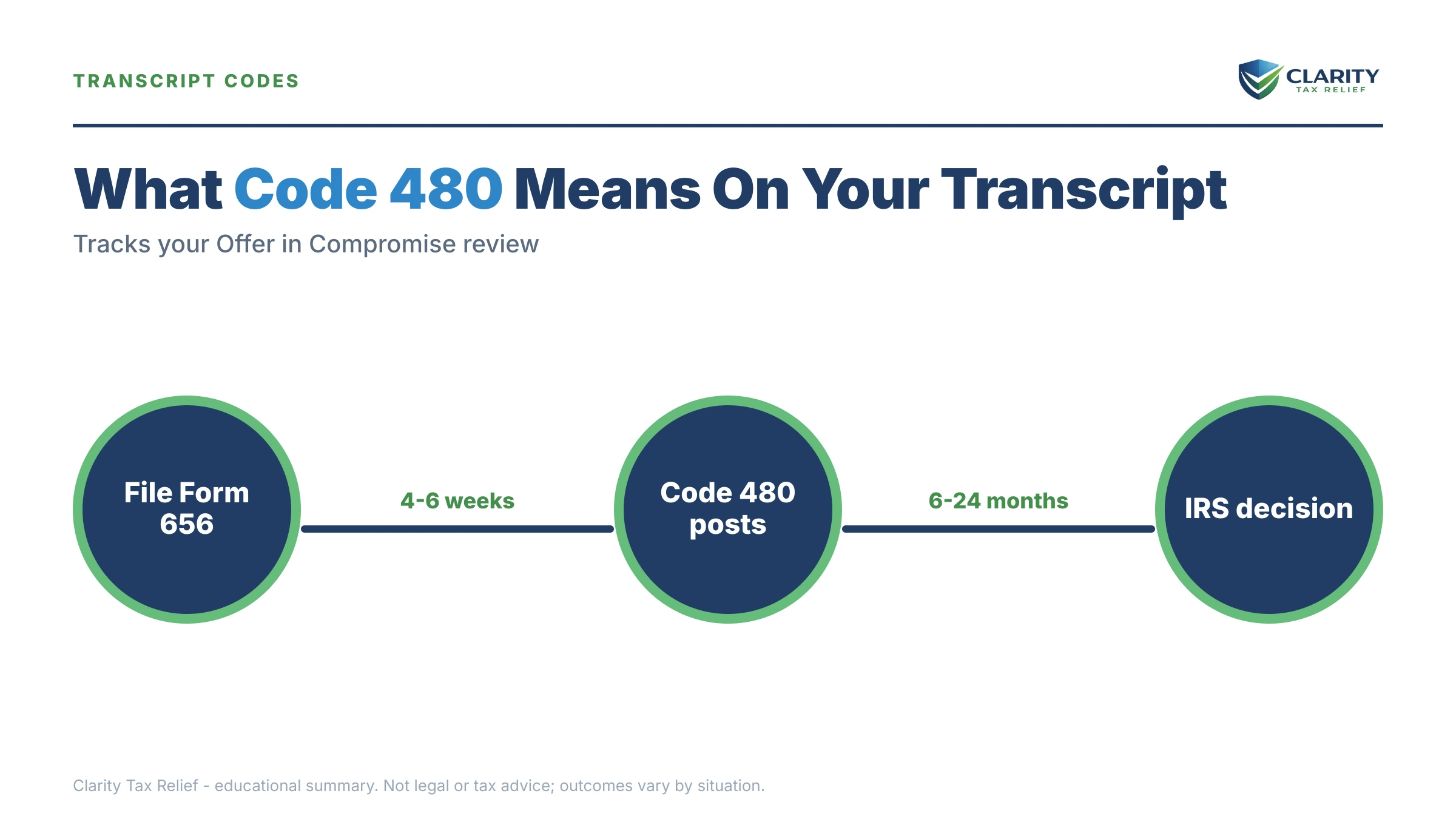
What the date next to code 480 controls
The date beside code 480 marks when the IRS treated your offer as pending — and it starts both the two-year decision clock and the pause on the 10-year collection statute. Under federal law, an offer the IRS doesn't decide within 2 years of its received date is deemed accepted, which is why that date is worth writing down the day you see it.
The same period works against you on the back end. Your 10-year collection window (the CSED) stops running while the offer is pending, for 30 days after a rejection, and through any appeal. All of that time is tacked onto the end of the IRS's collection period — one of several events covered in what extends the IRS collection statute. A pending offer is never "free time"; it's borrowed time the IRS gets back if the offer fails.
One caution: the 480 posting date can differ from the day you mailed the package by several weeks. The deemed-acceptance clock runs from the IRS received date on your offer, so keep your certified-mail receipt with the Form 656 copy.
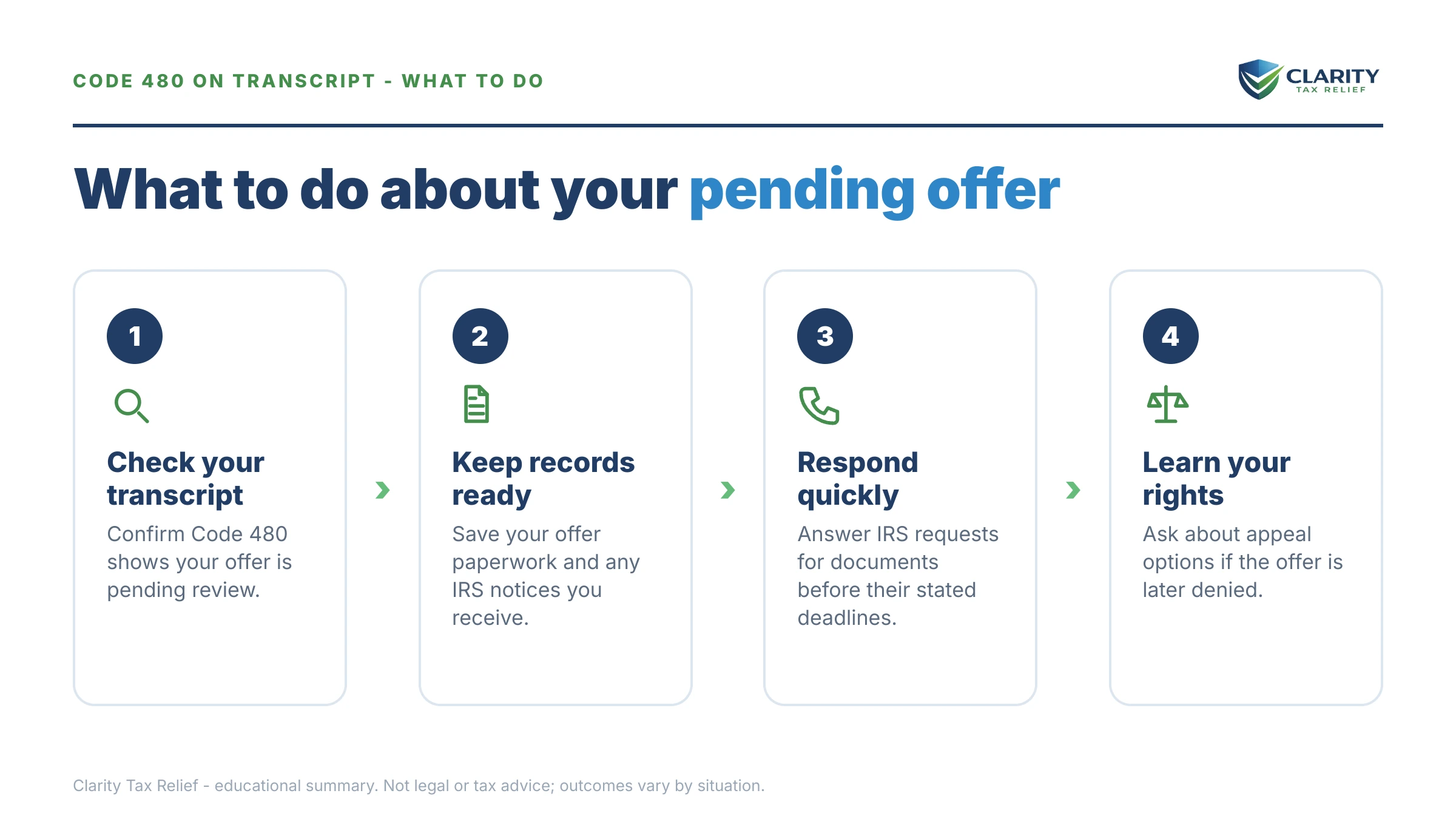
What code 480 pauses — and what keeps running
While code 480 is active, the IRS generally cannot levy your wages, bank accounts, or business receivables — the pending offer suspends levy action under IRC §6331(k). For a business owner, that means the accounts-receivable and operating-account levies that keep you up at night are off the table while the offer is in review, for 30 days after any rejection, and during a timely appeal.
Three things do not stop:
- Interest and the failure-to-pay penalty. Both accrue monthly on the full balance during review, posting as codes 196 and 276. If the offer is accepted and completed, they're compromised with the tax; if not, the balance is larger than when you filed.
- Refund offsets. An offset is not a levy, so the IRS can still keep refunds and apply them to the debt while the offer pends — details in will the IRS keep my refund after an offer in compromise.
- Lien filings. A pending offer does not prevent the IRS from filing a Notice of Federal Tax Lien to protect its claim, though many offer files move through without one.
And the pause runs both directions: while your offer pends, you must stay perfectly current — every return filed on time, every quarterly estimate paid, every payroll deposit made. Falling behind on current-year taxes is the fastest way to lose a pending offer.
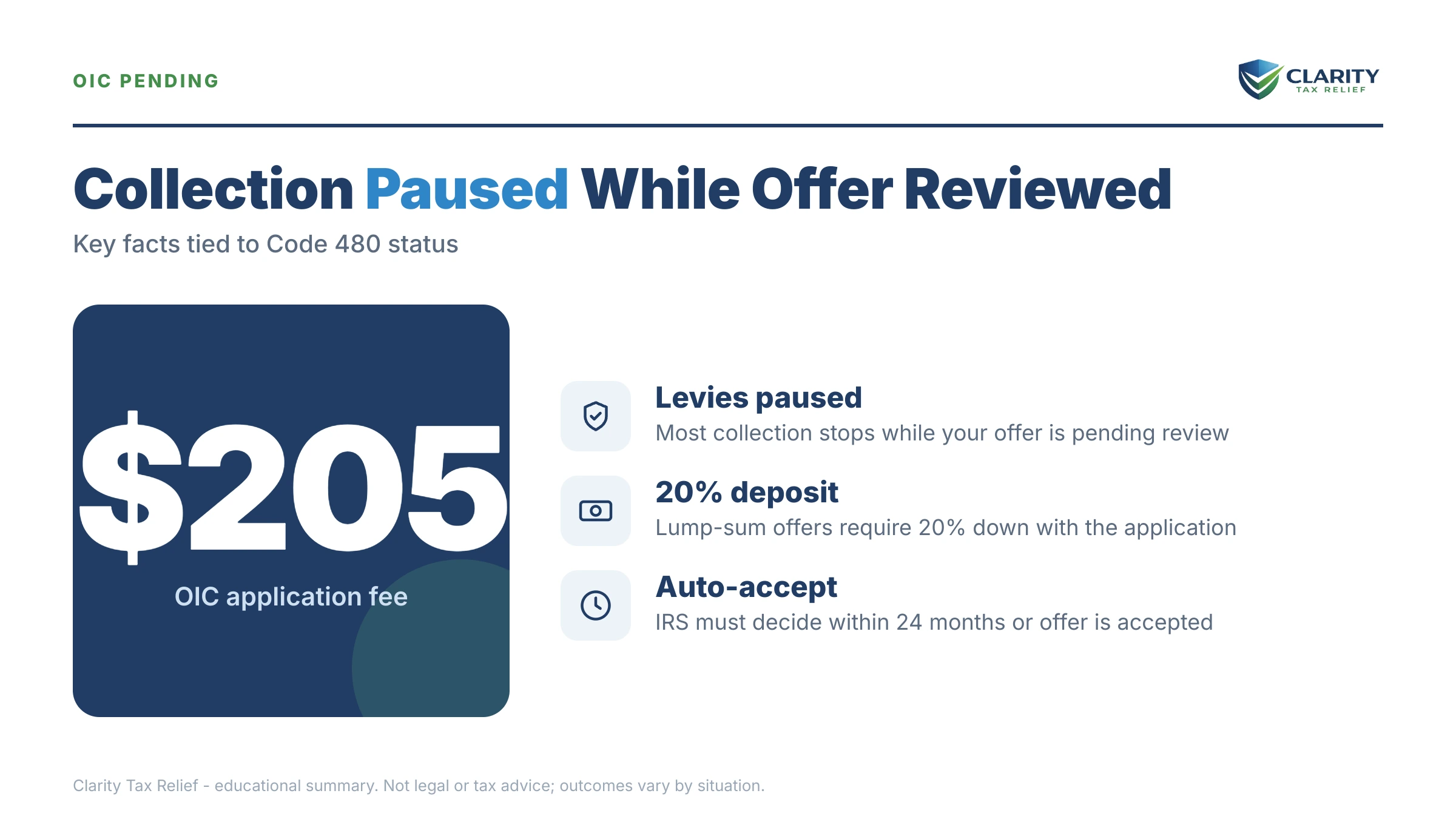
Say you owe $13,600: the pending-offer math
This is a hypothetical to show the arithmetic. Say you run a small shop with two part-time employees and owe $13,600 in personal income tax from a strong year that a slow one followed. Your offer amount is driven by Reasonable Collection Potential (RCP): net equity in assets plus your monthly disposable income multiplied out — the full method is in our guide to reasonable collection potential, and you can estimate your own figure with our Offer in Compromise Calculator.
Suppose your aging work van and equipment net $1,900 in quick-sale equity after loans, and after IRS allowable expenses your monthly disposable income is $180. On a lump-sum offer, RCP is:
$1,900 + ($180 × 12) = $1,900 + $2,160 = $4,060.
Filing that offer costs the $205 fee plus a 20% down payment of $812 — about $1,017 out the door, none of it refundable if the offer fails. Now the risk side: if the examiner disallows one business expense and recalculates your disposable income at $420, RCP becomes $1,900 + ($420 × 12) = $6,940 — and your $4,060 offer gets rejected unless you raise it or win the expense dispute on appeal. That single line item is where most self-employed offers live or die; the specifics are in OIC self employed. Compare the fallback: a 72-month streamlined plan on $13,600 runs roughly $189/month before interest and penalties. The IRS accepted roughly 1 in 5 offers in FY2024, so the fallback matters.
One payroll-specific warning: if any of your debt is unpaid 941 trust-fund tax rather than income tax, the rules tighten sharply — you must be current on deposits for a set run of quarters before the IRS will even consider it, and acceptance is rare. That path is covered separately in business offer in compromise payroll.
What happens if you break the rules while code 480 is pending
A pending offer dies from neglect in a predictable sequence — and the reader most at risk is exactly the busy owner juggling deposits, estimates, and offer payments at once:
- You miss an obligation — a monthly periodic offer payment, a quarterly estimate, a payroll deposit, or a return deadline. The offer examiner typically sends a letter demanding you cure it by a printed date.
- You don't cure it in time — the IRS returns the offer. A returned offer carries no appeal rights, and your fee and payments are not refunded. Code 481 posts on the transcript.
- Levy protection ends — collection resumes exactly where it paused, often at the notice stage you'd already reached before filing, so enforcement letters can restart quickly rather than from the beginning.
- The IRS has more time than before — the CSED restarts with the entire pending period plus 30 days added back, so the government's collection window is now longer than the day you mailed the offer.
There's a longer-term cost too: an offer returned for non-compliance makes the next examiner read your next Form 656 skeptically. Protecting the pending offer is cheaper than rebuilding after a return.
Code 480 pending — and payroll to keep current?
A pending offer survives only if every deposit, estimate, and offer payment lands on time while the IRS dissects your numbers. Get a free review of your pending offer and your compliance posture from an experienced tax professional before an examiner letter forces the issue.
If the offer doesn't survive: your options and eligibility
A failed offer is a setback, not a dead end — and on a $13,600 balance, every option below except the guaranteed-tier plan is realistically on the table. How long the review itself runs is covered in how long does an offer in compromise take; here's what comes after a bad answer:
| Option | Who it fits | Key facts |
|---|---|---|
| Appeal the rejection (Form 13711 OIC appeal) | Rejected offers only — returned offers can't be appealed | File within 30 days of the rejection letter; levy protection continues through the appeal |
| Fix and refile the offer | You can document a lower RCP than the examiner calculated, or your finances worsened | New Form 656 and fee (waived with low-income certification); the CSED pauses again while it pends |
| Short-term payment plan | You can pay in full within 180 days | $0 setup fee; interest and penalties continue until paid |
| Streamlined installment agreement | Balance of $50,000 or less | Up to 72 months, set up online; roughly $189/month on $13,600 before accruals |
| Partial-pay installment agreement | You can pay something monthly, but the balance won't clear before the CSED | Requires financial disclosure; the IRS re-reviews it periodically |
| Currently Not Collectible | Any payment would leave you unable to cover basic living and operating expenses | Collection pauses; the debt remains and interest keeps accruing |
Which door you take depends on why the offer failed. A rejection over one disputed expense is often worth appealing; a return for missed compliance usually means stabilizing on a payment plan first and refiling later from solid ground.
How to respond to code 480, step by step
- Confirm the code 480 date matches your offer timeline — pull your account transcript, find the 480 line, and note the posting date; it marks the start of the 2-year decision clock and the CSED pause.
- Calendar every obligation — periodic offer payments, quarterly estimated taxes, and payroll deposit dates — with reminders set a few days ahead, because one missed item can get the offer returned.
- Watch the mail for the offer examiner — requests for updated bank statements or profit-and-loss records carry short reply windows, so respond by the date printed on each letter.
- File every return on time during the review — a single late return lets the IRS return the offer without appeal rights.
- Plan for the decision — know your 30-day appeal window through Form 13711 if the offer is rejected, and have a fallback payment plan ready if the offer fails.
When you can handle code 480 yourself
Many pending offers need discipline, not representation. If your offer is a lump-sum with simple W-2 or single-Schedule-C finances, you've already paid the 20% down, and staying current on taxes is routine for you, monitoring code 480 yourself is reasonable: check the transcript monthly, answer examiner letters promptly, and keep records of every payment.
Experienced help changes outcomes in four situations: when payroll or trust-fund debt is mixed into the balance, when the examiner disputes your business expenses or asset values (the RCP fight in the worked example above), when a rejection lands and the 30-day appeal clock starts, and when multiple tax years or an unfiled return threatens processability. In those cases the difference between a defended number and an undefended one is often the difference between acceptance and code 481.
For self-checking, the primary sources are the IRS's own Offer in Compromise page, and — if your offer sits undecided far past reason or the IRS mishandles your payments — the Taxpayer Advocate Service, which exists for exactly that kind of stall. Note that IRS staffing fell sharply in 2025, so offer reviews and phone access are slower in 2026 — but the automated compliance checks that can return your offer never slowed down.
Terms on your transcript, decoded
- Pending / processable: the IRS confirmed your offer met the filing requirements and is in the review queue — not a judgment on whether it will be accepted.
- Reasonable Collection Potential (RCP): the IRS's math for the most it could ever collect from you — asset equity plus a multiple of your monthly disposable income.
- CSED suspension: the pause on the 10-year collection deadline while your offer pends, plus 30 days after rejection and any appeal time — all added back later.
- Deemed acceptance: the rule that an offer undecided 2 years after its received date is accepted automatically by law.
- Returned vs. rejected: returned means a rule was broken (no appeal — fix and refile); rejected means the IRS disagreed with your numbers (30-day appeal rights).
- Periodic-payment offer: an offer paid in monthly installments — with required payments continuing every month of the review unless you're low-income certified.
Code 480 questions, answered
Does code 480 mean my offer in compromise was accepted?
No. Code 480 only means the IRS screened your offer, found it processable, and placed your account in pending-offer status. Acceptance is a separate decision that arrives by letter, usually many months later. Until that letter comes, the offer can still be rejected, returned, or withdrawn — which posts as code 481 or code 482. Treat 480 as "under review," not "approved."
How long does code 480 stay on my transcript?
Code 480 stays active until the IRS decides your offer, and the line remains visible afterward as part of your account history. Reviews often take the better part of a year, and offers tied to business income usually take longer because the financial review is heavier. By law, if the IRS doesn't decide within 2 years of the date it received your offer, the offer is automatically accepted.
Can the IRS levy me while code 480 is on my account?
Generally no. While an offer is pending, the IRS is barred from levying your wages, bank accounts, or receivables, and that protection continues for 30 days after a rejection and through any timely appeal. Exceptions exist — the IRS can still levy if it decides the offer was filed only to delay collection, and refund offsets are not levies, so refunds can still be taken.
Does code 480 stop the 10-year collection statute?
It pauses it. The 10-year collection statute (CSED) stops running while the offer is pending, plus 30 days after a rejection, plus the time any appeal is under review. That time is added back to the end of the collection period, so a failed offer leaves the IRS with more time to collect, not less. Factor that in before filing an offer as a stalling tactic.
Do I keep making payments while my offer is pending?
If you chose the periodic-payment option on Form 656, yes — you must keep making the proposed monthly payments during the entire review, and missing one lets the IRS return the offer. Lump-sum offers require only the 20% down payment with filing. If you qualify for low-income certification (AGI at or below 250% of the federal poverty level), the fee, the down payment, and payments during review are all waived.
What does code 481 or 482 after code 480 mean?
Code 481 means the IRS rejected or returned your offer; code 482 means it was withdrawn or terminated. The difference matters: a rejection comes with 30-day appeal rights through Form 13711, while a returned offer has no appeal — you fix the problem and file a new Form 656. Either way, the levy protection ends and collection can resume.
Will the IRS keep my tax refund while my offer is pending?
Generally yes. A pending offer does not protect refunds — the IRS can offset any refund you're due and apply it to the old balance while code 480 is on the account, and that money does not count toward your offer amount. If you're expecting a meaningful refund, plan around losing it, or adjust your withholding and estimated payments so you aren't overpaying during the review.
Does code 480 stop interest and penalties from growing?
No. Interest keeps accruing on the unpaid balance the entire time your offer is pending, and the monthly failure-to-pay penalty continues as well — you'll see them post as codes 196 and 276. If the offer is accepted and you complete its terms, those accruals are compromised along with the tax. If the offer fails, you owe the larger balance.
Your next 24 hours
- Find the date next to code 480 on your account transcript and write it down — it anchors the 2-year decision clock and marks when your levy protection began.
- Gather your offer file: your Form 656 copy, the certified-mail receipt, proof of the fee and any down payment, and evidence you're current on this year's estimates and payroll deposits.
- Get a free pending-offer review — the form at claritytaxrelief.com/#consult or (888) 825-7779. Interest and penalties are accruing on the full balance while the IRS reviews your offer, and an examiner letter with a short reply window can arrive any week — knowing your compliance posture now beats scrambling then.
This guide is general information, not tax or legal advice for your specific situation. Eligibility for IRS programs depends on individual facts and circumstances; no outcome is guaranteed.