
IRS Transcript Codes
Code 482 on Your IRS Transcript: Offer in Compromise Withdrawn or Returned (2026)
The short answer: code 482 on an IRS transcript means your offer in compromise closed without a decision — you withdrew it, or the IRS returned it as unprocessable. Unlike a code 481 rejection, there are no appeal rights, but no waiting period either: fix the reason and resubmit. Collection and the 10-year clock resume from the 482 date.
You submitted an offer, watched code 480 sit on your transcript for months, and made your payments while the review dragged on. Now a code 482 transcript entry has closed the whole thing out — no acceptance, no rejection letter with appeal rights, just a closed file. The good news: a 482 is usually a paperwork or compliance problem, not a verdict that your offer was too low, and it's often the fastest transcript code on this site to fix.
Three facts make 482 different from every neighboring code. First, it means the IRS never ruled on your offer amount — the file closed for a procedural reason. Second, there is no appeal, because there's no decision to appeal — but there's also no cooling-off period before you resubmit. Third, the date next to the 482 marks the moment the legal hold on collection ended and the 10-year collection clock started running again.
The image below shows exactly where code 482 sits on a real account transcript and how to read the 480, 971, and payment entries around it — worth a look before you call anyone, because the sequence of those codes tells you which version of 482 you have.
⏱ The clock that matters: code 482 sets no printed deadline — but it ends the hold on IRS collection. From the 482 date, levies become legally possible again, the paused 10-year collection statute resumes, and the interest and failure-to-pay penalty that accrued through the entire review are now part of your balance. Every month without a plan in place adds more.
What a code 482 transcript entry means
IRS transcript code 482 means your offer in compromise was withdrawn or returned — closed with no decision on whether your offer amount was acceptable. It's one of a four-code family the IRS uses to track offers on your account. When your Form 656 is accepted for processing, code 480 posts and freezes collection. If the IRS evaluates the offer and says no, code 481 posts. If the offer never reaches a decision — you pulled it back, or the IRS kicked it out for a procedural failure — you get 482. (A rare code 483 simply corrects a 480 posted in error.)
That distinction between returned and rejected is the single most important thing on this page. A rejection means an offer examiner ran the numbers on your income and assets and decided your offer was too low — and the law gives you 30 days to appeal that decision. A return means nobody ever ran those numbers. Your offer math might have been perfectly fine; the file closed anyway. If you're not sure how to read the codes and dates around the 482 line, our guide to how to read an IRS account transcript walks through the column layout in two minutes.
| Code | What it means | What to do |
|---|---|---|
| 480 | Offer accepted for processing; collection and the 10-year clock are paused | Stay current on filings and estimated payments — slipping here is what creates a 482 |
| 481 | Offer rejected on the merits — the IRS decided the amount was too low | You have 30 days to appeal with Form 13711; don't let the window pass |
| 482 | Offer withdrawn by you or returned as unprocessable — no decision made | No appeal exists; find the return reason, fix it, resubmit or pivot to another option |
| 483 | Correction of a code 480 posted in error | Usually nothing — confirm your offer status by calling the number on your last offer letter |
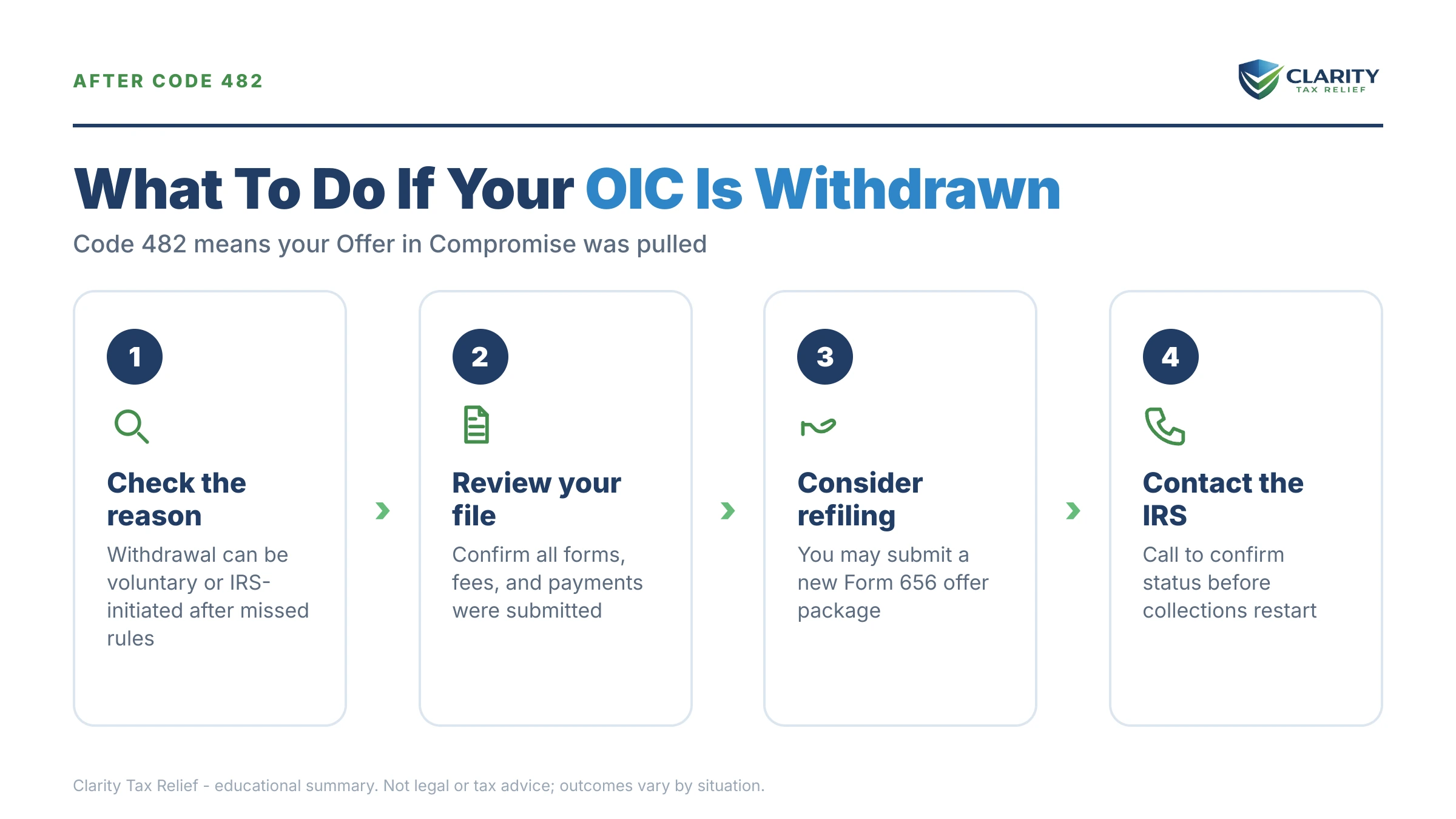
Why code 482 posted: withdrawn vs. returned
Most 482s are returns, and most returns happen because something on your side of the file went stale during the months of review. The IRS closes an offer without deciding it when:
- You missed a periodic payment. If you chose the periodic-payment option, you must keep sending installments while the offer is under review. Miss one without qualifying for the low-income waiver, and the offer can be returned.
- You fell out of filing or payment compliance. A missed current-year estimated tax payment, a late-filed return, or (for business owners) a missed federal tax deposit during review is the most common return trigger we see.
- You didn't respond to a document request in time. Offer examiners send requests with firm reply deadlines; silence past the deadline closes the file.
- You filed bankruptcy while the offer was pending. Bankruptcy and an OIC can't run at the same time — the offer gets returned.
- The IRS concluded the offer was filed solely to delay collection. Less common, but it happens with offers filed days before a scheduled levy.
A withdrawal, by contrast, is your move. People withdraw when a job change or windfall wrecks the offer math, when they decide a payment plan fits better, or on professional advice that the offer is headed for rejection and the resubmission should be rebuilt from scratch. Either way, the transcript shows the same 482 — the letter the IRS mailed you (often flagged by a code 971 notice entry near the 482) tells you which version you have and why.
| How the offer closed | Transcript code | Your rights | Your practical window |
|---|---|---|---|
| Rejected on the merits | 481 | 30 days to appeal via Form 13711 to the IRS Independent Office of Appeals | Firm 30-day deadline printed on the rejection letter |
| Returned as unprocessable | 482 | No appeal — but unrestricted right to resubmit a corrected offer | No deadline, but collection can resume any time after the 482 date |
| Withdrawn by you | 482 | No appeal needed — you ended it; resubmit whenever the math works | Same: the sooner a new offer or plan is pending, the sooner protection returns |
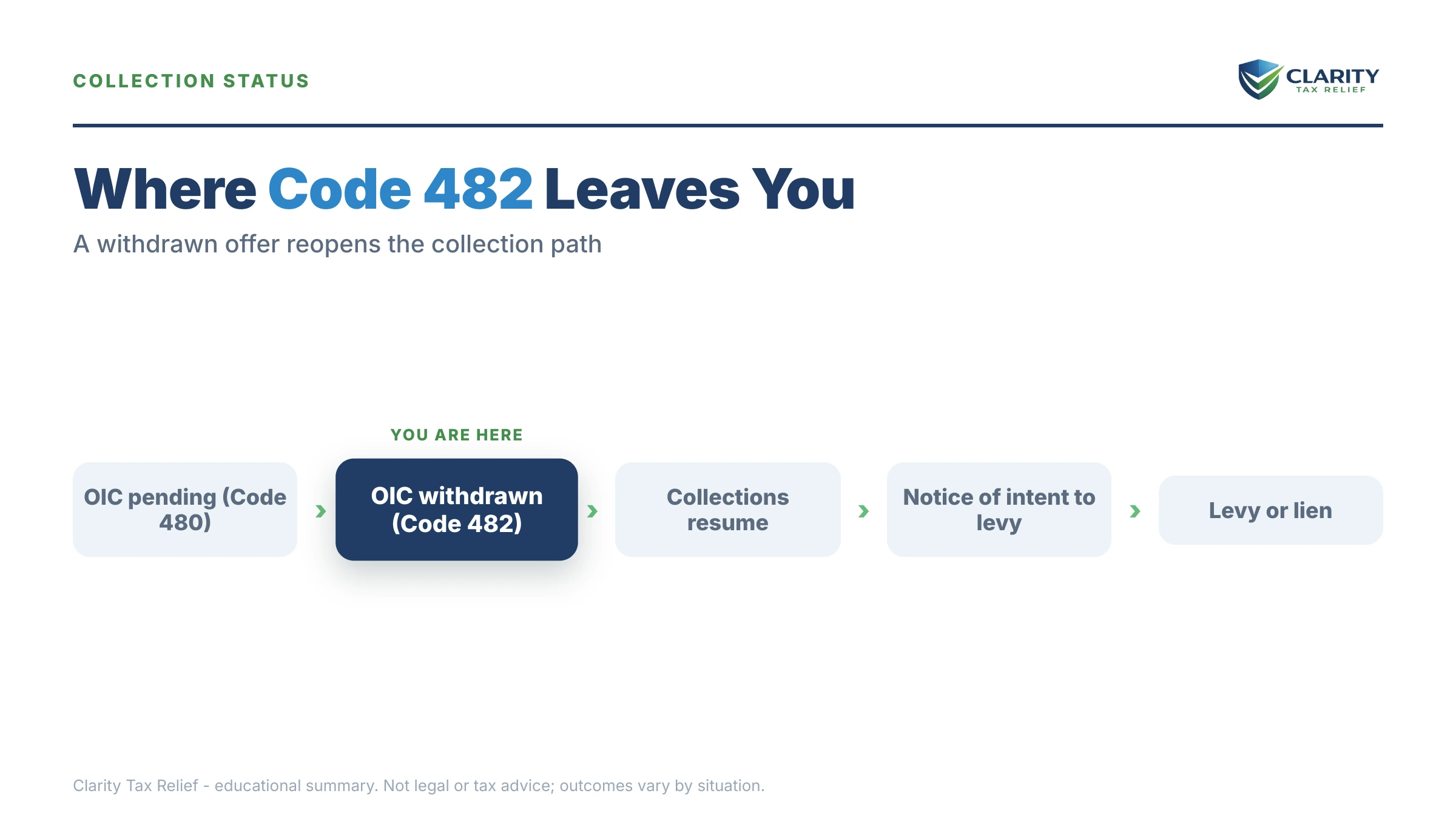
What happens after code 482 if you do nothing
Once code 482 posts, your account leaves the protected offer status and re-enters the collection stream exactly where it left off. The sequence from here is automated, and in 2026 — with the IRS workforce down roughly 27% but its collection systems fully staffed by software — the machine escalates whether or not a human ever reviews your file:
- The legal hold on levies ends. Levies are generally barred while an offer is pending; the 482 date is when that protection stops.
- The review-period accruals hit your balance. Interest (posted as code 196) and the 0.5%-per-month failure-to-pay penalty (posted as code 276) ran through the entire review and now compound on a larger balance.
- Collection notices resume where they paused. If you were at the reminder stage before the offer, reminders resume; if you were further along, you rejoin further along.
- If a final notice already went out, no new warning is required. An LT11 or Letter 1058 issued before your offer generally still counts — the IRS can move to wage or bank levies without re-sending it.
- Lien filing stays on the table. A Notice of Federal Tax Lien can be filed — or, if one was already filed, it simply remains — attaching to property you own or acquire.
One more quiet consequence: the 10-year collection statute (CSED) was suspended the whole time code 480 was active. The 482 restarts the clock, and the suspended months get tacked onto the end — so an offer that dies procedurally hands the IRS extra collection time and gives you nothing back for it.
Code 482 just posted on your transcript?
The collection hold is off and your balance grew all through the review. Get your transcript and return letter reviewed free — an experienced tax professional will tell you whether to resubmit the offer or pivot, before the notices restart. Call (888) 825-7779 or use the 2-minute form.
Your options after a withdrawn or returned offer
A returned offer is not a dead end — it's an unanswered question, and you get to ask it again. Which path fits depends on why the 482 posted and what your finances look like now:
- Fix the defect and resubmit. There is no waiting period after a return or withdrawal. File a fresh Form 656 with updated financials, a new $205 fee, and a new 20% down payment for a lump-sum offer — all three waived if your AGI is at or below 250% of the federal poverty level. Before you spend that money, sanity-check your Reasonable Collection Potential — the net-equity-plus-future-income figure the IRS compares your offer against. You can estimate your own offer with our Offer in Compromise Calculator before deciding whether resubmission is worth it. Be honest about odds: the IRS accepted roughly 1 in 5 offers in FY2024, and a resubmission only beats those odds if the original problem is genuinely fixed. Our guide to resubmitting an offer after a denial covers what to change the second time.
- Pivot to an installment agreement. If your offer died because the compliance burden was unsustainable, a monthly plan may fit better. Balances of $50,000 or less can qualify for a streamlined plan online over up to 72 months; above that, the IRS wants financial disclosure — see payment plans over $50,000 for how that review works. Interest and penalties keep accruing on any plan, but enforcement stops.
- Currently Not Collectible status. If paying anything would leave you unable to cover basic living expenses, collection can be paused entirely. The debt remains and interest still runs, but levies stop — and the CSED keeps running, which sometimes makes CNC smarter than a new offer for older debts.
- Penalty relief. The failure-to-pay penalty that stacked up during review may be removable — through first-time abatement if your prior three years are clean, through reasonable cause, or under the new Automatic Exemption from Penalty (AEP) rolling out starting summer 2026, which applies qualifying relief without a request.
- Appeal — only if your code is actually 481. People regularly misread the two codes. If your transcript shows 481, not 482, you have a 30-day appeal right using Form 13711 — check the code before assuming you have no recourse.
What code 482 looks like in dollars: a $68,500 example
Say you and your spouse filed jointly and owe $68,500 across two tax years. You submitted a lump-sum offer of $12,000 — paying the $205 fee and a $2,400 down payment (20% of the offer) — and the offer sat under review for nine months. During that stretch, one quarterly estimated payment on your side 1099 income slipped through the cracks. The offer comes back returned, and code 482 posts. Here's the arithmetic, all figures rounded and hypothetical:
- Failure-to-pay penalty during review: roughly 0.5% per month × 9 months × $68,500 ≈ $3,080 added.
- Interest during review: at recent rates, roughly another $3,500–$3,700 over nine months, compounding daily.
- Credits for what you paid: the $2,400 down payment and (typically) the $205 fee aren't refunded, but they're applied to the balance ≈ −$2,605.
- New balance: roughly $68,500 + $3,080 + $3,600 − $2,605 ≈ $72,600 — about $4,100 more than when the offer went in, with nothing decided.
From here the couple has two realistic moves. Catch up the missed estimate, document current-year compliance, and resubmit the offer — the $12,000 figure gets re-run against updated income, so it may need to change. Or pivot to a payment plan: at roughly $72,600 they're above the $50,000 streamlined line, so they either submit financials on Form 433-F or pay the balance below $50,000 to qualify for a streamlined agreement — which at 72 months pencils out to roughly $695/month on a $50,000 balance before ongoing interest. Whether the down payment they already sent was recoverable is a common question; the honest answer lives in what happens to your OIC down payment.
How to respond to code 482, step by step
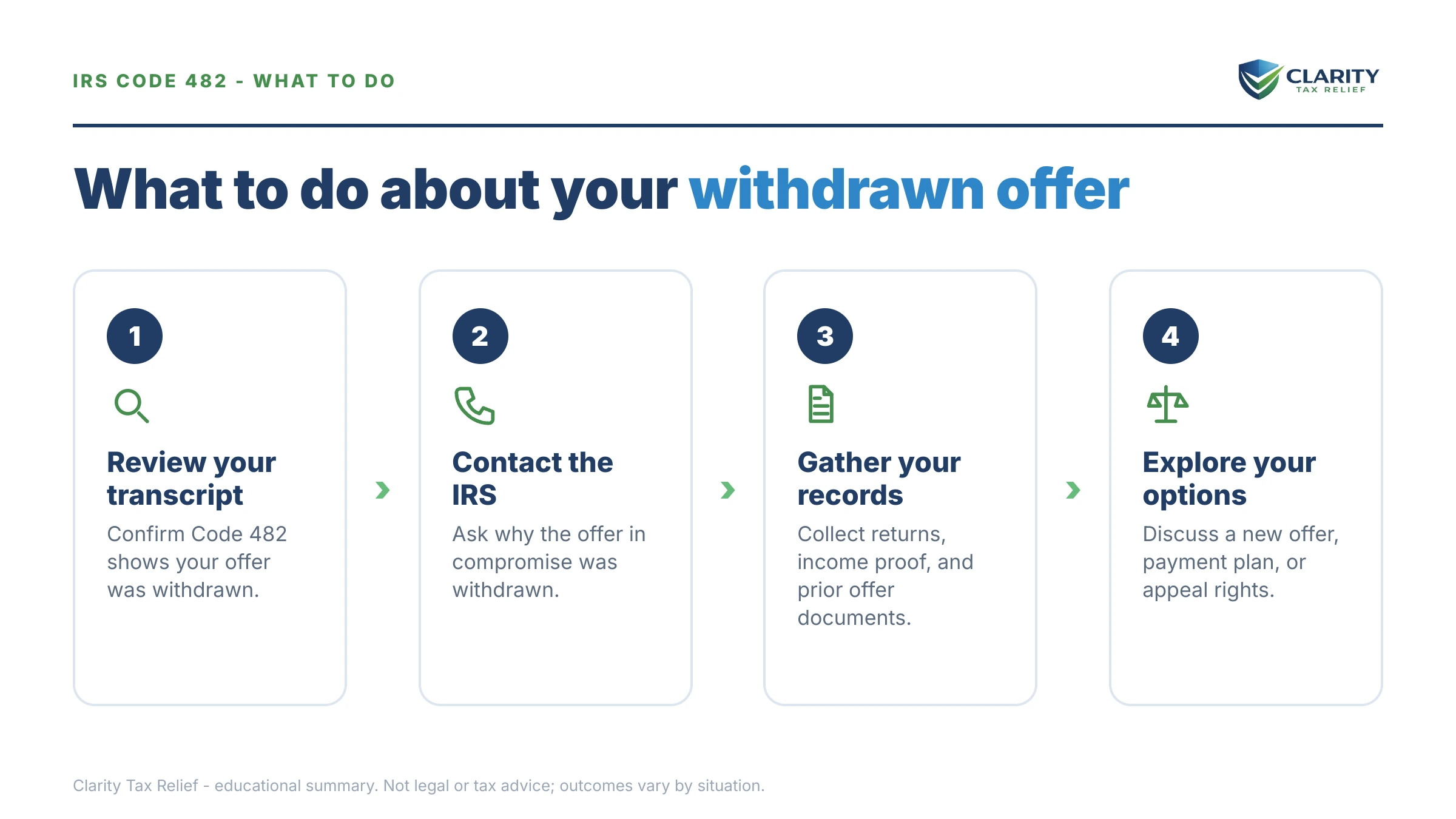
- Confirm the code 482 date. Pull your account transcript, find the 482 line, and note the date — that's when the collection hold ended and your response window effectively opened.
- Find out exactly why the offer closed. Read the return letter the IRS mailed (often flagged by a code 971 on the same transcript), or call the number on it — the stated reason dictates everything that follows.
- Get back into compliance. File any missing returns and catch up current-year estimated payments or withholding — no resolution option works while you're out of compliance.
- Choose your path. Resubmit a corrected Form 656 if the offer math still works, or pivot to an installment agreement or Currently Not Collectible status if it doesn't.
- Get something pending before collection resumes. A new offer or a proposed payment plan on file is what keeps levies off your accounts while the details get worked out.
When you can handle this yourself
Plenty of code 482 situations don't need professional help. If the return letter names a simple, fixable defect — one missed estimated payment, a document you forgot to send, a return that's since been filed — and your finances haven't changed since the first submission, you can catch up, re-copy your original offer package with fresh dates, and resubmit on your own. Likewise, if you've decided the offer route isn't for you and your balance is under $50,000, setting up a streamlined payment plan online takes an evening, not an engagement letter.
Experienced help changes outcomes in the harder versions: when a final notice of intent to levy was already issued before your offer and collection can restart without warning; when the return reason is murky or you suspect the IRS closed the file in error; when the resubmission requires re-running Reasonable Collection Potential around new income, a spouse's separate assets, or business cash flow; and when multiple years or unfiled returns sit underneath the offer. A second offer that dies the same way as the first costs another fee, another down payment, and another stretch of penalty accrual — the review is where that money gets protected.
Terms on your transcript, decoded
- Returned offer — an offer the IRS closed for a procedural reason without ever evaluating the amount; no appeal rights, unlimited resubmission rights.
- Rejected offer — a decision on the merits that your offer was too low; posts as code 481 and carries a 30-day appeal window.
- Withdrawn offer — an offer you pulled back yourself before a decision; also posts as 482.
- Code 480 — the "offer pending" marker that paused collection and the statute clock while your offer was under review.
- CSED (Collection Statute Expiration Date) — the end of the IRS's 10-year window to collect; suspended while an offer is pending and extended by the suspended time.
- RCP (Reasonable Collection Potential) — the IRS's calculation of your asset equity plus future income; the number any resubmitted offer must realistically match.
Code 482 transcript questions, answered
What does code 482 mean on an IRS transcript?
Code 482 means your offer in compromise closed without a decision on the merits — either you withdrew it or the IRS returned it as unprocessable. The date next to the code marks when the offer closed, which is also when the hold on collection ended and the 10-year collection clock resumed. It replaces the code 480 pending status that posted when your offer was accepted for processing.
Is code 482 the same as having my offer rejected?
No — a rejection posts as code 481, not 482, and the difference matters. A rejection is a decision on the merits and comes with a 30-day right to appeal using Form 13711. A returned or withdrawn offer (code 482) was never decided, so there is nothing to appeal — but there is also no waiting period, and you can resubmit a corrected offer as soon as you fix the reason it closed.
Do I get my $205 fee and 20% payment back after code 482?
Generally no — payments submitted with an offer are not refunded, but they are not lost either: the IRS applies them to your tax balance. If your offer was returned before it was ever accepted for processing, the $205 application fee is typically sent back; once processed, the fee and your 20% down payment stay with the IRS and reduce what you owe. Taxpayers with low-income certification (AGI at or below 250% of the poverty level) owe neither the fee nor the down payment in the first place.
Can I submit a new offer in compromise after code 482?
Yes, and there is no mandatory waiting period after a return or withdrawal. You file a fresh Form 656 with a new application fee and down payment (unless you qualify for low-income certification), and the new offer gets its own code 480 when accepted for processing. The key is fixing the reason the first offer closed — a resubmission with the same defect will be returned again.
Why would the IRS return an offer instead of rejecting it?
A return means the IRS never evaluated whether your offer amount was enough — it closed the file for a procedural reason. Common triggers are missed periodic payments during review, falling behind on required tax filings or current-year estimated payments, not responding to a request for documents by the deadline, or filing bankruptcy while the offer was pending. A rejection, by contrast, means the IRS did the math and decided your offer was too low.
Does code 482 restart the 10-year collection statute?
It doesn't reset the clock, but it restarts it. The 10-year collection statute (CSED) is suspended while an offer is pending — that suspension began when code 480 posted and ends around the code 482 date. The paused months are added to the end of your original deadline, so the IRS gets more total time to collect, which is one reason a poorly planned offer can backfire.
Will the IRS levy me right after code 482 posts?
Not automatically, but the legal barrier is gone. Levies are generally prohibited while an offer is pending; once the offer closes, that protection ends. If the IRS already sent a final notice of intent to levy (LT11 or Letter 1058) before your offer, it generally does not have to send a new one — which is why getting a payment plan or new offer pending quickly matters most for people who were deep in the collection sequence.
Should I withdraw my offer instead of letting it be rejected?
Sometimes. Withdrawing makes sense when your finances have changed so much that the offer math no longer works, or when you've decided an installment agreement fits better and want to stop making offer payments toward a doomed application. The trade-off is that withdrawal gives up the appeal rights a formal rejection would carry, so never withdraw just because the examiner sounds skeptical — an appeal after rejection succeeds more often than people expect.
Your next 24 hours
- Find the 482 date on your transcript — and check whether a code 971 posted near it, which points to the letter explaining exactly why the offer closed.
- Gather three things: the IRS return or withdrawal letter, a copy of the offer package you originally submitted, and proof of your current-year payments and filings.
- Get a free case review — the collection hold is off and interest is compounding on a bigger balance than the one your offer was built on, so send us the letter and transcript through the 2-minute form or call (888) 825-7779 and we'll map resubmit-vs-pivot with you before the notices restart.
For primary-source reading, the IRS's own overview of the program lives at IRS.gov: Offer in Compromise, its plan thresholds and terms at IRS payment plans and installment agreements, and independent taxpayer-rights help at the Taxpayer Advocate Service.
This guide is general information, not tax or legal advice for your specific situation. Eligibility for IRS programs depends on individual facts and circumstances; no outcome is guaranteed.