
Offer in Compromise
OIC Rejected — Can I Reapply? How a Second Offer in Compromise Works in 2026
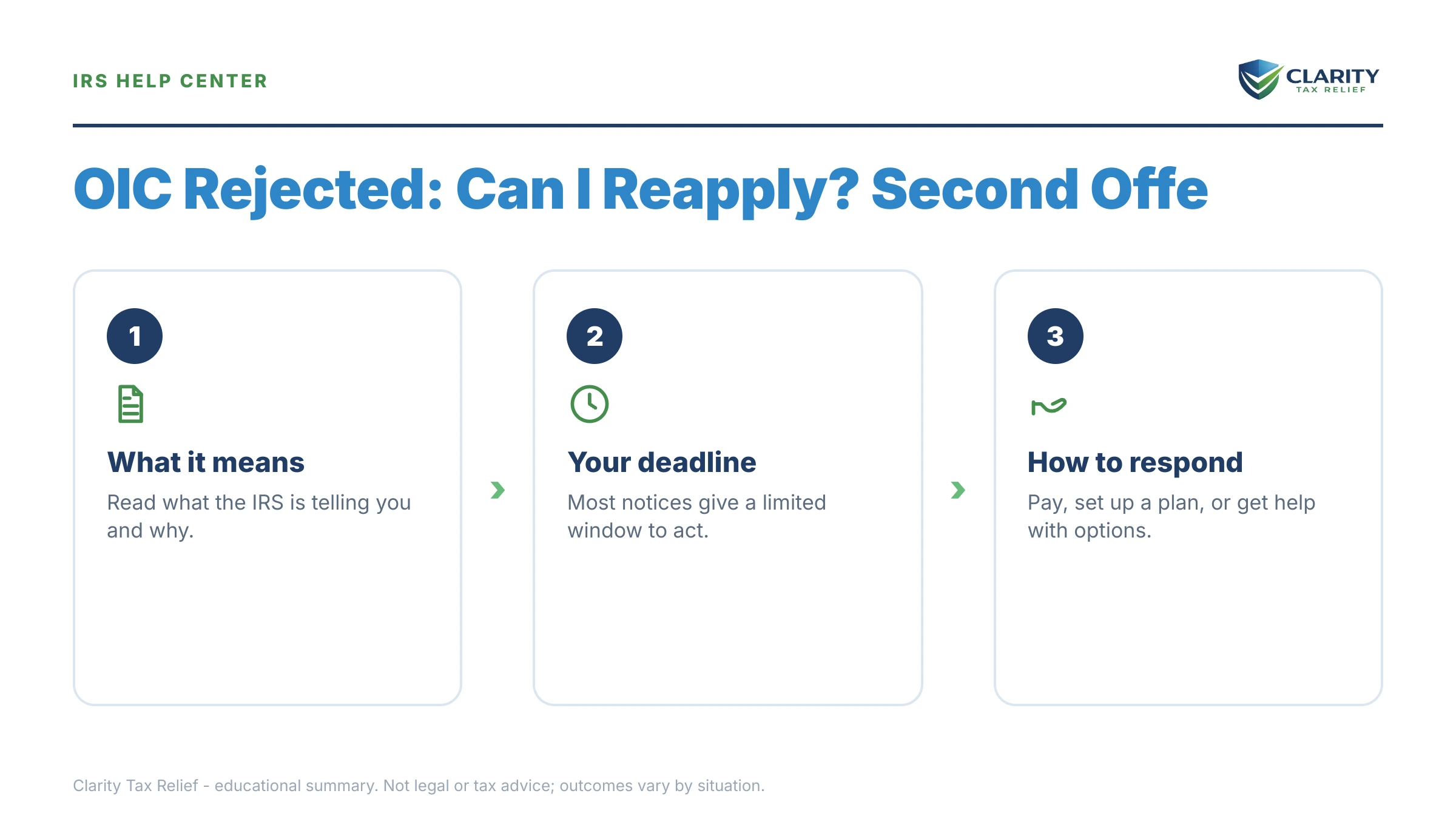
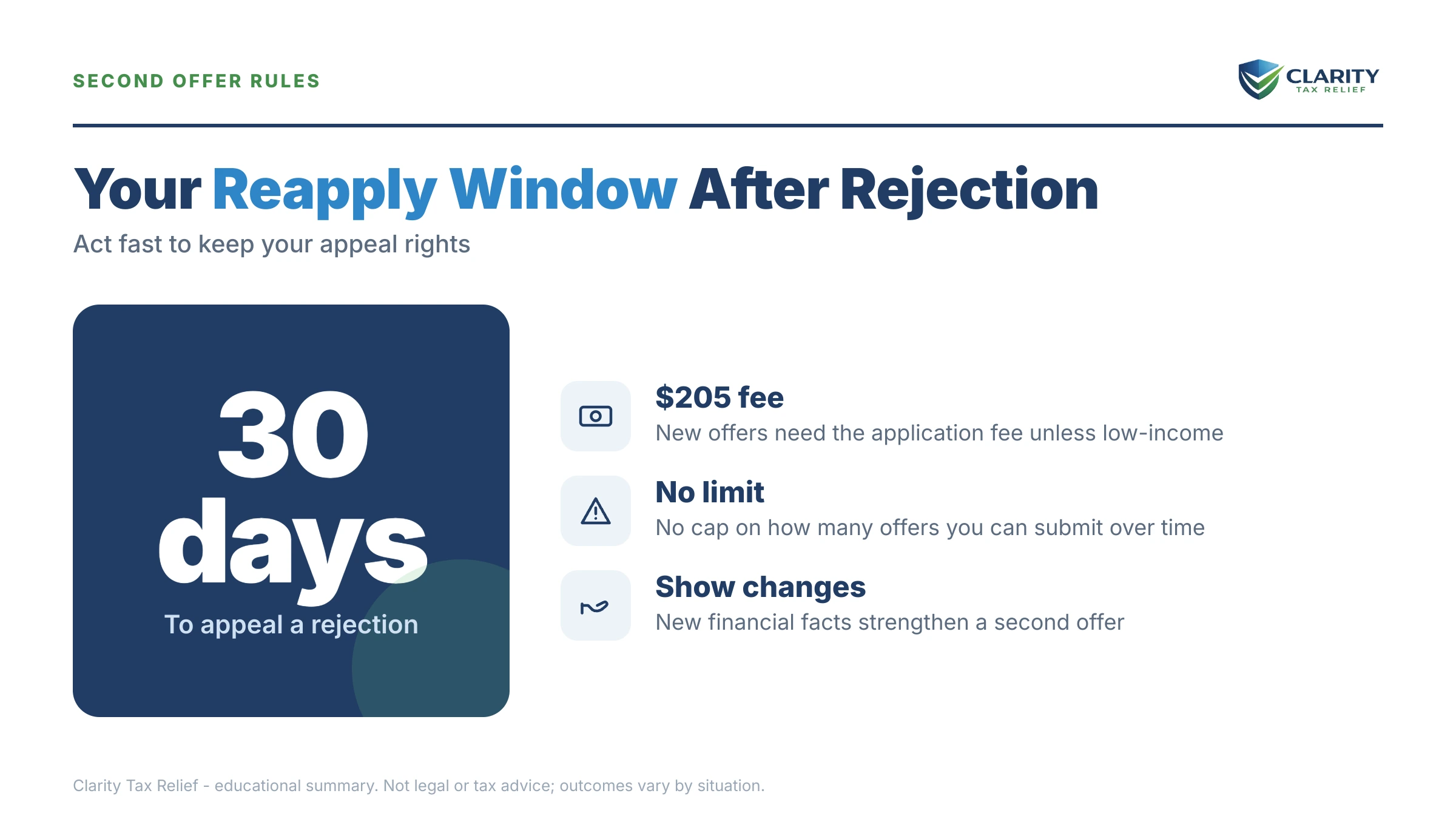
The short answer: yes — if your OIC was rejected, you can reapply. There is no waiting period and no limit on the number of offers you can file. A new offer means a new $205 fee and fresh financial forms — but you also have 30 days from the rejection letter to appeal instead.
You spent months on the first offer — the bank statements, the Form 433-A(OIC), the long wait — and the answer still came back no. That stings, but one rejection does not end the road. The IRS processes second offers all the time, and the letter in your hand tells you exactly what to fix.
The image below shows what an OIC rejection letter looks like and where to find the two numbers that decide your next move: the IRS's own figure for what it believes you can pay, and the date that starts your appeal clock.
⏱ Your deadline: you have 30 days from the date on your OIC rejection letter to appeal with Form 13711. Miss that window and the appeal right is gone for good — but the right to submit a new offer never expires.
Why your offer in compromise was rejected
The IRS accepted roughly 1 in 5 offers in FY2024, and nearly every rejection comes down to one number: the examiner calculated your Reasonable Collection Potential (RCP) as higher than the amount you offered. RCP is the IRS's estimate of everything it could collect from you — your asset equity plus your future monthly disposable income. (For the full mechanics of the program itself, see how an offer in compromise works.)
Your rejection letter states the IRS's RCP figure and how the examiner got there. For self-employed and gig applicants, the most common drivers are:
- Gross deposits counted as income. If business and personal money run through one account, the examiner may treat every deposit as income and allow only the expenses you can prove.
- Undocumented vehicle and business expenses. No mileage log, no receipts — no deduction from disposable income, even if the spending was real.
- Income averaged over a strong stretch. A few good months can inflate the "future income" side of the calculation if you didn't show the slow ones.
- Dissipated assets. Money you spent while the debt existed — a cashed-out retirement account, a sold vehicle — can be added back to your RCP as if you still had it.
- Expense standards. The IRS caps living expenses at its national and local standards; actual spending above those caps is often disallowed.
One critical check before anything else: read whether your letter says rejected or returned. A rejection is a decision on the merits, and it comes with appeal rights. A returned offer never got a decision — usually because of unfiled returns, missed estimated tax payments, or missing paperwork. If you applied with open unfiled years (a common trap when you haven't filed taxes in 3 years), you almost certainly got a return, not a rejection — and the fix is compliance, not better math.
What happens if you do nothing after the rejection
After an OIC rejection, the IRS resumes collection where it left off — it does not restart the notice sequence from the beginning. Here is the order of what follows:
- The 30-day appeal window runs. Collection generally stays on hold during this window, and through a timely-filed appeal.
- The window closes. Your account returns to active collection at whatever stage it had reached before the offer paused things.
- Balance-due notices resume — larger than before. Interest and the failure-to-pay penalty kept accruing through the entire offer review.
- Enforcement picks up where it stopped. If the IRS had already issued its final notice of intent to levy before your offer, it does not need to send a new one before levying wages or bank accounts.
- The 10-year collection clock restarts. Your pending offer (plus 30 days) paused the CSED. Once it resumes, the IRS knows it has extended time to collect — and its automated systems use it.
One more sunk cost to know: the $205 fee, your 20% down payment, and any periodic payments from the rejected offer are not refunded. They were applied to your tax balance — which helps, but they don't carry over as credit toward a second offer's required payments.
Your offer was rejected — the 30-day appeal clock is already running
Send us the rejection letter. An experienced tax professional will tell you — free — whether the IRS's RCP math is appealable, fixable with a second offer, or a sign to change strategy entirely, before the window closes.
OIC rejected — can I reapply, appeal, or choose another path?
You can reapply after an OIC rejection with no waiting period, appeal within 30 days for free, or pivot to a payment plan or hardship status — and the right choice depends entirely on why the first offer failed.
| Option | Cost to start | Timeline | Best when |
|---|---|---|---|
| Appeal (Form 13711) | $0 | Must file within 30 days of the rejection letter; Appeals review typically takes months | The IRS's math is wrong — a misvalued asset, a documented expense disallowed, income overstated |
| New offer (Form 656) | $205 fee + 20% of a lump-sum offer (both waived with low-income certification) | No waiting period to file; reviews commonly run many months; deemed accepted if no decision within 2 years | Your finances changed, or you can now document what the first package couldn't |
| Installment agreement | Setup fee varies; $0 for a short-term plan up to 180 days | Balances ≤ $50,000 can be set up online for up to 72 months, often same-day | The IRS's RCP is close to the full balance — settlement math simply doesn't work for you |
| Currently Not Collectible | $0 (requires a financial statement) | Lasts until your finances improve; IRS reviews periodically; interest still accrues | Paying anything would leave you unable to cover basic living expenses |
Appeal when you can point to a specific error in the examiner's calculation — our Form 13711 OIC appeal guide walks through the request itself, and the broader decision tree lives in OIC rejected — now what. Appeals go to the IRS Independent Office of Appeals, a separate body from the examiner who said no.
Reapply when the facts changed or your documentation was thin. A second offer that resubmits the same numbers gets the same answer; one that cures the stated deficiency is a genuinely new application. The most common fixable errors are cataloged in how to get an OIC accepted.
Pivot when the rejection revealed that settlement math will never favor you. An installment agreement in the meantime doesn't close the door — see can I apply for an OIC while on a payment plan. And if the debt is old, large, and paired with other unsecured debt, compare bankruptcy or offer in compromise before spending another year on offers.
Rebuilding the math: a worked second-offer example
A second offer succeeds when it answers the exact RCP finding that killed the first one — with documents, not explanations. RCP has two parts: what your assets are worth to the IRS, and your monthly income left over after allowable expenses, multiplied by 12 for a lump-sum offer. The full formula is broken down in our guide to Reasonable Collection Potential, and you can estimate your own figure with our Offer in Compromise Calculator.
Say you owe $68,500 across three years of gig income you've now filed. Your first offer was $8,000 — rejected, with the letter showing an RCP of $24,600. Here's how the examiner got there:
- Disposable income of $520/month (your gross app deposits, minus only the expenses you could prove) × 12 = $6,240 future income
- Car equity at full retail value: $14,000 − $5,600 loan = $8,400
- A $9,000 retirement cash-out from last year, treated as a dissipated asset and added back
- Savings of $960
- RCP: $6,240 + $8,400 + $9,000 + $960 = $24,600 — triple your $8,000 offer
Round two attacks each finding with paper. A reconstructed mileage log and a separated business bank account support disposable income of $220/month — $220 × 12 = $2,640. The car is revalued at quick-sale value (80% of $14,000 = $11,200) minus the $5,600 loan = $5,600 equity. Rent receipts and utility bills show the $9,000 retirement withdrawal went to necessary living expenses during a slow quarter — grounds to exclude it from the add-back, though whether the examiner accepts that is a judgment call, never a given. New RCP: $2,640 + $5,600 + $960 = $9,200.
A second lump-sum offer of $9,300 now matches what the IRS's own formula says it can collect. Filing it costs the $205 fee plus a 20% down payment of $1,860 — unless your AGI is at or below 250% of the federal poverty level, in which case OIC low-income certification waives the fee, the down payment, and payments during review. This is a hypothetical illustration, not a promised result: the same documents can support a very different RCP depending on your actual assets and income.
How to submit a second offer after an OIC rejection, step by step
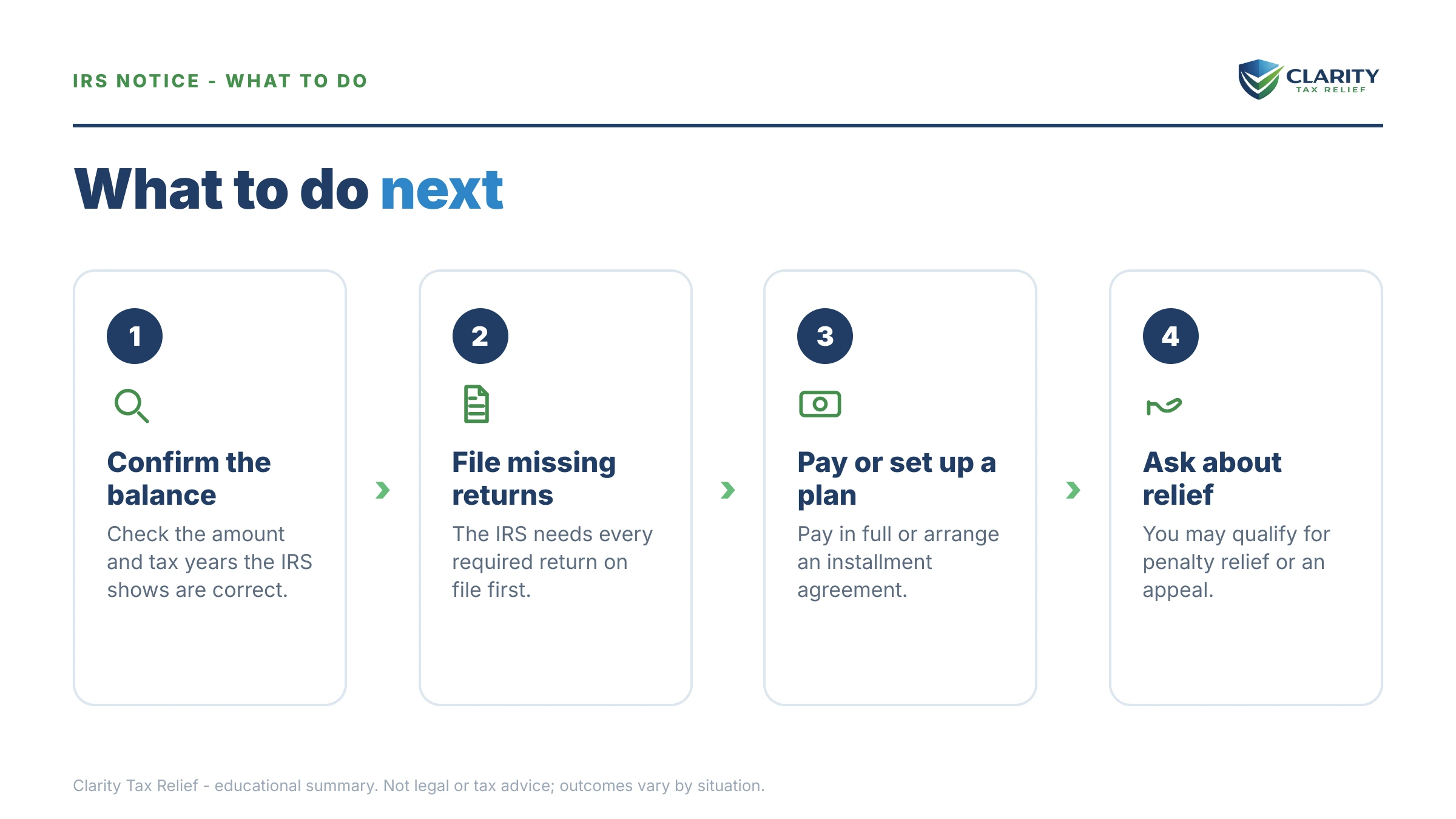
- Find the deadline and the RCP figure. The rejection letter shows the date that starts your 30-day appeal window and the IRS's calculation of what it believes you can pay — both drive every decision that follows.
- Get fully compliant. File every missing return and start current-quarter estimated tax payments; a new offer filed while returns are outstanding gets returned, not reviewed.
- Choose your track. File Form 13711 within 30 days if the IRS's math is wrong, or prepare a fresh offer if your facts or documentation have changed.
- Rebuild Form 433-A(OIC) with proof. Mileage logs, separated bank statements, and current expense records — aimed squarely at the exact finding that sank round one.
- Submit the new Form 656 package. Include the $205 fee and 20% of a lump-sum offer, or check the low-income certification box if your AGI qualifies.
- Track the offer. Confirm code 480 posts to your transcript, and answer every examiner request by its stated deadline so the offer isn't returned.
The current Form 656 booklet, pre-qualifier tool, and mailing addresses are on the IRS's official Offer in Compromise page — always download a fresh booklet, because the IRS periodically revises the forms and rejects offers filed on outdated versions.
When you can handle a second offer yourself
You can file a second offer yourself — and if the first rejection was a simple documentation gap, you probably should. A W-2 earner whose offer failed because two bank statements were missing, or whose income dropped after a job loss, can often refile a clean package alone using the IRS booklet and the pre-qualifier tool. The appeal form itself is one page.
Experienced help changes outcomes in specific situations: the 30-day appeal deadline is running and you can't yet tell whether the examiner's math is wrong; the rejection hinges on a dissipated-asset add-back you need to argue out of the RCP; your income is self-employment income the IRS reconstructed from gross deposits; or you're juggling the offer against active levy risk on the same debt. Those are judgment-and-evidence fights, not form-filling — and losing them twice costs another year plus another paused collection statute. If you get stuck mid-process, the Taxpayer Advocate Service can also intervene when an offer sits unworked or a hardship develops.
What your transcript shows after a rejection
Transaction code 481 on your account transcript confirms the rejection posted — and code 480 will appear again once a new offer is accepted for processing. Watching these codes tells you where your offer stands without waiting on the mail:
| Transcript code | What it means | What to do |
|---|---|---|
| Code 480 | An offer in compromise is pending; collection is generally held while it's under review | After resubmitting, confirm 480 posts — it's your proof the new offer was accepted for processing |
| Code 481 | The offer was rejected and the account is returning to active collection | Calendar 30 days from the letter date (the letter controls, not the transcript) and choose appeal or refile |
| Code 482 | The offer was withdrawn — by you, before the IRS decided it | No appeal exists because there was no decision; a new offer can be filed whenever you're ready |
Terms on your rejection letter, decoded
- Rejected vs. returned: rejected means the IRS reviewed your offer and refused it (appealable); returned means it never reviewed it because the package wasn't processable (not appealable, but resubmittable).
- Reasonable Collection Potential (RCP): the IRS's calculation of everything it could collect from you — asset equity plus your future monthly disposable income.
- Dissipated asset: money or property you spent or transferred while the tax debt existed, which the IRS can add back into your RCP as if you still had it.
- Low-income certification: an AGI test — generally 250% of the federal poverty level or less — that waives the application fee, the down payment, and payments during review.
- CSED tolling: the pause of the IRS's 10-year collection clock; a pending offer plus 30 days stops the clock, extending how long the IRS can collect.
- Form 13711: the one-page request that sends a rejected offer to the IRS Independent Office of Appeals — due within 30 days of the rejection letter.
Reapplying after an OIC rejection: your questions answered
Is there a waiting period before I can reapply after an OIC rejection?
No. The IRS sets no waiting period and no lifetime limit on offers — you can mail a new Form 656 the day after the rejection arrives. But a new offer built on the same numbers will meet the same result, so fix the specific deficiency named in your rejection letter first. If your finances have genuinely worsened since the review, that alone can justify an immediate refile.
Do I have to pay the $205 application fee again for a second offer?
Yes — every Form 656 is a new application, so a second offer means a new $205 fee and, for a lump-sum offer, a new 20% down payment. Both are waived if you qualify for low-income certification, which generally applies when your adjusted gross income is at or below 250% of the federal poverty level. Certification also excuses payments while the offer is under review.
Should I appeal my OIC rejection or just file a new offer?
Appeal when the IRS's math is wrong — a misvalued asset, a documented expense it disallowed, income it overstated. The appeal is free, but Form 13711 must be filed within 30 days of the rejection letter. File a new offer instead when your circumstances changed or your first package was missing documentation you can now supply. You cannot meaningfully do both at once, so match the tool to the problem.
What's the difference between a rejected offer and a returned offer?
A rejected offer was reviewed on the merits and turned down — that decision comes with 30-day appeal rights. A returned offer never got a decision because it wasn't processable: unfiled returns, missed estimated tax payments, a new balance accruing, or missing information. Returns carry no appeal rights, but you can resubmit as soon as the defect is fixed, and the fix is usually mechanical.
What happens to the 20% down payment from my rejected offer?
The IRS keeps it — but it isn't lost. The down payment and any periodic payments you made during review are applied to your underlying tax balance, so they reduce what you owe. They are not refunded to you, and they don't carry over as a credit toward a second offer's required payments. Low-income certified applicants are exempt from these payments entirely.
Does filing a second offer stop IRS collection again?
Generally yes — while a processable offer is pending, the IRS typically suspends levy action, just as it did during your first offer. Two caveats: an offer returned as non-processable loses that protection quickly, and the entire pending period plus 30 days pauses the 10-year collection statute, giving the IRS more total time to collect if the offer fails.
How long does a second offer in compromise take?
Plan on months, not weeks — offer reviews routinely run many months, and 2025's roughly 27% IRS workforce reduction has slowed human review further. One safeguard works in your favor: if the IRS doesn't decide within two years of receiving your offer, it is deemed accepted by law. A complete, well-documented package moves fastest because it avoids rounds of follow-up requests.
What are the chances a second offer will be accepted?
The IRS accepted roughly 1 in 5 offers in FY2024, but that average blends strong applications with hopeless ones. A second offer that directly cures the stated rejection reason — new documentation, changed finances, corrected asset values — is a fundamentally different application than a resubmission of the same numbers. No one can promise acceptance; eligibility rests entirely on your documented finances.
Your next 24 hours
- Find two things on your rejection letter: the letter date (count 30 days forward and write down your appeal deadline) and the IRS's RCP figure — the number your next move has to beat or dispute.
- Gather your file: the rejection letter, the Form 433-A(OIC) you submitted, and your last 12 months of bank statements with business expenses flagged.
- Get a free case review before the appeal window decides for you: call (888) 825-7779 or use the 2-minute form — an experienced tax professional will tell you whether your rejection is appealable, refile-able, or a signal to change course.
This guide is general information, not tax or legal advice for your specific situation. Eligibility for IRS programs depends on individual facts and circumstances; no outcome is guaranteed.