
Offer in Compromise
How to Get an OIC Accepted in 2026: Avoiding the Mistakes That Sink Most Offers
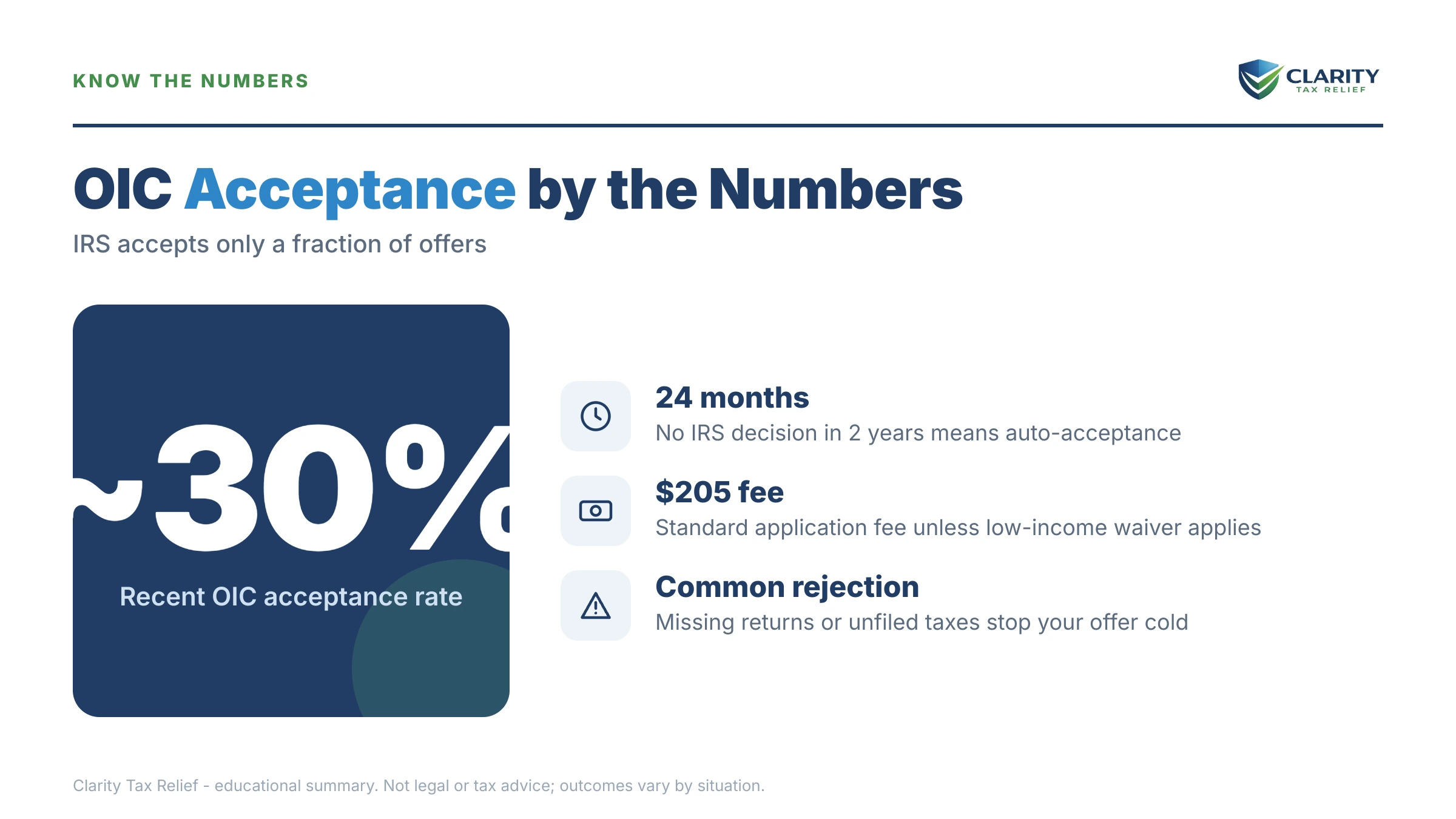
The short answer: how to get an OIC accepted comes down to three things — complete filing and deposit compliance before you apply, an offer amount that meets or beats your Reasonable Collection Potential (asset equity plus future income), and a fully documented Form 656 package. The IRS accepted roughly 1 in 5 offers in FY2024; preparation separates the two groups.
You didn't reach a $92,700 balance overnight — a couple of hard years, quarterly estimates skipped so payroll could clear, and the interest compounded. Now you're weighing an offer in compromise, and you've heard about offers that come back denied after months of waiting. Here's the part nobody says plainly: most failed offers were doomed before the envelope was sealed, for reasons you can check today.
This guide covers the specific triggers that get offers returned or rejected, the exact math the IRS runs against your number, and the sequence that follows a failed offer. The image below shows what a complete Form 656 offer package looks like and where to focus before anything goes in the mail.
⏱ The clocks that matter: there's no deadline to file an offer in compromise — but penalties and interest keep accruing on your balance while you prepare, and if your offer is rejected, you have 30 days from the date on the rejection letter to appeal with Form 13711. Miss that window and your only path is starting over with a new offer.
Why the IRS rejects most offers in compromise
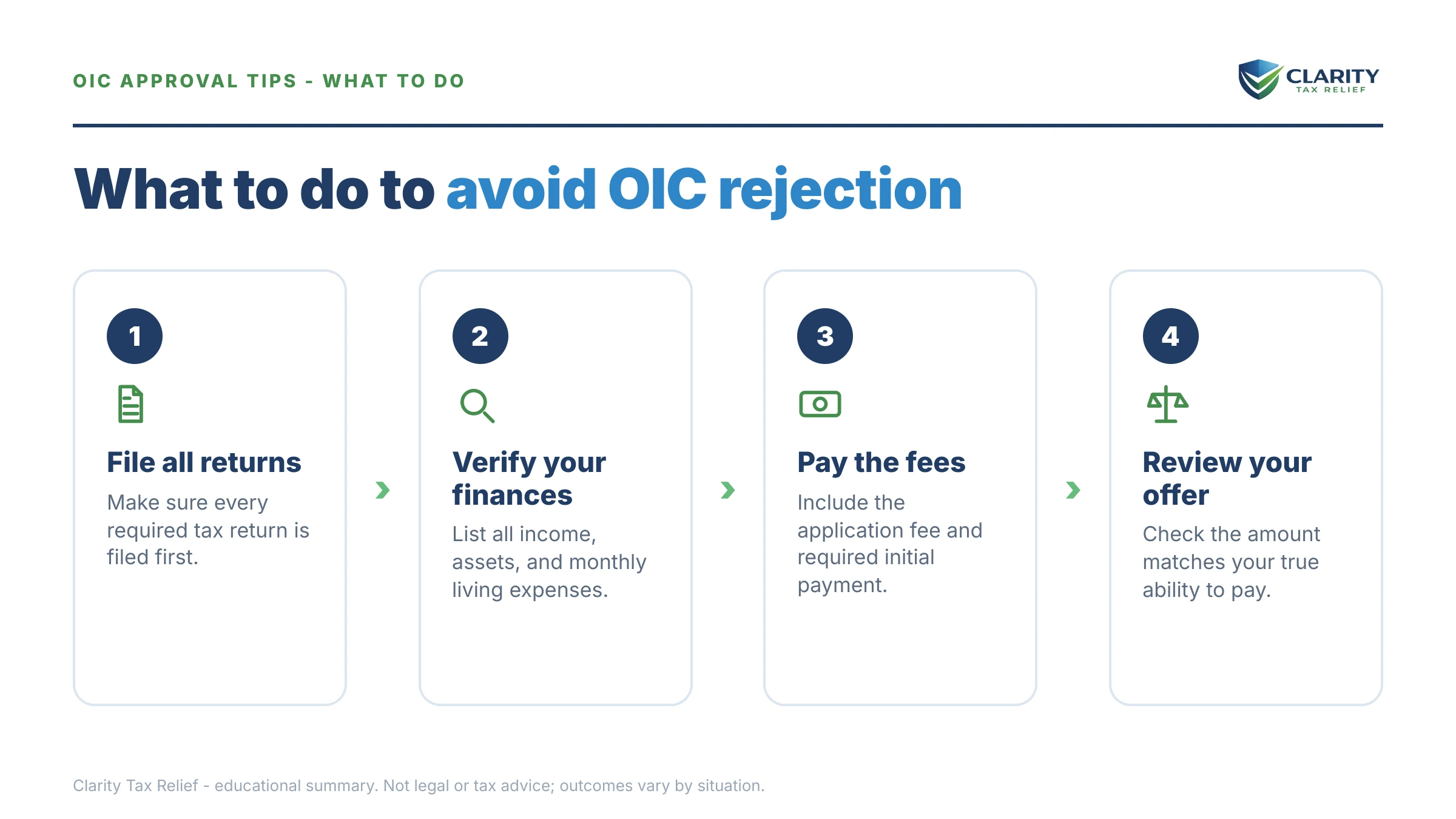
The IRS accepted roughly 1 in 5 offers in compromise in FY2024 — and the failures split into two very different piles. One pile was genuinely evaluated and denied. The other, larger pile never got read at all: those offers were returned as "not processable" over compliance and paperwork problems that take an afternoon to prevent.
An offer examiner's first move isn't judging your hardship story. It's a checklist: are all required returns filed, are this year's estimated payments made, are the business's federal tax deposits current, is the fee attached, is every form signed. Fail any item on that screen and your offer comes back without appeal rights — while interest kept accruing the whole time it sat in the queue.
Offers that survive the screen fail for one dominant reason: the offer amount is lower than what the IRS calculates it could collect from you. That calculation — not persuasion, not sympathy — is the entire game, and the next section shows how to run it before the IRS does. For the general mechanics of the program, see our hub on how does an offer in compromise work; this page stays focused on getting to yes.
| Problem | Returned or rejected? | The fix |
|---|---|---|
| Unfiled required returns (personal or business) | Returned — never evaluated | File every missing return before you submit |
| Behind on current-year estimated taxes or payroll deposits | Returned | Get the current quarter fully paid and deposited first |
| Offer amount below your Reasonable Collection Potential | Rejected after review | Re-run the 433-A (OIC) math; offer at least your RCP |
| Missing documents, unsigned forms, or no fee/payment | Returned | Use a checklist; mail one complete package |
| Dissipated assets — money spent or transferred after the debt arose | Rejected — value added back to your RCP | Document where funds went and why before filing |
| Ignoring the offer examiner's information request | Returned mid-review | Respond by the date printed in the letter, every time |
| New balance accrued while the offer is pending | Returned | Stay current on every payment and deposit during review |
| Open bankruptcy case | Returned | Resolve the bankruptcy before applying |
The acceptance formula: offer at least your Reasonable Collection Potential
An offer gets accepted when it equals or exceeds your Reasonable Collection Potential — the IRS's calculation of everything it could realistically collect from you. RCP has two parts: the net realizable value of your assets, plus a multiple of your monthly disposable income.
On the asset side, the IRS uses quick-sale value — typically about 80% of fair market value — minus any loans against the asset. Home equity, vehicles beyond a basic allowance, business equipment, bank balances, and retirement accounts all count. Money that "disappeared" after the tax debt arose doesn't escape the math: the IRS can add back dissipated assets oic examiners believe you spent or transferred to avoid collection.
On the income side, the IRS takes your gross monthly income, subtracts allowable living expenses under its national and local standards (not your actual lifestyle spending), and multiplies what's left: 12 months for a lump-sum offer, 24 months for a periodic offer. That multiplier choice alone can swing your minimum offer by thousands of dollars. You can estimate your own number in a few minutes with our Offer in Compromise Calculator, and the full mechanics are in our guide to reasonable collection potential.
If you're self-employed, the income side gets harder: the IRS averages fluctuating business income and disallows expenses you consider essential. That math has its own traps — covered in oic self employed — and if the debt itself is unpaid 941 trust-fund tax rather than income tax, the standards are far stricter; see business offer in compromise payroll before assuming an offer is even on the table.
A worked example: $92,700 owed, small business with payroll
Say you owe $92,700 in personal income tax built up over three lean years running a print shop with three employees. Hypothetically, your numbers look like this:
- Assets: home equity after the quick-sale discount and mortgage payoff, $16,500; business equipment at quick-sale value minus its loan, $4,500; bank accounts, $3,000. Net realizable equity: $24,000.
- Income: $7,900/month average take-home from the business, minus $7,050 in IRS-allowable expenses = $850/month disposable.
The RCP math: a lump-sum offer must be at least $24,000 + ($850 × 12 = $10,200) = $34,200, filed with the $205 fee and a 20% down payment of $6,840. A periodic offer must be at least $24,000 + ($850 × 24 = $20,400) = $44,400, paid monthly while the IRS reviews it. On these facts, either figure beats collecting $92,700 from someone who can't produce it — but only if every number ties to a bank statement, and only if the shop's 941 deposits are current the day the offer arrives. This is a hypothetical illustration, not a predicted result; your RCP depends entirely on your own assets, income, and documentation.
Returned vs. rejected: the sequence after a failed offer
A returned offer and a rejected offer are different outcomes with different rights — and only one of them can be appealed. Here's the sequence when an offer fails:
- Return letter. Your offer was never evaluated — a processability problem sent it back. No appeal rights exist. You can fix the problem and refile, but the months in the queue are gone and interest accrued the whole time.
- Rejection letter. Your offer was fully reviewed and denied, usually with the IRS's own RCP calculation attached showing why. The letter starts a 30-day appeal window.
- Appeal — or a corrected second offer. Within 30 days you can request review by the IRS Independent Office of Appeals using form 13711 oic appeal. Past 30 days, your remaining path is a new offer built around the examiner's stated objections — see oic rejected can i reapply.
- Collections resume. The 10-year collection statute, paused during review, restarts — meaning a failed offer actually gave the IRS more time to collect. Your account returns to the notice stream, and everything you paid with the offer stays applied to the balance; the oic down payment refundable question has an answer you won't like.
Milestone letters during a live offer each carry their own clock:
| Stage / letter | What it means | Your window |
|---|---|---|
| Acknowledgment letter | Offer received; processability screen underway | No action — keep every deposit and payment current |
| Information request from the offer examiner | Examiner needs documents to verify your figures | The date printed in the letter — often only a couple of weeks |
| Return letter | Offer sent back unprocessed | No appeal rights; correct and refile when ready |
| Rejection letter | Offer reviewed and denied | 30 days from the letter date to appeal (Form 13711) |
| Acceptance letter | Settlement terms begin | Pay per your offer terms; stay fully compliant for 5 years |
| No decision within 2 years | Offer deemed accepted by law | Automatic — no action needed |
Preparing an offer on a five-figure balance?
Before you mail a $205 fee and a five-figure down payment on a package that might come back unread, have an experienced tax professional pressure-test your compliance, your RCP math, and your documentation — free and confidential. A returned offer costs months while interest keeps accruing.
OIC vs. your other options: costs and timelines
An offer in compromise is the slowest and most demanding resolution path — which is exactly why it should be a calculated choice, not a hopeful one. If your RCP math shows the IRS could collect the full balance from your assets and income within the statute, an offer will be rejected no matter how well it's packaged, and one of these alternatives is the honest answer. (Decision timelines vary by workload and complexity; our guide on how long does an offer in compromise take breaks down each stage.)
| Option | Upfront cost | Timeline | Best fit |
|---|---|---|---|
| OIC — lump sum | $205 fee + 20% of the offer | Months to over a year for a decision; balance of offer in 5 or fewer payments after acceptance | RCP well below the balance; cash available for the down payment |
| OIC — periodic | $205 fee + first monthly payment | Monthly payments continue through review; up to 24 months of payments total | RCP below the balance but no lump of cash on hand |
| OIC — low-income certified | $0 — fee, down payment, and review-period payments all waived | Same review process | You may qualify if your AGI is at or below 250% of the federal poverty level |
| Short-term payment plan | $0 setup | Full payment within 180 days | You can raise the money; you just need time |
| Installment agreement | Setup fee varies by method | Up to 72 months online for balances of $50,000 or less; interest and penalties continue | You can afford meaningful monthly payments — you can even apply for an OIC later; see can i apply for oic while on payment plan |
| Currently Not Collectible | $0 | Collection paused until finances improve; reviewed periodically | Paying anything at all would create genuine hardship |
How to get an OIC accepted: step by step
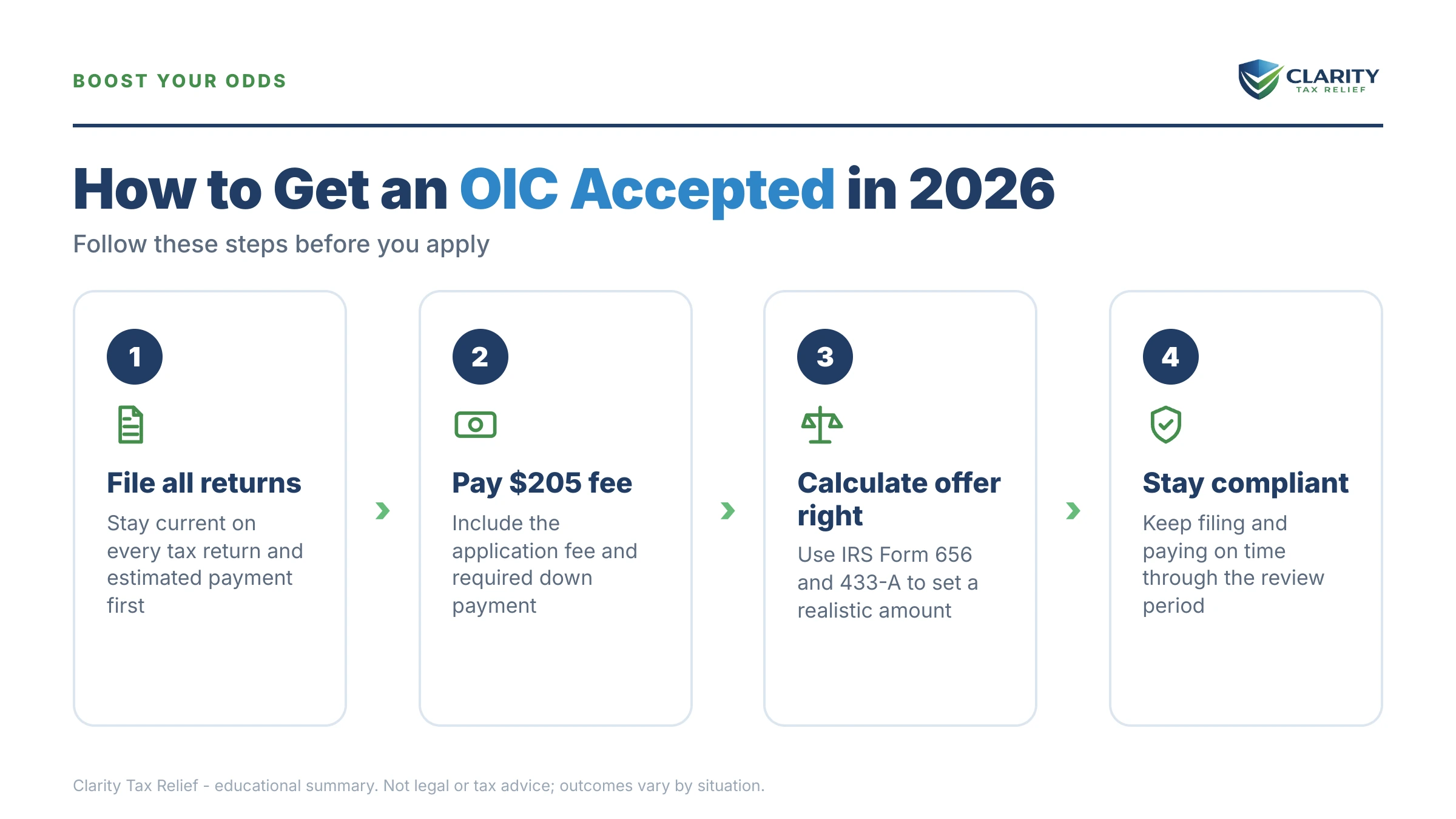
- Get compliant before you calculate — file every required return and get current on this year's estimated taxes and payroll deposits; an offer filed out of compliance comes back unprocessed.
- Run your RCP math honestly — total your net realizable asset equity plus 12 or 24 months of disposable income; that figure is your minimum credible offer amount.
- Pick lump-sum or periodic deliberately — lump-sum uses a 12-month future-income multiplier and requires 20% down; periodic uses 24 months with monthly payments during review.
- Document every line — match each Form 433-A (OIC) entry to a bank statement, pay stub, profit-and-loss report, or valuation you can produce on request.
- Submit a complete package — send Form 656, the financial statement with attachments, the $205 fee, and the required payment — or low-income certification — in one complete mailing.
- Answer the offer examiner fast and stay current — respond to information requests by the date printed in the letter, and keep every deposit and estimated payment on time while the offer is pending.
For a line-by-line walkthrough of the main form itself, see our Form 656 walkthrough. Business owners with an operating entity may also need Form 433-B (OIC) for the business's own finances alongside the personal 433-A (OIC).
When you can handle an OIC yourself
Plenty of taxpayers submit successful offers without professional help — and the IRS gives you a free screening tool to start. If you have W-2 income, simple assets, no business, and a balance your documented finances clearly can't cover, run the IRS's OIC pre-qualifier tool, follow the Form 656-B booklet carefully, and you have a real shot at doing this on your own.
Experienced help changes outcomes in specific situations: self-employment or fluctuating business income the IRS will average against you, payroll or trust-fund tax in the mix, home equity the IRS values higher than you do, money movements an examiner could call dissipated assets, or a prior offer already returned or rejected. In those cases the argument isn't the paperwork — it's the valuation and expense fights inside it, where knowing the IRS's internal standards is the whole battle. And if your RCP math shows an offer can't win, an honest professional will tell you that before you spend the fee, not after.
One caution while you research: any firm promising to settle your debt for "pennies on the dollar" before seeing a single financial document is describing a marketing script, not the program. Acceptance is a math test the IRS controls — as the real numbers in our IRS offer in compromise acceptance rate analysis show.
Terms on your offer paperwork, decoded
- Reasonable Collection Potential (RCP): the IRS's calculation of your net asset equity plus future income — the floor your offer must meet.
- Quick-sale value: the discounted value (typically about 80% of market) the IRS assigns your assets in the RCP math.
- Processable offer: an offer that passes the compliance and completeness screen and actually gets evaluated.
- Dissipated assets: money or property you spent or transferred after the tax debt arose that the IRS adds back to your RCP.
- Offer examiner: the IRS employee who verifies your financial statement and recommends acceptance or rejection.
- Deemed acceptance: the legal rule that an offer not decided within 2 years is automatically accepted.
OIC acceptance questions, answered
What percentage of offers in compromise get accepted?
The IRS accepted roughly 1 in 5 offers in FY2024, so most offers fail. That headline number is misleading, though: a large share of failures are returned offers that were never evaluated at all — unfiled returns, missing documents, or offers filed while behind on current-year taxes. Simply avoiding the preventable return reasons puts you ahead of a large share of applicants before an offer examiner ever opens your file.
How much should I offer the IRS in an offer in compromise?
Offer at least your Reasonable Collection Potential: the net realizable value of your assets plus 12 months of your disposable monthly income for a lump-sum offer, or 24 months for a periodic offer. Offering less than that figure is the most common reason a fully processed offer gets rejected — and offering meaningfully more than it is money you can't get back.
Does the IRS have to decide my offer within a certain time?
Yes — if the IRS doesn't make a decision within 2 years of receiving your offer, the offer is automatically deemed accepted by law. In practice, most offers are decided well before then, and a returned offer ends the clock entirely because it was never processed. The 2-year rule is a backstop, not a strategy.
Does filing an OIC stop IRS collections?
While a processable offer is pending, the IRS generally suspends levy action — but it can still file or keep a federal tax lien, and interest continues to accrue on your balance. The 10-year collection statute is also paused during review, which extends how long the IRS has to collect if your offer ultimately fails. An offer is not an instant shield, and it has conditions.
What is the difference between a returned offer and a rejected offer?
A returned offer was never evaluated — the IRS sent it back over a processability problem like unfiled returns, missing documents, or a new unpaid balance, and you have no appeal rights. A rejected offer was fully reviewed and denied, usually because the offer amount fell below your calculated Reasonable Collection Potential, and you get 30 days from the rejection letter's date to appeal with Form 13711.
Do I get my application fee and down payment back if my offer is rejected?
No. The $205 application fee is nonrefundable, and any payments you send with or during the offer are applied to your tax balance rather than returned. That's why the offer-amount math matters before you file — every dollar attached to a doomed offer still leaves your pocket. Low-income certification waives both the fee and the payments if your AGI is at or below 250% of the federal poverty level.
Can I apply for an OIC while I'm on a payment plan?
Yes — an existing installment agreement doesn't disqualify you, and your monthly plan payments are generally suspended while the offer is under review. If the offer is returned or rejected, the installment agreement resumes. Make sure the plan is in good standing when you file; a defaulted agreement signals exactly the compliance problems that get offers sent back unprocessed.
Do I have to stay compliant after my offer is accepted?
Yes — an accepted offer requires you to file every return and pay every balance on time for the next 5 years. Default during that window and the IRS can reinstate the original debt, minus what you paid, plus accrued penalties and interest. For a business owner, that includes staying current on payroll tax deposits — a missed 941 deposit can unravel the entire settlement.
The IRS's official program rules and forms live at IRS.gov's Offer in Compromise page. If your offer stalls or you hit an IRS delay you can't resolve, the independent Taxpayer Advocate Service can intervene at no cost.
Your next 24 hours
- Check your compliance status. Confirm every required return is filed and this quarter's estimated payments — and, if you have employees, your federal payroll deposits — are current. This is the single biggest reason offers come back unread.
- Gather your numbers. Pull three months of bank statements, your latest profit-and-loss, asset values (home, vehicles, equipment), and loan balances — everything the RCP math runs on.
- Get your offer pressure-tested free. Send us your figures through the 2-minute form or call (888) 825-7779. An experienced tax professional will tell you whether your offer math holds up before you commit the fee and down payment — while interest on the balance keeps accruing either way.
This guide is general information, not tax or legal advice for your specific situation. Eligibility for IRS programs depends on individual facts and circumstances; no outcome is guaranteed.