
IRS Transcript Codes
IRS Code 481 Transcript: Your Offer in Compromise Was Rejected — What to Do (2026)
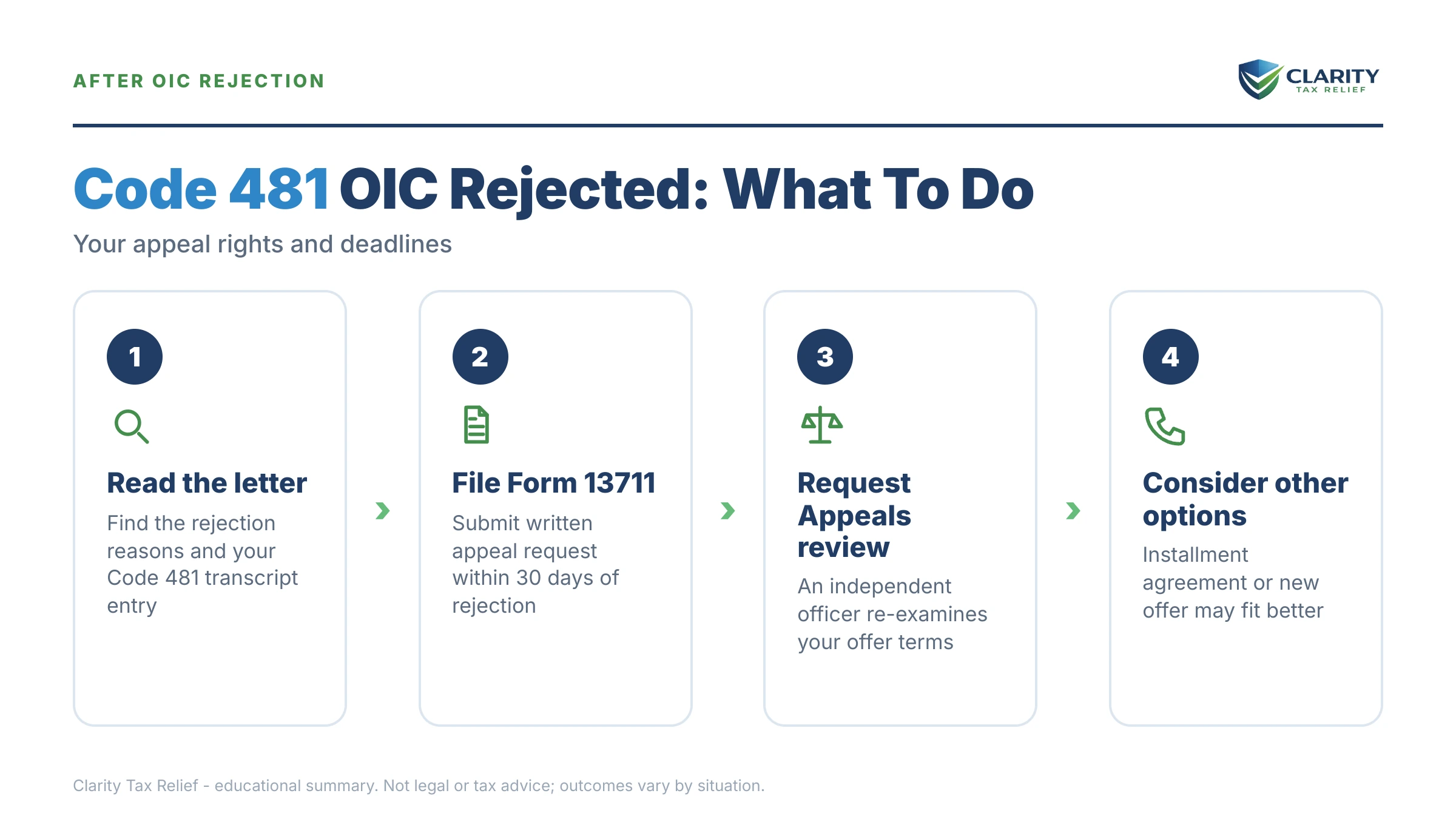
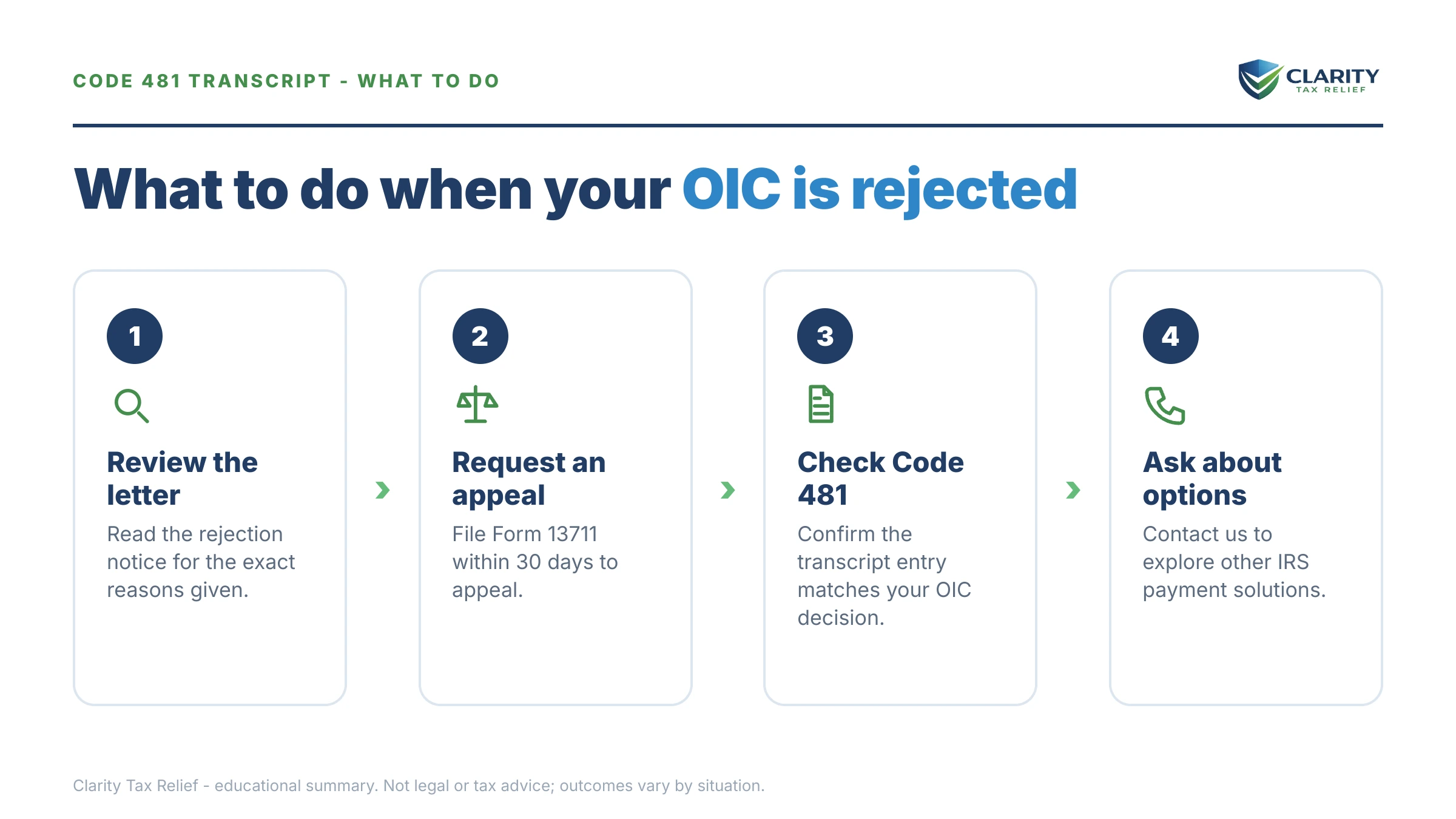
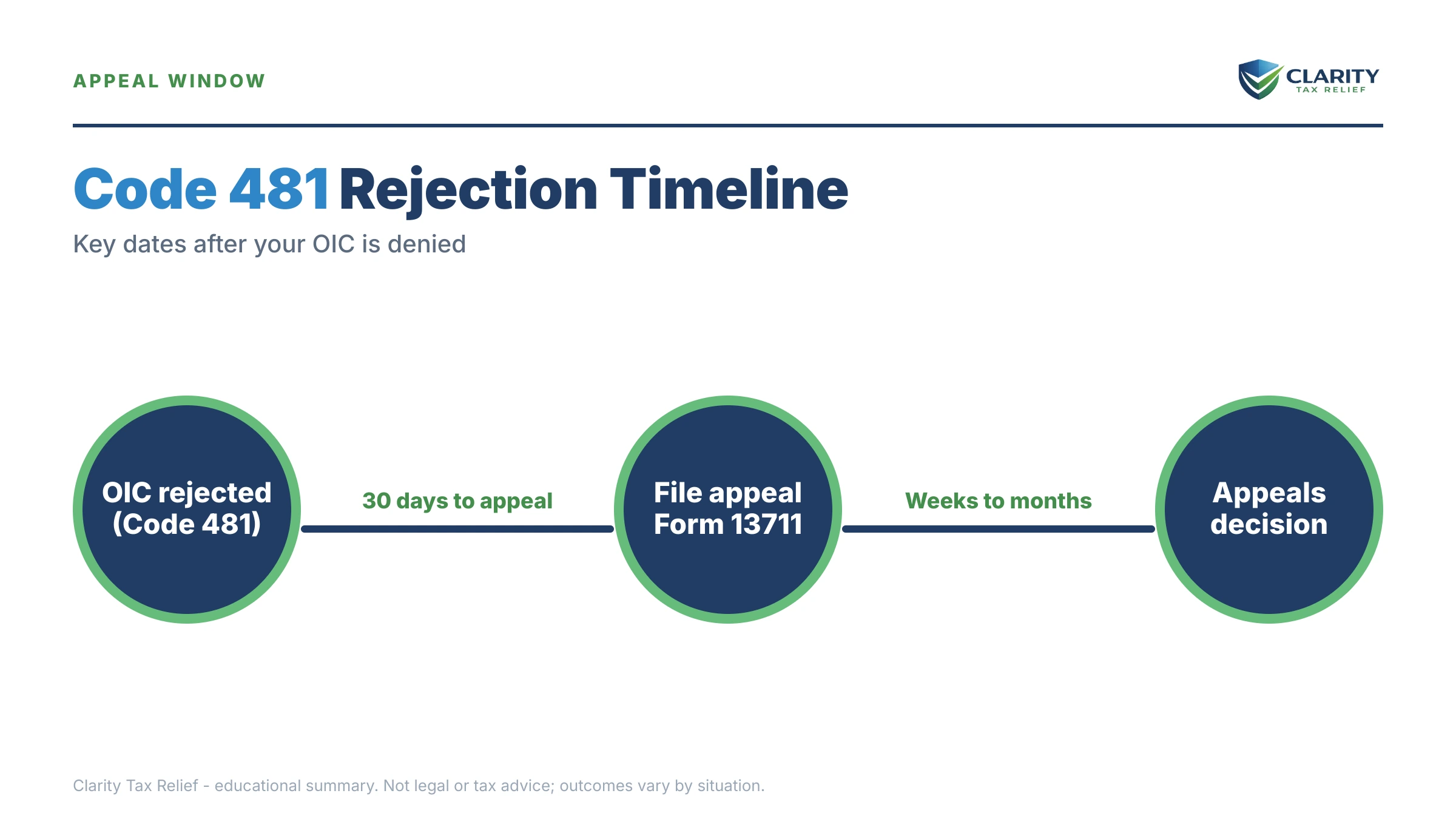
The short answer: a code 481 transcript entry means the IRS rejected — or in some cases returned — your offer in compromise. It reverses code 480, and the collection hold that protected you is ending. You typically have 30 days from the date on your rejection letter, not the transcript date, to appeal with Form 13711.
You spent months getting here — three years of gig returns filed to become compliant, an offer packet mailed, then the long wait while code 480 sat frozen on your transcript. This week the update you kept refreshing for finally posted, and it's the wrong one. Take a breath: a rejection is a decision point, not the end of the road, and the clock it starts is short but very workable.
The image below shows exactly where code 481 sits on an account transcript and which nearby lines — 480, 196, 276 — tell the rest of the story about your account.
⏱ Your deadline: you have 30 days from the date printed on your OIC rejection letter to appeal with Form 13711. The date next to code 481 on your transcript does not control — the letter date does. Miss it and your appeal rights on this offer expire, while interest and the monthly failure-to-pay penalty keep accruing.
Why code 481 posted to your transcript
Transaction code 481 posts when the IRS rejects an offer in compromise, reversing the code 480 that marked your offer as pending. The transcript entry is just the bookkeeping side of a decision made by an offer examiner — the substance arrives (or already arrived) in a rejection letter that explains the IRS's reasoning and lists your appeal rights.
Nearly every rejection comes down to one calculation: the examiner concluded your offer was less than your Reasonable Collection Potential (RCP) — the IRS's estimate of what it could collect from your asset equity plus your future monthly disposable income. If the IRS thinks it can collect $9,000 from you over time, it will not accept $3,000, no matter how sincerely you can't spare it today. Our guide to reasonable collection potential breaks down the formula; you can also run your own numbers with our Offer in Compromise Calculator to estimate where the examiner likely landed.
One distinction matters enormously here. A rejected offer was evaluated on the merits and comes with 30-day appeal rights. A returned offer was kicked back without evaluation — usually for missed filings, missed estimated payments, a new balance accruing during review, or an incomplete packet — and a returned offer generally carries no appeal rights. Your letter tells you which happened; the transcript code alone does not. If your account shows 481 but you never received a letter, call the number on your last IRS correspondence or check your online account before assuming anything.
If transcripts are new territory, our hub on how to read an IRS account transcript covers the layout in five minutes; this page stays focused on what 481 specifically means for you.
Code 481 vs. 480 vs. 482: reading the offer codes together
The three offer codes — 480, 481, and 482 — tell you the full life cycle of your OIC, and the lines around them show what your balance did while you waited.
| Code | What it means | What to do |
|---|---|---|
| 480 | Your offer was accepted for processing; collections paused and the CSED clock stopped. | Nothing — this was the waiting phase. Its date tells you how long the CSED was tolled. |
| 481 | Offer rejected (or returned). The collection hold is ending. | Find the rejection letter and act inside the 30-day appeal window — this page's playbook. |
| 482 | Offer withdrawn or terminated — you pulled it back, or missed a required payment during review. | No appeal rights; move straight to a payment arrangement or a corrected new offer. |
| 196 | Interest charged to your account — it kept compounding through the entire offer review. | Expect the balance to be higher than when you applied; verify the current total before choosing a plan. |
| 276 | Failure-to-pay penalty posted — 0.5% per month, also accruing during review. | Ask whether penalty relief applies once your resolution path is set. |
What happens if you ignore code 481
Federal law (IRC §6331(k)) bars the IRS from levying while your offer is pending, for 30 days after a rejection, and while a timely appeal is under consideration — and code 481 starts that final protected window running. Here is the sequence if you do nothing:
- Code 481 posts and the rejection letter arrives. Levy protection continues for 30 more days. This is your highest-leverage moment.
- Day 30 passes with no appeal. Your appeal rights on this offer expire permanently, and the statutory levy hold lifts.
- Your account returns to active collections. The notice sequence resumes where it paused — it does not start over. Interest (the 196 lines) and the failure-to-pay penalty (the 276 lines) have been compounding the entire time your offer sat in review.
- Balance-due and intent-to-levy notices resume — a CP504 lets the IRS take your state tax refund, and an LT11 or Letter 1058 final notice opens a 30-day window before wage and bank levies become legal.
- If you already received a final notice before you filed the offer, the IRS does not have to reissue it. Levies can follow much sooner once the hold lifts — this is the single most dangerous edge case after a rejection.
One more quiet consequence: the months your offer spent in review were added to the back end of the IRS's 10-year collection statute (the pending period plus 30 days). Doing nothing doesn't run out the clock — it handed the IRS more clock.
Code 481 just posted on your transcript?
The 30-day appeal window on a rejected offer is running from your letter's date right now. Send us the rejection letter and your transcript — an experienced tax professional will tell you whether an appeal, a new offer, or a payment plan is the smarter move. Free and confidential.
Your options after an OIC rejection
A rejected offer leaves you four realistic paths, and the right one depends on whether the IRS's math was actually wrong. For the full decision framework, see OIC rejected — now what; here is how each path applies once 481 is on your account:
- Appeal with Form 13711 — free, but only within 30 days of the letter date, and only for rejected (not returned) offers. An appeal works when you can show the IRS mis-measured something specific: it disallowed an expense you can document, averaged a one-time income spike into your monthly figure, or valued an asset you can't actually sell. Your appeal also keeps levy protection in place while Appeals considers it.
- Fix the problem and refile a new offer — there's no waiting period, but a second offer means a new $205 fee and a new 20% down payment unless you hold low-income certification (AGI at or below 250% of the poverty line), which waives both. Refiling identical numbers gets identical results; see refiling an OIC after a denial for what has to change first.
- Pivot to a payment plan — often the fastest exit. Balances under $25,000 fit a streamlined installment agreement with no detailed financial disclosure, spread over up to 72 months. Interest and penalties continue, but enforcement stops the day it's approved.
- Currently Not Collectible status — if the reason your offer was low is that you genuinely cannot pay anything, hardship status pauses collection entirely. The IRS already has your full financials from the offer, which can make qualifying for CNC faster than usual. The debt remains and the CSED keeps running.
| Window | What it controls | What you lose if it passes |
|---|---|---|
| 30 days from the rejection letter date | Your right to appeal to the IRS Independent Office of Appeals via Form 13711 | Appeal rights on this offer — permanently. Only a new offer or other resolution remains. |
| Same 30 days (IRC §6331(k)) | The statutory bar on levies after a rejection; a timely appeal extends it | Levy protection — collections resume, and faster if a final notice already went out. |
| Anytime after rejection | Your right to submit a new Form 656 (new fee and down payment unless low-income certified) | Nothing expires, but interest and the 0.5%/month penalty grow the balance every month you wait. |
| The CSED (10 years from assessment, extended by the offer period + 30 days) | How long the IRS can legally collect | This deadline binds the IRS, not you — but your offer's review time was added to it. |
A worked example: $13,600, three gig years, one rejected offer
Say you owe $13,600 across the three gig-work years you just filed. You offered a $2,000 lump sum, sending $400 (the 20% down payment) plus the $205 fee. The examiner then rebuilt your budget: you claimed $2,850/month in living expenses, but the allowable standards capped you at $2,560. Against average gig income of $2,850/month, that leaves $290/month in future income. The math:
$290 × 12 = $3,480 future income, plus $2,300 in car equity = an RCP of $5,780. Your $2,000 offer came in under it, so code 481 posted. Your $400 down payment was applied to the debt, so the balance is roughly $13,200 plus accruals.
From here, three doors: appeal if you can document the $290/month of disallowed expenses (say, a required loan payment the examiner skipped); refile at $5,780 or above if the math is right and you can fund it; or take the streamlined plan — $13,200 ÷ 72 ≈ $184/month as a floor, rounded up in practice because interest and penalties keep accruing until payoff. This is a hypothetical illustration, not a predicted result — but it's exactly the comparison your rejection letter equips you to make.
How to respond to code 481, step by step
- Find your rejection letter — locate the dated rejection letter; your 30-day appeal window runs from that date, not from the transcript posting.
- Compare the IRS's math — pull the income and expense table from the letter and compare it line by line with the Form 433-A(OIC) you submitted.
- Choose your path — appeal with Form 13711 if the IRS's numbers are wrong; pivot to a payment plan or a new offer if they're right.
- Act before day 30 — file the appeal or set up your installment agreement while levy protection is still in place.
- Stay compliant — keep current-year filings and estimated payments on time; new noncompliance sinks an appeal or a second offer.
When you can handle code 481 yourself
Not every rejection needs professional help — and knowing the difference saves you money. You can likely handle this yourself if the IRS's RCP math is simply correct and your balance fits a streamlined plan: setting up a $184-a-month agreement online takes under an hour, and the rejection changes nothing about your eligibility for it. Likewise, if the letter shows one obvious, documentable error — a paycheck counted twice, an expense with a receipt attached — a clean Form 13711 stating that single issue is within reach.
Experienced help changes outcomes in four situations: a final levy notice was already issued before your offer, so collections can move fast once the hold lifts; your gig income is irregular and the examiner averaged your best quarter into a permanent monthly figure (self-employed RCP disputes are where appeals are won and lost); the letter cites dissipated assets — money you spent during or before the offer that the IRS added back; or you're weighing a second offer and need someone to pressure-test the numbers before you spend another fee and down payment on the same answer.
Terms on your transcript and letter, decoded
- TC 480: the transcript code that posted when your offer was accepted for processing — it marks the start of the collection hold and CSED pause.
- Reasonable Collection Potential (RCP): the IRS's calculation of what it could collect from you — asset equity plus future monthly income over a set multiplier — and the benchmark your offer failed.
- Form 13711: the one-page Request for Appeal of Offer in Compromise; it must identify each disputed item and why you disagree.
- Rejected vs. returned: rejected means evaluated and denied, with appeal rights; returned means sent back unprocessed, with none.
- IRC §6331(k): the statute that bars levies while an offer is pending, for 30 days after rejection, and during a timely appeal.
- CSED: the Collection Statute Expiration Date — the end of the IRS's 10-year window to collect, pushed back by the time your offer spent in review plus 30 days.
Primary sources if you want the IRS's own words: the IRS offer in compromise page covers rejection and appeal rights, the IRS payment plans page covers the pivot options, and the Taxpayer Advocate Service can step in if the rejection process itself went wrong.
Code 481 transcript questions, answered
What does code 481 mean on an IRS transcript?
Code 481 means the IRS rejected your offer in compromise. It reverses transaction code 480, which posted when your offer was accepted for processing, and it signals that the collection hold tied to your pending offer is ending. Your rejection letter — not the transcript — explains why the offer failed and starts your 30-day appeal clock.
How long do I have to appeal after code 481 posts?
You have 30 days from the date printed on your rejection letter to appeal using Form 13711. The transcript posting date does not control the deadline, so find the letter itself. If you miss the window, you lose appeal rights on that offer, though you can still submit a brand-new offer or set up a payment plan.
Can the IRS levy me right after code 481 appears?
Not immediately. Federal law bars levies while an offer is pending, for 30 days after a rejection, and while a timely appeal is being considered. Once that protection ends, though, your account returns to active collections and the notice sequence resumes where it left off — so use the 30 days to lock in your next move.
What is the difference between code 481 and code 482?
Code 481 means the IRS rejected your offer; code 482 means the offer was withdrawn or terminated — usually because you pulled it back or missed a payment or paperwork deadline during review. The distinction matters because a rejection comes with 30-day appeal rights through Form 13711, while a withdrawn or returned offer generally does not.
Do I get back the money I sent with my offer after a rejection?
No — the $205 application fee is kept, and the 20% down payment on a lump-sum offer (plus any monthly payments made during review) is applied to your tax balance rather than refunded. That money isn't wasted, since it reduces what you owe, but it's a reason to confirm you're a realistic candidate before filing a second offer. Taxpayers with low-income certification pay neither the fee nor the down payment.
Can I submit a new offer in compromise after code 481?
Yes — there is no waiting period or lifetime limit on offers. A second offer only makes sense if something material changes: your income dropped, you can document expenses the IRS disallowed, or you can offer an amount at or above the reasonable collection potential the IRS calculated. Refiling the same numbers usually produces the same rejection — and the IRS accepted roughly 1 in 5 offers in FY2024.
Does code 481 restart the 10-year collection clock?
No, but the clock was paused while your offer was pending. The IRS normally has 10 years from assessment to collect (the CSED), and that period stops running while an offer is under review plus 30 more days — and during any appeal. So the months your offer sat in review were added to the back end of the IRS's collection window.
Why was my offer in compromise rejected?
The most common reason is that your offer was less than your reasonable collection potential — the IRS's math on what it could collect from your equity plus future monthly income. Other frequent causes: missed current-year estimated payments or filings, dissipated assets the IRS added back, or expense claims above the allowable living standards. Your rejection letter includes the IRS's income and expense table, so you can see exactly where its numbers differ from yours.
Your next 24 hours
- Find the rejection letter and circle its date. Count 30 days forward — that's your appeal and levy-protection deadline, and it may already be partly spent by mail time.
- Gather your offer file: the Form 656 and 433-A(OIC) you submitted, the letter's income/expense table, and your last three months of gig income records. The appeal-or-pivot decision lives in those documents.
- Get a free case review before the window closes — use the 2-minute form or call (888) 825-7779. Whether the answer is Form 13711, a $184-a-month plan, or a stronger second offer, deciding inside the 30 days is what keeps every option on the table.
This guide is general information, not tax or legal advice for your specific situation. Eligibility for IRS programs depends on individual facts and circumstances; no outcome is guaranteed.