
IRS Notices
IRS CP45 Notice: Why the IRS Couldn't Apply Your Overpayment to Estimated Taxes (2026)
The short answer: a CP45 notice means the IRS could not apply your overpayment to next year's estimated taxes as you requested on your return — usually because an adjustment or offset shrank the overpayment first. Your estimated payments are now underfunded by the difference, and covering that gap before your next quarterly due date is the fix.
You did the responsible thing on your tax return: instead of taking the refund, you told the IRS to roll it forward to cover next year's estimated taxes. Now a CP45 says the IRS couldn't do it. The letter itself is quiet — no threats, no bill — but the quarterly payments you thought were already funded may not be, and that gap grows a penalty for every quarter it sits open.
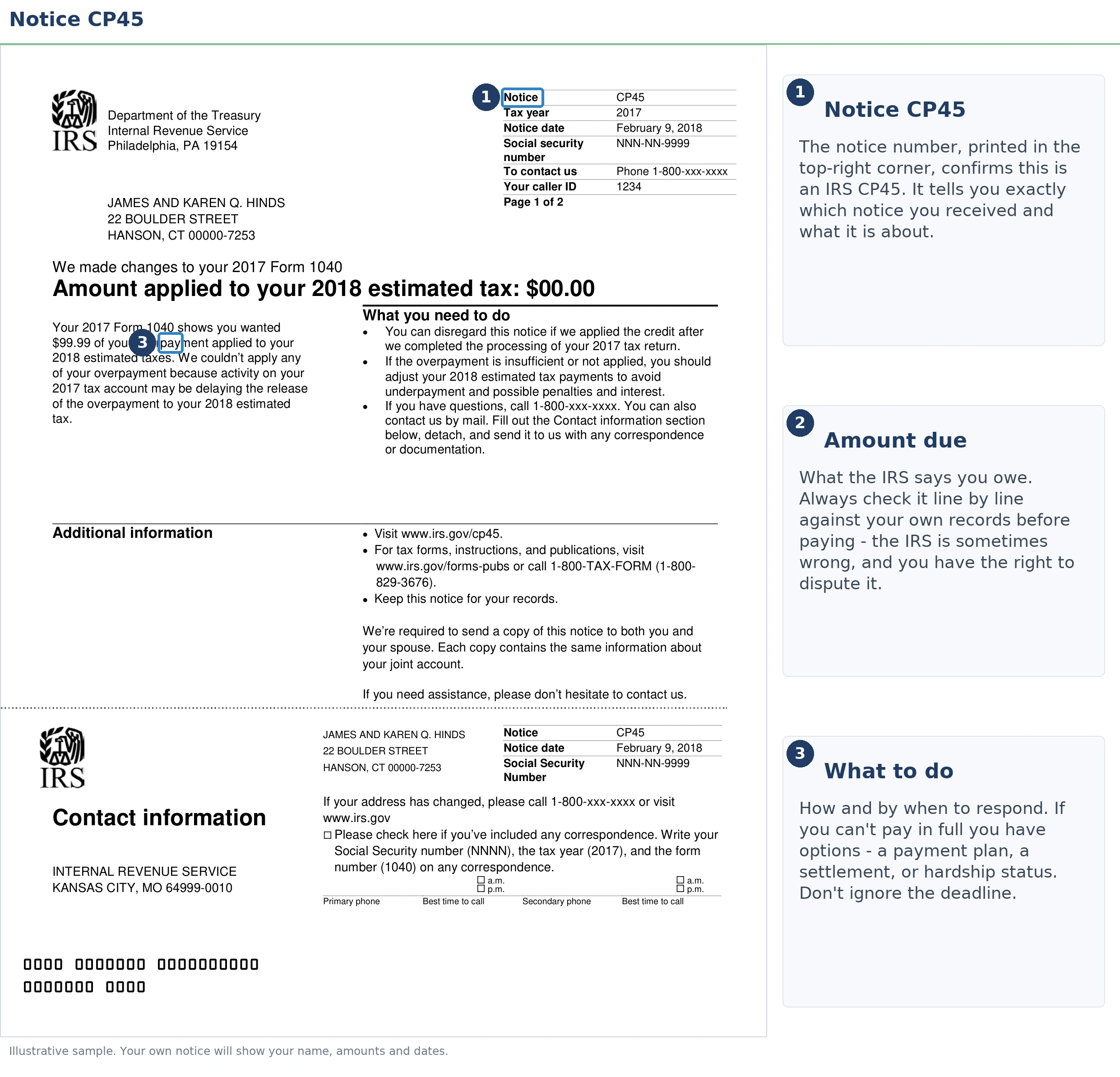
Two numbers on the notice tell the whole story: the amount you asked the IRS to apply and the amount it actually applied. The image below shows exactly what a CP45 looks like and where to find those figures on the page.
⏱ The clock that matters: a CP45 sets no response deadline of its own. The real deadline is your next quarterly estimated tax due date — April 15, June 15, and September 15, 2026, and January 15, 2027 — because the underpayment penalty accrues on the uncovered gap from each due date it misses.
Why you got a CP45 notice
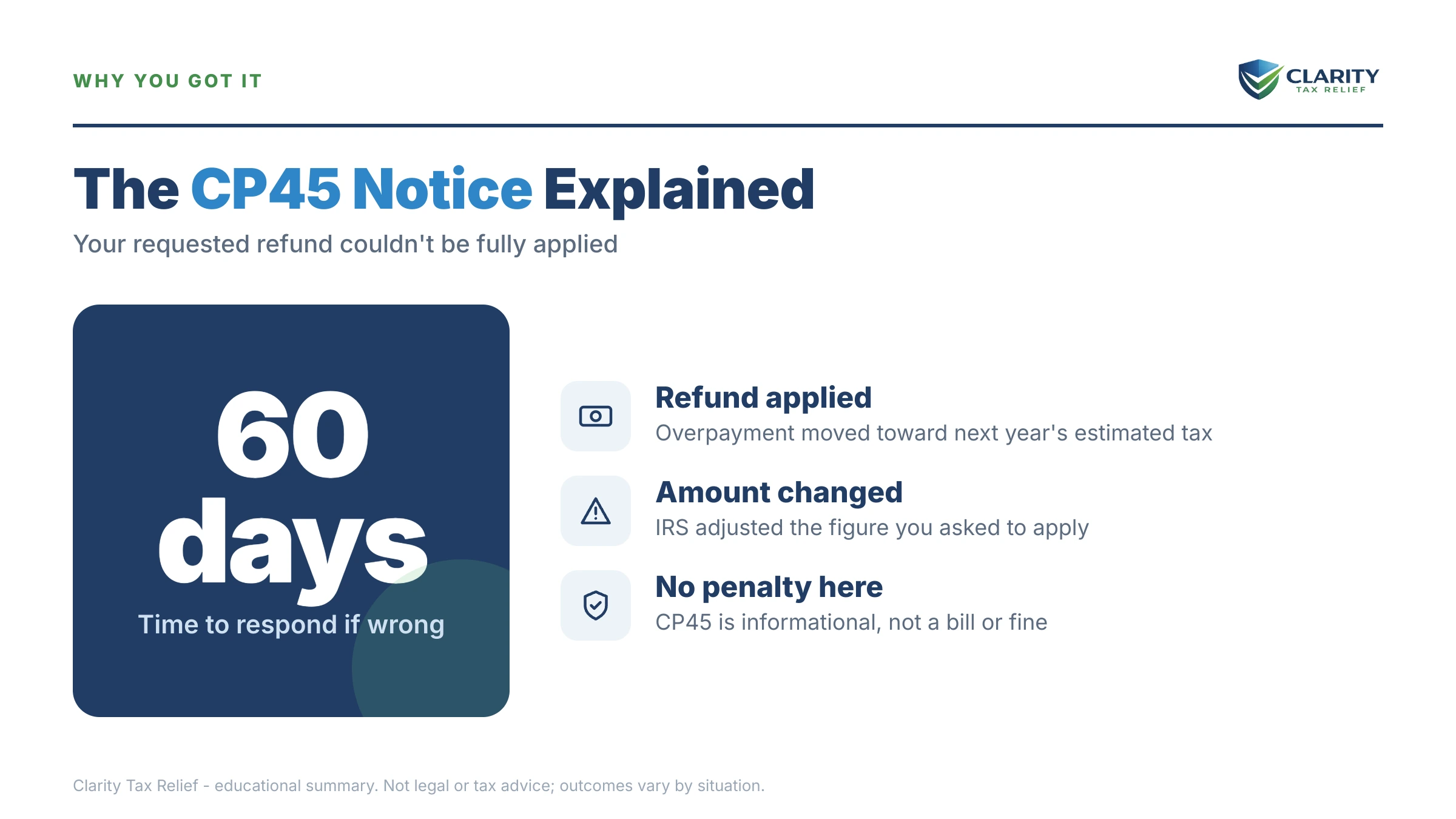
A CP45 notice means the IRS processed your return, saw your election to apply the overpayment to next year's estimated taxes, and could not complete it — in full or in part. That election (the "amount you want applied to your estimated tax" line on Form 1040) only works if the overpayment actually exists in the amount you calculated. Something reduced yours before the transfer happened.
Three causes account for nearly every CP45. First, the IRS corrected your return — a math error, a miscalculated credit — and the overpayment shrank. Second, part of the money was pulled to pay a federal tax balance from another year or a spouse's account. Third, the Treasury Offset Program intercepted it for a non-tax debt like state taxes or child support. The money didn't disappear — it went somewhere, and the notice or its companion tells you where.
A CP45 is not an audit and usually not a bill. It's an accounting report — one of dozens the IRS's automated systems mail every week; our guide to why did I get a letter from the IRS explains how that machine works. What makes this one different is who it hurts: people who fund their quarterlies with the prior year's refund — retirees drawing IRA money with no withholding, and self-employed filers — are the ones left short.
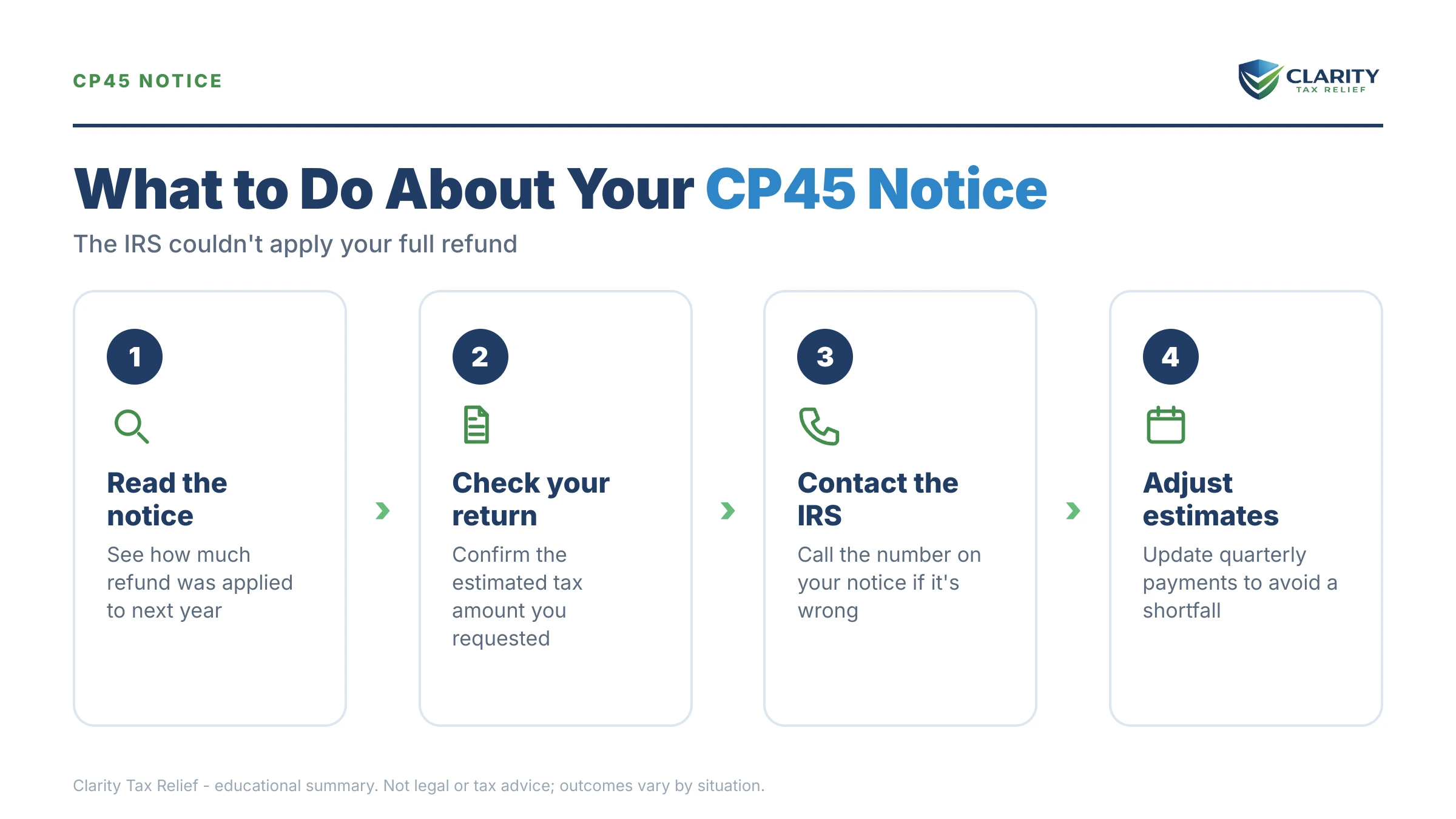
First, find out where your overpayment actually went
Every dollar the IRS couldn't apply was either erased by an adjustment or redirected to another debt — and each cause has its own companion notice and its own fix. Match your situation against this table before you send the IRS a dime or a letter:
| What reduced your overpayment | Notice that explains it | What to check |
|---|---|---|
| The IRS corrected a math error or credit on your return | CP12 notice (refund changed) or CP11 notice (balance due) | Whether the correction is actually right — you have a short window, printed on that notice, to dispute it |
| Money was applied to a federal tax balance from another year | CP44 notice or CP49 refund applied | Which year absorbed it, and whether that old balance is accurate |
| Money was applied to your spouse's separate debt on a joint return | CP39 notice or CP42 | Whether an injured-spouse claim can recover your share of the joint overpayment |
| A non-tax debt took it — child support, state taxes, federal student loans | Offset letter from the Bureau of the Fiscal Service (Treasury Offset Program) | Which agency received the money; disputes go to that agency, not the IRS |
Ten minutes in your IRS online account settles most of this: the account transcript shows the adjustment or transfer, dated, dollar for dollar. The gap between what you requested and what was applied is the only number that matters for the rest of this article. Write it down.
What happens if you ignore a CP45
Ignoring a CP45 doesn't trigger collection — it triggers a quietly growing underpayment penalty. Because the notice doesn't demand anything, it's easy to file away. Here's the sequence that follows if you do:
- The quarter the gap lands in. The estimated-tax underpayment penalty starts accruing on the uncovered portion from that quarter's due date. It's computed like interest — the federal short-term rate plus 3 percentage points — so it compounds silently.
- Each later quarterly deadline. Until you cover the shortfall, every passing due date adds another underfunded quarter to the penalty math. A gap you could have closed in one payment becomes four separate underpayments.
- Next filing season. Form 2210 (or the IRS's own computation) totals the penalty on your return. If the IRS bills it, it arrives as a CP30 notice — the estimated-tax penalty assessment.
- Separately, any balance the adjustment created. If the correction behind your CP45 also left you owing for the prior year (a CP11 situation), that balance follows the ordinary bill-and-escalation sequence, starting with a CP14 — a completely different clock with real enforcement behind it.
The trap is assuming your quarterlies are funded when they aren't. If you keep making payments sized as though the full credit went through, you'll be short all year and discover it in April 2027. The full penalty mechanics are covered in our guide to the underpayment penalty estimated taxes charge.
Holding a CP45 and not sure where your money went?
A CP45 is usually two problems in one envelope: an adjustment or offset you may be able to dispute, and an estimated-tax gap accruing penalty every quarter it stays open. Send us the notice — an experienced tax professional will trace where your overpayment went and map the cheapest way to cover the gap before your next quarterly deadline. Free, confidential, no pressure.
Your options for covering the shortfall a CP45 creates
You have five real ways to fix an underfunded estimated-tax year, and for retirees the withholding route is usually the most powerful. Compare them before defaulting to writing a check:
| Option | How it works | Best when |
|---|---|---|
| Catch-up estimated payment | Pay the gap directly to your 2026 estimated tax before the next quarterly due date | You have the cash and want the simplest fix |
| Increase withholding (Form W-4V / W-4P) | Withholding counts as paid evenly through the year — even if it starts in November | You're retired with Social Security, pension, or IRA income |
| Recalculate to a safe harbor | Pay in 100% of last year's total tax (110% if AGI topped $150,000), or 90% of this year's | Your 2026 income will be lower than 2025's — you may need less than you think |
| Annualized income method (Form 2210, Schedule AI) | Matches required payments to when income actually arrived during the year | Your income is lumpy — a late-year Roth conversion, asset sale, or RMD |
| Dispute the reduction | Challenge the adjustment on the companion notice's timeline, or file Form 8379 for a spouse's offset | The IRS's math — not yours — created the shortfall |
Two of these deserve a closer look. The withholding fix is nearly custom-built for anyone on fixed income: file Form W-4V to withhold 7%, 10%, 12%, or 22% from Social Security benefits, or Form W-4P to add withholding to pension and IRA distributions. Because the IRS treats withholding as if it arrived evenly across all four quarters, a withholding fix started mid-year can neutralize penalty exposure that a mid-year estimated payment cannot.
And if a penalty has already accrued by the time you catch this, relief exists: Form 2210 includes a waiver for taxpayers who retired after age 62 (or became disabled) in the current or prior year, where the underpayment was due to reasonable cause rather than willful neglect. Our guide to the estimated tax penalty waiver walks through the request.
Whichever route you choose, aim it at the next payment date. These are the deadlines your catch-up is racing:
| Income period | Payment due |
|---|---|
| January 1 – March 31, 2026 | April 15, 2026 |
| April 1 – May 31, 2026 | June 15, 2026 |
| June 1 – August 31, 2026 | September 15, 2026 |
| September 1 – December 31, 2026 | January 15, 2027 |
Full details, including farmer and fisherman exceptions, are in our quarterly estimated tax deadlines 2026 guide.
What a CP45 shortfall actually costs: a worked example
Say you're retired, living on Social Security plus IRA withdrawals that have no withholding. Your 2025 return showed a $41,800 overpayment, and you elected to apply all of it to your 2026 estimated taxes — a clean $10,450 per quarter, exactly matching your projected 2026 tax.
Then the CP45 arrives. The IRS corrected a miscalculated credit on your 2025 return (a CP12, −$7,400) and applied another slice to a small 2023 balance you'd forgotten about (a CP49, −$4,800). The math:
$41,800 requested − $7,400 adjustment − $4,800 offset = $29,600 actually applied. Your 2026 estimates are short $12,200 — $3,050 per quarter.
What does that cost if you do nothing? The penalty runs at the federal short-term rate plus 3 points. If that rate were 8% for illustration, leaving the full $12,200 uncovered for a year costs roughly $976 ($12,200 × 8%). Catch it within one quarter and the exposure drops to roughly $244. Catch it and switch the fix to withholding — say, an extra $1,020 per month withheld from IRA distributions via Form W-4P for the rest of the year — and the "paid evenly" rule can shrink the penalty further still. You can estimate your own penalty and interest with our free calculator using your real numbers and dates.
This is a hypothetical, but the lesson isn't: on a CP45, speed is the whole game — the same $12,200 gap costs four times more if it sits for four quarters instead of one.
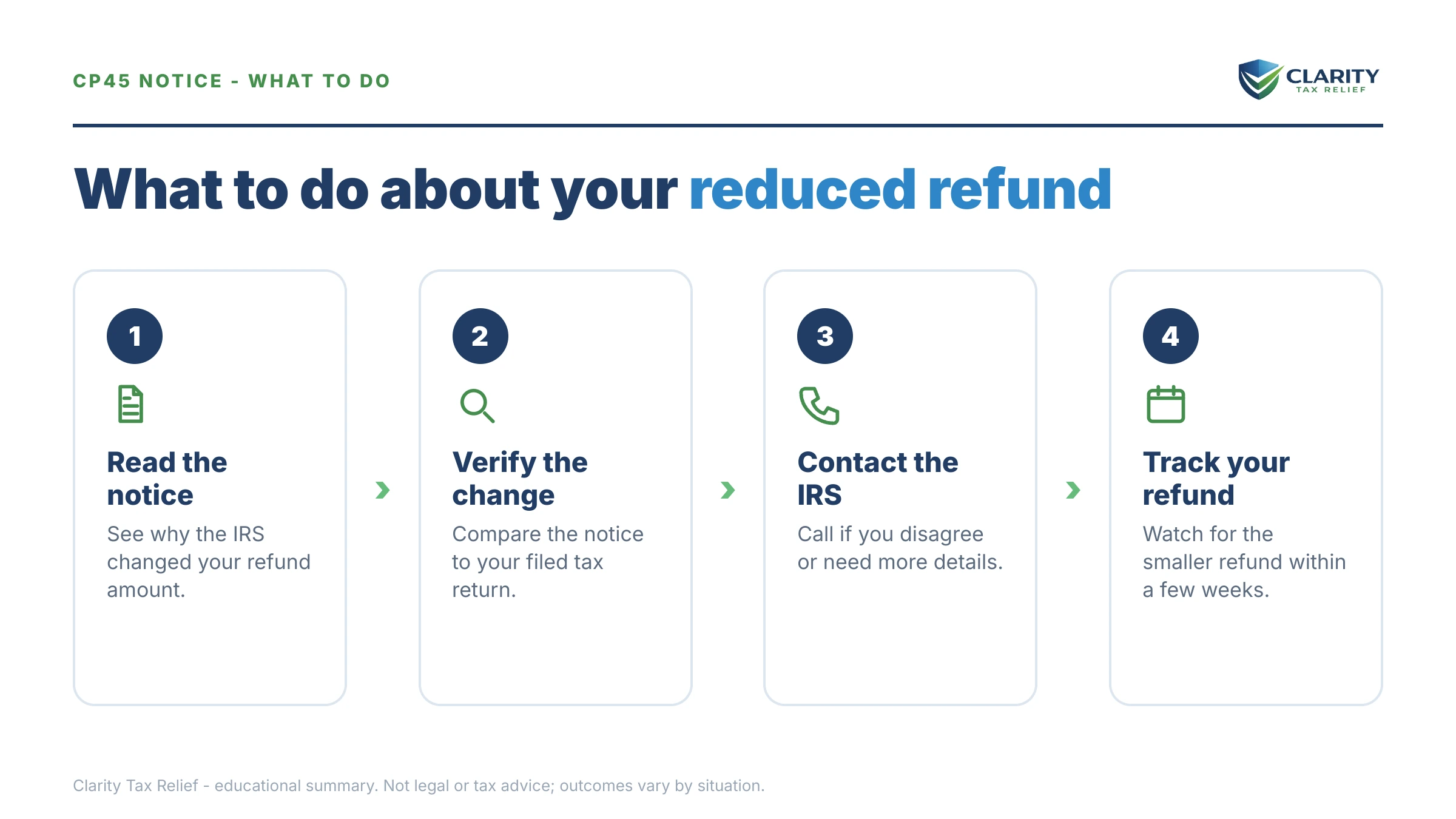
How to respond to a CP45 notice, step by step
- Find your shortfall. Compare the amount you elected to apply on your return with the applied amount printed on the CP45 — the difference is the gap you need to cover.
- Trace the missing money. Log in to your IRS online account and match the reduction to its cause — an adjustment notice, a prior-year balance, or an offset to another debt.
- Recalculate your 2026 estimates. Confirm what you actually need to pay in to reach a safe harbor — 100% of last year's total tax (110% if your AGI was over $150,000) or 90% of this year's.
- Cover the gap before the next quarterly due date. Make a catch-up payment at IRS.gov/payments or raise withholding with Form W-4V or Form W-4P, which counts as paid evenly through the year.
- Dispute the underlying change if it's wrong. Respond to the companion notice (CP11, CP12, CP49, or CP39) on its own timeline, and consider Form 8379 injured spouse if a spouse's separate debt took your share of a joint overpayment.
The IRS's own summary of the notice is at Understanding your CP45 notice — useful for confirming the notice you're holding is genuine and matches the current format.
When you can handle a CP45 yourself — and when help changes the outcome
Most CP45 situations are genuinely do-it-yourself. If the adjustment behind it is correct, the shortfall is modest, and you can make a catch-up payment or bump your withholding, there is nothing here that requires professional help — follow the five steps above and you're done in an afternoon.
Experienced help earns its cost in three situations. First, when the adjustment or offset itself is wrong: disputing a math-error correction or unwinding a misapplied payment means working the companion notice's deadline, and the sequencing matters. Second, when the offset revealed an old balance you didn't know about — the CP45 is often the first symptom of a prior-year debt that will keep intercepting your money every year until it's resolved; our guide for anyone retired and owing back taxes covers that fork in the road. Third, joint-return offsets against one spouse's separate debt, where an injured-spouse allocation can recover your share — but only if it's claimed correctly.
The honest test: if the only problem is the gap, fix it yourself; if the CP45 uncovered a debt, get the debt reviewed.
Terms on your CP45, decoded
- Overpayment — the amount you paid in beyond your total tax for the year; the pool your refund or credit-forward comes from.
- Credit elect — the election on Form 1040 to apply your overpayment to next year's estimated tax instead of taking a refund; the CP45 is the notice that this election failed.
- Offset — the government applying your overpayment to another debt (federal tax, state tax, child support, student loans) before you ever see it.
- Underpayment penalty — the interest-like charge, computed on Form 2210, for each quarter your estimated payments fall short of what was required.
- Safe harbor — the pay-in level that shields you from that penalty: 90% of this year's tax, or 100% of last year's (110% if your AGI exceeded $150,000).
- Withholding vs. estimated payments — withholding is treated as paid evenly across the year no matter when it happens; estimated payments count only when they're actually made. That difference is why a late-year withholding fix beats a late-year check.
CP45 notice questions, answered
What does a CP45 notice from the IRS mean?
A CP45 means the IRS could not apply all or part of your overpayment to next year's estimated taxes, even though you requested it on your return. It usually arrives because an adjustment or offset shrank the overpayment before it could be applied. The notice shows how much, if anything, was actually credited — and the gap between that number and what you requested is now your problem to cover.
Do I need to respond to a CP45 notice?
No response to the IRS is required if you agree with the notice — but doing nothing has a cost. Your estimated-tax account for the year is now underfunded, and the underpayment penalty accrues quarter by quarter until you cover the gap. If you disagree with the adjustment or offset that caused the CP45, call the number on the notice or respond to the companion notice that explains the change.
Will I owe a penalty because of a CP45?
You can, if you don't make up the shortfall. The estimated-tax underpayment penalty is figured like interest — the federal short-term rate plus 3 percentage points, computed on each quarter's shortfall for as long as it stays unpaid. Covering the gap quickly, or replacing it with withholding (which the IRS treats as paid evenly through the year), keeps the penalty small or eliminates it.
Where did the rest of my overpayment go?
The CP45 or a companion notice tells you. Common destinations: an IRS adjustment reduced the overpayment (CP11 or CP12), it was applied to a prior-year federal tax balance (CP44 or CP49), it went to a spouse's debt (CP39 or CP42), or the Treasury Offset Program took it for child support, state taxes, or federal student loans. Your IRS online account shows exactly where each dollar posted.
What's the difference between a CP45 and a CP44?
A CP44 says your refund is being delayed while the IRS decides whether you owe other federal taxes; a CP45 says the IRS could not apply your overpayment to next year's estimated taxes as you requested. CP44 is about a refund you wanted back; CP45 is about a credit-forward you wanted applied. Both usually trace back to the same root cause — another balance somewhere on your account.
I'm retired and on Social Security — how do I fix the shortfall without quarterly payments?
Use withholding instead. File Form W-4V to have 7%, 10%, 12%, or 22% withheld from your Social Security benefits, or Form W-4P to add withholding to pension or IRA distributions. Because the IRS treats withholding as paid evenly across the year — no matter when it starts — a withholding fix late in the year can erase an underpayment penalty that quarterly catch-up payments can't.
Does a CP45 mean I'm being audited?
No. A CP45 is an accounting notice, not an examination — nobody is questioning your deductions or asking for documents. It simply reports that the credit-forward you elected on your return could not be completed. The adjustment behind it (a math-error correction, for example) is also not an audit, though you have the right to dispute it if it's wrong.
Your next 24 hours
- Find the two numbers on the notice. The amount you asked the IRS to apply, and the amount it says was actually applied. Subtract; that shortfall is the whole problem, in one figure.
- Gather three documents. The CP45, your most recent tax return, and any companion notice that arrived around the same time (CP12, CP49, CP39, or an offset letter) — plus a look at your IRS online account balance if you can log in.
- Get the gap and the cause reviewed free. Call (888) 825-7779 or use the 2-minute form. The penalty on an uncovered shortfall accrues quarter by quarter — the sooner the gap is closed or the reduction disputed, the less this notice ends up costing you.
This guide is general information, not tax or legal advice for your specific situation. Eligibility for IRS programs depends on individual facts and circumstances; no outcome is guaranteed.