
IRS Notices
IRS CP39 Notice: Your Spouse's Refund Was Applied to Your Tax Debt (2026)
The short answer: a CP39 notice means the IRS applied all or part of a tax refund — from you, your spouse, or a former spouse — to a past-due tax debt in your name. Most often, the refund came from your spouse's or former spouse's account. No response is required if you agree, but any remaining balance keeps collecting interest and penalties until you resolve it.
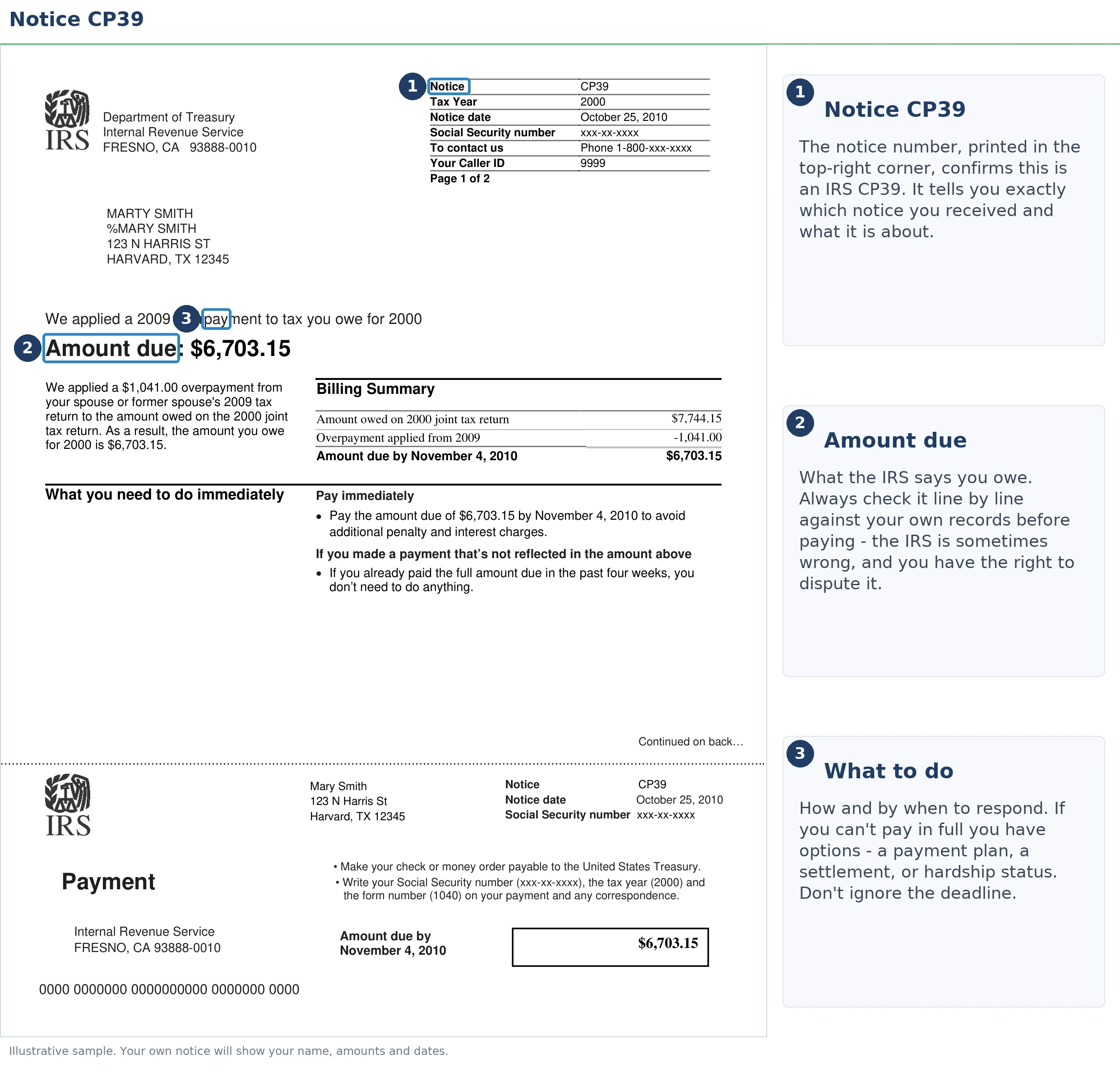
Maybe you're mid-refinance and the lender just asked whether you owe the IRS — and now a CP39 lands confirming that your spouse's refund got swept into an old balance of yours. It's an unwelcome surprise for both of you, but it's also a snapshot of exactly where the debt stands. Two numbers on that page decide everything that happens next: the amount applied and the amount you still owe.
The image below shows exactly what a CP39 looks like and where those two figures appear, so you can read your own notice with confidence before doing anything else. This guide covers the rest: whether the offset was correct, how your spouse can claim back their share, and how to resolve whatever balance survives.
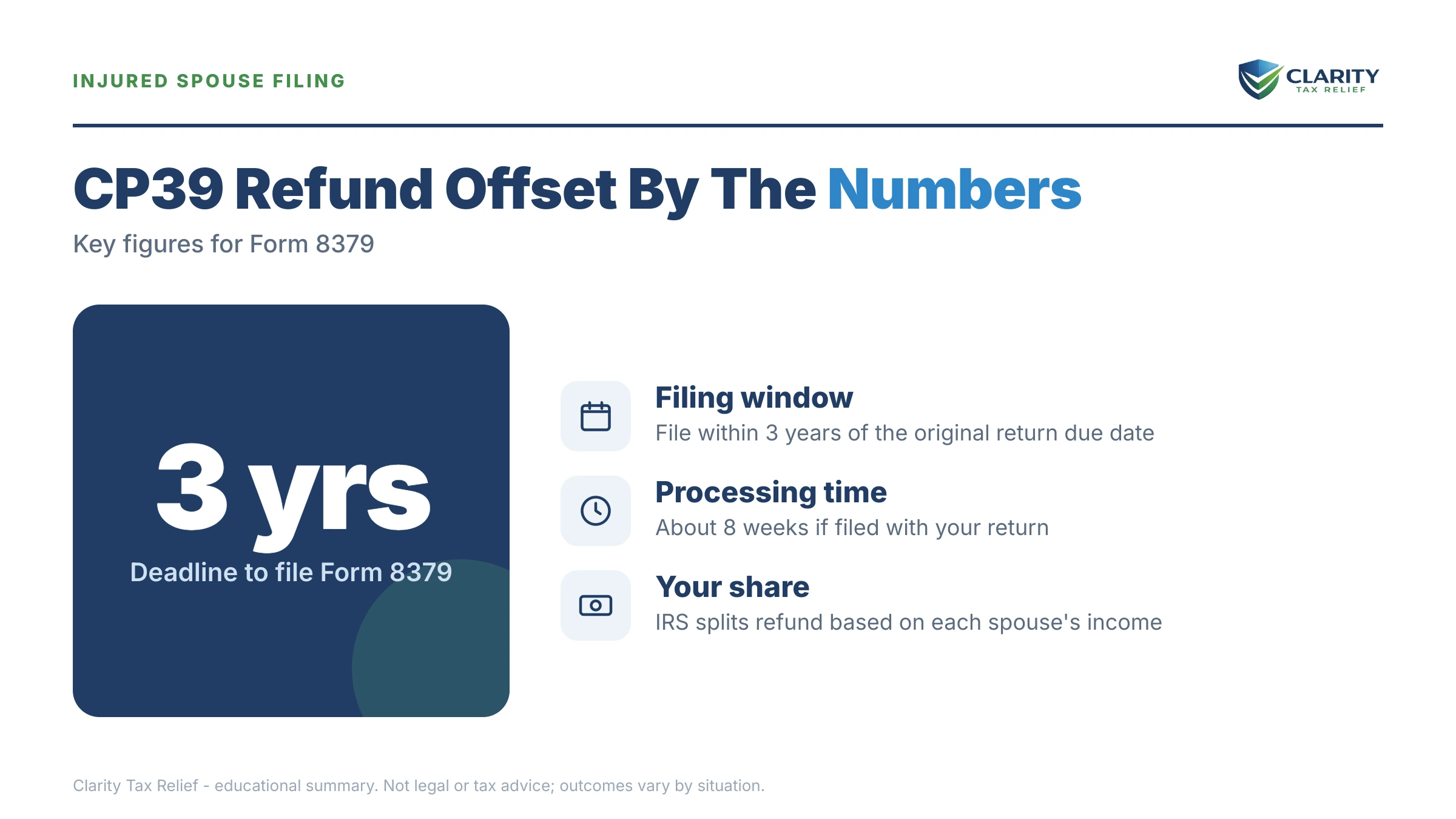
⏱ The clock on a CP39: there's no response deadline printed on this notice, but two clocks run anyway. Interest plus a 0.5% monthly failure-to-pay penalty accrue on any remaining balance, and your spouse's window to reclaim their share of the refund with Form 8379 is generally 3 years from filing the return (or 2 years from when the tax was paid).
Why you got a CP39 notice
A CP39 notice means the IRS applied a refund — from you, your spouse, or a former spouse — to your past-due tax balance. The most common scenario is a spouse offset: you filed a joint return that showed an overpayment, and the IRS's system automatically routed that refund to an older balance in your name before sending anyone a check.
The second common trigger involves an ex. If you and a former spouse still owe on a year you filed jointly, an overpayment on their account can be applied to that shared balance — and you get the CP39 telling you it happened.
The old debt itself can come from several places: a return you filed but couldn't fully pay, an underreporter adjustment, or an IRS math-error correction. If the balance began as a correction you never agreed to, the CP11 notice guide explains how those adjusted balances arise, and the CP12 notice guide covers the refund-side version. If you're not sure why the IRS is writing to you at all, start with why did I get a letter from the IRS.
One thing a CP39 is not: a demand or a levy warning. The money has already moved — this notice is the receipt. The only open question is what remains.
CP39 vs. CP42 vs. CP49: who got which notice
CP39, CP42, and CP49 describe three different refund offsets — the difference is whose refund paid whose debt. Couples often receive two of these the same week, describing the same transaction from opposite sides. Match yours before acting:
| Notice | Who receives it | What happened |
|---|---|---|
| CP39 | The spouse who owes the past-due debt | A refund from your spouse's or former spouse's account was applied to your balance |
| CP42 | The spouse whose refund was reduced | Their expected refund shrank because it paid a spouse's or ex-spouse's past-due debt |
| CP49 | The taxpayer who owes | Your own refund was applied to your own back taxes — no spouse involved |
Getting this right matters because the remedies differ. A CP39 recipient's job is to resolve the remaining balance. A CP42 recipient's job — if part of that refund was rightfully theirs — is to claim it back.
What happens if you ignore the remaining balance
A remaining balance on a CP39 goes straight back into the IRS's automated collection sequence — the same track that ends in levy notices. The offset doesn't reset anything; it just made the number smaller. If the notice shows anything on the amount-you-still-owe line, the machine keeps going:
- CP39 — refund applied, balance remains. You are here. Informational only; no new enforcement power.
- CP501 / CP503 — reminder bills on the remaining balance. Still just letters, but interest and the monthly penalty compound the whole way.
- CP504 — Notice of Intent to Levy. The IRS can now seize your state tax refund, and a Notice of Federal Tax Lien becomes a live risk — the public filing a refinance underwriter fears most.
- LT11 / Letter 1058 — final notice of intent to levy. It starts a 30-day clock, after which wage and bank levies are legal. You can demand a Collection Due Process hearing with Form 12153 during those 30 days.
One more quiet consequence: every future refund — yours or a joint one — will be swept the same way until the balance is gone. And in 2026, with IRS staffing down roughly 27%, humans are hard to reach, but the notice-and-levy system is fully automated and never paused.
Holding a CP39 with a balance left over?
The IRS already took the refund — the question is what happens to the balance that survived it. Send us a photo of your CP39 and an experienced tax professional will map the debt behind it, your spouse's refund rights, and the cheapest path to resolved — free, before another month of penalties and interest posts.
Your options for the balance a CP39 leaves behind
Any balance under $50,000 left after a CP39 can usually be put on an IRS payment plan online, often in under an hour. But a payment plan isn't the only path — which option fits depends on the size of the remainder and your finances:
| Option | Who it fits | Cost & terms |
|---|---|---|
| Pay in full | Any balance you can cover now | No fee; stops penalty and interest accrual immediately |
| Short-term plan | Balances you can clear within 180 days | $0 setup; interest and penalties continue until paid |
| Long-term installment agreement | Balances up to $50,000 — set up online, up to 72 months | Setup fee varies (lower with direct debit); accrual continues at a slower penalty rate |
| Currently Not Collectible | Paying anything would create genuine hardship (financial disclosure required) | $0; the debt remains and accrues, but active collection pauses |
| Offer in Compromise | Assets and income genuinely can't cover the debt — the IRS runs the math | $205 application fee (waived with low-income certification); roughly 1 in 5 offers accepted in FY2024 |
Penalty relief stacks with all of these. If your prior three years are clean, first-time penalty abatement can strip the failure-to-pay penalty from the balance — and starting summer 2026, the IRS's new Automatic Exemption from Penalty (AEP) begins applying qualifying relief automatically, with no request needed. Details on plan terms are on the IRS payment plans page.
A worked example: $27,500, a joint refund, and a refinance on the line
Say you owe $27,500 from a year before you married, and this year's joint return showed a $4,300 overpayment. The IRS applies the full $4,300 to your old balance and mails you a CP39. Remaining balance: $27,500 − $4,300 = $23,200.
Left alone, that $23,200 grows by the 0.5% monthly failure-to-pay penalty — about $116 a month — plus interest at the IRS's quarterly rate, compounding daily. You can estimate how fast your own balance grows with our IRS penalty & interest calculator.
On a 72-month streamlined installment agreement, $23,200 works out to roughly $323 a month before continuing interest — a documented plan most mortgage underwriters can work with. One wrinkle to plan for: if your spouse files Form 8379 and recovers, say, $1,800 of that applied refund as their share, your balance climbs back to about $25,000 and the 72-month payment rises to roughly $348. Decide the 8379 question before you set the plan amount, not after.
Your spouse's rights — and your dispute rights
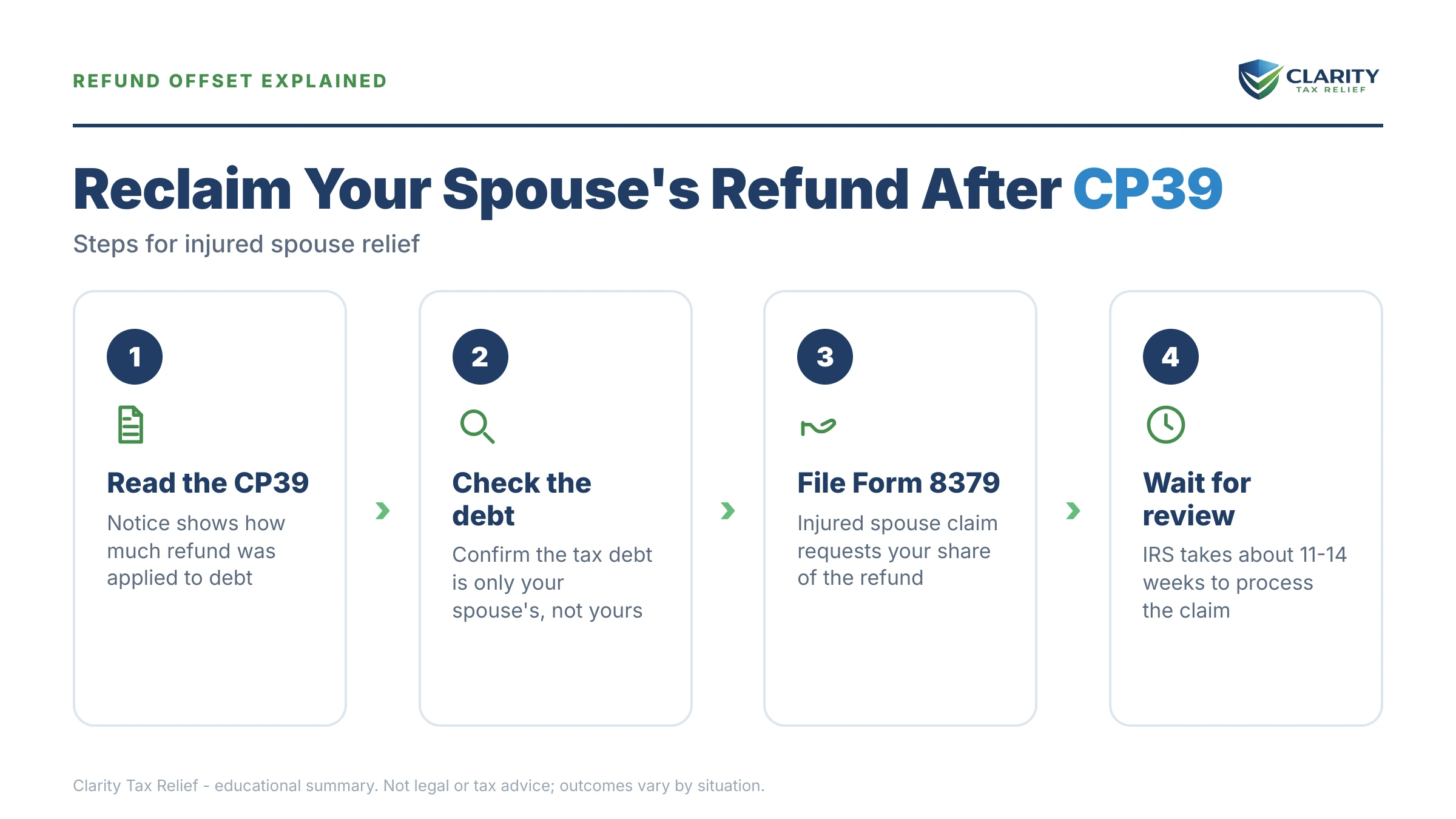
The spouse who doesn't owe the debt has a real claim to their share of the applied refund. If the offset refund came from a joint return, the non-liable spouse can file Form 8379, Injured Spouse Allocation, to recover the portion attributable to their income and withholding (the official form page is at About Form 8379). If instead the debt itself shouldn't be yours — a joint-year balance your ex created — that's an innocent spouse question, a different remedy entirely. The injured spouse vs. innocent spouse guide walks the line between them.
| What you want to do | Your window | How to claim it |
|---|---|---|
| Reclaim your spouse's share of the applied refund | Generally 3 years from filing the joint return, or 2 years from when the tax was paid | Form 8379, Injured Spouse Allocation |
| Dispute a joint-year debt your ex created | Varies by relief type — act while the IRS is still collecting | Form 8857, Request for Innocent Spouse Relief |
| Contest a future levy if the balance escalates to an LT11 | 30 days from the LT11 notice date | Form 12153, Collection Due Process hearing |
| Remove the failure-to-pay penalty on the balance | Any time the penalty is on the account | First-time abatement or reasonable cause (Form 843) |
How to respond to a CP39 notice, step by step
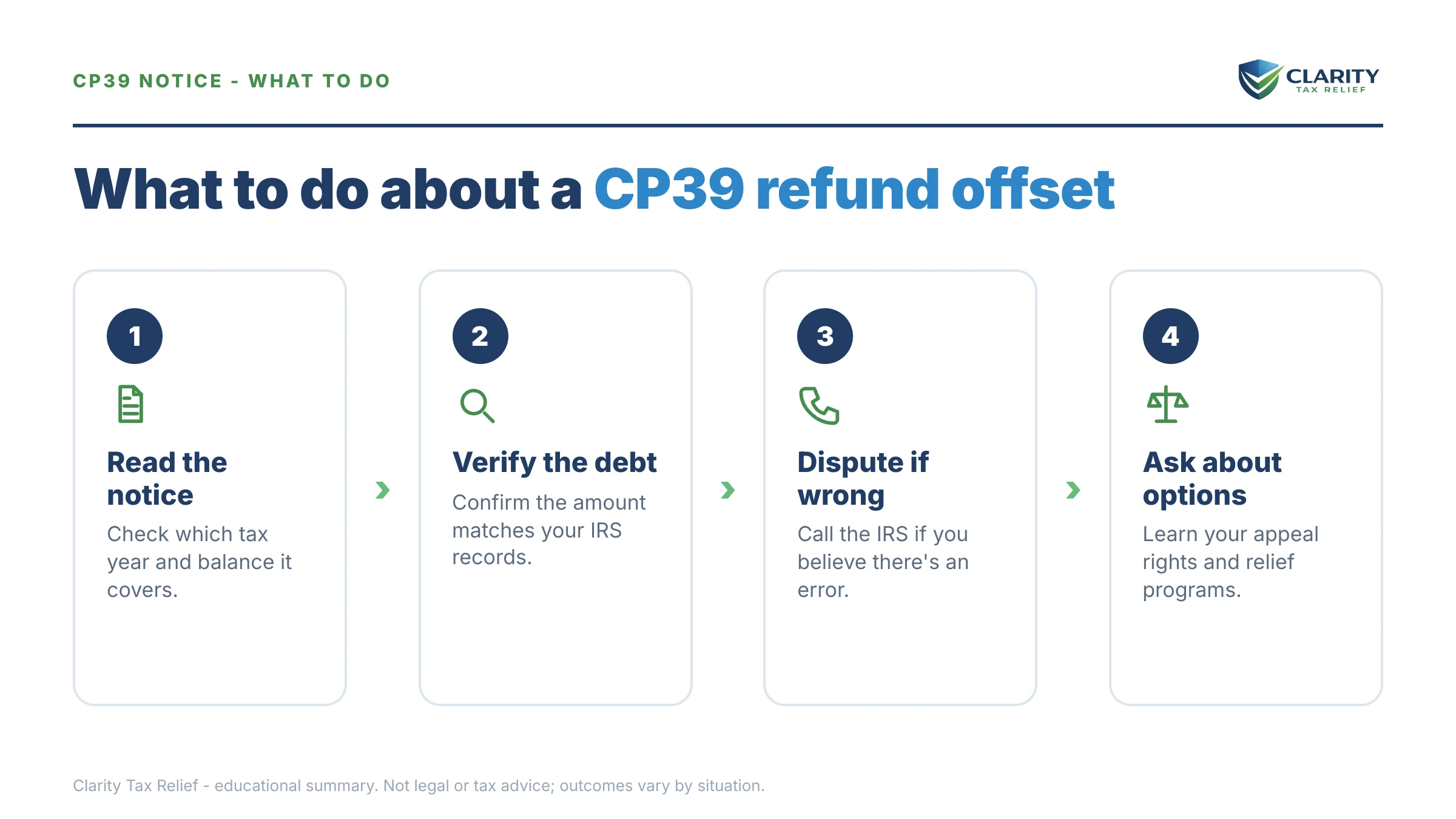
- Verify the offset. Log into your IRS online account and confirm the amount applied and the remaining balance match what's printed on the notice.
- Trace the underlying debt. Pull the tax year listed on the notice and confirm the balance is genuinely yours — not an IRS adjustment you never agreed to.
- Protect your spouse's share. If part of the applied refund was earned by your spouse, have them file Form 8379 before the claim window closes.
- Resolve the remaining balance. Pay it, start a payment plan, or request hardship status before the reminder notices begin arriving.
- Request penalty relief. If your prior three years are clean, first-time abatement can remove the failure-to-pay penalty that's growing the balance.
The IRS's own plain-language page on this notice is at Understanding your CP39 notice — worth a read alongside your account transcript.
Refinancing or buying with a CP39 balance on the books
Mortgage underwriters can approve a loan with an IRS balance — what they can't work around is an unresolved one. Loan applications ask about federal tax debt, and a balance discovered late in underwriting stalls closings. The two things that change the outcome:
First, a documented installment agreement in good standing. Many lenders will treat the monthly IRS payment like any other debt in your ratios, provided the agreement exists on paper and payments have started. Set it up before the lender orders final verifications, not after.
Second, no Notice of Federal Tax Lien. A lien is public record and changes the conversation from ratios to title. Resolving the balance early is how you keep one from being filed; if one already exists, refinancing with an IRS lien covers subordination and your realistic paths to closing. Buying rather than refinancing? The same logic applies — see buying a house while owing the IRS.
When you can handle a CP39 yourself
Most CP39s need no professional help at all. If the notice is accurate and the applied refund wiped the balance to zero, there is nothing to fix — file the notice with your tax records and move on. If a modest balance remains and you can pay it within 180 days, the free short-term plan takes minutes to set up. A straightforward online installment agreement under $50,000 is also comfortably DIY territory.
Experienced help changes the outcome in four situations: you dispute the underlying debt itself; the debt is a joint-year balance your ex created and an innocent spouse case needs building; a lien is threatening a closing date; or the remaining balance sits alongside other years, unfiled returns, or an amount too large for streamlined terms. In those cases, the order you fix things in changes what you ultimately pay.
Terms on your notice, decoded
A short decoder for the language printed on a CP39:
- Overpayment — the IRS's word for a refund before it's paid out; on a CP39, an overpayment on your spouse's account became a payment on your debt.
- Offset — applying money owed to a taxpayer against money owed by a taxpayer, done automatically before any refund check is cut.
- Injured spouse — the spouse whose refund share was taken for a debt that isn't theirs; the remedy is Form 8379.
- Innocent spouse — a spouse seeking release from a joint-year debt itself, usually because the other spouse caused it; the remedy is Form 8857.
- Failure-to-pay penalty — the 0.5% monthly charge that accrues on any unpaid balance, on top of interest.
- Notice of Federal Tax Lien — a public filing securing the IRS's claim against your property; it doesn't take anything, but it complicates any sale or refinance.
CP39 notice questions, answered
Why did I get a CP39 notice?
You got a CP39 because the IRS applied all or part of a refund — from you, your spouse, or a former spouse — to a past-due tax debt in your name. It usually follows a jointly filed return that showed an overpayment while one spouse carried an older separate balance. The notice shows the amount applied and whatever balance remains.
What is the difference between a CP39 and a CP42 notice?
They are mirror images of the same offset. The CP39 goes to the spouse who owes the debt, confirming the refund was applied to their balance. The CP42 goes to the spouse whose refund was reduced. In many households both notices arrive the same week, describing the same transaction from opposite sides.
Can my spouse get their share of the refund back after a CP39?
Often, yes. If the refund came from a joint return and part of it was earned by the spouse who does not owe the debt, that spouse can file Form 8379, Injured Spouse Allocation, to recover their share. The claim generally must be filed within 3 years of the return's filing date or 2 years of the payment. Any amount refunded to your spouse is added back to your balance.
Do I have to respond to a CP39 notice?
No response is required if the notice is accurate and no balance remains — the offset already happened. You do need to act if a balance remains (set up payment or a plan before reminder notices start) or if you disagree with the debt itself, in which case call the number on the notice and dispute it with documentation.
Does a CP39 mean my tax debt is paid off?
Only if the applied refund covered the entire balance — check the amount-you-still-owe line on the notice. If any balance remains, interest and the 0.5% monthly failure-to-pay penalty keep accruing on it, and the account stays in the IRS collection stream until it is paid or resolved.
Will a CP39 notice affect my mortgage or refinance?
The notice itself is not reported to lenders or credit bureaus, but the underlying balance can surface in underwriting. Loan applications ask about federal tax debt, and an unresolved balance can stall approval — especially if the IRS files a Notice of Federal Tax Lien, which is public record. A documented payment plan in good standing is the standard fix lenders accept.
What if the CP39 debt belongs to my ex-spouse, not me?
If the debt comes from a jointly filed year, the IRS can collect it from either spouse regardless of what your divorce decree says. If your ex caused the understatement and you did not know about it, innocent spouse relief under Form 8857 may remove your liability. Dispute quickly — relief gets harder to document as years pass.
What if I already paid the debt shown on my CP39?
Check your IRS online account to see whether your payment posted to the right tax year — payments applied to the wrong year are a common cause of phantom balances. If your records show the debt was paid before the offset, call the number on the notice with proof; the applied refund can be corrected once the account is fixed.
Your next 24 hours
- Find the two numbers. On your CP39, locate the amount the IRS applied from your spouse's refund and the amount-you-still-owe line — that second figure is the one every decision hangs on.
- Gather three documents. The CP39 itself, the joint return that produced the refund, and any proof of payments you've already made toward the old balance.
- Get the free case review. Use the 2-minute form or call (888) 825-7779 — an experienced tax professional will confirm the offset was correct, weigh the Form 8379 question against your remaining balance, and set the resolution up before another month of penalties and interest posts.
This guide is general information, not tax or legal advice for your specific situation. Eligibility for IRS programs depends on individual facts and circumstances; no outcome is guaranteed.