
IRS Notices
IRS CP42 Notice: Your Refund Was Applied to Your Spouse's Tax Debt (2026)
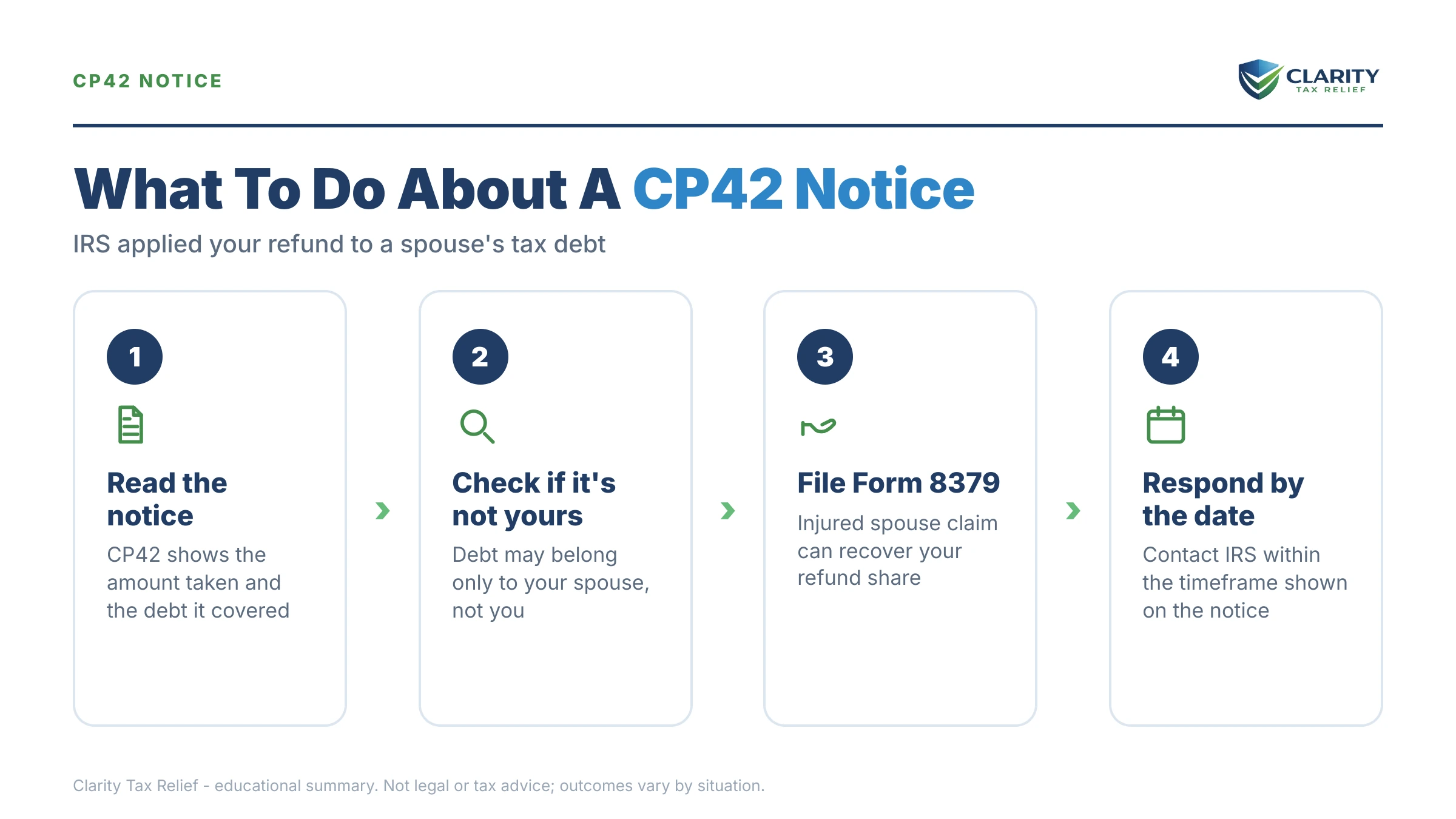
The short answer: a CP42 notice means the IRS took some or all of your tax refund and applied it to your spouse's separate past-due tax debt. You did nothing wrong — and if the debt is genuinely not yours, Form 8379 (Injured Spouse Allocation) can recover your share of that refund.
You filed a joint return, watched "Where's My Refund" say approved, and then the money never landed — instead a CP42 arrived saying your refund went to a tax debt your spouse ran up, maybe years before you even met. That's infuriating, and it's also recoverable. There is a specific IRS form built for exactly this, and a real filing window to use it.
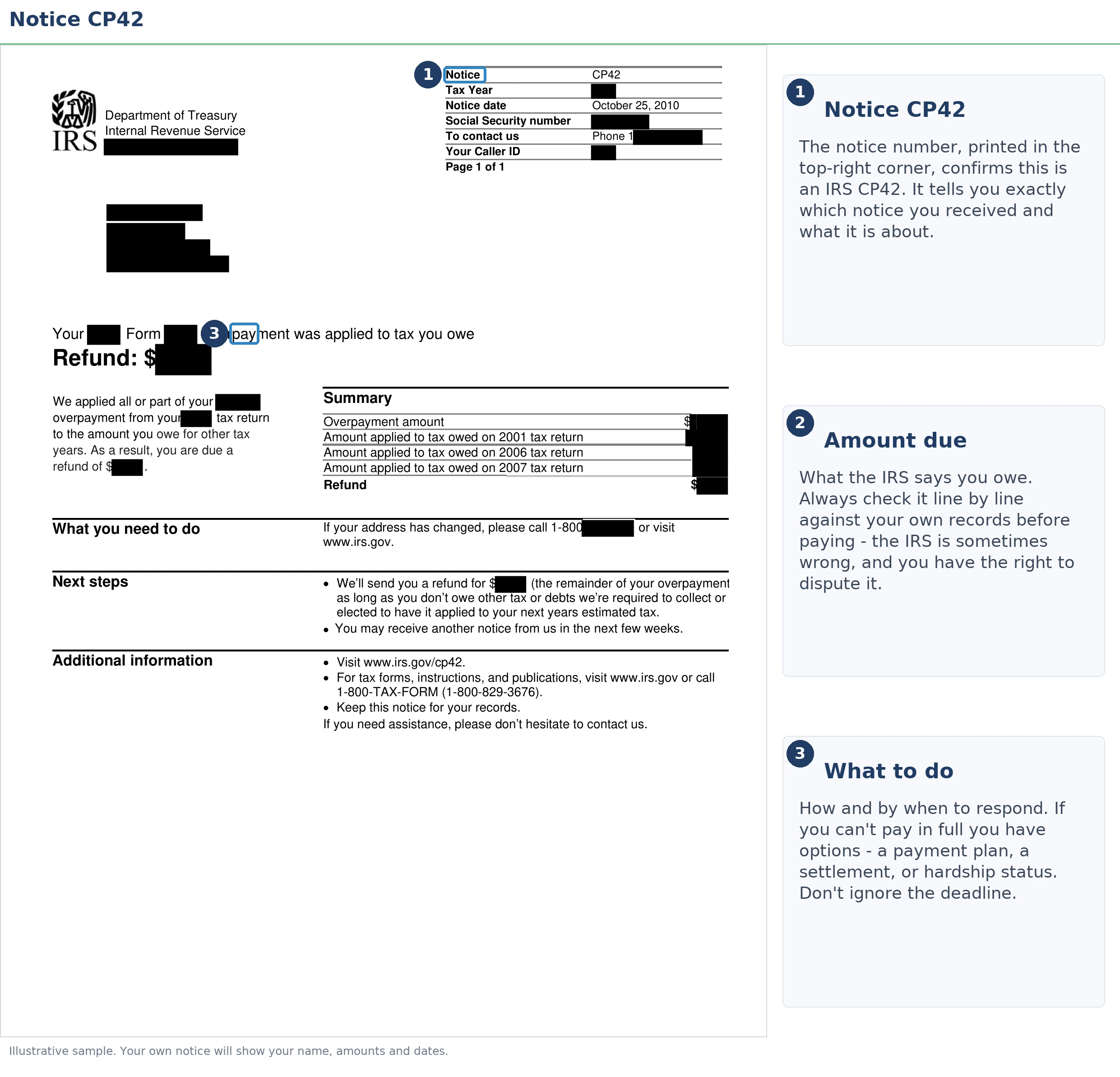
Everything turns on two facts printed on the notice — whose debt was paid and which tax year that debt comes from. The image below shows exactly what a CP42 looks like and where to find both.
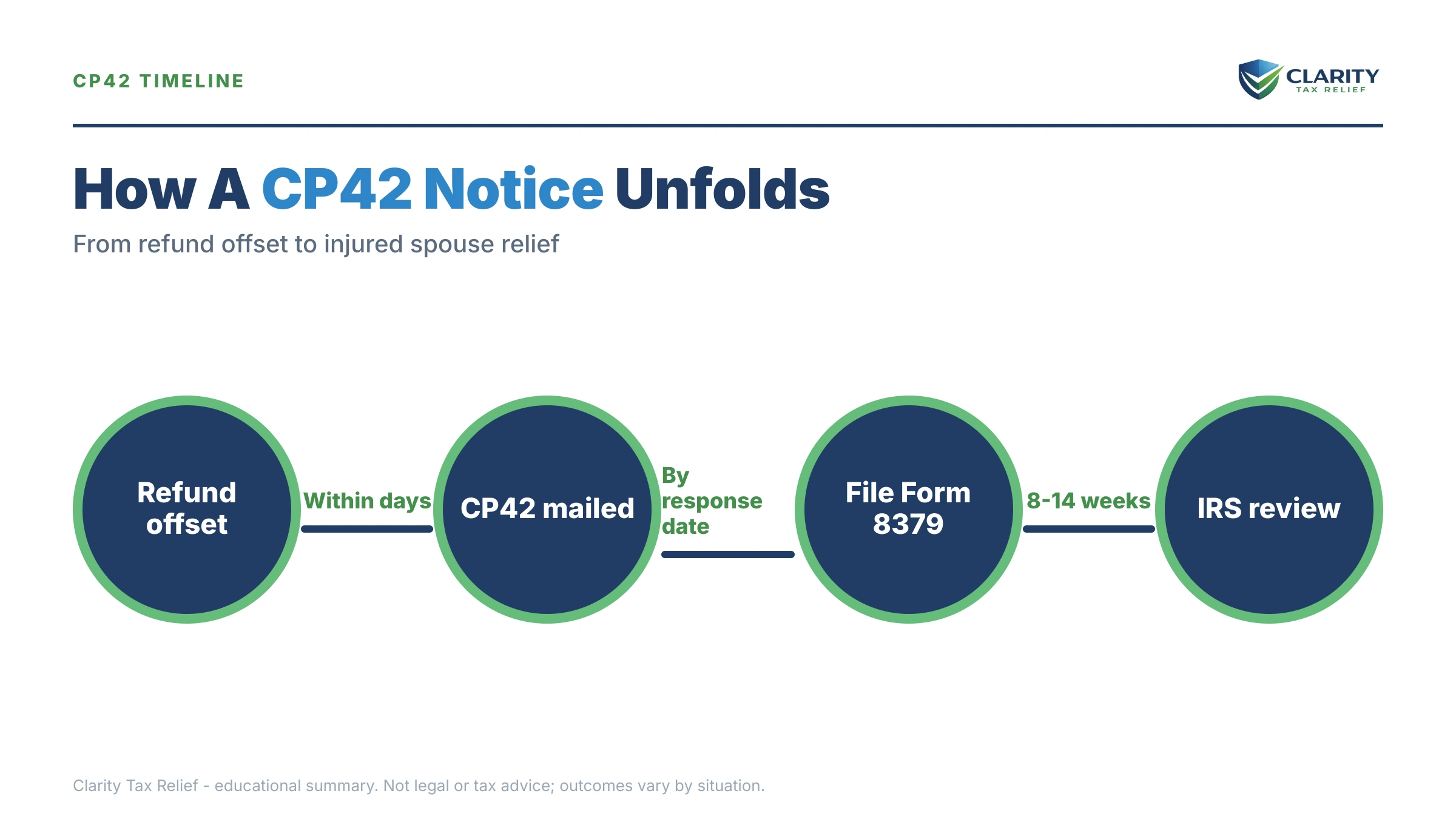
⏱ Your real clock: you generally have 3 years from the due date of the joint return (or 2 years from when the tax was paid, whichever is later) to file Form 8379 and claim your share of the offset refund. The CP42 itself has no response deadline — but once that claim window closes, your portion of this year's refund is gone permanently.
Why you got a CP42 notice
A CP42 is triggered when a joint return produces a refund and IRS records show one spouse — not both — owes past-due federal tax from a separate account. The debt is your spouse's, but the refund was joint, so the IRS treats the whole overpayment as available and applies it to that balance before releasing anything to you.
The debt behind a CP42 usually comes from one of three places: tax years before your marriage, a year your spouse filed separately or as single, or a business balance assessed against your spouse individually. If you're not sure why the IRS mails what it mails, our overview of why you got a letter from the IRS covers the system in general — this page covers only the CP42.
One thing a CP42 does not mean: that the debt is now yours. An offset is not an assessment against you. The IRS reached the refund because your names were on it together — not because you're personally liable.
CP42 vs. CP39 vs. CP49: which refund, whose debt
The IRS uses three different notices for "we kept a refund," and the right response is different for each. Your CP42 states the debt details in the middle of page one — the image below shows what the notice looks like and where that section sits, so you can confirm you're actually holding a CP42 and not one of its cousins.
| Notice | Whose refund was taken | Whose debt it paid | Your main remedy |
|---|---|---|---|
| CP42 | Yours (from a joint return) | Your spouse's separate federal tax debt | Form 8379 injured spouse claim |
| CP39 | Your spouse's or ex-spouse's | A federal tax debt you owe | Verify the balance, then resolve your own debt |
| CP49 | Yours | Your own back taxes from another year | Verify the balance; dispute or set up a plan |
| Treasury Offset Program letter (Bureau of the Fiscal Service) | Yours (joint) | Non-tax debt — child support, federal student loans, state tax | Form 8379 for a spouse's non-tax debt; disputes go to the agency owed |
If your notice is actually a CP39 notice or a CP49 refund-applied notice, an injured spouse claim won't help — the debt is on your side of the ledger. And if the money went to student loans or child support, that offset ran through the Treasury Offset Program, which comes with its own letter from the Bureau of the Fiscal Service rather than a CP42. If your refund simply changed or stalled without being applied to anyone's debt, you're likely looking at a CP12 notice (a math-error adjustment) or a CP05 notice (a refund review) — different problems entirely.
Injured spouse or innocent spouse: which relief fits your CP42
A CP42 almost always calls for injured spouse relief, not innocent spouse relief — and mixing them up wastes months. The test is simple: whose name is on the return that created the debt.
If the debt comes from your spouse's separate return, single years, or pre-marriage years, you are an injured spouse: the debt isn't yours, only the refund got caught. Form 8379 recalculates the refund and returns the portion generated by your income, your withholding, and your estimated payments.
If the debt comes from a joint return you signed — say your spouse understated income on a return you filed together — Form 8379 doesn't apply, because legally you owe that balance too. The path there is innocent spouse relief on Form 8857, which asks the IRS to remove your liability entirely. The full comparison lives in our guide to injured spouse vs. innocent spouse; for a CP42, start from the assumption that you're injured, then check the debt year to confirm.
What happens if you ignore a CP42
Nothing on a CP42 threatens a levy or lien against you — the enforcement already happened when the refund was taken. Ignoring it doesn't trigger escalating collection letters; instead, it quietly locks in losses in a predictable sequence:
- This year's refund stays applied. The offset is final unless you file Form 8379 — the IRS never re-examines it on its own.
- Next year's refund follows. Every joint refund you file for gets offset the same way until the debt is paid or resolved — the pattern our guide on whether the IRS will take your refund every year walks through in detail.
- Your claim window closes. After roughly 3 years from the joint return's due date, the law bars the refund claim — your share becomes permanently unrecoverable.
- The underlying debt keeps compounding. Interest and penalties accrue on your spouse's balance monthly, and their collection case can escalate to liens and levies that complicate jointly owned property — even though you're not liable.
Here's the deadlines picture in one place — each clock, and the right it protects:
| Clock | Typical window | What's at stake if it passes |
|---|---|---|
| Injured spouse refund claim (Form 8379) | Generally 3 years from the joint return's due date, or 2 years from payment, whichever is later | Your share of this year's offset refund — gone for good |
| Innocent spouse request (Form 8857), if the debt is joint-year | Generally 2 years from the IRS's first collection activity for most relief types | Relief from liability on a joint-return debt |
| Your spouse's collection statute (CSED) | 10 years from assessment, pausable by appeals, an OIC, or bankruptcy | Once it expires, the IRS can no longer offset refunds for that debt |
| Next filing season | Attach Form 8379 when you file the joint return | Filing it up front protects your share before the offset instead of after |
Holding a CP42 right now?
The IRS already has this year's refund — and it will take next year's the same way unless something changes. Send us the notice and we'll map your injured spouse claim, the allocation math, and whether the underlying debt itself can be resolved. Free, confidential review by an experienced tax professional.
Your options after a CP42 notice
You have more than one lever: recover this year's money, protect future refunds, or shrink the debt that keeps causing the offsets. Most people end up combining two or three of these.
| Option | What it does | Best when |
|---|---|---|
| Form 8379 for this year | Recovers your allocable share of the offset refund; no filing fee; typically around 8 weeks when filed by itself | The debt is your spouse's alone and you had income, withholding, or estimated payments on the joint return |
| Form 8379 attached to each future return | Protects your share up front, before any offset happens | The debt will take years to resolve and you keep filing jointly |
| Married filing separately | Keeps your refund entirely out of reach for your spouse's separate debt | The extra tax cost of MFS is smaller than the refund you'd otherwise chase each year |
| Adjust withholding or estimated payments | Shrinks the refund so there's little for the IRS to take | You'd rather keep the money during the year than reclaim it after |
| Innocent spouse relief (Form 8857) | Removes your liability for a joint-year debt entirely | The debt comes from a joint return with income or errors you didn't know about |
| Resolve the underlying debt | A payment plan, Offer in Compromise, or hardship status stops the annual offsets at their source | The balance is large and offsets alone will never catch up |
Our Form 8379 injured spouse walkthrough covers the allocation line by line. On the filing-status question, the trade-offs cut both ways — see filing separately when your spouse owes the IRS before you switch, because losing the EITC or education credits often costs more than the offset does. The IRS's own form page is at About Form 8379, Injured Spouse Allocation.
The injured spouse math, worked through
Form 8379 works by splitting the joint return in two: your income and payments on one side, your spouse's on the other, and the refund allocated accordingly. Here's a clearly hypothetical example showing how strongly the math can favor a 1099 earner.
Say you're a self-employed contractor who netted $118,000 on 1099s last year, and your spouse — who carries a $92,700 tax debt from a business that failed years before you married — had no income. You made four quarterly estimated payments of $6,500, or $26,000 total. The joint return shows $19,800 in total tax:
- $26,000 paid in − $19,800 tax = $6,200 refund
- The IRS applies all $6,200 to the $92,700 debt (leaving $86,500) and mails you a CP42
- On Form 8379: 100% of the income is yours and 100% of the estimated payments are yours — estimated payments are allocated to the spouse who made them, which is exactly the position most 1099 filers are in
- In a non-community-property state, essentially the entire $6,200 is allocable to you and recoverable
Two caveats. First, in the nine community property states, state law can require splitting community income and the refund it generated — often roughly in half — so your recovery may shrink; our guide to community property tax relief explains how those states treat spousal debt. Second, notice the bigger arithmetic: at $6,200 a year against a $92,700 balance that grows with interest, offsets alone would run well past a decade — which is longer than the IRS may even have. The debt carries a 10-year collection statute from assessment (pausable by appeals, an OIC, or bankruptcy); you can estimate when your spouse's debt actually expires with our CSED Calculator. For a balance this size, resolving the debt itself — not just reclaiming refunds — is usually the move that ends the cycle.
How to respond to a CP42 notice, step by step
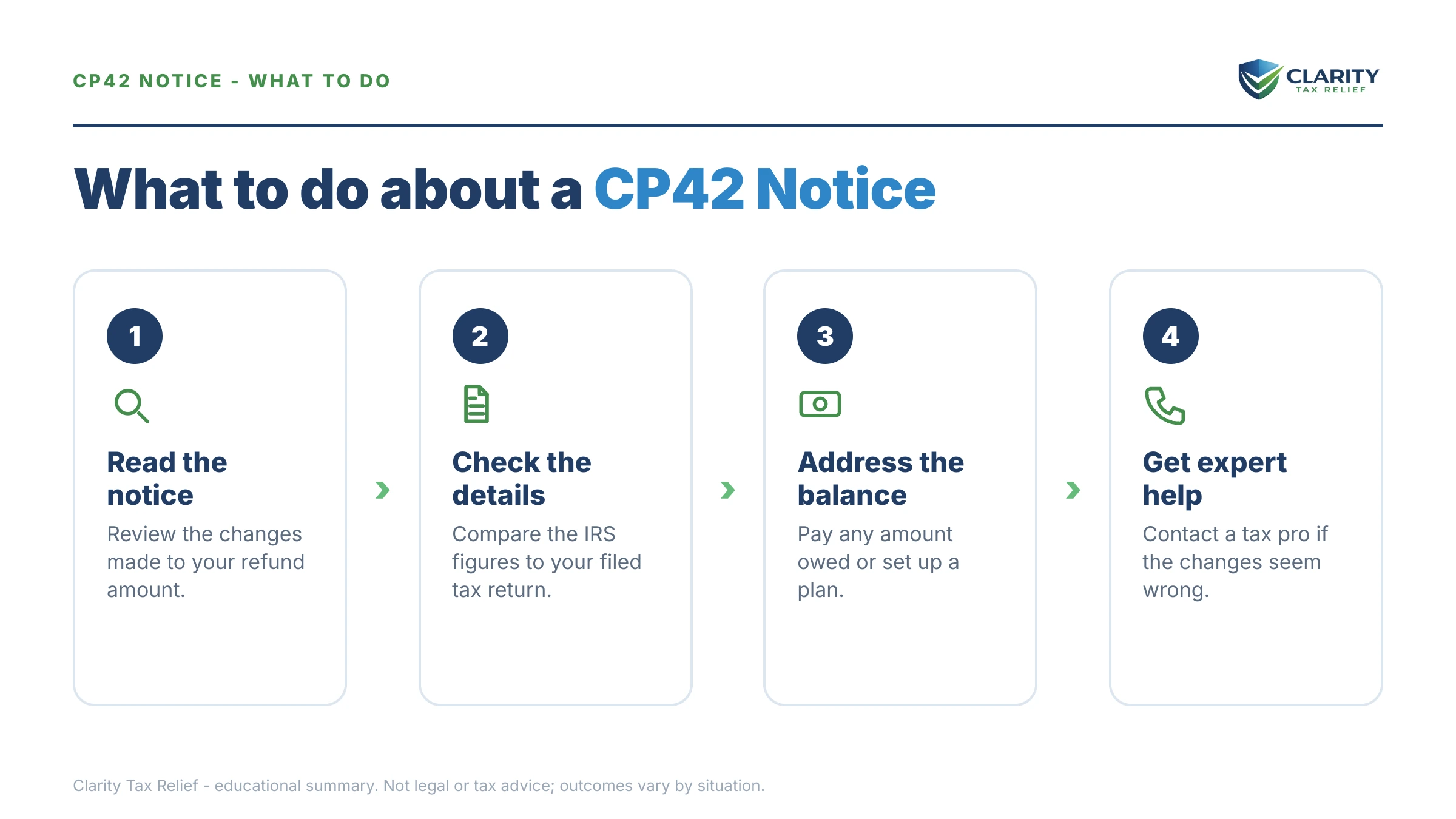
- Find whose debt it paid: your CP42 names the spouse whose debt received the money and the tax year it came from. Write both down — those two facts decide every step that follows.
- Verify the debt in the IRS online account: have your spouse log in at IRS.gov and confirm the balance, the tax year, and that it comes from a separate return or pre-marriage year — not a joint return you signed.
- Decide injured spouse or innocent spouse: if the debt is your spouse's alone, you are an injured spouse and Form 8379 applies. If the debt is from a joint return, injured spouse relief does not fit — evaluate innocent spouse relief on Form 8857 instead.
- File Form 8379 to claim your share: complete the Injured Spouse Allocation showing your income, withholding, and estimated tax payments, and file it — generally within 3 years of the joint return's due date.
- Protect next year's refund: attach Form 8379 to next year's joint return, reduce your estimated payments so less refund builds up, or start resolving the underlying debt so the offsets stop at the source.
The IRS's official explanation of this notice is at Understanding your CP42 notice — worth a read alongside your specific numbers.
When you can handle a CP42 yourself
Plenty of CP42 situations are genuinely do-it-yourself. If the debt is clearly your spouse's alone, the offset covers one tax year, and your income and payments are cleanly separate — one W-2 or a tidy set of 1099s and quarterlies — Form 8379 is a form you can complete in an evening, for free. File it, wait the roughly 8 weeks, and you're done.
Experienced help changes the outcome in a narrower set of cases: you live in a community property state and the allocation is contested; the debt mixes joint-year and separate-year balances so injured and innocent spouse relief overlap; your Form 8379 was denied or reduced and you need to push back; or the underlying balance is large — like the $92,700 in our example — and the real fix is a payment plan, Offer in Compromise, or hardship status for your spouse rather than a yearly refund chase. If a claim stalls far past normal processing times, the Taxpayer Advocate Service is a free, independent escalation path inside the IRS.
Terms on your CP42, decoded
- Overpayment — the IRS's word for your refund: the amount you paid in beyond the tax you owed.
- Offset — applying a refund to a debt instead of paying it out; it is not a new assessment against you.
- Injured spouse — a spouse whose share of a joint refund was taken for the other spouse's separate debt; the remedy is Form 8379.
- Allocation — the Form 8379 math that splits the joint return's income, payments, and refund between the two spouses.
- Community property — state law (in nine states) treating income earned during marriage as owned by both spouses, which can change how much of the refund you recover.
- CSED — the Collection Statute Expiration Date: the 10-year deadline after which the IRS can no longer collect a debt, including by offsetting refunds.
CP42 questions, answered
Why did the IRS take my refund for my spouse's tax debt?
Because you filed a joint return, and the IRS treats a joint refund as belonging to both spouses — so it applies the overpayment to either spouse's past-due federal tax before releasing a dime. The offset does not make you legally liable for the debt. If the debt is your spouse's alone, Form 8379 lets you claim back the portion generated by your own income and payments.
Can I get my refund back after a CP42 notice?
Yes, if the debt belongs only to your spouse and you reported income, withholding, or estimated payments on the joint return. File Form 8379, Injured Spouse Allocation — generally within 3 years of the joint return's due date. The IRS recalculates your share and refunds it, typically in about 8 weeks when the form is filed by itself. Community property states can reduce the amount you recover.
What is the difference between a CP42 and a CP39?
They are mirror images. A CP42 means your refund was applied to your spouse's past-due tax debt; a CP39 means your spouse's (or ex-spouse's) refund was applied to a debt you owe. If your refund went to your own back taxes instead, that arrives as a CP49. The remedy differs: CP42 usually calls for an injured spouse claim, while CP39 and CP49 call for verifying and resolving the underlying balance.
Do I file injured spouse or innocent spouse for a CP42?
Almost always injured spouse. Injured spouse relief (Form 8379) recovers your share of a refund taken for your spouse's separate debt — which is exactly what a CP42 describes. Innocent spouse relief (Form 8857) is different: it removes your liability for a debt from a joint return you signed, such as unreported income you didn't know about. If the offset paid a joint-year balance, look at Form 8857 instead of 8379.
Do I have to file Form 8379 every year?
Yes, for as long as the debt exists and you keep filing jointly with a refund. Each year's offset requires its own Form 8379 — there is no standing election. The efficient move is attaching the form to your joint return when you file, so the IRS calculates your protected share before applying anything to the debt instead of taking the refund first and making you claim it back.
Does a CP42 mean I owe my spouse's tax debt?
No. An offset is not an assessment against you — you are not personally liable for tax from your spouse's separate returns or pre-marriage years, and the IRS cannot levy your separate wages or accounts for it. What the IRS can reach is any joint refund you file for and, in the nine community property states, some community income. Marriage alone never transfers the debt to you.
How long does Form 8379 take to process?
Roughly 8 weeks when filed by itself after the joint return has processed, roughly 11 weeks when e-filed with the return, and up to about 14 weeks with a paper return. With IRS staffing down roughly 27% since 2025, real-world times can run longer. Check status by calling the IRS or through your online account; the Taxpayer Advocate Service can help if the claim stalls past normal timeframes.
Should we file separately if my spouse owes back taxes?
Sometimes, but run the numbers first. Married filing separately keeps your refund fully out of reach for your spouse's separate debt, with no annual Form 8379. The cost: you typically lose credits like the EITC and education credits, hit less favorable brackets, and both spouses must itemize or both take the standard deduction. For many couples, filing jointly with Form 8379 attached nets more money than filing separately.
Your next 24 hours
- Find the debt details on page one of your CP42 — note the spouse named, the tax year the debt comes from, and the exact dollar amount applied. Those three items determine whether you're an injured spouse.
- Gather your paperwork: the joint return, your 1099s or W-2s, and proof of your withholding and estimated payments — that's everything Form 8379's allocation asks for.
- Get a free case review at the 2-minute form or (888) 825-7779 if the debt is large, the split isn't clean, or you're in a community property state — the offset will repeat every filing season, and interest keeps building on the underlying balance until it's actually resolved.
This guide is general information, not tax or legal advice for your specific situation. Eligibility for IRS programs depends on individual facts and circumstances; no outcome is guaranteed.