
IRS Notices
IRS CP44 Notice: Your Refund Is Delayed Because You May Owe Other Taxes (2026)
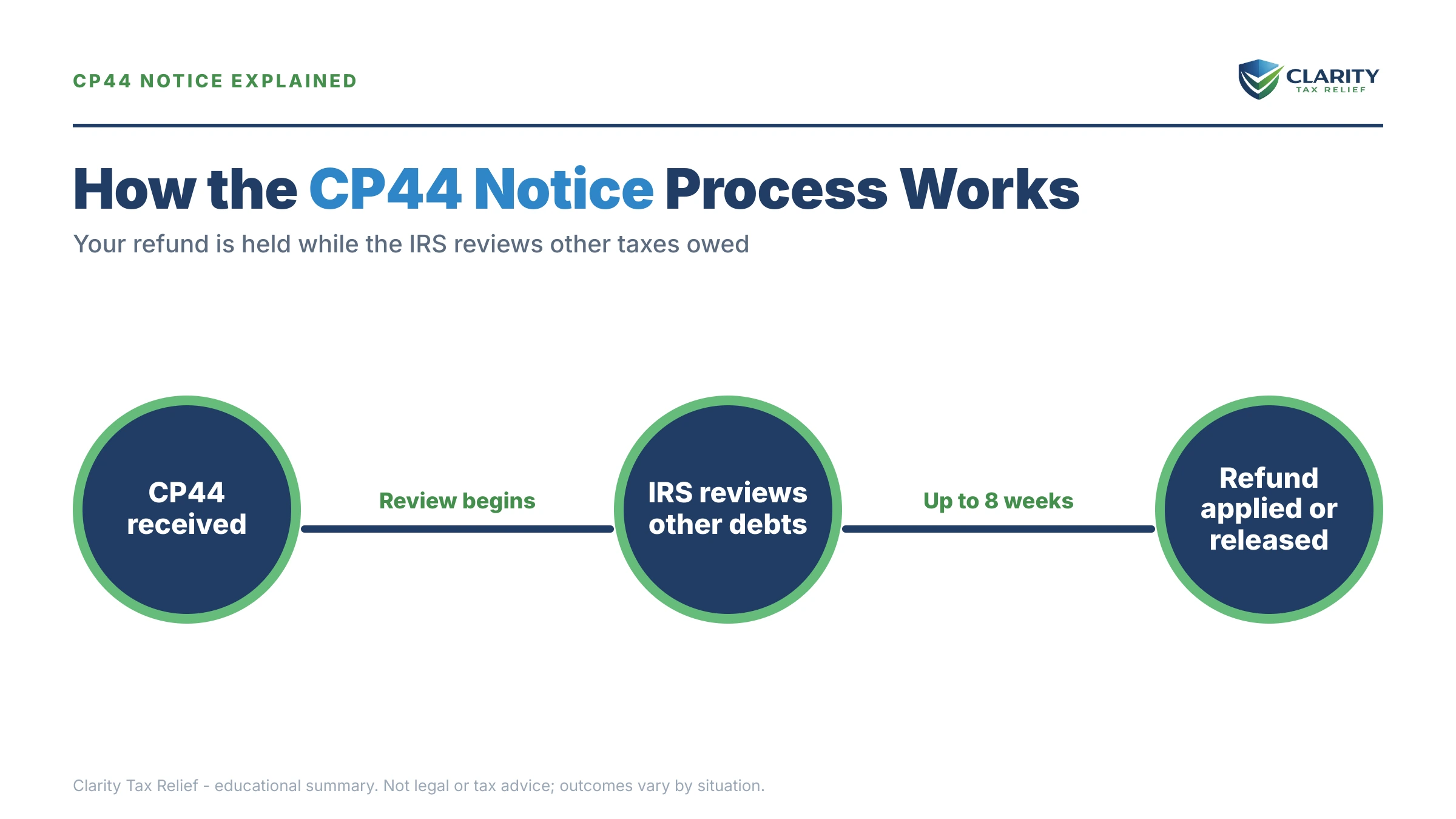
The short answer: a CP44 notice means the IRS is delaying your tax refund while it checks whether you owe other federal taxes. You don't have to respond. Within several weeks the IRS will either apply the refund to a balance you owe — you'd then get a CP49 or CP42 — or release it to you in full.
You tracked your refund for weeks, and instead of a deposit you got a letter saying the money is delayed because you "may owe other taxes" — without saying which taxes, how much, or for how long. That vagueness is the worst part of a CP44, and it's fixable: the answer is sitting in your IRS account right now, and this guide shows you how to pull it.
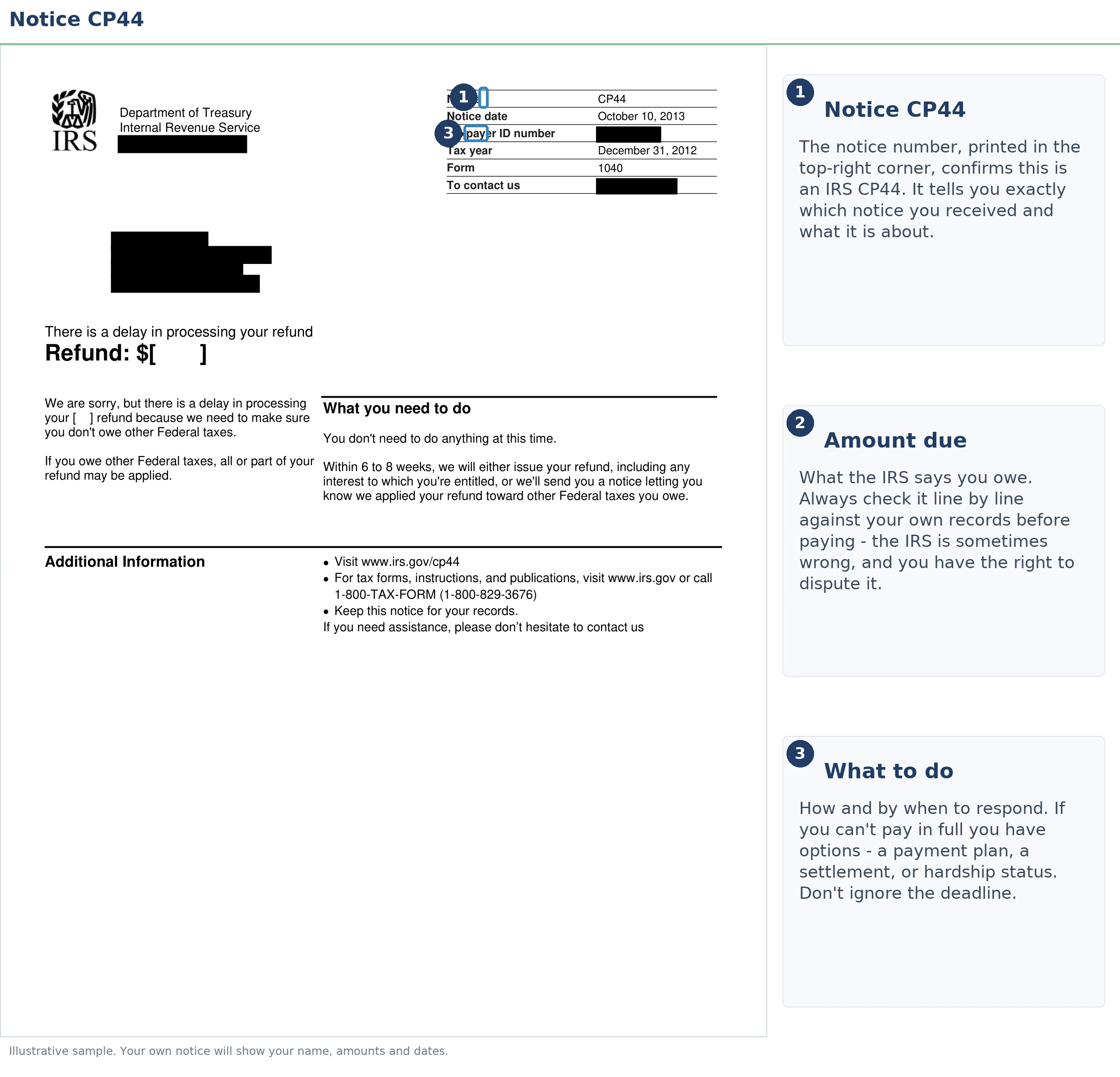
Unlike almost every other IRS letter, a CP44 asks you for nothing — no payment, no documents, no phone call. But "no action required" is not the same as "nothing worth doing." There is exactly one window in this process where you can still influence where your refund goes, and it closes the day the review ends. The image below shows you exactly what a CP44 looks like and where to find the tax year and refund amount the IRS is holding.
⏱ The real clock: a CP44 sets no response deadline — the notice itself says no action is needed while the IRS reviews. The clock that matters runs on whatever balance is behind the hold: interest compounds daily and the failure-to-pay penalty adds 0.5% per month to that balance until it's resolved.
Why you got a CP44 notice
The IRS sends a CP44 notice when your return shows a refund but IRS records suggest you may owe other federal taxes — so the refund is frozen while the IRS matches your overpayment against every account tied to you. Your return itself was accepted. Nothing on it is being questioned. The only open question is where the money goes.
The "other taxes" behind the hold usually come from one of these places:
- An unpaid balance on a prior-year 1040 — including one you're paying down or thought was settled.
- Business taxes tied to your Social Security number — a sole proprietor's unpaid 941 back taxes or FUTA, for example.
- A trust fund recovery penalty assessed against you personally for a business's unpaid payroll withholding — even if the business is a corporation or LLC.
- Your spouse's separate federal tax debt on a jointly filed return.
- A balance you're actively disputing — the automated refund system doesn't always know a dispute is pending.
Note the word may. A CP44 is not a determination — sometimes the flagged balance turns out to be paid or misapplied, and the full refund is released. For the broader picture of how IRS letters fit together, see why did I get a letter from the IRS; the rest of this page covers only what's specific to the CP44.
CP44 vs. CP49, CP42, and other refund-hold letters
A CP44 is the only refund notice that means the IRS is still deciding — every similar letter announces a decision already made. Readers mix these up constantly, and the difference determines what you can still do:
| Notice | What it means | What to do |
|---|---|---|
| CP44 | Refund frozen while the IRS checks for other federal tax debts — no decision yet | Verify your balances now; act before the review ends if you need the refund |
| CP49 | Decision made — refund already applied to your own back taxes | Confirm the balance was right; resolve whatever remains |
| CP42 | Refund from a joint return applied to your spouse's separate debt | File Form 8379 if your share of the refund was taken |
| CP05 | Refund held because the return itself is under review (income, withholding, credits) | Wait, or respond with documents if a CP05A follows |
| BFS offset letter | Refund taken for a non-tax debt — child support, student loans, state tax | Contact the agency named in the letter, not the IRS |
That last row matters: a CP44 covers only federal taxes. If your worry is child support or student loans, that's the Treasury Offset Program — a different system with a different letter.
What happens after a CP44 if you do nothing
Doing nothing after a CP44 leads to one of three outcomes, and the follow-up notice tells you which one you got. The review typically runs six to eight weeks, sometimes longer with 2026's thinner IRS staffing, and the sequence is automated from there:
- CP44 — refund held. You are here. The IRS is matching your overpayment against every federal tax account tied to your SSN.
- The review ends — one of three ways: your refund is applied to your own balance (a CP49 arrives), applied to your spouse's balance (a CP42 arrives), or released to you in full, with interest for the delay. On your transcript, an applied refund shows as code 826.
- If a balance survives the offset, collection restarts on the remainder: reminder bills (CP501, CP503), each with more interest attached.
- CP504 — Notice of Intent to Levy. The IRS can now seize your state tax refund, and a federal tax lien becomes a live possibility.
- LT11 / Letter 1058 — final notice. A 30-day clock starts, along with Collection Due Process appeal rights; after it runs, the IRS can levy wages and bank accounts.
Here's the honest framing: waiting out the review is exactly what the notice tells you to do, and for many people it's fine. Ignoring the debt behind the review is what gets expensive — the refund rarely covers all of it, and the remainder rides the escalator above.
Holding a CP44 with a bigger balance behind it?
The IRS is deciding where your refund goes right now — and once it's applied, some options close for good. Send us the notice and an experienced tax professional will map every balance behind the hold and what to do about each one. Free, confidential, before the review ends.
Your options while the CP44 review runs
The CP44 stage is the only point in the offset process where you still have moves — every one of them expires when the review does. Here's the full menu:
| Option | When it fits | How it works |
|---|---|---|
| Let the offset happen | You agree you owe, and the refund shrinks the debt | Do nothing; the refund is applied to the oldest balance first and you get a CP49 accounting |
| Verify and dispute the balance | You don't recognize the debt, or you already paid it | Respond in writing with proof of payment or corrected figures; free |
| Offset bypass refund | Losing the refund would leave you unable to cover rent, utilities, or other basics | Request through the Taxpayer Advocate Service — only possible before the offset posts |
| Form 8379 injured spouse | Joint return, but the debt is solely your spouse's | File the allocation to recover your share of the joint refund; free |
| Payment plan for the remainder | The debt is real and bigger than the refund | Short-term plan up to 180 days ($0 setup), or an installment agreement — balances of $50,000 or less can be set up online over up to 72 months |
| Penalty relief | Clean compliance history, or circumstances beyond your control | First-time abatement can remove penalties baked into the balance; starting summer 2026, the Automatic Exemption from Penalty (AEP) applies some of this relief with no request at all |
One more honest note on penalty relief and payment plans: shrinking the penalties shrinks the balance the refund gets applied to — which means more of the refund survives to cover tax instead of penalty. Ordering matters. Our guide to setting up an IRS payment plan online walks through the plan mechanics step by step.
A worked example: CP44 with $76,400 of payroll tax debt behind it
This is a hypothetical, but it's the exact shape of case where a CP44 stings most. Say your company fell behind on payroll deposits during a rough stretch, and the IRS assessed the trust fund recovery penalty against you personally: $76,400 now sits on your individual account. This spring you file your personal return and it shows a $9,200 refund.
Instead of the deposit, a CP44 arrives. Here's the likely math:
- The review confirms the $76,400 balance, and the full $9,200 refund is applied to it. A CP49 follows.
- Remaining balance: $76,400 − $9,200 = $67,200, and it keeps growing — IRS interest runs at the federal short-term rate plus 3%, so at an illustrative 7% that's roughly $67,200 × 0.07 ≈ $4,700 a year in interest alone.
- Next year's refund gets held the same way, and the year after — offsets repeat until the balance is gone.
The takeaway: the $9,200 was never really in play. The decision that matters is what you do about the $67,200 — a payment plan, penalty relief on the assessment, or challenging the trust-fund determination itself if you weren't actually the responsible person. You can estimate how the penalties and interest on a balance like this stack up with our Penalty & Interest Calculator.
How to respond to a CP44 notice, step by step
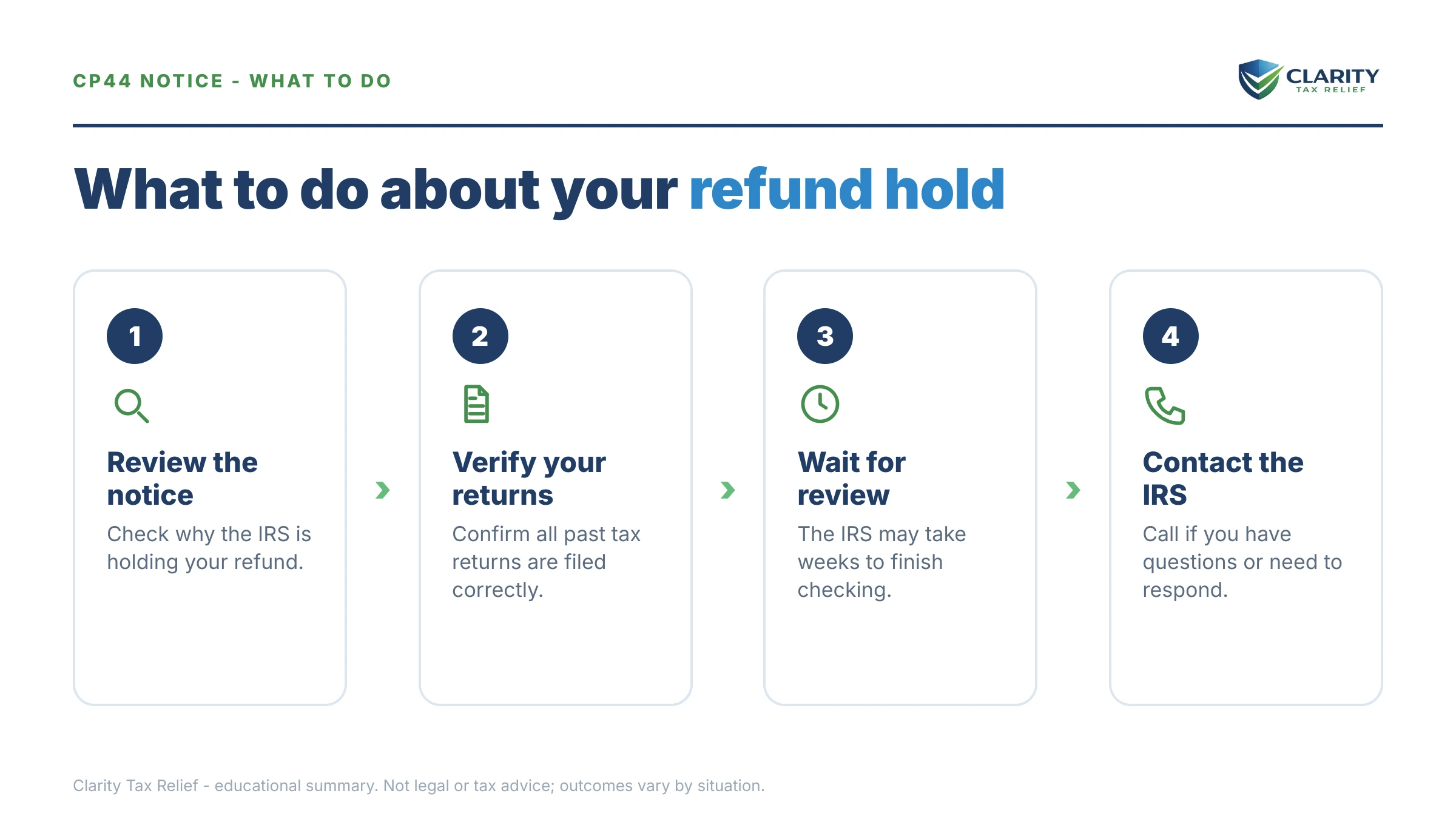
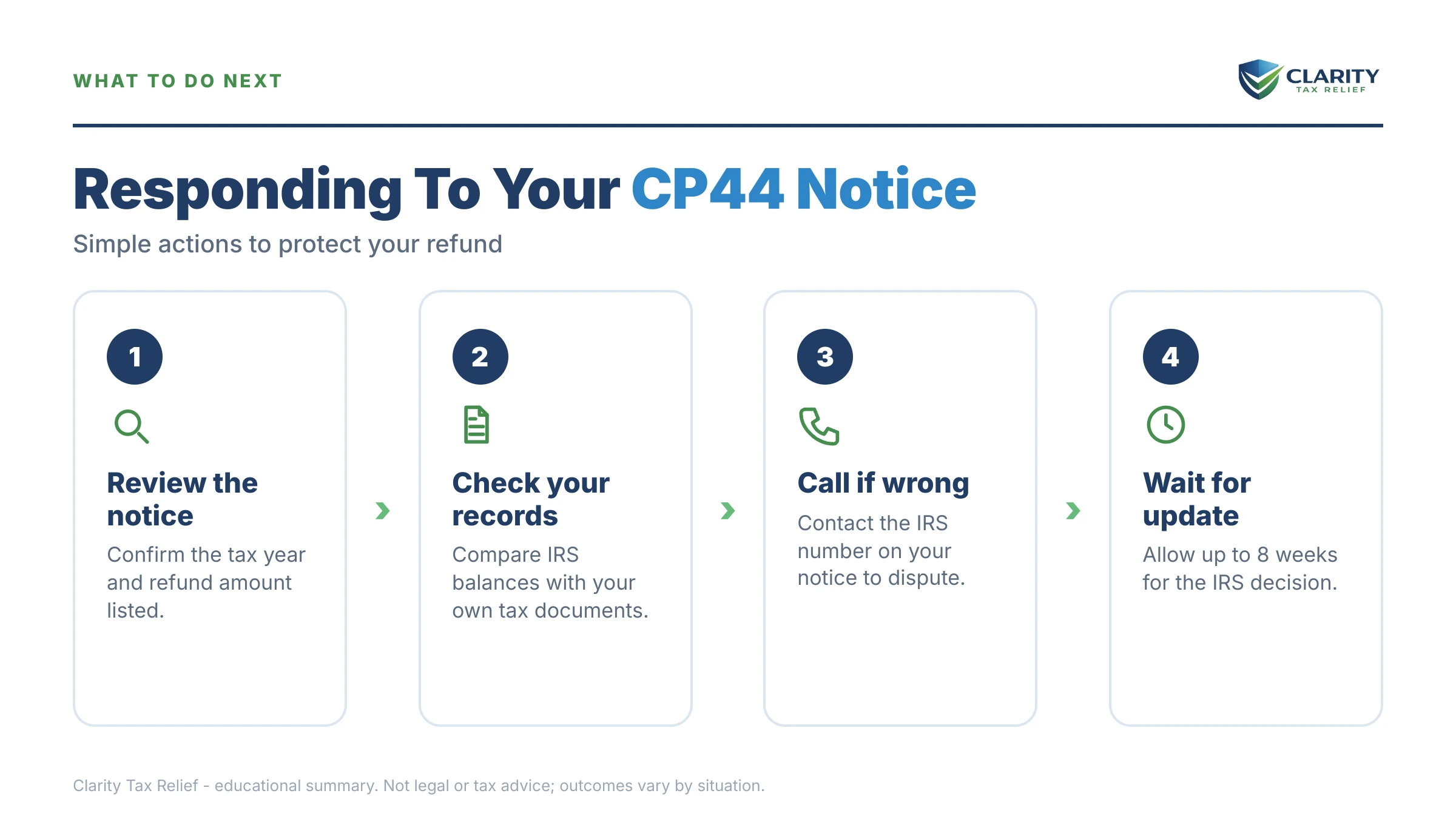
- Find the tax year and refund amount on your CP44 — both are printed near the top of the notice. Confirm they match the return you actually filed.
- Log into your IRS online account and list every year that shows a balance due — that list is almost certainly what triggered the hold.
- Check the business side too if you've ever run payroll — employment-tax balances under your EIN don't appear in the individual online account, so call the number on the notice or have a professional pull the business transcripts.
- Act before the offset posts if you need the refund to live on — contact the Taxpayer Advocate Service about an offset bypass refund; once the money is applied, this option is gone.
- Dispute a wrong balance in writing — send proof of payment or corrected figures to the address on the notice, and keep copies of everything.
- Watch the mail for the follow-up notice — a CP49, a CP42, or your released refund — and deal with any balance that survives the offset before the collection notices restart.
When you can handle a CP44 yourself — and when help changes the outcome
Most CP44 recipients don't need professional help, and it's worth saying so plainly. Handle it yourself if:
- You know exactly which balance triggered the hold and you agree with it;
- The debt is smaller than the refund, so the offset ends the matter; or
- The remainder is modest and you can pay it within 180 days on a $0-setup short-term plan.
Experienced help earns its cost when the picture behind the hold is bigger than the notice: a trust fund recovery penalty or other payroll assessment (where the "responsible person" determination itself can sometimes be fought), multiple years of balances or unfiled returns, a debt you dispute but can't document alone, or a hardship situation where the offset bypass request has to be built and filed before a review clock you can't see runs out. In those cases, the refund is a side issue — the sequencing of returns, penalty relief, and resolution determines what you ultimately pay.
Terms on your CP44, decoded
- Overpayment — the IRS's word for your refund: tax you paid beyond what the return required.
- Offset — applying that overpayment to a debt instead of sending it to you.
- CP49 — the follow-up notice confirming your refund was applied to your own back taxes.
- Offset bypass refund (OBR) — a hardship-based release of a refund that would otherwise be offset to federal tax, available only before the offset posts.
- Trust fund recovery penalty (TFRP) — a business's unpaid payroll withholding assessed personally against the people responsible for paying it.
- Account transcript — the IRS's line-by-line record of a tax year; it shows the hold, the balances, and the offset when it happens.
CP44 questions, answered
How long does a CP44 refund delay take?
The review behind a CP44 typically takes six to eight weeks, though 2026's reduced IRS staffing can stretch it longer. You'll know it's over when the follow-up arrives: a CP49 if your refund was applied to your own back taxes, a CP42 if it went to your spouse's debt, or the refund itself if the IRS found nothing owed.
Does a CP44 mean I definitely owe other taxes?
No — the notice says you MAY owe, and the review exists precisely because the IRS isn't sure yet. If the flagged balance turns out to be paid, misapplied, or not yours, the full refund is released with interest. That said, most CP44s do trace to a real balance somewhere in IRS records, so use the wait to find out what it is.
What is the difference between a CP44 and a CP49?
A CP44 says the IRS is still deciding whether to keep your refund; a CP49 says the decision is made and your refund was applied to a back-tax balance. That order matters: while you're at the CP44 stage, options like a hardship-based offset bypass refund are still open. Once the CP49 posts, the money has moved and those options close.
Can I stop the IRS from taking my refund after a CP44?
Sometimes, but only in narrow situations and only before the offset posts. If losing the refund would leave you unable to cover basics like housing or utilities, the Taxpayer Advocate Service can be asked to direct some or all of it to you as an offset bypass refund. On a joint return where the debt belongs solely to your spouse, Form 8379 can recover your share.
Is a CP44 notice an audit?
No. A CP44 doesn't question anything on your return — your income, deductions, and credits are accepted as filed. The IRS is only deciding where to send the refund you already earned. If your return itself were under review, you'd receive a CP05 or CP05A instead, and those ask about the return's contents, not other balances.
Will a CP44 take my refund for child support or student loans?
No — a CP44 covers only other federal taxes. Child support, defaulted student loans, and state income tax debts are collected through the Treasury Offset Program, which is run by the Bureau of the Fiscal Service and generates its own separate offset letter. If you owe both kinds of debt, federal tax balances are generally satisfied first.
What if the balance the IRS applies my refund to is wrong?
Dispute it in writing with proof — a payment confirmation, a canceled check, or the corrected figures — sent to the address on the notice, and keep copies. Don't wait for the review to finish, because a wrongly applied refund is much harder to claw back than a hold is to correct. If the debt belongs to someone else entirely, say so explicitly and ask the IRS to verify the assessment.
Your next 24 hours
- Find the tax year and refund amount printed near the top of your CP44, and confirm they match the return you filed.
- Gather the picture behind the hold: log into your IRS online account, pull your last two returns, and write down every year — personal or business — where a balance might exist.
- Get the free case review. If the balance behind your CP44 is bigger than the refund — especially payroll or multi-year debt that will keep accruing interest and penalties long after the refund is gone — call (888) 825-7779 or use the 2-minute form and an experienced tax professional will map your options before the review ends.
Primary sources: the IRS's own explainer at Understanding your CP44 notice, payment and plan options at IRS.gov/payments, and hardship help through the Taxpayer Advocate Service.
This guide is general information, not tax or legal advice for your specific situation. Eligibility for IRS programs depends on individual facts and circumstances; no outcome is guaranteed.