
Refund Delays
PATH Act Refund Delay 2027: When Your EITC/ACTC Refund Will Actually Arrive
The short answer: the PATH Act refund delay in 2027 applies if you claim the Earned Income Tax Credit or Additional Child Tax Credit — federal law bars the IRS from releasing your entire refund before February 15, 2027. Most PATH-held refunds arrive by early March. If you owe back taxes, the IRS applies the refund to that debt first.
You filed the first week the IRS opened, you're counting on that refund for rent, and "Where's My Refund" is stuck on a message about the PATH Act — while an unpaid IRS balance from an old year keeps generating notices in your mailbox. The path act refund delay 2027 is not a problem with your return; it's a hold written into federal law. What you do during the hold, though, decides whether that refund actually lands in your bank account.
You don't have to wait blind. Your IRS account transcript shows exactly where the refund stands weeks before "Where's My Refund" moves — the image below shows what a PATH-season transcript looks like and which lines to check.
⏱ The date that controls everything: the IRS cannot release any refund claiming the EITC or Additional Child Tax Credit before February 15, 2027. That date is set by statute — no preparer, software, or phone call moves it. Most PATH-held refunds then arrive by direct deposit in late February or early March if nothing else is holding the return.
Why the PATH Act refund delay happens in 2027
The PATH Act requires the IRS to hold every refund claiming the EITC or Additional Child Tax Credit until at least February 15 — the entire refund, not just the credit portion. That includes the part of your refund that came straight out of your own paychecks as withholding.
Congress built the hold into the Protecting Americans from Tax Hikes Act of 2015 as an anti-fraud measure. Employers must file W-2s with the government by the end of January; the hold gives the IRS a window to match those W-2s against returns claiming refundable credits before money goes out the door.
Three things the PATH hold is not: it's not an audit, it's not a flag on your account, and it doesn't require anything from you. It applies automatically to every EITC/ACTC return, every year. If you instead received an identity-verification letter, or your transcript shows a code 810 refund freeze, that's a different problem — the PATH hold ends in mid-February on its own; those don't.
One prerequisite worth stating plainly: the hold only applies to a filed return. If you're still deciding whether your income even requires one, start with do I have to file taxes 2027 — the EITC is only paid to people who file and claim it.
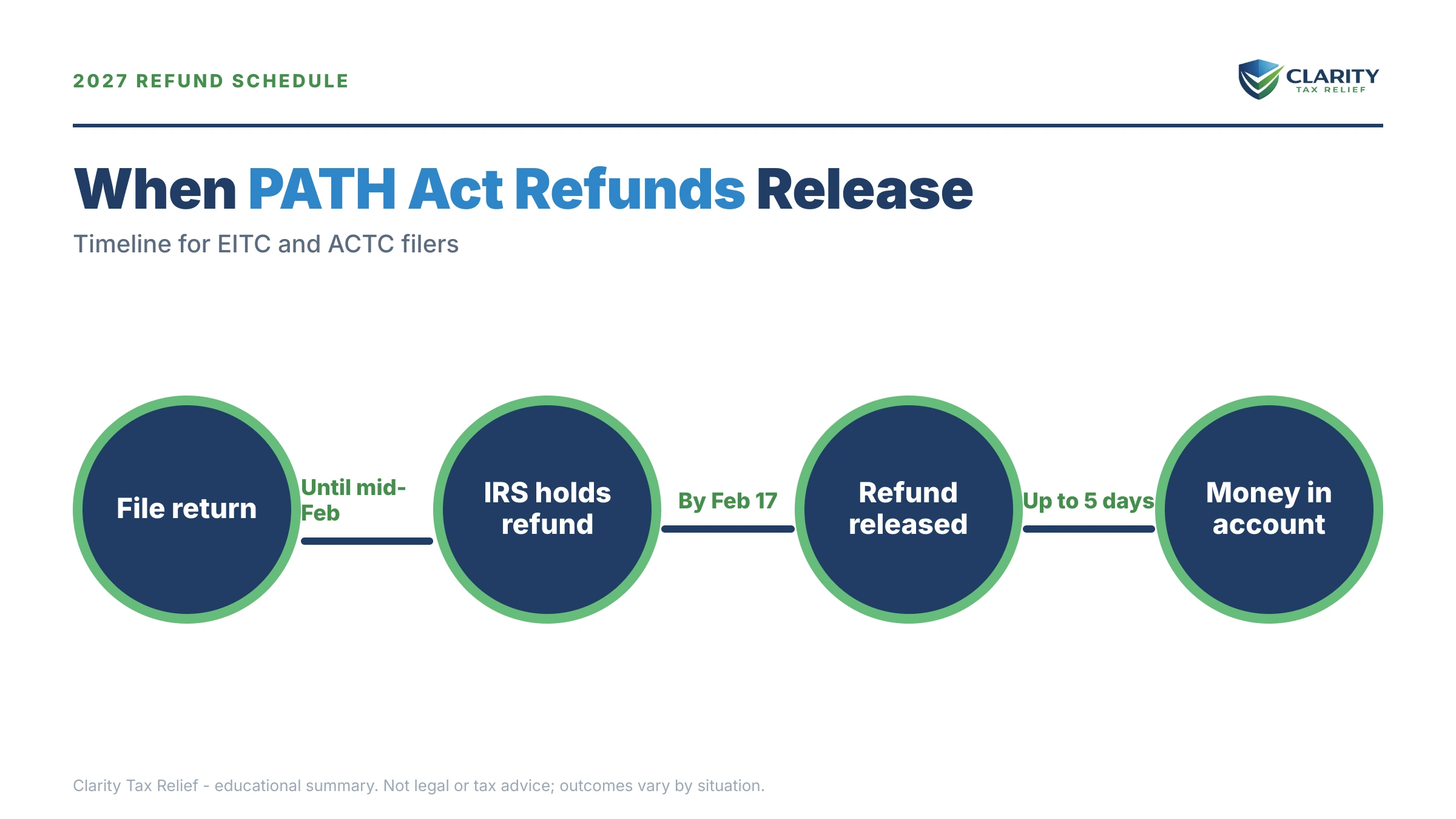
The 2027 PATH refund timeline: what happens when
PATH-held refunds move on a predictable calendar, and February 15 is the hinge date. Here's how the 2027 season typically plays out for an EITC or ACTC filer:
| Stage | What happens | What you should do |
|---|---|---|
| Late January 2027 (IRS typically opens e-file) | Your return is accepted; credits post to your transcript as codes 766/768, but no refund can be scheduled yet | File as early as you can — your place in line matters once the hold lifts |
| Through February 14 | "Where's My Refund" shows the PATH message; the refund sits legally held even if processing is finished | Nothing — calling the IRS cannot release a PATH-held refund early |
| February 15, 2027 | The statutory hold ends; the IRS begins scheduling PATH refunds in processing order | Start checking your transcript for code 846 and its date |
| Late February – early March 2027 | Most PATH refunds land by direct deposit, absent a hold code or an offset | If it hasn't arrived, read the transcript codes below before assuming the worst |
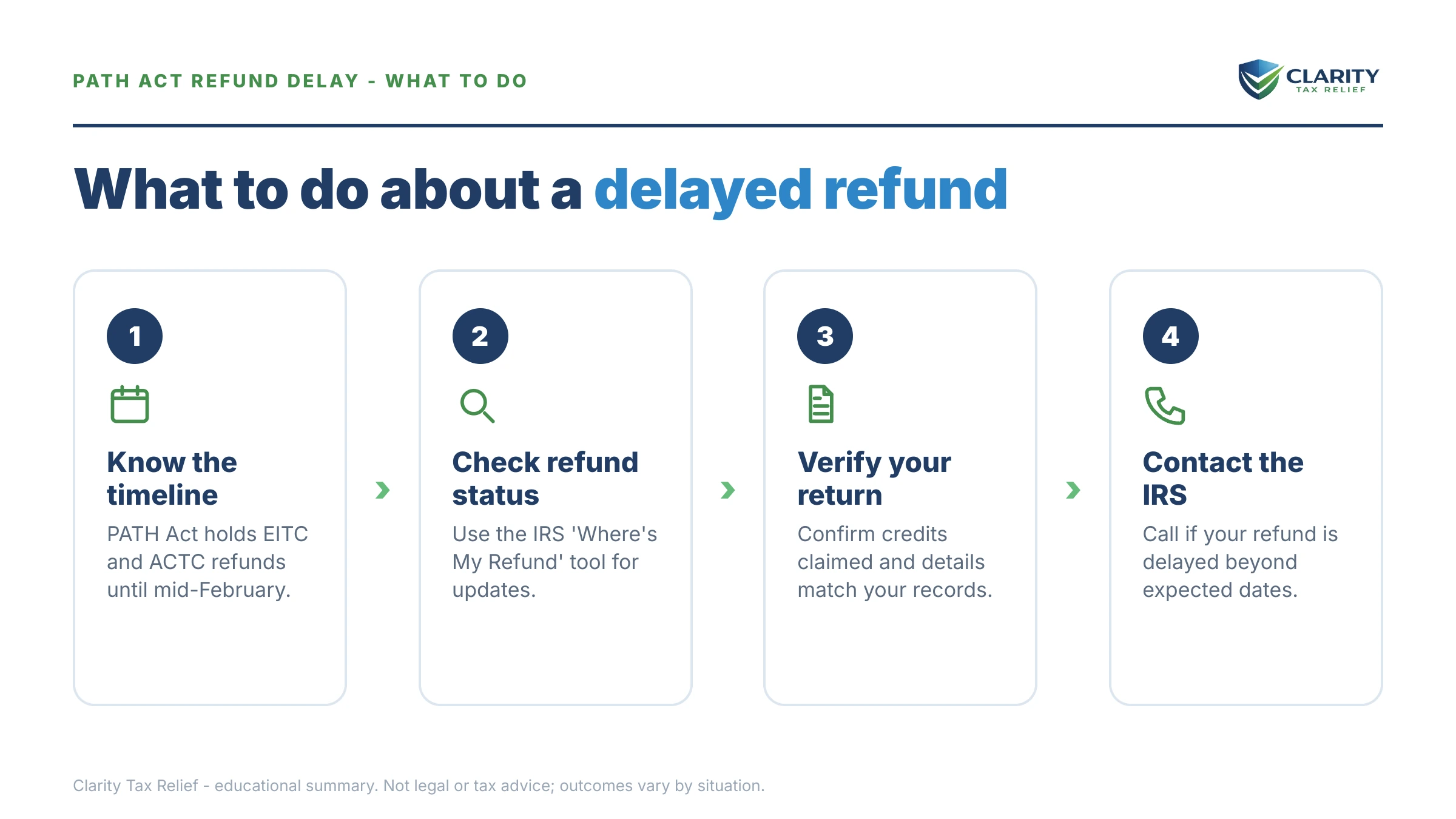
What happens while your refund is held — if you owe back taxes
A PATH Act hold pauses your refund, but it does not pause IRS collection on taxes you already owe. If you're carrying a balance from a prior year, the automated notice sequence keeps moving through February on its own schedule while your new refund sits locked:
- Reminder notices (CP501/CP503) keep arriving, and the balance keeps growing — the failure-to-pay penalty adds 0.5% per month on top of interest.
- CP504 — Notice of Intent to Levy. At this stage the IRS can seize your state tax refund under IRC §6331(d). Your federal PATH refund is still held, but the state one is now exposed.
- LT11 / Letter 1058 — Final Notice. This starts a 30-day clock and your Collection Due Process rights (requested on Form 12153). After 30 days, levies are authorized.
- Levy. A bank levy freezes funds with a 21-day hold before the money leaves; a wage levy is continuous until released. And here's the part that surprises people: your held refund being offset in February does not, by itself, stop a levy that's already been authorized — it just reduces the balance.
If a wage levy is what you're bracing for, you can estimate how much of a paycheck the IRS could actually reach with our IRS Wage Garnishment Calculator — for most workers it's everything above a modest exempt amount, which is why acting before the levy beats reacting after it.
Waiting on a held refund while IRS notices keep coming?
If you're counting on a PATH-delayed refund while a levy notice sits on your table, the order you handle things in matters. An experienced tax professional will review your notices and transcript free and map out what happens to your refund — before the automated system decides for you. Interest and penalties accrue every month you wait.
Owe back taxes? Your options before the refund releases
If you owe the IRS, your held refund will be applied to that balance before you see a dollar of it — the offset is automatic and shows on your transcript as code 826. The question isn't whether the offset happens; it's what you set up around it. The full playbook for resolving a balance on your own lives in our guide to how to settle tax debt yourself — here's how each option interacts with a PATH-season refund:
| Option | Who it fits | Cost and catch |
|---|---|---|
| Let the offset resolve it | Refund is bigger than the balance | Free; interest accrues until the offset posts, and any leftover refund is released to you |
| Short-term payment plan | Can pay the rest within 180 days | $0 setup; interest and penalties continue, but the notice sequence stops |
| Streamlined installment agreement | Balance ≤ $50,000; up to 72 months, set up online, no financial statement | Setup fee applies (lower with direct debit); future refunds are still offset while you owe |
| Currently Not Collectible | Paying anything would leave you unable to cover rent, food, utilities | Free; collection pauses but the debt remains — and refunds are still offset |
| Offer in Compromise | Assets and income genuinely can't cover the debt before collection expires | $205 fee and 20% down on lump-sum offers — both waived with low-income certification (AGI ≤ 250% of the poverty level), which many EITC filers meet; the IRS accepted roughly 1 in 5 offers in FY2024, per IRS data |
| Penalty relief | Clean compliance history for the prior 3 years (First-Time Abatement), or reasonable cause | Free to request; starting summer 2026, the Automatic Exemption from Penalty (AEP) applies qualifying relief with no request needed |
A worked example: $13,600 owed, $5,800 refund held
Say you rent, you owe the IRS $13,600 from a prior year, and your 2026 return claims a $5,800 refund — $4,000 of EITC, $1,100 of ACTC, and $700 of your own withholding. The PATH Act holds all $5,800 until at least February 15, 2027. When it releases, none of it hits your bank account: the IRS applies it to the old balance, and $13,600 − $5,800 leaves $7,800 owing.
That offset quietly improves your options. At $13,600 you were above the $10,000 line for a guaranteed installment agreement; at $7,800 you're under it — provided you meet the other conditions: the guaranteed agreement is for individuals only, the $10,000 limit applies to income tax alone (excluding penalties and interest), all your required returns must be filed, you must have filed and paid on time for the past 5 years with no installment agreement during that period, and you must agree to pay the balance in full within 3 years. Spread over 72 months, $7,800 works out to a floor of about $108/month before interest — call it roughly $110–$130 in practice as interest and the monthly late-payment penalty accrue on the shrinking balance.
The trap in this scenario: if an LT11 arrived in January, its 30-day clock runs out before the offset posts. Don't wait for February 15 to act — set up the agreement (or request the CDP hearing) now, and let the offset shrink what the agreement has to cover.
How to read your transcript during the PATH hold
Your IRS account transcript shows your refund's real status days before "Where's My Refund" updates. During PATH season these are the codes that matter, in roughly the order you'll see them:
| Code | What it means | What to do |
|---|---|---|
| 150 | Your return posted — the IRS has processed it | Nothing; this is the baseline every refund builds on |
| 806 | Your W-2/1099 withholding credited to the account | Confirm it matches your W-2 box 2 totals |
| 766 / 768 | Refundable credits posted — 768 is specifically your EITC | Nothing; these sit dated for mid-April but release after the PATH hold lifts |
| 570 | Additional account hold — code 570 is common and usually routine in PATH season | Wait unless it lingers weeks past February 15, especially with a 971 (notice issued) beside it |
| 810 | Hard refund freeze — separate from PATH and it will not lift on February 15 | Act: this usually means identity verification or a credit review; see the code 810 guide |
| 826 | Refund applied to a federal tax balance you owe | Check which year it went to; any excess is still sent to you |
| 898 | Refund offset to another agency (child support, defaulted student loans) via the Treasury Offset Program | Call the Treasury offset hotline to confirm which agency took it |
| 846 | Refund issued — the date beside it is your actual payment date | Expect direct deposit within days; see the 846 refund issued date guide for how that date works |
How to track and protect your PATH-delayed refund, step by step
- Confirm the IRS accepted your return. Check your e-file confirmation or the Where's My Refund tool within 24–48 hours of filing — a PATH hold only applies to a return the IRS actually has.
- Pull your free account transcript. Log in at IRS.gov and look for codes 766/768 (your credits posted), 570 (hold), 810 (freeze), and 846 (refund sent) — the transcript usually updates before Where's My Refund does.
- Check whether your refund is headed to a debt. Codes 826 or 898 mean some or all of the refund is being applied to back taxes or another agency's debt; the Treasury Offset Program call center can confirm which.
- Set up a payment arrangement if you owe the IRS. An installment agreement started now stops the notice sequence before it reaches a levy — the offset will still apply, and it shrinks the balance your monthly payment has to cover.
- Escalate genuine hardship. If a levy or offset would leave you unable to pay rent or keep utilities on, contact the Taxpayer Advocate Service through Form 911 and ask about an offset bypass refund.
When you can handle the PATH delay yourself
For most filers the honest answer is: you don't need any help — you need to wait until early March. If you don't owe the IRS or any other agency, no code 810 appears on your transcript, and no verification letter arrived, the hold ends by itself and the refund follows. There's nothing a professional (or a paid "refund tracker") can speed up.
You can also handle it yourself when the situation is simple: reading your own transcript, calling the offset hotline to confirm a debt, or setting up a payment plan online for a balance you agree with at IRS.gov/payments.
Experienced help changes the outcome in a narrower set of situations: a levy is already in motion while the refund sits held; you have multiple unfiled years (the IRS can hold a refund past PATH until those are resolved); a joint refund is being taken for a debt that's only your spouse's — the fix there is an injured-spouse allocation on Form 8379, covered in our guide to an ex-spouse's tax debt taking your refund; or the offset itself would cause an eviction, where an offset bypass request through the offset bypass refund for hardship process has to be made before the refund releases. Timing is everything on that last one — after February 15, the window closes fast.
Terms on your transcript, decoded
- PATH Act — the 2015 federal law that requires the IRS to hold all EITC/ACTC refunds until at least February 15 each year so W-2s can be matched first.
- ACTC (Additional Child Tax Credit) — the refundable portion of the Child Tax Credit, paid out even when it exceeds the tax you owe; claiming it triggers the PATH hold.
- Refundable credit — a credit the IRS pays you in cash even if your tax bill is zero, which is exactly why these refunds get extra fraud screening.
- Refund offset — the government applying your refund to a debt before paying you; if it happens once, expect it every year until the debt is gone — see will IRS take refund every year.
- Tax Topic 152 — the generic "your refund is processing" reference on Where's My Refund; during PATH season it's normal, not a warning.
- Treasury Offset Program (TOP) — the Bureau of the Fiscal Service system that routes refunds to non-IRS debts like child support and defaulted federal student loans.
PATH Act refund delay questions, answered
When will the IRS release PATH Act refunds in 2027?
February 15, 2027 is the earliest date federal law allows the IRS to release a refund claiming the EITC or Additional Child Tax Credit. Most PATH-held refunds arrive by direct deposit in late February or early March, assuming the return has no other issues. A code 570 hold, an identity-verification letter, or a refund offset can each extend that timeline.
Does the PATH Act delay my whole refund or just the credit portion?
The entire refund is held, including the part that comes from your own paycheck withholding. The law requires the IRS to hold the full refund on any return claiming the EITC or ACTC — it cannot release a partial refund early. If you want part of your money sooner in future years, adjusting your W-4 withholding is the only real lever.
Can I avoid the PATH Act delay by filing early?
No — the February 15 date is set by statute, and no filing method, software, or preparer can move it. Filing early still helps: accepted returns are processed in roughly the order received, so early filers tend to see refunds in the first wave after the hold lifts. Refund-advance loans can front the money sooner, but they are bank products with their own terms and eligibility rules.
Will the IRS take my PATH refund if I owe back taxes?
Yes. Once the hold lifts, the IRS applies your refund to any federal tax balance automatically — code 826 on your transcript — before sending you anything left over. Debts owed to other agencies, like child support or federal student loans in default, come out through the Treasury Offset Program (code 898). If the debt belongs only to your spouse on a joint return, Form 8379 can recover your share.
Is a code 570 during the PATH hold an audit?
Usually not. During PATH season, code 570 is most often a routine hold that resolves on its own once the IRS finishes verifying wages and credits. It becomes worth attention if it is still sitting there weeks after February 15, especially with a code 971 next to it — that means a letter is coming. A code 810, by contrast, is a hard refund freeze that almost always requires action from you.
Why did my state refund arrive but my federal refund is still delayed?
The PATH Act is federal law and only delays federal refunds — every state runs its own processing schedule, and many issue refunds in February regardless. One caution if you owe the IRS: after a CP504 notice, the IRS can seize your state refund to cover federal back taxes, so a missing state refund can also signal an intercept.
What should I do if my PATH refund still hasn't arrived by late March 2027?
Pull your free account transcript at IRS.gov and read the codes: 846 means it was sent, 826 or 898 means it was offset to a debt, and 570 or 810 means it is still held. If it was offset, the Treasury Offset Program call center can tell you which agency took it. If the delay is causing genuine hardship — an eviction notice, utility shutoff — the Taxpayer Advocate Service can intervene through Form 911.
Your next 24 hours
- Check your status in two places: the Where's My Refund tool at IRS.gov for the PATH message, and your free account transcript for codes 768, 570, 826, and 846 — the transcript is the one that tells the truth first.
- Gather three things: your e-file acceptance confirmation, any IRS notices you've received on prior-year balances (especially a CP504 or LT11), and last year's return. Those tell you whether this refund is coming to you or going to a debt.
- If you owe back taxes or a levy notice has arrived, get a free case review — use the 2-minute form at claritytaxrelief.com/#consult or call (888) 825-7779. The refund hold will resolve itself; the collection side won't, and interest and penalties accrue every month it sits.
If a delay or offset is causing hardship the normal channels can't fix, the Taxpayer Advocate Service is an independent, free resource inside the IRS built for exactly that.
This guide is general information, not tax or legal advice for your specific situation. Eligibility for IRS programs depends on individual facts and circumstances; no outcome is guaranteed.