
Filing Requirements
Do I Have to File Taxes in 2027? The 2026 Income Thresholds, Explained
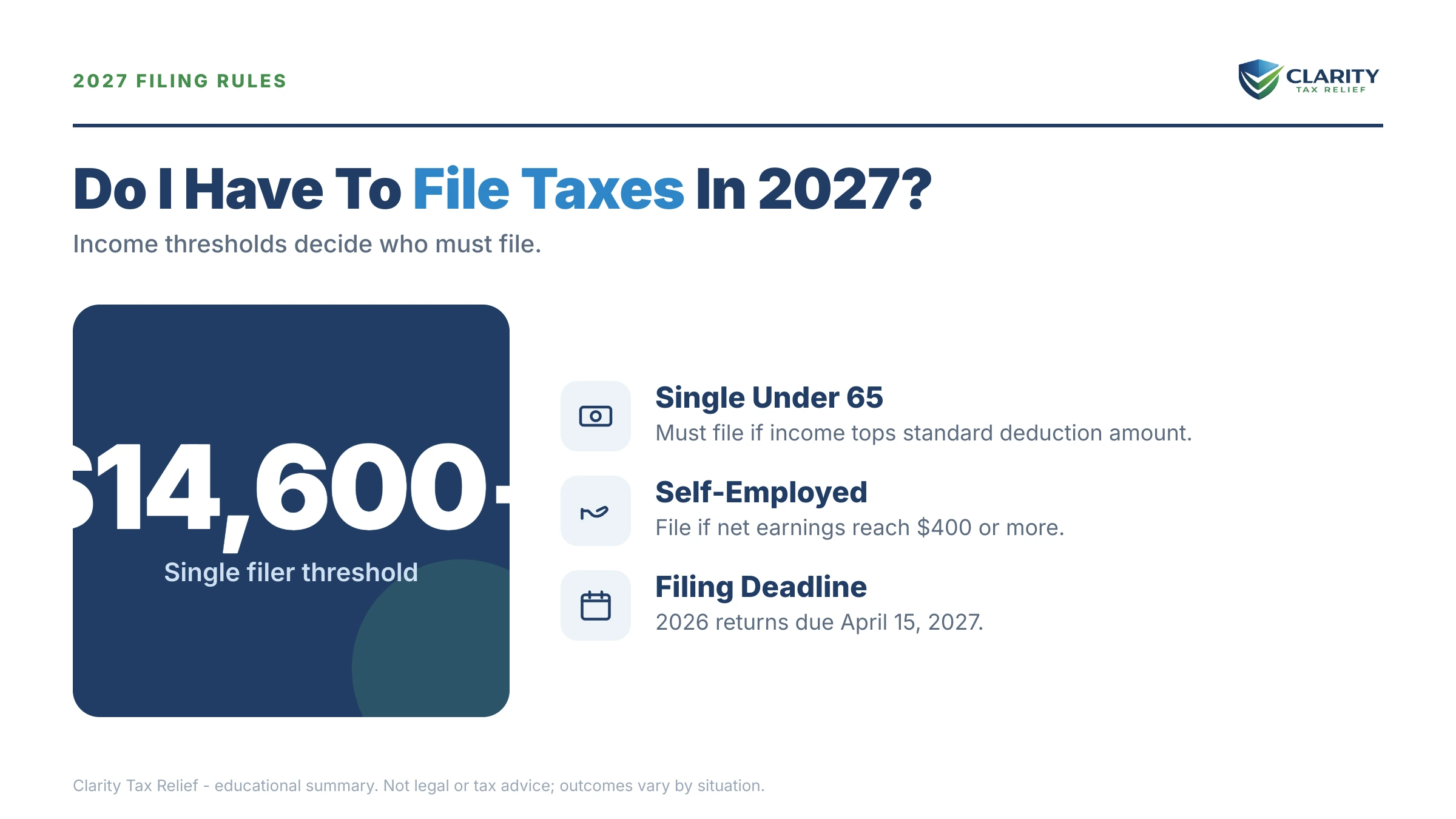
The short answer: you have to file taxes in 2027 if your 2026 gross income reaches the standard deduction for your filing status — above $30,000 for a married couple filing jointly. Special rules override that line: $400 of net self-employment earnings, $5 of income while married filing separately, or any advance premium tax credit.
Maybe you only worked part of 2026 and you're hoping you fall under the line. Or you and your spouse are adding up two W-2s and a side gig at the kitchen table, wondering whether the total forces a return. Either way, the answer comes down to a handful of specific numbers — and a few of them are much lower than most people expect.
⏱ The deadline that matters: 2026 federal returns are due April 15, 2027. An extension moves the filing deadline to October 15, 2027 — but an extension does not give you more time to pay. And if a refund is waiting, you have three years from the due date to file and claim it before it's forfeited.
How much do you have to make to file taxes in 2027?
For most taxpayers, you have to file taxes in 2027 once your 2026 gross income reaches the standard deduction for your filing status. One quick clarification first: the return you file in 2027 covers your 2026 income — January 1 through December 31, 2026.
"Gross income" means everything you received before any deduction: wages, tips, self-employment receipts, interest, dividends, unemployment, rental income, most retirement distributions — even 1099-C cancelled debt. It's not your take-home pay, and it's not your taxable income after deductions.
Because the threshold tracks the standard deduction, it rises with inflation every year. For 2026 returns, a married couple filing jointly crosses the line above $30,000 of gross income, and a single filer above $15,000, with higher limits for taxpayers 65 and older. Pin down your exact number in the 2026 Form 1040 instructions or the IRS's own checker (linked in the step-by-step section below) — don't guess from an old year's table, because the figures changed under recent tax law.
The general test is only the starting point, though. Several rules force a return at income levels far below it — and one of them applies at just five dollars.
Situations where you must file in 2027 no matter your income
Self-employed taxpayers must file a 2026 return once net earnings reach $400 — regardless of any other threshold. That rule exists because self-employment tax (Social Security and Medicare) is calculated on Schedule SE, and the only way to report it is a tax return. It catches gig drivers, resellers, freelancers, and creators every year — if you earned platform income and never filed, the OnlyFans creator back taxes guide walks through catching up.
The other overrides are just as absolute. Here is the full list:
| Trigger | Threshold | Why a return is required |
|---|---|---|
| Net self-employment earnings | $400 or more | Self-employment tax must be reported on Schedule SE |
| Married filing separately | Just $5 of gross income | A statutory rule strips MFS filers of the normal threshold |
| Church employee income | $108.28 or more | Special self-employment-tax rule for exempt church wages |
| Advance premium tax credit received | Any amount | Marketplace subsidies must be reconciled on Form 8962 |
| Household employee wages you paid | Nanny taxes owed | Schedule H is filed with your Form 1040 |
| Extra tax on retirement or HSA money | Any additional tax owed | Early-distribution and HSA taxes are reported on the return |
| Dependent's unearned income | Above the small annual dependent limit | Kiddie-tax rules require a return at low dollar amounts |
The $5 married-filing-separately rule surprises couples most. If you and your spouse file separately — often to protect one spouse from the other's debts — essentially any income at all means both of you file. The choice of filing status changes the filing requirement itself, not just the tax bill.
Do I have to file taxes in 2027 if my only income is Social Security?
Social Security benefits alone almost never require a 2026 tax return. Benefits only become potentially taxable when your "combined income" — adjusted gross income, plus nontaxable interest, plus half your benefits — passes $25,000 for single filers or $32,000 for married couples filing jointly.
The catch is other income. A pension, IRA withdrawals, part-time wages, or even meaningful interest income all feed into that formula. A retiree with $19,000 in benefits and nothing else is safely below the line; add a $15,000 pension and the math changes. If anything besides Social Security landed in your account in 2026, run the numbers before deciding not to file.
Worked example: a married couple with $76,400
Say you and your spouse brought in $76,400 in 2026 — $61,400 in W-2 wages between you, plus $15,000 from a weekend consulting side gig. This is a hypothetical, but the math is exact.
Two separate triggers say you must file in 2027. Your gross income is more than double the married-filing-jointly threshold, and the side gig's net earnings blow past the $400 self-employment rule on their own. Whether it's smart to file was never the question — it's required. What it costs to skip is where the numbers get sharp:
- If you'd owe $3,200 (the side gig had no withholding): not filing triggers the failure-to-file penalty at 5% per month — though in months where the 0.5% failure-to-pay penalty also applies, the failure-to-file portion drops to 4.5% (5% combined), about $160 a month total — capping at 25%, or $800, after five months. Filing on time but paying late costs only the 0.5% failure-to-pay penalty, about $16 a month. Filing the return, even with zero payment attached, saves roughly $144 every month. The full comparison is in failure-to-file vs. failure-to-pay penalties.
- If withholding overshot and you're due $1,900 back: there's no late-filing penalty at all — the penalty is a percentage of unpaid tax, and yours is zero. But the refund isn't automatic. Don't file by April 15, 2030 (or roughly October 15, 2030 if you filed an extension for your 2026 return), and that $1,900 belongs to the Treasury permanently.
Either way, the return itself is the cheap part. It's the delay that gets expensive.
What happens if you're required to file and don't
The IRS identifies non-filers automatically, by matching the W-2s and 1099s your employers and payers already sent it against the returns on file. No one has to notice you; the computer does. From there the sequence runs in stages:
- Document matching flags the gap — the income reported under your Social Security number has no return attached.
- CP59 notice — the first "we have no record of your return" letter. Filing now usually ends the whole sequence.
- CP516 and CP518 — repeat requests, then the final warning that the IRS will act without you.
- Substitute for Return (SFR) — the IRS files a return for you using only the income it was told about: no dependents' credits, no business expenses, no itemizing, and the least favorable filing status. The resulting tax is almost always higher than what you'd owe on your own return.
- CP3219N deficiency notice — a 90-day window to file your real return or petition Tax Court before the SFR amount becomes final.
- Assessment and collection — the balance is now legally owed. Bills arrive, then the collection sequence that ends in liens and levies. Penalties run the whole time: 5% per month for not filing, capped at 25%, plus interest that compounds daily.
The single most important takeaway from this page: filing and paying are separate obligations, and filing is the one with the 10× penalty — and in months where both penalties apply, the failure-to-file portion drops to 4.5% (5% combined). If you'll owe money you don't have, file even if you can't pay — you cut the monthly penalty by roughly ninety percent the moment the return goes in. If a year has already gone unfiled, you can estimate what it's cost so far with our Penalty & Interest Calculator.
Not sure where you stand for 2027 — or carrying unfiled years already?
Get a free case review before the April 15, 2027 deadline. An experienced tax professional will tell you which years actually require a return, what each one would cost to fix, and where money may be waiting for you — no pressure, no obligation.
Even if you don't have to file, here's when you should
You have until April 15, 2030 (or roughly October 15, 2030 if you filed an extension for your 2026 return) to file a 2026 return and claim its refund — after that, the money is forfeited to the Treasury for good. That three-year window is the reason "not required" and "shouldn't bother" are different answers. Filing a return you don't owe can put real money in your pocket:
| Your 2026 situation | Required to file? | What filing gets you |
|---|---|---|
| Income above your standard deduction | Yes | Avoids the 5%-per-month failure-to-file penalty if you owe |
| Income below the threshold, taxes withheld | No | Every dollar of withholding back as a refund |
| Net self-employment earnings of $400+ | Yes | Reports SE tax, earns Social Security work credits, prevents an SFR |
| Married filing separately, almost any income | Yes ($5 rule) | Keeps both spouses out of the non-filer pipeline |
| Social Security only | Usually no | Generally nothing — unless combined income passes the limits |
| Low income with kids or earned income | Often no — but file | EITC and Additional Child Tax Credit pay out even at zero tax |
| Dependent with a small paycheck | Usually no | Recovers withholding the employer took out |
Two more reasons filing pays even when it's optional. First, refundable credits like the Earned Income Tax Credit are paid in cash even if you owe nothing — but only to people who file. Second, filing starts the IRS's normal three-year clock to question that year; a year you never file stays open indefinitely. And if you're weighing an old year's refund, see the 3-year refund deadline for old returns before it lapses.
One threshold clarification for app income: platforms only issue a Form 1099-K after $20,000 and 200 transactions — the 1099-K threshold reverted to $20,000 — but the tax law never cared about the form. Income is reportable from the first dollar, and $400 of net earnings requires a return whether or not any paperwork arrives.
How to decide whether you have to file in 2027, step by step
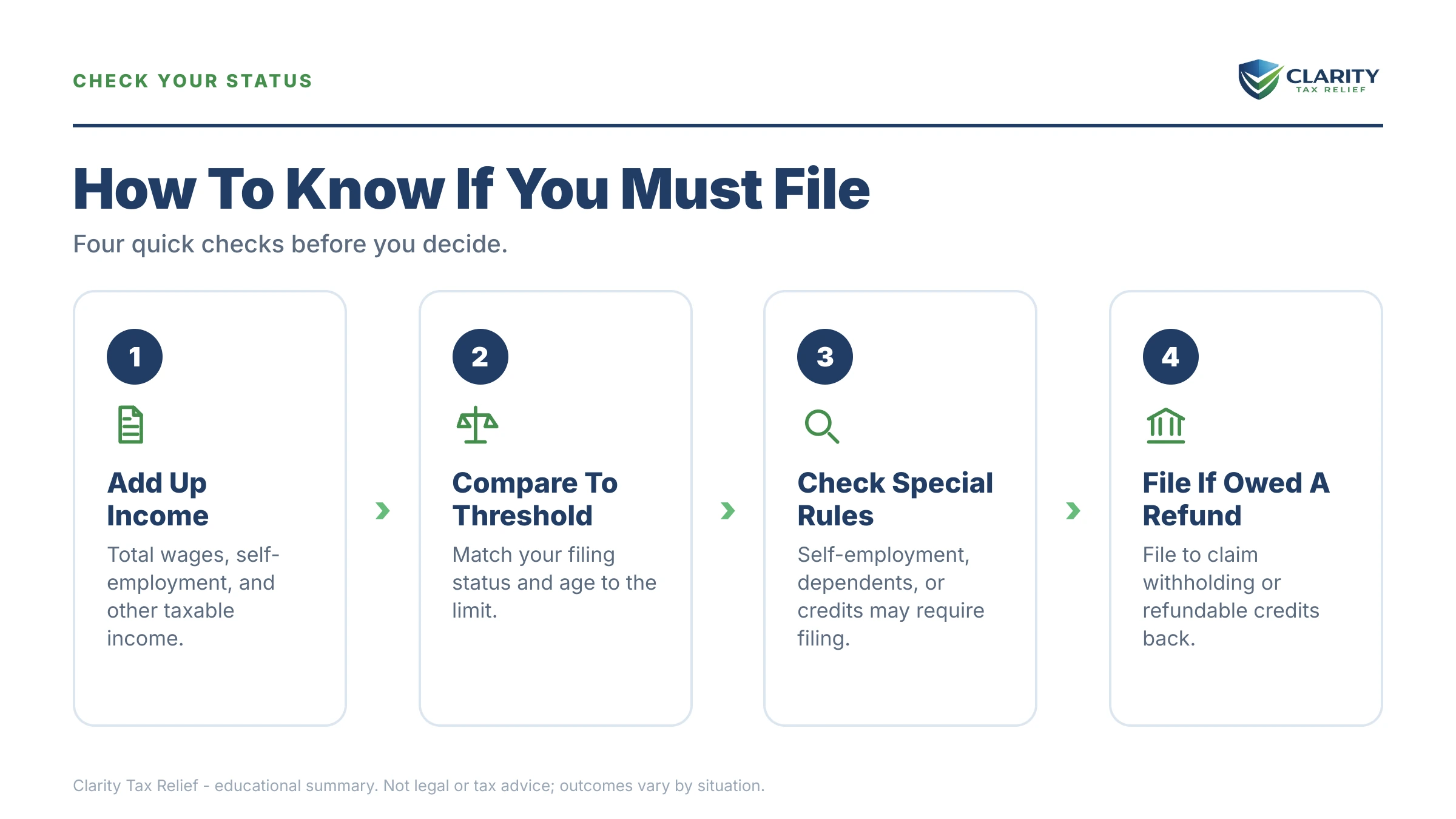
- Add up your 2026 gross income. Total every W-2, 1099, benefit statement, and cash payment before any deductions — gross income, not take-home pay, drives the filing test.
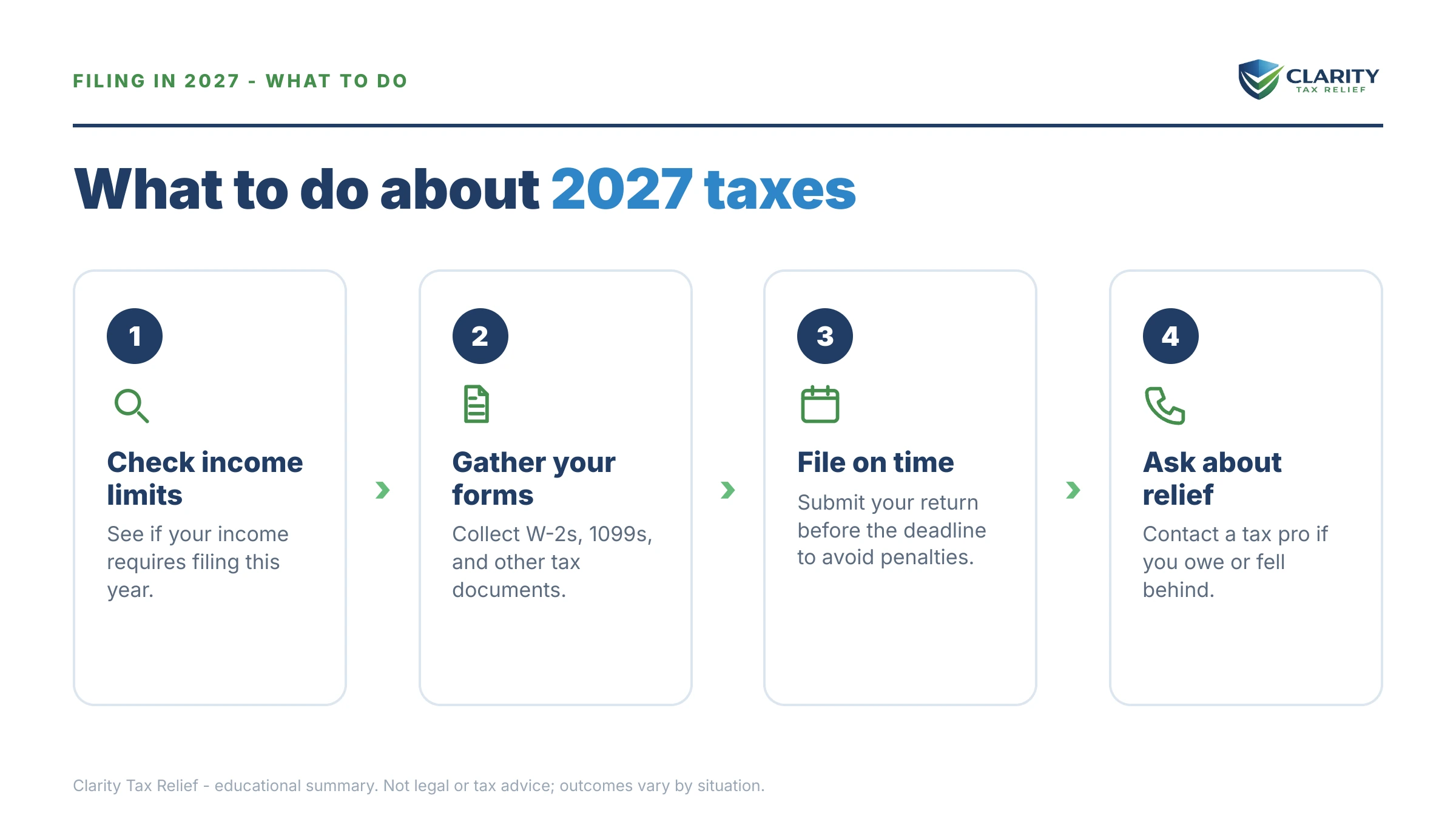
- Run the trigger tests. Compare that total to the standard deduction for your filing status, then check the overrides: $400 of net self-employment earnings, $5 while married filing separately, or any advance premium tax credit.
- Confirm with the IRS's own checker. The interactive "Do I Need to File a Tax Return?" tool at IRS.gov gives a yes-or-no answer in about ten minutes.
- File by April 15, 2027 — even if you can't pay. Filing on time stops the 5% monthly failure-to-file penalty; payment arrangements can come after.
- File anyway if money is waiting. If you had withholding or qualify for refundable credits, a return is the only way to collect it.
When you can handle this yourself — and when help changes the outcome
Most people asking this question can answer it and act on it without hiring anyone. If 2026 is your only open year, your income fits on W-2s and a 1099 or two, and you either owe nothing or can pay what you owe, run the IRS checker, file, and be done — free and low-cost filing routes exist, and the general filing hub at IRS.gov/filing lists them. If a balance does show up, most single-year debts can be resolved without a firm too; our guide to how to settle tax debt yourself covers every DIY path.
Experienced help earns its fee in a narrower set of situations: three or more unfiled years, where choosing which years to file first genuinely changes what you'll pay; missing documentation, where filing back taxes with no records means reconstructing income from IRS transcripts; an SFR the IRS already filed against you, which usually needs to be replaced with a correct return; or substantial self-employment income with no withholding and no bookkeeping. And if you already owe for prior years, that's not a reason to skip this year — should you file this year if you owe prior years explains why staying current is the foundation of every resolution program.
Terms in the filing rules, decoded
- Gross income — everything you received before any deduction: wages, self-employment receipts, interest, cancelled debt, unemployment. Not your take-home pay.
- Standard deduction — the flat amount that shields income from tax for your filing status; it doubles as the general filing threshold.
- Substitute for Return (SFR) — the return the IRS builds for you when you don't file, computed with no deductions or credits and almost always higher than your real tax.
- Refundable credit — a credit, like the EITC, the IRS pays out in cash even when you owe zero tax — but only if you file.
- Combined income — the Social Security formula (AGI + nontaxable interest + half your benefits) that decides whether benefits become taxable.
2027 filing requirement questions, answered
How much do you have to make to file taxes in 2027?
For most people, the line is your 2026 standard deduction — once gross income reaches it, you must file. Married couples filing jointly cross it above $30,000; single filers above $15,000, with higher limits at age 65 and up. The exact figures are in the 2026 Form 1040 instructions, and special rules override them: $400 of self-employment earnings or $5 of income while married filing separately requires a return.
Do I have to file taxes in 2027 if my only income is Social Security?
Usually no — Social Security benefits alone almost never require a return. Benefits only become potentially taxable when your combined income (adjusted gross income plus nontaxable interest plus half your benefits) passes $25,000 for single filers or $32,000 for married couples filing jointly. If you had other income — a pension, IRA withdrawals, or part-time wages — run the numbers, because those can push you over the line.
Do I have to file if my employer withheld taxes all year?
Withholding doesn't replace filing — if your gross income is above the threshold for your filing status, you must still file a return. Withholding is just a prepayment; the return is how the IRS reconciles what you actually owed. If your income was below the threshold, you aren't required to file, but filing is the only way to get that withheld money back as a refund.
Do dependents have to file taxes in 2027?
Dependents have their own, lower filing thresholds. A dependent generally must file once unearned income like interest or dividends passes a small annual limit, or once earned income from a job passes the dependent standard deduction — the exact 2026 figures are in the Form 1040 instructions. Many dependents with small paychecks should file anyway, because it's the only way to recover taxes their employer withheld.
What happens if I was required to file in 2027 and didn't?
The IRS's document-matching system flags the missing return, then sends non-filer notices starting with a CP59. Ignore those and the IRS can file a substitute for return using only the income reported to it — no deductions, no credits — and assess the resulting tax. If you owe, the failure-to-file penalty runs 5% per month, up to 25%, on top of interest. Filing late is always cheaper than not filing.
Can I still get a refund if I wasn't required to file?
Yes — filing is the only way to collect it, and there's a deadline. You generally have three years from the return's original due date to file and claim a refund, so a 2026 refund is forfeited after April 15, 2030 (or roughly October 15, 2030 if you filed an extension for your 2026 return). There is no late-filing penalty when the IRS owes you money, because the penalty is calculated as a percentage of unpaid tax.
Do I have to file taxes on Venmo or PayPal income under $20,000?
Possibly — the paperwork threshold and the tax threshold are different things. Payment apps only issue a Form 1099-K once you pass $20,000 and 200 transactions, but self-employment income is taxable from the first dollar, and $400 of net earnings triggers a filing requirement on its own. Personal transfers between friends and family aren't income and don't count.
Do I have to file state taxes if I don't have to file federal?
Possibly — states set their own filing thresholds, and some are lower than the federal one. A handful of states have no income tax at all, while others require returns at income levels below the federal standard deduction. Check the filing requirements on your state revenue agency's website rather than assuming the federal answer carries over.
Your next 24 hours
- Add up your income. Pull your 2026 pay stubs, W-2s, 1099s, and benefit statements and total the gross figures — that one number answers most of this question.
- Gather your documents. Last year's return, this year's income forms, and records of any withholding or estimated payments. If you owe when you file, the payment options live at IRS.gov/payments.
- Get a free case review. If you're over the line — or prior years are already unfiled — call (888) 825-7779 or use the 2-minute form before April 15, 2027, while filing on time is still on the table.
This guide is general information, not tax or legal advice for your specific situation. Eligibility for IRS programs depends on individual facts and circumstances; no outcome is guaranteed.