
Back Taxes & Filing
Should I File Taxes If I Owe Back Taxes? Yes — Here's Why (2026)
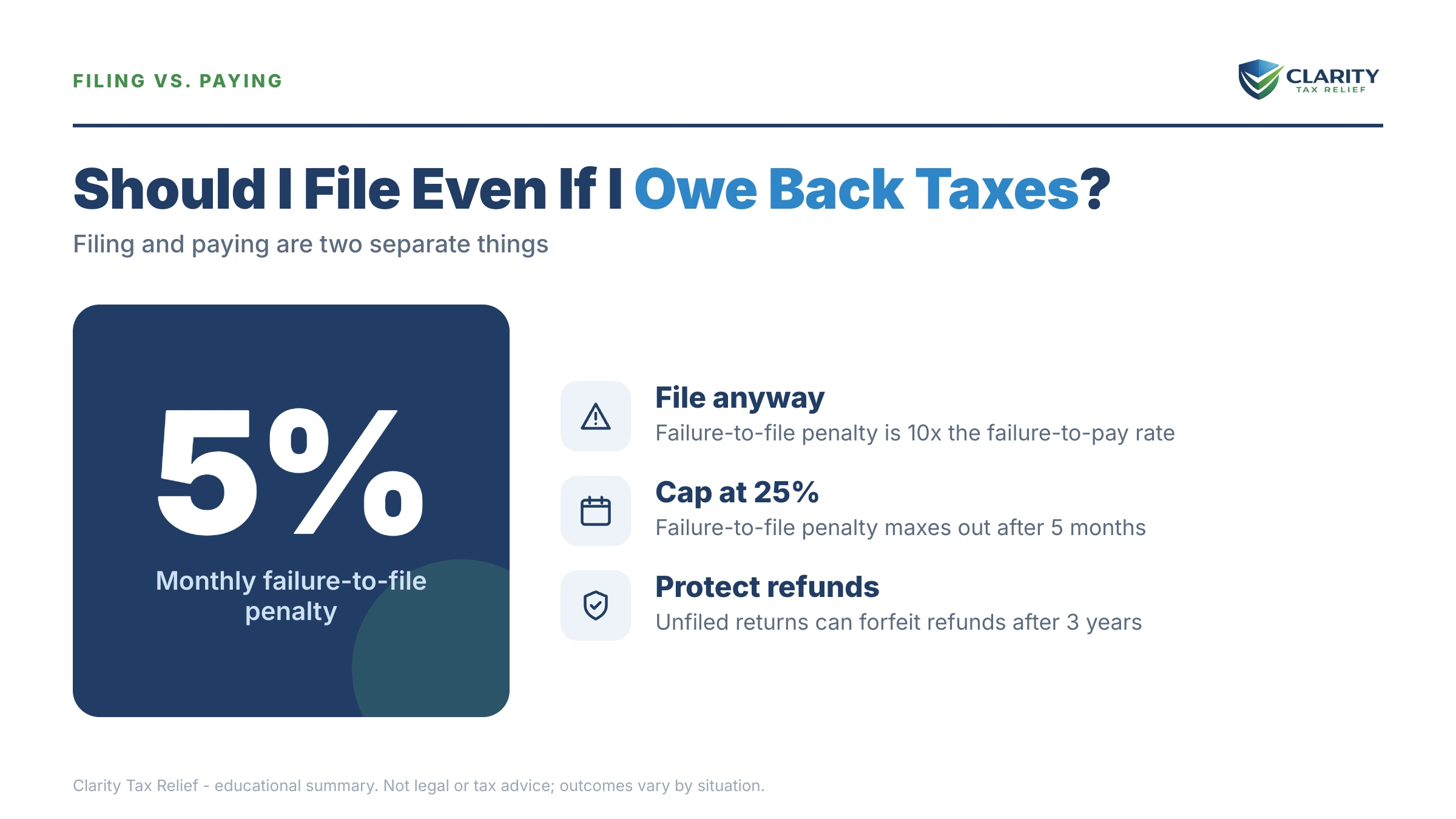
The short answer: yes — file this year's return on time even if you owe back taxes. The failure-to-file penalty runs 5% per month, ten times the 0.5% failure-to-pay penalty, and every IRS resolution program — payment plan, Offer in Compromise, hardship status — requires all your required returns filed first.
You already owe the IRS for prior years, this year's return is sitting half-finished, and part of you is whispering that filing it will just make things worse. If you're typing "should I file taxes if I owe back taxes" into a search bar at midnight, that whisper is the real question. Here's the honest answer: skipping the return is the one move that makes everything worse — and filing it, even with no payment attached, is the cheapest decision available to you right now.
⏱ The clock that's actually running: every month an unfiled return stays unfiled adds 5% of the unpaid tax in failure-to-file penalty, up to 25% — versus 0.5% per month if you file and simply can't pay. And if any unfiled year shows a refund, that refund expires three years after the return's original due date.
Should I file taxes if I owe back taxes? The penalty math says yes
Filing a return you can't pay costs 0.5% of the balance per month in penalties; not filing it costs 5% per month — ten times more, on the exact same debt. That single ratio answers the question before anything else does.
Here's how the two penalties work. The failure-to-file penalty vs failure-to-pay penalty comparison comes down to this: failure-to-file charges 5% of the unpaid tax per month (or partial month) the return is late, capped at 25%. Failure-to-pay charges 0.5% per month, also capped at 25% over time — but that cap takes years to reach instead of months.
In months where both apply, the failure-to-file portion drops to 4.5% and failure-to-pay adds 0.5% — still a combined 5% per month. Once you're more than 60 days late, a minimum flat penalty (adjusted annually for inflation) applies even to small balances. Interest compounds daily on the whole growing pile.
Three more reasons the answer stays yes no matter how much you already owe:
- Filing is the gate to every fix. The IRS will not approve a payment plan, hardship status, or settlement on your old debt while a required return is missing. More on this rule below.
- An unfiled year can turn into a Substitute for Return. The IRS files it for you using only the income reported to it — no business expenses, no dependents, worst filing status — and assesses the inflated result. See the IRS filed a return for you (SFR) for how ugly that math gets.
- Refund years pay your debt for free. If this year's return shows a refund, the IRS offsets it against your back taxes automatically — money toward the balance that never touches your bank account or your budget.
One quieter point: the IRS's 10-year collection clock only starts when tax is assessed, and assessment requires a return (yours or an SFR). An unfiled year isn't a debt that's aging out — it's a debt whose expiration timer hasn't even started.
| What you do | Monthly penalty | Penalty after 5 months |
|---|---|---|
| Don't file, don't pay | 5% combined (4.5% FTF + 0.5% FTP) ≈ $420 | ≈ $2,100 |
| File on time, pay nothing | 0.5% FTP ≈ $42 | ≈ $210 |
| File on time, approved payment plan | FTP drops to 0.25% ≈ $21 | ≈ $105 |
Interest applies in every row — no option freezes the balance — but the gap between row one and row two is pure, avoidable penalty. You can estimate your own numbers with our IRS penalty and interest calculator.
Filing compliance: the rule that locks or unlocks every option
The IRS will not negotiate your back taxes — not a payment plan, not a settlement, not hardship status — until every required return is filed. This is called filing compliance, and it's the least-advertised rule in tax resolution.
It means the return you're tempted to skip is the key to fixing the debt you already have. Submit an installment agreement request with a missing return and it gets rejected. Submit an Offer in Compromise and it comes back unprocessed, application fee wasted. Ask for Currently Not Collectible status and the assistor will tell you to file first.
Compliance generally means the last six years of required returns — the IRS's own internal policy, covered in detail in how many years of back taxes you have to file. It also means staying current going forward: adequate withholding or estimated payments, and for business owners, current payroll returns and deposits.
So the sequence is fixed whether you like it or not: file this year, close any unfiled prior years, then resolve the combined balance once. The shared playbook for that last step lives in our guide to how to settle tax debt yourself; the rest of this page covers what's specific to filing on top of existing debt.
Worked example: $23,800 in back taxes, plus a new balance
Say you run a small landscaping company with four employees, and you owe the IRS $23,800 from two prior personal tax years. This year's Form 1040 — with self-employment income the business passed through — will show another $8,400 due, and you don't have $8,400. (This is a hypothetical, not a client story.)
Option A: don't file, hoping to stay off the radar. The new year accrues roughly $420 a month in combined penalties. Within about five months the failure-to-file penalty alone reaches its 25% cap — roughly $2,100 added — plus failure-to-pay and daily interest. Meanwhile the $23,800 keeps generating collection notices, and the missing return blocks you from putting any of it on a plan.
Option B: file on time, pay nothing with the return. The new year accrues about $42 a month instead of $420 — a savings of roughly $1,890 over those same five months. Your combined balance is now about $32,200, which sits comfortably under the $50,000 ceiling for a streamlined installment agreement. Spread over 72 months, that's roughly $450 a month before interest — the IRS will set the payment somewhat higher so accruing interest doesn't outlast the term. Once the agreement is approved, the failure-to-pay rate on the whole balance drops by half, to 0.25% per month.
Same debt, same income, same business. The only difference between the two paths is whether one return got filed — and it's worth about $1,900 in the first five months, plus access to every option Option A locked away.
What happens if you skip filing this year
Skipping a return when you already owe back taxes puts you into two IRS collection tracks at once: the non-filer sequence for the new year and the balance-due sequence already running on the old ones. The non-filer track escalates in this order:
- CP59 — the IRS's records show no return filed for the year. A request, not yet a threat.
- CP516, then CP518 — escalating reminders; the CP518 is the final "file now" notice before the IRS acts on its own.
- Substitute for Return — the IRS builds the return from W-2s, 1099s, and 1099-Ks reported under your SSN: no deductions, no business expenses, single or married-filing-separately status. For a business owner, gross receipts get taxed as if they were pure profit.
- CP3219N — a 90-day notice of deficiency for the inflated SFR amount. Miss that window and the balance is assessed as legally owed.
- The new debt merges into collections — the SFR balance joins your existing $23,800 in the same billing-and-levy stream, and if the combined total crosses $66,000 (the 2026 threshold), the IRS can certify you for passport denial or revocation.
Two aggravating factors in 2026. First, the IRS workforce shrank roughly 27% in 2025 — but CP59s, SFRs, and levies are generated by automated systems that never took a buyout. The escalation runs whether or not a human ever reads your file. Second, the entire time that return sits unfiled, you cannot resolve the old debt either — so the notices on the $23,800 keep marching toward levy with your best defenses switched off.
And if you're already on a payment plan for the back taxes, an unpaid new balance is one of the most common ways it dies: the IRS issues a CP523 defaulted installment agreement notice, and the whole debt goes back into active collection.
Owe back taxes with a return you haven't filed yet?
Every month that return stays unfiled adds ten times the penalty of filing without paying — and keeps every resolution option locked. Get a free review of your filing order and combined balance from an experienced tax professional before another month accrues.
Your options for the combined balance once everything is filed
Once your returns are in, the IRS has a full menu of resolution programs — and every one of them checks filing compliance before anything else. Here's what each requires and costs:
| Option | Typical eligibility | All returns filed? | Cost |
|---|---|---|---|
| Short-term payment plan | Can pay in full within 180 days | Required | $0 setup; penalties + interest continue |
| Guaranteed installment agreement | Owe $10,000 or less, pay within 3 years | Required | Setup fee varies; interest continues |
| Streamlined installment agreement | Up to $50,000, up to 72 months, set up online | Required | Setup fee (lower with direct debit); FTP drops to 0.25%/mo |
| Currently Not Collectible | Paying anything would create genuine hardship | Required | $0; debt remains, interest accrues, collection pauses |
| Offer in Compromise | Assets + future income genuinely can't cover the debt | Required | $205 fee + 20% down (both waived with low-income certification) |
| Penalty abatement | Clean 3-year history (FTA) or reasonable cause | Required | $0 to request |
On the Offer in Compromise: it's real, but the IRS accepted roughly 1 in 5 offers in FY2024, and acceptance is pure math on your assets and income — never a discount for asking. On penalties: first-time penalty abatement can wipe the failure-to-pay penalties on your first delinquent year if the prior three were clean, and starting summer 2026 the IRS's new Automatic Exemption from Penalty (AEP) begins applying similar relief automatically, with no request needed.
Which options are realistic depends mostly on the size of the combined balance after you file:
| Total you owe (all years) | Realistic options | What the IRS will ask for |
|---|---|---|
| Under $10,000 | Pay in 180 days, or guaranteed installment agreement | Nothing beyond the request — approval is close to automatic |
| $10,000–$25,000 | Streamlined agreement, online setup | No financial disclosure |
| $25,000–$50,000 | Streamlined agreement (direct debit typically required); OIC or CNC if finances warrant | Direct-debit enrollment; financials only for OIC/CNC |
| $50,000–$100,000 | Non-streamlined agreement, OIC, CNC, partial-pay agreement | Full financial statement (Form 433 series) |
| Over $100,000 | Same programs, but likely assigned to a revenue officer | Detailed financials, possible asset review, lien likely |
How to file this year when you owe back taxes, step by step
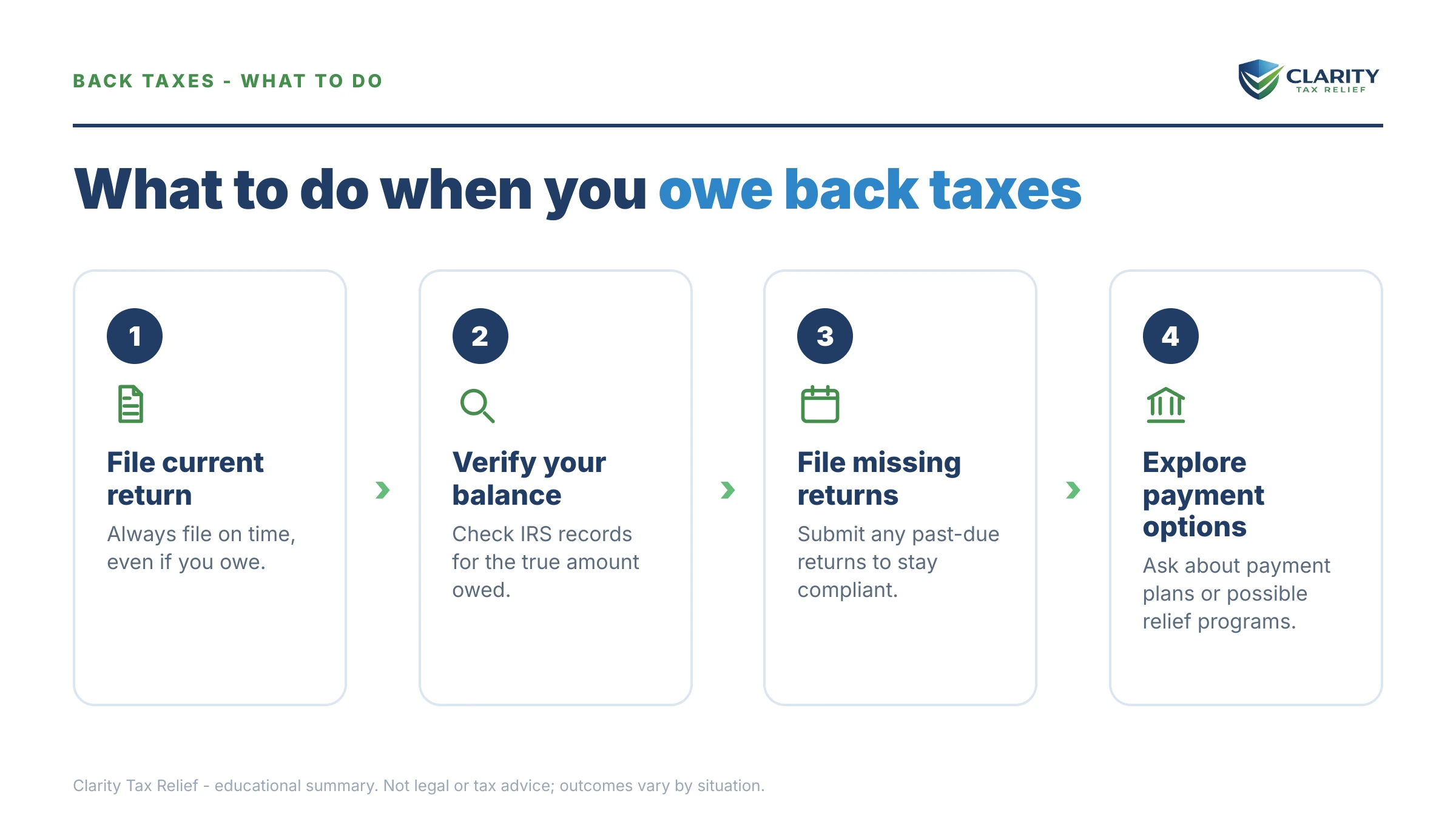
- File this year's return by the deadline. Submit the return on time even if you send no payment with it — filing alone caps your penalty exposure at 0.5% per month instead of 5%.
- Pull your IRS account transcripts. Confirm the exact balance for every prior year and identify any years the IRS shows as unfiled, so you resolve the whole picture at once.
- Catch up any unfiled prior years. The IRS generally requires the last six years of returns for filing compliance; file any refund years first, because refunds expire three years after the original due date.
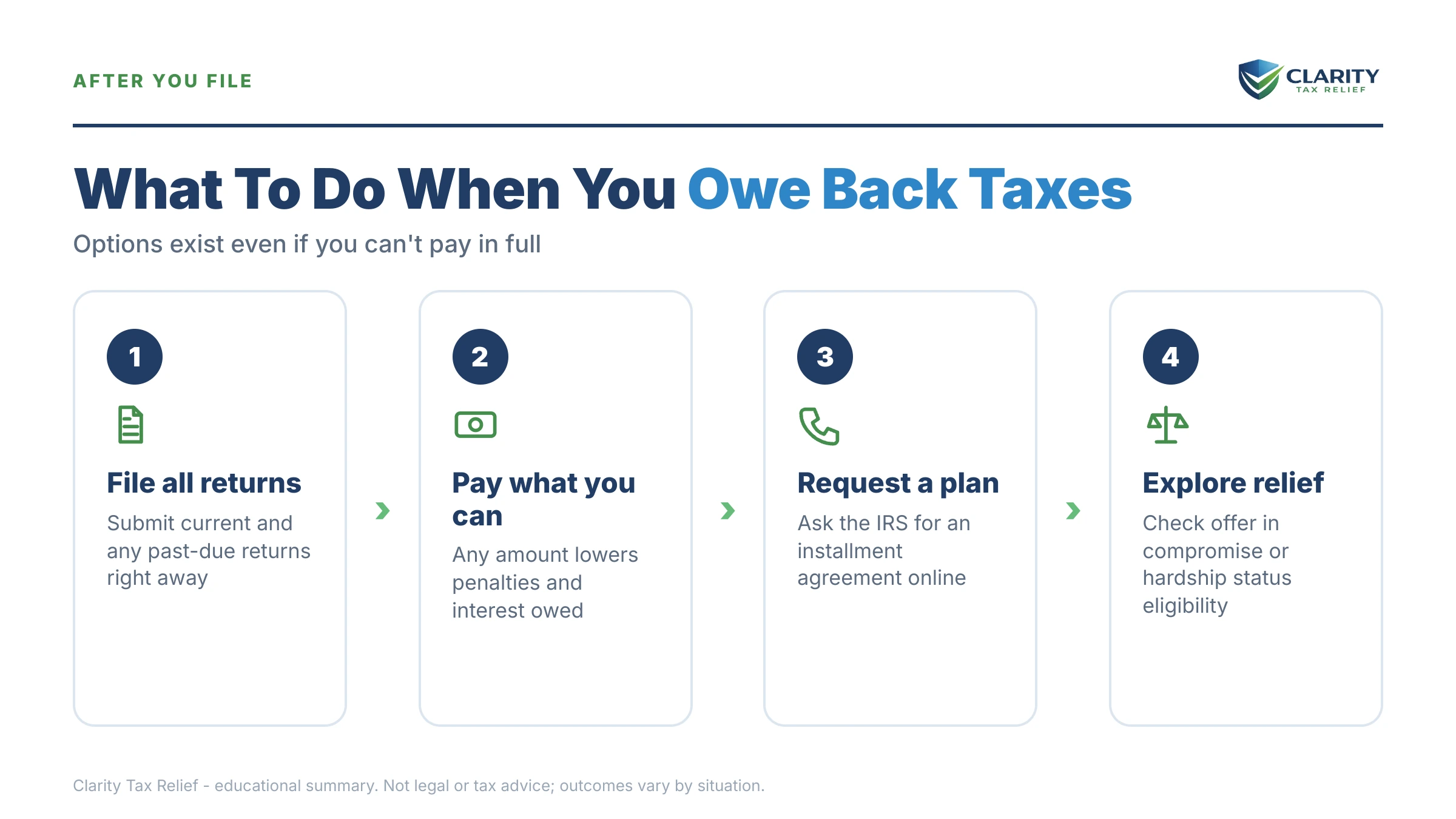
- Set up one resolution for the combined balance. Choose a payment plan, hardship status, or an Offer in Compromise covering every year you owe — one agreement for the full combined debt beats separate fixes.
- Fix your withholding or estimated payments. Adjust now so next April's return doesn't add a new balance — a fresh liability you can't pay can default the agreement you just set up.
For step two, our walkthrough on how to get IRS transcripts online shows exactly which transcript types to pull and what to look for.
Situations that change the plan — but never the answer
The answer to whether you should file stays yes in every scenario below; what changes is the order of operations and what "compliance" includes.
You own a business with payroll
For a business owner, filing compliance is bigger than the 1040. The IRS also checks that your quarterly Form 941s and annual Form 940 are filed and your federal tax deposits are current — fall behind there and your personal resolution can be denied even with every 1040 in. Unpaid payroll tax is also the most dangerous kind, because the withheld "trust fund" portion can be assessed against you personally. If any of your debt is payroll-side, start with our guide to 941 back taxes before you decide what to file first.
You're already on an installment agreement
File — but plan for the new balance before it's assessed. A new liability you can't pay triggers default. Call the IRS (or have your representative call) to amend the agreement to include the new year, or pay the new balance by its due date to keep the plan untouched.
This year's return shows a refund
File it — the refund will be applied to your back taxes, which is the point. The full mechanics are in will my refund be taken for back taxes. One exception worth knowing: if you're newly married and the debt is yours alone, your spouse's share of a joint refund can be protected — some couples weigh married filing separately when a spouse owes the IRS, trading some tax benefits for a shielded refund.
You have multiple unfiled years, not just this one
File the current year on time first — it's the only one with a live deadline you can still meet cleanly — then work backward through the missing years. Lost paperwork isn't a blocker: IRS wage and income transcripts can reconstruct most of it, as covered in filing back taxes with no records.
You're retired or on fixed income
Filing still protects you — especially because the IRS can take up to 15% of Social Security benefits through the Federal Payment Levy Program once collection escalates, and hardship programs that stop it all require filing compliance. The fixed-income playbook is in retired and owe back taxes.
Money is genuinely gone — hardship or very low income
File anyway; it costs nothing and unlocks the programs built for exactly this. Currently Not Collectible pauses collection with no payment at all, and if your AGI is at or below 250% of the federal poverty level, the OIC low-income certification waives the $205 application fee, the 20% down payment, and payments during review.
When you can handle this yourself — and when help changes the outcome
Most people asking this question can execute the fix without hiring anyone. If it's one current-year return, your prior balances are accurate, and the combined total is under $50,000, the path is genuinely DIY: file, then set up a streamlined plan online in under an hour through the IRS payment plans page. Free filing help also exists through VITA sites, and the Taxpayer Advocate Service can intervene when the IRS itself is the obstacle.
Experienced help earns its cost in specific situations: multiple unfiled years with reconstruction needed, an SFR already assessed at an inflated amount (a correctly filed original return can replace it and shrink the debt), business debt that mixes 1040, 941, and deposit penalties, a payment plan about to default, a levy already in motion, or Offer in Compromise math where getting the financial disclosure right decides acceptance. In those cases, the sequencing — which returns first, which penalties to challenge, which program to request — often changes what you ultimately pay more than any single form does.
Terms you'll run into, decoded
- Filing compliance — the IRS's requirement that all required returns (generally the last six years) be filed before any resolution program is approved.
- Substitute for Return (SFR) — a return the IRS files for you from reported income only, with no deductions or credits, almost always overstating what you owe.
- Refund offset — the automatic application of your tax refund to a balance you owe; you receive a CP49 notice showing which year it paid down.
- Failure-to-file penalty — 5% of unpaid tax per month a return is late, capped at 25%; the single most expensive consequence of not filing.
- CSED — Collection Statute Expiration Date; the IRS generally has 10 years from assessment to collect, but the clock never starts on a year with no return.
- AEP — Automatic Exemption from Penalty, the automatic penalty-relief regime replacing first-time abatement starting summer 2026 — no request required.
If your situation mixes personal back taxes with business payroll years, the filing order genuinely matters — a free case review at (888) 825-7779 or through the 2-minute form can map that sequence before you submit another return.
Filing with back taxes: your questions answered
Will the IRS keep my refund if I owe back taxes?
Yes. Any refund on the return you file will be offset against your back-tax balance automatically, and you'll get a CP49 notice showing where it went. That's not a reason to skip filing — the offset pays down your debt without costing you a penalty, and it's often the cheapest money you'll ever put toward the balance.
Can I set up a payment plan if I haven't filed all my returns?
No. The IRS requires filing compliance — generally all required returns from the last six years — before it will approve an installment agreement, an Offer in Compromise, or Currently Not Collectible status. Filing first isn't optional paperwork; it's the gate every resolution program sits behind.
What happens if I don't file because I can't afford to pay?
You trade a 0.5% monthly penalty for a 5% monthly one on the same balance, and you block yourself from every payment option until the return is in. If you're more than 60 days late, a minimum flat penalty applies even on small balances. File on time and send nothing if you must — it's the cheaper mistake by a factor of ten.
Does filing this year's return alert the IRS to my old debt?
The IRS already knows about your back taxes — they're assessed on your account and generating notices whether you file or not. What not filing does is add a non-filer flag to an account that's already in collections, which makes enforcement more likely, not less. Filing on time is what keeps your account looking resolvable.
How many years of unfiled returns do I have to file?
The IRS generally requires the last six years of returns to consider you filing-compliant, under its own policy statement. Older years are usually not demanded unless there's significant income or fraud involved. If some of those years are refund years, file them quickly — refunds expire three years after the original due date.
Will a new balance default my existing installment agreement?
It can. An installment agreement requires you to stay current on new filings and new taxes; a fresh balance you can't pay is one of the most common triggers for a CP523 default notice. If this year's return will show tax due, contact the IRS before the balance is assessed and ask to amend the agreement to include the new year.
Can I still get a refund from an old unfiled year?
Only within three years of the return's original due date. File after that window and the refund is gone permanently — it can't even be applied to your back taxes. If you have unfiled years from the last three filing seasons that show refunds, those are the returns to file first, because the money offsets your balance.
Do the failure-to-file and failure-to-pay penalties both apply at the same time?
Yes. In months where both apply, the failure-to-file penalty is reduced to 4.5% and the failure-to-pay penalty adds 0.5%, for a combined 5% per month. Both cap at 25% each over time, and interest compounds daily on the whole growing balance — which is why an unfiled, unpaid year grows so much faster than a filed one.
I run payroll — does business filing compliance count too?
Yes. If you own a business, the IRS looks at your whole compliance picture: personal 1040s, quarterly Form 941 payroll returns, annual Form 940, and current federal tax deposits. A resolution on your personal back taxes can be denied or delayed because payroll filings are behind — and unpaid payroll tax carries personal exposure through the Trust Fund Recovery Penalty.
Your next 24 hours
- Find your real numbers. Log into your IRS online account and write down the exact balance for each prior year, plus any year flagged as unfiled — your plan starts from that total, not a guess.
- Gather this year's documents. W-2s, 1099s, business income and expense records, and last year's return — enough to file the current year even if you send no payment with it (payment options live at IRS.gov/payments when you're ready).
- Get the filing order reviewed free. Call (888) 825-7779 or use the 2-minute form. Every month the return stays unfiled costs ten times the penalty of filing without paying — the review costs nothing.
This guide is general information, not tax or legal advice for your specific situation. Eligibility for IRS programs depends on individual facts and circumstances; no outcome is guaranteed.