
Tax Debt & Family
What Happens to IRS Debt When You Die? Who Pays, Who Doesn't (2026)
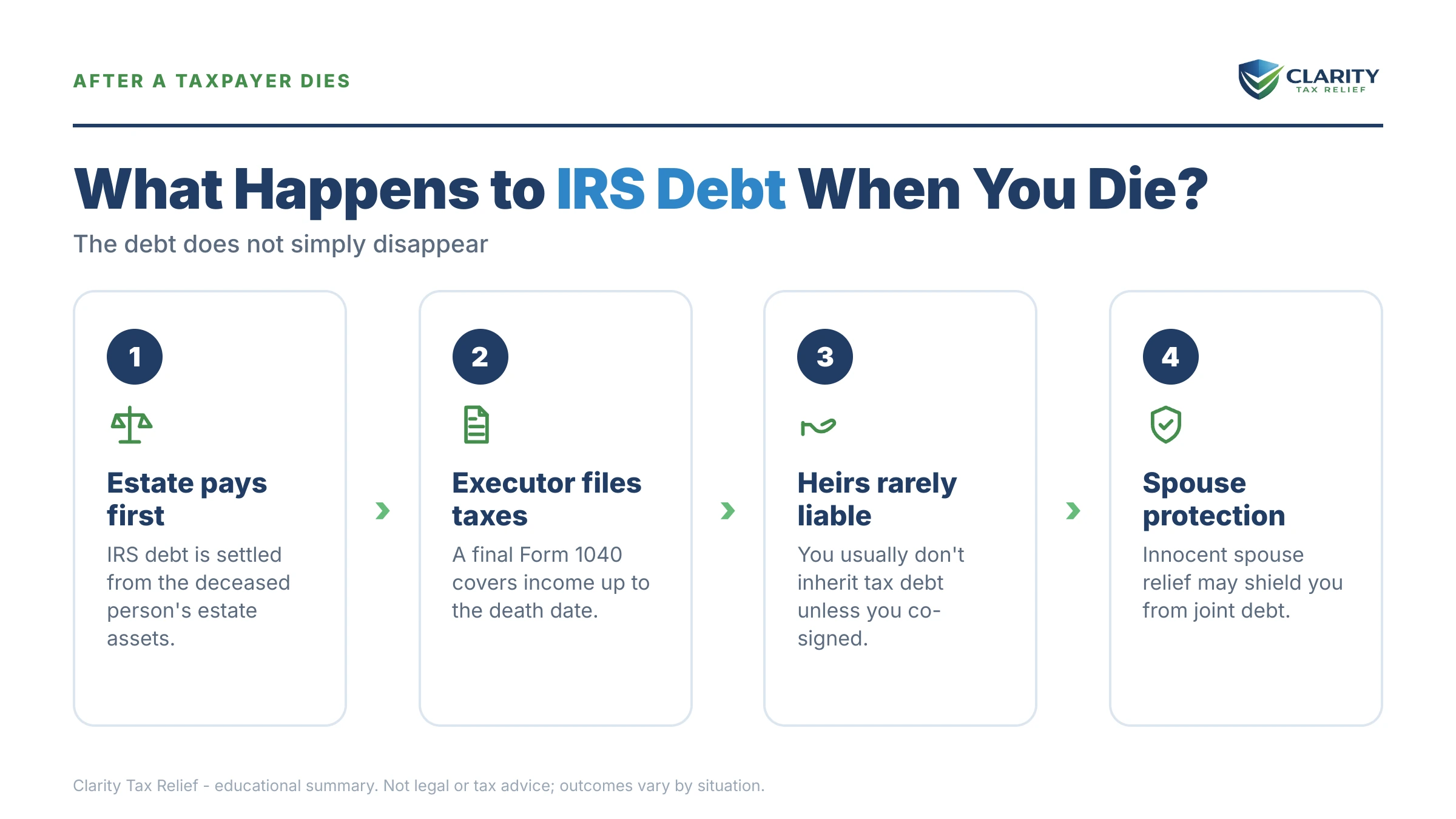
The short answer: what happens to IRS debt when you die is this — it becomes a claim against your estate. It does not vanish, and it does not pass to your children. The executor must pay the IRS from estate assets before heirs inherit; if the estate can't cover it, the balance generally goes unpaid — though joint-return spouses stay fully liable.
Maybe you're going through a parent's or brother's mail and just found a stack of IRS envelopes nobody ever mentioned. Or maybe the debt is yours — years of gig income, a few returns you never got around to filing — and you're lying awake wondering what you'd leave your family. Either way, the rules protect your family more than you fear, and the order you do things in matters more than the amount.
⏱ The clocks that matter: the decedent's final Form 1040 is typically due April 15 of the year after death — and penalties and interest keep accruing monthly on every unpaid and unfiled year until the estate resolves them. No letter arrives to pause either one.

What happens to IRS debt when you die: the mechanics
Unpaid IRS debt survives death as a claim against the deceased person's estate — everything they owned when they died. If you just want the one-line answer, our companion piece does IRS debt die with you gives it; this guide covers what actually happens next, step by step.
When someone dies owing back taxes, their assets — bank accounts, vehicles, real estate, business equipment — pass into an estate managed by an executor (also called a personal representative). Before that executor can hand anything to the heirs, the estate's debts must be addressed. Federal tax claims sit at or near the front of that line under 31 U.S.C. §3713, a statute that gives United States claims priority over most other creditors of an insolvent estate.
Three consequences flow from that structure:
- Heirs are not personally liable. The IRS collects from what the decedent owned, not from a child's own paycheck or savings. An inheritance can shrink or vanish; the heir's own money cannot be touched for the decedent's income tax.
- The estate pays before anyone inherits. An executor who reverses that order takes on the risk personally — more on that below.
- Debt the estate genuinely can't cover generally dies with it. The IRS writes off what a properly administered, insolvent estate cannot pay.
One more thing that surprises families: the filing obligation survives too. A final return must be filed for the year of death, and any unfiled prior years are still owed to the system — a common discovery when the person who died worked gig or 1099 jobs with no withholding.
Who pays IRS debt after death — and who doesn't
Personal liability for a decedent's IRS debt attaches to exactly one group automatically: spouses who signed joint returns for the years in question. Everyone else's exposure depends on what they received and when.
| Your relationship | Personally liable? | What the IRS can actually reach |
|---|---|---|
| Spouse — joint return years | Yes — joint and several | Your own income and assets, for 100% of those years' balances |
| Spouse — separate return years | Generally no | Only the decedent's estate (community-property states add wrinkles) |
| Child or other heir | No | Only what you inherit — the inheritance shrinks; your own money doesn't |
| Executor / personal representative | Not for the tax itself | Your personal assets, but only if you distribute the estate before paying the IRS (31 U.S.C. §3713) |
| Named beneficiary of life insurance or retirement | Generally no | Proceeds paid directly to you usually pass outside the estate; exceptions if the estate is the beneficiary or a lien attached before death |
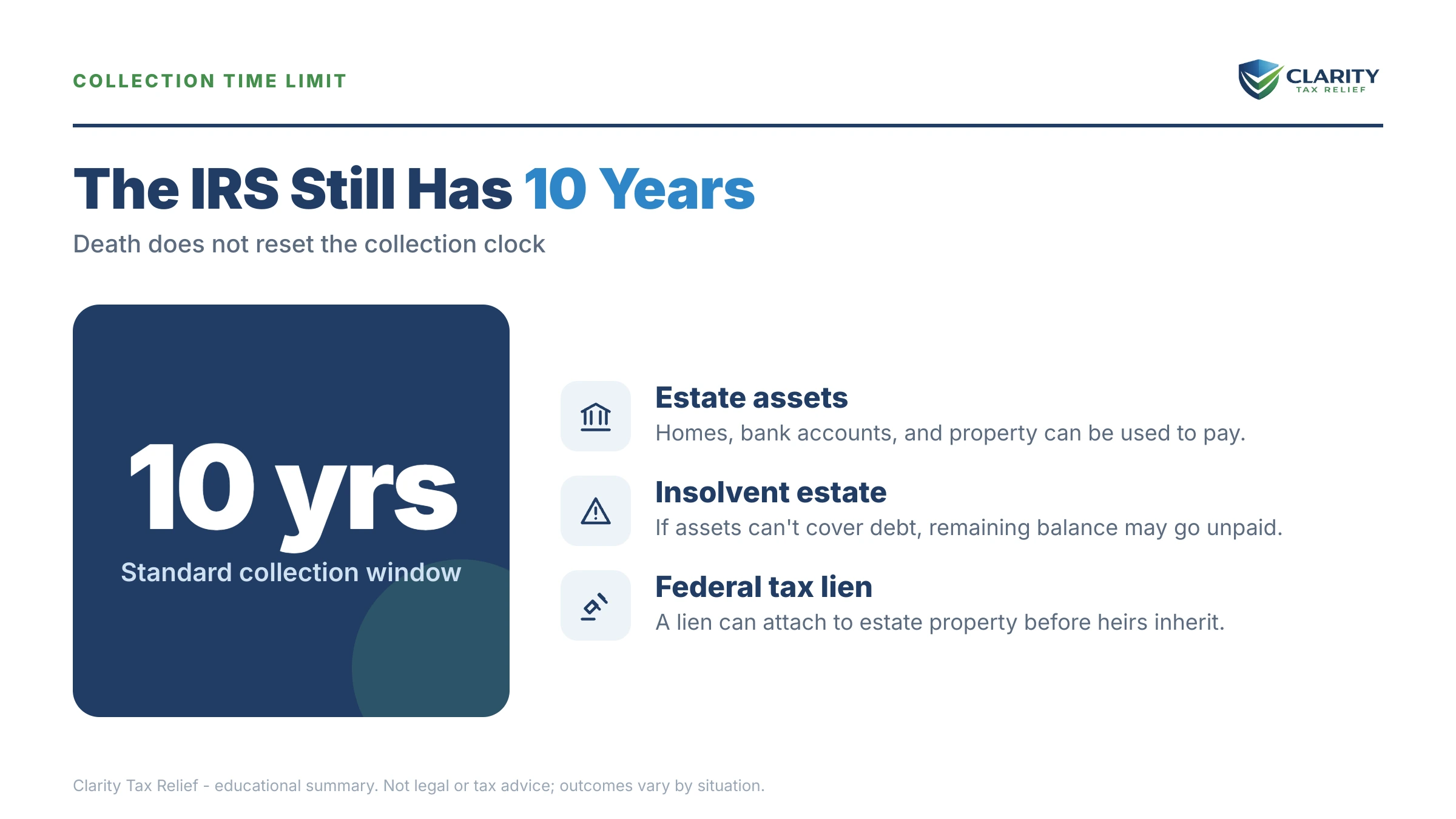
| Person who received gifts or transfers before death | Possibly | Transferee liability up to the value received, if the transfers left the estate unable to pay |
The executor row deserves emphasis, because it's the trap families walk into most often. An executor who knows about an IRS balance and pays other creditors — or hands money to heirs — before satisfying the government's claim can be held personally liable up to the amount distributed. The full mechanics are in our guide to when an executor is personally liable to the IRS. The protective move is boring but absolute: establish the IRS balance first, distribute last.
What happens if nobody deals with the debt
An unhandled IRS debt doesn't disappear when its owner does — the IRS's automated systems keep working the account, in a predictable sequence. Here's the order things unravel in when a family ignores the envelopes:
- Notices keep arriving. Bills and reminder letters go to the decedent's last known address while penalties and interest compound monthly on every unpaid year.
- Unfiled years get invented for you. The IRS can create substitute returns (SFRs) from raw 1099 data — gross income, zero deductions. For a gig worker with heavy mileage and expenses, an SFR can assess double or triple the true liability.
- A federal tax lien attaches to estate property. Once tax is assessed and demanded, the lien reaches the house, the car, the accounts — and it follows the property even after it changes hands. See IRS lien after death for how liens complicate selling estate assets.
- The executor becomes the target. Distributions made while the IRS goes unpaid convert the government's problem into the executor's personal one under §3713.
- Heirs face clawbacks. Transferee liability lets the IRS pursue distributed assets in the hands of the people who received them — often years later, after the money is spent.
Every one of these stages is avoidable by doing things in the right order, and none of them requires the family to pay a dollar of its own money. The damage in these cases almost never comes from the debt itself — it comes from distributing first and discovering the debt second.
Settling an estate that owes the IRS?
Before anything is distributed, get the decedent's IRS account reviewed free. We'll identify every assessed year, every unfiled year, and what the estate actually has to pay — while penalties and interest are still accruing on the balance.
How the estate can resolve the debt: every option
An estate has most of the same resolution tools a living taxpayer has, plus two that only exist after death: insolvency closure and unusually strong penalty-relief grounds. The general mechanics of these programs are covered in our pillar on how to settle tax debt yourself — what changes here is one hard rule: the IRS gets addressed before the heirs do.
| Option | When it fits | Key requirement or limit |
|---|---|---|
| Pay in full from estate funds | Estate is solvent | Pay before any distributions; keep the zero-balance transcript |
| Reasonable-cause penalty abatement | Penalties trace to the final illness or death itself | Form 843 with documentation — death and serious illness are recognized grounds |
| First-Time Abate / AEP | Decedent had a clean compliance history the prior 3 years | Removes one year's penalties; the automatic version (AEP) begins rolling out in summer 2026 |
| Payment over time | Estate stays open while property sells | Requires IRS agreement; interest keeps accruing until paid |
| Offer in Compromise | Estate assets genuinely can't cover the balance | Uncommon and fact-specific; $205 application fee; the IRS runs the math, not the family |
| Insolvent-estate closure | Nothing left after court-approved administration costs | Document assets and shortfall; the remaining balance goes uncollected |
| CSED expiration | Assessments approaching the 10-year mark | Verify each year's date on account transcripts before paying anything |
Two options that living taxpayers lean on are off the table for estates. Bankruptcy is one: a probate estate can't file for bankruptcy relief, so the analysis in does bankruptcy clear IRS debt only applies while the taxpayer is alive. Hardship (Currently Not Collectible) status is the other — it protects a living person's income, and an estate has no paycheck to protect.
The single highest-value move for most estates is penalty abatement. When someone's final months were consumed by illness, the late-filing and late-payment penalties from that period frequently qualify for reasonable-cause removal — sometimes shaving 25% or more off the assessed balance before the estate pays a dime of it. For the broader picture of when the IRS reduces balances at all, see does the IRS ever forgive tax debt.
A worked example: $7,400 in tax, three unfiled years
Say your brother drove rideshare and delivery for years, died in early 2026, and never filed for 2023, 2024, or 2025. You're named executor. You pull his wage-and-income transcripts and find 1099-K and 1099-NEC forms for all three years. Prepared properly — with his mileage and expenses deducted — the three returns show a combined $7,400 in income and self-employment tax.
Here's the math the estate is facing:
- Failure-to-file penalty: 5% per month, capped at 25% of the unpaid tax — up to roughly $1,850 across the three years.
- Failure-to-pay penalty: 0.5% per month, still running on each year.
- Interest: compounding daily on the tax and the penalties.
Depending on how old each year is, the total by filing time might sit around $9,800–$10,300. His estate holds $16,500 in checking and a $5,200 car — $21,700. You file the three returns, then request reasonable-cause abatement of the failure-to-file penalties, documenting his final illness. If the IRS removes them, the bill drops by about $1,850, the estate pays roughly $8,000–$8,400, and the heirs split what remains. Nobody in the family owes a cent personally.
Now the contrast — the do-nothing version. The IRS eventually files substitute returns on his gross 1099 income: no mileage, no expenses, no adjustments. The same three years could easily assess at two to three times the real liability, a lien attaches to the car and the account, and an executor who already distributed the $21,700 is personally on the hook for what the IRS should have received. Same person, same income — wildly different outcomes, decided entirely by sequence.
How to respond, step by step
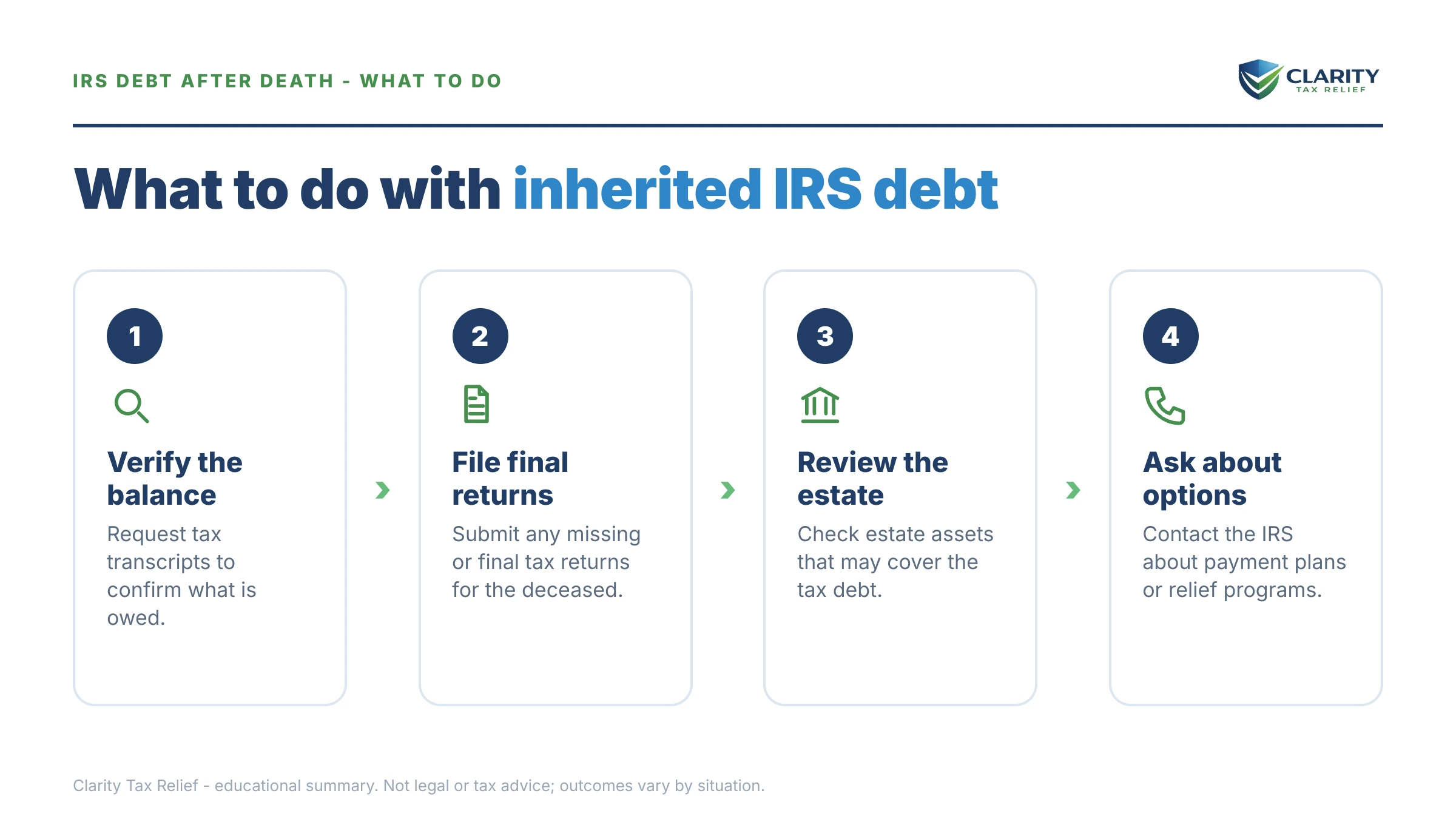
- Secure the paperwork. Gather every IRS letter, prior tax returns, 1099s, bank statements, and the death certificate — and pause all distributions from the estate.
- File Form 56. This tells the IRS you're the fiduciary, so notices come to you instead of piling up at the decedent's last address.
- Pull IRS transcripts. Order account transcripts and wage-and-income transcripts for the last several years to see what's assessed, what's unfiled, and each year's collection deadline.
- File the missing returns. Prepare the final Form 1040 and any unfiled back years from real records so deductions replace the IRS's no-deduction substitute assessments.
- Resolve the balance from estate funds. Pay what's owed, request penalty abatement where reasonable cause applies, or document insolvency — all before anything goes to heirs.
- Keep proof of resolution. Retain zero-balance transcripts or closing documentation before final distributions, protecting the executor from personal liability.
The paperwork maps onto that sequence cleanly:
| Stage | What happens | Key form |
|---|---|---|
| 1. Estate opens | Court appoints the executor / personal representative | Letters testamentary (state court) |
| 2. IRS is notified | Fiduciary steps into the taxpayer's shoes for notices | Form 56 |
| 3. Balances verified | Account + wage-and-income transcripts pulled for each year | Form 8821 or 4506-T |
| 4. Returns filed | Final 1040 plus unfiled back years; refund claims by non-spouse | Form 1310 (refunds) |
| 5. Estate income reported | Interest, rent, or sale gains earned after death | Form 1041 |
| 6. Debt resolved | Payment, penalty abatement, or documented insolvency | Form 843 (abatement) |
| 7. Estate closes | Distributions to heirs, with proof of resolution retained | — |
If the final return itself shows a balance the estate must handle, our guide to a deceased person's final tax return with a balance due covers that specific fork. For the full estate-side resolution playbook, see estate owes the IRS.
If you're the surviving spouse
A joint return makes both signers fully liable for that year's tax — and that liability survives your spouse's death. The IRS doesn't split a joint balance in half; it can collect 100% of a joint-return year from the surviving spouse's own income and assets, no probate required. Our guides on deceased spouse tax debt and whether a widow is responsible for her husband's tax debt walk through this in detail.
Two doors may still open for you. If the debt traces to income your spouse earned and hid from you — unreported gig deposits, gambling winnings, a side business — innocent spouse relief can remove your liability for the understatement, and death does not bar the request. And for years your spouse filed separately, you generally have no liability at all, though the nine community-property states apply their own income-splitting rules that can pull a surviving spouse partway back in. If you live in one, get the specific years reviewed before assuming you're clear.
Does the 10-year collection statute keep running after death?
Yes — each assessed year's Collection Statute Expiration Date runs for 10 years from assessment, and death neither pauses nor restarts it. For a decedent whose debt is old, this changes everything: a balance assessed in 2017 may expire before the estate would otherwise pay it, exactly as described in does IRS debt go away after 10 years. Certain events toll the clock — a pending Offer in Compromise, bankruptcy filed during life, some appeals — so the printed dates need checking, not guessing. You can estimate each year's expiration with our CSED Calculator, then confirm against the account transcripts.
The mirror-image warning: unfiled years have no clock at all, because nothing was ever assessed. A decedent's three unfiled gig years aren't quietly expiring — they're waiting to be assessed, either by the family's accurate returns or by the IRS's inflated substitute ones.
Life insurance, retirement accounts, and other non-probate assets
Assets that pass by beneficiary designation generally bypass the estate — and with it, the decedent's income tax debt. Life insurance paid directly to a named beneficiary, a 401(k) or IRA with a living designated beneficiary, and transfer-on-death accounts typically go straight to the recipient without passing through the executor's hands. The nuances (including the cash-value exception) are in can the IRS take life insurance.
The exceptions are narrow but real. If the estate is the named beneficiary — or no beneficiary survives — the proceeds land inside the estate and become payable toward the IRS claim like any other asset. And a federal tax lien that attached to property during the decedent's life, including a policy's cash value, doesn't evaporate at death; it follows the property. One clarification families often need: this section is about the decedent's debt reaching what you inherit. If you owe the IRS yourself, the analysis flips — that's covered in can the IRS take my inheritance.
When you can handle this yourself — and when to get help
Plenty of estates can resolve an IRS balance without professional help. If the decedent filed every year, the balance is one recent year, the estate clearly has enough cash to cover it, and no lien has been filed, the path is genuinely simple: file Form 56, verify the balance on a transcript, pay it from estate funds at IRS.gov, keep the proof, and distribute the rest. That's an afternoon of careful paperwork, not a case.
Experienced help changes outcomes in four situations. Multiple unfiled years — especially gig or 1099 income — where reconstructing expenses can cut the assessed debt by half or more before the estate pays it. A lien already recorded against estate property that has to be sold. Executor exposure — anything has already been distributed, or heirs are pressuring you to distribute now. And joint-return liability where a surviving spouse may have an innocent-spouse case worth building. In each of these, the fee for help is usually small against the dollars the sequencing decisions move.
If the estate you're handling has unfiled years, a recorded lien, or heirs already asking for their share, a free review with an experienced tax professional — two-minute form or (888) 825-7779 — can map every year and every deadline before you distribute a dollar.
Terms you'll hear, decoded
- Estate: everything the person owned at death — accounts, vehicles, property — gathered into one legal pot that pays debts before heirs.
- Executor / personal representative: the person a court authorizes to manage the estate, file the returns, and pay the claims.
- Form 56: the one-page notice telling the IRS a fiduciary now speaks for the deceased taxpayer, redirecting all notices.
- Substitute for Return (SFR): a return the IRS builds for a non-filer from raw income reports — no deductions, so almost always overstated.
- Transferee liability: the IRS's power to recover assets from whoever received them, when transfers left the estate unable to pay its tax.
- CSED: the Collection Statute Expiration Date — the day, 10 years after assessment, when the IRS's right to collect a given year ends.
IRS debt after death: your questions, answered
Do children inherit IRS debt from their parents?
No — children never become personally liable for a parent's IRS debt. The debt is paid from the parent's estate before heirs receive anything, so an inheritance can shrink or disappear, but the IRS cannot pursue a child's own wages, bank accounts, or property. The main exception is transferee liability: if a parent gave away assets before death to dodge the debt, the IRS can recover up to the value of what was transferred.
Is a surviving spouse responsible for a deceased husband's or wife's tax debt?
Only for years you filed jointly. A joint return creates joint and several liability, so the IRS can collect 100% of those years from the surviving spouse's own income and assets. For years the decedent filed separately, you're generally not liable, though community-property states can complicate that. Innocent spouse relief may remove joint liability if the debt came from income your spouse hid from you.
Can the IRS take life insurance money after someone dies?
Generally not when the proceeds pay directly to a named beneficiary — that money passes outside the estate and outside the reach of the decedent's income tax debt. Two exceptions matter: if the estate itself is the beneficiary, the proceeds become estate assets the executor must use to pay the IRS, and a federal tax lien that attached to a policy's cash value before death can still be enforced.
What happens if the estate has no money to pay the IRS?
The debt generally goes unpaid and dies with the estate. The executor documents the insolvency — assets, court-approved administration costs, and the shortfall — pays the IRS whatever properly remains, and closes the estate. The IRS cannot then pursue heirs' own money. What it can do is claw back assets that were distributed or given away before the debt was paid, so the order of payment matters more than the amount.
Does the IRS 10-year statute of limitations continue after death?
Yes — the Collection Statute Expiration Date keeps running exactly as it did in life, 10 years from each assessment. Death neither pauses nor restarts it. For long-ago balances, part of the debt may already be near expiration, so pull account transcripts and check each year's assessment date before paying. Watch for unfiled years, though: nothing was ever assessed, so no clock has started on them.
Do I have to file a tax return for someone who died?
Yes. The executor or surviving spouse must file the decedent's final Form 1040 covering income from January 1 through the date of death, typically due April 15 of the following year. If the estate earns income afterward — interest, rent, sale gains — a Form 1041 estate return may also be required. Any unfiled prior years should be filed too; the filing obligation doesn't die with the taxpayer.
Can an executor be held personally liable for the decedent's tax debt?
Yes, in one specific situation: under 31 U.S.C. §3713, an executor who pays other creditors or distributes assets to heirs while knowing about an unpaid federal tax debt can be personally liable up to the value of what was distributed. The fix is simple — establish what the IRS is owed before anything leaves the estate. Executors who follow that order are not liable for the tax itself.
What if the person who died never filed tax returns?
The executor should file the missing returns from actual records — otherwise the IRS may file substitute returns (SFRs) that allow no deductions and assess far more than is really owed. For a self-employed decedent, an SFR taxes gross 1099 income with no expenses or mileage, often doubling or tripling the true liability. Filing accurate late returns typically shrinks the assessed debt before the estate pays it.
Can an estate set up a payment plan or settle with the IRS?
Yes — an estate can arrange to pay over time while assets are sold, request penalty abatement (death and final illness are recognized reasonable-cause grounds), and in limited cases submit an Offer in Compromise when assets genuinely can't cover the balance. Estate offers are uncommon and fact-specific, and the IRS accepted roughly 1 in 5 offers in FY2024, so get the transcripts and math right before applying.
Your next 24 hours
- Find the paperwork. Gather every IRS envelope, the last filed return, and any 1099s from the decedent's mail and files — note each tax year and amount you can see.
- Freeze distributions. Nothing leaves the estate — not to creditors, not to heirs — until the IRS balance is known. That single pause is what protects the executor personally.
- Get a free case review. Call (888) 825-7779 or use the 2-minute form — an experienced tax professional can pull the decedent's transcripts and map every assessed and unfiled year while penalties and interest are still accruing.
For the IRS's own guidance on a deceased taxpayer's account, see the agency's deceased person page and the instructions for Form 56, Notice Concerning Fiduciary Relationship. Estate payments themselves go through IRS.gov/payments, payable only to the United States Treasury.
This guide is general information, not tax or legal advice for your specific situation. Eligibility for IRS programs depends on individual facts and circumstances; no outcome is guaranteed.