
Tax Debt Relief
Does the IRS Ever Forgive Tax Debt? The Honest 2026 Answer
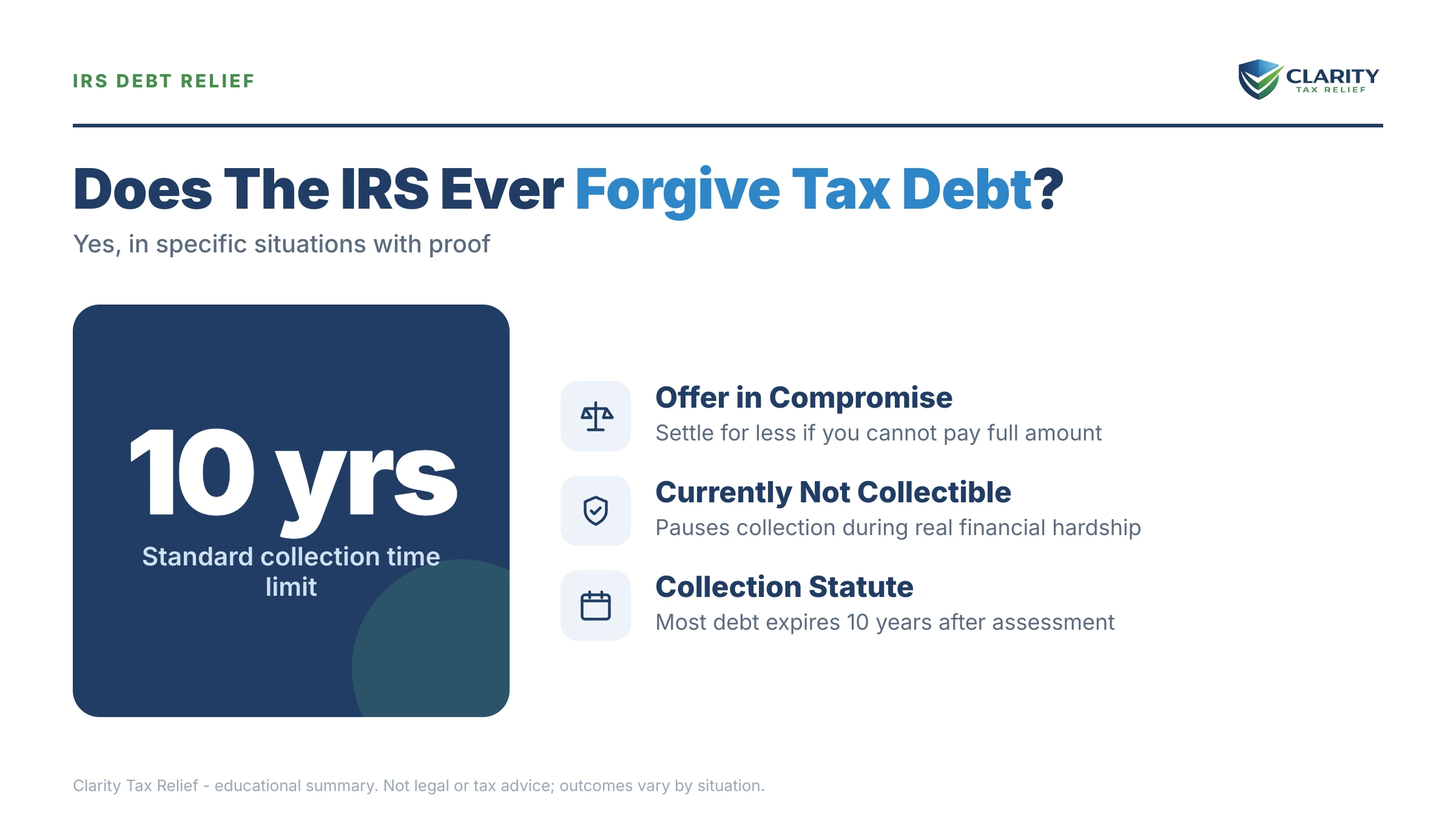
The short answer: does the IRS ever forgive tax debt? Yes — through specific, means-tested programs, not blanket amnesty: the Offer in Compromise (roughly 1 in 5 accepted in FY2024), penalty abatement, Currently Not Collectible status, partial-pay agreements, innocent spouse relief, bankruptcy discharge, and the 10-year collection statute. No "one-time forgiveness" program exists.
You and your spouse just added up what you owe across a couple of tax years, and the total doesn't fit any budget you can build. Somewhere between the radio ads promising the debt can vanish and the quiet fear that it never will sits the real answer — and it's more useful than either extreme. The IRS does write off balances every single year; it just never does it for anyone who can't pass one of seven specific tests.
⏱ The real clock: there is no application deadline for IRS forgiveness programs, but two clocks run every month you wait. The failure-to-pay penalty adds 0.5% of your balance per month and interest compounds daily. Meanwhile, the 10-year collection statute only works in your favor if you know exactly when it started.

What "IRS tax debt forgiveness" actually means
The IRS forgives tax debt when collecting it in full is either mathematically impossible or demonstrably unfair — never as an act of mercy. Every real forgiveness path is a test: either a collectibility test (can the government realistically get this money before time runs out?) or a fairness test (should this person owe it at all?).
That framing changes how you approach the question. You don't ask the IRS to be kind. You show it — with transcripts, a financial statement, and the right form — that your case passes one of its own tests. When the numbers support it, forgiveness is routine paperwork, not a miracle.
You may also have heard of the "Fresh Start" program. Fresh Start was a real policy expansion — it raised lien thresholds and widened streamlined payment plans — but it is not a program you apply to. It's the umbrella marketing name for the same tools covered below. Our guide to whether the IRS Fresh Start program is real separates the policy from the sales pitch.
The "one-time forgiveness" ads, debunked
"IRS one-time forgiveness" is a marketing term — no IRS form, notice, publication, or webpage uses that name. Firms that advertise it are usually bundling two real things: first-time penalty abatement (which does have a "first time" flavor) and the Offer in Compromise. We break the sales script down line by line in our IRS one-time forgiveness explainer.
The same goes for "settle for pennies on the dollar." Some accepted offers genuinely settle low — but only because the applicant's finances were genuinely that thin under the IRS's own formula. No company can negotiate below what the formula says you can pay. Anyone promising a settlement amount before reviewing your transcripts and financials is quoting a fantasy, and the FTC has shut firms down for exactly that pitch.
The honest version: forgiveness is real, common, and rules-based. The rest of this page shows you the rules.
What happens while you wait for forgiveness that never arrives
Tax debt you don't address escalates through an automated notice sequence that ends in levies — regardless of how understaffed the IRS is. The 2025 workforce cuts (roughly 27%) made humans harder to reach, but the notice stream, lien filings, and levies are generated by systems that never got laid off. Hoping the debt gets lost in the shuffle is not a strategy; here is the sequence a growing balance follows:
- CP14 — the first bill, with roughly 21 days to pay or arrange something (10 business days if the balance is $100,000 or more) before the next notice queues up.
- CP501 / CP503 — reminder notices. Still just bills, but penalties and interest are compounding the whole time.
- CP504 — Notice of Intent to Levy. The IRS can now seize your state tax refund, and a federal tax lien becomes a live possibility.
- LT11 / Letter 1058 — Final Notice of Intent to Levy. A 30-day clock starts, along with your Collection Due Process rights (requested on Form 12153).
- Enforcement — bank levies (funds held 21 days before they leave), continuous wage levies, refund offsets year after year, and up to 15% of Social Security through the Federal Payment Levy Program.
Two more consequences stack on top for larger or older debts: if a balance grows past $66,000 (the 2026 threshold), the IRS can certify it to the State Department and block your passport, and a filed lien attaches to everything you own, complicating any sale or refinance. Every forgiveness program on this page works better — and costs less — the earlier in that sequence you start.
Want to know which program your numbers actually support?
Penalties and interest are compounding on your balance every month it sits. Send us your situation and an experienced tax professional will run the forgiveness math — OIC, abatement, hardship status, or the statute clock — free and confidentially.
Does the IRS ever forgive tax debt? The 7 real programs in 2026
Seven real mechanisms can reduce, pause, or erase federal tax debt in 2026 — each with its own eligibility test and its own paperwork. The mechanics of applying (transcripts, financial statements, forms) are covered in our full guide to how to settle tax debt yourself; this table and the sections below focus on what each path forgives and who it actually fits.
| Program | What it forgives | Core eligibility test | Common disqualifier |
|---|---|---|---|
| Offer in Compromise | Part of the tax, penalties, and interest — permanently | Equity + future disposable income less than the balance | Unfiled returns; enough assets to full-pay |
| Penalty abatement (FTA / AEP / reasonable cause) | Penalties, plus interest charged on them | Clean prior 3 years, or a documented cause beyond your control | Repeat penalties with no supporting story |
| CSED expiration (10-year rule) | Whatever remains when the statute runs out | 10 years from assessment, adjusted for tolling | OICs, bankruptcy, and appeals pause the clock |
| Currently Not Collectible | Nothing directly — pauses collection; balance may expire | Allowable living expenses equal or exceed income | Income recovery triggers reactivation |
| Partial-pay installment agreement | The gap between your payments and the balance at CSED | Can pay something monthly, but not everything, before the statute ends | Asset equity the IRS wants tapped first; periodic reviews |
| Innocent spouse relief | Your share of a debt caused by a spouse's error | Didn't know — and had no reason to know — about the understatement | Knowledge of the error, or benefit from the unpaid tax |
| Bankruptcy discharge | Qualifying income tax debt | 3-year, 2-year, and 240-day timing tests all pass | Recent debt, payroll trust-fund tax, fraud; liens survive |
1. Offer in Compromise — the only true settlement
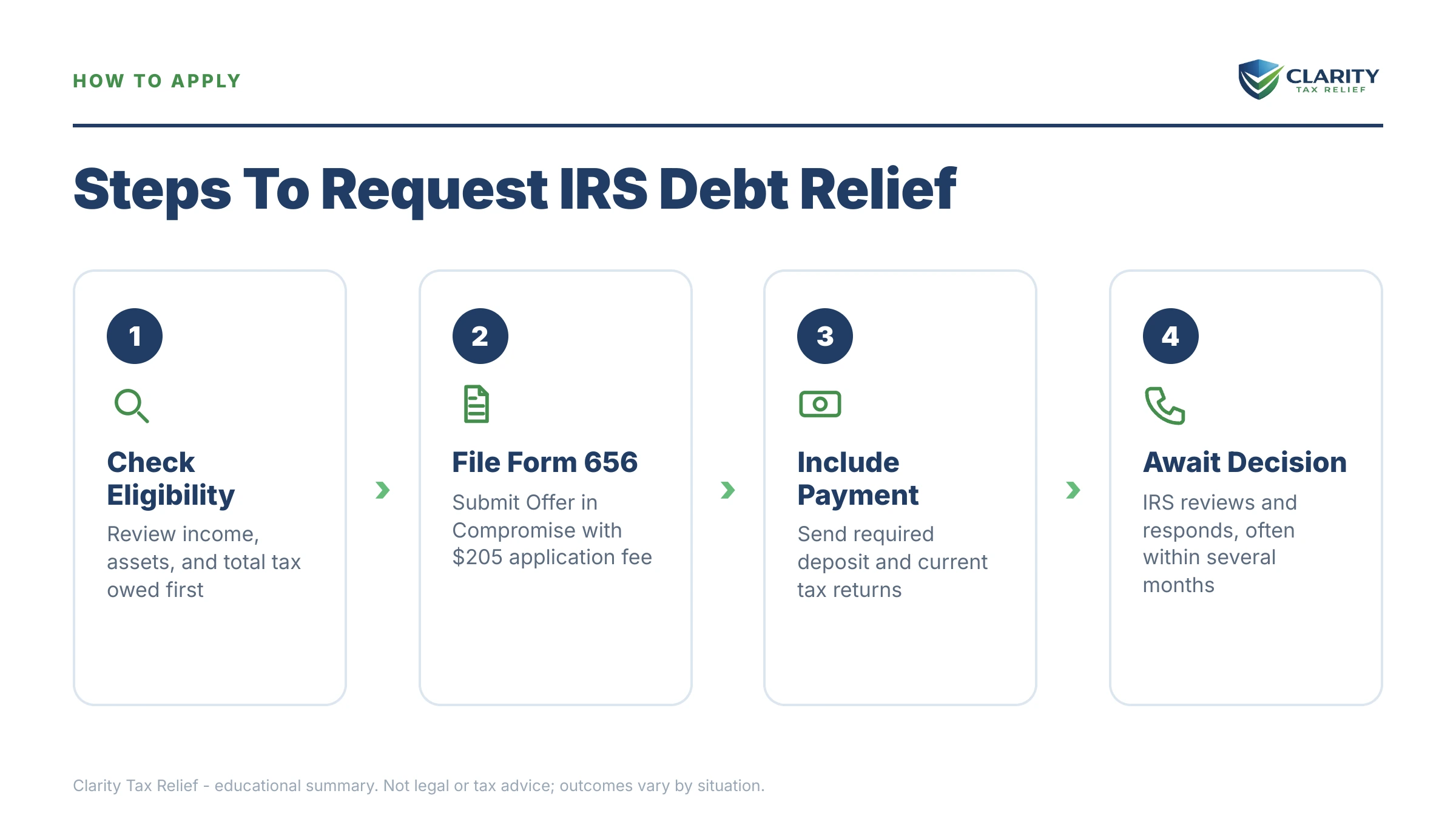
An Offer in Compromise (OIC) is the one program where the IRS permanently accepts less than you owe. The IRS decides using a formula called Reasonable Collection Potential (RCP): your net equity in assets plus your monthly disposable income times 12 (lump-sum offer) or 24 (periodic offer). If your RCP is genuinely less than your balance, the IRS is often better off taking your offer than chasing you — that's why acceptance exists at all. You can estimate your own numbers with our Offer in Compromise Calculator before deciding whether to pursue it.
The costs and terms: a $205 application fee, a 20% down payment on lump-sum offers, Form 656, and a full financial disclosure on Form 433-A(OIC). If your AGI is at or below 250% of the federal poverty level, the low-income certification waives the fee, the down payment, and payments during review. One quiet advantage: if the IRS doesn't rule on your offer within 2 years, it's automatically accepted — with narrow exceptions: a returned or rejected offer stops the clock, and time during court disputes does not count. The IRS accepted roughly 1 in 5 offers in FY2024 — real, but never something anyone can promise. The full mechanics are in how an offer in compromise actually works.
2. Penalty abatement — forgiveness most people already qualify for
Penalties are the most commonly forgiven piece of any tax debt, and often the easiest. If your prior three years were clean — filed on time, paid on time, no penalties — first-time penalty abatement can remove failure-to-file and failure-to-pay penalties with a phone call or Form 843. Starting in summer 2026, the IRS is replacing FTA with the Automatic Exemption from Penalty (AEP), which applies without any request; our guide to the automatic exemption from penalty AEP 2026 covers who gets it and when.
Beyond first-time relief, reasonable cause abatement covers penalties caused by serious illness, disaster, or other circumstances outside your control. When a penalty is removed, the interest charged on that penalty comes off with it — but interest on the underlying tax survives every abatement.
3. The 10-year collection statute — forgiveness by expiration
The IRS generally has 10 years from the date a tax is assessed to collect it; at the Collection Statute Expiration Date (CSED), whatever remains is written off. This is genuine, automatic forgiveness — but it's slower and riskier than the ads imply, because the clock pauses during an OIC, bankruptcy, or collection appeal, sometimes adding years. Two companion guides matter here: does IRS debt go away after 10 years for the expiration reality, and what extends the IRS collection statute for the tolling traps.
4. Currently Not Collectible — the pause that can become forgiveness
Currently Not Collectible (CNC) status stops levies and garnishments when your allowable living expenses eat your entire income. The debt doesn't go away — refunds get offset, a lien can still be filed, and the IRS re-checks your income periodically. But here's the strategic piece: the CSED keeps running during CNC. Ride hardship status to the statute's end, and the balance dies without a dime paid. See Currently Not Collectible status for the qualification math.
5. Partial-pay installment agreement — settlement in slow motion
A partial payment installment agreement (PPIA) is the least-advertised forgiveness path: you pay what your budget actually allows each month, and whatever remains when the CSED arrives is written off. The IRS reviews your finances periodically and can raise the payment if your income rises, but for people who can afford something — just not $228-plus a month for six years — a PPIA often forgives more than an OIC would, without the OIC's upfront costs.
6. Innocent spouse relief — the fairness test
When a joint-return debt exists because your spouse or ex-spouse understated income or overstated deductions without your knowledge, Form 8857 can remove your liability entirely — a fairness-based forgiveness rather than a math-based one. The knowledge standard is strict, and timing rules apply, so start with innocent spouse relief: how to qualify before assuming you're in or out.
7. Bankruptcy — real discharge, narrow lane
Income tax debt can be discharged in bankruptcy when it passes three timing tests: the return was due at least 3 years ago, was filed at least 2 years ago, and the tax was assessed at least 240 days before the petition. Payroll trust-fund taxes and fraud penalties never discharge, and a recorded federal tax lien survives to encumber property you owned at filing. Does bankruptcy clear IRS debt walks through the Chapter 7 tests year by year.
What forgiveness looks like on $16,400: a worked example
A single balance produces wildly different outcomes depending on which program the numbers support. Say you and your spouse owe $16,400 across two tax years, filing jointly, with $6,300 in combined monthly take-home income, $6,150 in IRS-allowable living expenses, and about $2,400 in countable equity. Here's the math on each path:
- 72-month installment agreement: $16,400 ÷ 72 ≈ $228/month minimum — before the interest and 0.25%/month reduced failure-to-pay penalty that continue on an active plan, so the true payoff exceeds $16,400.
- Lump-sum OIC: RCP = $2,400 equity + ($150 disposable × 12) = $4,200. If accepted, roughly $12,200 is permanently forgiven. Acceptance is never assured — but this profile is exactly the kind the formula favors.
- The same couple, better income: raise disposable income to $500/month and add $12,000 in home equity, and RCP = $14,400 + $6,000 = $20,400 — more than the debt. The offer fails, and a payment plan becomes the right answer. Same balance, opposite outcome.
- Penalty abatement: if $1,700 of the $16,400 is failure-to-pay penalty and the first year was their first slip in years, abatement removes that $1,700 plus the interest charged on it — stackable with any option above.
| Path | Roughly what you'd pay | Timeline |
|---|---|---|
| Pay in full now | $16,400 + interest accrued to date | Immediate; all accrual stops |
| Short-term plan (180 days) | Full balance + ~6 more months of accrual; $0 setup fee | Up to 6 months |
| 72-month installment agreement | Full balance + ongoing interest; ≈ $228/month minimum | Up to 6 years |
| Partial-pay installment agreement | What your budget allows monthly; remainder written off at CSED | Until the statute expires; periodic reviews |
| Offer in Compromise (RCP $4,200) | $4,200 total, if accepted | Months to over a year for review |
| Currently Not Collectible | $0/month; refunds offset; balance may expire at CSED | Until finances improve or the statute runs |
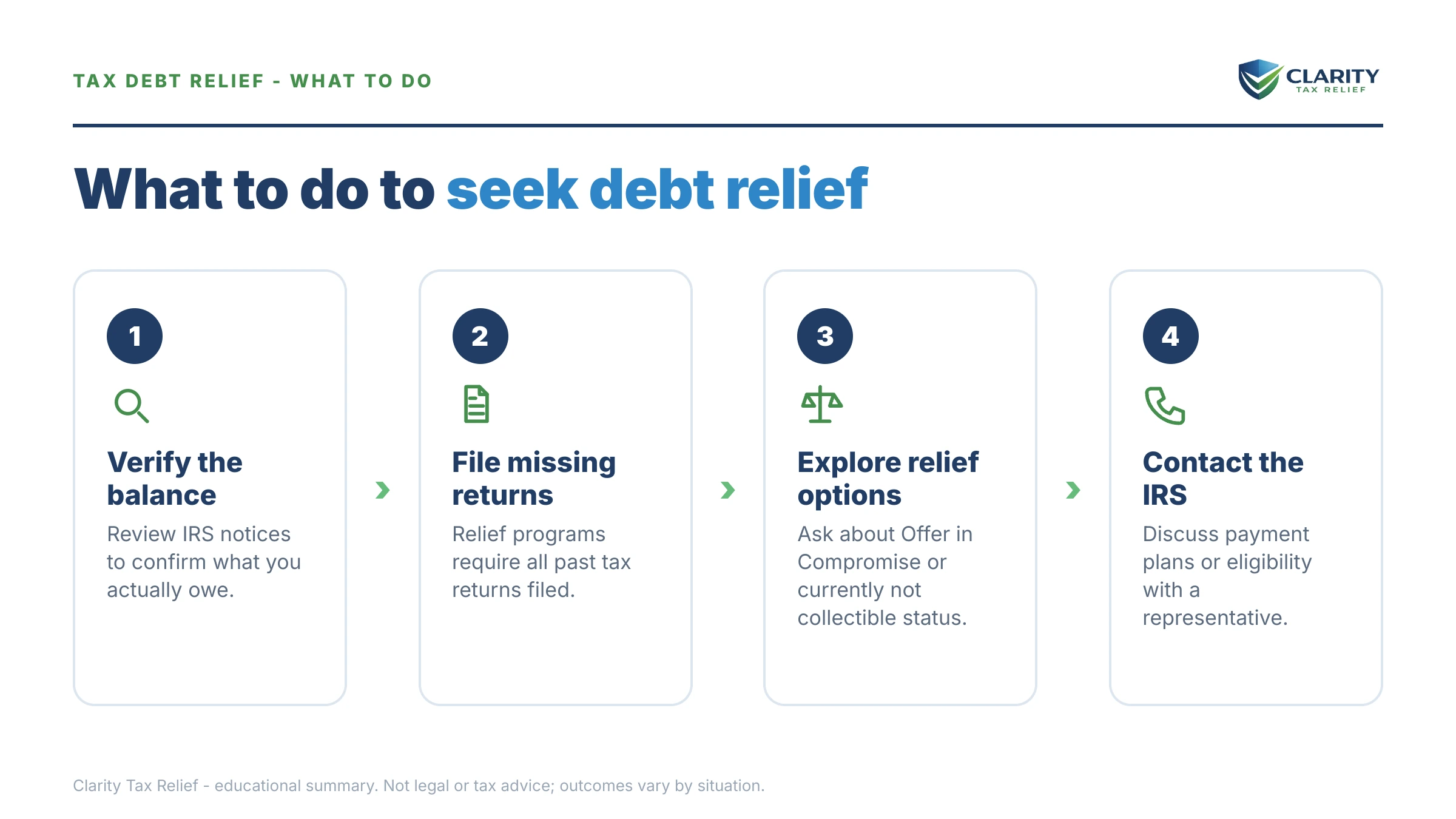
How to pursue IRS tax debt forgiveness, step by step
- Pull your IRS records. Get your account transcripts or log into your IRS online account to confirm every balance, the assessment date for each year, and how much of the total is penalties rather than tax.
- File every missing return. No forgiveness program — not an OIC, not CNC, not a payment plan — will be approved while required returns are unfiled. Filing also stops the 5%-per-month failure-to-file penalty, which is ten times the failure-to-pay rate.
- Run the collectibility math. Add your net equity in assets to 12 months (lump-sum offer) or 24 months (periodic offer) of monthly disposable income. If that total is less than your balance, you are an OIC candidate; if your disposable income is near zero, look at CNC; otherwise, price out a payment plan.
- Apply to the program the math supports. File Form 656 with Form 433-A(OIC) for an offer, request penalty abatement by phone or Form 843, or submit Form 433-F financials for Currently Not Collectible or a partial-pay installment agreement.
- Stay compliant afterward. An accepted OIC requires five years of on-time filing and payment, and CNC lasts only while your finances stay tight. A new unpaid balance can undo the forgiveness you earned.
Deadlines and rights that shape a forgiveness case
Forgiveness cases are won and lost on clocks — some run in your favor, some against you. These are the ones that matter:
| Clock or right | Window | What it means for you |
|---|---|---|
| Collection statute (CSED) | 10 years from assessment | The remaining balance is written off — but OICs, bankruptcy, and appeals pause the clock |
| OIC decision deadline | 2 years | Your offer is automatically accepted if the IRS doesn't rule in time — with narrow exceptions: a returned or rejected offer stops the clock, and time during court disputes does not count |
| CDP hearing after LT11 | 30 days (Form 12153) | Pauses the levy and lets you propose an OIC, plan, or CNC to Appeals |
| Bank levy hold | 21 days before funds leave | Your window to prove hardship or arrange a release |
| OIC compliance period | 5 years after acceptance | Default reinstates the balance the IRS forgave |
| Penalty refund claim (Form 843) | Generally 3 years from filing (or 2 from payment) | Penalties you already paid can still be recovered after abatement |
When you can handle this yourself — and when help changes the outcome
Most balances under $50,000 can be resolved without paying anyone for help. If you owe $10,000 or less and can pay within six years, the guaranteed installment agreement is essentially yours for the asking. Balances up to $50,000 fit streamlined plans you can set up online in minutes at the IRS payment plans page, and a clean-history penalty abatement is often a single phone call. If you can pay in full within 180 days, the short-term plan costs nothing to set up. For offers, the IRS's own pre-qualifier and forms live on the official Offer in Compromise page.
Experienced help earns its fee in specific situations: OIC math involving self-employment or business income, a levy already in motion, multiple unfiled years that have to be sequenced before anything else, payroll or trust-fund debt, an innocent spouse case that needs evidence built, or balances large enough that a revenue officer — not a computer — is running your file. In those cases the difference between a well-built application and a hopeful one is usually the difference between approval and rejection. Wherever your situation lands, a free case review will tell you honestly which side of that line you're on.
Situations that change the forgiveness math
The same debt gets forgiven — or doesn't — depending on who owes it and how it arose. The variables that most change the answer:
- Married filing jointly: both spouses are fully liable for the whole balance. One spouse's OIC compromises only that spouse's liability; the IRS can still pursue the other. If the debt traces to a divorce, know that the IRS ignores divorce decrees — see divorce and IRS debt: who pays.
- Self-employed: the OIC formula counts business assets and income, and no offer or plan gets approved unless you're current on this year's estimated taxes. Compliance first, forgiveness second.
- Business and payroll debt: trust-fund payroll taxes are the least forgivable debt in the system — they survive bankruptcy, rarely clear an OIC, and can be assessed against owners personally.
- Multiple years: each year carries its own assessment date and its own CSED, so parts of an old debt can expire while newer years still have most of a decade to run.
- State tax debt: nothing here transfers automatically to states. California's FTB can collect for 20 years under R&TC §19255, and a New York tax warrant is a public civil judgment — each state runs its own programs on its own clocks.
- Death: the debt becomes a claim against the estate rather than vanishing — the details are in does IRS debt die with you.
- Genuine hardship the IRS won't acknowledge: the independent Taxpayer Advocate Service can intervene for free when the normal channels stall.
If your balance sits in five figures like the couple in our example, an experienced tax professional can usually tell you in one free conversation which of the seven programs your numbers support — start with the 2-minute form or call (888) 825-7779.
Terms you'll hear, decoded
- Offer in Compromise (OIC): the IRS program that permanently settles a tax debt for less than the full balance when the math supports it.
- Reasonable Collection Potential (RCP): the IRS's formula — your net equity plus future disposable income — that sets the minimum acceptable offer.
- CSED: the Collection Statute Expiration Date, generally 10 years after assessment, when the IRS's legal right to collect ends.
- Tolling: events (an OIC, bankruptcy, appeals) that pause the 10-year clock and push the CSED later.
- Currently Not Collectible (CNC): hardship status that pauses IRS collection while your finances can't support any payment.
- Abatement: the formal removal of a penalty — and the interest charged on it — from your account.
IRS tax debt forgiveness questions, answered
Is there a real IRS debt forgiveness program?
Yes, but it is not one program — it is several means-tested ones. The Offer in Compromise settles debt for less than the full balance, penalty abatement removes penalties, Currently Not Collectible pauses collection, and the 10-year collection statute erases whatever is left when it expires. Each has its own eligibility test, and none of them is automatic — you have to apply or qualify on the numbers.
What is the IRS one-time forgiveness program?
It is a marketing phrase, not an IRS program — no IRS form, notice, or webpage uses the term. Companies use it to describe first-time penalty abatement or the Offer in Compromise, both of which are real. If a company promises "one-time forgiveness" before reviewing your transcripts and finances, treat that as a red flag, because eligibility for the real programs depends entirely on your numbers.
Does IRS tax debt ever go away on its own?
Yes. The IRS generally has 10 years from the date a tax is assessed to collect it; when that Collection Statute Expiration Date passes, the remaining balance is written off. The catch is tolling: an Offer in Compromise, bankruptcy, or a collection appeal pauses the clock, so the real date is often later than year ten. Waiting it out also means living with liens and levy risk the whole time.
How hard is it to get an Offer in Compromise accepted?
The IRS accepted roughly 1 in 5 offers in FY2024, so acceptance is real but far from guaranteed. Offers succeed when the math works — when your equity plus future disposable income genuinely totals less than you owe — and fail when applicants ignore that math or leave returns unfiled. A well-prepared offer built on accurate Form 433-A(OIC) figures has much better odds than the raw average suggests.
Can the IRS forgive penalties and interest?
Penalties, yes — through first-time abatement, reasonable cause, and, starting in summer 2026, the Automatic Exemption from Penalty. Interest is harder: the IRS only removes interest that was charged on a penalty it abated, or interest caused by its own errors or delays. Interest on the underlying tax itself keeps accruing until the tax is paid, settled, or expires.
Does the IRS forgive tax debt for low-income taxpayers?
Low income does not erase the debt by itself, but it unlocks the strongest terms. If your AGI is at or below 250% of the federal poverty level, the Offer in Compromise low-income certification waives the $205 application fee, the 20% down payment, and payments while the offer is reviewed. Low income also makes Currently Not Collectible status — a full collection pause — much easier to qualify for.
Does bankruptcy count as IRS forgiveness?
It can discharge income tax debt, but only when the debt passes three tests: the return was due at least 3 years ago, was actually filed at least 2 years ago, and the tax was assessed at least 240 days before you filed bankruptcy. Recent debt, trust-fund payroll taxes, and fraud penalties survive. A recorded federal tax lien can also survive the discharge and stay attached to your property.
Is forgiven IRS tax debt taxable income?
No. When the IRS accepts an Offer in Compromise or a balance expires at the CSED, the written-off amount is not cancellation-of-debt income, so you will not get a 1099-C the way you would from a private lender who forgives a loan. That makes IRS settlement more valuable dollar-for-dollar than most private debt settlements, which often create a new tax bill.
Does the IRS forgive tax debt when someone dies?
Not automatically. The debt becomes a claim against the estate, and the IRS gets paid from estate assets before most heirs do. Heirs do not inherit the debt personally, but a surviving spouse who filed jointly remains fully liable on those joint years. If the estate has no assets, the IRS generally writes the balance off because there is nothing to collect.
Your next 24 hours
- Find your numbers. Log into your IRS online account (or pull your account transcripts) and write down each year's balance, its assessment date, and how much of the total is penalties.
- Gather three things: your most recent filed return, a rough monthly income-and-expense picture for your household, and any IRS notices you've received.
- Get the forgiveness math run for free. Interest and penalties compound on the balance every month it sits, so find out now which of the seven programs your numbers support — use the 2-minute form or call (888) 825-7779.
This guide is general information, not tax or legal advice for your specific situation. Eligibility for IRS programs depends on individual facts and circumstances; no outcome is guaranteed.