
IRS Collections
Does IRS Debt Go Away After 10 Years? The CSED Expiration Reality (2026)
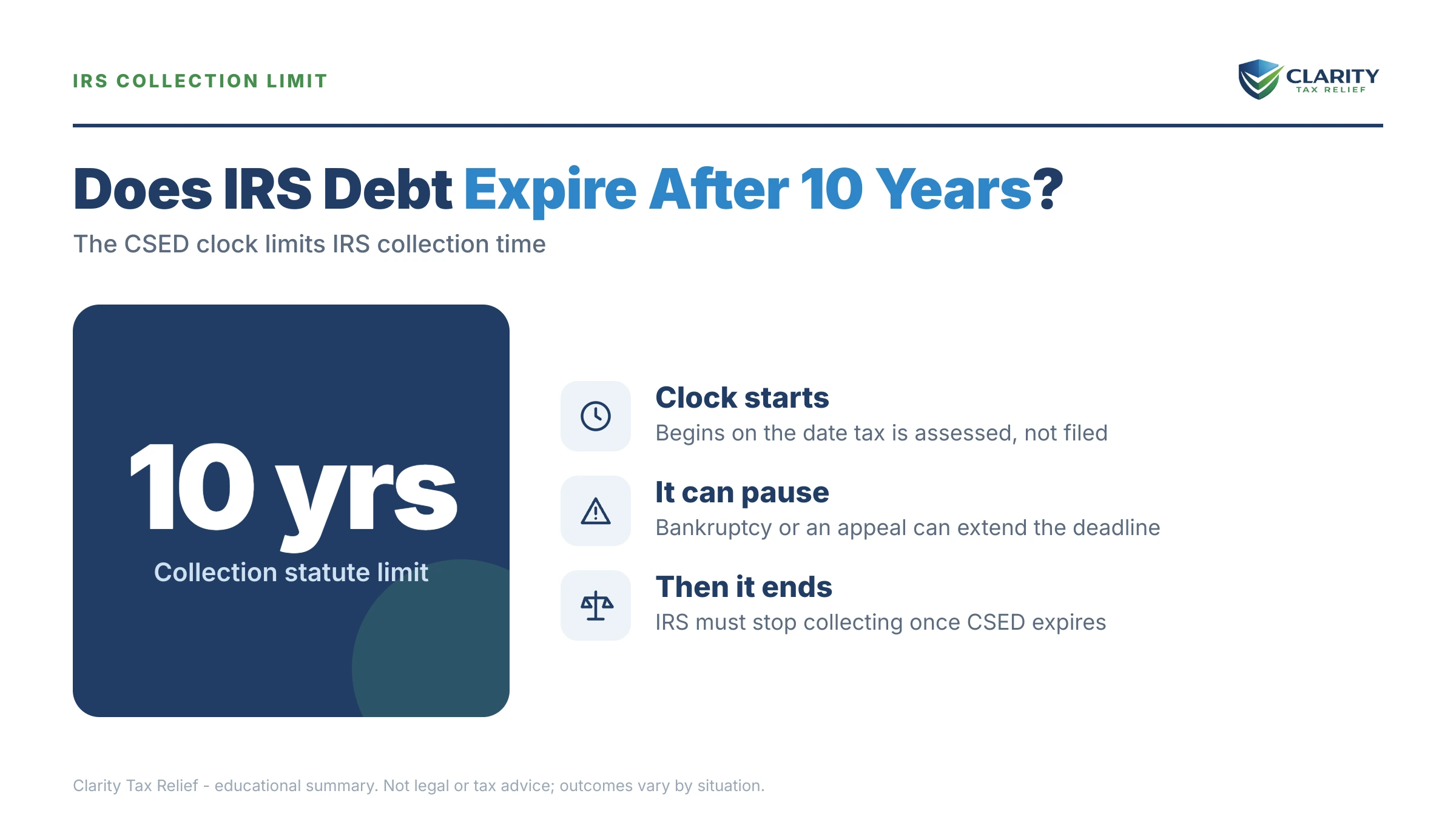
The short answer: yes — IRS debt does go away after 10 years. Under IRC §6502, the IRS generally has 10 years from the date it assessed your tax to collect it; whatever remains at the Collection Statute Expiration Date (CSED) is written off. But the clock starts at assessment, not the tax year, and common events pause it — sometimes adding years.
You've been carrying this balance for years, and somewhere you heard the IRS only has a decade to collect. Now you're doing the math in your head — was it the year on the return, the year you filed, the year the letters started? — and wondering whether waiting is actually a strategy.
Sometimes it is. The 10-year rule is real, not a loophole rumor. But the expiration date the law gives you is almost never the date you'd guess, and what the IRS is allowed to do to you during those 10 years is the part most articles skip. Here's the full picture.
⏱ Two clocks are running at once. Your CSED counts down from each assessment date — but until it arrives, interest and the 0.5%-per-month failure-to-pay penalty keep growing, and the IRS can lien, levy, and offset the whole time. The assessment date on your account transcript is day one; find it before you decide anything.
Does IRS debt go away after 10 years? The rule behind it
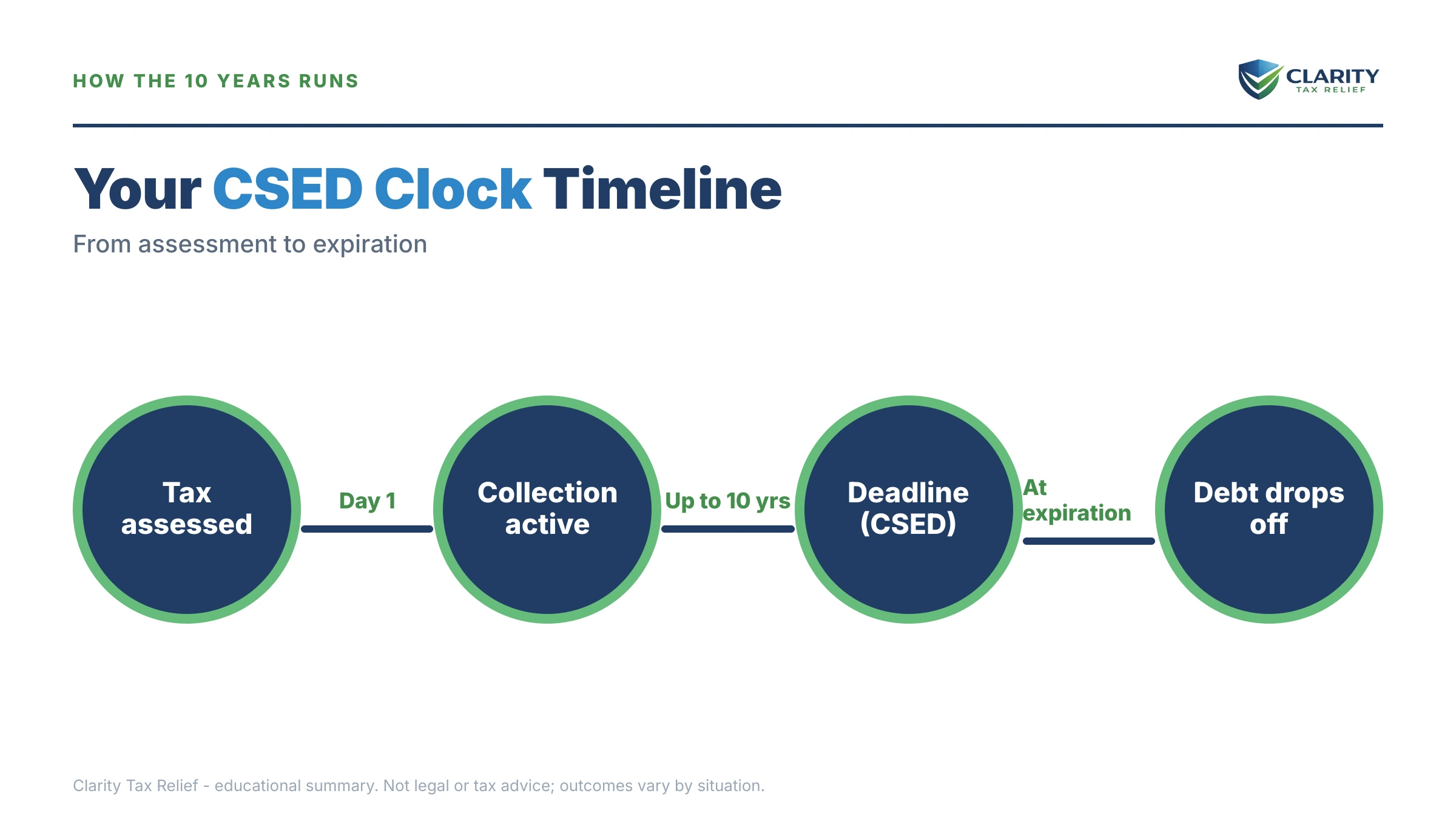
IRS tax debt legally expires 10 years after the date of assessment under IRC §6502 — that deadline is called the Collection Statute Expiration Date, or CSED. When a balance hits its CSED, the IRS must stop collecting, and the remaining amount comes off your account. There's no application, no negotiation, no approval — it happens by operation of law.
This is the honest core behind every "IRS forgiveness" pitch you've seen. As we cover in does the IRS ever forgive tax debt, most "forgiveness programs" are marketing labels for ordinary IRS options — but CSED expiration is the one form of write-off that requires nothing from you except surviving the clock.
The problem is that almost everyone calculates their expiration date wrong, in two directions: they start the clock too early, and they forget the events that paused it.
When your 10-year clock actually started
The 10 years runs from the assessment date — the day the IRS formally recorded the debt on its books — not from the tax year you owe for. For a filed return, assessment usually happens within a few weeks of processing. For everything else, it can be years later:
- You filed late. A 2018 return filed in 2022 was assessed in 2022 — that year's clock runs to roughly 2032, not 2028.
- The IRS added tax later. A CP2000 adjustment or audit assessment gets its own CSED starting when that extra tax was assessed. One tax year can have two or three separate clocks.
- The IRS filed for you. If you never filed and the IRS created a substitute for return (SFR), the clock runs from the SFR assessment. If nothing was ever filed or assessed, there is no clock running at all — a trap for long-term non-filers who assume old years quietly aged out.
- Penalties and interest attached to an assessment expire with it — they don't get their own longer life.
The full mechanics of the statute live in our guide to how long the IRS can collect back taxes; what matters on this page is your date, not the theory.
What pauses the 10-year clock (tolling)
Tolling events stop the CSED countdown day-for-day — and some add extra time on top when they end. This is why a debt "from 2015" can still be fully collectible in 2026. The most common pauses:
| Event | Effect on the CSED |
|---|---|
| Offer in Compromise pending | Clock paused the entire time the offer is under review, plus about 30 days after a rejection |
| Bankruptcy | Paused for the whole case, plus an additional 6 months after it ends |
| Collection Due Process (CDP) hearing | Paused while the hearing and any appeal are pending, with a short additional period after |
| Installment agreement request pending | Paused while the IRS considers it, plus about 30 days after a rejection or termination (an active, approved plan does not pause the clock) |
| Innocent spouse relief request | Paused for the requesting spouse while the claim is pending |
| Living outside the U.S. for 6+ continuous months | Paused for the time abroad |
| Signed CSED waiver (Form 900) | Extends the date by the period you agree to — occasionally requested as a condition of certain agreements; read before signing |
Notice what's not on that list: making payments, being in Currently Not Collectible status, or an installment agreement in good standing. None of those pause or reset the clock. For the deeper mechanics of each pause, see what extends the IRS collection statute.
What happens if you try to wait out the 10 years
Waiting for the CSED is a legal strategy the IRS actively works to make painful. During those 10 years, collection escalates in a predictable sequence — and each stage costs you something even if you never write a check:
- Annual bills and refund offsets. A CP71 reminder arrives each year, and every federal refund you're ever due gets seized and applied to the debt until it's gone or expired.
- Notice of Federal Tax Lien. On balances your size, a lien is nearly certain. It attaches to everything you own, becomes public record, and complicates selling or refinancing a home for as long as the debt lives.
- Passport certification. Once your total debt passes $66,000 (the 2026 threshold), the IRS can certify you as "seriously delinquent" and the State Department can deny or revoke your passport — see passport revoked for tax debt.
- Intent-to-levy notices, then levies. CP504 and LT11 notices open the door to wage garnishment, bank levies, and a continuous 15% levy on Social Security through the Federal Payment Levy Program.
- The final years get harder, not easier. As a CSED approaches on a meaningful balance, the IRS has an incentive to collect aggressively while it still can — and on large debts it can sue to reduce the balance to a court judgment, which survives well past the 10 years.
And 2026's IRS staffing cuts don't help you here: liens, offsets, passport certifications, and levy notices are generated by automated systems that kept running while roughly 27% of the workforce left. The humans who could flexibly work with you are scarcer; the machine that escalates against you is not.
Not sure how many years are left on your clock?
Send us your situation. An experienced tax professional will pull your transcripts, calculate your real CSED for every year you owe, and map which option costs you least while the clock runs — free, confidential, no pressure. Interest and penalties are accruing either way.
Your options while the CSED clock runs
The right move depends on two numbers: how many years remain, and how much you can realistically pay per month. Some options pay the debt off; two of them legally let part of it expire. The DIY versions of all of these are covered in our guide to how to settle tax debt yourself — here's how each interacts with the 10-year clock:
| Option | Who it fits | Effect on the 10-year clock |
|---|---|---|
| Short-term plan (≤180 days) | Can pay in full within 6 months; $0 setup fee | Clock keeps running; debt gone before it matters |
| Streamlined installment agreement | Balance ≤ $50,000; up to 72 months; set up online without financial disclosure | Keeps running while you pay; only the pending request pauses it |
| Non-streamlined agreement (over $50k) | Balance above $50,000; requires Form 433-F financial disclosure | Keeps running; IRS may occasionally ask for a Form 900 waiver — negotiable |
| Partial-payment installment agreement (PPIA) | Finances show you can pay something, but not everything, before the CSED | Keeps running; the unpaid remainder expires at the CSED if reviews don't change the terms |
| Currently Not Collectible (CNC) | Paying anything would leave you unable to cover basic living expenses | Keeps running — collection stops but the countdown doesn't |
| Offer in Compromise (Form 656) | Assets plus future income genuinely can't cover the debt; $205 fee, 20% down on lump-sum offers (both waived with low-income certification); roughly 1 in 5 accepted in FY2024 | Pauses the clock the entire time it's pending — a real cost if your CSED is close |
| Bankruptcy | Older income-tax debt meeting strict timing tests — see does bankruptcy clear IRS debt | Pauses the clock for the case plus 6 months |
The strategic insight most people miss: if your CSED is only a few years out, the options that pause the clock can cost more than they save. An Offer in Compromise filed with three years left freezes those three years while the IRS reviews it — and about four out of five offers are rejected. A PPIA or CNC, by contrast, lets the statute keep working for you while keeping levies off your paycheck.
A worked example: $68,500 with about six years left
Say you're a W-2 employee filing single, and you owe $68,500 from your 2020 return. This is hypothetical, but the math is real:
- Finding the clock: you filed in 2021 and the IRS assessed the tax in August 2021 — so the base CSED is August 2031. In 2024 you submitted an Offer in Compromise that sat under review for 8 months before rejection. That pause, plus 30 days, pushes your real CSED to roughly May 2032 — about 70 months from mid-2026.
- Full-pay plan: at $68,500 you're above the $50,000 streamlined line, so a regular plan means Form 433-F financial disclosure. Paying it inside the remaining clock is roughly $68,500 ÷ 70 ≈ $980/month before interest — realistically over $1,000/month once accruals are included.
- Pay-down play: if you could put $18,500 toward the balance, the remaining $50,000 fits streamlined territory — up to 72 months, set up online, no financial disclosure and no negotiation over your budget.
- PPIA: if the allowable-expense math on your 433-F shows only $325/month of ability to pay, a partial-payment agreement would collect roughly $325 × 70 ≈ $22,750 — and if your finances don't improve at the IRS's periodic reviews (typically every two years), the remaining ~$45,750 expires at the CSED.
- The passport problem: at $68,500 you're above the $66,000 certification threshold, so your passport is exposed right now. Getting into any approved agreement — even a PPIA — generally stops or reverses certification. Doing nothing doesn't.
Same debt, three legitimate paths, with outcomes ranging from paying every dollar plus interest to paying about a third. Which one you're actually eligible for depends entirely on your documented finances — which is exactly why the transcript-and-433-F work comes first.
How to find your CSED on your transcript
Your IRS account transcript contains everything needed to calculate your CSED — the assessment dates that start each clock and the transaction codes that paused it. Get yours through your IRS online account at IRS.gov's Get Transcript page (our walkthrough: how to get your IRS transcript online), then look for these codes:
| Code | What it means | What it does to your 10-year clock |
|---|---|---|
| 150 | Return filed, tax assessed | Starts the clock — this date + 10 years is your baseline CSED |
| 290 / 300 | Additional tax assessed (adjustment or audit) | Starts a separate clock for that additional amount |
| 480 | Offer in Compromise pending | Clock paused from this date |
| 481 / 482 | OIC rejected / withdrawn | Clock resumes about 30 days later — add the paused span to your CSED |
| 520 | Bankruptcy or litigation freeze | Clock paused |
| 521 | Freeze released | Clock resumes; for bankruptcy, add 6 more months of pause |
| 530 | Currently Not Collectible | No pause — the clock keeps running while collection is stopped |
| 582 | Federal tax lien filed | No effect on the clock; the lien normally self-releases when the CSED passes — see does an IRS tax lien expire |
Once you have your assessment dates and tolling spans, you can estimate your own expiration date with our CSED Calculator. Treat any DIY figure as an estimate — when multiple pauses overlap (an OIC filed during a CDP hearing, say), the arithmetic gets genuinely tricky, and the IRS's own recorded CSEDs are sometimes wrong in its favor.
How to respond, step by step
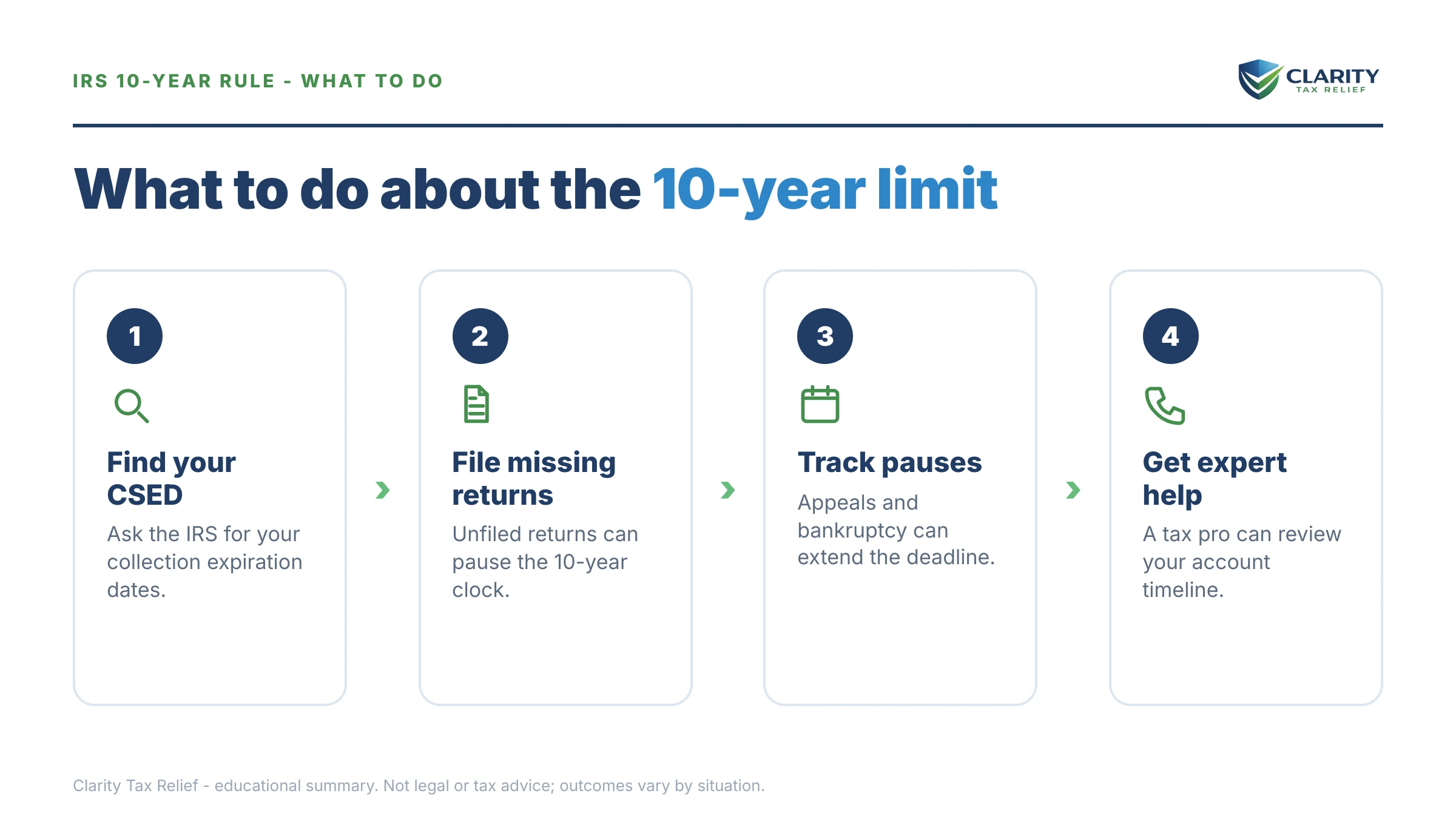
- Pull your account transcripts. Get the account transcript for every year you owe and find the Transaction Code 150 assessment date on each — that date is day one of that year's 10-year clock.
- Map your tolling events. List every bankruptcy, Offer in Compromise, CDP hearing request, pending installment agreement request, and stretch of six-plus months outside the U.S. since assessment — each one pushed your CSED out.
- Estimate each CSED. Add 10 years to each assessment date, then add the paused time from your tolling events. When multiple events overlap, have the math checked — overlapping pauses are where DIY calculations usually go wrong.
- Match your strategy to the years remaining. Full pay or a monthly plan if the clock is long and your income covers it; a partial-payment plan, hardship status, or an offer if your finances can't realistically cover the balance before it expires.
- Protect the clock before you sign anything. Know which moves pause the CSED — an Offer in Compromise, a CDP hearing, a Form 900 waiver — and weigh the added time against the benefit before committing.
If a payment plan turns out to be the right fit, the official terms and setup paths are on the IRS payment plans page.
When you can handle this yourself — and when help changes the outcome
You can likely handle this alone if your situation is simple: one tax year, no bankruptcies or offers in your history, a clock you can read straight off the transcript, and a balance your budget can cover on a standard plan. Setting up an installment agreement online is genuinely a do-it-yourself task, and if money is tight, the Taxpayer Advocate Service and Low Income Taxpayer Clinics offer free help.
Experienced help tends to change the outcome when the CSED itself is the strategy: multiple years with different clocks, overlapping tolling events, a balance over $50,000 requiring Form 433-F negotiation, a lien or levy already in motion as the expiration approaches, or a genuine PPIA-versus-OIC decision where pausing the clock could cost you tens of thousands. In those cases, the difference between a well-built financial statement and a sloppy one is often the difference between part of the debt expiring and all of it being collected.
Terms on this page, decoded
- CSED — Collection Statute Expiration Date: the day a specific assessed balance legally dies.
- Assessment — the IRS formally recording a tax debt on its books; the event that starts the 10-year clock.
- Tolling — pausing the clock; tolled time is added to the end of the 10 years.
- PPIA — partial-payment installment agreement: monthly payments sized to your finances, with the unpaid remainder expiring at the CSED.
- Self-releasing lien — a Notice of Federal Tax Lien that, by its own terms, operates as a release once the collection statute (plus extensions) has run.
- Reduce to judgment — an IRS lawsuit that converts a tax debt into a court judgment before the CSED, extending how long it can be enforced.
10-year rule questions, answered
Does the IRS really forgive tax debt after 10 years?
Yes — when a balance reaches its Collection Statute Expiration Date, the IRS can no longer collect it, and the remaining amount is written off the books. This isn't forgiveness you apply for; it happens by law under IRC §6502. The catch is the timing: the 10 years runs from assessment, not from the tax year, and events like an Offer in Compromise or bankruptcy pause the clock and push the date out.
How do I find my CSED date?
Pull your IRS account transcript for each year you owe and find the Transaction Code 150 date — that assessment date starts the 10-year clock for that year. Then add time for any tolling events shown, like code 480 (offer pending) or 520 (bankruptcy). You can also call the IRS and ask for your CSED directly, or have a tax professional calculate it from your transcripts, which is more reliable when multiple pauses are involved.
Does an IRS payment plan restart the 10-year clock?
No — making payments on an installment agreement does not reset or restart the CSED. The clock keeps running while you pay. Two cautions: the period while your installment agreement request is pending (plus about 30 days after a rejection) pauses the clock, and in limited cases the IRS may ask you to sign a Form 900 waiver extending the CSED as a condition of an agreement — read anything you sign carefully.
Does Currently Not Collectible status pause the 10-year clock?
No — CNC (hardship) status is one of the few statuses that stops collection without stopping the clock. While your account sits in CNC, the CSED keeps counting down, and if it expires while you're still in hardship, the remaining balance is written off. The trade-offs: the IRS usually files a tax lien on larger balances, keeps your refunds each year, and reviews your income periodically to see if you can pay.
What happens to a federal tax lien after the 10 years?
A Notice of Federal Tax Lien is normally self-releasing: the lien document itself states that it operates as a release once the collection statute (plus any extensions) has expired. The IRS can refile a lien if the CSED was extended, so the recorded dates matter. If a lien still shows as active after your debt has expired, you can request a certificate of release to clear the public record.
Does state tax debt also expire after 10 years?
Not necessarily — the 10-year rule is federal, and every state sets its own collection statute. California's FTB has 20 years from assessment to collect, and New York converts debts into tax warrants that act like civil judgments. If you owe both the IRS and a state, calculate each clock separately; the strategy that fits your federal debt may be wrong for the state side.
What if I never filed a return for the year I owe?
Then the 10-year clock may never have started. The CSED begins at assessment, and there is no assessment until either you file or the IRS files a substitute return (SFR) for you and assesses tax from it. If the IRS filed an SFR, the clock runs from that assessment date. If nothing was ever filed or assessed, there's no balance yet — and no expiration date counting down.
Can the IRS still collect after my CSED expires?
Generally no — once the CSED passes, levies must stop and the remaining balance is cleared. Two exceptions: if the IRS sued and reduced the debt to a court judgment before expiration, the judgment can be enforced much longer, and if your CSED was extended by tolling events, the real date may be later than you calculated. If you're contacted about an expired debt, verify the CSED on your transcript before paying anything.
Your next 24 hours
- Find your assessment dates. Log into your IRS online account and pull the account transcript for each year you owe — locate the Transaction Code 150 date on each one.
- Gather your history. Collect your old notices and jot down any bankruptcy, Offer in Compromise, CDP hearing, or extended time abroad since those dates — that list is your tolling record.
- Get the clock calculated. Bring both to a free case review — the 2-minute form at the top of this page or (888) 825-7779 — and an experienced tax professional will estimate your real CSEDs and which option costs least while they run. Every month of waiting adds interest and penalties; the clock doesn't need you to sit still to work.
This guide is general information, not tax or legal advice for your specific situation. Eligibility for IRS programs depends on individual facts and circumstances; no outcome is guaranteed.