
IRS Transcript Codes
IRS Code 971 Notice Issued: What It Means on Your Transcript and What to Do (2026)
The short answer: IRS code 971 notice issued means the IRS generated a notice or letter about your account. The date beside the code is when it went out. Code 971 is neutral by itself — the companion codes around it and the notice it announces tell you whether you owe, face a delay, or must respond.
You logged in to check on your account, scrolled down the transaction list, and stopped at a line that reads 971 — Notice issued, with a date and $0.00. Your mailbox has nothing. The IRS clearly did something — you just can't tell what yet. That gap between the transcript posting and the envelope arriving is exactly what this guide closes: you can usually identify the notice today, before it lands, and start on the fix.
The image below shows exactly where code 971 sits on a real account transcript and how to read the date and description beside it — the layout is identical for every taxpayer, so once you know where to look, you can decode your own in seconds.
⏱ The clock to watch: code 971 itself sets no deadline — the notice it announces does. Response windows run from the date printed on the notice (roughly 21 days on a CP14, 30 days on an LT11, 90 days on a CP3219A), not from the day the letter reaches you. And if a balance exists, interest and late-payment penalties accrue monthly while you wait.

IRS code 971 notice issued: what it actually means
Transaction code 971 on an IRS account transcript records that the IRS took an action on your account — most commonly, generating a notice or letter to you. Internally, TC 971 is a "miscellaneous transaction" that the IRS pairs with an action code identifying which of dozens of possible events occurred. Your transcript doesn't show that internal action code — it usually just prints "Notice issued" — which is why the line feels so vague.
Three things about the 971 line trip almost everyone up:
- The $0.00 amount is normal. Code 971 logs an event, not a dollar change. Any money movement appears on other lines — the original tax on code 150 on your IRS transcript, added tax on 290, penalties on 276.
- The date can be in the future. Transcripts often post the 971 a week or more before the notice is printed and mailed. A future date is the scheduled issue date, not an error.
- The transcript beats the mail. Seeing the 971 online days before the letter arrives is expected — and it's an advantage, because you can identify the notice and prepare before the envelope shows up.
If the rest of your transcript still looks like alphabet soup, our hub guide on how to read an IRS account transcript walks through every column and section; this page stays focused on the 971 line specifically. For a broader decode of the code across refund and balance situations, see our companion guide to code 971 on your IRS transcript.
Why code 971 posted to your account
A code 971 posts for dozens of different reasons, and the codes surrounding it are what tell you which reason applies to you. Read the 971 in context — the transaction directly above or below it, and any codes sharing a similar date, form a pattern that identifies your situation with surprising precision.
| Codes on your transcript | What it usually means | What to do |
|---|---|---|
| 971 alone | An informational notice or letter went out — adjustment explanation, annual balance reminder, or account update | Check your IRS online account's Notices and Letters section; read before reacting |
| 971 + 570 | Your account (often a refund) is on hold and a letter is coming to explain what the IRS is reviewing | Wait for the letter, respond fast if it asks for documents — see our guide to 570 and 971 codes on transcript |
| 971 + 290 | The IRS assessed additional tax and mailed a notice showing the new balance | Verify the assessment; dispute with documentation or arrange payment — see code 290 on your IRS transcript |
| 971 + 922 | The underreporter program flagged a mismatch — the notice is likely a CP2000 proposing added tax | Compare the proposal to your records; agree, dispute, or partially agree by the printed date |
| 971 + 977 (or 976) | Your amended return was received and is processing — the 971 is a receipt, not a warning | No action; amended returns take months to process |
| 971 + 420 | Your return was selected for examination and an audit letter is on the way | Gather records now; see code 420 on your IRS transcript before you respond |
| 971 + 150 with a balance | Your return processed with tax still owed — the notice is almost certainly a bill (CP14) | Pay by the printed date or set up a payment arrangement before the sequence escalates |
One more possibility worth naming: TC 971 also records events that never generate mail to you at all — a bankruptcy filing noted on the account, an innocent spouse claim received, a collection-due-process hearing request logged. If no letter arrives and your online account shows nothing new, the 971 may simply be the IRS documenting one of these events.
Which notice did the IRS send? How to find out today
The fastest way to identify the notice behind a code 971 is the Notices and Letters section of your IRS online account — digital copies often appear there days before the paper version arrives. If you haven't set one up, our IRS online account setup walkthrough takes about fifteen minutes with a photo ID.
Once you know the notice number (printed in the top or bottom corner of the letter), the stakes and the clock become concrete:
| Notice | What it says | Your response window |
|---|---|---|
| CP14 | First bill for a balance due — tax, penalty, and interest itemized | Typically 21 days from the notice date |
| CP2000 | Proposed additional tax from an income mismatch (W-2s/1099s vs. your return) | The response date printed on the notice — typically 30 days |
| CP3219A | Statutory Notice of Deficiency — the IRS is finalizing the added tax | 90 days to petition Tax Court; this deadline cannot be extended |
| CP504 | Intent to levy your state tax refund under IRC §6331(d) | The pay-by date printed on the notice |
| LT11 / Letter 1058 | Final Notice of Intent to Levy — wages and bank accounts are now reachable | 30 days to request a Collection Due Process hearing (Form 12153) |
| 5071C / identity letters | The IRS needs you to verify your identity before processing continues | No fixed statutory window, but your refund stays frozen until you verify |
| CP523 | Your installment agreement is in default and set to terminate | The date printed on the notice — act before termination to preserve the agreement |
Notice the range: the same 971 line can announce anything from a routine receipt to the letter that opens the door to a levy. That's why the code alone should never drive your reaction — the notice number should.
What happens if you ignore the notice behind your 971
If the notice behind your code 971 shows a balance due and you ignore it, the IRS collection sequence escalates automatically — no human decision required. In 2026 that matters more than ever: the IRS workforce shrank roughly 27% in 2025, so reaching a person is harder, but the notice-and-levy pipeline is run by computers that never got laid off.
Here's the sequence for a balance-due notice, stage by stage:
- The bill (CP14 or, for a business, CP161). Your 971 announced it. Interest and a 0.5%-per-month failure-to-pay penalty accrue from here. No enforcement yet — this is the cheapest moment in the entire sequence.
- Reminders (CP501, CP503). Still just bills, each one arriving with a bigger balance than the last.
- CP504 — Notice of Intent to Levy. The IRS can now seize your state tax refund, and a federal tax lien becomes a live possibility. Each of these later notices posts its own fresh 971 line on your transcript.
- LT11 / Letter 1058 — Final Notice. A 30-day clock starts, along with your Collection Due Process rights via Form 12153. After the 30 days, levies are legally authorized.
- Enforcement. A bank levy freezes funds for 21 days before they're sent to the IRS; a wage levy is continuous until released; Social Security can be levied up to 15% through the Federal Payment Levy Program. And once your debt is certified as seriously delinquent — the 2026 threshold is $66,000 — the State Department can deny or revoke your passport for tax debt.
If instead your 971 announced a CP2000 and you ignore it, the track is different but just as automatic: the proposal becomes a CP3219A Notice of Deficiency, the 90-day Tax Court window runs, a code 290 assessment posts — and then you merge onto the collection sequence above, having skipped your best chances to dispute the numbers.
Staring at a 971 and don't know which letter is coming?
Send us your transcript. An experienced tax professional will identify the notice behind your code 971, tell you the real deadline it sets, and map your options — free, confidential, before the envelope even arrives.
Your options if the notice shows a balance you can't pay
Every balance-due notice behind a code 971 offers the same two choices — pay in full or call — but the IRS actually runs several resolution programs, each with its own eligibility line. Which one fits depends mostly on how much you owe and what your finances honestly show:
| Option | Who's eligible | Cost & key notes |
|---|---|---|
| Short-term payment plan | Anyone who can pay in full within 180 days | $0 setup fee; interest and penalties continue, but enforcement stops |
| Guaranteed installment agreement | Balance of $10,000 or less, returns filed, payoff within 3 years | Approval is required by law when the criteria are met; setup fee applies |
| Streamlined installment agreement | Balance of $50,000 or less | Up to 72 months, set up online with no financial disclosure; interest accrues throughout |
| Non-streamlined installment agreement | Balance over $50,000 | Requires Form 433-series financials; the IRS reviews income, expenses, and assets |
| Offer in Compromise | Only when assets plus future income genuinely can't cover the debt | $205 fee plus 20% down on lump-sum offers (both waived with low-income certification, AGI ≤ 250% of poverty); the IRS accepted roughly 1 in 5 offers in FY2024 |
| Currently Not Collectible | Paying anything would prevent basic living expenses, shown on Form 433 | Collection pauses; the debt remains and interest keeps accruing |
| Penalty relief (FTA / AEP) | Clean compliance history for the prior 3 years | Free; starting summer 2026 the new Automatic Exemption from Penalty applies qualifying relief without a request |
A worked example: a $92,700 balance behind a code 971
Say you run a six-employee HVAC company, and last spring a 971 posted on your personal account announcing a CP2000 you set aside during your busy season. The proposal went final, a code 290 assessment posted, and today your online account shows $92,700 — tax, accuracy penalty, and interest combined. Here's how the math plays out (this is a hypothetical, not a client case):
- The $50,000 line: at $92,700 you can't use the streamlined online 72-month plan. You either submit Form 433 financials for a non-streamlined agreement — where the IRS reviews your business income and assets — or pay the balance down below $50,000 first. Paying $42,701 gets you under the line; $50,000 over 72 months is roughly $695/month before ongoing interest.
- Full-balance plan: if the IRS accepts 72 months on the whole $92,700, that's about $1,288/month in principal alone — and because interest and the 0.5% monthly late-payment penalty keep accruing, the real payoff runs longer or the payment runs higher. You can estimate how fast your own balance grows with our IRS Penalty & Interest Calculator.
- The $66,000 line: $92,700 sits above the 2026 passport-certification threshold. Once the debt becomes "seriously delinquent" — generally after a lien filing or a levy notice — passport denial or revocation is on the table. Getting into an approved agreement before that point prevents certification.
- Offer in Compromise: only realistic if the numbers support it. If your equity is, say, $18,000 and your documented disposable income is $600/month, a lump-sum offer values future income at 12 months — $7,200 — for a reasonable collection potential around $25,200. If your actual equity and cash flow are healthy, the IRS will see it and reject the offer; the math decides, not the marketing.
- The payroll trap: whatever you do about the $92,700, keep your current 941 deposits current. Business owners who divert this quarter's withholding to pay old personal debt convert a fixable income-tax problem into trust-fund exposure — a far more dangerous category. If deposits have already slipped, read our guide to 941 back taxes before anything else.
- Penalty relief: if the prior three years were clean, first-time abatement — or the new automatic AEP relief rolling out in summer 2026 — can strip the failure-to-pay penalty from the balance before you negotiate the rest.
How to respond to IRS code 971, step by step
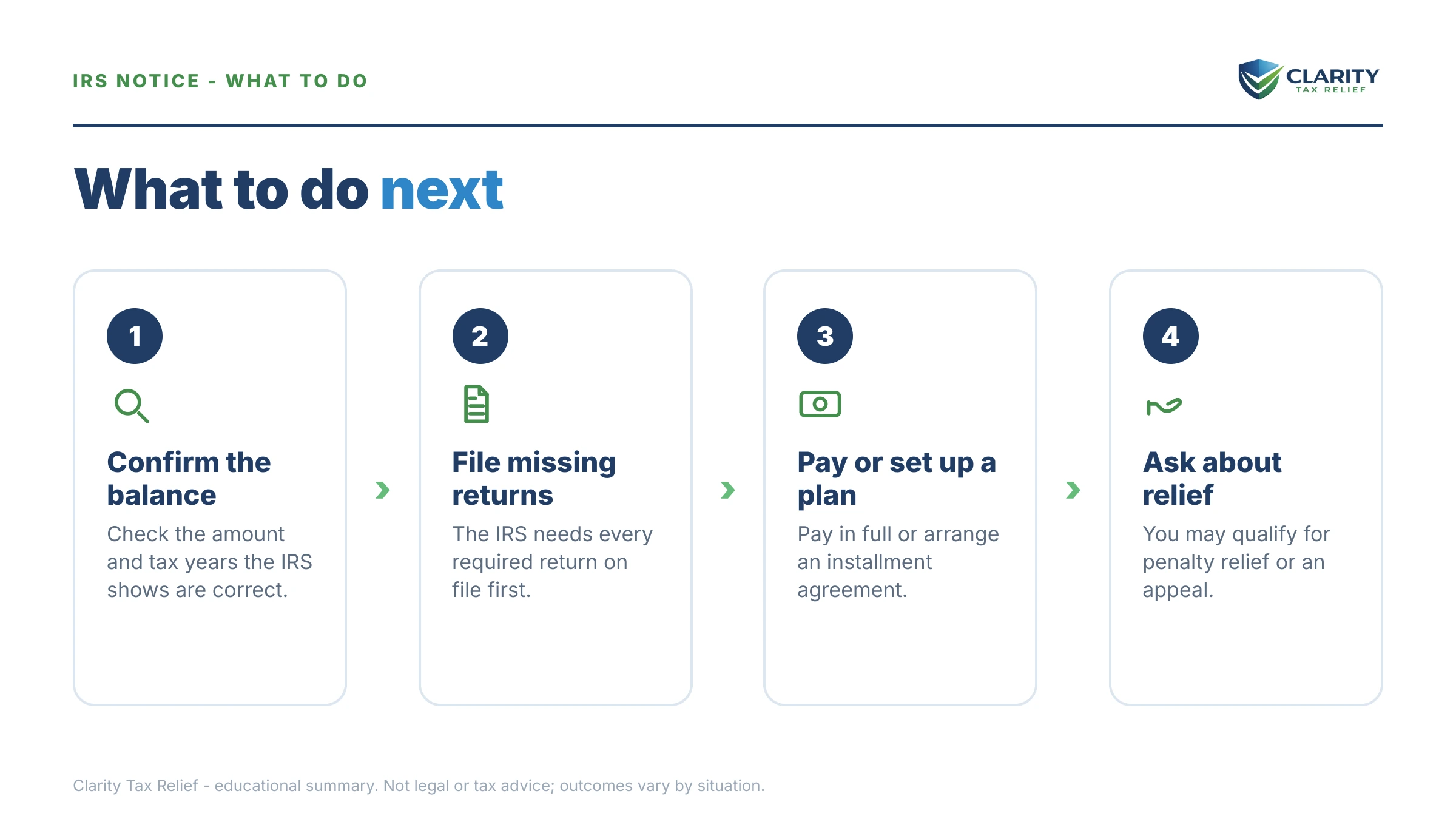
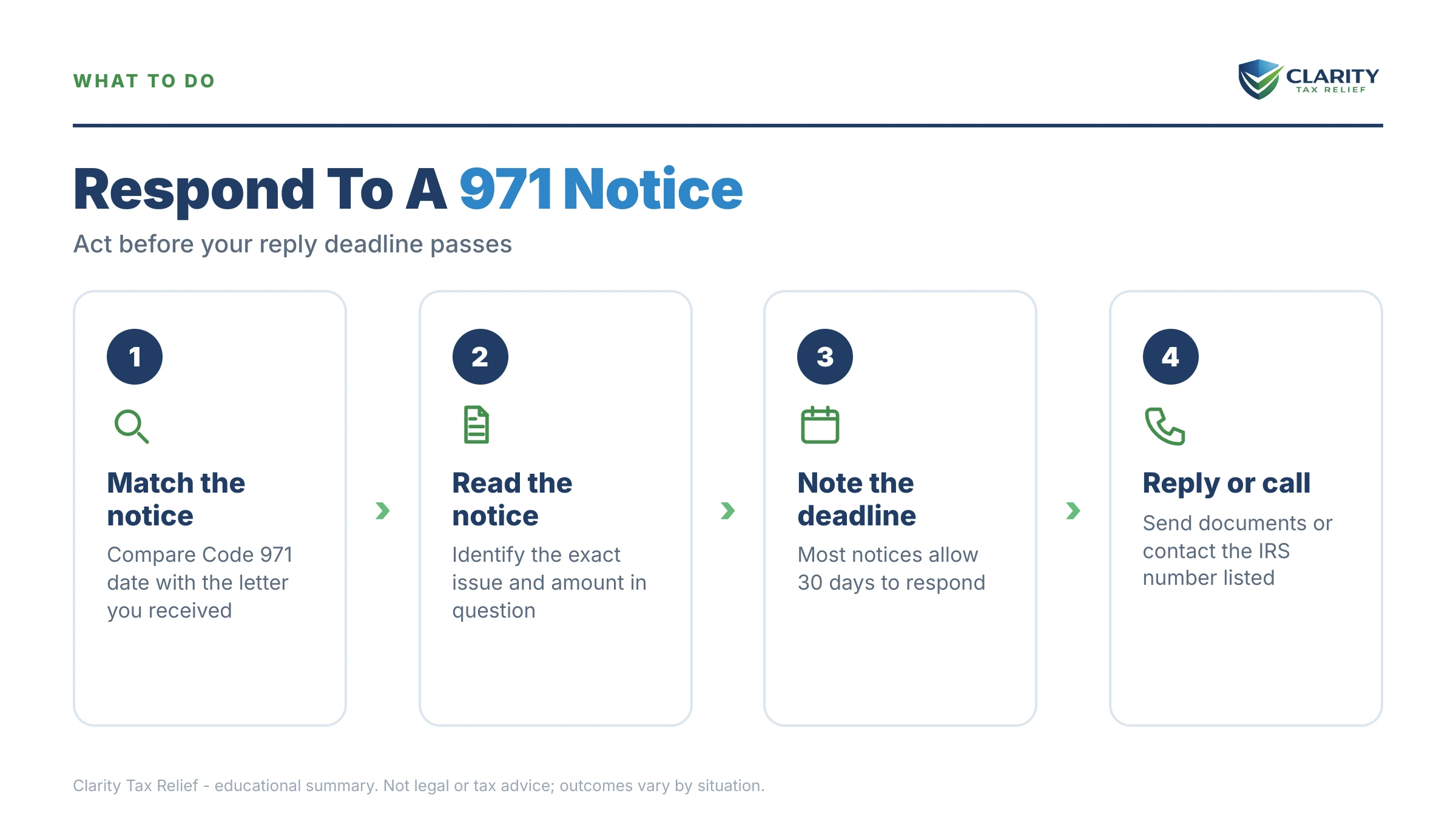
- Pull your full account transcript: get the account transcript for the year in question and write down every code and date around the 971 — the pattern identifies your situation. (Free at IRS Get Transcript, or see our walkthrough on how to get an IRS transcript online.)
- Identify the exact notice: match the 971 date to a specific letter in your IRS online account's Notices and Letters section — it often appears there before the paper copy arrives.
- Read the companion codes: check for 570 (hold), 290 (additional tax), 420 (exam), or 977 (amended return) to confirm whether the notice needs a response or is informational.
- Calendar the real deadline: write down the response date printed on the notice itself — windows run from the notice date, not from the day the letter reaches your mailbox.
- Respond or resolve before the window closes: pay, dispute with documentation, or set up a payment arrangement before the printed deadline — even a plan started today stops the escalation sequence. Payments and plans both run through IRS.gov/payments.
- Get experienced help for large or business balances: if the balance tops $50,000, involves payroll taxes, or the notice is a levy warning, have an experienced tax professional review it before you respond.
When you can handle a code 971 yourself — and when help changes the outcome
Most code 971 lines never need professional help — the honest answer is that the majority announce routine mail. You can confidently handle it yourself when:
- The 971 pairs with a 977 (amended return receipt) or announces an adjustment you already expected — there's nothing to do but wait.
- The notice is a first bill you agree with and can pay within 180 days — the $0-fee short-term plan takes minutes to set up online.
- The balance is under $50,000 and your returns are all filed — the streamlined installment agreement is designed for self-service, no financial disclosure required.
- It's an identity-verification letter — only you can verify; no professional can do that step for you.
Experienced help genuinely changes outcomes in a different set of situations: the 971 announces a CP3219A and the 90-day Tax Court clock is running; the balance is over $50,000, where the Form 433 financial disclosure determines your monthly payment and a poorly presented one costs you every month for years; the notice touches business payroll taxes, where personal liability is in play; multiple unfiled years sit behind the balance; or a levy notice has already posted. In those cases the sequencing — returns first, penalties second, balance last — often changes the final number materially. If you're weighing it, the Taxpayer Advocate Service is also a free option when IRS processing itself is causing you hardship.
Terms on your transcript, decoded
- TC 971: a "miscellaneous transaction" code recording an account event — most often that a notice or letter was issued to you.
- Action code: the internal sub-code the IRS attaches to a 971 to say exactly which event occurred; it doesn't display on the transcript you can download.
- TC 570: "additional account action pending" — a hold that stops refunds and account activity while something is reviewed; see code 570 on an IRS transcript.
- Assessment: the formal recording of tax you owe — code 150 for your original return, 290 for tax added later. Assessment is what starts the IRS's 10-year collection clock (the CSED).
- "As of" date: the date through which the transcript's penalty and interest figures are calculated — a moving projection, not a deadline.
- Notice date: the official issue date printed on the letter (and usually shown beside your 971). Every response window counts from this date, not from delivery.
If your 971 announced a balance-due notice and the amount is more than you can pay, it's worth a free review before the notice's printed date passes — request one here or call (888) 825-7779 and we'll decode the transcript with you.
Code 971 questions, answered
Is IRS code 971 bad news?
Not by itself — code 971 is a neutral flag meaning the IRS took an action, usually issuing a notice. Whether that's bad depends on the notice: it can announce a refund adjustment, a balance due, an identity-verification request, or confirmation of something you filed. Read the codes posted around it; a 971 next to a 570 hold or a 290 assessment deserves faster attention than a 971 standing alone.
How long after code 971 posts will I get the notice in the mail?
The letter typically arrives within one to two weeks of the date shown next to the 971 — the code often posts before the notice is even printed. You don't have to wait: log in to your IRS online account, where many notices appear digitally under Notices and Letters days before the paper copy lands. If nothing arrives within three weeks, call the IRS or check that your address on file is current.
What does the date next to code 971 mean?
It's the date the IRS generated or scheduled the action — usually the official issue date printed on the notice itself. Response windows run from that date, not from when the letter reaches you. That matters: a CP14 gives roughly 21 days from the notice date, and an LT11 gives 30, so mail time eats into your window. Future dates are normal; transcripts often post actions a week or more ahead.
Does code 971 mean I'm being audited?
No. The audit indicator on an account transcript is code 420 (or 424 for an exam request) — 971 simply means a notice or letter went out. Some of those notices relate to reviews, like a CP2000 underreporter proposal, but a CP2000 is a document-matching program, not a formal audit. If you see 420 alongside your 971, that combination does point to an examination.
Why does my code 971 show $0.00?
A $0.00 amount on a 971 line is completely normal and tells you nothing about what you owe. Code 971 records an event — a notice going out — not a dollar change to your balance. The financial impact, if any, shows up on other lines: tax on code 150 or 290, penalties on 276, interest on 196. The notice itself carries the amount the IRS wants you to see.
Can code 971 mean my refund is delayed?
Yes, when it appears with code 570. A 570 freezes your account while the IRS reviews something — wage verification, a credit claim, identity checks — and the 971 announces the letter explaining what it needs. Refunds don't move until a 571 or 846 posts. If your 971 has no 570 beside it and you're expecting a refund, the notice may just be an adjustment explanation.
Does code 971 always mean the IRS mailed me something?
Usually, but not always. TC 971 is technically a miscellaneous transaction the IRS uses with internal action codes, so it can also record events like an amended return being received (paired with 977), a bankruptcy filing, an innocent spouse claim, or a collection-due-process request. If no letter arrives and your online account shows no new notice, the 971 may simply be logging one of these account events.
What should I do if code 971 posted but I never received the letter?
Don't wait for the mail — deadlines run from the notice date, not delivery. Log in to your IRS online account and check the Notices and Letters section, verify your mailing address, and call the IRS to request a reissued copy. Undelivered notices don't pause anything: a CP3219A still starts its 90-day Tax Court clock whether or not you ever open the envelope.
Is code 971 the same thing as IRS Publication 971?
No — they just share a number. Transaction code 971 is an entry on your account transcript recording that a notice or action occurred. Publication 971 is an IRS booklet explaining innocent spouse relief. Confusingly, a TC 971 can post when you file an innocent spouse claim, which is how the two get tangled in search results — but the transcript code and the publication are unrelated.
Your next 24 hours
- Find the notice. Log in to your IRS online account, open Notices and Letters, and match the letter there to the date beside your 971 — write down the notice number and the response date printed on it.
- Gather three things: the transcript showing the 971, last year's return, and — if a balance is involved — a rough picture of your monthly income and expenses. Everything that follows is faster with these in hand.
- Get a free case review. If the notice shows a balance you can't pay, or you can't identify it at all, send it to us through the 2-minute form or call (888) 825-7779. Interest and penalties accrue monthly on any balance behind a 971 — the earlier the review, the cheaper the fix.
This guide is general information, not tax or legal advice for your specific situation. Eligibility for IRS programs depends on individual facts and circumstances; no outcome is guaranteed.