
IRS Data & Statistics
IRS Penalty Abatement Statistics (2026): How Often the IRS Actually Removes Penalties
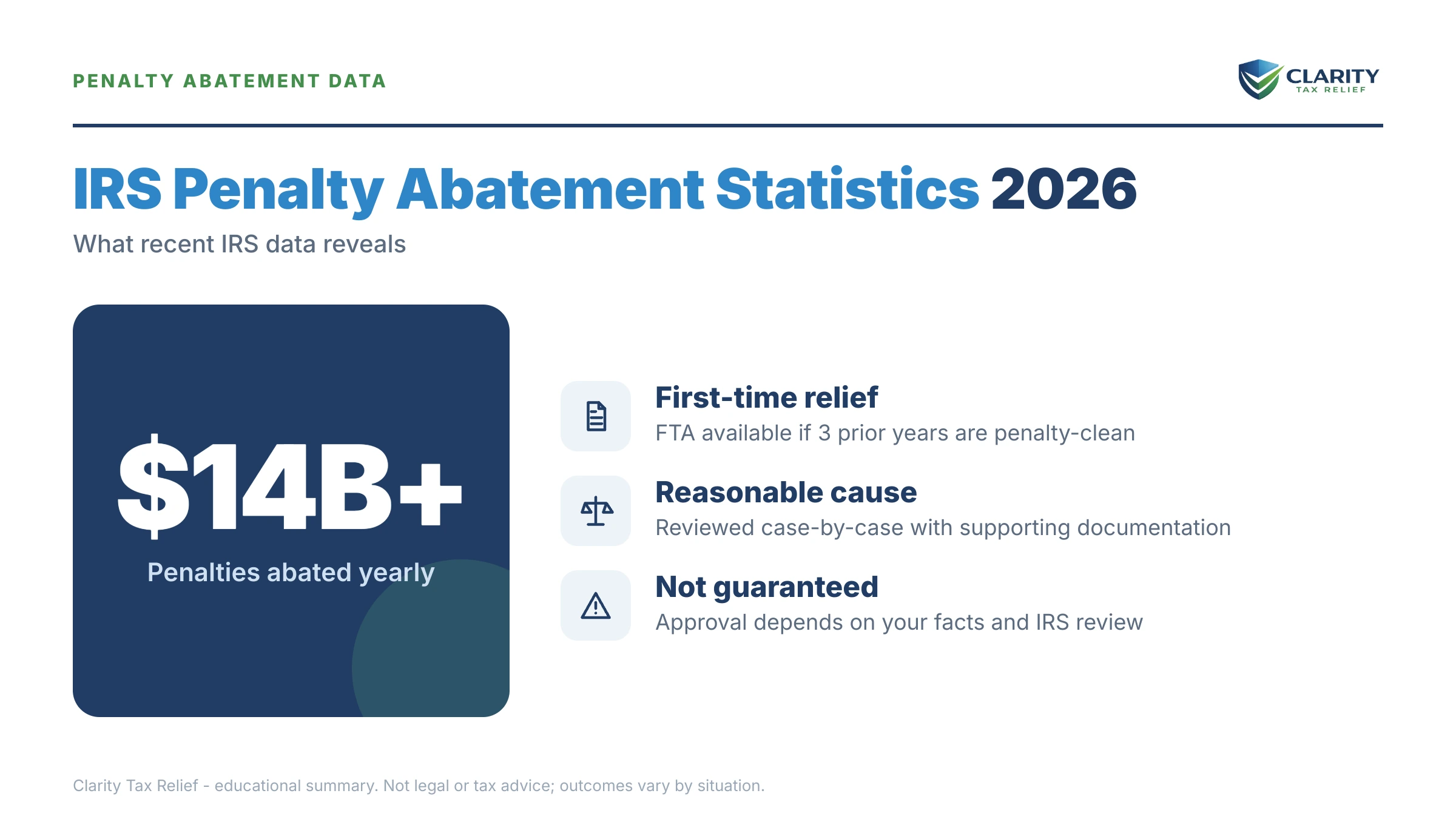
The short answer: yes, the IRS removes penalties constantly. Its own Data Book shows billions of dollars in civil penalties abated every year against tens of billions assessed. First-Time Abatement is granted near-mechanically when your prior three years are clean — and starting summer 2026, the new Automatic Exemption from Penalty applies with no request at all.
You're probably here because a penalty just changed a real number in your life. Maybe your lender pulled an IRS payoff for a refinance and it came back thousands higher than the tax you actually owe — and now you want to know whether the IRS ever really removes penalties, or whether abatement is a marketing myth. The IRS penalty abatement statistics answer that question clearly: relief is real, it's routine, and it overwhelmingly goes to the people who ask for it.
This guide walks through what the official data does and doesn't show, why the aggregate numbers mislead, and — the part that matters most — the specific paths that get penalties removed in 2026, with the math on what that's worth on a real balance.
⏱ Two clocks are running: if a penalty is still unpaid, it keeps accruing monthly until it hits its legal cap, with interest compounding on top. If you already paid a penalty, you generally have 2 years from the payment date (or 3 years from the return's filing date, whichever is later) to claim a refund with Form 843. After that window closes, the money is gone even if you would have qualified.
IRS penalty abatement statistics: what the data actually shows
The IRS publishes its penalty numbers once a year in the IRS Data Book, which reports civil penalties assessed and civil penalties abated, broken out by penalty type. In recent editions, assessments run into the tens of billions of dollars annually — and abatements into the billions. Penalty removal is not an exotic loophole. It is a routine, high-volume function of the agency, happening every business day.
But raw abatement totals are widely misread, and the difference matters if you're deciding whether to bother requesting relief. Three things the aggregate numbers hide:
- "Abated" doesn't only mean "request granted." The Data Book's abatement figures include IRS-initiated corrections, penalties reversed because the underlying tax changed, disaster-related relief applied in bulk, and statutory adjustments — not just taxpayers who wrote a persuasive letter. So the dollar total overstates how often a discretionary request wins, and understates nothing about whether you should ask.
- The dollar totals are dominated by business and employment-tax cases. Individual failure-to-file and failure-to-pay penalties are enormous in count but modest in average size compared to payroll and information-return penalties. An aggregate "percentage abated" blends a homeowner's $7,000 penalty with a corporation's seven-figure one — which is why no single published percentage predicts an individual's odds.
- The IRS publishes no approval rate for abatement requests. Unlike the Offer in Compromise program — where the IRS accepted roughly 1 in 5 offers in FY2024 — there is no official "abatement acceptance rate." Anyone quoting you a precise one is guessing. What can be said with confidence: when you meet the First-Time Abatement criteria, relief is applied near-mechanically, because it's a rules test, not a judgment call.
The most important finding in the abatement data isn't a percentage at all. A Treasury Inspector General review found that most taxpayers who qualified for First-Time Abatement never received it — for the simple reason that they never requested it. Relief existed; awareness didn't. That single finding is why this page exists, and it's also why the IRS is changing the system in 2026 (more on the new Automatic Exemption from Penalty below).
If you want the assessment side of the picture — which penalties get charged most and how large they grow — see the companion data pages on IRS failure to pay penalty statistics and IRS estimated tax penalty statistics, and the full penalty math in how much are IRS penalties on back taxes.
Why the IRS assesses so many penalties in the first place
Nearly every individual late-filing and late-payment penalty is assessed by computer, with no human reviewing your circumstances first. The machine sees a return filed after the deadline or a balance unpaid after the due date, applies the statutory rate, and adds the penalty to your account. Your reasons — illness, a lost job, a preparer who dropped the ball — are invisible to it.
That design explains the shape of the statistics. The two workhorse penalties are wildly different in severity: the failure-to-file penalty runs 5% per month, ten times the 0.5% per month failure-to-pay penalty, each capped at 25% of the unpaid tax. The system charges first and considers circumstances only if someone raises them — which is exactly what an abatement request does. It's the built-in appeal valve for an automated penalty machine.
2026 adds a twist: the IRS workforce was cut roughly 27% in 2025, so reaching a human to discuss a penalty is harder than it has been in years. The computers assessing penalties were not laid off. The gap between automated assessment and human review has never been wider — which makes knowing the formal relief channels, rather than hoping to talk it out, the practical path.
What happens if you never request abatement
An unaddressed penalty doesn't sit still — it grows on a fixed schedule until it hits its statutory cap, and it drags collection consequences behind it. Here's the sequence on a typical unpaid individual balance:
- The penalty accrues monthly. Failure-to-pay adds 0.5% of the unpaid tax every month, marching toward its 25% ceiling.
- Interest compounds on the penalty itself. IRS interest compounds daily and applies to penalties as well as tax — so an unabated penalty generates its own growing interest charge.
- The rate can jump. Once the IRS issues its final intent-to-levy notice and the deadline passes, the failure-to-pay rate increases to 1% per month.
- Collection notices escalate. The balance rides the standard sequence — bill, reminders, intent to levy, final notice — with each stage adding enforcement power.
- Thresholds get crossed. Penalties and interest can push a balance over the $66,000 line at which the IRS certifies seriously delinquent debt to the State Department — see passport revoked for tax debt.
- A lien becomes more likely. As an unpaid balance ages and grows, a federal tax lien filing becomes an increasing risk — the single item most likely to derail a mortgage or refinance. If one has already been filed, start with can I refinance with an IRS lien.
Every dollar of penalty you could have abated but didn't is a dollar that compounds against you at each of these stages. The cheapest moment to request relief is always now.
Penalties inflating your IRS payoff right now?
Interest and penalties compound monthly while you research. Send us your notice or transcript and an experienced tax professional will check your abatement eligibility — First-Time Abatement, reasonable cause, and the new 2026 automatic relief — free and confidential.
Your penalty relief options in 2026, compared
Every abatement path costs $0 to request on your own — the "cost" of penalty relief is time, documentation, and knowing which door to knock on. Here's the full menu:
| Relief path | Who may qualify | Cost & timeline |
|---|---|---|
| First-Time Abatement (FTA) | No penalties in the prior 3 years, all required returns filed, tax paid or on a payment arrangement | $0; phone requests are often decided on the call |
| Automatic Exemption from Penalty (AEP) | Replaces FTA starting summer 2026 — applied automatically, no request needed | $0; posts to qualifying accounts without action |
| Reasonable cause | Circumstances beyond your control: serious illness, death in the family, disaster, unobtainable records | $0; written review — timelines vary, longer than FTA |
| Statutory exception | You relied on incorrect written IRS advice, or a declared-disaster extension applies | $0; documented with the written advice or disaster designation |
| Interest abatement (IRC §6404) | Interest caused by IRS error or unreasonable delay — narrow, but real | $0; requested on Form 843 with a timeline of the IRS delay |
First-Time Abatement is the highest-percentage play in all of penalty relief because it's a compliance test, not a sympathy test. Clean prior three years, current on filings, paying or arranged to pay — meet those and relief is applied as a matter of administrative policy. It typically covers one tax period; the full mechanics are in our first time penalty abatement guide, and if several years are penalized, see first time abatement multiple years for how FTA and reasonable cause stack.
AEP is the 2026 headline. Because the data showed most eligible taxpayers never claimed FTA, the IRS is replacing the ask-first model with automatic relief beginning summer 2026. Two practical implications: don't let anyone charge you for "securing" relief that will post by itself — and don't wait passively if you need the penalty off your account on a schedule (say, before underwriting), because an affirmative request puts you in control of the timing. Details in automatic exemption from penalty AEP 2026.
Reasonable cause is the path when your history isn't clean or the penalty is too large for FTA's scope. It succeeds on documented facts: hospital records, a death certificate, a disaster declaration, proof a third party failed you despite your ordinary care. Vague hardship loses; a dated timeline with evidence wins. Start with reasonable cause penalty abatement, and use a structured written request — our IRS penalty abatement letter guide shows the format the IRS reviewer is trained to evaluate.
Already paid? You're not done. A paid penalty is recoverable by refund claim on Form 843 within the window in the deadline box above — the process is covered in penalty abatement after paying.
Business penalties run on different rails: payroll deposit penalties tier by lateness and partnership/S-corp late-filing penalties multiply per partner per month. If your penalty is on a 941 or a business return, the individual playbook above only half-applies — see 941 penalty abatement for the payroll-specific standards.
One honest boundary on all of this: abatement removes penalties, not the tax. The underlying balance and the interest on the tax remain, and interest itself is only abatable in the narrow §6404 situations — the full picture is in can IRS interest be waived. But interest that was charged on an abated penalty comes off with the penalty, which is often a bigger number than people expect.
A worked example: abating penalties on a $61,200 balance before a refinance
This is hypothetical, but the arithmetic is exact. Say you're a homeowner planning to refinance, you filed on time two years ago, and $61,200 of that year's tax went unpaid. The failure-to-pay penalty has been running at 0.5% per month:
| Months unpaid | Monthly penalty (0.5% × $61,200) | Cumulative penalty |
|---|---|---|
| 1 month | $306 | $306 |
| 6 months | $306 | $1,836 |
| 12 months | $306 | $3,672 |
| 24 months | $306 | $7,344 |
| At the 25% cap | — | $15,300 maximum |
At the 24-month mark, the payoff your lender sees is $61,200 in tax plus $7,344 in penalties, plus daily-compounding interest on both. That interest matters twice here: left alone, this balance is drifting toward the $66,000 passport-certification threshold — and every month adds another $306 of penalty that also accrues its own interest.
Now run the abatement scenario. If the prior three years are clean, a First-Time Abatement request removes the $7,344 — and the interest that was charged on that $7,344 comes off automatically with it. The refinance payoff drops by thousands, and pairing the abatement with an installment agreement cuts the ongoing penalty rate in half, from 0.5% to 0.25% per month ($306 down to $153) while the plan is in good standing. To estimate the penalty and interest picture on your own numbers, run them through our Penalty & Interest Calculator.
If instead you had also filed that return late, the stakes multiply: failure-to-file accrues at 5% per month and maxes out at 25% of the tax in five months — on $61,200, that's up to another $15,300 in filing penalty alone, which is exactly why abatement requests on late-filed years are worth real money.
How to request IRS penalty abatement, step by step
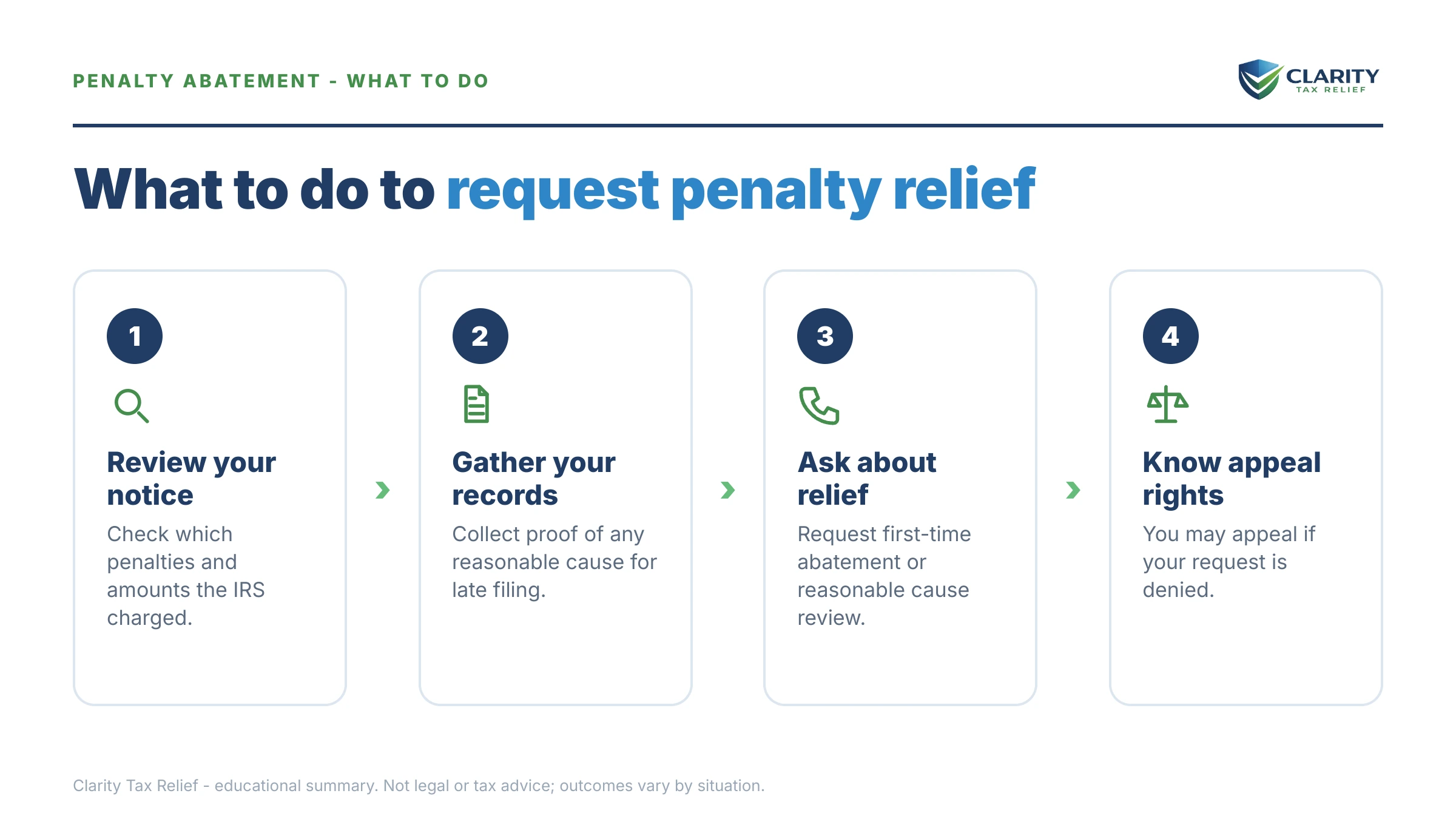
- Pull your account transcripts — download the account transcript for each penalty year at IRS.gov, find the penalty lines, and confirm whether the three prior years are penalty-free.
- Match your facts to a relief path — if your prior three years are clean, request First-Time Abatement; otherwise build a reasonable-cause case or check whether a statutory exception applies.
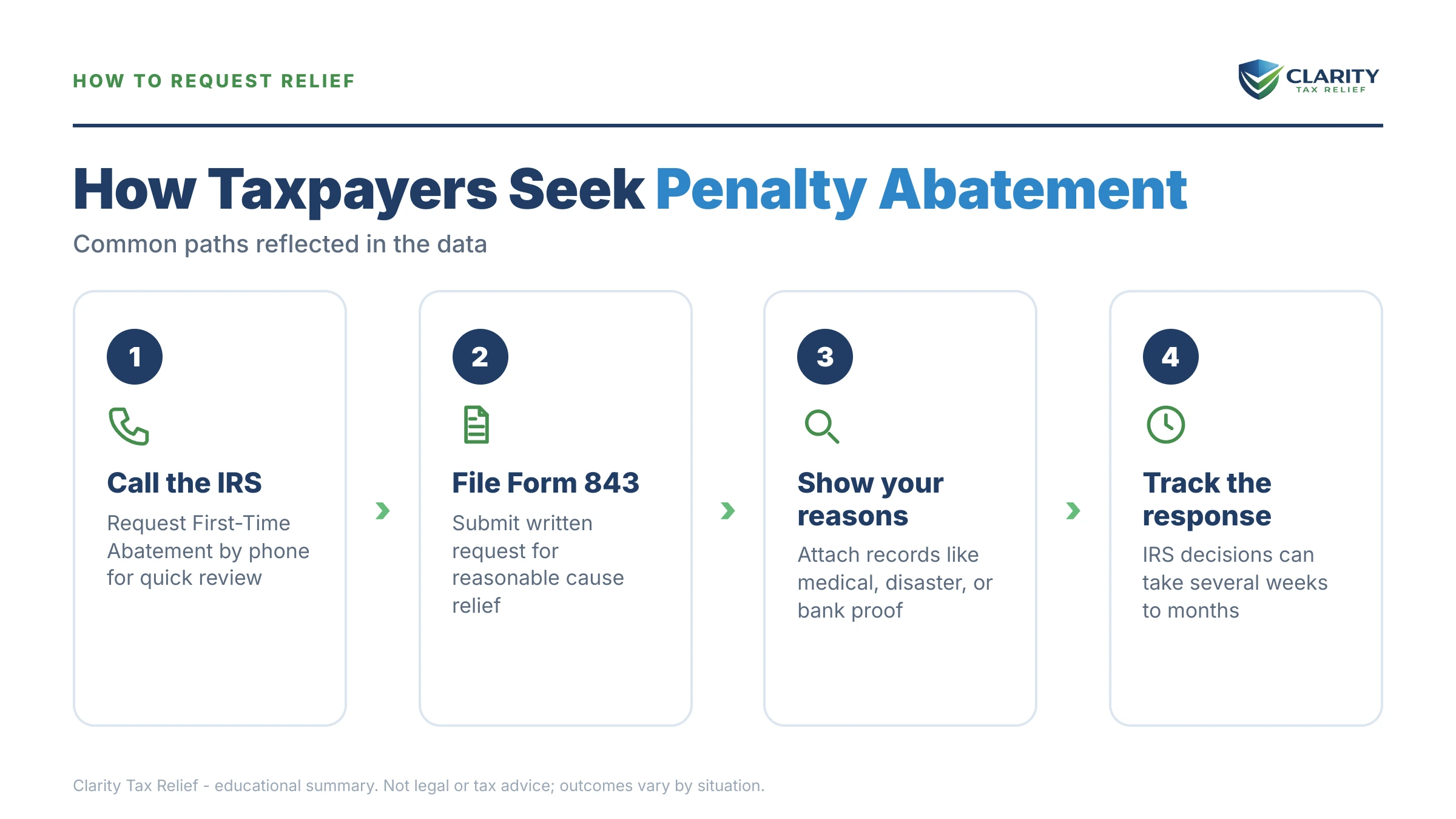
- Make the request — call the number on your notice for a phone FTA request, or send a written request or Form 843 with your documentation attached.
- Claim refunds of paid penalties on time — if you already paid a penalty, file Form 843 within 3 years of the return's filing date or 2 years of the payment, whichever is later.
- Appeal a denial in writing — a denied reasonable-cause request comes with appeal rights; follow the instructions on the denial letter and respond within the window it states.
- Verify the adjusted balance — after abatement posts, pull a fresh transcript to confirm the penalty and its associated interest were removed, and get an updated payoff figure.
Deadlines and rights: the clocks that control abatement
Penalty relief has no application season, but it does have hard windows — and the one people miss most is the refund-claim deadline on penalties they already paid.
| Your situation | Deadline or window | Your right |
|---|---|---|
| Penalty assessed, still unpaid | No fixed deadline — but the penalty and interest accrue monthly until addressed | Request FTA or reasonable-cause relief at any time while the balance exists |
| Penalty already paid | 3 years from the return's filing date or 2 years from payment, whichever is later | File Form 843 as a refund claim for the penalty and its interest |
| Abatement request denied | The response window printed on your denial letter | Written appeal to the IRS Independent Office of Appeals — see penalty abatement appeal |
| Qualify under AEP (from summer 2026) | None — relief is automatic | Verify on your transcript that it actually posted; request affirmatively if timing matters |
When you can handle penalty abatement yourself
A single-year FTA request is one of the most DIY-friendly tasks in tax resolution. If one tax year has a penalty, your prior three years are clean, your returns are filed, and you're paying the tax or on a plan, call the number on your notice and ask for First-Time Abatement — no form, no fee, and often an answer on the call. The IRS's own overview of the relief categories is at IRS.gov penalty relief, and a free template is in our IRS penalty abatement letter guide if you'd rather write than wait on hold.
Experienced help changes outcomes in a different set of situations: multiple penalized years, where sequencing FTA against reasonable cause across years determines how much comes off; large-dollar reasonable-cause cases, where the narrative and evidence package is the whole game; business and payroll penalties, which run on stricter standards; denials headed to appeal; and any case where a lien, levy, or closing date puts the abatement on a clock. If you can't afford representation, the Taxpayer Advocate Service exists precisely for taxpayers stuck between an automated penalty and an unreachable agency.
One warning the statistics justify: any company promising to "wipe out" penalties for a large upfront fee, before anyone has looked at your transcript, is selling you a coin flip. Eligibility is determined by your compliance history and facts — which are checkable for free before you pay anyone anything.
Terms in the penalty data, decoded
- Abatement — the formal removal or reduction of a penalty (or interest) that has already been charged to your account.
- First-Time Abate (FTA) — administrative relief granted when you had no penalties in the prior three years and are current on filing and payment arrangements.
- Automatic Exemption from Penalty (AEP) — the FTA replacement rolling out from summer 2026 that applies qualifying relief without any request.
- Reasonable cause — the legal standard for discretionary relief: you exercised ordinary care but circumstances beyond your control caused the failure.
- Statutory exception — relief required by law, such as when you relied on incorrect written IRS advice or a declared-disaster extension applied.
- Form 843 — the claim form used to request abatement in writing or to seek a refund of penalties and interest you already paid.
If penalties are stacked on several years or sitting on top of a payroll balance, the order you resolve them in changes what you keep — get a free transcript-level review before you commit to a strategy.
IRS penalty abatement questions, answered
What percentage of IRS penalty abatement requests are approved?
The IRS does not publish a single approval rate for abatement requests. Its Data Book reports penalties assessed and abated in aggregate dollars, and those abatement totals mix granted requests with IRS-initiated corrections and statutory adjustments. What the data does support: First-Time Abatement is applied near-mechanically when the three-year clean-history test is met, while reasonable-cause outcomes turn on the quality of your documentation.
How much in penalties does the IRS abate each year?
Billions of dollars annually, according to the civil-penalties table in the IRS Data Book, against tens of billions assessed. The exact figure changes each year and is heavily influenced by business and employment-tax cases, so the aggregate number says little about any one individual's odds. For your own situation, the question that matters is binary: do you meet a relief standard or not.
Is first-time penalty abatement automatic if I qualify?
Historically, no — you had to ask, and government reviews found most eligible taxpayers never did. That changes with the Automatic Exemption from Penalty (AEP), rolling out starting summer 2026, which applies qualifying relief without a request. If you need a penalty removed now — for example, before a refinance closes — request relief affirmatively rather than waiting for an automatic adjustment to post.
What is the success rate for reasonable cause penalty abatement?
No official success rate exists, because reasonable cause is judged case by case on your specific facts. Serious illness, natural disaster, death in the family, and records genuinely beyond your control are the fact patterns that succeed; forgetting, being busy, or not having the money generally fail on their own. A denial is not final — you have the right to appeal, and appeals frequently reach different conclusions on the same facts.
Can IRS interest be abated too?
Generally no — interest is set by law and only comes off in narrow situations, mainly IRS error or unreasonable delay under IRC Section 6404. The important exception: when a penalty is abated, the interest that was charged on that penalty is removed with it automatically. Interest on the underlying tax keeps running until the tax itself is paid.
Can I get back penalties I already paid?
Yes — paying a penalty does not forfeit your right to relief. You file Form 843 as a refund claim, generally within 3 years of the return's filing date or 2 years of the payment, whichever is later. If the abatement is granted, both the penalty and the interest you paid on it come back.
What is the Automatic Exemption from Penalty (AEP)?
AEP is the IRS program replacing First-Time Abate, starting summer 2026. Instead of requiring taxpayers to know the relief exists and request it, qualifying penalty relief is applied automatically — no call, no letter, no form. It addresses the biggest finding in the abatement data: relief historically went to people who asked, not to everyone who qualified.
Does requesting penalty abatement trigger an audit?
No — an abatement request is an account adjustment handled on the collection and service side of the IRS, not by examiners, and it is not an audit selection factor. The reviewer looks at your penalty history and the facts you present, not your deductions. That said, everything you submit should be accurate; a reasonable-cause narrative is a factual statement to the IRS.
Does penalty abatement help me qualify for a mortgage or refinance?
Indirectly, yes. Abatement lowers the total payoff your lender sees, and a smaller balance paired with a formal payment arrangement reduces the chance of a federal tax lien filing — the item most likely to stall underwriting. It can also keep an aging balance from crossing the $66,000 passport-certification threshold. Abatement does not remove a lien that has already been filed; that is a separate process.
Your next 24 hours
- Pull your account transcript for each year with a penalty and look at two things: the penalty lines and dollar amounts on the year in question, and whether the three prior years show any penalties at all — that single check tells you if First-Time Abatement is on the table.
- Gather your paper trail: the IRS notices, the filed returns, proof of any penalty payments (that 2-year refund clock is running), and documentation of whatever caused the late filing or payment — medical records, a disaster declaration, correspondence with a preparer.
- Get a free penalty review — use the 2-minute form or call (888) 825-7779. An experienced tax professional will read your transcript, tell you which relief path your facts actually support, and what an abatement is worth against a payoff that's compounding monthly while it waits.
Primary sources: the IRS publishes penalty assessment and abatement data in the annual IRS Data Book; the official relief criteria live on the IRS penalty relief page.
This guide is general information, not tax or legal advice for your specific situation. Eligibility for IRS programs depends on individual facts and circumstances; no outcome is guaranteed.