
IRS Data & Penalties
IRS Estimated Tax Penalty Statistics: How Many People Get Hit and What It Costs (2026)
The short answer: IRS estimated tax penalty statistics show a sharp spike. The IRS assessed roughly $7 billion in estimated-tax penalties in fiscal year 2023 — nearly four times the prior year's roughly $1.8 billion — across about 14 million filers, with the average penalty near $500. Rising interest rates, not new rules, drove the surge.
You ran your return expecting roughly a wash, and instead there's an extra penalty line stacked on top of a balance you didn't see coming. If you're wondering whether you're the unlucky exception, the IRS's own data says the opposite: you're part of the fastest-growing penalty in the system. That's oddly good news — the causes are known, the math is checkable, and the exits are specific.
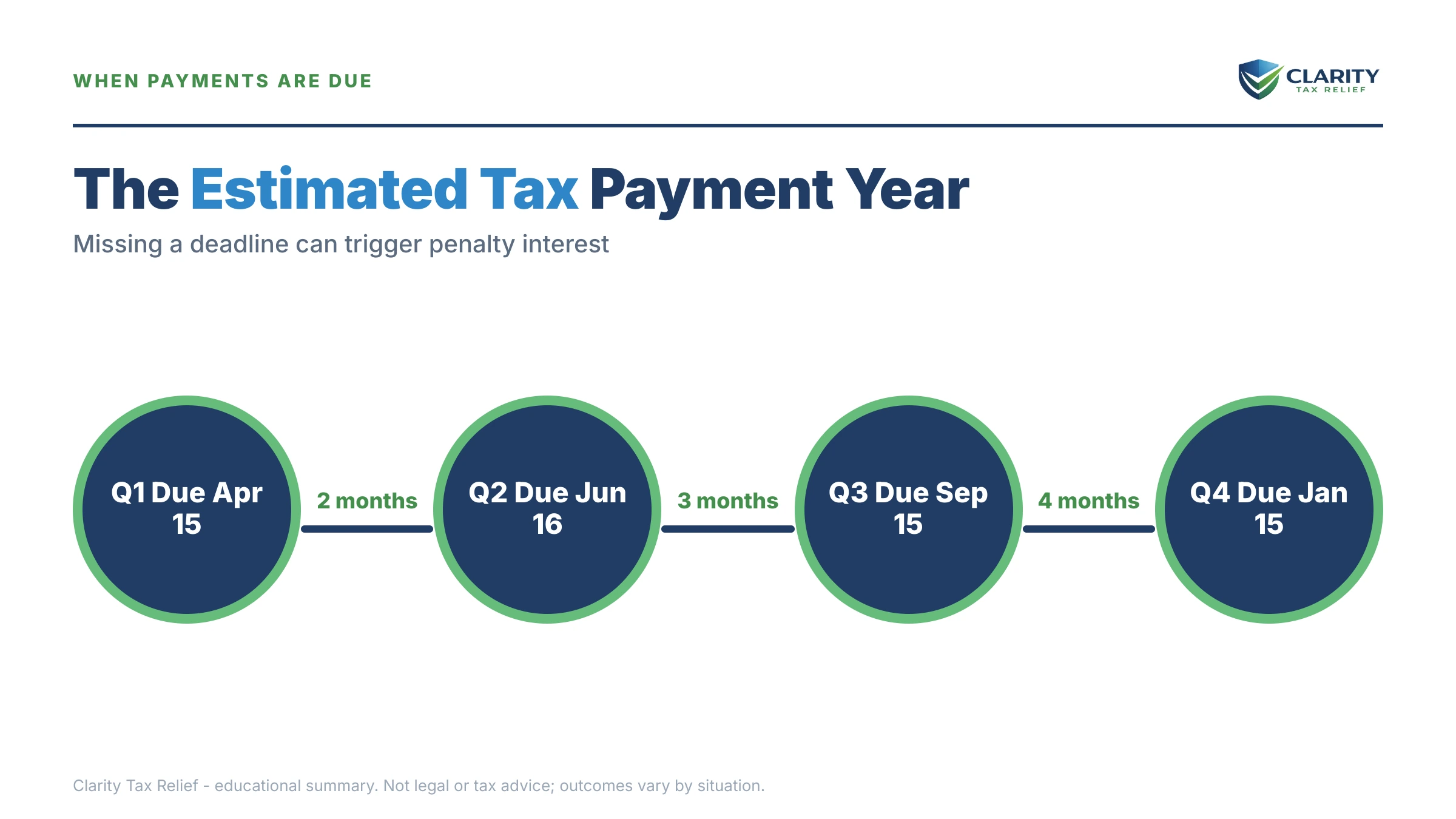
⏱ The clock that matters: this penalty has no response deadline, but it never sits still. Interest accrues daily on any unpaid balance, and the next round of quarterly estimated payments is due April 15, June 15, and September 15, 2026, and January 15, 2027 — every missed quarter builds next year's penalty on top of this one.
IRS estimated tax penalty statistics: the headline numbers
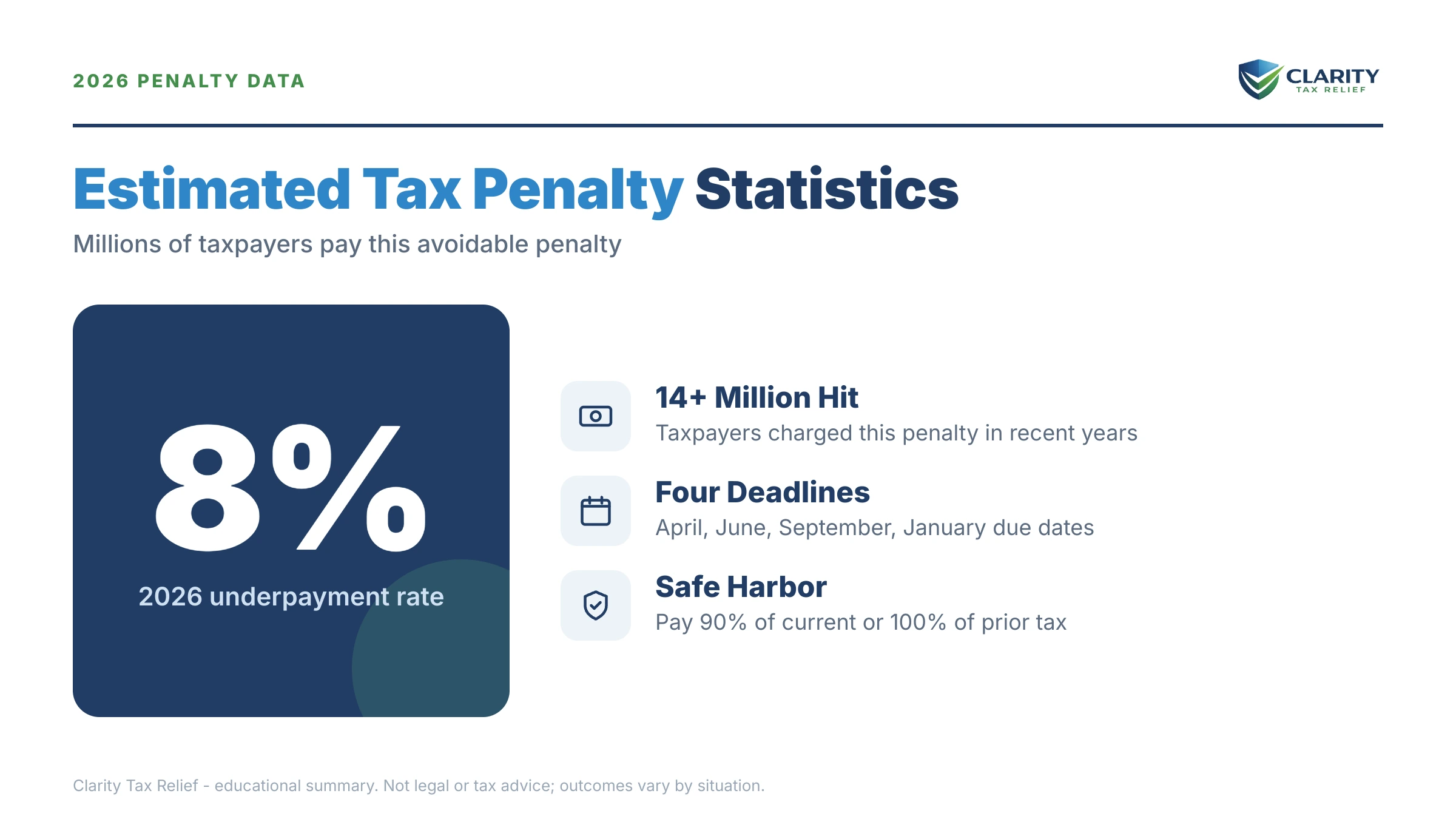
The IRS assessed roughly $7 billion in estimated-tax penalties on about 14 million filers in fiscal year 2023 — nearly quadruple the prior year's total, per IRS Data Book figures. That's the most recent complete year of published penalty data, and it marks the sharpest one-year jump this penalty has ever recorded.
| Metric | FY 2022 | FY 2023 | What changed |
|---|---|---|---|
| Total penalty dollars assessed | ~$1.8 billion | ~$7 billion | Nearly 4× in one year |
| Filers assessed the penalty | ~12 million | ~14 million | ~2 million more households |
| Average penalty (dollars ÷ filers) | ~$150 | ~$500 | Roughly tripled per person |
| Underpayment interest rate | 3%–6% through the year | 7%, then 8% by year-end | The rate is the penalty's engine |
Two things stand out in that table. First, the number of penalized filers grew modestly — but the cost per filer exploded, because this penalty is priced like interest. Second, roughly 14 million assessments puts this among the IRS's most common penalties, in the same volume neighborhood as the late-payment penalty tracked in our IRS failure to pay penalty statistics guide. Rates stayed at 8% through 2024 and 7% through 2025, so the pressure behind these numbers hasn't let up even where newer full-year figures aren't yet published.
Why underpayment penalties exploded — and why you got one
The estimated-tax penalty isn't a fine — it's an interest charge on money you paid later in the year than the law required. The rate is set quarterly at the federal short-term rate plus 3 percentage points. In early 2022 that came to 3%. By late 2023 it hit 8% and stayed there through 2024, easing to 7% in 2025 — our IRS interest rates 2026 page tracks the current quarter.
So the same shortfall that cost a filer $150 in 2021 cost roughly triple by 2023. Nothing about the rules changed — the price did.
The second driver is who earns income without withholding. Gig work, 1099 contracting, brokerage gains, crypto sales, and retirement-account distributions all arrive with no tax taken out. The U.S. system is pay-as-you-go: if enough tax doesn't come in during the year — through withholding or quarterly estimated taxes — the penalty applies even if you pay every dime by April 15. That timing rule is the single most misunderstood fact in these statistics: paying in full at filing does not prevent this penalty.
And that's why a growing slice of the 14 million are ordinary W-2 employees. Your paycheck withholding was calibrated to your salary — not to the stock you sold in March or the freelance project you invoiced in August. The withholding covered the job; nothing covered the rest.
How the penalty is calculated — the math behind the statistics
The penalty equals each quarter's underpayment, multiplied by the underpayment rate, prorated for the days the money was late. There is no flat percentage. Form 2210 splits your required annual payment into four installments (due April 15, June 15, September 15, and January 15 — see the quarterly estimated tax deadlines for 2026) and charges the rate on each shortfall from its due date until it's paid or until April 15 of the following year. You can rough out your own number with our Penalty & Interest Calculator, which estimates penalties and interest on a balance.
Say you're a W-2 employee, filing single, $16,400 short
This is a hypothetical, but it's the exact shape of the modern penalty case. Say your salary withholding was fine, but you sold employer stock during 2025 and your April 2026 return shows $16,400 of tax due beyond your withholding — all of it below your safe harbor. Simplified evenly across four quarters, that's a $4,100 shortfall per installment. Using a 7% rate for illustration:
- Q1 installment (due April 15, 2025), unpaid ~12 months: $4,100 × 7% ≈ $287
- Q2 installment (due June 15, 2025), unpaid ~10 months: $4,100 × 7% × 304/365 ≈ $239
- Q3 installment (due September 15, 2025), unpaid ~7 months: $4,100 × 7% × 212/365 ≈ $167
- Q4 installment (due January 15, 2026), unpaid ~3 months: $4,100 × 7% × 90/365 ≈ $71
Total: roughly $760 in penalty on top of the $16,400 — about 4.6% of the shortfall. Real Form 2210 math differs in the details (the required installment is based on your safe-harbor amount, not the full balance), but the shape holds: the earlier the quarter you missed, the more it costs.
Now the twist that only helps W-2 filers: the IRS treats withholding as paid evenly across the year, no matter when it actually came out of your check. If that stock sale happened in October, a big W-4 withholding bump in November and December would have been credited back to all four quarters — retroactively curing the earlier shortfalls. A self-employed filer sending the same dollars as a January estimated payment gets no such credit. And if the income itself arrived late in the year, the annualized income method on Form 2210 can legitimately shrink the penalty — more on that below.
What happens if you ignore an estimated tax penalty
An unpaid estimated-tax penalty rolls into your total balance and rides the IRS collection sequence like any other tax debt. Ignoring it doesn't freeze it — it compounds it, in this order:
- Assessment. The penalty is computed on your return via Form 2210, or the IRS calculates it for you and announces it on a CP30 notice or by adjusting your refund.
- The first bill. If a balance remains, a CP14 notice arrives with roughly 21 days to pay (10 business days when the balance is $100,000 or more). From the return's due date forward, the separate failure-to-pay penalty (0.5% per month) and daily interest are also running on the whole balance — penalty included.
- Reminders. CP501 and CP503 follow, each with a larger balance than the last.
- CP504 — intent to levy. The IRS can now take your state tax refund, and a federal tax lien becomes a live possibility.
- LT11 / Letter 1058 — final notice. A 30-day clock starts, with Collection Due Process appeal rights; after it runs, wages and bank accounts are fair game.
One 2026 reality check: the IRS workforce shrank by roughly 27% in 2025, which makes humans harder to reach — but this entire sequence is automated and never stopped. A ~$760 penalty is an annoyance; a $17,000+ balance riding into levy territory is a different problem.
Penalized and staring at a balance you can't pay?
If the estimated-tax penalty is sitting on top of a tax bill you can't clear — like the $16,400 scenario above — get it reviewed free before interest and late-payment penalties stack another month onto it. An experienced tax professional will check whether the penalty is even correct and map your cheapest way out.
Your options after the penalty is assessed
The single most important fact here: First-Time Abate does not apply to the estimated-tax penalty. FTA — and the Automatic Exemption from Penalty (AEP) replacing it starting summer 2026 — covers filing and payment penalties, not the §6654 underpayment charge. Our IRS penalty abatement statistics page shows how often relief succeeds on the penalties it does cover. For this one, the paths are narrower but real:
| Option | Out-of-pocket cost | Timeline | Best for |
|---|---|---|---|
| Pay the penalty with the balance | The penalty amount only | Immediate; stops further accrual on it | Small penalties not worth hours of paperwork |
| Form 2210 waiver request | $0 | Filed with your return | Casualty, disaster, or unusual circumstances; retired 62+ or disabled with reasonable cause |
| Annualized income method (Form 2210 Schedule AI) | $0 (but tedious) | Filed with your return | Income that arrived late in the year — year-end stock sales, Q4 contracts |
| Form 843 claim after assessment | $0 | Often several months for a decision | Penalty assessed in error, or waiver grounds discovered after filing |
| Payment plan on the whole balance | $0 setup for short-term (up to 180 days); modest setup fee for long-term plans | Set up online same day for most balances under $50,000 | Anyone who can't pay the tax plus penalty at once — it halts the escalation sequence |
The waiver grounds and the exact Form 2210 mechanics get their own full treatment in our estimated tax penalty waiver guide, and how penalties interact across a whole back-tax balance is covered in how much IRS penalties on back taxes really cost. One dispute angle worth knowing: the IRS's own calculation assumes even income and standard prior-year figures. If your prior-year tax was lower than the IRS used, or your income was back-loaded, the number on your notice may simply be too high — this penalty is one of the few where re-running the math yourself routinely produces a smaller answer.
How to stay out of next year's statistics: the safe-harbor rules
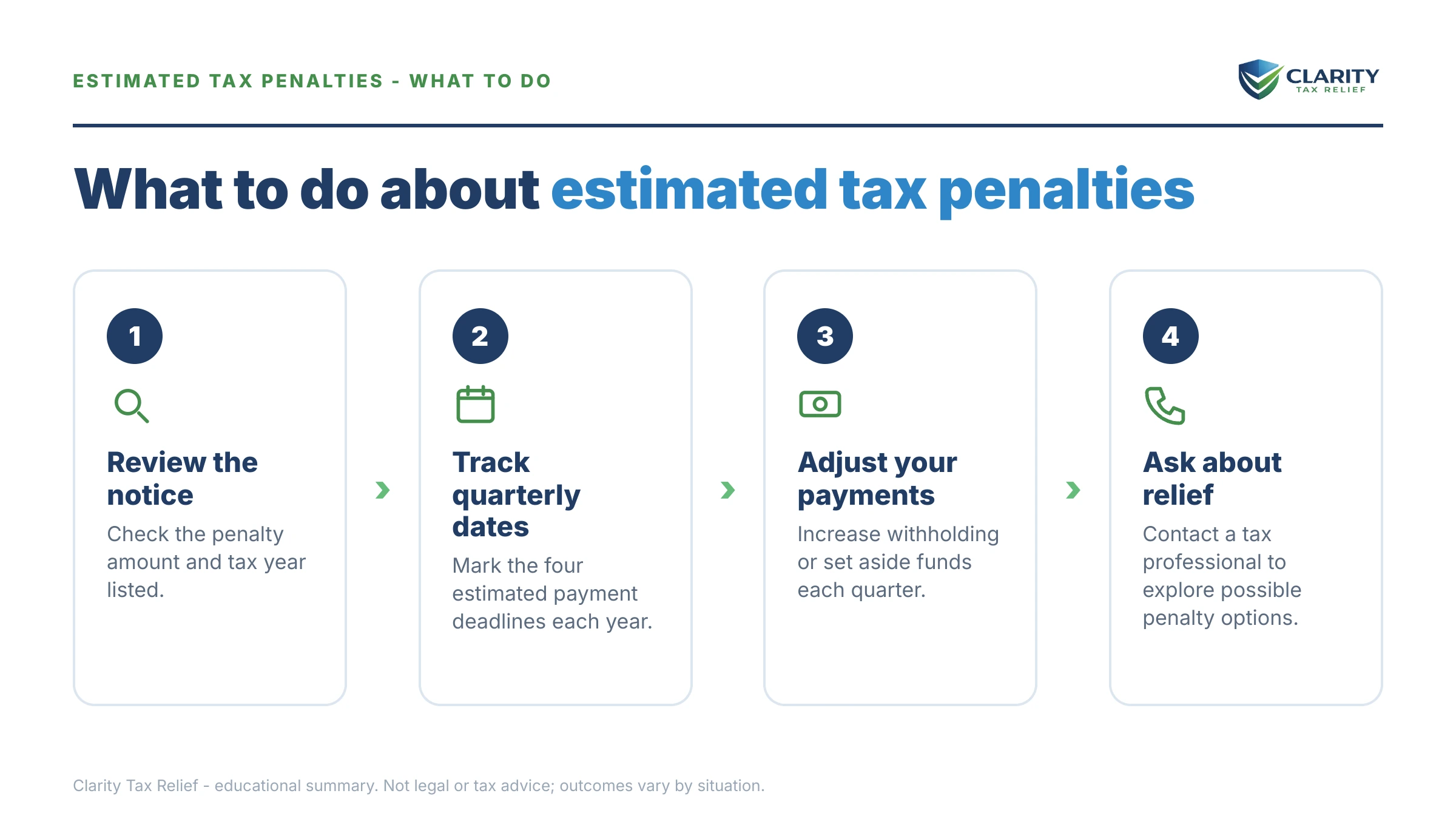
No penalty applies if you owe less than $1,000 after withholding, or if your payments during the year hit a safe harbor. The safe harbors are the entire game — the 14 million people in the statistics are, by definition, the people who missed all of them:
| Your situation | What avoids the penalty |
|---|---|
| Balance due under $1,000 after withholding | Nothing — no penalty applies |
| AGI of $150,000 or less | Pay the lesser of 90% of this year's tax or 100% of last year's tax, spread through the year |
| AGI over $150,000 | Prior-year safe harbor rises to 110% of last year's tax (90% of current year still works) |
| Married filing separately | The 110% threshold kicks in at AGI over $75,000 |
| Farmers and fishermen (two-thirds of income) | Pay 66⅔% of the current year's tax — one payment by January 15 satisfies it |
| W-2 employee with untaxed side income | Raise W-4 withholding — even a late-year increase counts as paid evenly across all four quarters |
The current year's rate mechanics, dollar figures, and quarter-by-quarter planning live in our estimated tax penalty rate 2026 guide. One state warning: if you also file in California, the FTB runs its own underpayment penalty with its own safe harbors and mandatory e-pay rules — don't assume the IRS numbers above apply. See FTB estimated tax penalty or check directly with the Franchise Tax Board before relying on a federal threshold.
How to respond to an estimated tax penalty, step by step
- Find the penalty on paper. Look at the estimated tax penalty line near the bottom of your Form 1040 (line 38 on recent forms), your CP30 notice, or your account transcript so you know the exact figure you are dealing with.
- Check the safe-harbor math. Compare your withholding and payments against 100% of last year's total tax (110% if your AGI topped $150,000) — software and the IRS both get prior-year figures wrong on amended or late-filed returns.
- Run the annualized income method if your income was uneven. If the income arrived late in the year — a December stock sale, a fourth-quarter contract — Schedule AI of Form 2210 recalculates the penalty quarter by quarter and can shrink or erase it.
- Request a waiver if you qualify. Casualty, disaster, or other unusual circumstances — or retiring after age 62 or becoming disabled with reasonable cause — are grounds for relief, requested with Form 2210 or with Form 843 after the penalty is assessed.
- Pay or arrange the full balance. The penalty rides on top of your tax debt; a payment plan stops the collection sequence while you pay it down, though interest continues to accrue until the balance is zero.
- Fix the current year today. Adjust your W-4 withholding or start quarterly payments now so next April's return does not repeat this one — most people in the penalty statistics appear there more than once.
When you can handle this yourself
A standalone estimated-tax penalty on a balance you can pay is a do-it-yourself problem. If the penalty is a few hundred dollars, the math checks out, and you can clear the balance within 180 days on a $0-setup short-term plan, pay it, adjust your W-4, and move on — no professional needed.
Experienced help changes the outcome in a narrower set of cases: the penalty sits on a multi-year balance already generating CP504 or LT11 notices; you're self-employed with several unfiled quarters and the penalties are stacking across years; the underlying tax itself is disputed; or the total debt is large enough that the resolution order — returns first, penalty relief second, balance strategy last — materially changes what you pay. In those cases the penalty is a symptom, and treating only the symptom costs more.
Terms behind the statistics, decoded
- Safe harbor — a payment level (90% of this year or 100–110% of last year) that makes you penalty-proof no matter what you owe in April.
- Underpayment rate — the federal short-term rate plus 3 points, reset quarterly; it's the price tag on each dollar of shortfall.
- Form 2210 — the form that computes the penalty, requests waivers, and houses the annualized method; most filers let software or the IRS run it unquestioned.
- Required annual payment — the safe-harbor amount Form 2210 splits into four installments; the penalty is charged on the gap between it and what you actually paid in.
- Annualized income method — a Schedule AI recalculation matching each installment to when income actually arrived, instead of assuming it came in evenly.
- CP30 — the notice the IRS sends when it calculates this penalty for you, usually by trimming your refund.
Estimated tax penalty statistics: FAQs
How many people pay the IRS estimated tax penalty?
Roughly 14 million filers were assessed an estimated-tax penalty in fiscal year 2023, according to IRS Data Book figures — up from about 12 million the year before. That makes it one of the most commonly assessed penalties in the tax system. Many of those filers never made a quarterly payment in their lives; a growing share are W-2 employees with side income, stock sales, or retirement distributions.
What is the average estimated tax penalty?
The average estimated-tax penalty was roughly $500 in fiscal year 2023 — about $7 billion assessed across roughly 14 million filers — up from an average near $150 the year before. Your own penalty depends on three inputs: the size of your quarterly shortfall, the underpayment interest rate in effect, and how long each installment went unpaid. Large shortfalls held all year can run well over $1,000.
Why did estimated tax penalties increase so much?
Because the penalty is really an interest charge, and interest rates roughly tripled. The rate is set quarterly at the federal short-term rate plus 3 percentage points — it sat at 3% in early 2022 and reached 8% by late 2023. At the same time, more 1099, gig, and investment income with no withholding pushed more filers below the safe harbor at exactly the moment each dollar of shortfall got more expensive.
Does first-time penalty abatement apply to the estimated tax penalty?
No. First-Time Abate covers failure-to-file, failure-to-pay, and failure-to-deposit penalties — the estimated-tax penalty under IRC §6654 is excluded, and the Automatic Exemption from Penalty rolling out in summer 2026 replaces FTA for those same penalties, not this one. The estimated-tax penalty has its own narrow relief: a Form 2210 waiver for casualty, disaster, or unusual circumstances, or if you retired after age 62 or became disabled and had reasonable cause.
Do W-2 employees get estimated tax penalties?
Yes — increasingly. A W-2 employee whose withholding covers the paycheck but not a stock sale, side hustle, or bonus can fall below the safe harbor and owe the penalty. The upside of being W-2: withholding is treated as paid evenly through the year, so raising your W-4 withholding even late in the year can retroactively cover earlier quarters — a fix unavailable to the self-employed.
How do I avoid the underpayment penalty?
Meet any safe harbor: owe less than $1,000 after withholding, pay 90% of the current year's tax during the year, or pay 100% of last year's tax (110% if your AGI was over $150,000, or over $75,000 married filing separately). For most people with rising income, the prior-year safe harbor is the simplest — it is a fixed number you can calculate in January and split into four payments.
What is the estimated tax penalty rate in 2026?
The rate equals the federal short-term rate plus 3 percentage points and resets every quarter, so check the current quarter before running your own math. For recent context, the rate ran at 8% through 2024 and eased to 7% in 2025. The penalty accrues daily on each quarterly shortfall from its due date until it is paid or until April 15, whichever comes first.
Is the estimated tax penalty the same as the failure-to-pay penalty?
No — they are separate charges that often stack. The estimated-tax penalty covers underpaying during the tax year, before your return is even due. The failure-to-pay penalty (0.5% per month) starts after April 15 on any balance you did not pay with the return. A filer who underpaid all year and then cannot pay in April gets hit with both, plus daily interest.
Your next 24 hours
- Find your exact number. Pull your return and read the estimated tax penalty line near the bottom of Form 1040 — or the amount on your CP30 — so you're working from the real figure, not a guess.
- Gather three documents: last year's return (for the safe-harbor comparison), this year's return, and records showing when your untaxed income actually arrived during the year.
- Get the penalty and balance reviewed free. If the penalty sits on a balance you can't pay, use the 2-minute form or call (888) 825-7779 — interest and the late-payment penalty keep accruing on the whole balance every month it goes unaddressed.
Primary sources for the figures in this guide: the IRS publishes penalty and collection data at IRS Tax Statistics (Data Book), the safe-harbor and waiver rules at About Form 2210, and the pay-as-you-go requirements at IRS estimated taxes guidance.
This guide is general information, not tax or legal advice for your specific situation. Eligibility for IRS programs depends on individual facts and circumstances; no outcome is guaranteed.