
Audit Risk & IRS Data
IRS Partnership Audit Rate in 2026: How Often Partnerships Really Get Audited
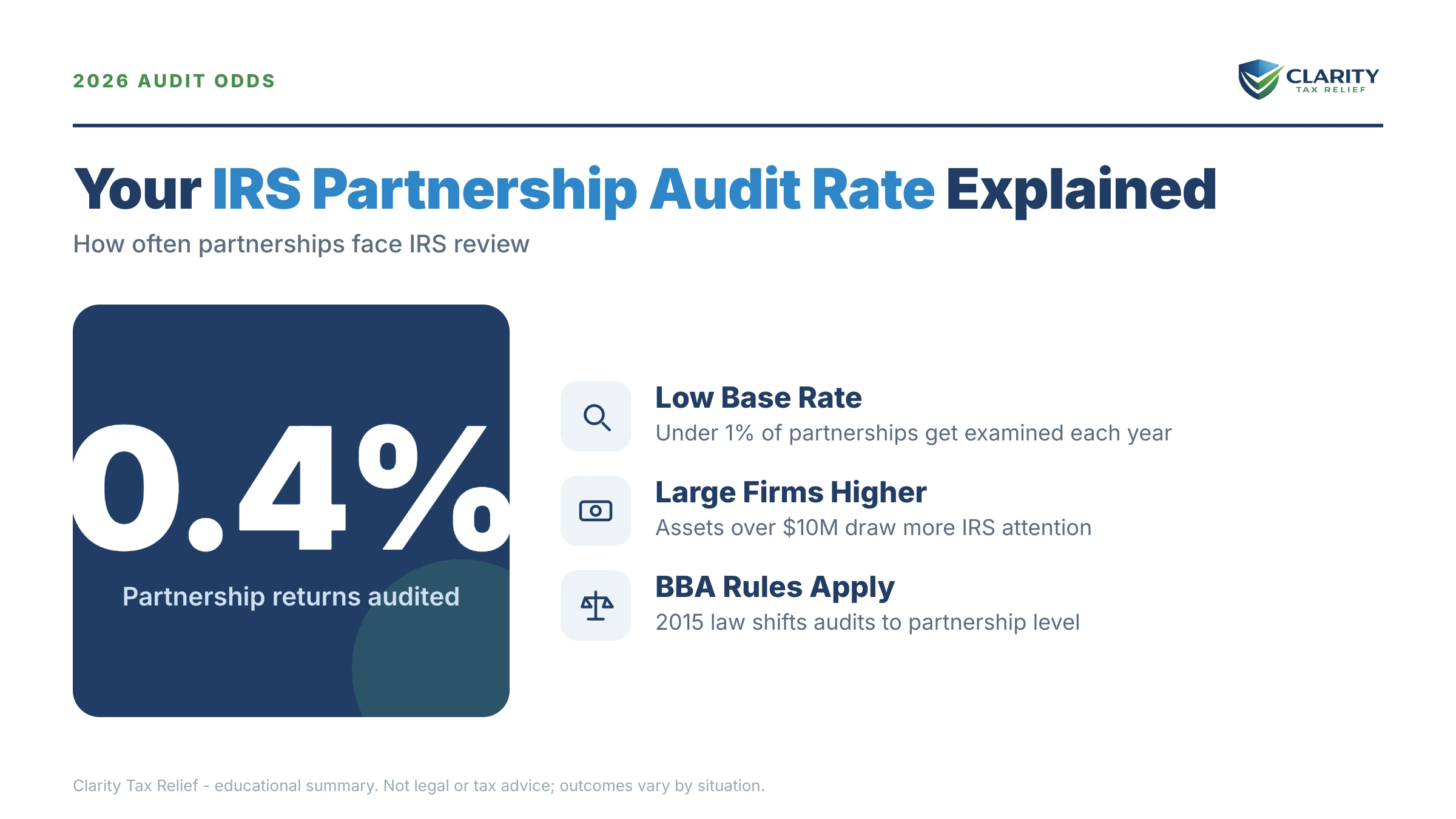
The short answer: the IRS partnership audit rate is a small fraction of 1% — among the lowest of any return type. But the raw rate is misleading: Schedule K-1 computer matching catches partner-level errors without any audit, and since 2018 the BBA regime lets the IRS assess tax against the partnership itself at the 37% top rate.
You and your spouse file jointly, you own a two-member LLC together, the Form 1065 went in months ago — and a headline about an IRS partnership crackdown just sent you searching for your actual odds. Here's the honest picture: the audit rate is genuinely tiny, the automated matching behind it is not, and the rules that apply if your partnership is picked changed completely in 2018 and can now put the bill on the entity itself.
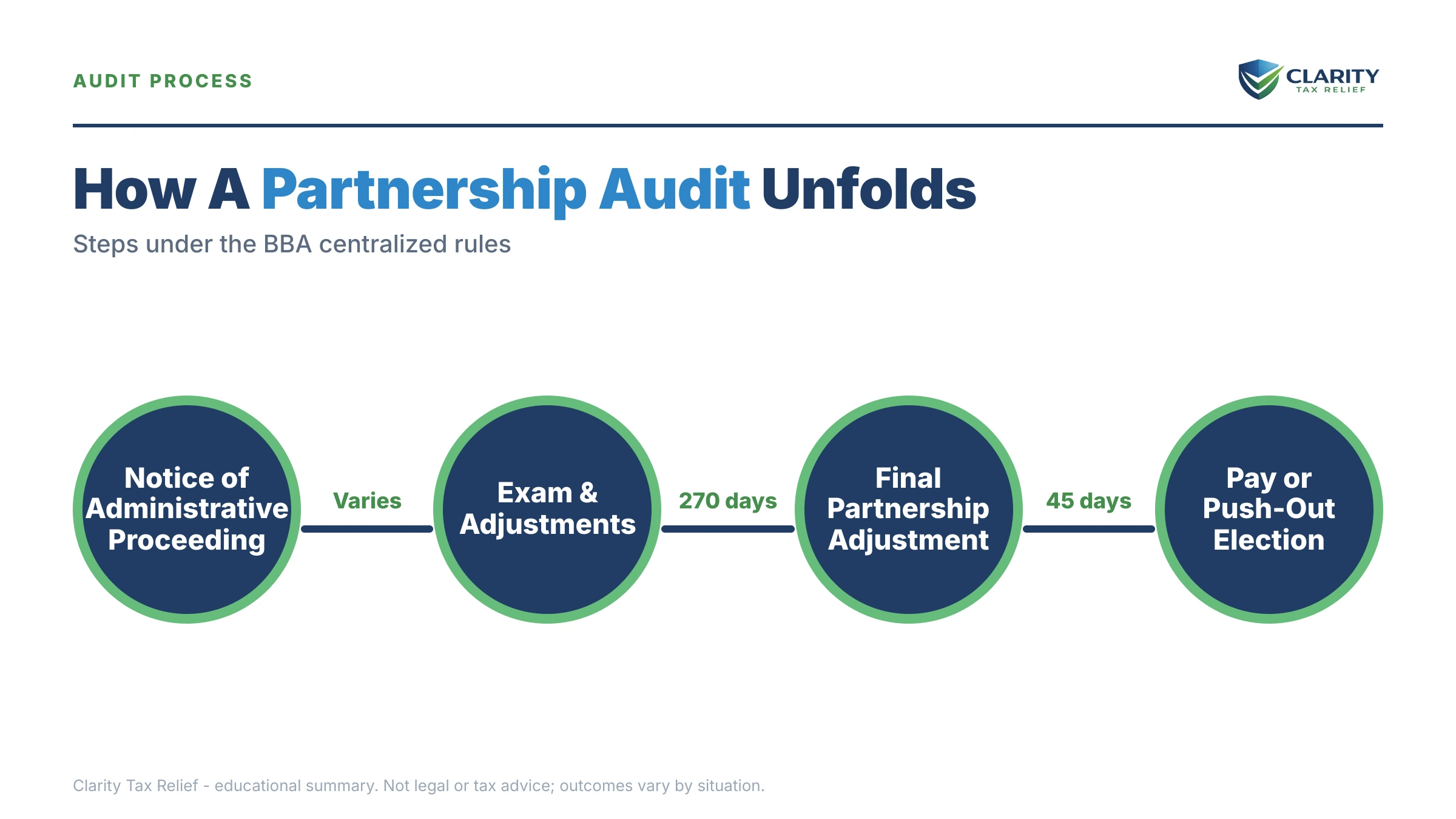
The image below maps the full BBA audit sequence stage by stage, so you can see exactly where each deadline falls and where a partnership exam is won or lost.
⏱ The clocks that matter: if your partnership has already received a Final Partnership Adjustment (FPA), two statutory clocks are running — 45 days to elect to push the adjustments out to partners, and 90 days to petition the Tax Court. If you're only weighing your odds, the running clock is interest: it accrues on any eventual adjustment from the original due date.
What the IRS partnership audit rate actually is in 2026
The IRS examines only a small fraction of 1% of the roughly four million partnership returns filed each year — for much of the past decade, coverage has been measured in tenths, and some years hundredths, of a percent. That makes Form 1065 one of the least-audited return types in the system, lower than comparable figures in our guides to the IRS corporate audit rate and the IRS audit rate by income.
The coverage that does exist is lopsided. In late 2023 the IRS announced examinations of 76 of the largest partnerships in the country — entities with billions in assets — as part of a compliance push aimed at hedge funds, real estate investment partnerships, and large law and trading firms, with selection assisted by machine-learning models. If your partnership is two people and a lawn-care truck, you were never the target of that initiative.
Then 2025 happened: the IRS workforce shrank by roughly 27%, and the specialized teams built for complex partnership exams were not spared. Face-to-face partnership audits in 2026 are, if anything, rarer than the headlines from two years ago suggested. What did not shrink is the automated side of enforcement — the computers that match K-1s and assess penalties never got laid off.
| Partnership profile | Realistic exam exposure | What actually catches errors |
|---|---|---|
| 2–4 partner family LLC or small business | Very low — full exams are rare | K-1-to-1040 computer matching; automatic late-filing penalties |
| Mid-size operating partnership (under 100 partners) | Low, rises with recurring losses or cash intensity | Document-matching, related-party flags, referral from a partner's audit |
| Large partnership ($10M+ in assets, LB&I jurisdiction) | Meaningfully higher than average | LB&I campaign selection, balance-sheet discrepancy screening |
| Largest / most complex (multi-billion, tiered structures) | Highest — explicit target of the 2023 enforcement push | AI-assisted selection, dedicated exam teams (thinner after 2025 cuts) |
Why the low partnership audit rate is misleading
A partnership can face a five-figure IRS bill without a single auditor ever opening its file. Three mechanisms do the work the audit rate doesn't show:
K-1 matching. Every Schedule K-1 the partnership files is cross-checked by computer against each partner's Form 1040. Report less than your K-1 shows — or forget a K-1 entirely — and the Automated Underreporter program generates a CP2000 notice proposing tax, penalties, and interest on your personal return. No exam. No agent. For married couples whose only "partnership exposure" is a jointly owned LLC, this is where nearly all the real risk lives.
Automatic late-filing penalties. File the Form 1065 late — even one month, even with no tax due — and the IRS assesses a per-partner, per-month penalty (currently over $200 per partner, per month, for up to 12 months) via a CP162 notice. A two-partner LLC three months late owes over $1,200 in penalties on a return that itself owed nothing.
The BBA regime raises the stakes when audits do happen. Since tax year 2018, most partnerships fall under the Bipartisan Budget Act's centralized audit rules: the IRS audits the partnership once and can assess the resulting "imputed underpayment" against the entity itself — computed at the highest individual rate, currently 37%, regardless of what rates the actual partners pay. A rare audit that lands under these defaults is far more expensive than the same adjustment would have been under the old partner-by-partner rules.
What raises a partnership's audit odds
Partnership exams are not random — a handful of return characteristics drive nearly all selections. The general list lives in our guide to IRS audit triggers; these are the ones specific to Form 1065:
- Recurring losses passed out on K-1s — especially losses that partners deduct against high W-2 or investment income year after year.
- Return-vs-information-reporting gaps — gross receipts on the 1065 that don't line up with 1099-Ks and 1099-NECs filed under the partnership's EIN.
- Related-party transactions — leases, loans, and management fees flowing between the partnership and its own partners or sibling entities.
- Capital-account problems — missing, negative, or inconsistent tax-basis capital reporting, a required disclosure the IRS screens systematically.
- Cash-intensive operations — restaurants, salons, and contractors organized as partnerships inherit all the scrutiny described in our cash business audit guide.
- Size and complexity — tiered structures where partnerships own partnerships are exactly what the IRS's AI-driven exam selection models were built to unwind.
One more path worth knowing: a partner's personal audit can boomerang. If an agent examining an individual return questions a K-1 loss, the inquiry can expand into the partnership that generated it — the same dynamic that keeps the IRS millionaire audit rate elevated flows downhill to the entities millionaires invest through.
What happens if your partnership is audited — the BBA sequence
A BBA partnership audit moves through fixed statutory stages, and ignoring any of them locks in the most expensive outcome. Here is the sequence, in order:
- Exam opening letter. The IRS notifies the partnership (through its partnership representative) that a tax year is under examination and begins issuing document requests.
- NOPPA — Notice of Proposed Partnership Adjustment. The IRS states its proposed changes and the imputed underpayment, computed at the 37% top rate. This opens a 270-day window to request modifications that lower the number.
- FPA — Final Partnership Adjustment. The IRS's final answer. Two clocks start: 45 days to make the push-out election, 90 days to petition the Tax Court.
- Assessment. If the partnership does nothing, the full imputed underpayment — plus penalties and interest — is assessed against the partnership itself, payable in the year the audit closes.
- Collection. An unpaid assessment moves into the standard IRS collection machine: balance-due notices, lien filing, and eventually levies on partnership bank accounts and receivables. Our guide to what happens when a partnership owes the IRS covers that stage.
The trap in doing nothing is structural, not just financial: silence means the current partners' entity pays tax on the reviewed year's income at the top rate — even if the partners who earned that income are long gone, and even if every actual partner sits in the 22% bracket.
| Stage | The clock | What you can still do |
|---|---|---|
| Exam opening letter | No fixed statutory clock — agent sets response dates | Designate/confirm the partnership representative; get representation in place |
| NOPPA issued | 270 days to request modification | Lower the 37% default using partners' real rates, amended partner returns, tax-exempt partners |
| FPA issued | 45 days to elect push-out; 90 days to petition Tax Court | Shift liability to reviewed-year partners, or litigate before assessment |
| Assessment & collection | Ongoing — penalties and interest accrue monthly | Payment plan, penalty relief, or other resolution against the assessed balance |
Partnership exam letter — or a K-1 mismatch notice — in hand?
Every BBA deadline that matters is statutory and unforgiving, and what your partnership representative says first binds every partner. Get the letter reviewed free before you respond — an experienced tax professional will map your exact stage and options.
Your options before, during, and after a partnership audit
A partnership's best options exist before the FPA arrives — and the single best one is elected before any audit begins. Each option below has hard eligibility lines:
| Option | Who qualifies / when | What it does |
|---|---|---|
| Elect out of BBA (annual, on Form 1065) | 100 or fewer K-1s, all issued to eligible partners (individuals, C corps, S corps, estates of deceased partners); a partnership, trust, or disregarded entity as partner disqualifies | Any audit happens at the partner level under pre-2018 rules — usually a smaller bill and each partner controls their own case |
| Modification of the imputed underpayment | Within 270 days after the NOPPA | Replaces the 37% default with partners' actual rates, amended partner returns, or tax-exempt partner status — often the biggest dollar lever in the exam |
| Push-out election (§6226) | Any BBA partnership; must elect within 45 days of the FPA | Shifts liability to the reviewed-year partners at their own rates, via Form 8986 statements; interest runs 2 percentage points above the normal underpayment rate |
| Administrative Adjustment Request (AAR, via Form 8082) | Before the IRS opens an exam on that year | The partnership corrects its own error on its own terms — BBA partnerships generally cannot simply amend a 1065, so this is the fix-it-first path |
| Appeals / Tax Court petition | Disagree with proposed findings; 90 days from the FPA to petition | Independent review before assessment — see our guide to an IRS audit appeal |
A worked example: the $23,800 difference the push-out decision can make
Say you and your spouse each hold 50% of an LLC taxed as a partnership, you file jointly in the 22% bracket, and a BBA audit of a prior year ends with a $64,300 income adjustment. Under the default rules, the IRS computes the imputed underpayment at the 37% top rate: $64,300 × 37% ≈ $23,800, assessed against the LLC itself — before a possible 20% accuracy-related penalty (another ~$4,760) and interest.
Now run the push-out election instead: the same $64,300 flows to your joint 1040 at your actual 22% rate — $64,300 × 22% ≈ $14,146. That single 45-day election saves this hypothetical couple roughly $9,650 in tax, at the cost of interest accruing two points higher than the standard rate. Modification during the 270-day NOPPA window can reach a similar result earlier. You can estimate what penalties and interest would stack on top of any adjustment with our IRS Penalty & Interest Calculator.
How to respond if your partnership is selected for audit, step by step
- Verify the letter and identify the audit type. Confirm the notice is addressed to the partnership (not you personally), note the tax year under exam, and record the revenue agent's name and contact information. Real exam letters arrive by postal mail, never by text or email.
- Confirm who your partnership representative is. Pull the Form 1065 for the year under audit and check the partnership representative designation. That person has sole authority to bind every partner — if the wrong person is named, or nobody is, fix it before responding.
- Gather the reviewed-year records. Assemble the Form 1065, every Schedule K-1, capital-account schedules, the partnership agreement and any amendments, bank statements, and the books behind the numbers the IRS is questioning.
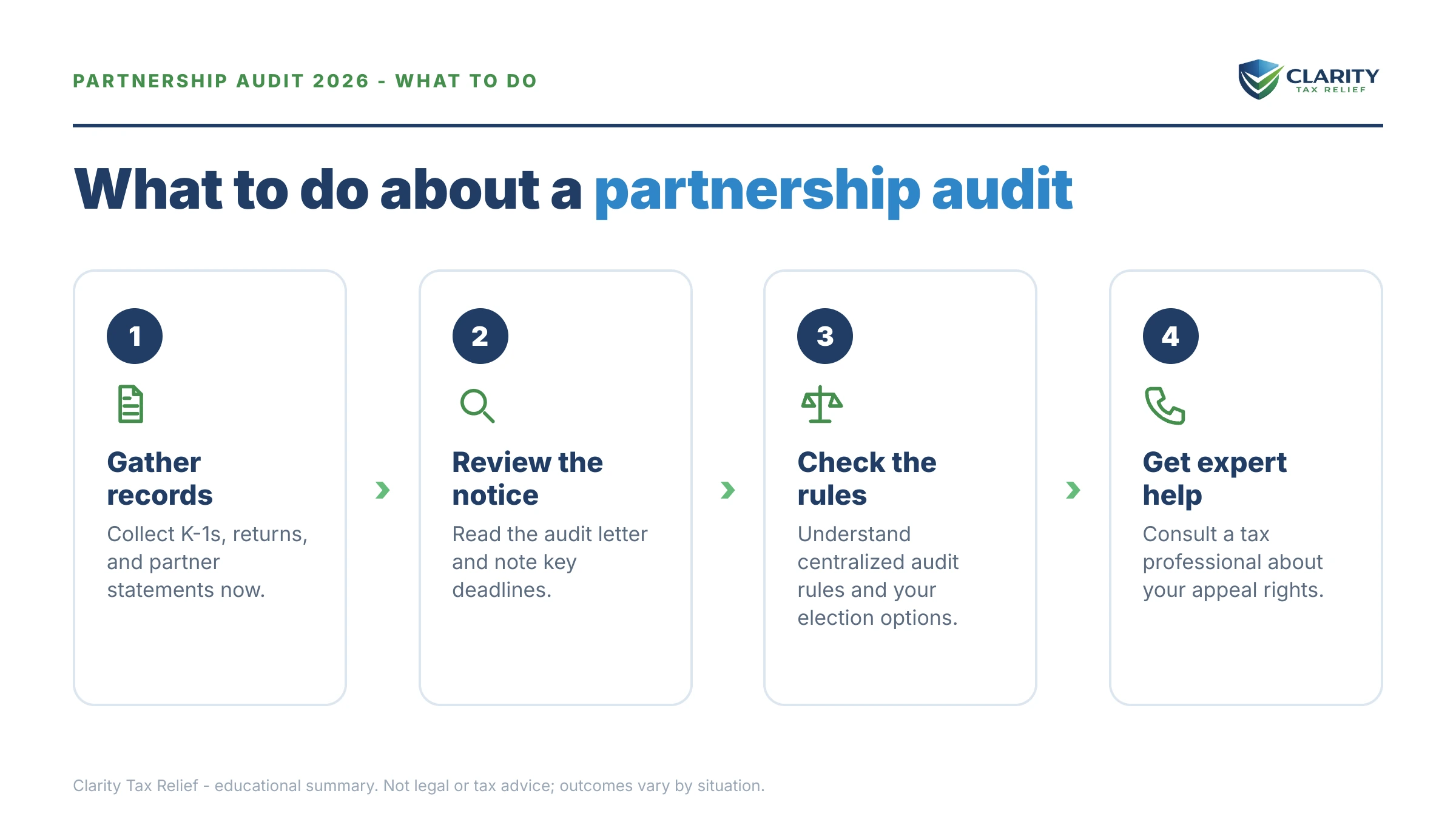
- Calendar every statutory deadline. Mark the 270-day modification window that opens with the NOPPA, and the 45-day push-out and 90-day Tax Court clocks that start with the FPA. These windows do not extend because you were busy or unrepresented.
- Run the entity-pay vs. push-out math. Compare the default imputed underpayment at the 37% top rate against what the reviewed-year partners would owe at their actual rates. For most small partnerships the difference is thousands of dollars.
- Get experienced representation before substantive answers. File Form 2848 so an experienced tax professional speaks to the agent for you. What the partnership representative concedes early in a BBA exam binds every partner permanently.
One decision that comes up in almost every partnership exam deserves its own mention: the agent will often ask the partnership to sign a statute extension. Whether to agree is strategic — our Form 872 statute extension guide walks through when signing helps you and when it only helps the IRS. For the underlying lookback rules, see how far back the IRS can audit.
When you can handle this yourself — and when experienced help changes the outcome
Most partnership "audit rate" worry resolves itself with no professional at all. You can confidently handle it yourself when:
- You're just checking exposure. Your 1065s are filed on time, your joint 1040 matches your K-1s to the dollar, and there's no letter. Your realistic exam odds are a fraction of a percent — verify your K-1 math each year and move on.
- You got a CP162 for one late 1065 with a clean filing history. A first-time abatement request — or, starting summer 2026, the IRS's new Automatic Exemption from Penalty (AEP) — often removes it without help.
- You got a CP2000 for a K-1 line you simply forgot and you agree with the IRS's number. Responding with agreement and a payment arrangement is a form-and-checkbox task.
Experienced help genuinely changes outcomes when the stakes flip: an actual exam opening letter (the 37% entity-level default punishes small mistakes in procedure), a NOPPA where modification math can cut the bill by 40% or more, a disputed adjustment heading toward the 90-day Tax Court window, multiple partners with conflicting interests, or a partnership with unfiled 1065 years stacking automatic penalties. In BBA exams, most of the money is won or lost on election timing — not on arguing facts — and that is procedure, not paperwork volume.
If a partnership exam letter is already sitting on your kitchen table, having it reviewed before you answer the revenue agent costs nothing — request a free case review or call (888) 825-7779.
Partnership audit terms, decoded
- BBA regime: the centralized audit system (Bipartisan Budget Act of 2015) that lets the IRS audit and assess a partnership at the entity level — the official rules live on the IRS's BBA Centralized Partnership Audit Regime page.
- Partnership representative (PR): the one person or entity named on the 1065 whose audit decisions legally bind every partner.
- Imputed underpayment: the audit adjustment converted to tax at the highest individual rate (37%) and charged to the partnership itself.
- NOPPA: the Notice of Proposed Partnership Adjustment — the IRS's proposed numbers, and the start of the 270-day modification window.
- FPA: the Final Partnership Adjustment — the IRS's final answer, starting the 45-day push-out and 90-day Tax Court clocks.
- Push-out election: the §6226 choice to shift audit liability from the partnership to the people who were partners in the audited year.
- AAR: an Administrative Adjustment Request — how a BBA partnership corrects its own return, since ordinary amending is generally off the table.
For the raw examination-coverage data behind the rates discussed here, the IRS publishes annual figures in its Data Book at IRS.gov/statistics. If a partnership exam is causing hardship the IRS won't address through normal channels, the independent Taxpayer Advocate Service can intervene.
IRS partnership audit rate questions, answered
What percentage of partnerships get audited by the IRS?
Historically, well under 1% — for much of the past decade the partnership audit rate has been measured in tenths, and some years hundredths, of a percent of the roughly four million Forms 1065 filed annually. Coverage is concentrated at the top: recent IRS enforcement pushes target the largest, most complex partnerships, while small family LLCs are far more likely to hear from the K-1 matching computers than from an auditor.
Does the IRS audit small partnerships and LLCs?
Rarely through a full examination — small multi-member LLCs have some of the lowest face-to-face audit odds in the tax system. Their real exposure is automated: every Schedule K-1 the partnership files is matched against each partner's Form 1040, and a mismatch generates a CP2000 underreporter notice without any auditor involved. A late or unfiled Form 1065 also triggers an automatic per-partner penalty via a CP162 notice.
What is the BBA centralized partnership audit regime?
It's the audit system that has applied to most partnerships since tax year 2018 under the Bipartisan Budget Act of 2015. Instead of auditing each partner separately, the IRS audits the partnership once and can assess an "imputed underpayment" against the partnership itself, computed at the highest individual rate — currently 37%. The partnership can shift the liability back to its partners through a push-out election, but only within 45 days of the final adjustment.
Can our partnership elect out of the BBA rules?
Yes, if it qualifies — a partnership that issues 100 or fewer Schedule K-1s, all to eligible partners (individuals, C corporations, S corporations, and estates of deceased partners), can elect out annually on a timely filed Form 1065. Having a partnership, a trust, or a disregarded entity as a partner disqualifies the election. Electing out means any audit happens at the partner level under the older rules, which often produces a smaller bill.
Who pays the tax when a partnership is audited?
Under the default BBA rules, the partnership itself pays — the imputed underpayment is assessed at the entity level in the year the audit closes, which means current partners can bear tax on income earned when someone else owned the interest. The partnership can instead elect, within 45 days of the Final Partnership Adjustment, to push the adjustments out to the people who were partners in the audited year, who then pay at their own rates plus interest at two percentage points above the normal underpayment rate.
What triggers an IRS partnership audit?
Large or recurring losses passed out on K-1s, big discrepancies between the return and information reporting, related-party transactions, missing or inconsistent capital-account reporting, and cash-intensive operations all raise selection odds. Since 2023 the IRS has also used AI-assisted scoring to pick large, complex partnerships for exam. For small partnerships, the most common trigger is mundane: a partner reporting K-1 numbers that don't match what the partnership filed.
How far back can the IRS audit a partnership return?
Generally three years from the later of the date the Form 1065 was filed or its due date. The window extends to six years for substantial understatements of income and has no limit for fraud or a return that was never filed. The IRS often asks partnerships under exam to sign a statute extension; whether to sign is a strategic decision, not automatic.
Does a partnership audit mean my personal return gets audited too?
Not automatically — under the BBA regime the exam happens at the partnership level, and most partners never deal with the IRS directly during it. But the results reach you: if the partnership pushes out adjustments, you'll receive a Form 8986 and owe additional tax on your own return, and an auditor who spots personal-return issues while examining the partnership can open a separate individual exam.
What is a partnership representative and why does it matter?
The partnership representative (PR) is the single person or entity designated on Form 1065 with sole authority to deal with the IRS in a BBA audit — their decisions bind every partner, and partners have no legal right to notice or participation. If you didn't name one, the IRS can pick one for you. Reviewing who your PR is, before any audit letter arrives, is one of the cheapest protective moves a partnership can make.
Your next 24 hours
- Pull the partnership's last Form 1065 and your own K-1s and check two boxes: who is named as partnership representative, and whether the K-1 amounts match what went on your joint 1040. Those two lines cover most real-world partnership risk.
- Gather the core file — the last three years of 1065s and K-1s, the partnership agreement, and any IRS letter (exam, CP162, or CP2000) the partnership or either spouse has received.
- Get a free case review. If any IRS letter is in the picture, have an experienced tax professional map your stage and deadlines before you respond — the statutory windows in a BBA exam don't reopen, and penalties and interest accrue on any balance while you wait. Start at the 2-minute form or call (888) 825-7779.
This guide is general information, not tax or legal advice for your specific situation. Eligibility for IRS programs depends on individual facts and circumstances; no outcome is guaranteed.