
IRS Audits & Data
IRS Corporate Audit Rate in 2026: The Real Numbers by Company Size
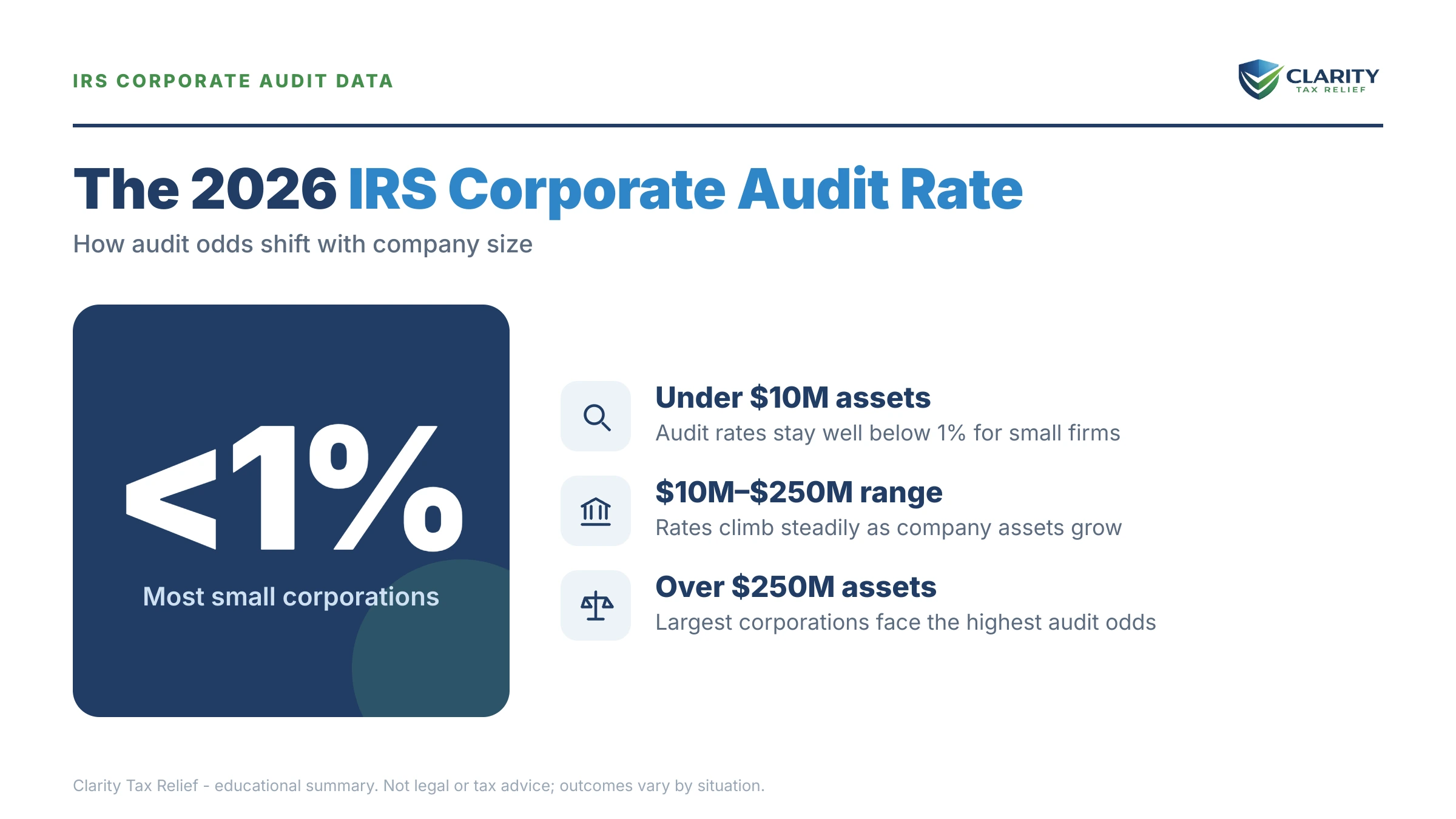
The short answer: the IRS corporate audit rate depends almost entirely on size. Small C corporations — assets under $10 million — are examined at well under 1%. The IRS set a 22.6% audit-rate target for corporations with assets over $250 million for tax year 2026, though 2025 staffing cuts put that target in doubt.
Maybe you still run the small S corporation you built before retirement, or you just filed your company's first 1120 and a friend warned you that incorporating "puts a target on your back." You searched for the IRS corporate audit rate because you want a real number, not a rumor. Here it is: for a company your size, the odds are lower than almost anyone guesses — and the handful of things that actually raise them are specific and avoidable.
The image below shows how these audit rates compare at a glance — from the smallest 1120 filers to the corporations the IRS examines almost continuously — and it's worth a look before you worry about your own return.
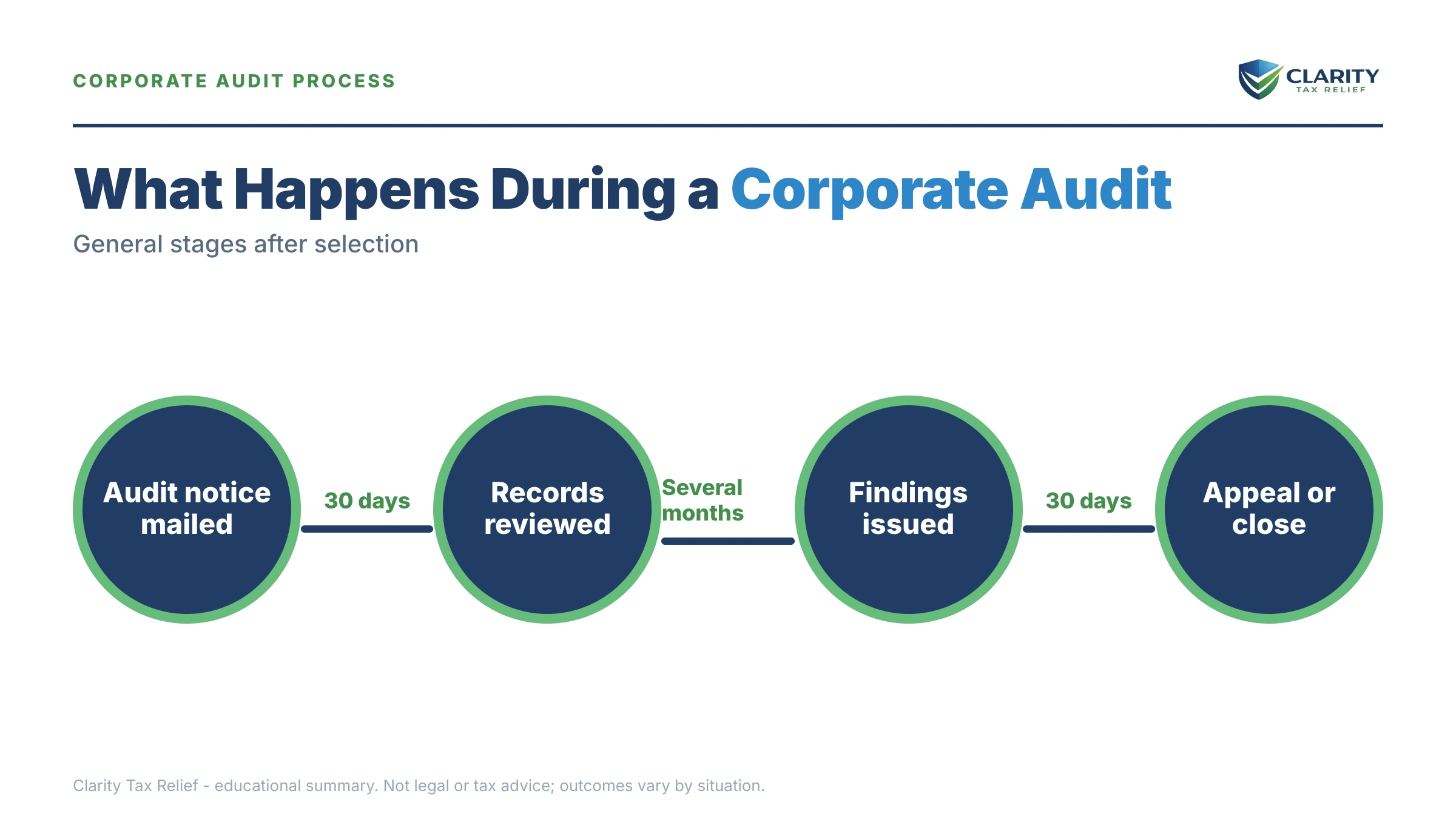
⏱ Is there a clock? If you're only researching odds, no. If an audit letter has already arrived, the date printed on it controls everything: an exam report typically gives you 30 days to respond or protest, and a Notice of Deficiency gives you 90 days from the date on the notice — not the date you receive it — to petition Tax Court (150 days if the notice is addressed to you outside the U.S.).
The IRS corporate audit rate in 2026, by the numbers
Small corporations with assets under $10 million have been audited at well under 1% in recent years, while the IRS announced a target rate of 22.6% for corporations with assets over $250 million for tax year 2026. That gap — roughly a hundredfold — is the single most important fact about corporate audit odds: the IRS concentrates its exam resources where the dollars are.
Those targets came out of the IRS's 2024 enforcement plan, which promised to nearly triple large-corporate exam coverage (up from 8.8% for tax year 2019), raise the audit rate on large partnerships with over $10 million in assets to 1% (from 0.1%), and hold audit rates flat for taxpayers earning under $400,000. Then 2025 happened: the IRS workforce shrank roughly 27%, and the seasoned revenue agents who handle complex corporate exams were among the hardest positions to replace. Whether the announced targets survive is an open question — but the automated selection systems that flag small-business returns kept running without interruption.
| Entity / size | Audit rate | What it means for you |
|---|---|---|
| C corporations, assets under $10M | Well under 1% (a fraction of returns in a typical recent year) | Handled by the Small Business/Self-Employed division; most exams are narrow, single-issue, and often by mail |
| C corporations, assets $10M–$250M | Low but meaningfully higher than small corps | Falls under LB&I jurisdiction; exams are field audits with a revenue agent, not correspondence |
| C corporations, assets over $250M | 22.6% target for tax year 2026 (announced 2024; up from 8.8% in 2019) | The centerpiece of the IRS's enforcement plan — though 2025 staffing cuts make the target uncertain |
| Largest corporations (multi-billion asset) | Highest of any group; many under near-continuous review | Some participate in the Compliance Assurance Process (CAP), resolving issues before filing |
| S corporations (Form 1120-S) | Well under 1% historically | Adjustments flow through to shareholders' 1040s — the exam is corporate, the bill is personal |
| Partnerships, assets over $10M | 1% target for tax year 2026 (up from 0.1%) | See our IRS partnership audit rate guide for the BBA regime that changes who pays |
One caution when you see audit rates quoted anywhere: the IRS reports them with a lag, and rates for recent tax years keep rising as the IRS opens exams within the three-year assessment window. A "0.2% audit rate" for a fresh tax year is a floor, not a final number.
If you're comparing your business odds against your personal return, the pattern is the same on the individual side — coverage climbs steeply with income, as our breakdown of the IRS audit rate by income shows.
Why company size decides your audit odds
The IRS splits corporate exams between two divisions at a hard line: $10 million in assets. Below it, your return sits with the Small Business/Self-Employed division alongside tens of millions of other filers; above it, the Large Business and International division (LB&I) takes over with teams built for complex, multi-year field exams.
The economics drive everything. A large-corporate exam can recover millions per agent-year; a small 1120 exam might recover a few thousand. When headcount is scarce — and after 2025 it is scarcer than at any point in decades — the IRS spends its human hours upmarket and lets computers police the rest.
That's why "the rest" matters to you. Small-corporation returns are scored by the Discriminant Inventory Function (DIF) system, which compares every line of your return against statistical norms for businesses like yours. High-scoring returns get pulled for human review. Nobody at the IRS decided to look at you; an algorithm did — which means your real audit risk isn't the published rate, it's how far your return sits from normal.
What actually triggers a small-corporation audit
Most corporate audit selections come from math, not suspicion: mismatched information returns and statistical outliers account for the bulk of small-business exams. The specific patterns that raise a small corporation's score include:
- Gross receipts below your paper trail. The IRS matches your 1120 or 1120-S against 1099-K and 1099-NEC filings under your EIN. Reporting less than the forms show is the closest thing to a guaranteed flag.
- Officer compensation at the extremes. An S corp owner taking a token salary while pulling large distributions (avoiding payroll tax), or a C corp paying an outsized salary to strip out profit — both are classic exam issues.
- Recurring losses. A corporation that loses money year after year while the owner keeps living invites the question of where the money really comes from.
- Related-party transactions. Shareholder loans with no notes or repayment, rent paid to yourself at odd rates, family on payroll with no duties.
- Balance sheets that don't reconcile. Schedule L figures that jump between years without explanation are a quiet but potent scoring factor.
- Heavy cash. Restaurants, salons, contractors, and other cash-intensive operations face structurally higher scrutiny — our cash business audit guide covers how those exams reconstruct income.
For the full list of what raises exam odds — and what's myth — see IRS audit triggers and the owner-specific small business audit red flags.
Did the 2025 IRS layoffs lower corporate audit rates?
The 2025 workforce reduction cut IRS staffing by roughly 27%, and complex corporate field exams almost certainly declined with it. Experienced revenue agents take years to train, and the enforcement plan that promised 22.6% large-corporate coverage was written for an agency that no longer exists in that form.
But here is the part that matters for a small corporation: your audit risk was never driven by people. Document matching, DIF scoring, automated underreporter notices, and computer-generated exam letters run regardless of headcount. And the three-year assessment statute means a return filed today can be selected in 2027 or 2028, by whatever IRS exists then. Filing aggressively because the agency looks weakened is a bet with a multi-year tail — we walk through why in IRS layoffs: will I still get audited.
What happens if you ignore a corporate audit letter
An ignored audit doesn't go away — it defaults, and a defaulted audit means the IRS's numbers become your bill. The sequence runs in a fixed order, and each stage closes a door the previous one held open:
- Opening letter (Letter 566 or 2205-A). The exam begins. The letter names the years and issues and prints a response or appointment date. Silence here doesn't pause anything.
- Exam report (Letter 915 / Letter 950). With no response, the agent disallows the questioned items — often all of them — and proposes the tax, usually with a 20% accuracy-related penalty attached. You have roughly 30 days to protest to IRS Appeals for free.
- Notice of Deficiency. Miss the protest window and the statutory notice arrives — the 90-day letter and Tax Court petition window is your last chance to dispute the tax before paying it.
- Assessment and the first bill. No petition means the tax is assessed. Corporations get a CP161 notice; pass-through owners see the adjustment billed on their personal account (often via CP22E). Failure-to-pay penalties and daily-compounding interest start here.
- Collection escalates. Unpaid bills move to intent-to-levy notices (CP504B for businesses), then a final notice (CP297 or LT11) that starts a 30-day Collection Due Process clock. After that, the IRS can levy bank accounts and receivables — and if the bill sits on your personal account, garnish wages or take up to 15% of Social Security benefits through the Federal Payment Levy Program.
Notice what the sequence really costs: at stage 2 the dispute is free, at stage 3 it requires a court filing, and by stage 5 the argument is over and only payment terms remain.
Holding an audit letter or an exam report you disagree with?
The response date printed on it is the clock — appeal rights expire with it. Send us the letter and an experienced tax professional will map exactly where you stand and what your strongest move is. Free, confidential, no pressure.
| Stage / notice | Response window | What you lose if it passes |
|---|---|---|
| Letter 566 / 2205-A (exam opens) | Date printed on the letter | The chance to shape the exam — silence means every questioned item defaults against you |
| Letter 915 / 950 (exam report, "30-day letter") | Typically 30 days | Free review by IRS Appeals without going to court |
| Notice of Deficiency (CP3219A / Letter 531) | 90 days (statutory — cannot be extended) | The right to dispute the tax in Tax Court before paying it |
| Assessment + CP161 (or CP14/CP22E for pass-through owners) | Pay-by date printed on the notice | Penalty-free payoff — failure-to-pay penalties and compounding interest accrue from here |
| CP504B (intent to levy) | Date printed on the notice | Your state tax refund becomes seizable under IRC §6331(d) |
| CP297 / LT11 (final notice) | 30 days | Collection Due Process hearing rights (Form 12153) — after this, levies can issue |
Your options if the audit ends in a bill
An audit assessment is resolved the same way any IRS balance is — but the order matters, because appeal and abatement rights expire while payment options don't. Here is the full menu, with who qualifies:
| Option | Who qualifies | Cost and notes |
|---|---|---|
| Appeal (protest the 30-day letter) | Anyone, before assessment, within the window on the exam report | Free; Form 12203 works for smaller disputes. Appeals settles many cases based on hazards of litigation |
| Audit reconsideration | After assessment, if you have information the exam never considered | Free; no deadline, but collection continues while it's reviewed |
| Pay in full | Anyone | Stops the 0.5%/month failure-to-pay penalty and interest immediately |
| Guaranteed installment agreement | Individuals owing $10,000 or less (common when a pass-through adjustment lands on your 1040) | Paid within 3 years; approval is automatic if you're filing-compliant. Interest and penalties continue |
| Streamlined installment agreement | Individuals owing $50,000 or less | Up to 72 months, set up online, no financial disclosure. Interest and penalties continue |
| Business payment plan | Operating corporations with smaller balances (generally $25,000 or less for online setup) | Larger corporate balances require financial statements and often a revenue officer |
| Penalty abatement | Clean 3-year compliance history (first time penalty abatement) or reasonable cause | Free to request; removes penalties, not tax. Starting summer 2026, the Automatic Exemption from Penalty (AEP) applies qualifying relief with no request needed |
| Currently Not Collectible | Income covers only necessary living expenses — common on fixed incomes | Free; pauses collection but the debt and interest remain |
| Offer in Compromise | Only when assets plus future income genuinely can't cover the balance; rare for operating businesses | $205 fee (waived with low-income certification); the IRS accepted roughly 1 in 5 offers in FY2024 — never a quick fix |
The shared background on how these programs work — and the assessment statutes behind exam selection — lives in our hub on how far back the IRS can audit: generally 3 years, 6 years if more than 25% of gross income was omitted, and no limit for fraud or unfiled returns. One exam-specific wrinkle: agents near the statute deadline often ask you to sign Form 872 extending it. Whether to sign is a genuine strategic decision — refusing can force a rushed assessment, agreeing gives the IRS more runway.
A worked example: a $7,400 audit adjustment on a retiree's S corporation
Say you're retired, drawing Social Security, and you still run a small S corporation for part-time consulting. A correspondence exam disallows $29,600 of deductions — home office, vehicle, and travel with thin documentation — and at your roughly 25% combined marginal rate, the pass-through adjustment adds $7,400 in tax to your personal return. This is a hypothetical, but the math is how these cases actually run:
- The penalty question comes first. If the 20% accuracy related penalty applies, that's another $1,480 — total $8,880 before interest. Documentation showing a reasonable basis for the deductions can knock the penalty out entirely at Appeals, which is why the 30-day window is worth more than any payment plan.
- If the tax stands and you can't pay at once: $8,880 is under the $10,000 guaranteed installment agreement line. Spread over the maximum 36 months, that's about $247/month before interest — call it roughly $260 once accrual is added. Estimate your own figures with our Penalty & Interest Calculator.
- If Social Security is most of your income: the IRS's own expense standards may show you can't pay $260/month without hardship. Currently Not Collectible status exists for exactly this — see IRS hardship social security — and it also blocks the 15% Federal Payment Levy Program bite that unresolved balances can eventually trigger on benefit checks.
Notice the ordering: fight the penalty first (a $1,480 swing), then pick the payment structure. Reversing that order forfeits money for nothing.
How to respond to a corporate audit letter, step by step
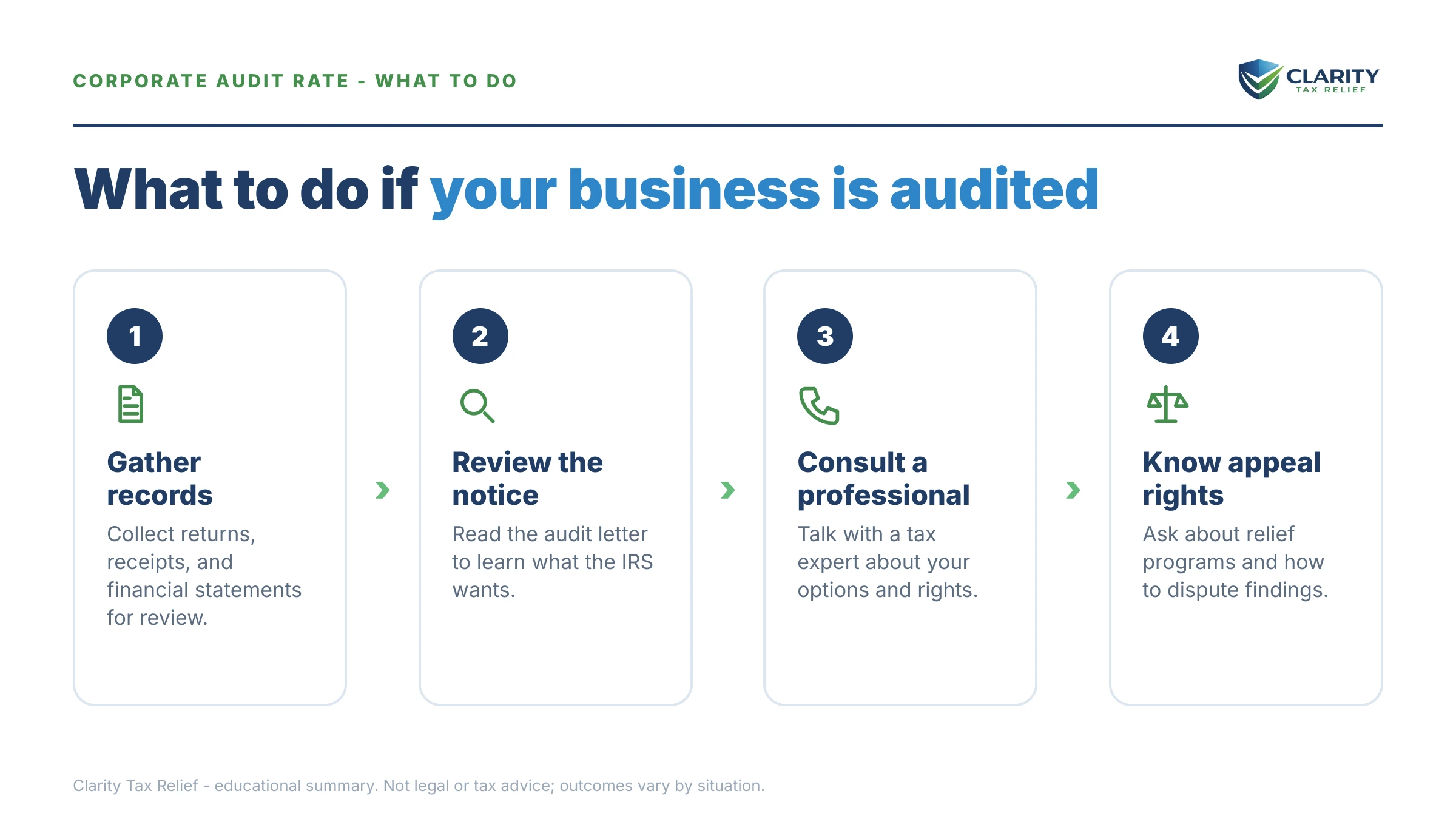
- Verify the letter is real. Genuine audit letters arrive by postal mail with a letter number in the corner (566, 2205-A, 915, 950). Confirm the exam exists through your IRS business or individual online account before sending anyone anything.
- Calendar the response date. The date printed on the letter controls every right you have from here. Write it down, then work backward — gathering records always takes longer than expected.
- Pull only what was asked for. Organize records by the specific issues and years listed in the letter. Never volunteer extra years, extra accounts, or extra explanations — you can expand an audit by accident.
- Decide on the statute before signing anything. If the agent asks you to sign Form 872 extending the assessment deadline, get advice first. Extending can buy goodwill or simply give the IRS more time — the right answer depends on your facts.
- Respond in writing by the deadline. Send organized documentation with a short cover letter, keep copies of everything, and use certified mail. If you disagree with an exam report, file a protest within the 30-day window instead of letting it default.
When you can handle this yourself — and when help changes the outcome
Many corporate audits are genuinely self-manageable. If yours is a single-issue correspondence exam, your records are clean, and the questioned amount is small, an organized response by the printed date usually closes it. The same goes for a proposed adjustment you agree with and can pay, or a straightforward payment plan on a balance under the streamlined thresholds — none of that requires paying anyone.
Experienced help earns its cost in specific situations: a field exam at your place of business (where agents interview you and tour the operation), multiple years or multiple entities under exam at once, a cash-intensive business facing income reconstruction, any hint of criminal exposure underneath the civil exam, disputed penalties worth four figures or more, and every deadline-driven stage — the 30-day protest and the 90-day Tax Court window — where a missed date is unrecoverable. In those cases, representation isn't about hiding anything; it's about controlling scope, sequencing the penalty fight before the payment talk, and never letting a right expire by accident.
If a field audit or a multi-year exam is what you're facing, it costs nothing to have an experienced tax professional look at the letter first — request a free review or call (888) 825-7779.
Terms in corporate audit statistics and letters, decoded
- DIF score — the computer score the IRS assigns every return, measuring how far it deviates from statistical norms; high scores drive most small-business exam selections.
- LB&I — the Large Business and International division, which examines corporations with $10 million or more in assets; smaller companies fall under the Small Business/Self-Employed division.
- 30-day letter — the exam report (Letter 915 or 950) proposing changes; the 30 days is your window to protest to IRS Appeals for free.
- Notice of Deficiency — the "90-day letter" that legally proposes the tax; petitioning Tax Court within 90 days is the only way to dispute it before paying.
- Form 872 — the consent that extends the IRS's assessment deadline; agents request it when an exam runs close to the 3-year statute.
- CAP — the Compliance Assurance Process, a pre-filing program where the largest corporations resolve issues with the IRS before the return is even filed.
IRS corporate audit rate questions, answered
What is the current IRS corporate audit rate?
For most corporations, well under 1%. Small C corporations with assets under $10 million have been examined at a fraction of 1% in recent years, and S corporation rates have run similarly low. The exception is size: the IRS announced a 22.6% audit-rate target for corporations with assets over $250 million for tax year 2026, and the very largest corporations face near-continuous review.
What percentage of small businesses get audited?
A fraction of 1% in a typical recent year, whether the business files as a C corporation, S corporation, or partnership. Sole proprietors filing Schedule C have historically faced somewhat higher odds because unreported cash and inflated deductions are easier to slip into a 1040. Low odds are not zero odds — returns with mismatched 1099s, recurring losses, or outlier deductions are selected far more often than the averages suggest.
Are S corporations audited more than C corporations?
No — S corporations have historically been among the least-audited return types, with exam rates well under 1%. The catch is that S corporation adjustments flow through to shareholders, so an 1120-S exam usually ends as a bill on your personal 1040. The IRS also watches specific S corp issues closely, especially owners who take an unreasonably low salary to avoid payroll tax.
Did the 2025 IRS layoffs reduce corporate audit rates?
They almost certainly reduced complex field exams — the IRS workforce shrank roughly 27% in 2025, and experienced revenue agents were hit hard. But small-corporation audits lean heavily on automation: document matching, DIF scoring, and computer-generated notices never stopped. Filing aggressively because you expect the IRS to be too short-staffed to notice is a bet against software, not people, and the assessment statute gives the IRS years to catch up.
How far back can the IRS audit a corporation?
Generally three years from the date the return was filed. That extends to six years if the return omitted more than 25% of gross income, and there is no time limit at all for a fraudulent return or a year with no return filed. During an exam, agents often ask you to sign Form 872 to extend the statute — get advice before signing, because that decision changes your leverage.
What triggers an IRS audit of a small corporation?
Most selections are math, not humans: gross receipts that don't match 1099-K and 1099 filings, deductions far outside industry norms, and recurring losses year after year. Entity-specific triggers include officer compensation (too low on an S corp, suspiciously high on a C corp), related-party loans that look like disguised distributions, and balance-sheet figures on Schedule L that don't reconcile from one year to the next. Cash-intensive businesses draw extra scrutiny at every size.
Will a corporate audit affect my personal taxes?
If the company is an S corporation or partnership, almost always — adjustments pass through to the owners' individual returns, so the final bill lands on your 1040. A C corporation's tax is generally its own, but exams frequently spill over into the owner's return through officer compensation, constructive dividends, or personal use of company assets. Expect the agent to look at both returns when one owner controls the company.
What happens if a corporate audit ends with tax due?
You get an exam report first, with roughly 30 days to accept it or protest to IRS Appeals — a free review that resolves many cases. If you don't respond, a Notice of Deficiency starts a 90-day window to petition Tax Court before the tax is assessed. After assessment, collection notices begin, and your options shift to payment plans, penalty abatement, hardship status, or — in narrow cases — an Offer in Compromise.
Does incorporating lower my audit risk?
Historically, small corporations and S corporations have been examined less often than sole proprietors filing Schedule C, so the odds do tend to drop. But incorporating solely to dodge audits is a bad trade: you take on payroll filings, reasonable-salary rules, and corporate formalities that create their own exam issues if handled sloppily. Choose your entity for business reasons and keep clean records — that combination lowers risk more than any structure.
Your next 24 hours
- Check what you're actually holding. If an IRS letter arrived, find the letter number in the top corner and the response date printed on it — those two facts determine everything. If you're only researching, pull your last three corporate returns and note anything an algorithm would flag: recurring losses, big year-over-year swings, round-number deductions.
- Gather the paper. The audited-year return (or your most recent one), business bank statements, and the records behind your largest deduction categories. Organized records are the difference between a closed exam and an expanded one.
- Get a free case review. If a letter has a date on it, that printed deadline is the real clock; if not, the only thing accruing is risk on a return you can still tighten up. Either way, an experienced tax professional can tell you in one call whether you have a problem — start with the 2-minute form or call (888) 825-7779.
Primary sources: the IRS publishes its official examination statistics in the annual IRS Data Book; payment options for any resulting balance are at IRS.gov/payments; and if an exam or collection action is causing hardship the IRS won't address, the independent Taxpayer Advocate Service can intervene.
This guide is general information, not tax or legal advice for your specific situation. Eligibility for IRS programs depends on individual facts and circumstances; no outcome is guaranteed.