
IRS Data & Enforcement
IRS Millionaire Audit Rate in 2026: What the Numbers Really Show
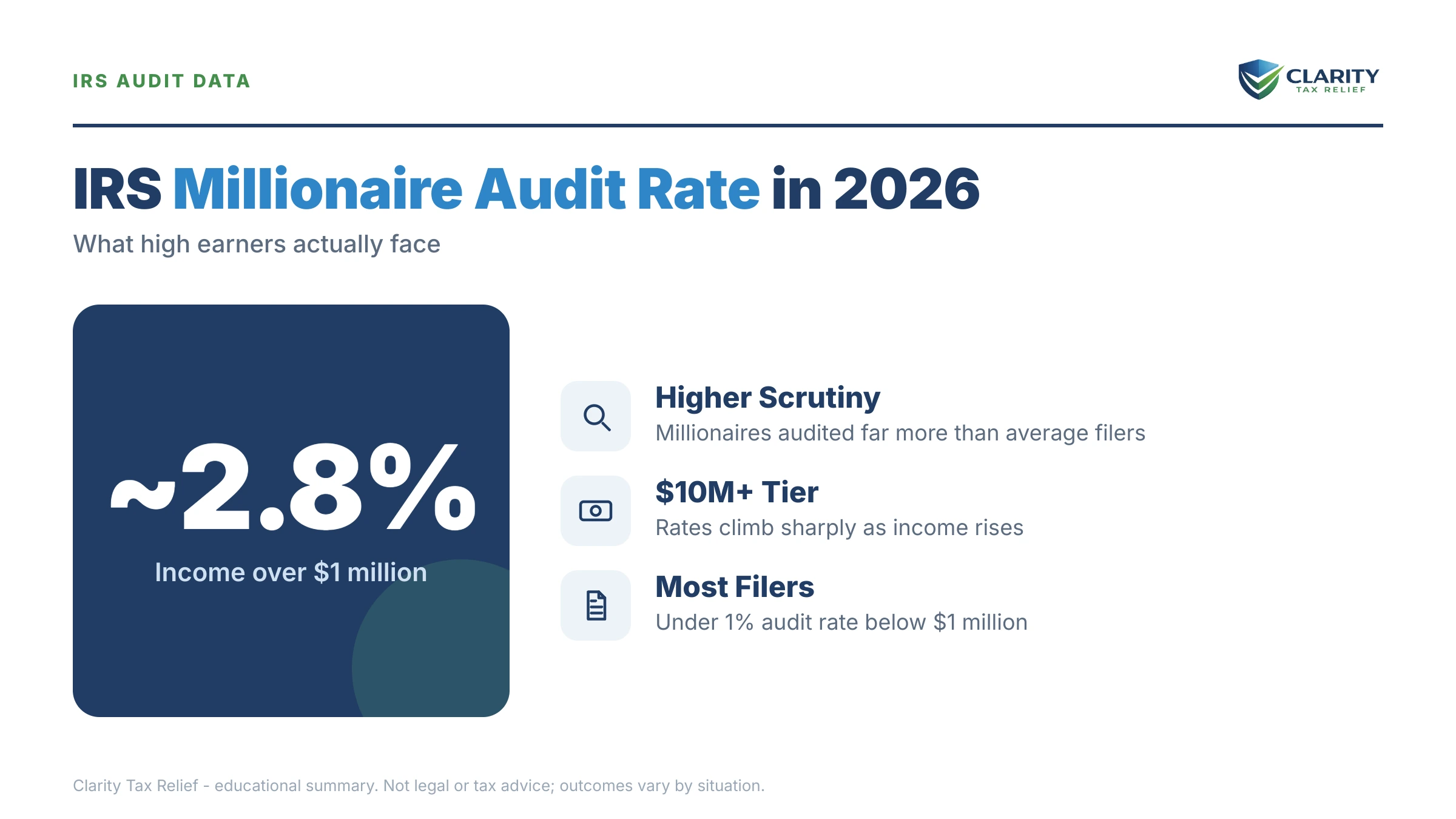
The short answer: the IRS millionaire audit rate fell from roughly 7% in 2011 to under 1% by 2019, according to the Government Accountability Office. A funded 2024 enforcement push aimed to reverse that — targeting a 16.5% audit rate on incomes above $10 million by tax year 2026 — but 2025's roughly 27% workforce cut has stalled the rebuild.
Maybe you're here out of curiosity. Or maybe you're here the harder way: you owe about $16,400, a levy warning just landed in your mailbox, and the headline on your phone says millionaires face audit odds under one in a hundred. The unfairness stings — but it won't slow the automated system reaching for your account.
This guide covers both halves honestly: what the millionaire audit rate actually is in 2026, why it collapsed, what the enforcement push did and didn't fix — and why none of it protects you from collections, plus exactly what will.
⏱ The clock that actually matters: audit statistics carry no deadline — but a final notice of intent to levy does. If an LT11 or Letter 1058 is in your mail, you have 30 days from its date to request a Collection Due Process hearing before the IRS can levy your wages or bank account.
What the IRS millionaire audit rate actually is in 2026
The audit rate for returns reporting $1 million or more in income fell from roughly 7% in 2011 to under 1% by 2019, per the Government Accountability Office. That single decade of decline is the reason this statistic became a national story — millionaires went from a nearly one-in-fourteen chance of examination to odds most people would happily accept at a casino.
One caution before any number sticks: audit rates are counted by tax year, and high-income exams open years after filing. The rate for a recent tax year keeps climbing as new audits open, so the freshest figures always understate what final coverage will be. The IRS publishes the official counts annually in its Data Book.
What 2026 adds to the story is a collision of two forces. The 2022 enforcement funding produced formal targets — most notably, a 16.5% audit rate on taxpayers with total positive income above $10 million by tax year 2026, up from roughly 11% for 2019. Then the 2025 workforce reduction of roughly 27% removed a large share of the people who were supposed to hit that target. Announced ambition and delivered staffing are now pointing in opposite directions.
For context on how millionaires compare with every other bracket, see the full IRS audit rate by income breakdown — and if you're really asking about your own exposure, start with your real odds of being audited.
Why audit rates for millionaires collapsed
A millionaire's return can take an experienced revenue agent hundreds of hours to examine; a correspondence audit of an ordinary return costs the IRS almost nothing. That cost asymmetry, not any policy memo, is what gutted high-income coverage when budgets shrank through the 2010s.
High-income returns aren't just bigger — they're structurally different. Income flows through partnerships, S corporations, trusts, and sometimes offshore entities, each with its own return to trace. When senior revenue agents retired and weren't replaced, the IRS lost the only people qualified to work those cases. The cheap, automated exams stayed; the expensive human ones vanished.
The same dynamic explains why the IRS partnership audit rate sits near zero even as partnership income exploded, and why the IRS corporate audit rate for the largest companies fell alongside it. Wealth increasingly lives in pass-through structures — exactly the returns the shrunken IRS was least equipped to open.
There's also a quieter reason: high-income audits get fought. Millionaires hire representation, contest adjustments, and appeal. An agency measuring itself on closed cases learns to prefer audits nobody fights — which for years meant mail audits of low-income credits instead.
The 2024 enforcement push — and what the 2025 layoffs undid
In 2024 the IRS announced it had collected more than $1 billion in past-due tax from high-wealth taxpayers — people with high incomes and large assessed debts who simply hadn't paid. Notably, that milestone came from collections, not audits: the debts were already on the books, so results arrived fast once someone was assigned to pursue them.
The same period brought a campaign against wealthy people who stopped filing entirely — the IRS announced pursuit of well over 100,000 high income non filer cases dating back to 2017, tens of thousands of them involving incomes above $1 million. Alongside it came the audit targets for the $10 million-plus tier and a Treasury pledge that audit rates for households earning under $400,000 would not rise above historical levels.
Then came 2025. A roughly 27% workforce reduction hit the agency, and the specialized examiners hired for the high-wealth push were among the newest employees — the most exposed in any cutback. Open exams continue, but the trajectory toward those 2026 targets has visibly bent. Our guide to whether you'll still get audited after the IRS layoffs covers what the cuts changed case by case.
Here is the part that matters most if you owe: the layoffs cut people, not software. Document matching, notice generation, lien filings, and levies are automated. The human-intensive work — millionaire audits — slowed. The machine-driven work aimed at everyone else never paused.
Millionaires vs. everyone else: two different enforcement machines
The IRS examines millionaires with people and collects from everyone else with software — and the two systems run at completely different speeds. Understanding which machine you're in explains almost everything about how your case will move.
| Taxpayer profile | Typical IRS action | Who — or what — runs it |
|---|---|---|
| Income above $10 million | Field audit of the full return, often multiple years and related entities | Senior revenue agents; the centerpiece of the post-2024 rebuild, now short-staffed |
| Income $1M–$10M | Field or office exam; coverage fell under 1% in recent complete years | Revenue agents — the scarcest resource the IRS has |
| W-2 and middle income | CP2000 document-matching notice; occasional mail audit | Automated underreporter systems — unaffected by staffing |
| EITC claimants | Pre-refund correspondence audit by mail | Automated selection filters (see the IRS EITC audit rate) |
| Anyone with an assessed balance | Escalating notice sequence ending in lien and levy | The Automated Collection System — runs regardless of headcount |
Notice what that last row means. If you owe $16,400, your case doesn't compete with millionaire audits for scarce agents. It sits in a computer queue that escalates on schedule. What lands you in an audit in the first place is a separate question — covered in our guide to IRS audit triggers — but a balance due needs no trigger at all.
What happens if you ignore your own balance while the audit debate rages
An assessed balance moves from first bill to levy authority through an automated notice sequence — no auditor, no human judgment, no discretion required. The stages run in a fixed order:
- CP14 — the first bill. Typically about 21 days to pay before the sequence advances. No enforcement yet.
- CP501 / CP503 — reminder notices. Still just bills, but interest and the monthly late-payment penalty keep compounding the balance.
- CP504 — intent to levy your state tax refund under IRC §6331(d). Serious, but not yet the final notice.
- LT11 / Letter 1058 — the final notice. A 30-day clock starts on your Collection Due Process rights. This is the last stage where you hold formal leverage.
- Levy — a bank levy freezes funds with a 21-day hold before the money leaves (details in our IRS bank levy 21 days guide); a wage levy is continuous until released.
If a wage levy is what you're bracing for, you can estimate how much of each paycheck the IRS could reach with our IRS Wage Garnishment Calculator — for most workers, the exempt amount is far smaller than people expect.
And a balance that's ignored doesn't just sit there. Let one grow past $66,000 — the 2026 threshold — and passport certification enters the picture too. The system's whole design is that waiting always costs more than acting.
Reading about millionaire audits while holding a levy notice?
The IRS can take years to audit a millionaire — its computer can reach your paycheck or bank account in weeks. If a CP504, LT11, or Letter 1058 is sitting on your table, get it reviewed free before the 30-day window on a final notice closes. An experienced tax professional will tell you exactly where your case sits in the sequence and which options are still open.
Your options if you owe the IRS: eligibility at a glance
Every IRS resolution program is means-tested — eligibility turns on your balance, your filing compliance, and what the IRS's own math says you can pay. Here's how the options line up for a balance in the $16,400 range:
| Option | Basic eligibility | What disqualifies or limits you |
|---|---|---|
| Short-term payment plan | Can pay in full within 180 days; $0 setup fee | A balance you genuinely can't clear in six months |
| Guaranteed installment agreement | Balance of $10,000 or less | A $16,400 balance is over the limit — the streamlined tier applies instead |
| Streamlined installment agreement | Up to $25,000 online without full financial disclosure (up to $50,000 with direct debit), spread over up to 72 months | Unfiled returns must be filed first; a defaulted prior agreement complicates approval |
| Currently Not Collectible status | Paying anything would leave you unable to cover basic living expenses, shown on Form 433-F | Disposable income or assets the IRS's standards say you could tap |
| Offer in Compromise | The IRS's collection math shows less than the full balance is realistically collectible | Equity or income that covers the debt; missing filings; roughly 1 in 5 offers accepted in FY2024 |
| Penalty relief (FTA / AEP) | Clean compliance for the prior 3 years; a new Automatic Exemption from Penalty begins rolling out in summer 2026 | Penalties inside the prior 3-year window (for first time penalty abatement) |
What each option costs and how long it takes
Cost and speed differ as much as eligibility does — and the cheapest option to set up isn't always the cheapest to live with, because interest and penalties keep accruing on every path except full payment.
| Option | Upfront cost | Timeline & ongoing cost |
|---|---|---|
| Short-term plan (180 days) | $0 setup | Set up online the same day; interest and the 0.5%/month late-pay penalty run until paid |
| Streamlined installment agreement | Setup fee applies — lower online, reduced or reimbursed for low-income taxpayers | Up to 72 months; interest continues, and the late-pay penalty rate is cut in half while the agreement stays current |
| Currently Not Collectible | $0 | Weeks to document and request; the balance still grows, and the IRS reviews your income periodically |
| Offer in Compromise | $205 application fee plus 20% down on lump-sum offers — both waived with low-income certification (AGI at or below 250% of the poverty level) | Commonly months to over a year for a decision; auto-accepted if the IRS doesn't decide within 2 years |
| Penalty abatement | $0 | Often resolved in a single call or letter; interest charged on the abated penalty comes off too |
A worked example: $16,400, a rented apartment, and a levy warning
Say you owe $16,400, you rent, and a CP504 just arrived. Here's the actual arithmetic behind each door — all numbers hypothetical:
Streamlined installment agreement: $16,400 ÷ 72 months ≈ $228/month minimum. Interest and the late-pay penalty continue on the shrinking balance — at 0.5%/month the penalty starts around $82/month, dropping by half once the agreement is active — so paying more than the minimum saves real money. Your balance is under $25,000, so you can set this up online with no financial disclosure at all.
Offer in Compromise: being a renter matters here, because you have no home equity for the IRS to count. Suppose you hold $900 in savings and, after the IRS's allowable living expense standards, have $120/month left over. A lump-sum offer values future income at 12 months: $900 + ($120 × 12) = $2,340 as your approximate reasonable collection potential. An offer near that figure may be viable — but only if the IRS's numbers match yours, and it accepted roughly 1 in 5 offers in FY2024. At that income level, low-income certification would also waive the $205 fee and the 20% down payment.
Currently Not Collectible: if that $120/month cushion doesn't really exist — if rent, food, and transport consume everything — CNC pauses levies entirely while the debt sits. It grows with interest, but the 10-year collection statute keeps running in the background.
The honest takeaway: for most people with $16,400, steady income, and no assets, the streamlined agreement is the fast, self-service fix. The offer route only beats it when your finances genuinely show the IRS can't collect in full.
How to respond, step by step
- Identify the exact notice you received. Find the notice number in the top or bottom corner — CP504, LT11, and Letter 1058 carry very different powers, and only the final notices start the 30-day levy clock.
- Pull your IRS account transcript. Log into your IRS online account and confirm the balance, tax years, and whether penalties and interest match the letter before you commit to any plan.
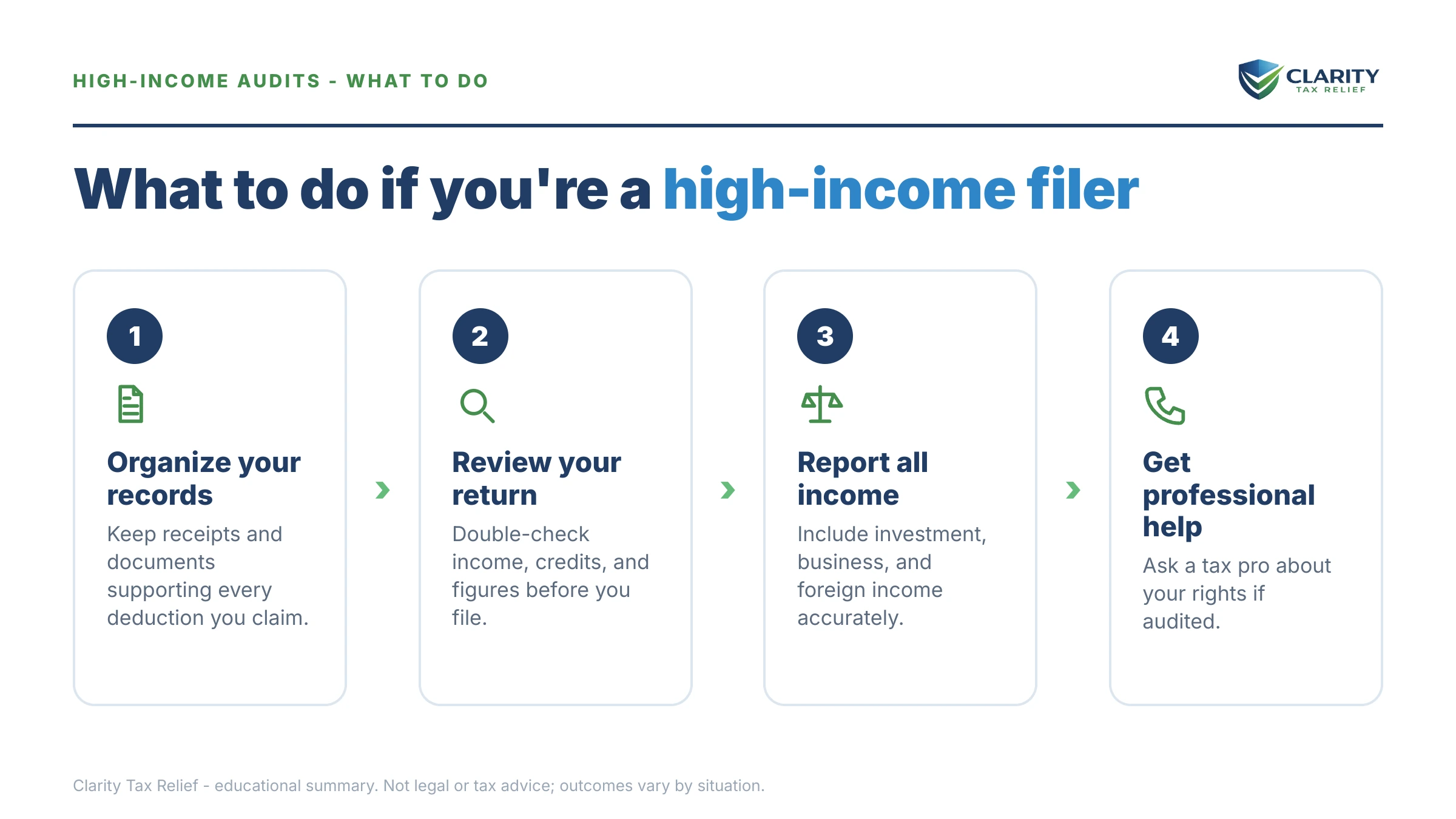
- Protect your appeal rights if it's a final notice. If you received an LT11 or Letter 1058, file Form 12153 within 30 days to request a Collection Due Process hearing — this pauses the levy while a settlement officer reviews alternatives.
- Set up a resolution before the deadline. Choose the option that fits your finances — a payment plan, Currently Not Collectible status, or an Offer in Compromise — and get it submitted; a pending arrangement is what stops enforcement.
- Request penalty relief. If your prior three years are clean, ask for first-time penalty abatement — and from summer 2026, the IRS's Automatic Exemption from Penalty applies some relief with no request at all.
Payment plans can be set up directly at the IRS payment plans page — no middleman required for the simple cases.
When you can handle this yourself — and when help changes the outcome
Most people with a five-figure balance and current filings can resolve it without paying anyone. If you agree with the amount, your returns are filed, and your balance fits the streamlined tier — as $16,400 does — the online agreement takes about twenty minutes and no professional adds much value. The same goes for a first notice you can pay within 180 days, or a straightforward penalty-abatement call.
Experienced help changes outcomes in a narrower set of situations: a final notice already issued with the 30-day clock running, a levy in motion against your bank or wages, multiple unfiled years that must be filed before any program opens, offer-in-compromise math where allowable-expense judgment calls swing the number by thousands, or business and payroll debt where personal liability is on the table. In those cases, the sequencing — what gets filed, requested, and appealed in what order — is the whole game.
If money is the barrier, know that free help exists too: the Taxpayer Advocate Service assists when IRS actions cause hardship, at no cost.
Terms in the audit-rate headlines, decoded
- Total positive income (TPI) — the IRS's income measure for audit statistics: all positive income items added up, losses ignored.
- Field audit vs. correspondence audit — a field audit is an in-person exam by a revenue agent; a correspondence audit is a letter asking you to mail in proof.
- Revenue agent vs. revenue officer — agents audit returns; officers collect assessed debts. Different jobs, different letters, different risks to you.
- No-change rate — the share of audits that end with zero adjustment; high no-change rates mean the IRS is picking the wrong returns.
- ACS (Automated Collection System) — the computer-driven pipeline that issues balance-due notices, liens, and levies without a human caseworker.
- CDP (Collection Due Process) — the formal appeal right triggered by a final levy notice; requested on Form 12153 within 30 days.
One glossary note that surprises people: an audit reaching back several years is normal for high-income cases — the assessment windows are explained in our guide to how far back the IRS can audit. The official coverage statistics behind everything on this page are published annually in the IRS Data Book at IRS.gov/statistics.
If you're staring at a levy notice rather than a statistics debate, skip the research spiral — have an experienced tax professional review your notice free and map your options before the automated sequence advances.
IRS millionaire audit rate: your questions, answered
What percentage of millionaires get audited by the IRS?
In recent complete data years, well under 2% of returns reporting $1 million or more in income were audited — down from roughly 7% in 2011, according to the Government Accountability Office. The IRS announced plans to raise coverage for the wealthiest filers, targeting a 16.5% audit rate on total positive income above $10 million by tax year 2026, though 2025 staffing cuts have put that target in doubt.
Did the IRS really collect $1 billion from millionaires?
Yes. In 2024 the IRS announced it had recovered more than $1 billion in past-due tax from high-wealth taxpayers — a campaign focused on people with high income and large assessed balances who simply hadn't paid. That was collections work on debts already on the books, not new audits, which is why it moved faster than the audit rebuild itself.
Why did the millionaire audit rate drop so much?
Budget cuts through the 2010s pushed out the experienced revenue agents these exams require. A millionaire's return — with partnerships, S corporations, trusts, and sometimes offshore accounts — can take hundreds of agent hours to examine, while a correspondence audit of an ordinary return costs almost nothing. When staffing fell, the expensive exams were the first to disappear.
Does the IRS audit poor people more than millionaires?
On raw odds, some years came close: Earned Income Tax Credit claimants have historically faced audit rates comparable to — and in some years above — several upper-income bands, because EITC audits are cheap automated letters sent before refunds go out. Millionaire audits are expensive field exams, so far fewer happen. Our guide to the IRS EITC audit rate covers those numbers in depth.
Will the 2025 IRS layoffs stop audits of millionaires?
They slow them; they don't stop them. Exams already open continue, and the roughly 27% workforce reduction in 2025 hit the human-driven audit rebuild hardest. What the layoffs did not touch is automation: document matching, collection notices, liens, and levies are issued by systems that keep running at full speed regardless of headcount.
What is the IRS $400,000 audit pledge?
It's a Treasury directive that the IRS will not raise audit rates above historical levels for households earning under $400,000 a year. The new enforcement money was aimed at high-income individuals, large partnerships, and corporations. The pledge covers audit selection only — it does not limit collection activity like levies on balances you already owe.
If millionaires barely get audited, why is the IRS levying me over $16,400?
Because audits and collections are two different machines. An audit questions whether your return is accurate; a levy collects a balance that's already assessed and final. Your $16,400 sits in the Automated Collection System, which escalates by computer — no auditor, no discretion, no staffing shortage. The fix is to get into a payment plan, hardship status, or an offer before the levy executes.
Does a low audit rate mean the IRS won't notice unreported income?
No. The IRS matches every W-2, 1099, and other information return against your filed return automatically, and a mismatch generates a CP2000 underreporter notice without any human audit. Audit rates measure formal examinations — the matching program touches essentially every return and is unaffected by staffing levels.
How long does a millionaire audit take?
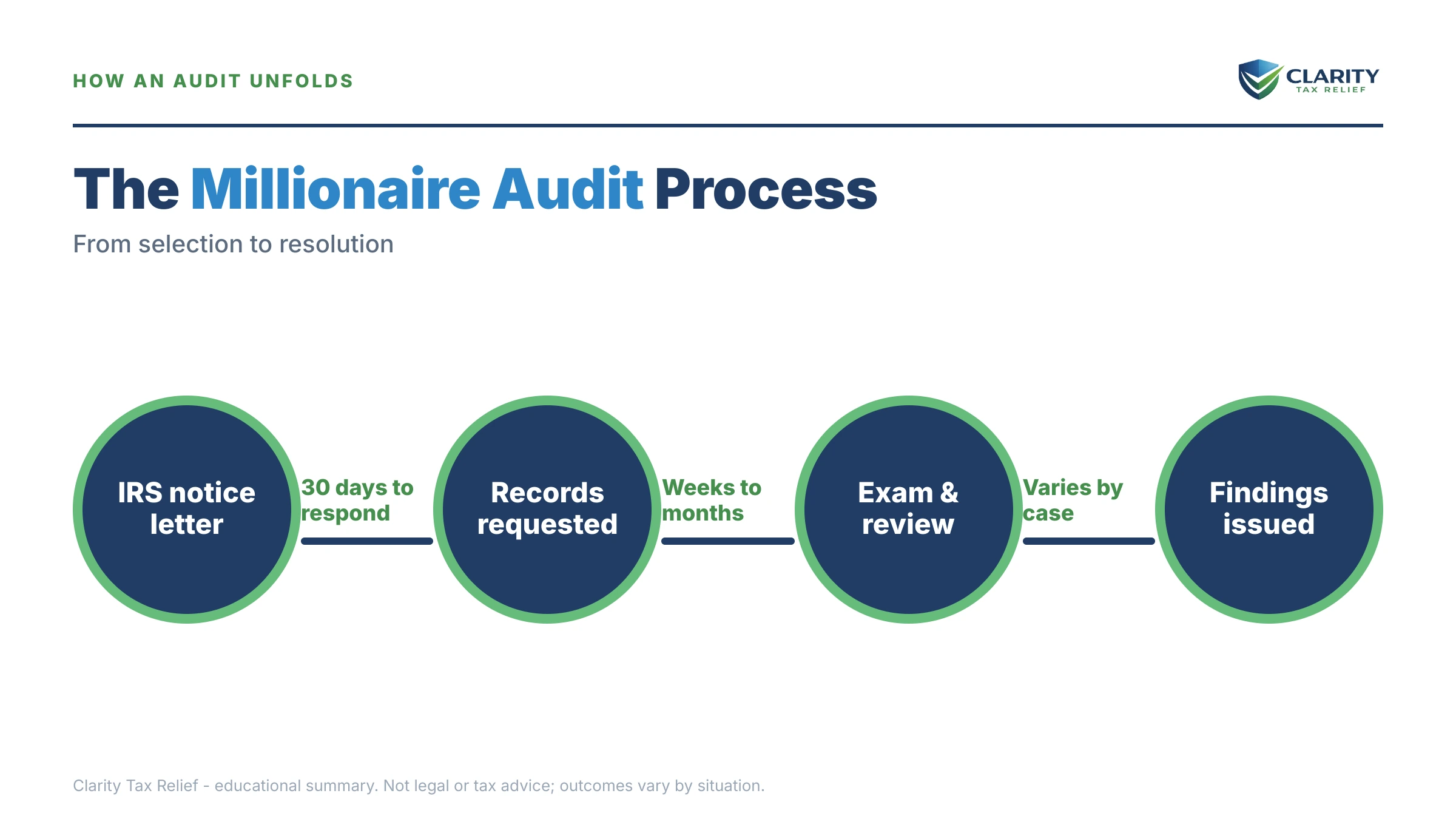
High-income exams are usually field audits run by a revenue agent and commonly stretch a year or longer, often expanding to multiple tax years and related entities. The standard assessment window gives the IRS three years from filing, extended to six for substantial understatements — which is why these audits open long after the return was filed.
Your next 24 hours
- Find your notice number and date. It's printed in the corner of the letter — that one code tells you whether you're weeks from a levy or holding a routine bill, and whether a 30-day CDP clock is running.
- Gather three things: your last filed tax return, the notice itself, and a recent pay stub or income summary. That's everything needed to size up every option on this page.
- Get a free case review. Call (888) 825-7779 or use the 2-minute form — an experienced tax professional will read your notice, confirm where you sit in the collection sequence, and map the cheapest path out while interest and penalties are still small.
This guide is general information, not tax or legal advice for your specific situation. Eligibility for IRS programs depends on individual facts and circumstances; no outcome is guaranteed.