
IRS Business Notices
IRS CP210 Notice: What the Business Adjustment Means and What to Do (2026)
The short answer: a CP210 notice means the IRS changed your business tax return or account for a specific period — and the result is a balance due, a refund, or no change at all. Check the notice summary for the amount and the pay-by date; you can pay, arrange payments, or dispute the change.
The envelope isn't addressed to you — it's addressed to a business, maybe one you closed when you retired, and it announces that the IRS "made changes" to a tax period you thought was long settled. That's disorienting, but it's also decodable: a CP210 always tells you exactly which form it touched, which period, and what the change did.
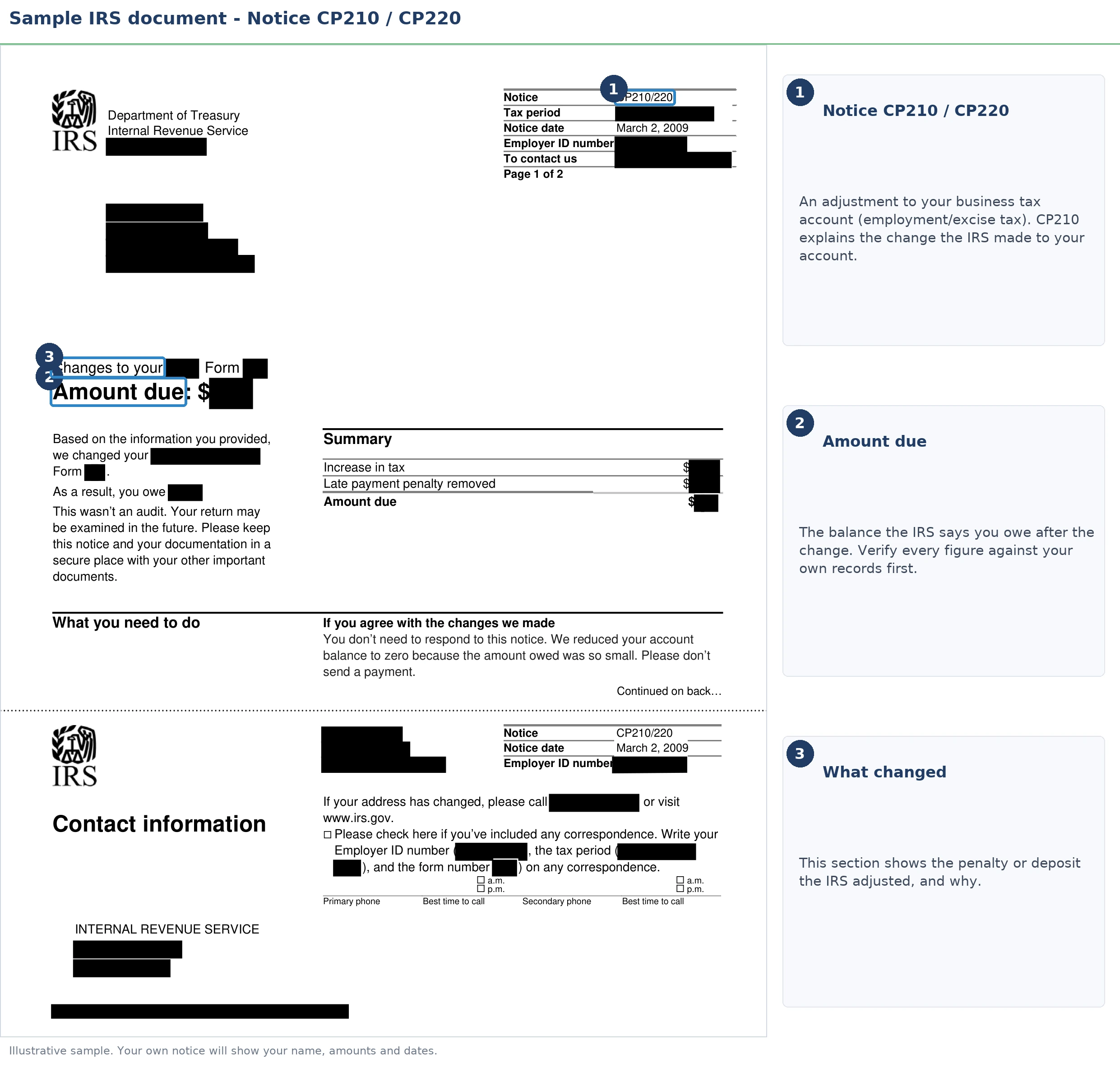
Unlike most IRS mail, a CP210 has three possible outcomes — you owe more, you're owed a refund, or the numbers moved but netted to zero. Everything you should do next depends on which of the three is printed in your summary box. The image below shows exactly what a CP210 looks like and where to find the three numbers that control your next move: the form adjusted, the tax period ending, and the pay-by date.
⏱ Your deadline: the "pay by" date printed on your CP210. If the notice shows a balance due, interest accrues on it every day and the late-payment penalty adds 0.5% of the unpaid tax each month until you pay or set up an arrangement — the balance on the notice is the smallest it will ever be.
Why you got a CP210 notice
A CP210 is issued when the IRS adjusts a business tax account — it is tied to your EIN, not your Social Security number. If you got a "we changed your return" letter on your personal 1040 instead, you're looking at a CP11 notice (balance due) or CP12 notice (refund) — different notices, different articles.
The most common triggers behind a CP210 in 2026:
- Payroll return corrections. The IRS reconciled your Form 941 or 940 against the federal tax deposits actually received and found a mismatch — a deposit applied to the wrong quarter, a missing deposit, or a math correction.
- Employee Retention Credit adjustments. The IRS reduced or reversed an ERC claim on a 941 quarter. This is a huge share of current CP210 volume; if the adjusted quarter matches an ERC claim, see our guide to ERC recapture.
- Your own amended return posting. If you filed a Form 941-X or an amended 1120/1065, the CP210 is often just the IRS confirming it processed the change — which is why some CP210s show a refund.
- Penalty changes. A penalty was added, recalculated, or removed on the account. (A standalone civil penalty assessment usually arrives as a CP215 notice instead.)
Note what a CP210 is not: it is not an audit letter, and it is not the same as a CP161 notice, which bills a balance from the return you filed without changing it. A CP210 means the IRS's number is now different from yours. Its close cousin, the CP220 notice, announces the same kind of change but typically follows a closer review of the account. For the general map of how IRS letters work, see why did I get a letter from the IRS — this page stays focused on what's unique to the CP210.
The three outcomes a CP210 can show
Every CP210 resolves to one of three results, and each demands a different response.
Balance due. The IRS's change increased what the account owes. The notice shows the adjusted tax, any penalties, interest, and a total with a pay-by date. This is the version the rest of this guide focuses on, because it's the one that escalates if ignored.
Refund. The change went in your favor — often after a 941-X posted or a penalty was reversed. Verify the amount, then watch for it: refunds on business accounts are frequently applied to other periods with balances rather than mailed out. Keep the notice with your permanent records; it's your proof of what changed if the IRS later revisits the period.
No change to the balance. The IRS moved figures around — reclassified a deposit, corrected a line — but the net is zero. Read it anyway and confirm the adjusted figures match your records, because a "harmless" reclassification this year can create a mismatch on a future return.
What happens if you ignore a CP210 balance
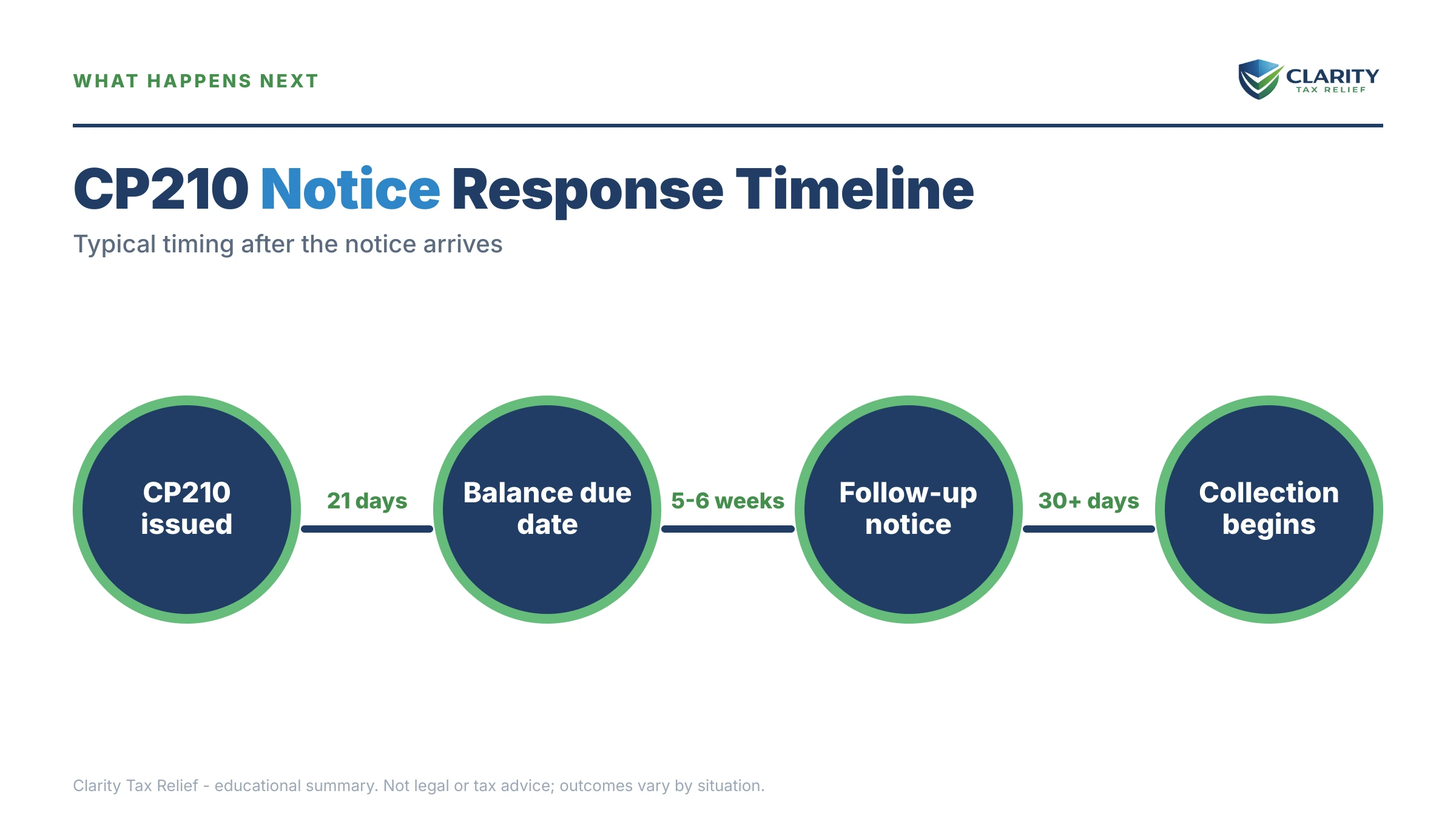
An unpaid CP210 balance enters the IRS's automated business collection sequence, and that sequence ends at levies on business bank accounts and receivables. Nothing is seized at the CP210 stage — but each notice that follows carries more enforcement power, and the system generates them on its own schedule whether or not a human ever reviews your file. With the IRS workforce down roughly 27% since 2025, the humans who could pause a mistake are harder to reach than ever; the automated notices never slowed down.
- CP210 — the adjustment and first bill for the new balance. You are here. No enforcement yet, but penalties and interest are already running.
- Reminder notices — such as a CP163 notice, restating the growing balance. Still just bills.
- CP504B — the business intent-to-levy notice. The IRS can now seize the business's state tax refund, and a federal tax lien becomes a realistic next step. See the CP504B notice guide.
- Final notice of intent to levy — for a business, typically a CP297 or Letter 1058. This starts a 30-day clock and your Collection Due Process rights (requested on Form 12153). After 30 days, the IRS can levy.
- Levy — business bank accounts (funds are held 21 days before they're sent to the IRS), accounts receivable, and other business assets. If the business is closed and the liability is yours personally, levies can reach personal accounts — and up to 15% of Social Security benefits through the Federal Payment Levy Program.
| Stage | What it says | What the IRS can do |
|---|---|---|
| CP210 | We changed your return — new balance, refund, or no change | Bill only; penalties and interest accrue on any balance |
| Reminder (e.g., CP163) | Your business balance remains unpaid | Bill only; balance keeps growing monthly |
| CP504B | Intent to levy | Seize the state tax refund; lien filing becomes likely |
| CP297 / Letter 1058 | Final notice — 30 days, with CDP appeal rights | Levy authority after 30 days unless you respond or appeal |
| Levy | Enforcement in motion | Bank accounts (21-day hold), receivables, federal payments |
One more escalation unique to payroll-related CP210s: if the balance includes withheld employee taxes that were never paid over, the IRS can pursue the trust fund portion against owners and check-signers personally — even after the business closes — through the Trust Fund Recovery Penalty. That decision gets made while notices are being ignored, not after.
Holding a CP210 with a balance you didn't expect?
Send us a photo of it before the pay-by date on your notice passes. An experienced tax professional will decode exactly what the IRS changed, whether the adjustment is even correct, and your cheapest path out — free, confidential, no pressure.
Your options if the CP210 balance is correct
If you verify the change and the IRS is right, you have more than the two choices the notice implies. Which options are realistic depends on the amount and on whether the liability sits with an operating business, a closed one, or you personally (a sole proprietor's payroll debt is personal from day one).
- Pay in full at IRS.gov/payments. This stops the late-payment penalty and the notice sequence immediately; interest runs through the payoff date and then stops.
- Installment agreement. Businesses can set up monthly payment plans; smaller balances can often be arranged online, while larger ones require financial disclosure. An operating business with payroll debt has its own rules — see business IRS installment agreement. If the liability is personal (sole proprietor), individual plan thresholds apply: balances of $25,000 or less generally fit a streamlined agreement, and up to $50,000 can be set up online over as long as 72 months.
- Penalty relief. If the business has a clean compliance history for the prior three years, first-time penalty abatement can remove the penalty portion — and starting summer 2026, the IRS's new Automatic Exemption from Penalty (AEP) applies some of this relief automatically, with no request needed. Reasonable-cause relief (illness, disaster, reliance on a payroll provider that failed you) is requested on Form 843.
- Currently Not Collectible status. If you're retired, the business is closed, and paying anything would leave you unable to cover basic living expenses, collection can be paused. The debt remains and interest accrues, but levies stop while you're in hardship status.
- ERC-specific paths. If the adjustment is an ERC reversal you can't pay, there are dedicated repayment routes — see can't repay ERC before defaulting to a standard plan.
| What your CP210 shows | Realistic options | What to know |
|---|---|---|
| Refund or no change | Verify, file the notice, watch for the refund | Refunds are often applied to other periods you owe first |
| Under $10,000 | Pay in full, short plan, or penalty abatement first | Abating penalties before paying can shrink the check |
| $10,000–$25,000 | Installment agreement; CNC if on fixed income; dispute if wrong | Streamlined setup usually possible without full financials |
| Over $25,000 | Negotiated plan with financial disclosure; professional review | Payroll balances at this level draw revenue officer attention |
If the CP210 is wrong: disputing the adjustment
A CP210 dispute is won with documents, not arguments. Call the number printed on the notice — or respond in writing to the address on it — with the records that contradict the IRS's change: the 941 or 941-X you actually filed, deposit confirmations with dates and amounts, payroll registers for the adjusted quarter.
Two dispute-specific rules matter here. First, act before the pay-by date even though you disagree — interest accrues on the disputed balance until it's corrected, and some adjustment types carry limited windows to reverse (your notice states the deadline that applies to your change; follow the date printed on it). Second, don't pay a balance you believe is wrong on the theory that the IRS will notice its own error later; it won't, and recovering an overpayment takes far longer than preventing one. If only the penalty portion is wrong, Form 843 is the formal removal request.
Common winnable disputes: a deposit posted to the wrong quarter (the money exists — it's just misapplied), a 941-X the IRS processed differently than you filed it, and an ERC reduction based on quarters you never claimed.
What an $11,300 CP210 actually costs — a worked example
Say you're retired, living on Social Security, and a CP210 arrives for the business you closed two years ago showing $11,300 due on its final Form 941 quarter — $10,400 in adjusted tax plus $900 in penalties and interest already added. Here's the math on each path (all figures hypothetical and rounded):
- Do nothing for a year: the failure-to-pay penalty adds 0.5% of the unpaid tax monthly — about $52/month, roughly $624 over the year — plus compounding interest on the whole balance. You'd cross $12,000 while the notice sequence marches toward levy, and up to 15% of your Social Security check (about $285/month on a $1,900 benefit) becomes reachable once a final notice expires.
- Payment plan: as a former sole proprietor, this liability is personal, so streamlined terms apply at $11,300. Roughly $471/month clears it in about 24 months; stretching toward 72 months drops the payment near $157/month, though interest and the reduced late-payment penalty continue until it's paid.
- Penalty relief first: if the prior three years were clean, first-time abatement could remove the penalty portion of that $900 before you pay anything — shrinking both the balance and every future month's accruals. You can estimate the penalty-and-interest side of your own balance with our IRS penalty and interest calculator.
- Hardship: if Social Security is your only income and a $157 payment would crowd out food, housing, or medicine, Currently Not Collectible status may fit — collection pauses, though the debt and interest remain and the IRS reviews your situation periodically.
The point of the math: the same $11,300 can cost $11,300, $12,000+, or meaningfully less depending on which move you make first — and penalty relief is almost always the move to check before writing any check.
How to respond to a CP210 notice, step by step
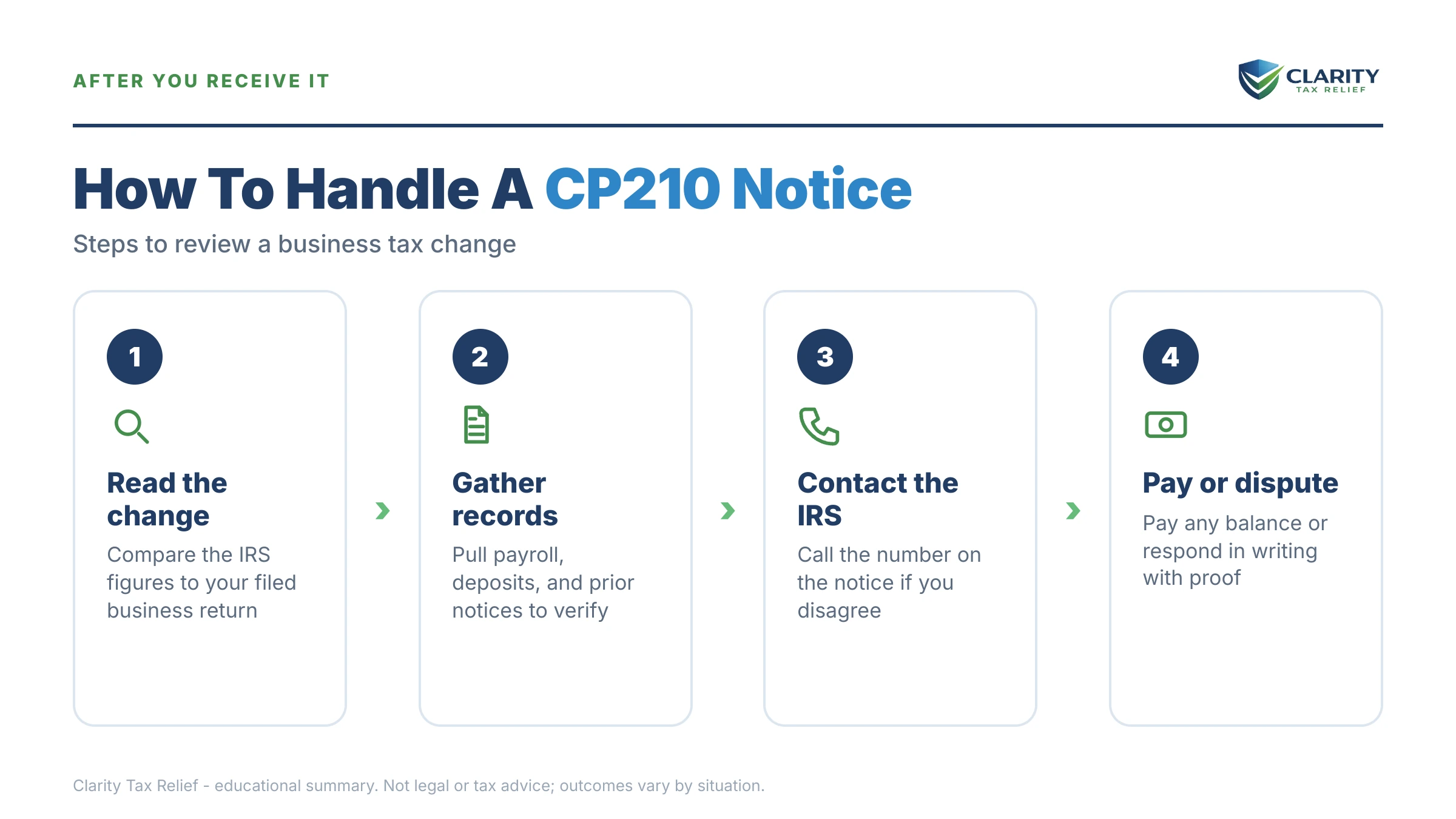
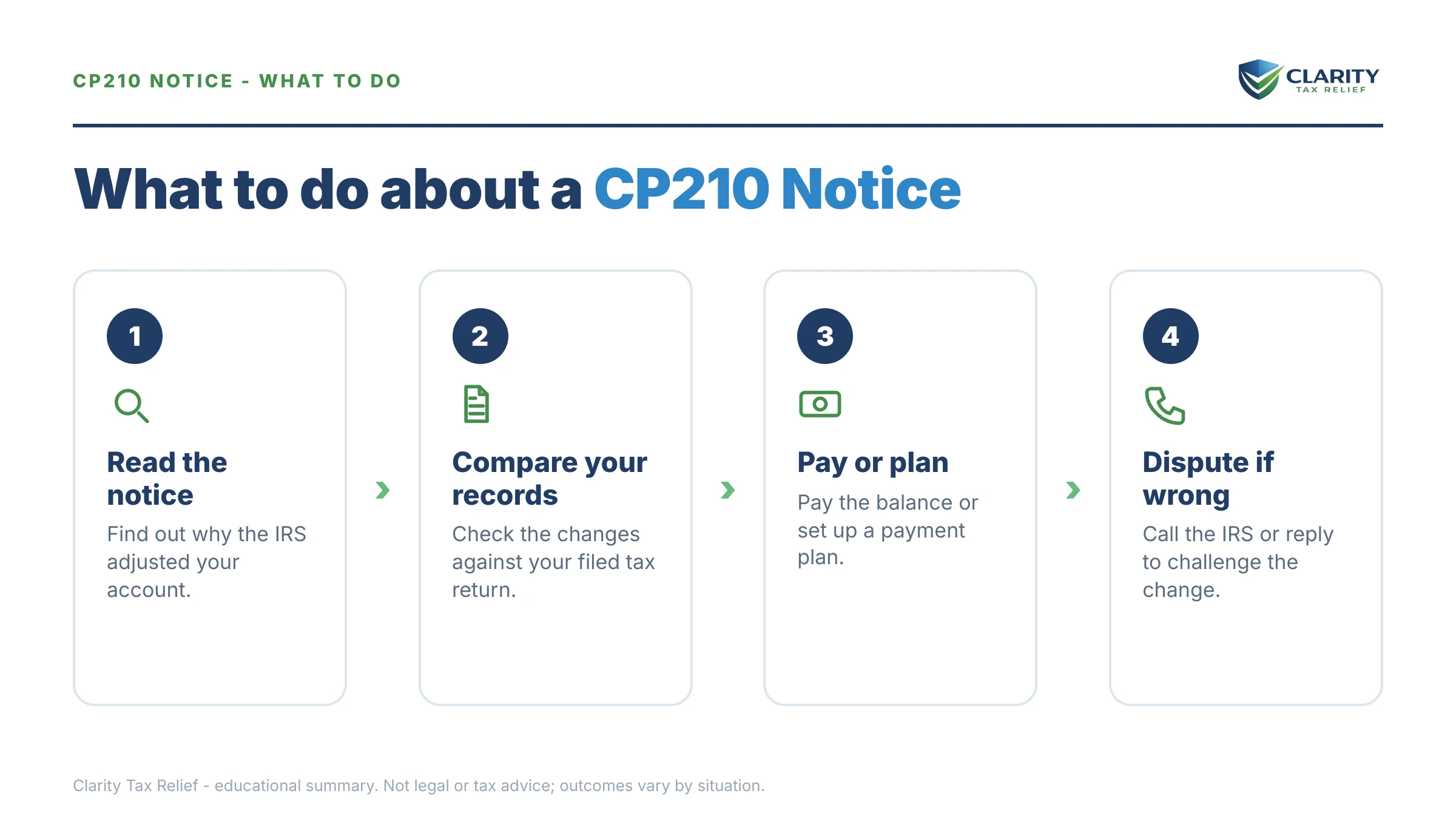
- Read the summary box — identify which form the IRS adjusted (941, 940, 1120, etc.), the tax period ending date, and whether the result is a balance due, a refund, or no change.
- Compare the change to what you filed — pull the return or Form 941-X for that exact period and match the IRS's figures line by line; most CP210 disputes are won or lost on this comparison.
- Verify the account balance — check the business's IRS account transcript for that period so you're working from live numbers, not a notice that crossed in the mail with a payment.
- Pay or dispute by the pay-by date — if the change is right, pay at IRS.gov/payments or set up a payment arrangement; if it's wrong, call the number on the notice with your documentation.
- Request penalty relief before paying penalties — ask about first-time abatement or reasonable cause, or file Form 843; penalties are often the most removable part of a CP210 balance.
- Get experienced help if the stakes are high — a closed business, payroll trust-fund exposure, an ERC recapture, or multiple adjusted quarters each change the strategy.
When you can handle a CP210 yourself
Plenty of CP210s need no professional at all. Handle it yourself when the notice shows a refund or no change, when it confirms a 941-X you filed and the numbers match, or when the balance is small, clearly correct, and you can pay it (or set up a simple plan) by the date on the notice. Ten minutes of verification and an online payment closes those cases.
Experienced help changes the outcome in a narrower set of situations: the adjustment involves unpaid payroll withholding on a closed business (personal trust-fund exposure is on the table — the wind-down rules in 941 back taxes apply), the CP210 is an ERC recapture you dispute, the IRS adjusted multiple quarters at once, or a CP504B or final notice has already arrived while you were sorting out whether the change was even right. In those cases, the order you fix things in — dispute first, penalties second, balance last — determines what you ultimately pay, and it's easy to get the order wrong alone.
Terms on your CP210, decoded
- EIN — the nine-digit Employer Identification Number; a CP210 is addressed to it, which is why the notice names your business, not you.
- Tax period ending — the quarter or year the change applies to (e.g., "December 31, 2023" on a 941 means Q4 2023). Every dispute starts by matching this date to your records.
- Assessment — the IRS formally recording tax on the account; interest on a CP210 balance runs from the assessment, not from when you opened the envelope.
- Federal tax deposit (FTD) — the payroll tax payments a business sends through the year; deposit mismatches are a classic CP210 trigger.
- ERC recapture — the reversal of a previously paid Employee Retention Credit, billed back with interest on the affected quarter.
- CSED — the Collection Statute Expiration Date; the IRS generally has 10 years from assessment to collect, though certain events pause that clock.
CP210 notice questions, answered
What is a CP210 notice from the IRS?
A CP210 is the IRS telling a business it changed something on that business's tax return or account for a specific period. The result — printed in the notice summary — is a balance due, a refund, or no change at all. It arrives addressed to your business EIN, and common triggers include Form 941 corrections, penalty adjustments, and Employee Retention Credit changes.
What is the difference between a CP210 and a CP220?
Both notices announce a change to a business tax account, and the IRS's own guidance covers them on the same page. In practice, a CP210 typically reflects an adjustment the IRS made while processing something — a corrected deposit, an amended return, a penalty change — while a CP220 usually follows a closer review of the account. Your response is the same either way: verify the change before you pay or dispute it.
What if my CP210 notice shows a refund?
Verify it before you spend it. A CP210 refund means the IRS adjusted the period in your favor — often after processing a Form 941-X or reversing a penalty — but the money can be applied to other periods you owe instead of being sent to you. Check whether the refund actually arrived, and keep the notice: if the IRS later reverses the adjustment, it documents what was changed and why.
I closed my business — do I still owe the balance on a CP210?
Usually, yes — closing a business does not erase its tax debt. If you operated as a sole proprietor, the liability is personally yours already. If the balance involves unpaid payroll withholding, the IRS can assess the trust fund portion against you personally through the Trust Fund Recovery Penalty even if the entity is dissolved. Get the notice reviewed before assuming the debt died with the business.
Can I dispute the changes on a CP210 notice?
Yes. Call the number printed on the notice or respond in writing with documentation showing why the IRS's change is wrong — payroll records, deposit confirmations, the return you filed. Act quickly: some adjustment types carry short windows to reverse, and interest keeps accruing on any disputed balance until it is corrected. If penalties are the issue, Form 843 is the formal request to remove them.
Will an unpaid CP210 balance lead to a levy?
Eventually, yes, if it is ignored. The balance moves through the IRS's automated business collection sequence — reminder notices, then a CP504B intent-to-levy notice, then a final notice that starts a 30-day clock before the IRS can levy business bank accounts and accounts receivable. Nothing is levied at the CP210 stage itself, which is exactly why it is the cheapest point to act.
Is my CP210 related to the Employee Retention Credit?
It very well may be — in 2026, ERC adjustments are one of the most common reasons businesses receive a CP210. If the IRS reduced or recaptured an ERC claim on your Form 941, the notice shows the credit reversal plus interest as a balance due for that quarter. Compare the adjusted period against the quarters your ERC claim covered; if they match, the notice is your recapture bill.
How long can the IRS collect a CP210 balance?
Generally 10 years from the date the adjusted tax was assessed — the Collection Statute Expiration Date, or CSED. That clock can be paused by events like an offer in compromise, bankruptcy, or certain appeals, so the real expiration is often later than ten calendar years. Waiting out the statute while ignoring notices rarely works, because levies and liens arrive long before the clock runs out.
Your next 24 hours
- Find three things on the notice: the form adjusted, the "tax period ending" date, and the pay-by date in the summary box. Circle them — everything else on the page is detail.
- Gather your side of the story: the return or 941-X you filed for that period, deposit or payment confirmations, and any earlier IRS letters about the same period.
- Get the notice reviewed free before the pay-by date printed on it: the 2-minute form at claritytaxrelief.com/#consult or (888) 825-7779. Whether the right move is disputing the change, abating the penalties, or structuring a payment you can live with on a fixed income, knowing which comes first is what saves money.
Primary sources: the IRS's own explainer at Understanding your CP210 or CP220 notice, payment options at IRS.gov/payments, and — if the IRS's error is causing hardship you can't get resolved — the Taxpayer Advocate Service.
This guide is general information, not tax or legal advice for your specific situation. Eligibility for IRS programs depends on individual facts and circumstances; no outcome is guaranteed.