
IRS Notices
IRS CP130 Notice: Filing Requirements Changed — What It Means in 2026
The short answer: a CP130 notice tells you your tax return filing requirements may have changed — most often that you may no longer need to pay the alternative minimum tax (AMT). It is not a bill and not an audit, and no response is required. Verify with Form 6251 before changing your withholding or estimated payments.
You saw the IRS logo, braced for a bill, and instead got a letter saying your "filing requirements may have changed" — with no amount due and no deadline anywhere on the page. That's disorienting in its own way: is this a trap, a mistake, or actual good news? For most readers it's the third one, and this page shows you how to confirm it.
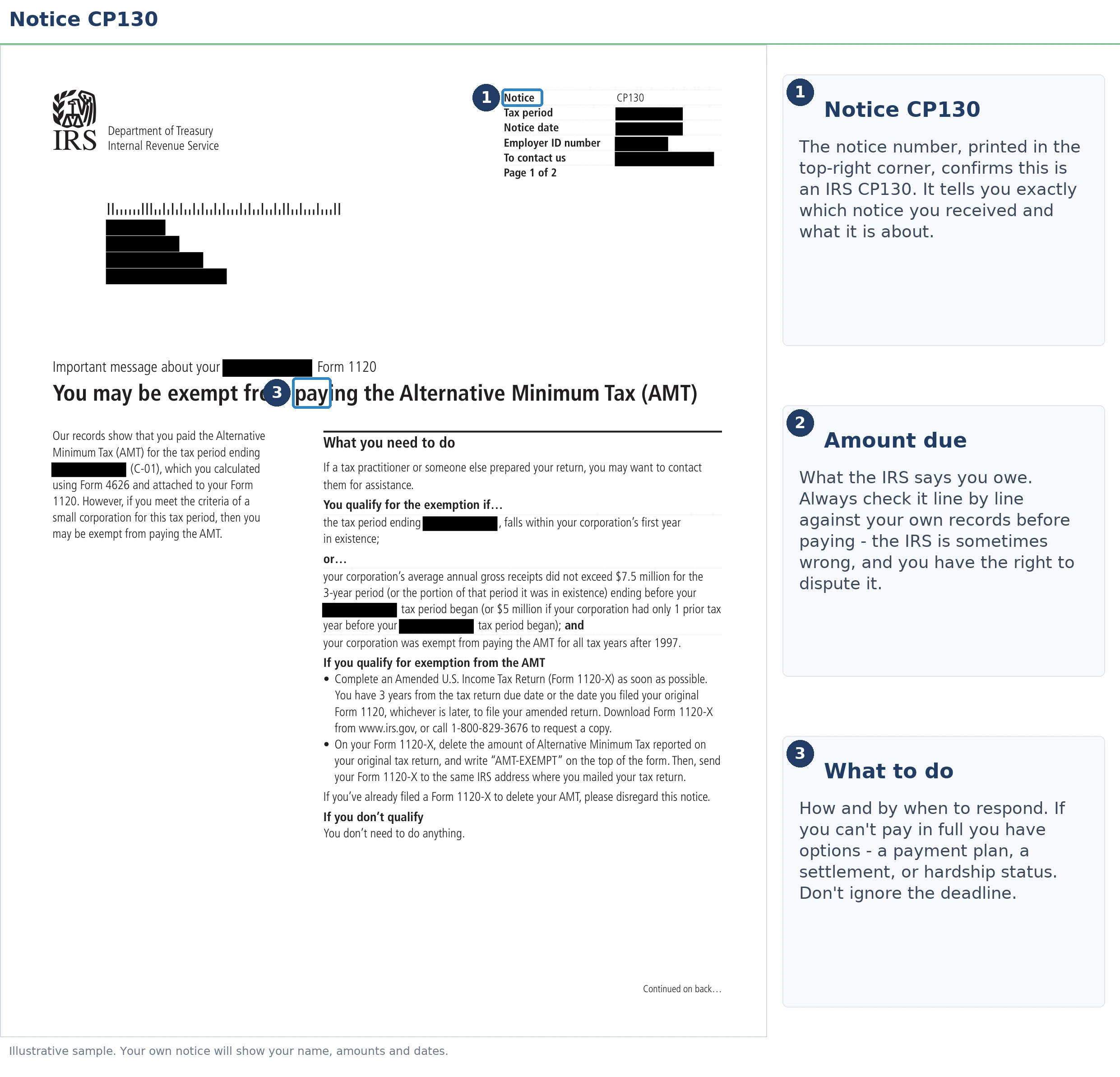
The CP130 is one of the few letters the IRS sends that can put money back in your paycheck rather than take it out. The image below shows you exactly what a CP130 looks like and where to find the tax year the IRS based it on — that year is the key to reading the whole notice correctly.
⏱ Your deadline: there isn't one — a CP130 requires no response and sets no clock. The only dates that matter now are the quarterly estimated-tax deadlines if you adjust your payments based on it. Cut your payments too far and the underpayment penalty starts accruing quarter by quarter until you catch up.
What a CP130 notice means (and why the IRS sent you one)
A CP130 notice means the IRS compared your most recently processed return against current tax rules and concluded your filing requirements may have changed — typically that you may no longer owe the alternative minimum tax. The AMT is a parallel tax calculation, figured on Form 6251, that historically caught taxpayers whose deductions or specific income types pushed their "regular" tax below a minimum floor.
Two things usually put a CP130 in your mailbox. First, the AMT exemption amounts were raised sharply in 2018 and made permanent by 2025's tax legislation — far fewer people owe AMT now than a decade ago (see our breakdown of the One Big Beautiful Bill tax changes). Second, the numbers on your last return — income, deductions, AMT paid — now fall below the level where the parallel calculation bites.
The IRS runs that comparison by computer and mails CP130s in batches. Nobody reviewed your file personally, and nobody is questioning anything you claimed. If you want the broader map of why the IRS sends mail at all — bills, adjustments, holds, and letters like this one — see why did I get a letter from the IRS.
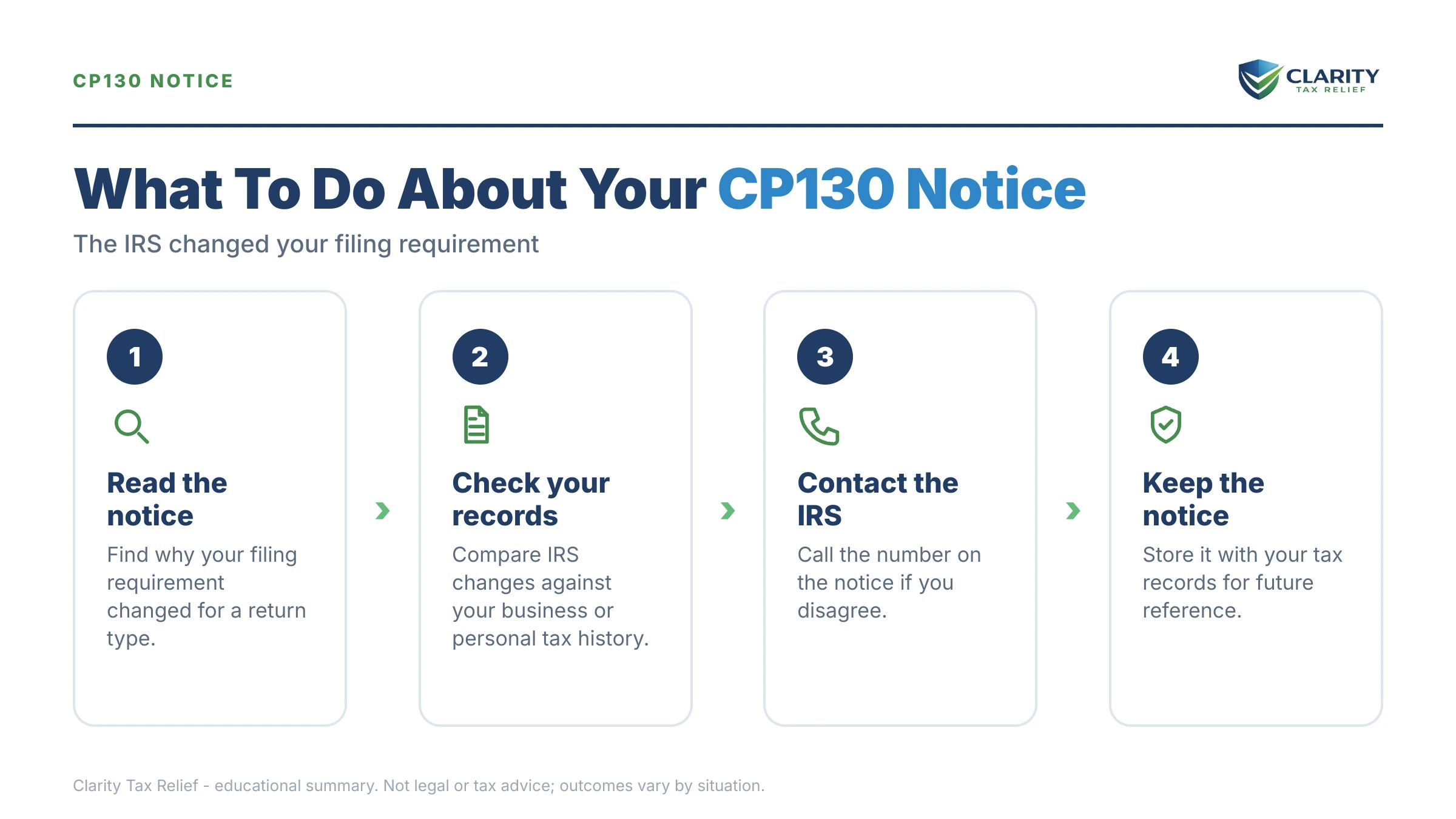
Is a CP130 bad news? What this notice is — and isn't
A CP130 involves no balance due, no refund change, and no required response — which makes it different from nearly every notice people confuse it with. Like the CP08 notice and CP09 notice, it belongs to the small family of IRS letters written to help you rather than collect from you.
Here's how it compares to the notices readers most often mistake it for:
| Notice | What it's telling you | Money involved? | Response needed? |
|---|---|---|---|
| CP130 | Your filing requirements may have changed going forward — often, AMT may no longer apply | None — $0 due, no refund change | No — verify on your own, then adjust if warranted |
| CP11 notice / CP12 notice | The IRS corrected a math error on a return you already filed | Yes — a changed balance (CP11) or changed refund (CP12) | Yes, if you disagree — respond promptly with documentation |
| CP14 notice | You owe a balance — the first bill in the collection sequence | Yes — a specific amount with a pay-by date | Yes — pay or arrange payment by the printed date |
| CP08 / CP09 | You may qualify for a credit (Additional Child Tax Credit / EITC) you didn't claim | Possibly money owed to you | Yes, if you want the credit — return the worksheet |
Quick self-check: if your letter shows a corrected refund, a balance due, or a pay-by date, you are not holding a CP130 — reread the notice number in the top corner and match it to the right guide above.
What happens if you ignore a CP130 notice
Nothing happens from the IRS if you ignore a CP130 — it carries no penalty, no follow-up notice, and no enforcement. The cost of ignoring it lands entirely on your own budget, and it compounds quietly through the year in one of two directions:
- Every pay period — if you added extra withholding to cover AMT that no longer applies, that money keeps leaving each paycheck. In the example below, that's roughly $342 per biweekly check you didn't need to send.
- Each estimated-tax deadline — if you build an AMT cushion into quarterly payments, you keep overpaying four times a year. Or, if you overcorrect and cut payments below the safe harbor, the underpayment penalty on estimated taxes starts stacking quarter by quarter. The quarterly estimated tax deadlines 2026 are the checkpoints where each miss gets locked in.
- Filing season 2027 — everything reconciles on your return. Overpayments come back as a refund, which sounds fine until you realize it was an interest-free loan to the Treasury all year. Underpayments come due at once, with penalty and interest attached.
- If a shortfall becomes a balance you can't pay — the ordinary collection sequence begins with a CP14 notice and escalates from there. That outcome is entirely avoidable if you verify before you adjust.
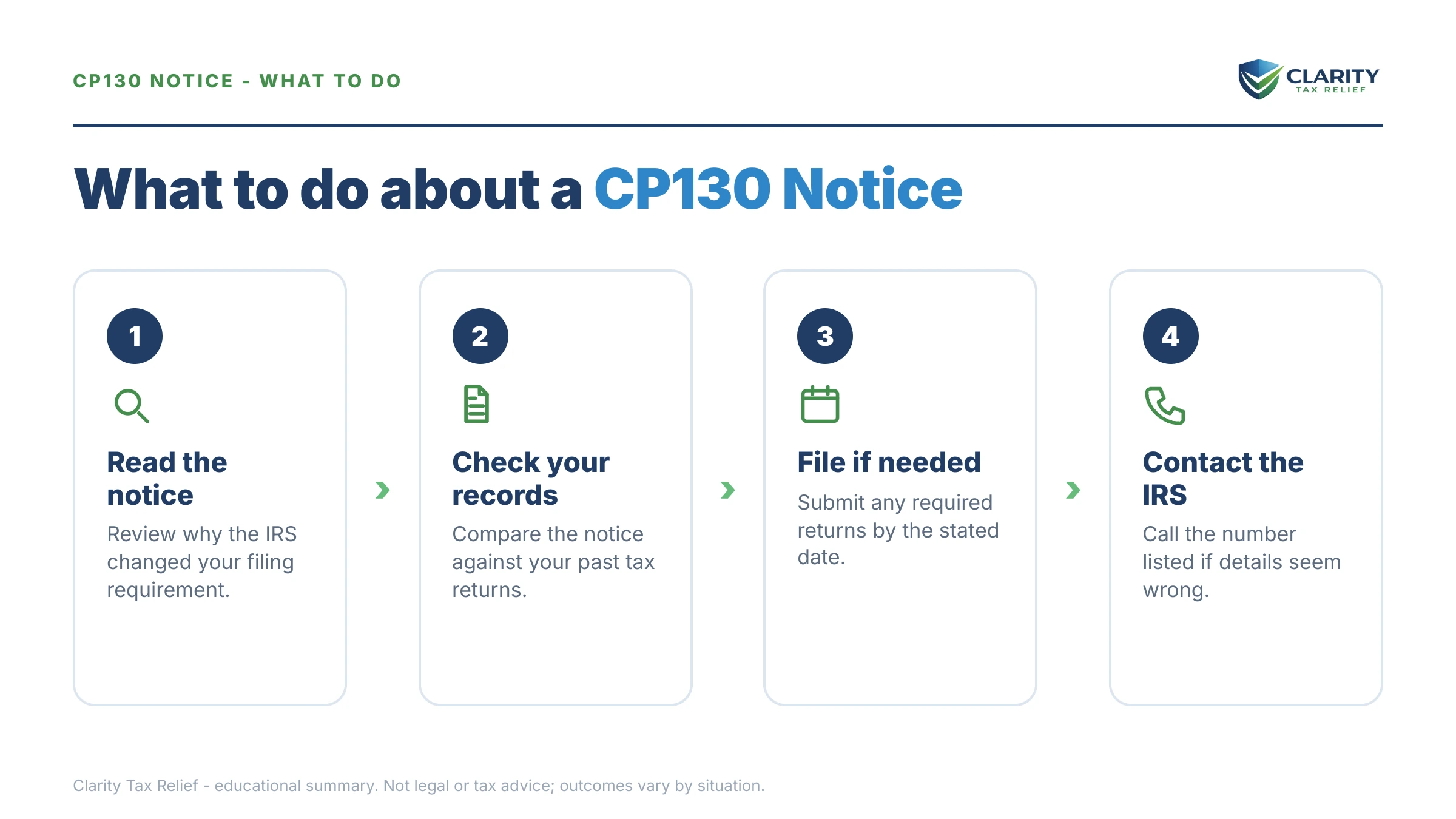
Got a CP130 and not sure whether the AMT still applies to you?
Send us a photo of the notice and last year's return. An experienced tax professional will run the AMT math, tell you whether it's safe to adjust your withholding, and flag anything else on your account — free and confidential. There's no deadline on a CP130, but every paycheck you wait may be another paycheck of tax you don't owe.
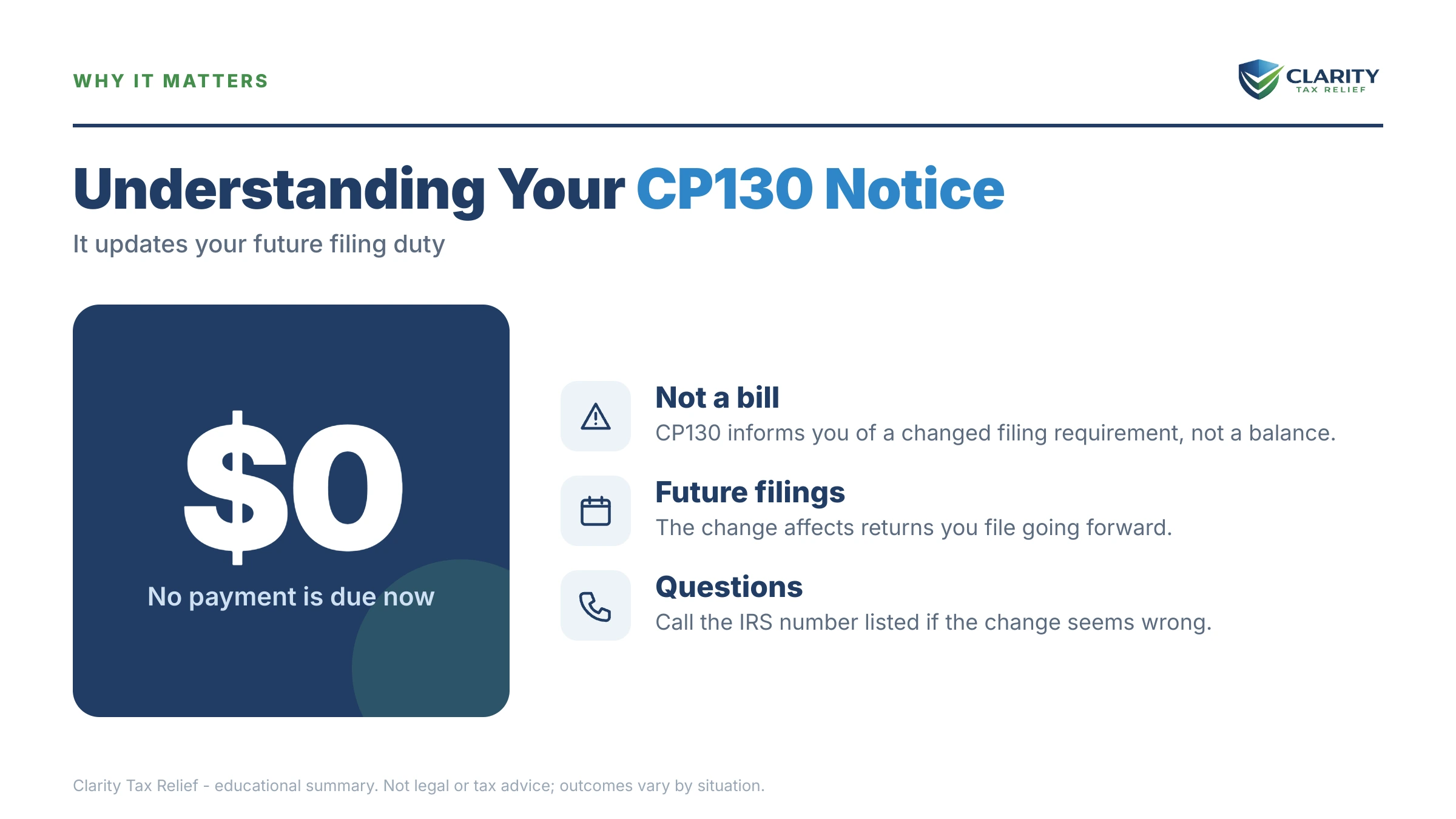
Your options after a CP130 notice
A CP130 gives you one real decision: whether to keep, reduce, or remove the extra tax you've been paying toward AMT. The right answer depends on why AMT hit you in the first place and whether that cause could repeat this year.
| Your situation | What the CP130 likely means for you | Your move |
|---|---|---|
| AMT came from a one-time event (e.g., a stock option exercise) that won't repeat | The notice is probably right — AMT was a one-year visitor | Run Form 6251 to confirm, then file a new Form W-4 to remove the extra withholding |
| You make quarterly estimates with an AMT cushion built in | You may be overpaying every quarter | Rerun your Form 1040-ES worksheet without AMT, keeping the safe-harbor amount intact |
| You expect another AMT trigger this year (ISO exercise, large gain, income jump) | The notice reflects last year — it doesn't know your 2026 plans | Keep paying; recheck Form 6251 after the event before touching anything |
| The notice doesn't match your records, or arrived alongside collection letters | Something else may be happening on your account | Check your account transcript online, then get a professional review before acting |
Whatever you choose, the safe-harbor rule is the guardrail: keep your total withholding plus estimates at 90% of this year's expected tax, or 100% of last year's (110% at higher incomes), and no underpayment penalty applies even if your AMT prediction is wrong. If you want to see what a shortfall would actually cost before deciding, you can estimate it with our Penalty & Interest Calculator.
A worked example: the $8,900 question
Say you're a single W-2 employee, and last year an incentive stock option exercise added $8,900 of AMT to your return via Form 6251. Stung once, you added extra withholding to cover a repeat: $8,900 ÷ 26 biweekly paychecks ≈ $342 per check.
Now the CP130 arrives. If you have no ISO exercise planned for 2026 and Form 6251 shows zero AMT on your projected numbers, that $342 per paycheck is pure over-collection — roughly $8,900 over the year that could sit in your emergency fund instead of the Treasury's.
Flip it: you drop the extra withholding, then exercise options again in October. The $8,900 comes due when you file — plus an underpayment penalty computed at the federal interest rate on each quarter's shortfall. Same notice, opposite outcomes. The difference is fifteen minutes with Form 6251 before you change anything. (This scenario is hypothetical, for illustration only.)
Could you still owe AMT in 2026?
A CP130 is a prediction based on last year's return — it cannot see the income events you haven't had yet. Before you treat the notice as permission to stop paying, check whether any of these apply to your 2026 plans:
| Trigger | Why it can create AMT | Who it usually hits |
|---|---|---|
| Exercising incentive stock options (ISOs) | The spread between strike price and market value counts as income for AMT even though regular tax ignores it until you sell | W-2 employees at companies with equity compensation |
| Large long-term capital gains | Big gains raise total income enough to shrink your AMT exemption through the phase-out | Anyone selling appreciated stock, crypto, or property |
| A sharp one-year income jump | Bonuses, severance, or a business sale can push you past the exemption phase-out threshold | High earners with variable compensation |
| Interest from private-activity municipal bonds | Tax-exempt for regular tax, but counted as income in the AMT calculation | Investors holding specialty muni funds |
| Certain depreciation and business adjustments | AMT recalculates some deductions on a slower schedule, creating a gap between the two systems | Owners with pass-through business income |
If none of these are in your picture — you're a W-2 employee whose AMT year came from a single event that's behind you — the CP130 is very likely correct for you, and the adjustment steps below are safe to run.
How to respond to a CP130 notice, step by step
- Read the notice — note which tax year the IRS based it on, and keep it with that year's records.
- Verify with Form 6251 — run this year's numbers through Form 6251 or your tax software before assuming AMT is gone.
- Adjust your withholding — if AMT no longer applies, file a new Form W-4 with your employer to redirect the extra amount you were having withheld.
- Recalculate any estimated payments — rework your Form 1040-ES figures so you still meet the IRS safe harbor after removing the AMT cushion.
- Recheck after any big income event — an ISO exercise or large asset sale mid-year can put AMT back on the table.
For step 2, the IRS publishes the current form and instructions at About Form 6251, Alternative Minimum Tax — Individuals. For step 3, the IRS Tax Withholding Estimator will translate the change into exact W-4 entries.
One more check worth two minutes: confirm the notice matches what the IRS actually has on file by logging into your account — our IRS online account setup walkthrough shows how. A real CP130 asks you for nothing, so any version demanding payment or "verification" is an impostor; here's how to tell if an IRS letter is real.
When you can handle a CP130 yourself — and when help changes the outcome
Most people can handle a CP130 entirely on their own. If your tax life is a W-2, standard software, and one AMT year caused by a single event, the five steps above take an afternoon: run Form 6251, update your W-4, done. There is nothing to negotiate and nothing to appeal — hiring anyone just to "respond" to a CP130 would be paying for a stamp you don't need.
Experienced help earns its cost in a few specific situations. If you have equity compensation and are planning ISO exercises, the timing of exercise versus sale can swing your AMT by thousands — that's planning, not paperwork. If you suspect a prior return computed AMT wrong and money might be recoverable, whether amending a return to lower a tax debt makes sense depends on statutes and math worth checking before you file anything. And if the CP130 arrived in the same season as balance-due or collection notices, the friendly letter isn't the story — the account behind it is, and a professional review of the whole transcript beats reacting notice by notice.
Terms on your CP130, decoded
- Alternative minimum tax (AMT): a parallel tax calculation that ignores certain deductions and income exclusions, designed to set a floor on what higher earners pay.
- Form 6251: the worksheet that runs the AMT calculation — you owe AMT only if its result exceeds your regular tax.
- AMT exemption: the amount of income shielded from the AMT calculation; it phases out as income rises, which is why AMT mainly hits upper incomes.
- Tentative minimum tax: the tax figured under AMT rules before it's compared to your regular tax — the higher of the two is what you actually pay.
- Filing requirement: the set of forms and calculations the law obligates you to complete — a CP130 says one of yours (usually Form 6251) may no longer be needed.
- Safe harbor: the prepayment level (generally 90% of this year's tax or 100–110% of last year's) that protects you from the underpayment penalty even if your final bill is bigger than expected.
CP130 notice questions, answered
Is a CP130 notice bad news?
No — for most people a CP130 is good news. It usually means the IRS's records suggest you no longer need to pay the alternative minimum tax, which can free up money you've been withholding or sending in as estimated payments. The catch is the word "may": the notice is based on your last filed return, so you still need to confirm with Form 6251 that AMT truly doesn't apply to your current-year numbers.
Do I have to respond to a CP130 notice?
No response is required. The IRS is not asking for money, documents, or a signature, and no penalty attaches if you file the letter away and do nothing. The smart move is still to act on it: run Form 6251 for the current year, and if AMT no longer applies, adjust the extra withholding or estimated payments you were making to cover it.
Does a CP130 notice mean I'm getting a refund?
Not by itself. A CP130 looks forward — it doesn't change any return you already filed or trigger a payment to you. If you overpay during 2026 because your withholding still assumes AMT, you'd recover that money as a refund when you file in 2027. If you believe you overpaid AMT on a prior return because of an error, that's a separate amended-return question.
Can I stop making estimated tax payments after a CP130?
Only after you've verified the math — never on the notice alone. If Form 6251 shows zero AMT for 2026 and your regular withholding covers your regular tax, you can reduce or drop the AMT cushion in your quarterly payments. But if you undershoot the IRS safe harbor (generally 90% of this year's tax or 100–110% of last year's), an underpayment penalty accrues quarter by quarter.
Why does the IRS think I no longer owe AMT?
Two things usually drive it: the higher AMT exemption amounts first set in 2018 were made permanent, and the numbers on your most recently processed return fall below the level where AMT kicks in. The IRS runs that comparison automatically and mails CP130s in batches. It doesn't know your 2026 plans — a stock option exercise or a large asset sale can put you right back into AMT territory.
Could I still owe the alternative minimum tax after getting a CP130?
Yes. The notice reflects last year's return, not this year's events. Exercising incentive stock options, realizing large long-term capital gains, or a big jump in income can all trigger AMT even after a CP130. If any of those apply to you this year, complete Form 6251 (or let your tax software run it) before you touch your withholding.
How do I know my CP130 is real and not a scam?
A genuine CP130 arrives by postal mail and asks you for nothing — no payment, no bank details, no "verification" link. That makes it easy to screen: any "CP130" that demands money or personal information is fake. You can confirm the notice against your own records by logging into your account at IRS.gov rather than calling any number printed on a suspicious letter.
What's the difference between a CP130 and a CP12?
A CP12 changes a return you already filed — the IRS corrected a math error and adjusted your refund. A CP130 changes nothing; it's a forward-looking heads-up that your filing requirements may be different going forward. If your letter shows a corrected refund or balance, you're holding a math-error notice like a CP12 or CP11, not a CP130.
Your next 24 hours
- Find the tax year on your CP130 — it's printed near the top of the first page. That's the return the IRS based its conclusion on, and the starting point for every check that follows.
- Gather three documents: that year's tax return (including Form 6251 if one was filed), your most recent pay stub showing current withholding, and the notice itself.
- Get a free review before you change anything. If your situation has any wrinkle — equity compensation, quarterly estimates, or other IRS letters on the pile — have an experienced tax professional run the AMT math with you first. Use the 2-minute form or call (888) 825-7779. There's no deadline on a CP130, but every pay period of unnecessary withholding is money you don't get back until 2027.
The IRS's general reference for decoding any letter is Understanding your IRS notice or letter.
This guide is general information, not tax or legal advice for your specific situation. Eligibility for IRS programs depends on individual facts and circumstances; no outcome is guaranteed.