
IRS Penalties
Late Filing Penalty Relief in 2026: How to Get the IRS Failure-to-File Penalty Removed
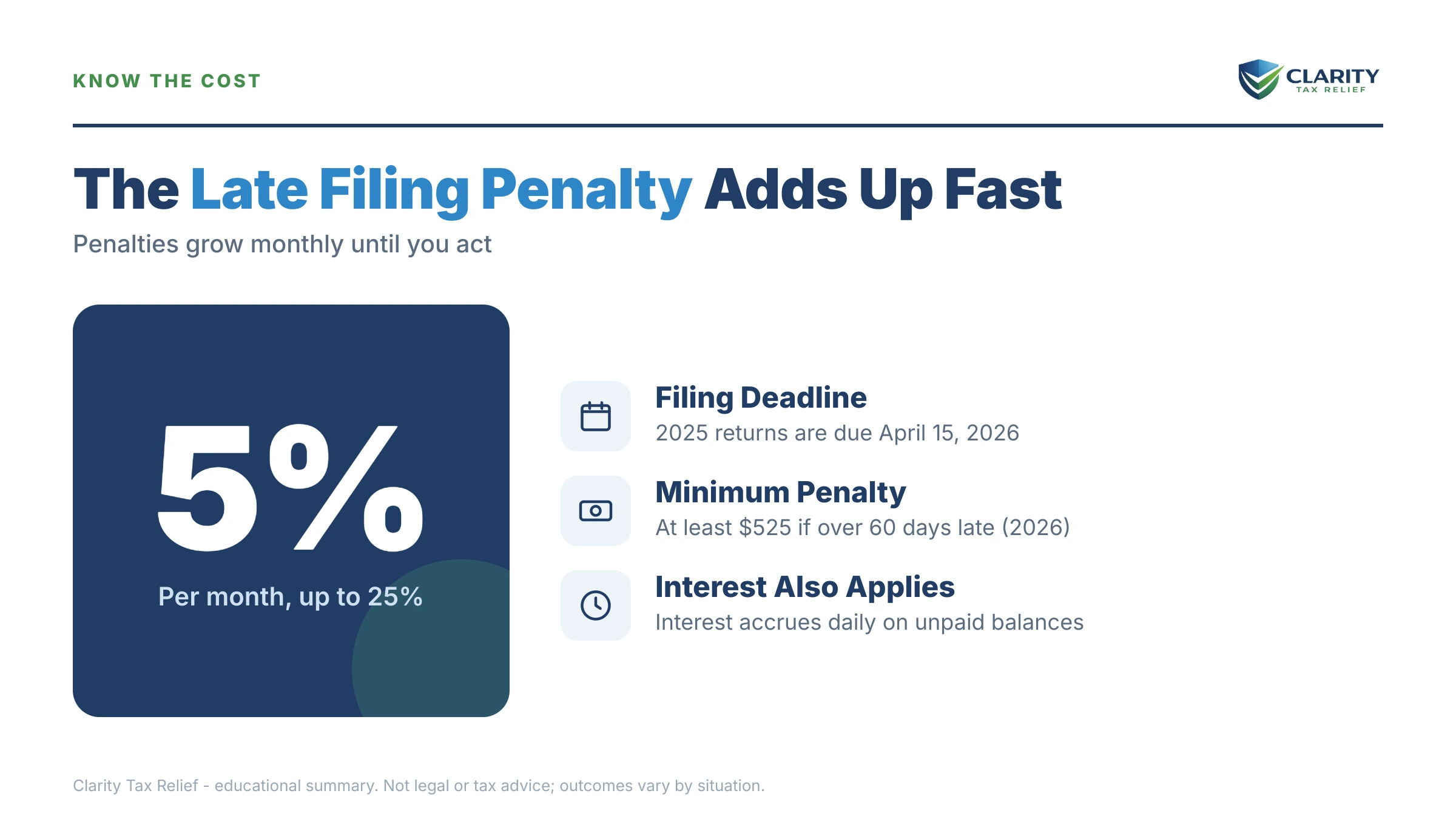
The short answer: late filing penalty relief means getting the IRS failure-to-file penalty — 5% of the unpaid tax per month, up to 25% — removed or refunded. The three main paths in 2026 are first-time penalty abatement, the new Automatic Exemption from Penalty (AEP), and reasonable-cause relief. All three cost nothing to request.
You filed months after the deadline, expected a bill for the tax itself — and the notice in your hand shows nearly a quarter of that tax stacked on top as a penalty. If you've never been late before, that number feels less like a fee and more like a punishment. Here's the part the notice doesn't say: that penalty is one of the most removable charges the IRS assesses, and this page walks you through every path to get it off your account.
⏱ The real clocks: there is no application deadline for penalty abatement itself, but two clocks are running. If your return is still unfiled, the failure-to-file penalty grows another 5% every month until it caps at 25% of the unpaid tax. And if you already paid the penalty, a refund claim generally must be filed within 3 years of filing the return or 2 years of the payment, whichever is later.
Why the IRS charged you a late filing penalty
The IRS failure-to-file penalty is 5% of the unpaid tax for each month or part of a month your return is late, capped at 25% — ten times the 0.5% monthly failure-to-pay penalty. No one at the IRS decided you deserved it. The moment your late return processed with a balance due, a computer calculated the penalty and posted it to your account automatically.
Three details on your notice matter more than the rest. First, "part of a month" counts as a full month — filing one day into month three means three months of penalty. Second, in months where both penalties run, the failure-to-file portion is reduced to 4.5% so the combined charge is 5% per month. Third, if you filed more than 60 days late, a flat minimum penalty applies even on small balances — the amount is inflation-adjusted each year and printed on your notice.
Because filing late costs 10× more per month than paying late, the penalty math punishes the wrong instinct — waiting to file until you could pay. The full breakdown of how the two penalties interact lives in our guides to failure to file penalty vs failure to pay and how much are IRS penalties on back taxes. This page stays on the question you actually have: how to get the penalty removed.
One scope note: everything here covers the individual (Form 1040) penalty. Partnership and S-corp late-filing penalties are charged per owner, per month, under different rules — those paths are covered in business penalty abatement.
What the penalty costs: a $61,200 example
On a $61,200 balance, each month of not filing adds $3,060 in combined penalties. Say you're a W-2 employee filing single: a large RSU vesting was under-withheld, your return showed $61,200 due, and — knowing you couldn't pay — you didn't file until five months after the deadline, with no extension. Here's the math the IRS ran, clearly hypothetical but exact:
- Failure-to-file penalty: 4.5% × 5 months = 22.5% of $61,200 = $13,770
- Failure-to-pay penalty: 0.5% × 5 months = 2.5% of $61,200 = $1,530
- Combined penalties at filing: $15,300 — before a dollar of interest
Your balance is now $76,500 plus interest. That crosses the $66,000 threshold at which the IRS can certify a seriously delinquent tax debt to the State Department — a real consequence explained in passport revoked tax debt. Penalty relief matters here twice: it removes $15,300, and it can pull the certified balance back under the line.
| Months late | Failure-to-file | Failure-to-pay | Combined penalty |
|---|---|---|---|
| 1 month | $2,754 | $306 | $3,060 |
| 3 months | $8,262 | $918 | $9,180 |
| 5 months (FTF caps) | $13,770 | $1,530 | $15,300 |
| 12 months | $13,770 (capped) | $3,672 | $17,442 |
After month five the failure-to-file penalty stops growing, but the failure-to-pay penalty keeps adding 0.5% a month toward its own 25% cap, and interest compounds on everything. You can estimate your own numbers with our Penalty & Interest Calculator. Note it estimates — your transcript has the official figures.
What happens if you ignore the penalty
A late filing penalty is not a separate account you can let sit — it's folded into your balance and rides the IRS's automated collection sequence. Left alone, here's the order things happen:
- The balance compounds. The failure-to-pay penalty keeps posting monthly, and interest accrues on tax, penalties, and prior interest together.
- Your refunds disappear. Future federal refunds are applied to the balance automatically, penalty included, before you see a dime.
- The notice ladder climbs. The bill that carries your penalty escalates from a first notice through reminders to an intent-to-levy notice — each rung with less flexibility than the last (windows below).
- Enforcement begins. After the final notice window closes, the IRS can levy bank accounts and garnish wages — over a balance that might have been cut by a quarter with one free abatement request.
The 2026 wrinkle: the IRS workforce shrank roughly 27% in 2025, so reaching a human takes longer — but the notice stream and levies are automated and never paused. Slow phones do not mean slow enforcement.
| Notice | What it means | Response window |
|---|---|---|
| CP14 | First bill — tax, penalties, and interest itemized | Pay-by date, typically 21 days from the notice date |
| CP501 / CP503 | Reminder notices — balance still growing monthly | Pay-by date printed on each notice |
| CP504 | Intent to levy your state tax refund (IRC §6331(d)) | Pay-by date on the notice; state refund at risk after |
| LT11 / Letter 1058 | Final notice of intent to levy — wages and bank accounts | 30 days to request a Collection Due Process hearing (Form 12153) |
Staring at a five-figure late filing penalty?
Many of them come off with one properly made request. Get your penalty reviewed free before another month of failure-to-pay penalty and interest posts to your balance — an experienced tax professional will tell you which relief path fits your history, with no pressure.
Your late filing penalty relief options in 2026
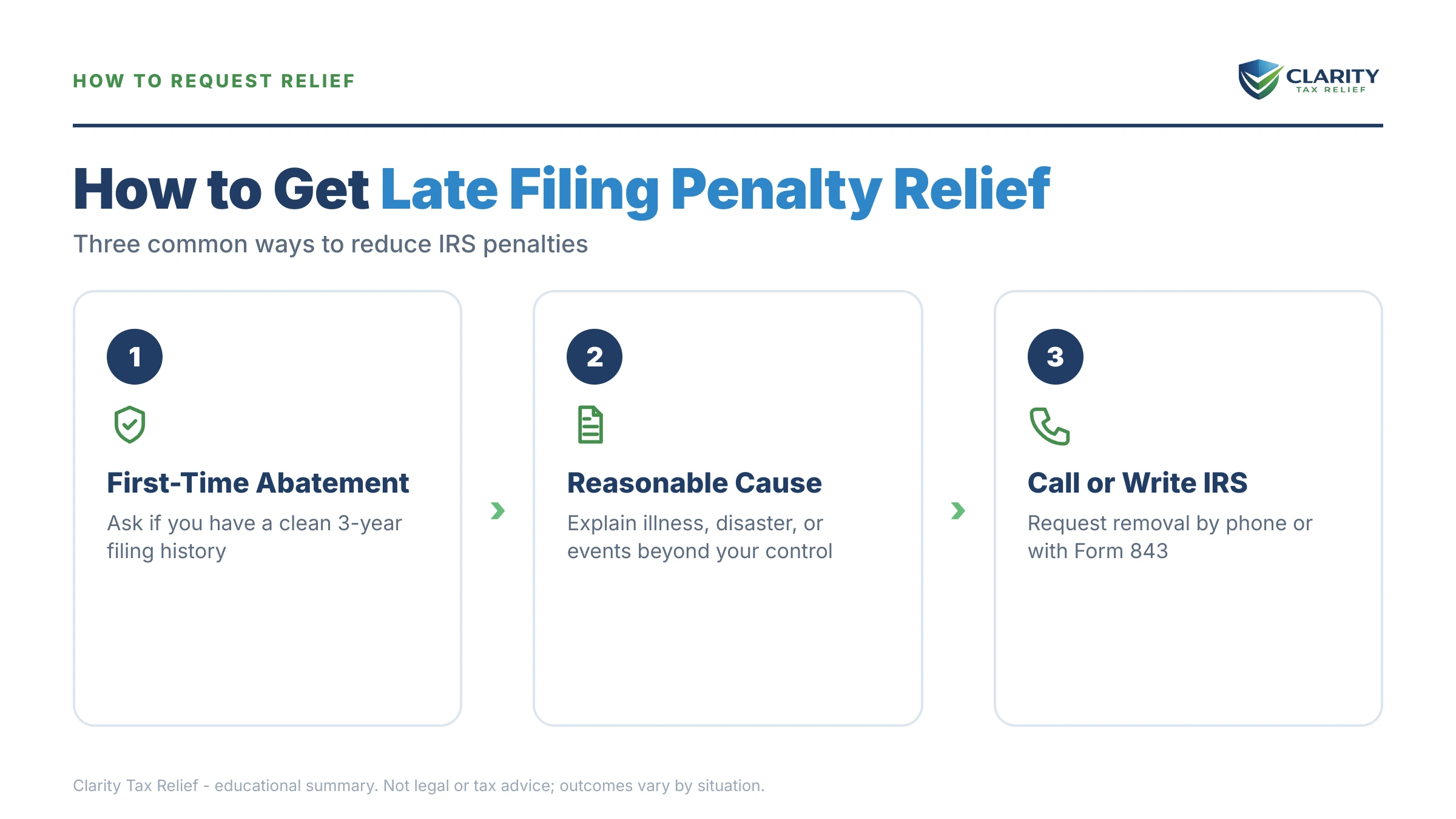
The IRS has four distinct paths to remove or refund a late filing penalty, and every one of them is free to pursue. Which one fits depends on your penalty history, why you filed late, and whether you've already paid.
| Relief path | Cost to request | Typical timeline | Best fit |
|---|---|---|---|
| First-time abatement (FTA) | $0 | Phone requests often decided on the call; weeks for the adjustment to post | Clean penalty history for the prior 3 years, one bad year |
| Automatic Exemption from Penalty (AEP) | $0 — no request needed | Automatic, rolling out summer 2026 | Qualifying penalties assessed after the rollout |
| Reasonable cause | $0 | Typically one to several months for written review | Documented illness, death, disaster, or destroyed records |
| Form 843 refund claim | $0 | Several months | Penalty already paid, within the 3-year/2-year window |
| Appeal of a denial | $0 | Months, depending on Appeals backlog | Strong facts that a first-round reviewer dismissed |
First-time abatement: the fastest path
FTA removes failure-to-file and failure-to-pay penalties for one tax period with no explanation required — you qualify on history, not hardship. The test: no penalties in the prior three tax years, all currently required returns filed, and the tax paid or on a payment arrangement. It's administrative, not discretionary; if the criteria are met, the request should be granted. Details, phone scripts, and a template live in first time penalty abatement and the first time penalty abatement letter sample.
AEP: the 2026 replacement for FTA
Starting in summer 2026, the IRS is replacing FTA with the Automatic Exemption from Penalty — qualifying penalties come off automatically, no request needed. That's genuinely good news for clean-history filers, with two cautions: penalties assessed before the rollout still need an affirmative request, and "automatic" doesn't mean instant — verify on your transcript that the removal actually posted. Full coverage of the transition is in automatic exemption from penalty AEP 2026.
Reasonable cause: when life got in the way
Reasonable cause removes penalties when circumstances beyond your control prevented filing despite ordinary care — hospitalization, a death in the immediate family, a natural disaster, records destroyed. It has no lookback limit and can cover multiple years, but it lives or dies on documentation and timing: the event must overlap the deadline, and you must have filed promptly once it passed. "I couldn't afford to pay" fails for filing penalties, because filing costs nothing. What actually persuades reviewers is covered in reasonable cause penalty abatement.
Form 843: getting a paid penalty refunded
Already paid the penalty? Relief isn't lost — it becomes a refund claim on Form 843, subject to the 3-years-from-filing / 2-years-from-payment window. The walkthrough is in Form 843 penalty abatement request.
Strategy note for multiple late years
FTA applies to one period, so if several years carry penalties, sequencing matters: reasonable cause on the years with the strongest facts, FTA on the cleanest remaining year. Get the order wrong and you can burn FTA on a small penalty while a large one survives. Also know FTA's limits — it does not cover the estimated-tax penalty, which has its own waiver rules covered in didn't pay estimated taxes penalty.
Back to the hypothetical $61,200 filer: with no penalties in the prior three years and the return now filed, an FTA request removes the $13,770 failure-to-file and $1,530 failure-to-pay penalties — $15,300 off with one free request — plus the interest charged on those penalties. The tax and its own interest remain, handled separately through a payment plan.
How to request late filing penalty relief, step by step
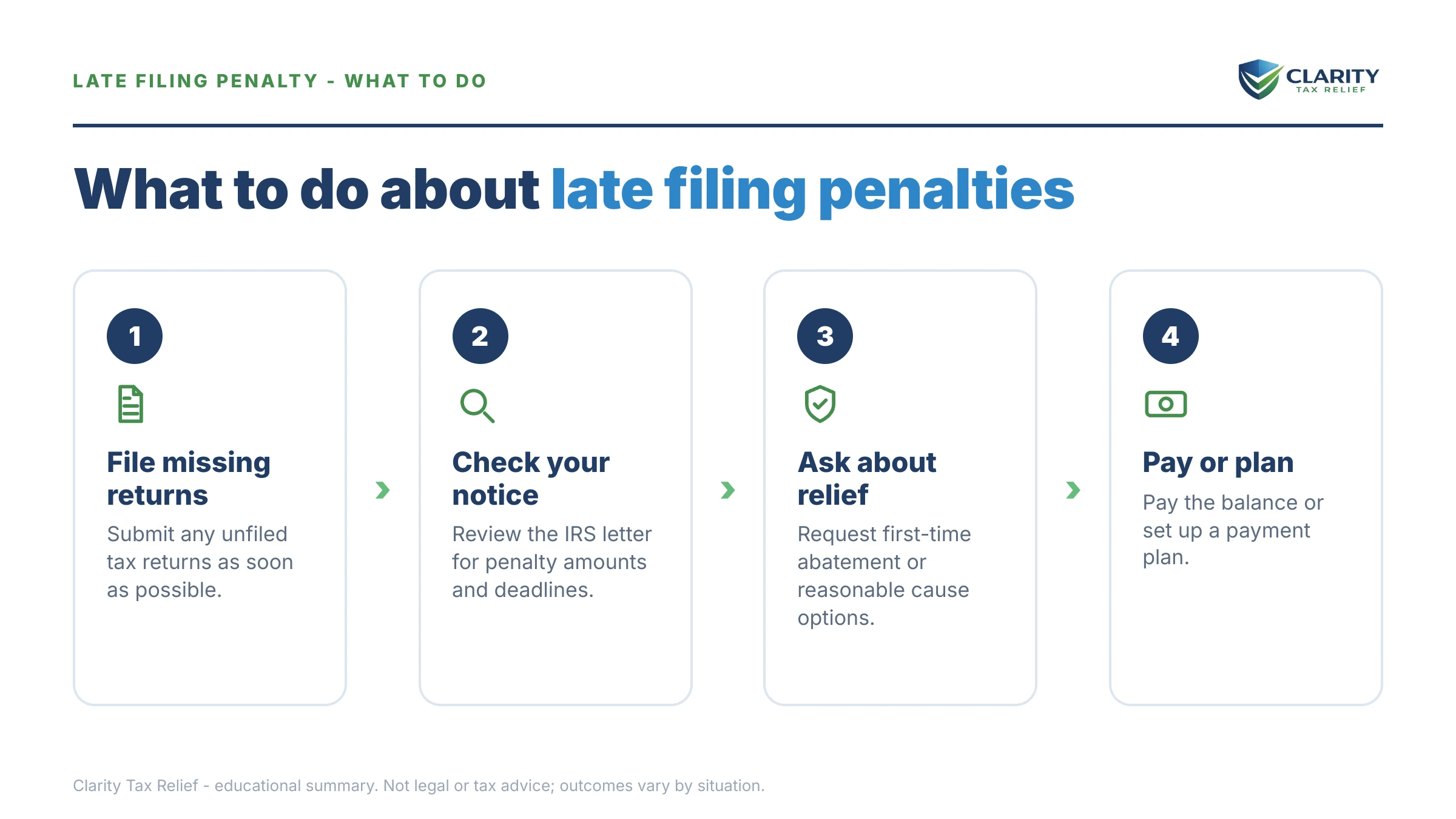
- File any unfiled returns. Filing stops the 5%-per-month failure-to-file penalty from growing — and nothing can be abated on a return the IRS never received.
- Confirm the exact penalty amounts. Pull your IRS account transcript or your notice and note each year's failure-to-file and failure-to-pay penalty, which are listed separately.
- Check your three-year history for first-time abatement. If you had no penalties in the prior three tax years and all required returns are filed, request FTA first — it requires no explanation of why you were late.
- Make the request. Call the number on your notice for FTA, or send a written abatement request — and use Form 843 if you already paid the penalty and want it refunded.
- Build a reasonable-cause case if FTA doesn't fit. Match documents — hospital records, a death certificate, insurance or disaster claims — to the filing deadline, and explain why you couldn't file on time and filed as soon as you could.
- Appeal a denial in writing. First-round denials are often computer-scored; a written appeal puts your facts in front of a human with authority to reverse it.
If your request is denied, that's the middle of the process, not the end — the appeal route and what changes on review are covered in penalty abatement appeal.
When you can handle this yourself — and when help changes the outcome
A straightforward FTA request is one of the few IRS problems most people can genuinely handle alone. If you have one late year, a clean prior three years, the return filed, and the tax paid or on a plan, one phone call to the number on your notice — asking specifically for "first-time abatement" — is often all it takes. Don't pay anyone hundreds of dollars for that call.
Experienced help earns its cost in the harder patterns: multiple penalty years that need FTA/reasonable-cause sequencing, a five-figure penalty riding a balance already at CP504 or LT11, a reasonable-cause narrative that has to be built from medical or disaster records, a denial headed to Appeals, or a paid penalty near the end of its refund window. In those cases the difference between a granted and denied request is usually how the facts are framed and documented — which is exactly the part a professional does differently.
Terms on your notice, decoded
- Failure-to-file penalty: the charge for filing late — 5% of the unpaid tax per month (4.5% when running alongside failure-to-pay), capped at 25%.
- Failure-to-pay penalty: the separate, smaller charge for paying late — 0.5% per month, with its own 25% cap.
- Abatement: the IRS's word for removing a penalty from your account; a granted abatement also removes interest charged on that penalty.
- First-Time Abate (FTA): administrative penalty removal based on a clean prior-three-year compliance history — no excuse required.
- AEP: the Automatic Exemption from Penalty, replacing FTA starting summer 2026 — qualifying penalties removed with no request at all.
- Reasonable cause: the documented-circumstances standard for relief — events beyond your control that prevented filing despite ordinary care.
The IRS's own overview of these programs is at IRS penalty relief, and the refund-claim form and instructions are at About Form 843. If a pending request stalls for months while collection moves forward, the Taxpayer Advocate Service can intervene at no cost.
Late filing penalty relief questions, answered
Can the IRS remove a late filing penalty?
Yes — the IRS removes late filing penalties regularly through three programs: first-time penalty abatement, reasonable-cause relief, and, starting in summer 2026, the Automatic Exemption from Penalty (AEP). None of them costs anything to request. The catch is that relief is criteria-based: FTA requires a clean three-year penalty history, and reasonable cause requires documented circumstances beyond your control, not just an honest mistake.
How do I qualify for first-time penalty abatement?
You may qualify for first-time abatement if you had no penalties in the prior three tax years, all currently required returns are filed, and you have paid or arranged to pay any tax due. It covers failure-to-file, failure-to-pay, and failure-to-deposit penalties for a single tax period. If a penalty was assessed anywhere in that three-year lookback, FTA is off the table for this year — but reasonable cause may still work.
What counts as reasonable cause for filing late?
Reasonable cause means circumstances beyond your control kept you from filing despite ordinary business care — serious illness or hospitalization, a death in the immediate family, a natural disaster, or records destroyed in a fire, for example. Not having the money to pay does not excuse late filing, because filing itself costs nothing. The IRS weighs timing: the event has to line up with the filing deadline, and you are expected to have filed promptly once it passed.
What is the Automatic Exemption from Penalty (AEP) in 2026?
AEP is the program replacing first-time abatement starting in summer 2026 — qualifying penalties are removed automatically, with no phone call, letter, or form required. It targets the same clean-history taxpayers FTA served, but takes the request step out of the process. If your penalty predates the rollout or was not automatically removed, the traditional FTA and reasonable-cause request paths still work — do not wait on AEP to fix an older year.
Can I get a late filing penalty refunded after I already paid it?
Yes — if you paid a penalty that qualifies for abatement, you can claim a refund with Form 843. The general window is three years from when the return was filed or two years from when you paid the penalty, whichever is later. Miss that window and the money is gone even if your abatement argument is airtight, so file the claim before you are certain it will win.
Does penalty abatement remove the interest too?
Only partly. Interest that was charged on the penalty itself comes off automatically when the penalty is abated — but interest on the underlying tax stays and keeps accruing until the tax is paid. The IRS almost never waives interest on the tax; the narrow exception is interest caused by IRS errors or delays under IRC §6404.
Is there a late filing penalty if I'm owed a refund?
No. The failure-to-file penalty is calculated as a percentage of unpaid tax, so if the IRS owes you money, the penalty is zero. But do not sit on it: you generally have three years from the original due date to claim that refund, after which it is forfeited to the Treasury. Unfiled years also disqualify you from first-time abatement on years where you do owe.
How long does late filing penalty abatement take?
A first-time abatement request made by phone can be decided on the call, with the adjustment posting to your account within a few weeks. Written reasonable-cause requests typically take one to several months, and Form 843 refund claims can take longer — 2026 staffing cuts have stretched every paper queue. Penalties and interest on the unpaid tax keep accruing while a request is pending, so pay or arrange payment on the tax itself in parallel.
Your next 24 hours
- Find the penalty lines. On your notice (or account transcript), locate the failure-to-file and failure-to-pay amounts for each year — they're listed separately, and you need both figures to know what relief is worth.
- Gather three things: the notice itself, proof of your filing history for the prior three years, and any documents behind why you filed late — medical records, a death certificate, disaster claims.
- Get the free case review. Every month you wait adds another 0.5% failure-to-pay penalty plus interest to the balance. Call (888) 825-7779 or use the 2-minute form, and an experienced tax professional will map which relief path fits your penalty history — free.
This guide is general information, not tax or legal advice for your specific situation. Eligibility for IRS programs depends on individual facts and circumstances; no outcome is guaranteed.