
IRS Transcript Codes
IRS Code 846 Refund Issued: What the Date and Amount Mean (2026)
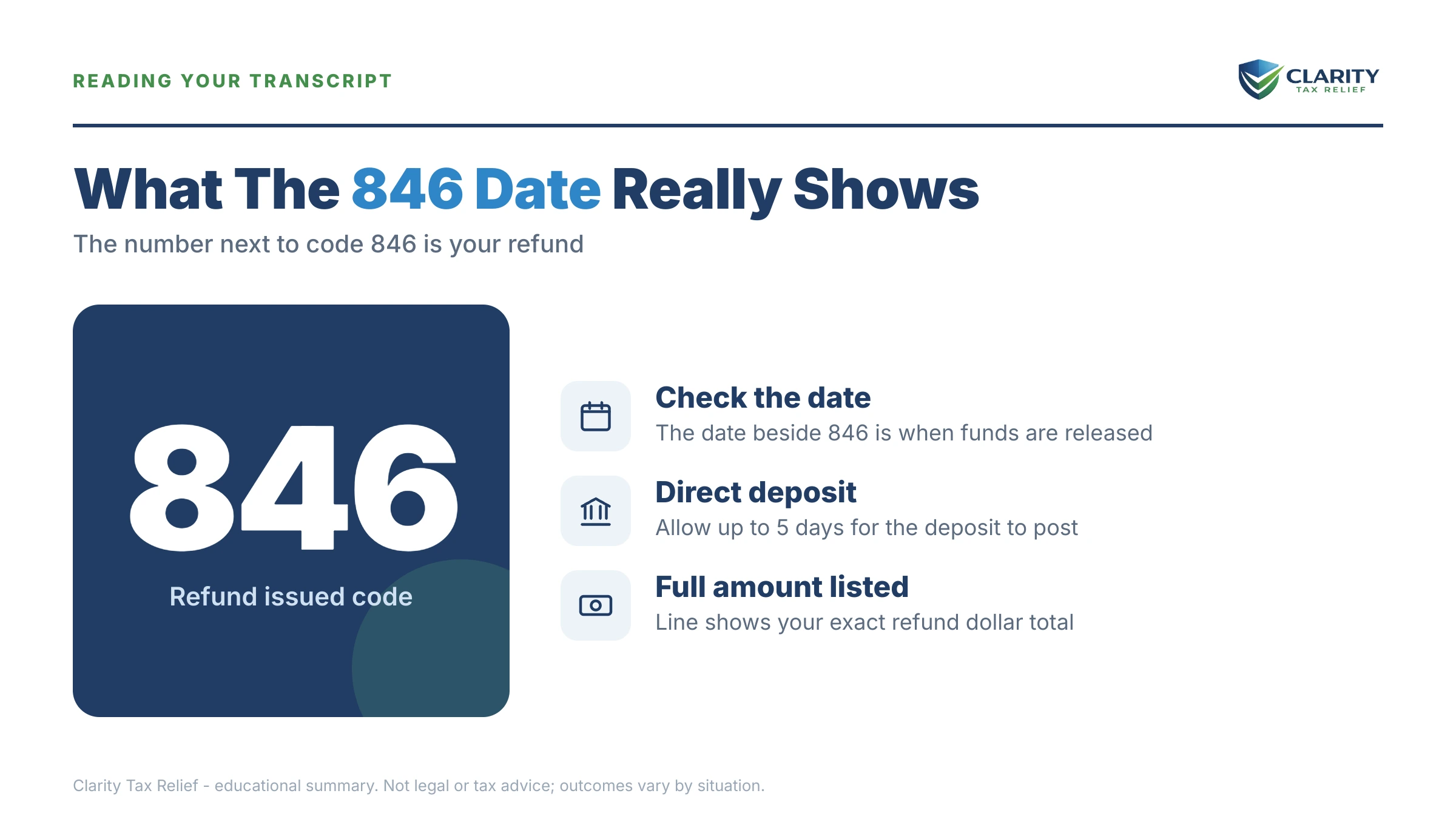
The short answer: IRS code 846 "refund issued" on your tax transcript means the IRS has finished processing your return and released your refund. The date beside code 846 is the day the money is sent — direct deposits typically arrive within 5 business days; mailed checks take a few weeks. The amount shown is what the IRS is actually sending.
You've refreshed your transcript every morning for weeks — first nothing, maybe a hold code, then more nothing — and today a new line finally appeared: 846, Refund Issued, with a date and a dollar figure. That line is the finish line of IRS processing, and unlike everything else on the page, it means money is moving toward you.
Two details on that line decide everything from here: the date (when the money actually arrives) and the amount (which may not match your return). The image below shows exactly where the 846 line sits on a real account transcript and where to find both figures.
⏱ The date beside code 846 is your refund release date. Direct deposits typically arrive between that date and about 5 business days after it; mailed checks typically take 2–4 weeks. If nothing arrives after those windows, you can request a refund trace — you don't have to just keep waiting.

Why IRS code 846 "refund issued" appears on your transcript
Code 846 posts when the IRS approves an overpayment on your account and releases it as a refund — it is the last code in a normal refund cycle. Everything above it on the transcript is the story of how the IRS got there. Four paths lead to an 846:
- A normal filing. Your return posts as code 150 with your tax, your withholding posts as code 806, refundable credits post as codes 766 and 768, and the math nets out to an overpayment. The 846 releases it.
- A hold was lifted. If you sat behind code 570 on your IRS transcript or a code 810 refund freeze, the 846 appearing means the review closed in your favor and the money is released.
- The IRS reduced your tax. An amended return or IRS adjustment shows as code 291 — tax reduced, and the resulting overpayment refunds via a fresh 846.
- An exam closed with no change. If a code 420 audit indicator held your refund and the examination ended without changes, the 846 is the release.
One timing note: if your refund includes the Earned Income Tax Credit or Additional Child Tax Credit, federal law bars the IRS from releasing it before mid-February — so early filers claiming those credits won't see an 846 in January no matter how clean the return is.
If codes on your transcript still look like alphabet soup, the full walkthrough of every section lives in our guide to how to read an IRS account transcript — this page stays focused on the 846 line itself.
| Code | What it means | What to do |
|---|---|---|
| 150 | Return filed; tax assessed | Nothing — this is the baseline every account starts with |
| 806 | Withholding credited | Confirm it matches box 2 of your W-2 |
| 766 / 768 | Refundable credits posted | Confirm the credits match your return |
| 570 | Hold on the account | Wait, or respond if a notice asks for something |
| 810 | Refund freeze | Often requires identity verification before release |
| 811 | Freeze released | Good sign — 846 usually follows |
| 846 | Refund issued | Note the date and exact amount |
| 898 | Refund offset to a non-IRS debt | Call the Treasury Offset Program line, 800-304-3107 |
| 826 | Overpayment applied to another tax year | Check the other year's balance — it was paid first |
| 841 | Refund cancelled or returned | Watch the mail for a CP53; a paper check usually follows |
What happens after code 846 posts: your refund's path to you
After code 846 posts, the Treasury — not the IRS itself — actually sends your money on the date printed beside the code. The sequence runs like this, including the two places it can go sideways:
- The 846 posts, often dated a few business days in the future. Weekly-cycle accounts typically update on Fridays with a release date the following week — a future date is normal, not an error.
- On the 846 date, the IRS hands the payment to the Treasury's Bureau of the Fiscal Service, which transmits the deposit or prints the check.
- Direct deposit posts to your bank — same day for many banks, up to about 5 business days for others. If you paid your tax-prep fees out of the refund, the money routes through a third-party bank first, which can add a day or two.
- If the bank rejects the deposit — closed account, name mismatch, one wrong digit — the funds bounce back, code 841 posts, a CP53 notice goes out, and a paper check is reissued to the address on your return. That detour typically adds several weeks.
- If a mailed check is never cashed, U.S. Treasury checks go stale, and a CP32A explains how to get the refund reissued. The money isn't lost — it just needs a new check.
Notice what's absent from that sequence: anything you need to do. Once the 846 posts, the process is automatic. Your only jobs are to know the windows and to verify the amount — which is where most surprises hide.
Refund short — or swallowed by an old balance?
If your transcript shows codes 826 or 898 where your money should be, or your refund gets taken year after year for back taxes, send us your transcript. An experienced tax professional will map exactly where the money went and which option stops the cycle — free, confidential, no pressure.
Why your code 846 amount doesn't match your return
The 846 amount is what the IRS is sending — not necessarily what your Form 1040 said you'd get, and not necessarily what lands in your account. Three things move that number: offsets to other debts, IRS adjustments to your return, and interest the IRS owes you.
| What you see | What happened | What to do |
|---|---|---|
| 846 is smaller; code 826 sits above it | Part of your overpayment paid an IRS balance from another tax year | Pull that year's transcript and check the remaining balance — see code 826 |
| 846 shows the full refund, but the deposit is smaller; code 898 appears | The Treasury Offset Program redirected money to child support, student loans, or state debt | Call 800-304-3107 to identify the agency — see code 898 |
| 846 is smaller; a code 971 appears with no offset codes | The IRS adjusted your return (math error, credit reduced) and a notice is coming | Read the CP11/CP12-type notice before disputing — you typically have limited time to disagree |
| 846 is slightly larger than your return's refund | The IRS added overpayment interest for issuing the refund late | Nothing — but the interest is taxable, so expect a 1099-INT if it's $10 or more |
| No 846 at all; 826 consumed the full overpayment | Your entire refund went to a prior-year IRS balance | Address the underlying balance, or every future refund follows it |
A worked example, start to finish
Say you earned $48,300 in W-2 wages last year, filing single, and your employer withheld $5,900 in federal income tax. On your transcript, the $5,900 posts as code 806. Your processed return shows total tax of $3,560 on the code 150 line. The overpayment math: $5,900 − $3,560 = $2,340 — and $2,340 is the figure that should appear beside code 846.
Now say you also have a defaulted federal student loan. The 846 still posts at the full $2,340, but a code 898 for $800 appears with it. The Treasury sends $800 to the loan servicer and $1,540 lands in your bank. Where's My Refund never warned you — the transcript did.
Different scenario: if you owed the IRS $2,340 or more from a prior year, you'd never see an 846 for that money at all. Code 826 would move the overpayment to the old year first, and the transcript for that year would show the payment arriving.
One more wrinkle: if the IRS took months to release your refund, the 846 might post at $2,371 instead of $2,340 — the extra $31 is overpayment interest, which the IRS must pay when a refund goes out more than 45 days after the filing deadline. It's yours to keep, but it's taxable next year.
Special situations: amended returns, injured spouse, and old-year 846s
Not every 846 comes from a fresh filing, and a few situations change how to read it.
Amended returns. After a Form 1040-X processes, the transcript typically shows codes 971/977 (amended return received), then code 291 reducing the tax, then a new 846 for the additional refund. E-filed amended returns can now receive direct deposit; paper-filed 1040-X refunds still arrive by check, so use the check timeline, not the deposit one.
Married filing jointly with a spouse who owes. If your joint refund was offset to your spouse's separate debt — old child support, a defaulted loan, their premarriage tax balance — you can claim your share back with Form 8379, the injured spouse allocation. When the IRS approves it, your portion comes back as a new 846 (or a code 840 manual refund) weeks to months later.
An 846 on a prior year's transcript. Transcripts are permanent history. An 846 dated two years ago on an old transcript is the refund you already received then — not new money coming. Only an 846 with a current or future date means a payment is in motion.
Code 846 but no refund? Delivery windows and the refund trace
An issued refund that never arrives can be traced — the 846 line is your proof the money left. Before you panic, check the windows in the table below; most "missing" refunds are simply inside the normal delivery lag or visible under a code 841 reversal.
| How you're paid | Typical arrival after the 846 date | When to act |
|---|---|---|
| Direct deposit | Same day to about 5 business days | After 5 business days: check with your bank, then request an IRS trace |
| Paper check | Typically 2–4 weeks by mail | After about 4 weeks (6 if your mail is forwarded): start a trace |
| Rejected deposit → reissued check (code 841 + CP53) | Adds several weeks to the check timeline | Confirm the address on file is current; the check goes there |
| Check over a year old, never cashed | Stale — banks won't honor it | Follow the CP32A instructions to have it reissued |
To start a trace, use the Where's My Refund tool at IRS.gov, the IRS refund hotline, or Form 3911 (Taxpayer Statement Regarding Refund). For a lost check, the Treasury verifies whether it was cashed; if not, a replacement is issued. If someone else cashed it, a claims process follows — slower, but you're made whole.
Two 2026 realities worth knowing. First, the IRS workforce was cut roughly 27% in 2025, so reaching a human by phone is genuinely hard — your transcript, pulled through your IRS online account, will almost always tell you more than an hours-long hold. Second, if a delayed or traced refund is causing genuine financial hardship — an eviction, a shutoff notice — the Taxpayer Advocate Service can intervene when normal channels stall.
And if your transcript shows the 846 but the Where's My Refund tool still says "processing," that's a known lag between systems, not a problem — here's why the transcript updated but WMR didn't.
How to verify your code 846 refund, step by step
- Find the 846 line. Locate code 846 in the Transactions section of your account transcript and write down the date and exact dollar amount.
- Compare the amount. Check the 846 figure against the refund on line 35a of the return you filed — a mismatch points to an offset or an IRS adjustment.
- Confirm your bank details. Verify the routing and account numbers you entered on your return; a single wrong digit turns your deposit into a mailed check weeks later.
- Wait the delivery window. Give a direct deposit up to 5 business days after the 846 date and a mailed check about 4 weeks before assuming something went wrong.
- Start a refund trace. If the window passes with no money, use the Where's My Refund tool or file Form 3911 to have the Treasury trace the payment.
- Resolve any offset. If code 826 or 898 took part of your refund, address the underlying debt now — otherwise next year's refund gets taken the same way.
When you can handle this yourself — and when help changes the outcome
Almost everyone with a clean 846 needs zero professional help. The refund is issued, the process is automatic, and even a trace is a form and a wait — not a legal fight. If your 846 amount matches your return and the money arrives inside the windows above, you're done. Enjoy it.
Experienced help changes the outcome in a few specific situations:
- Code 826 keeps eating your refunds. An old IRS balance intercepts your overpayment every single year until it's resolved. Depending on your finances, a payment plan, hardship status, or an offer may end that cycle on better terms than silent annual offsets — and stop the penalties and interest still accruing on the balance.
- Unfiled years are blocking or complicating refunds. The IRS can hold current refunds while old returns are missing, and refunds from returns filed more than three years late are generally forfeited — sequencing the filings correctly matters.
- An 846 posted but someone else got the money. If a preparer redirected your deposit or an identity thief filed in your name, you're into Form 14039 and trace-claim territory, where documentation and persistence decide how fast you're made whole.
- You received a refund you weren't entitled to. The IRS will eventually bill an erroneous refund back, with interest. Getting ahead of it is far cheaper than waiting for the notice sequence.
If old balances are intercepting your refunds through the Treasury Offset Program or code 826 year after year, a free case review can map which resolution option actually ends the cycle — call (888) 825-7779 or use the 2-minute form.
Terms on your transcript, decoded
- TC 840: a manual refund issued by an IRS employee outside the automated cycle — common with hardship releases and injured spouse claims.
- TC 841: refund cancelled or returned — usually a direct deposit that bounced back and will be reissued as a check.
- Cycle code: the eight-digit number showing which processing batch your account updates in — it explains why some transcripts refresh daily and others only weekly.
- "As of" date: an internal bookkeeping date the IRS uses to compute interest and penalties — it is not your refund date.
- Refund trace: the formal process (Form 3911) the Treasury uses to locate a refund that was issued but never arrived.
- Treasury Offset Program (TOP): the program that redirects federal payments — including refunds — to child support, student loans, and state debts before the money reaches you.
Code 846 questions, answered
Does code 846 mean my refund is approved?
Yes — code 846 means more than approved: the IRS has actually released your refund. Approval happens earlier in processing; 846 posts only when the money is scheduled to leave the Treasury on the date shown. The one caveat is a code 898 next to it, which means part of the payment was redirected to another debt before it reaches you.
How long after code 846 will I get my direct deposit?
Direct deposits typically arrive between the 846 date itself and about 5 business days after it. Many banks post the money on the exact date shown; smaller banks and credit unions sometimes take a few days longer. If you paid tax-prep fees out of your refund, the deposit routes through a third-party bank first, which can add another day or two.
Is the code 846 date the day the money hits my bank account?
Not exactly — it's the day the IRS releases the payment, not a guaranteed posting date. Most direct deposits land on or within a few business days of that date, depending on your bank's processing. If you're getting a paper check, the 846 date is roughly when the check is mailed, so add another 2–4 weeks for delivery.
Why is my 846 amount less than the refund on my return?
The most common reasons are an offset or an IRS adjustment. Code 826 above the 846 means part of your overpayment paid an IRS balance from another year; code 898 means the Treasury Offset Program redirected money to child support, student loans, or state debt. If neither appears, look for code 971 — the IRS adjusted your return and a notice explaining the change is on its way.
Can the IRS take my refund back after code 846 posts?
The IRS can't reach into your bank account and pull a deposited refund back out. What it can do is cancel a refund before delivery (code 841), or bill you later if the refund turns out to be erroneous — in that case you'll get a notice demanding repayment, with interest. Offsets to other debts happen at or before issuance, not after the money arrives.
My transcript shows code 846 but Where's My Refund still says processing — which one is right?
Trust the transcript. Where's My Refund pulls from a different system and often lags the transcript by a day or more, especially right after a weekly update. If your transcript updated but WMR didn't, the 846 date and amount on the transcript are the authoritative figures — the tool usually catches up within a few days.
What does code 846 with a future date mean?
A future date is normal — it's the scheduled release date, not an error. Transcripts for weekly-cycle accounts typically update on Fridays, and the 846 often posts with a date a few business days ahead. Nothing more is required from you; the payment goes out automatically on the printed date.
What if my refund never arrives after code 846?
Wait out the delivery window first — about 5 business days for direct deposit, about 4 weeks for a mailed check (6 weeks if you moved and mail is being forwarded). Then start a refund trace through the Where's My Refund tool, the IRS refund hotline, or Form 3911. If the deposit bounced back, code 841 will appear and a paper check follows automatically.
Will the IRS pay me interest on a late refund?
Yes, if the IRS issues your refund more than 45 days after the filing deadline (or the date you filed, if later). The interest is added to your 846 amount or shown as a separate credit on the transcript. It's taxable income — if it totals $10 or more, expect a Form 1099-INT to report on next year's return.
Does code 846 mean my 570 hold or review is over?
For this refund, yes. An 846 posting after a code 570 hold or 810 freeze means the IRS resolved whatever it was reviewing and released the money for that tax year. It doesn't immunize the return from a later audit — the IRS generally has three years to examine a return — but the review that held your refund is closed.
Your next 24 hours
- Find the 846 line on your account transcript and write down the exact date and dollar amount — those two figures answer almost every "where's my money" question you'll have this month.
- Pull your copy of the return you filed: compare the 846 amount to line 35a, and confirm the routing and account numbers you entered are the account you still have.
- If codes 826 or 898 took part or all of your refund — or an old IRS balance intercepts it every year — get a free case review at the 2-minute form or (888) 825-7779. Interest and penalties keep accruing on that balance until it's resolved, and next year's refund follows this year's.
This guide is general information, not tax or legal advice for your specific situation. Eligibility for IRS programs depends on individual facts and circumstances; no outcome is guaranteed.