
Business & Owner Tax Debt
Restaurant Owner Tax Debt: How to Resolve Tips, Cash, Payroll, and Sales Tax Debt in 2026
The short answer: restaurant owner tax debt usually stacks up to four liabilities at once — personal income and self-employment tax, 941 payroll tax, federal unemployment (940) tax, and state sales tax. The payroll trust-fund and sales-tax portions follow you personally even if the restaurant closes, so resolve those two first, then put the income-tax balance on a plan.
The dinner rush ended hours ago, the deposit is counted, and somewhere in the office stack sits an IRS envelope you've been stepping around for weeks. You already know roughly what it says. What you may not know: this is one of the most structured problems the IRS handles — there is a defined order of operations, and starting it this week is far cheaper than starting it next quarter.
⏱ The real clock: restaurant tax debt has no single printed deadline — it compounds monthly. The failure-to-pay penalty adds 0.5% of the balance every month, interest compounds daily on top, and missed payroll deposits carry their own penalty tiers reaching 15%. Every month you wait, the number on the next notice is bigger.
Why restaurant owners fall behind on taxes
Most restaurant owner tax debt comes from four sources: skipped quarterly estimates, tips and cash income, payroll deposits used as float, and sales tax spent before it was remitted. None of them starts as a tax decision — they start as a cash-flow decision in a business running on 3–5% margins.
If you run the restaurant as a sole proprietor, your Schedule C profit hits your personal return with no withholding behind it — self-employment tax alone runs 15.3% before income tax even starts. When January and February are dead months, quarterly estimated taxes are the first payment that slips.
Tips create a second layer many owners underestimate: you owe the employer's share of FICA on every tip your staff reports, and larger food establishments have Form 8027 reporting on top. When tips are underreported and the IRS later runs a tip examination, the employer's share gets assessed years after the fact.
Cash is the third trap. If your reported sales don't match your POS data, supplier invoices, or bank deposits, the IRS can reconstruct your real income — a cash business audit uses deposit analysis and food-cost markup ratios, and the reconstructed number is rarely in your favor.
Then come the two "borrowed" taxes. In a slow month, the payroll taxes withheld from staff paychecks can quietly cover the produce vendor — that's how 941 back taxes begin. Sales tax collected at the register goes the same way. Both are trust-fund money the government considers already its own, which is why enforcement on them is faster and more personal than on ordinary income tax. A related trap: paying kitchen staff on 1099s to skip payroll entirely, which invites a worker misclassification penalty and reclassified payroll assessments.
The four tax debts a restaurant owner can owe at once
A restaurant owner can owe four separate tax debts at once, and two of them survive even if the restaurant closes. Which ones you owe — and which follow you personally — depends on the tax type and your entity, not on how the debt feels.
As a sole proprietor, there is no separation at all: the 1040 balance, the payroll tax, and (in most states) the sales tax are all assessed against your Social Security number or your personal liability. If you formed an LLC or corporation, the entity absorbs some exposure — but the trust-fund share of payroll tax can still be assessed against you personally through the Trust Fund Recovery Penalty, and the split is explained in our guide to LLC back taxes personal liability.
| Tax debt | Who owes it | First move |
|---|---|---|
| Income + self-employment tax (Form 1040, Schedule C) | You personally, always | File every year, then a payment plan — most flexible debt of the four |
| 941 payroll tax (withholding + FICA) | The business — and you personally for the trust-fund share via the TFRP | Get current-quarter deposits made first; this debt gets a revenue officer fastest |
| 940 FUTA (federal unemployment) | The business (a sole proprietor: you) | Usually small — fold into the same resolution as the 941 balance |
| State sales tax | You personally in most states — it's trust-fund money | Contact the state first; permits and licenses are on the line |
If your problem is mostly the business-side combination — payroll and sales tax on an operating entity — our companion guide to restaurant tax debt covers that track in depth. This page focuses on the owner's personal exposure and the personal resolution path.
What happens if you ignore restaurant tax debt
Unpaid restaurant taxes escalate through an automated IRS notice sequence that ends in levies on your bank account and your card processor. The sequence runs on its own — 2026's reduced IRS workforce slowed the phone lines, not the enforcement systems.
- First bill — a CP14 on your personal balance, or a CP161-series notice on a business balance. No enforcement yet; cheapest moment to act.
- Reminder notices — CP501 and CP503. Still just bills, but penalties and interest are posting monthly.
- CP504 — Notice of Intent to Levy. The IRS can now seize your state tax refund under IRC §6331(d), and a federal tax lien against your personal and business assets becomes realistic.
- LT11 / Letter 1058 — Final Notice. This starts a 30-day clock and your Collection Due Process rights (requested on Form 12153). After it passes, full levy authority opens.
- Enforcement. A bank levy freezes funds with a 21-day hold before the money leaves. Worse for a restaurant: the IRS can levy the settlement funds your card processor is holding — for a card-heavy operation, that's most of a week's revenue gone in one levy.
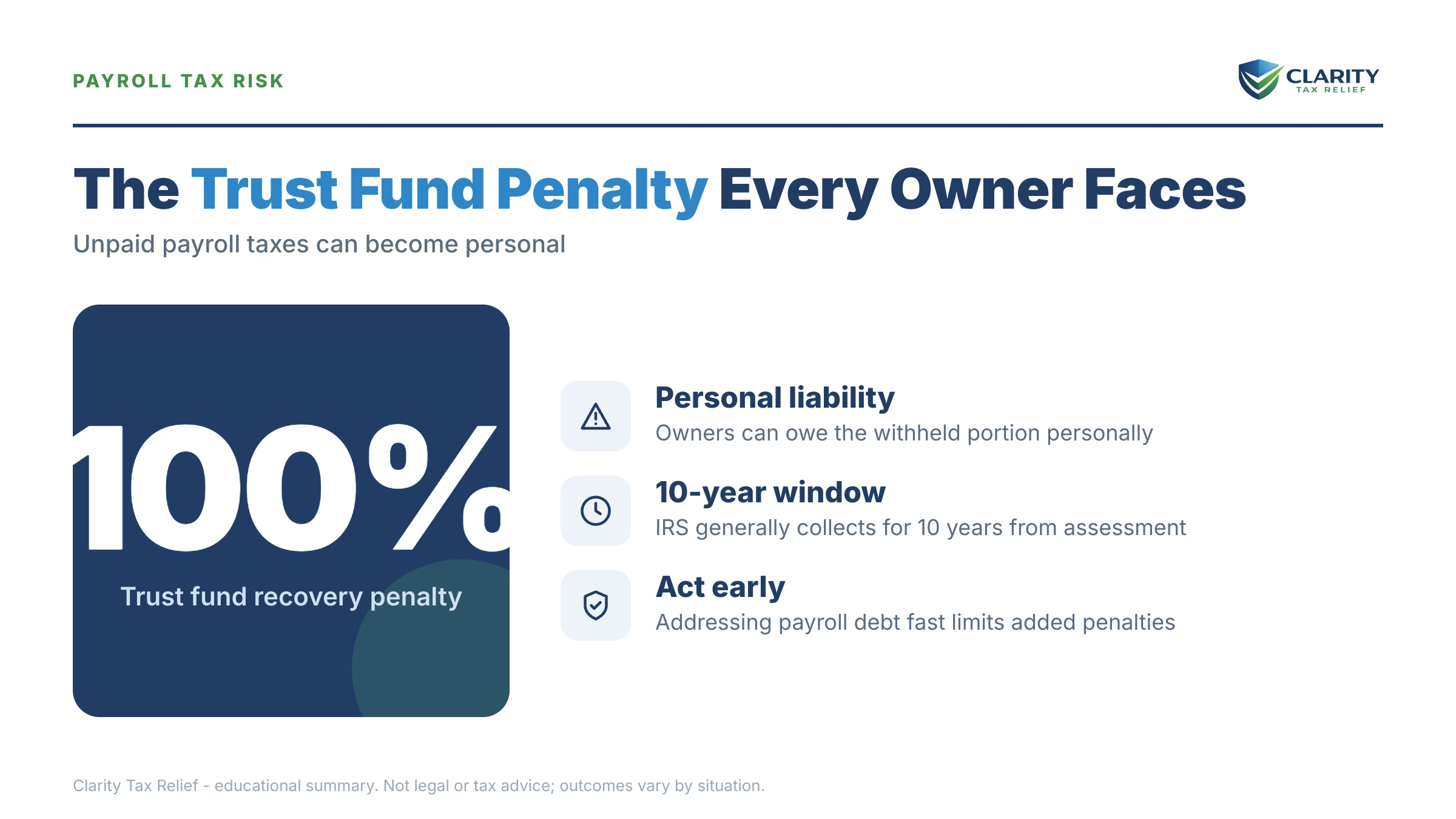
- The payroll track runs in parallel. Unpaid 941s draw a revenue officer, a Form 4180 "responsible person" interview, and Letter 1153 proposing the Trust Fund Recovery Penalty against you personally — a debt that survives the business.
Two more consequences arrive at scale: multiple years of combined assessments can cross the $66,000 passport-certification threshold (2026), and your state moves on its own clock — many states will suspend the seller's permit a restaurant cannot legally operate without.
Behind on restaurant taxes right now?
Before the next notice escalates, have an experienced tax professional map your balances — personal, payroll, and state — and the order to fix them. The review is free and confidential, and penalties and interest are posting to the balance monthly either way.
Your options to resolve restaurant owner tax debt in 2026
The IRS has five real resolution paths for restaurant owner tax debt, and eligibility turns on your balance and your compliance — not on how sympathetic the story is. The DIY mechanics of each program live in our guide to how to settle tax debt yourself; here is how each one plays for a restaurant owner specifically.
| Option | Typical eligibility | Cost and catch |
|---|---|---|
| Short-term payment plan | Any balance you can pay within 180 days | $0 setup; interest and penalties continue but enforcement stops |
| Guaranteed installment agreement | Individuals only; income-tax balance ≤ $10,000 (excluding penalties and interest); all returns filed; timely filing and payment for the past 5 years with no installment agreement in that period; full payment within 3 years | IRS must accept if the criteria are met; accruals continue |
| Streamlined installment agreement | ≤ $50,000, up to 72 months, set up online | No financial statement required; setup fee varies; accruals continue |
| Offer in Compromise | Means-tested — assets plus future income genuinely below the debt | $205 fee + 20% down on lump-sum offers (waived with low-income certification); roughly 1 in 5 accepted in FY2024 |
| Currently Not Collectible | Documented hardship — paying anything would break necessary expenses | Collection pauses; debt, interest, and a possible lien remain |
| Penalty relief (FTA / AEP) | Clean compliance the prior 3 years, or reasonable cause | Removes penalties, not tax; AEP becomes automatic starting summer 2026 |
Three restaurant-specific notes. First, an OIC self-employed case is harder than a wage-earner's: the IRS values your kitchen equipment, leasehold, and the income the restaurant throws off, and an operating restaurant with positive cash flow usually prices out of a low offer. Second, hardship status with business income is its own analysis — see currently not collectible self-employed for how the IRS treats fluctuating revenue. Third, none of these IRS programs touches your state balance; state sales tax debt help runs on separate rules and, usually, a faster fuse.
One more path for owners squeezed by the IRS, the state, and vendors at once: Chapter 13 and back taxes can force everything into a single court-supervised repayment plan. It's a serious step with real costs, but for some owners it beats fighting three collectors separately.
What $8,900 in restaurant back taxes actually costs
An $8,900 restaurant tax balance grows by roughly $44.50 in failure-to-pay penalty every month, before daily-compounding interest is added on top. Here's the full math on a clearly hypothetical case.
Say you owe $8,900 on last year's Form 1040 — your Schedule C profit came in better than expected, and the quarterly estimates never got paid. All returns are filed; this is income and self-employment tax only, no payroll component.
- Doing nothing: the failure-to-pay penalty posts at 0.5% per month — $44.50 a month, about $534 over a year — capping eventually at 25% ($2,225). Interest compounds daily on the whole balance the entire time. You can estimate your own penalty and interest total with our IRS Penalty & Interest Calculator.
- Guaranteed installment agreement: this program is for individuals with an income-tax balance of $10,000 or less (excluding penalties and interest). Because $8,900 is under that line, if all your returns are filed, you've filed and paid on time the prior five years without an installment agreement in that period, and you can pay in full within 3 years, the IRS must accept: $8,900 ÷ 36 ≈ $248 a month, plus the accruing penalty and interest.
- 72-month streamlined plan: the base is $8,900 ÷ 72 ≈ $124 a month, though the actual payment the IRS sets covers the accruals too — lower payment, more total interest.
- Offer in Compromise: at this size, while the restaurant runs, it almost never pencils. If your financials show even $600 a month of disposable income, twelve months of it ($7,200) plus any equity in kitchen equipment already approaches the full balance — the $205 fee and 20% down payment would buy you nothing.
- Penalty relief: if, say, $700 of the balance is already failure-to-pay penalty and your prior three years are clean, first-time penalty abatement can remove it — and starting summer 2026, the new Automatic Exemption from Penalty (AEP) applies similar relief automatically, with no request needed.
The takeaway: at $8,900, the fight isn't about settling — it's about stopping the accruals, picking the cheapest plan, and stripping the penalties.
How to respond to restaurant tax debt, step by step
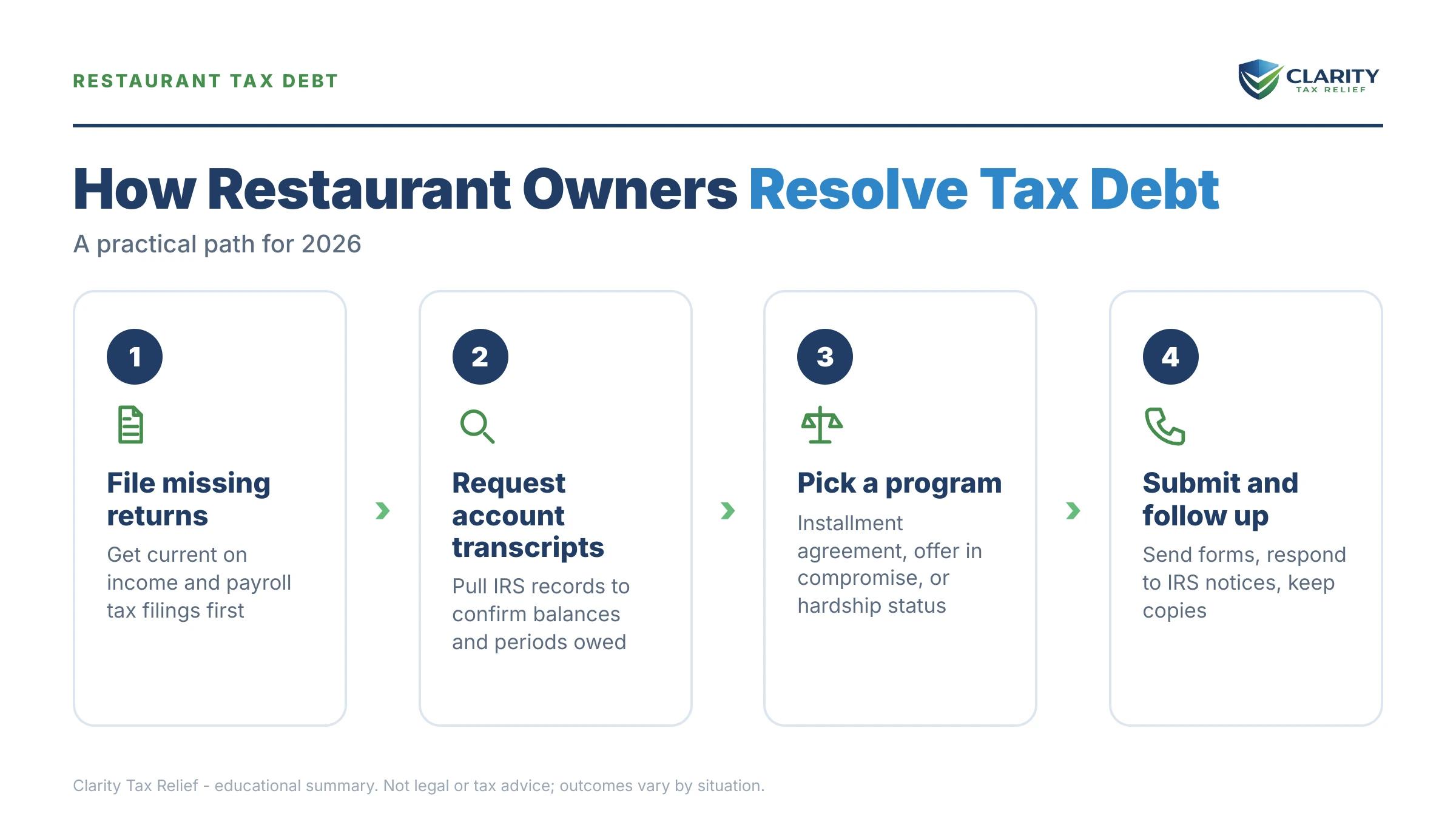
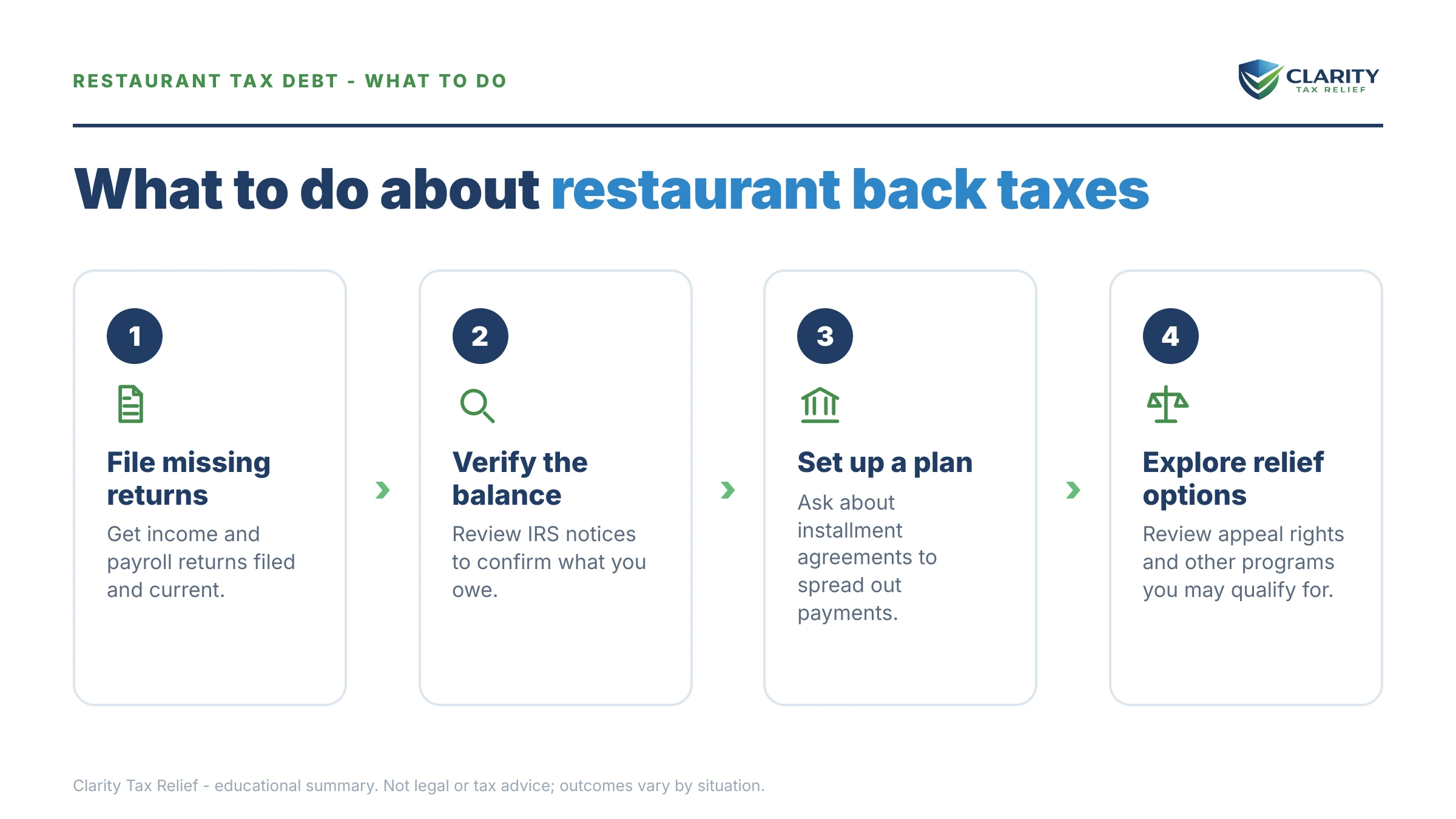
Compliance comes before resolution: the IRS will not approve any agreement while returns are missing or current deposits are behind. Work the sequence in this order.
- Pull your IRS transcripts. Get account transcripts for every open year — personal and, if you have an EIN, business — so you're negotiating from the IRS's numbers, not your memory.
- File every missing return. The IRS won't approve any agreement while 1040s or 941s are unfiled — and your state won't either while sales tax returns are missing.
- Get current on this quarter first. Start this quarter's estimated payments and payroll deposits before touching the old balance; current compliance is the price of admission to every program.
- Triage trust-fund debt ahead of income tax. Direct available money at state sales tax and payroll trust-fund balances first — they carry personal liability and the fastest enforcement.
- Set up your resolution before the next notice. Apply for a payment plan on the IRS payment plans page, or submit hardship or offer paperwork, while you're still ahead of the final levy notice.
- Request penalty relief once you're compliant. Ask for first-time abatement or reasonable-cause relief after the agreement is in place — removing penalties shrinks the balance the plan has to cover.
What your IRS transcript shows about your restaurant tax debt
Your IRS account transcript lists every assessment, penalty, and enforcement flag on your debt, line by line — it's the single most useful document you can pull before making any decision. These are the codes restaurant owners see most.
| Code | What it means on your account | What to do |
|---|---|---|
| 150 | Return filed and tax assessed for that year | This is the base balance the IRS is collecting — confirm it matches your return |
| 276 | Failure-to-pay penalty posted | Count how many months have posted; this is the piece abatement can remove |
| 196 | Interest charged | Recalculates as rates change; it stops growing only when the tax is paid |
| 971 | Notice issued | Match each one to the letter in your mailbox — the sequence tells you how close enforcement is |
| 582 | Federal tax lien indicator | The lien is public record against your assets; deal with it before any sale or refinance |
| 530 | Currently not collectible | Collection is paused for hardship — the debt and interest remain, and the IRS revisits it |
When you can handle restaurant back taxes yourself
You can resolve a sub-$10,000, income-tax-only balance yourself in about an hour online. If your situation matches the worked example above — one year, all returns filed, no payroll or sales tax component, no revenue officer — set up the plan through your IRS online account and skip the professional fees entirely. Our how to settle tax debt yourself guide walks every screen.
Experienced help changes outcomes in specific situations:
- Unfiled 941s or a revenue officer assigned — payroll cases move fast and personally.
- A Form 4180 interview is scheduled — what you say determines whether the Trust Fund Recovery Penalty lands on you, a partner, or a manager.
- A levy is in motion on your bank account or card processor — release negotiations are time-boxed and technical.
- Multiple cash-heavy years are unfiled — reconstructing income defensibly, before the IRS reconstructs it for you, is where representation pays for itself.
- You're weighing whether to close — the sequence of a wind-down changes what liability follows you out the door.
- The state and the IRS are both collecting — the triage order is the whole game. If a levy is causing immediate hardship and you can't get traction with collections, the Taxpayer Advocate Service is a free, independent escalation path.
Terms on your restaurant tax notices, decoded
- Trust fund taxes: money you collected on the government's behalf — withheld payroll taxes and sales tax — which is why nonpayment is treated as taking, not owing.
- Trust Fund Recovery Penalty (TFRP): the IRS's tool for assessing a business's unpaid trust-fund payroll taxes against a responsible person — an owner, officer, or even a manager — personally.
- Allocated tips: tips a large food establishment must assign to employees on Form 8027 when reported tips fall below 8% of gross receipts.
- Pyramiding: the IRS term for collecting payroll taxes from employees quarter after quarter without paying them over — the pattern that turns a civil case criminal.
- CSED: the Collection Statute Expiration Date — generally 10 years from assessment, though appeals, offers, and bankruptcy pause the clock.
- Levy vs. lien: a lien is a legal claim against your assets; a levy is the actual taking — from a bank account, a card processor, or accounts receivable.
If your notices span both a 941 balance and your personal 1040, have an experienced tax professional map the order of operations before you send the IRS a dollar — the free restaurant tax debt review takes one call to (888) 825-7779.
Restaurant owner tax debt questions, answered
Can the IRS shut down my restaurant for back taxes?
Yes, but seizing an operating restaurant is the IRS's last resort, not its first move. Physical seizure of a going business requires special approvals and usually a court order, and it is rare. What comes much sooner — and hurts almost as much — is a levy on your bank account or merchant processor, which can cut off cash flow overnight. Engaging before the final levy notice is what prevents both.
Am I personally liable for my restaurant's payroll taxes?
If you operate as a sole proprietor, yes — every dollar of the payroll debt is legally yours already. If you operate through an LLC or corporation, the IRS can still assess the trust-fund portion (withheld income tax plus the employees' share of FICA) against you personally through the Trust Fund Recovery Penalty if you were a responsible person who willfully failed to pay. Entity structure limits some exposure, but never the trust-fund share.
What happens if the IRS finds unreported cash sales or tips?
The IRS reconstructs a cash restaurant's real income using bank deposit analysis, POS records, and industry markup ratios, then assesses the extra tax plus a 20% accuracy-related penalty. Coming forward first — by amending returns before an exam opens — is dramatically cheaper than being caught. Willful, ongoing concealment is what pushes a case from civil to criminal, so the safest move is to fix it voluntarily.
Should I pay my state sales tax debt or the IRS first?
Usually the state sales tax first. Sales tax is trust-fund money you collected from customers, most states can assess it against you personally, and state agencies typically move faster than the IRS — including suspending the permits and licenses your restaurant needs to stay open. The IRS offers more flexible payment programs, so it is generally the safer creditor to put on a monthly plan while you clear the state.
Does closing my restaurant erase the tax debt?
No. As a sole proprietor, the income tax, self-employment tax, and payroll tax were assessed against you personally, so they follow you after the doors close. Even entity owners keep the trust-fund payroll share via the Trust Fund Recovery Penalty, and most states pursue former owners personally for uncollected sales tax. Closing can simplify a resolution, but it never deletes the balance.
Can the IRS levy my credit card processor or merchant account?
Yes. A levy served on your payment processor captures the settlement funds it is holding for you, which for a card-heavy restaurant can be most of a week's revenue. A levy on your business bank account comes with a 21-day hold before the bank sends the money, which is your window to negotiate a release. Both are typical moves once the final intent-to-levy notice window passes.
Can I get an offer in compromise while my restaurant is still open?
It is possible, but harder than for a wage earner. The IRS calculates your reasonable collection potential using business assets, equipment equity, and the income the restaurant produces — and it accepted roughly 1 in 5 offers in FY2024. An operating restaurant with positive cash flow usually prices out of a low offer; owners in genuine sustained losses or after closure are the more realistic candidates.
Will the IRS take my house over restaurant tax debt?
A federal tax lien attaching to your house is realistic; an actual seizure of your primary home is rare and requires court approval. The lien's practical damage is that it clouds any sale or refinance until the debt is addressed. Setting up a direct-debit payment plan early — before a lien filing becomes likely — is the standard way owners protect the house.
Can I go to jail for restaurant tax debt?
Not for owing money — tax debt itself is a civil matter. Criminal exposure comes from willful conduct: keeping two sets of books, skimming cash off the POS, or repeatedly collecting payroll taxes from employees and spending them (what the IRS calls pyramiding). Owners who file accurate returns, correct past underreporting voluntarily, and engage with collections stay firmly on the civil side.
Your next 24 hours
- Find the "Tax form" and "Tax period" boxes on your newest IRS notice. A 1040 balance and a 941 balance are two different problems with two different playbooks — that one box tells you which one you're in. If you're ready to pay something now, IRS.gov/payments is the only place to do it.
- Gather three things: your last filed personal return, your POS or sales summaries, and payroll records for any open quarters. Every resolution starts from these.
- Book the free case review — the 2-minute form at /#consult or (888) 825-7779 — before next month's 0.5% penalty and another month of daily interest post to your balance. The review maps all four possible debts and the order to fix them.
This guide is general information, not tax or legal advice for your specific situation. Eligibility for IRS programs depends on individual facts and circumstances; no outcome is guaranteed.